CRYOSURGERY 
PREPARED BY: - 
KETAN GOJ IYA
Table of Contents 
 Introduction 
 History of Cryosurgery 
Procedure 
Scientific Background 
 Patient Selection 
In what situations can cryosurgery be used to treat Prostate Cancer? 
 Summary 
 Reference
INTRODUCTION 
o Cryosurgery (cryotherapy) is the application of extreme cold to 
destroy abnormal or diseased tissue. The term comes from the 
Greek words cryo ("icy cold") and surgery meaning "hand 
work" or "handiwork". 
o Cryosurgery is the use of extreme cold produced by liquid 
nitrogen (or argon gas) to destroy abnormal tissue.
HISTORY OF CRYOSURGERY 
oJames Arnott, in 19th century, stated that a very low temperature 
will arrest every inflammation which is near enough to the surface. 
oThe first cryogens were liquid air and compressed carbon dioxide 
snow. 
oIn 1961, Cooper and Lee developed the first cryotherapy probe 
system, involving the circulation of liquid nitrogen through a closed 
metal tube placed in direct contact with the target tissue.
PROPERTY OF LIQUID NITROGEN (LN2) 
oLiquid nitrogen, which boils at −195.6°C (77.4 K), is the most 
effective cryogen for clinical use. It is particularly useful in the 
treatment of malignant lesions. 
o Temperatures of −25°C to −50°C can be achieved within 30 
seconds if a sufficient amount of liquid nitrogen is applied by 
spray or probe. 
o Generally, destruction of benign lesions requires 
temperatures of −20°C to −30°C. Effective removal of 
malignant tissue often requires temperatures of −40°C to 
−50°C
Cryogens - Boiling point 
o Liquid nitrogen (most commonly used) : -196°C 
o Nitrous oxide : - 89°C 
o Solidified CO 2 (dry ice, CO2 snow) : -78°C 
o Chlorodifluoromethane : -41°C 
o Dimethyl ether and propane : -24°C, -42°C
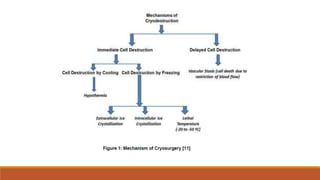
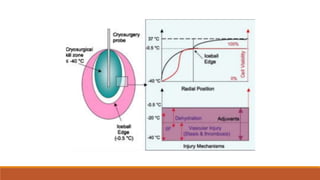
Mechanism of cryosurgery 
o The destructive effect of freezing tissue has been categorized 
into two major mechanisms 
1. Immediate cell destruction 
2. Delayed cell destruction
Controlling parameters during cryosurgery 
o cooling rate 
o Temperature 
o Thawing rate 
o Freeze duration 
o Repetitive freeze- thaw cycle
. 
Cooling rate 
• In cryosurgery, rapid cooling rate i.e. more than 500C/min 
produces intracellular ice- crystals which ismore destructive 
• Such higher rates of cooling can only be achieved close to 
the cryoprobe 
Temperature 
• Mazur stated that the lethal temperature range is between 
-50C to -500C. 
• The treatment of tumor requires a tissue temperature at 
which all the abnormal cells are certainly dead.
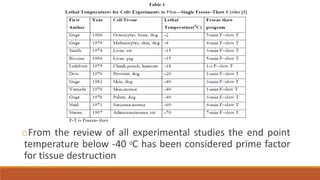
oFrom the review of all experimental studies the end point 
temperature below -40 0C has been considered prime factor 
for tissue destruction
Thawing rate 
• Thawing rate should be slow and continued for longer 
time period; rapid thaw rates allow cell survival. 
Repetitive freeze- thaw cycle 
• Rapid freezing and slow thawing do not guarantee effective 
cell destruction. 
• Use of repeated freeze-thaw cycle is also beneficial in 
treatment of cancerous tumor
Bio-heat Equation 
oSeveral heat transfer mechanisms occur during cryosurgery, 
including conduction, convection, metabolism and phase change. 
o Heat transfer by conduction has been assumed to be the primary 
heat transfer process during cryosurgery since the cryoprobe 
operates at an extremely low temperature. 
o Bio-heat transfer is the study of heat transfer in biological system. 
oThe fundamental heat transfer equation in biological tissue was 
firstly suggested by Pennes.
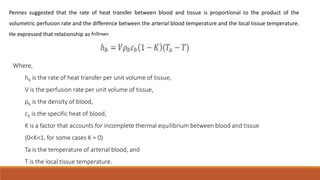
Pennes suggested that the rate of heat transfer between blood and tissue is proportional to the product of the 
volumetric perfusion rate and the difference between the arterial blood temperature and the local tissue temperature. 
He expressed that relationship as follows 
Where, 
hb is the rate of heat transfer per unit volume of tissue, 
V is the perfusion rate per unit volume of tissue, 
ρb is the density of blood, 
cb is the specific heat of blood, 
K is a factor that accounts for incomplete thermal equilibrium between blood and tissue 
(0<K<1, for some cases K = 0) 
Ta is the temperature of arterial blood, and 
T is the local tissue temperature.
PROCEDURE 
oWarts, moles, skin tags, solar keratoses, and small skin cancers are 
candidates for cryosurgical treatment. 
oSeveral internal disorders are also treated with cryosurgery, 
including liver cancer, prostate cancer, cervical disorders and, more 
commonly in the past, hemorrhoids. 
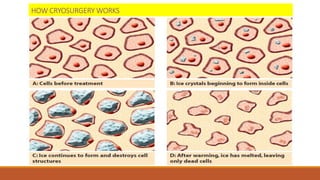
oCryosurgery works by taking advantage of the destructive force of 
freezing temperatures on cells. At low temperatures, ice crystals 
form inside the cells, which can tear them apart. More damage 
occurs when blood vessels supplying the diseased tissue freeze.
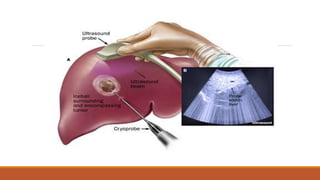
oIn this approach, several hollow probes (needles) are placed in 
direct contact with target tissue. 
oThe doctor guides them into the gland(tumor) using Trans-Rectal 
Ultra-Sound (TRUS). 
oThis type of procedure requires spinal or epidural anesthesia (where 
the lower half of your body is numbed) or general anesthesia (where 
you are asleep).
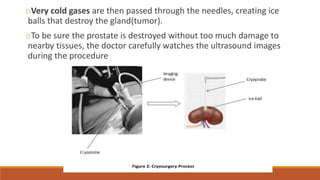
oVery cold gases are then passed through the needles, creating ice 
balls that destroy the gland(tumor). 
oTo be sure the prostate is destroyed without too much damage to 
nearby tissues, the doctor carefully watches the ultrasound images 
during the procedure
oAfter the procedure, there will be some bruising and soreness in 
the area where the probes were inserted. Patients might need to 
stay in the hospital overnight, but many patients leave the same 
day. 
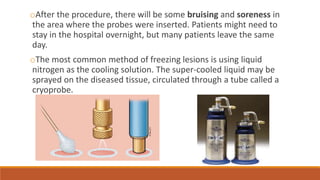
oThe most common method of freezing lesions is using liquid 
nitrogen as the cooling solution. The super-cooled liquid may be 
sprayed on the diseased tissue, circulated through a tube called a 
cryoprobe.
HOW CRYOSURGERY WORKS
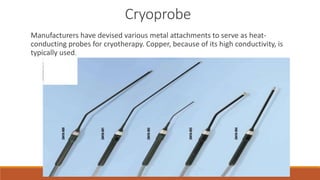
Cryoprobe 
Manufacturers have devised various metal attachments to serve as heat-conducting 
probes for cryotherapy. Copper, because of its high conductivity, is 
typically used.
oThe effect of cryoprobe diameter, cryoprobe temperature and heat 
generation due to metabolism and blood perfusion on phase change heat 
transfer process during cryosurgery in lung tumor has been analyzed 
numerically. 
oResults show that (i) increase in cryoprobe diameter (ii) decrease in 
cryoprobe freezing temperature, lead to increase in minimum temperature, 
freezing rate, freezing area in tissue and decrease in tumor freezing time 
oIn summary, to maximise the effectiveness of cryosurgery, it is important to 
use as low a temperature as possible, cool the tissue as rapidly as possible, 
Thaw as slowly as possible , use more than one freeze thaw cycle,.
Advantages of cryosurgery 
1. Minimal invasion of tissue 
2. Less bleeding 
3. Local application 
4. Less time taking 
5. Anesthetic capabilities 
6. Repetition of procedure 
7. Minimal hospitalization 
8. Less expensive
 In summary, to maximise the effectiveness of cryosurgery, it is important to use 
as low a temperature as possible, 
cool the tissue as rapidly as possible, 
Thaw as slowly as possible 
use more than one freeze thaw cycle,.
REFERENCE 
o History of cryosurgery. Semin Surg Oncol 1998 
o Guideline for the management of clinically localized prostate cancer: 2007 
o Longitudinal comparative study of early health-related quality-of-life outcomes 
in patients undergoing surgical treatment for localized prostate cancer: a short-term 
evaluation of five approaches from a single institution. J Endourol 2006 
o Cryosurgical ablation of the prostate: high risk patient outcomes. Cancer 2005 
o Cryosurgery of the prostate: techniques and indications. Rev Urol 2004 
o www.wikipedia.org/cryosurgery_for_prostate _cancer.htm
Cryosurgery

Cryosurgery

  • 1.
    CRYOSURGERY PREPARED BY:- KETAN GOJ IYA
  • 2.
    Table of Contents  Introduction  History of Cryosurgery Procedure Scientific Background  Patient Selection In what situations can cryosurgery be used to treat Prostate Cancer?  Summary  Reference
  • 3.
    INTRODUCTION o Cryosurgery(cryotherapy) is the application of extreme cold to destroy abnormal or diseased tissue. The term comes from the Greek words cryo ("icy cold") and surgery meaning "hand work" or "handiwork". o Cryosurgery is the use of extreme cold produced by liquid nitrogen (or argon gas) to destroy abnormal tissue.
  • 4.
    HISTORY OF CRYOSURGERY oJames Arnott, in 19th century, stated that a very low temperature will arrest every inflammation which is near enough to the surface. oThe first cryogens were liquid air and compressed carbon dioxide snow. oIn 1961, Cooper and Lee developed the first cryotherapy probe system, involving the circulation of liquid nitrogen through a closed metal tube placed in direct contact with the target tissue.
  • 5.
    PROPERTY OF LIQUIDNITROGEN (LN2) oLiquid nitrogen, which boils at −195.6°C (77.4 K), is the most effective cryogen for clinical use. It is particularly useful in the treatment of malignant lesions. o Temperatures of −25°C to −50°C can be achieved within 30 seconds if a sufficient amount of liquid nitrogen is applied by spray or probe. o Generally, destruction of benign lesions requires temperatures of −20°C to −30°C. Effective removal of malignant tissue often requires temperatures of −40°C to −50°C
  • 6.
    Cryogens - Boilingpoint o Liquid nitrogen (most commonly used) : -196°C o Nitrous oxide : - 89°C o Solidified CO 2 (dry ice, CO2 snow) : -78°C o Chlorodifluoromethane : -41°C o Dimethyl ether and propane : -24°C, -42°C
  • 7.
    Mechanism of cryosurgery o The destructive effect of freezing tissue has been categorized into two major mechanisms 1. Immediate cell destruction 2. Delayed cell destruction
  • 9.
    Controlling parameters duringcryosurgery o cooling rate o Temperature o Thawing rate o Freeze duration o Repetitive freeze- thaw cycle
  • 10.
    . Cooling rate • In cryosurgery, rapid cooling rate i.e. more than 500C/min produces intracellular ice- crystals which ismore destructive • Such higher rates of cooling can only be achieved close to the cryoprobe Temperature • Mazur stated that the lethal temperature range is between -50C to -500C. • The treatment of tumor requires a tissue temperature at which all the abnormal cells are certainly dead.
  • 11.
    oFrom the reviewof all experimental studies the end point temperature below -40 0C has been considered prime factor for tissue destruction
  • 12.
    Thawing rate •Thawing rate should be slow and continued for longer time period; rapid thaw rates allow cell survival. Repetitive freeze- thaw cycle • Rapid freezing and slow thawing do not guarantee effective cell destruction. • Use of repeated freeze-thaw cycle is also beneficial in treatment of cancerous tumor
  • 14.
    Bio-heat Equation oSeveralheat transfer mechanisms occur during cryosurgery, including conduction, convection, metabolism and phase change. o Heat transfer by conduction has been assumed to be the primary heat transfer process during cryosurgery since the cryoprobe operates at an extremely low temperature. o Bio-heat transfer is the study of heat transfer in biological system. oThe fundamental heat transfer equation in biological tissue was firstly suggested by Pennes.
  • 15.
    Pennes suggested thatthe rate of heat transfer between blood and tissue is proportional to the product of the volumetric perfusion rate and the difference between the arterial blood temperature and the local tissue temperature. He expressed that relationship as follows Where, hb is the rate of heat transfer per unit volume of tissue, V is the perfusion rate per unit volume of tissue, ρb is the density of blood, cb is the specific heat of blood, K is a factor that accounts for incomplete thermal equilibrium between blood and tissue (0<K<1, for some cases K = 0) Ta is the temperature of arterial blood, and T is the local tissue temperature.
  • 16.
    PROCEDURE oWarts, moles,skin tags, solar keratoses, and small skin cancers are candidates for cryosurgical treatment. oSeveral internal disorders are also treated with cryosurgery, including liver cancer, prostate cancer, cervical disorders and, more commonly in the past, hemorrhoids. oCryosurgery works by taking advantage of the destructive force of freezing temperatures on cells. At low temperatures, ice crystals form inside the cells, which can tear them apart. More damage occurs when blood vessels supplying the diseased tissue freeze.
  • 17.
    oIn this approach,several hollow probes (needles) are placed in direct contact with target tissue. oThe doctor guides them into the gland(tumor) using Trans-Rectal Ultra-Sound (TRUS). oThis type of procedure requires spinal or epidural anesthesia (where the lower half of your body is numbed) or general anesthesia (where you are asleep).
  • 19.
    oVery cold gasesare then passed through the needles, creating ice balls that destroy the gland(tumor). oTo be sure the prostate is destroyed without too much damage to nearby tissues, the doctor carefully watches the ultrasound images during the procedure
  • 20.
    oAfter the procedure,there will be some bruising and soreness in the area where the probes were inserted. Patients might need to stay in the hospital overnight, but many patients leave the same day. oThe most common method of freezing lesions is using liquid nitrogen as the cooling solution. The super-cooled liquid may be sprayed on the diseased tissue, circulated through a tube called a cryoprobe.
  • 21.
  • 22.
    Cryoprobe Manufacturers havedevised various metal attachments to serve as heat-conducting probes for cryotherapy. Copper, because of its high conductivity, is typically used.
  • 23.
    oThe effect ofcryoprobe diameter, cryoprobe temperature and heat generation due to metabolism and blood perfusion on phase change heat transfer process during cryosurgery in lung tumor has been analyzed numerically. oResults show that (i) increase in cryoprobe diameter (ii) decrease in cryoprobe freezing temperature, lead to increase in minimum temperature, freezing rate, freezing area in tissue and decrease in tumor freezing time oIn summary, to maximise the effectiveness of cryosurgery, it is important to use as low a temperature as possible, cool the tissue as rapidly as possible, Thaw as slowly as possible , use more than one freeze thaw cycle,.
  • 24.
    Advantages of cryosurgery 1. Minimal invasion of tissue 2. Less bleeding 3. Local application 4. Less time taking 5. Anesthetic capabilities 6. Repetition of procedure 7. Minimal hospitalization 8. Less expensive
  • 25.
     In summary,to maximise the effectiveness of cryosurgery, it is important to use as low a temperature as possible, cool the tissue as rapidly as possible, Thaw as slowly as possible use more than one freeze thaw cycle,.
  • 27.
    REFERENCE o Historyof cryosurgery. Semin Surg Oncol 1998 o Guideline for the management of clinically localized prostate cancer: 2007 o Longitudinal comparative study of early health-related quality-of-life outcomes in patients undergoing surgical treatment for localized prostate cancer: a short-term evaluation of five approaches from a single institution. J Endourol 2006 o Cryosurgical ablation of the prostate: high risk patient outcomes. Cancer 2005 o Cryosurgery of the prostate: techniques and indications. Rev Urol 2004 o www.wikipedia.org/cryosurgery_for_prostate _cancer.htm