CryosurgeryCryosurgery
 Cryosurgery is a procedureCryosurgery is a procedure
using freezing temperature tousing freezing temperature to
destroy the tissue. (destroy the tissue. (done bydone by
liquid nitrogen or nitrousliquid nitrogen or nitrous
oxideoxide))
CryosurgeryCryosurgery
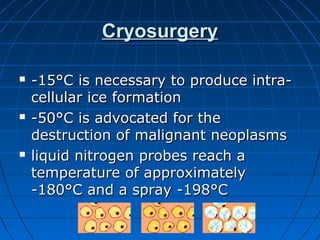
 -15°C is necessary to produce intra--15°C is necessary to produce intra-
cellular ice formationcellular ice formation
 -50°C is advocated for the-50°C is advocated for the
destruction of malignant neoplasmsdestruction of malignant neoplasms
 liquid nitrogen probes reach aliquid nitrogen probes reach a
temperature of approximatelytemperature of approximately
-180°C and a spray -198°C-180°C and a spray -198°C
CryoprobesCryoprobes
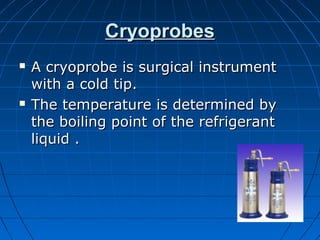
 A cryoprobe is surgical instrumentA cryoprobe is surgical instrument
with a cold tip.with a cold tip.
 The temperature is determined byThe temperature is determined by
the boiling point of the refrigerantthe boiling point of the refrigerant
liquid .liquid .
Probe tips come in a variety ofProbe tips come in a variety of
shapes and sizesshapes and sizes..
Uses of cryosurgery in oralUses of cryosurgery in oral
surgerysurgery
 Ablation of warts and smallAblation of warts and small
tumourstumours healing is usually goodhealing is usually good
with minimal scarring.with minimal scarring.
 Ablation of haemangiomasAblation of haemangiomas hashas
the advantage that there is nothe advantage that there is no
haemorrhage and the surface mayhaemorrhage and the surface may
be left intact.be left intact.
Uses of cryosurgery in oralUses of cryosurgery in oral
surgerysurgery
 Treatment of bony cavitiesTreatment of bony cavities
reduce recurrence of lesions suchreduce recurrence of lesions such
asas odontogenic keratocystsodontogenic keratocysts oror
central giant cell granulomacentral giant cell granuloma..
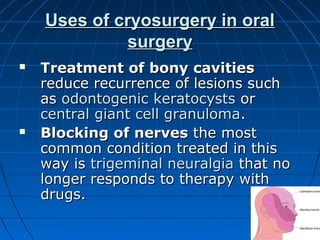
 Blocking of nervesBlocking of nerves the mostthe most
common condition treated in thiscommon condition treated in this
way isway is trigeminal neuralgiatrigeminal neuralgia that nothat no
longer responds to therapy withlonger responds to therapy with
drugsdrugs..
Cryosurgery techniquesCryosurgery techniques
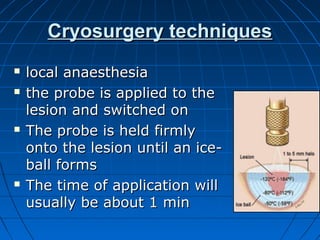
 local anaesthesialocal anaesthesia
 the probe is applied to thethe probe is applied to the
lesion and switched onlesion and switched on
 The probe is held firmlyThe probe is held firmly
onto the lesion until an ice-onto the lesion until an ice-
ball formsball forms
 The time of application willThe time of application will
usually be about 1 minusually be about 1 min
Cryosurgery techniquesCryosurgery techniques
 The probe should not be pulled awayThe probe should not be pulled away
 On turning the machine off thereOn turning the machine off there
should be a rapid thaw and the probeshould be a rapid thaw and the probe
is released.is released.
 One or two further applications areOne or two further applications are
made after 1 minmade after 1 min
 a water-soluble gel may be used toa water-soluble gel may be used to
aid contact with the bone surface.aid contact with the bone surface.
AdvantagesAdvantages
 No haemorrhageNo haemorrhage
 MinimalMinimal
postoperative painpostoperative pain
 Good recovery ofGood recovery of
nerve functionnerve function
 Minimal scarringMinimal scarring
 Bone structureBone structure
maintainedmaintained
 Blood vesselBlood vessel
recoveryrecovery
 Adjacent normalAdjacent normal
tissues recovertissues recover
 Excellent forExcellent for
haemangiomashaemangiomas
 Possible treatmentPossible treatment
of painful nerveof painful nerve
lesionslesions
DisadvantagesDisadvantages
 Cannot be used to cutCannot be used to cut
tissuestissues
 Difficulty in assessingDifficulty in assessing
extent of treatmentextent of treatment
 Excessive swellingExcessive swelling
(could endanger(could endanger
airway)airway)
 Effects at the peripheryEffects at the periphery
(dysplastic changes(dysplastic changes
can be potentiated)can be potentiated)
 Whole lesion notWhole lesion not
available foravailable for
pathologypathology
 Tumour growthTumour growth
may bemay be
acceleratedaccelerated
 Not effective forNot effective for
lymphangiomaslymphangiomas
Treatment of buccalTreatment of buccal
haemangiomahaemangioma
Treatment of mucoceleTreatment of mucocele
Treatment of lingualTreatment of lingual
haemangiomahaemangioma
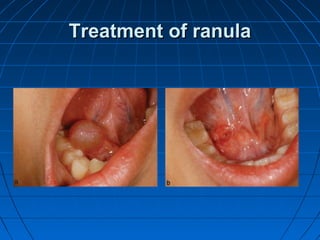
Treatment of ranulaTreatment of ranula

Cryosurgery

  • 1.
  • 2.
    CryosurgeryCryosurgery  Cryosurgery isa procedureCryosurgery is a procedure using freezing temperature tousing freezing temperature to destroy the tissue. (destroy the tissue. (done bydone by liquid nitrogen or nitrousliquid nitrogen or nitrous oxideoxide))
  • 3.
    CryosurgeryCryosurgery  -15°C isnecessary to produce intra--15°C is necessary to produce intra- cellular ice formationcellular ice formation  -50°C is advocated for the-50°C is advocated for the destruction of malignant neoplasmsdestruction of malignant neoplasms  liquid nitrogen probes reach aliquid nitrogen probes reach a temperature of approximatelytemperature of approximately -180°C and a spray -198°C-180°C and a spray -198°C
  • 4.
    CryoprobesCryoprobes  A cryoprobeis surgical instrumentA cryoprobe is surgical instrument with a cold tip.with a cold tip.  The temperature is determined byThe temperature is determined by the boiling point of the refrigerantthe boiling point of the refrigerant liquid .liquid .
  • 5.
    Probe tips comein a variety ofProbe tips come in a variety of shapes and sizesshapes and sizes..
  • 6.
    Uses of cryosurgeryin oralUses of cryosurgery in oral surgerysurgery  Ablation of warts and smallAblation of warts and small tumourstumours healing is usually goodhealing is usually good with minimal scarring.with minimal scarring.  Ablation of haemangiomasAblation of haemangiomas hashas the advantage that there is nothe advantage that there is no haemorrhage and the surface mayhaemorrhage and the surface may be left intact.be left intact.
  • 7.
    Uses of cryosurgeryin oralUses of cryosurgery in oral surgerysurgery  Treatment of bony cavitiesTreatment of bony cavities reduce recurrence of lesions suchreduce recurrence of lesions such asas odontogenic keratocystsodontogenic keratocysts oror central giant cell granulomacentral giant cell granuloma..  Blocking of nervesBlocking of nerves the mostthe most common condition treated in thiscommon condition treated in this way isway is trigeminal neuralgiatrigeminal neuralgia that nothat no longer responds to therapy withlonger responds to therapy with drugsdrugs..
  • 8.
    Cryosurgery techniquesCryosurgery techniques local anaesthesialocal anaesthesia  the probe is applied to thethe probe is applied to the lesion and switched onlesion and switched on  The probe is held firmlyThe probe is held firmly onto the lesion until an ice-onto the lesion until an ice- ball formsball forms  The time of application willThe time of application will usually be about 1 minusually be about 1 min
  • 9.
    Cryosurgery techniquesCryosurgery techniques The probe should not be pulled awayThe probe should not be pulled away  On turning the machine off thereOn turning the machine off there should be a rapid thaw and the probeshould be a rapid thaw and the probe is released.is released.  One or two further applications areOne or two further applications are made after 1 minmade after 1 min  a water-soluble gel may be used toa water-soluble gel may be used to aid contact with the bone surface.aid contact with the bone surface.
  • 10.
    AdvantagesAdvantages  No haemorrhageNohaemorrhage  MinimalMinimal postoperative painpostoperative pain  Good recovery ofGood recovery of nerve functionnerve function  Minimal scarringMinimal scarring  Bone structureBone structure maintainedmaintained  Blood vesselBlood vessel recoveryrecovery  Adjacent normalAdjacent normal tissues recovertissues recover  Excellent forExcellent for haemangiomashaemangiomas  Possible treatmentPossible treatment of painful nerveof painful nerve lesionslesions
  • 11.
    DisadvantagesDisadvantages  Cannot beused to cutCannot be used to cut tissuestissues  Difficulty in assessingDifficulty in assessing extent of treatmentextent of treatment  Excessive swellingExcessive swelling (could endanger(could endanger airway)airway)  Effects at the peripheryEffects at the periphery (dysplastic changes(dysplastic changes can be potentiated)can be potentiated)  Whole lesion notWhole lesion not available foravailable for pathologypathology  Tumour growthTumour growth may bemay be acceleratedaccelerated  Not effective forNot effective for lymphangiomaslymphangiomas
  • 12.
    Treatment of buccalTreatmentof buccal haemangiomahaemangioma
  • 13.
  • 14.
    Treatment of lingualTreatmentof lingual haemangiomahaemangioma
  • 15.