
Cryosurgery and its implications
in
Oral surgeryDr Shibani Sarangi
MDS IIIrd year
CONTENTS
 CONTENTS
 History
 Introduction
 Indications
 Contraindications
 Cryogens
 Armamentarium
 Mechanism of cellular injury
 Cryobiology
 Open system
 Close system
 Use in OMFS
 Limitations
HISTORY
James Arnott (1797-1833) first recorded the formal application of
controlled freezing to destroy tissues when used below -20 degree C.
First cryogen used was liquid Nitrogen & compressed CO2 snow became
popular in 1940s.
In 1961,Cooper and Lee popularised the first cryoprobe system for treating
Parkinsonism.
INTRODUCTION
 Cryosurgery involves the application of low temperature (above
freezing point.) on living tissues in a controlled manner in order to
induce irreversible changes/damage to the tissues.
 Cryosurgery has been used to treat skin lesions for approximately
100 years.The first cryogens were liquid air and compressed
carbon dioxide snow.
Indications of
cryosurgery in oral
and
maxillofacial surgery
Premalignant lesions
Benign oral and orofacial lesions
 Malignant soft tissue lesions of oral cavity,pharynx, face and scalp
 Bone lesions
 Cryosurgery of nerve
 Cryosurgery of blood vessels
 Cryosurgery of salivary glands
Cryosurgical treatment of melanin pigmented gingiva.
Contraindications
 Cryotherapy is contraindicated in patients suffering
from-
 Absolute contraindications
 Lesion located in an area with compromised circulation
 Melanoma
 Patient unable to accept possibility of pigmentary changes
 Proven sensitivity or adverse reaction to cryosurgery
 Sclerosing basal cell carcinoma or recurrent basal cell or squamous
cell carcinoma, particularly when located in a high-risk area (e.g.,
temple, nasolabial fold)
 Relative contraindications
 Cold intolerance
 Cold urticaria
 Collagen disease or autoimmune disease
 Concurrent treatment with immunosuppressive drugs
 Cryoglobulinemia
 Heavily pigmented skin
 Multiple myeloma
 Pyoderma gangrenosum
 Raynaud’s disease
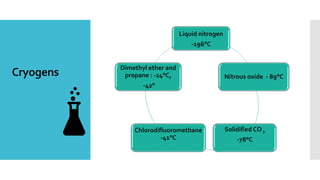
Cryogens
Liquid nitrogen
-196°C
Nitrous oxide - 89°C
Solidified CO2
-78°C
Chlorodifluoromethane
-41°C
Dimethyl ether and
propane : -24°C,
-42°
CRYOBIOLOGY
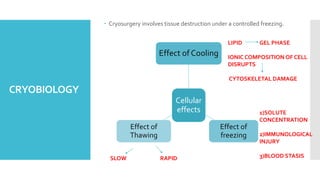
 Cryosurgery involves tissue destruction under a controlled freezing.
Cellular
effects
Effect of Cooling
Effect of
freezing
Effect of
Thawing
LIPID GEL PHASE
IONIC COMPOSITION OF CELL
DISRUPTS
CYTOSKELETAL DAMAGE
1)SOLUTE
CONCENTRATION
2)IMMUNOLOGICAL
INJURY
3)BLOOD STASISSLOW RAPID
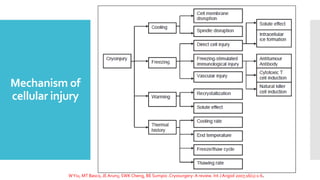
Mechanism of
cellular injury
WYiu, MT Basco, JE Aruny, SWK Cheng, BE Sumpio .Cryosurgery: A review. Int JAngiol 2007;16(1):1-6.
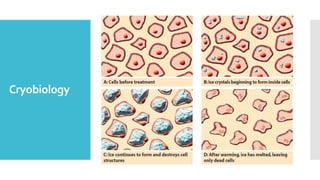
Cryobiology
Liquid nitrogen sprays & cotton swabs are more accessible to
clinicians but are not suitable for use in the oral cavity due to lack
of control over the temperature achieved within cells and the area
of freezing, which makes this method hazardous to use intraorally
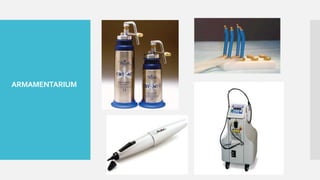
ARMAMENTARIUM
Cryotherapy
for treatment
of oral lesion
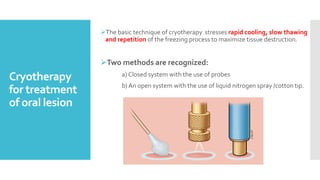
The basic technique of cryotherapy stresses rapid cooling, slow thawing
and repetition of the freezing process to maximize tissue destruction.
Two methods are recognized:
a) Closed system with the use of probes
b) An open system with the use of liquid nitrogen spray /cotton tip.
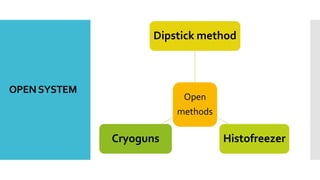
OPENSYSTEM
Open
methods
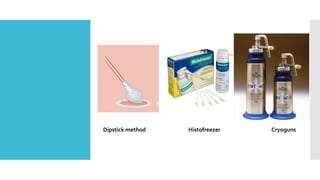
Dipstick method
HistofreezerCryoguns
Dipstick method Histofreezer Cryoguns
Open system
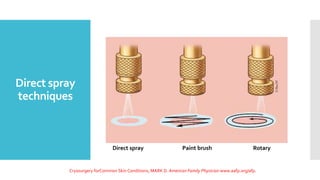
Liquid nitrogen spray methods for lesions of different sizes includes-
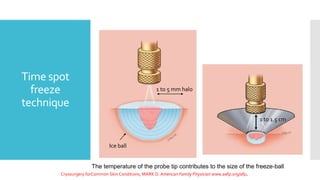
1)Timed spot freeze technique
2)Direct spray technique
The timed spot freeze technique allows greater standardization of liquid
nitrogen delivery.
Timed spot freeze technique-
 It is performed with a small spray gun(Cryoguns) that typically holds 300 to
500 mL of liquid nitrogen. Nozzle sizes ranges from A to F, with F
representing the smallest aperture.
Cryosurgery for Common SkinConditions, MARK D. American Family Physician www.aafp.org/afp.
Time spot
freeze
technique
1 to 1.5 cm
1 to 5 mm halo
Ice ball
Cryosurgery forCommon Skin Conditions, MARK D. American Family Physician www.aafp.org/afp.
The temperature of the probe tip contributes to the size of the freeze-ball
Direct spray
techniques
Cryosurgery forCommon Skin Conditions, MARK D. American Family Physician www.aafp.org/afp.
Direct spray Paint brush Rotary
Close system
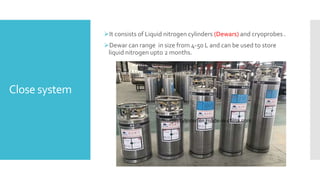
It consists of Liquid nitrogen cylinders (Dewars) and cryoprobes .
Dewar can range in size from 4-50 L and can be used to store
liquid nitrogen upto 2 months.
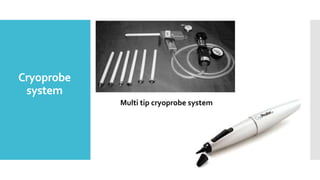
Cryoprobe
system
Multi tip cryoprobe system
Cryoprobes and their mechanism of action
Cell destruction mechanisms can be broadly classified as follows:
1. Direct cellular injury(Immediate type)
a. Hypothermia
b. Freezing injury
i. Extracellular ice crystallization
ii. Intracellular ice crystallization (IIF)
2. Delayed injury or vascular stasis
3. Apoptosis
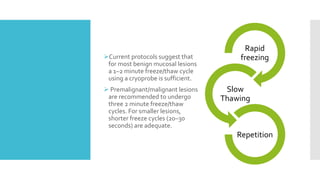
Current protocols suggest that
for most benign mucosal lesions
a 1–2 minute freeze/thaw cycle
using a cryoprobe is sufficient.
 Premalignant/malignant lesions
are recommended to undergo
three 2 minute freeze/thaw
cycles. For smaller lesions,
shorter freeze cycles (20–30
seconds) are adequate.
Rapid
freezing
Slow
Thawing
Repetition
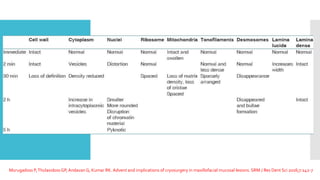
Murugadoss P,Thulasidoss GP,Andavan G, Kumar RK. Advent and implications of cryosurgery in maxillofacial mucosal lesions. SRM J Res Dent Sci 2016;7:242-7
Indications in
oral lesions
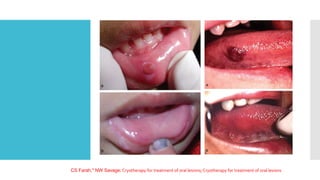
 Cryotherapy is used to treat various leisons in H/N region such
as-
 Mucocele
 Hemangiomas
 Ranula
 Oral leukoplakia
 Odontogenic keratocyst
 Viral warts
 Basal cell carcinoma
 Seborrheic dermatitis
 Actinic keratosis
 Dermatofibroma etc
CS Farah,* NW Savage; Cryotherapy for treatment of oral lesions; Cryotherapy for treatment of oral lesions
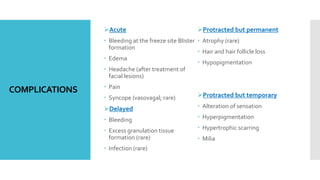
COMPLICATIONS
Acute
 Bleeding at the freeze site Blister
formation
 Edema
 Headache (after treatment of
facial lesions)
 Pain
 Syncope (vasovagal; rare)
Delayed
 Bleeding
 Excess granulation tissue
formation (rare)
 Infection (rare)
Protracted but permanent
 Atrophy (rare)
 Hair and hair follicle loss
 Hypopigmentation
Protracted but temporary
 Alteration of sensation
 Hyperpigmentation
 Hypertrophic scarring
 Milia
 CONCLUSION
 Currently, cryotherapy is an effective treatment method for a
variety of lesions of the head and neck region. Cryotherapy has
particular advantages over surgery and is much more readily
accepted by patients.
 It may therefore be the treatment of choice in infants, anxious
patients and patients for whom other treatment is contra-
indicated.
REFERENCES
Textbook of oral and maxillofacial surgery; Daniel M Laskin
Peterson’sTextbook of oral and maxillofacial surgery
Cryosurgery for Common Skin Conditions ;MARK D. ANDREWs
The use of liquid nitrogen cryotherapy in the management of the odontogenic keratocyst;
Oral Maxillofacial Surg Clin N Am 15 (2003) 393–405
Cryotherapy - Following Intraoral Surgeries and forTreatment of Oral Lesions : A Review ;
LOKESH et al., Biomed. & Pharmacol. J.,Vol. 8(Spl. Edn.), 621-624 (Oct. 2015)
Cryosurgery: ATherapeutic Modality for Oro-Facial Lesions ; HECS International Journal of
Community Health and Medical ResearchVol.3 Issue 3 2017
THANKYOU

Cryotherapy and its implications in Oral surgery

  • 1.
    Cryosurgery and itsimplications in Oral surgeryDr Shibani Sarangi MDS IIIrd year
  • 2.
    CONTENTS  CONTENTS  History Introduction  Indications  Contraindications  Cryogens  Armamentarium  Mechanism of cellular injury  Cryobiology  Open system  Close system  Use in OMFS  Limitations
  • 3.
    HISTORY James Arnott (1797-1833)first recorded the formal application of controlled freezing to destroy tissues when used below -20 degree C. First cryogen used was liquid Nitrogen & compressed CO2 snow became popular in 1940s. In 1961,Cooper and Lee popularised the first cryoprobe system for treating Parkinsonism.
  • 4.
    INTRODUCTION  Cryosurgery involvesthe application of low temperature (above freezing point.) on living tissues in a controlled manner in order to induce irreversible changes/damage to the tissues.  Cryosurgery has been used to treat skin lesions for approximately 100 years.The first cryogens were liquid air and compressed carbon dioxide snow.
  • 5.
    Indications of cryosurgery inoral and maxillofacial surgery Premalignant lesions Benign oral and orofacial lesions  Malignant soft tissue lesions of oral cavity,pharynx, face and scalp  Bone lesions  Cryosurgery of nerve  Cryosurgery of blood vessels  Cryosurgery of salivary glands Cryosurgical treatment of melanin pigmented gingiva.
  • 6.
    Contraindications  Cryotherapy iscontraindicated in patients suffering from-  Absolute contraindications  Lesion located in an area with compromised circulation  Melanoma  Patient unable to accept possibility of pigmentary changes  Proven sensitivity or adverse reaction to cryosurgery  Sclerosing basal cell carcinoma or recurrent basal cell or squamous cell carcinoma, particularly when located in a high-risk area (e.g., temple, nasolabial fold)
  • 7.
     Relative contraindications Cold intolerance  Cold urticaria  Collagen disease or autoimmune disease  Concurrent treatment with immunosuppressive drugs  Cryoglobulinemia  Heavily pigmented skin  Multiple myeloma  Pyoderma gangrenosum  Raynaud’s disease
  • 8.
    Cryogens Liquid nitrogen -196°C Nitrous oxide- 89°C Solidified CO2 -78°C Chlorodifluoromethane -41°C Dimethyl ether and propane : -24°C, -42°
  • 9.
    CRYOBIOLOGY  Cryosurgery involvestissue destruction under a controlled freezing. Cellular effects Effect of Cooling Effect of freezing Effect of Thawing LIPID GEL PHASE IONIC COMPOSITION OF CELL DISRUPTS CYTOSKELETAL DAMAGE 1)SOLUTE CONCENTRATION 2)IMMUNOLOGICAL INJURY 3)BLOOD STASISSLOW RAPID
  • 10.
    Mechanism of cellular injury WYiu,MT Basco, JE Aruny, SWK Cheng, BE Sumpio .Cryosurgery: A review. Int JAngiol 2007;16(1):1-6.
  • 11.
    Cryobiology Liquid nitrogen sprays& cotton swabs are more accessible to clinicians but are not suitable for use in the oral cavity due to lack of control over the temperature achieved within cells and the area of freezing, which makes this method hazardous to use intraorally
  • 12.
  • 13.
    Cryotherapy for treatment of orallesion The basic technique of cryotherapy stresses rapid cooling, slow thawing and repetition of the freezing process to maximize tissue destruction. Two methods are recognized: a) Closed system with the use of probes b) An open system with the use of liquid nitrogen spray /cotton tip.
  • 14.
  • 15.
  • 16.
    Open system Liquid nitrogenspray methods for lesions of different sizes includes- 1)Timed spot freeze technique 2)Direct spray technique The timed spot freeze technique allows greater standardization of liquid nitrogen delivery. Timed spot freeze technique-  It is performed with a small spray gun(Cryoguns) that typically holds 300 to 500 mL of liquid nitrogen. Nozzle sizes ranges from A to F, with F representing the smallest aperture. Cryosurgery for Common SkinConditions, MARK D. American Family Physician www.aafp.org/afp.
  • 17.
    Time spot freeze technique 1 to1.5 cm 1 to 5 mm halo Ice ball Cryosurgery forCommon Skin Conditions, MARK D. American Family Physician www.aafp.org/afp. The temperature of the probe tip contributes to the size of the freeze-ball
  • 18.
    Direct spray techniques Cryosurgery forCommonSkin Conditions, MARK D. American Family Physician www.aafp.org/afp. Direct spray Paint brush Rotary
  • 19.
    Close system It consistsof Liquid nitrogen cylinders (Dewars) and cryoprobes . Dewar can range in size from 4-50 L and can be used to store liquid nitrogen upto 2 months.
  • 20.
  • 21.
    Cryoprobes and theirmechanism of action Cell destruction mechanisms can be broadly classified as follows: 1. Direct cellular injury(Immediate type) a. Hypothermia b. Freezing injury i. Extracellular ice crystallization ii. Intracellular ice crystallization (IIF) 2. Delayed injury or vascular stasis 3. Apoptosis
  • 22.
    Current protocols suggestthat for most benign mucosal lesions a 1–2 minute freeze/thaw cycle using a cryoprobe is sufficient.  Premalignant/malignant lesions are recommended to undergo three 2 minute freeze/thaw cycles. For smaller lesions, shorter freeze cycles (20–30 seconds) are adequate. Rapid freezing Slow Thawing Repetition
  • 23.
    Murugadoss P,Thulasidoss GP,AndavanG, Kumar RK. Advent and implications of cryosurgery in maxillofacial mucosal lesions. SRM J Res Dent Sci 2016;7:242-7
  • 24.
    Indications in oral lesions Cryotherapy is used to treat various leisons in H/N region such as-  Mucocele  Hemangiomas  Ranula  Oral leukoplakia  Odontogenic keratocyst  Viral warts  Basal cell carcinoma  Seborrheic dermatitis  Actinic keratosis  Dermatofibroma etc
  • 25.
    CS Farah,* NWSavage; Cryotherapy for treatment of oral lesions; Cryotherapy for treatment of oral lesions
  • 26.
    COMPLICATIONS Acute  Bleeding atthe freeze site Blister formation  Edema  Headache (after treatment of facial lesions)  Pain  Syncope (vasovagal; rare) Delayed  Bleeding  Excess granulation tissue formation (rare)  Infection (rare) Protracted but permanent  Atrophy (rare)  Hair and hair follicle loss  Hypopigmentation Protracted but temporary  Alteration of sensation  Hyperpigmentation  Hypertrophic scarring  Milia
  • 27.
     CONCLUSION  Currently,cryotherapy is an effective treatment method for a variety of lesions of the head and neck region. Cryotherapy has particular advantages over surgery and is much more readily accepted by patients.  It may therefore be the treatment of choice in infants, anxious patients and patients for whom other treatment is contra- indicated.
  • 28.
    REFERENCES Textbook of oraland maxillofacial surgery; Daniel M Laskin Peterson’sTextbook of oral and maxillofacial surgery Cryosurgery for Common Skin Conditions ;MARK D. ANDREWs The use of liquid nitrogen cryotherapy in the management of the odontogenic keratocyst; Oral Maxillofacial Surg Clin N Am 15 (2003) 393–405 Cryotherapy - Following Intraoral Surgeries and forTreatment of Oral Lesions : A Review ; LOKESH et al., Biomed. & Pharmacol. J.,Vol. 8(Spl. Edn.), 621-624 (Oct. 2015) Cryosurgery: ATherapeutic Modality for Oro-Facial Lesions ; HECS International Journal of Community Health and Medical ResearchVol.3 Issue 3 2017
  • 29.

Editor's Notes

  • #15 propane+dimethylether -50 F
  • #18 Benign-1-2 mm Premalignant- 2-3 mm Malignant 5 mm