Drugs For Photodynamic Therapy Presented by: Rana Muhammad Irfan Roll # 22 Hafiz Muhammad Usman Roll # 23 UNIVERSITY OF SARGODHA PAKISTAN
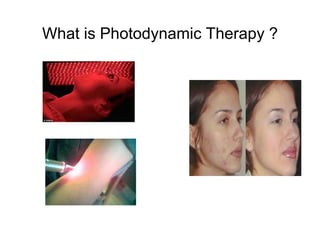
What is Photodynamic Therapy ?
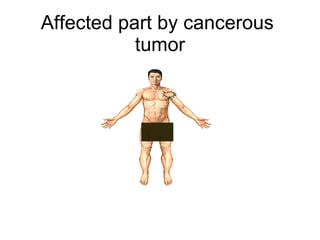
Affected part by cancerous  tumor
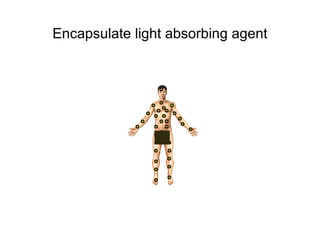
Encapsulate light absorbing agent
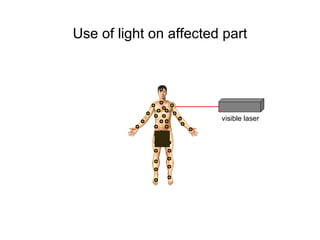
Use of light on affected part visible laser
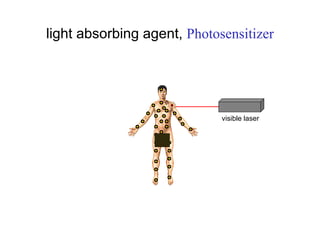
light absorbing agent,  Photosensitizer visible laser
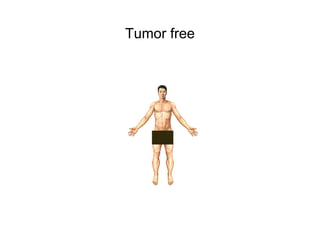
Tumor free
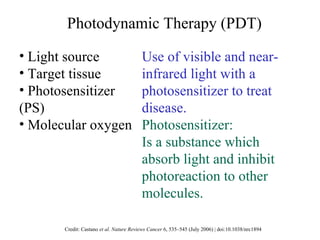
Photodynamic Therapy (PDT) Credit: Castano  et al.   Nature Reviews Cancer  6, 535 –545 (July 2006) | doi:10.1038/nrc1894 Light source Target tissue Photosensitizer (PS) Molecular oxygen Use of visible and near-infrared light with a photosensitizer to treat disease. Photosensitizer: Is a substance which absorb light and inhibit photoreaction to other molecules.
Principle: A photosensitizer is administered to the target tissue, for example a cancerous tumour. Then light is shined onto the target tissue, which is absorbed by the photosensitizer and causes generation of reactive oxygen species.
Hisroty The German physician  Friedrich Meyer–Betz  performed the first study with what was first called photoradiation therapy (PRT) with porphyrins in humans in 1913. Early patients were treated at Roswell, Los Angeles Children's Hospital, Los Angeles County Hospital, and other clinics and Hospitals in the USA. It was  John Toth  wrote the first "white paper" renaming the therapy as "Photodynamic Therapy" (PDT).  PDT received even greater interest as result of  Thomas Dougherty   helping expand clinical trials and forming the Intrnational Photodynamic Association, in 1986.
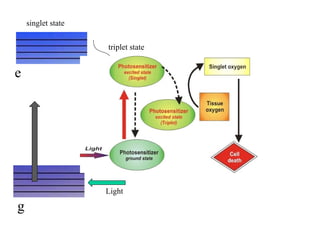
The photosensitizer moves from its ground state to an excited singlet state and then an excited triplet state.  molecular oxygen is present at its ground triplet state When the photosensitizer and an oxygen molecule are in proximity, an energy transfer can take place that allows the photosensitizer to relax to its ground singlet state,  and create an excited singlet state oxygen molecule.  Since singlet oxygen is highly reactive and cytotoxic, the tumour cells are destroyed. Mechanism of action
Light g e singlet state triplet state
Photosensitizers for PDT Chemically pure and of known composition Localize to the target tissue Absorb strongly at a specific wavelength high extinction coefficient Efficiently generate reactive oxygen  Design Criteria
Advantages of PDT It has no long-term  side effects  when used properly. It is  less invasive  than surgery  It usually takes only a  short time  and is most often done as an outpatient. It can be  targeted very precisely . Unlike radiation, PDT  can be repeated  many times at the same site if needed. There is little or  no scarring  after the site heals. It often  costs less  than other cancer treatments.
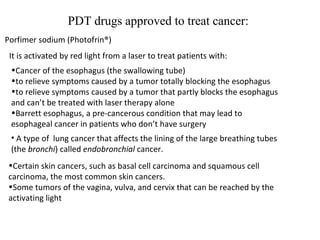
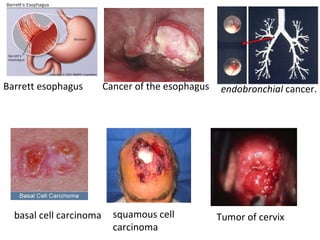
PDT drugs approved to treat cancer: Porfimer sodium (Photofrin®) It is activated by red light from a laser to treat patients with: Cancer of the esophagus (the swallowing tube) to relieve symptoms caused by a tumor totally blocking the esophagus to relieve symptoms caused by a tumor that partly blocks the esophagus and can’t be treated with laser therapy alone Barrett esophagus, a pre-cancerous condition that may lead to esophageal cancer in patients who don’t have surgery  A type of  lung cancer that affects the lining of the large breathing tubes (the  bronchi ) called  endobronchial  cancer. Certain skin cancers, such as basal cell carcinoma and squamous cell carcinoma, the most common skin cancers. Some tumors of the vagina, vulva, and cervix that can be reached by the activating light
Barrett esophagus Cancer of the esophagus  endobronchial  cancer. basal cell carcinoma   squamous cell  carcinoma Tumor of cervix
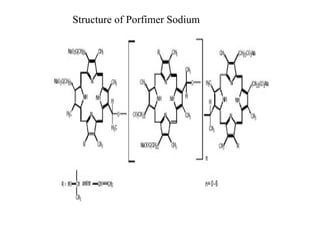
Structure of Porfimer Sodium
What is treatment like? First, the porfimer sodium is given through a vein.  It travels through the bloodstream and is absorbed by all cells in the body, both normal and cancer cells. The normal cells get rid of most of the porfimer sodium over a couple of days. But a lot of the drug stays in the cancer cells and in normal skin cells.  Porfimer sodium must be activated or turned on with light. This is done about  2 or 3 days after the drug is given. This gives the normal cells a chance to get rid of the drug.
The doctor directs a laser light at the area of cancer cells using a very thin  fiber optic  glass strand.  The laser used is a low-power light so it does not burn. It causes little or no pain. The light is applied for  5 to 40 minutes , depending on the size of the tumor.  Any dead tissue left in the treated area is removed about 4 or 5 days later during endoscopy or bronchoscopy. The treatment can be repeated if needed.
Who should not get treated with porfimer sodium? Porfimer sodium is NOT recommended for people with:  A fistula (abnormal opening) between the esophagus and  the windpipe (trachea) or one of the lower large  breathing tubes ( a bronchus) A tumor that is spreading into a major blood vessel  Enlarged veins in the stomach or esophagus, or ulcers in  the esophagus. Possible side effects The major possible side effects from porfimer sodium are  photosensitivity  reactions (reactions triggered by light) and swelling in the treated area. Swelling may cause pain or trouble swallowing or breathing.
Photosensitivity reactions As soon as porfimer sodium is put into the bloodstream, it starts to collect in the cells of the body. Some of it will stay in the cells for several weeks.  The skin and eyes become very sensitive to light during this time.  If exposed to sunlight or other forms of bright light, the skin can quickly become swollen, sunburned, and blistered.  After you get porfimer sodium, you should take precautions for at least 30 days to prevent reactions. Sensitivity to light can last as long as 3 months
Aminolevulinic acid (ALA or Levulan®) Aminolevulinic acid is a drug that is put right on the skin. It is used to treat  actinic keratosis. a skin condition that can become cancer and  mycosis fungoides , a skin lymphoma. It is approved for use only on the face or scalp. A special blue light, rather than laser light, is used to activate this drug. What is treatment like? Aminolevulinic acid (Levulan® Kerastick)  is a solution that is applied directly to the lesions or spots on the face or scalp. Unlike porfimer sodium, it does not reach other parts of the body.
About  14 to 18 hours  after the drug is applied (usually the next day), doctor will expose the area being treated to a blue light for about 15 minutes. During the light therapy must wear protective eyewear. The treated area may get red and scale and crust for up to 4 weeks before healing. If a lesion does not completely go away after treatment, it can be treated again 8 weeks later.
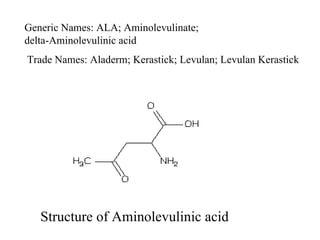
Generic Names: ALA; Aminolevulinate;  delta-Aminolevulinic acid  Trade Names: Aladerm; Kerastick; Levulan; Levulan Kerastick  Structure of Aminolevulinic acid
Possible side effects Reactions caused by light can show up on the skin where the drug is applied. They usually involve redness and a tingling or burning sensation. Sunscreens will not protect the skin from photosensitivity reactions. The treated skin will likely turn red and may swell after treatment.  The skin may also be itchy or change color after treatment. Who should not get treated with aminolevulinic acid? Aminolevulinic acid is NOT recommended for people  with skin sensitivity to blue light.
Methyl ester of ALA (Metvixia® cream) Methyl ester of ALA is one of several other forms of ALA that have been developed. A disadvantage of the older forms of ALA is that they do not get into the cancer cells very easily. It was approved by the FDA in July 2004 for  treatment of some types of actinic keratoses  of the face and scalp.  Again, these are skin conditions that can  become cancer. Methyl ester of ALA is activated with a red light.
Generic Names: 5-Aminolevulinic acid methyl ester; Aminolevulinic acid methyl ester   Structure of Methyl ester of Aminolevulinate
What is treatment like? It is a cream that is put on the skin of the face or  scalp to treat actinic keratosis lesions. The doctor will likely first scrape the area with a  small, sharp blade. The lesions where the cream is applied are  sensitive to light, but the rest of the body is not. The cream should not be left on the skin for  more than 4 hours. The cream is applied and covered with a bandage. About 3 hours later cream is removed. The area is exposed to a red light source for  5 to 20 minutes.
Two treatment sessions are usually done 7 days apart.  The treated area may turn red, blister, scale, and crust for up to 10 days before healing. Methyl ester of ALA is NOT recommended for those with:  Skin sensitivity to light Allergies to peanuts or almonds (these oils are used to make the cream) Immunosuppression (a weakened immune system)
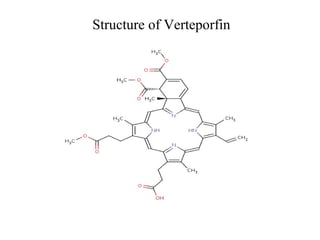
Possible side effects Photosensitivity reactions Skin changes Visudyne Generic Name: Verteporfin Molecular Formula: C 41 H 42 N 4 O 8 Photosensitizing agent activated by low-intensity laser light. It is synthetic benzoporphyrin derivative. For treatment of : pathologic myopia presumed ocular histoplasmosis due to age-related macular degeneration
Structure of Verteporfin
What is treatment like? Administer by IV infusion using an appropriate syringe pump and inline filter with  a pore size of 0.22–1.2 mcm. Protect diluted solution from bright light during  administration. Avoid contact of verteporfin solution with the eyes and skin during preparation and administration Possible side effects Extravasation produces severe pain,  inflammation, swelling, or discoloration Visual disturbances
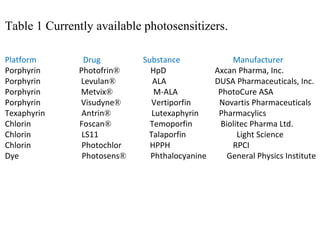
Table 1 Currently available photosensitizers. Platform  Drug  Substance  Manufacturer  Porphyrin  Photofrin ®   HpD  Axcan Pharma, Inc.  Porphyrin  Levulan ®   ALA  DUSA Pharmaceuticals, Inc.  Porphyrin  Metvix ®   M-ALA  PhotoCure ASA Porphyrin  Visudyne ®   Vertiporfin  Novartis Pharmaceuticals Texaphyrin  Antrin ®   Lutexaphyrin  Pharmacylics Chlorin  Foscan ®   Temoporfin  Biolitec Pharma Ltd.  Chlorin  LS11  Talaporfin  Light Science Chlorin  Photochlor  HPPH  RPCI Dye  Photosens ®   Phthalocyanine  General Physics Institute
The future of photodynamic therapy Studies are now being done to test the use  of PDT for several types of cancer and  pre-cancerous conditions, including  cancers of the:  Skin Cervix Bladder Prostate
Bile duct Pancreas Stomach Brain Head and neck Larynx (voice box)
New and better drugs Newer photosensitizing drugs now  being studied may have advantages  over the ones used today : They may be able to treat tumors that are deeper under the skin or in body tissues. They may be more selective for cancer cells as opposed to normal cells. They may collect in cancer cells more quickly, reducing  the time needed between getting the drug and the  light treatment.
They may be removed from the body more quickly,  reducing the time people need to worry about photosensitivity reactions. An example of one of these new drugs, Photochlor®, is now being used in clinical trials.  Photochlor or HPPH (2-[1-hexyloxyethyl]-2-devinyl pyropheophorbide-a) is a second-generation photosensitizer.
It is being studied in the treatment of esophageal, lung, skin, and mouth and throat cancers. So far, studies have shown that photosensitivity lasts a much shorter time, and the drug is removed from the body much faster than Photofrin. Studies are also being done to try to make PDT work better and have fewer side effects. Scientists around the world are looking at things like using ointments containing ferrous or cobalt ions and using hydrogen peroxide on the treated area to improve PDT outcomes,  but these studies are in very early stages and more research is needed .
References Axcan Pharma Inc. PDT with Photofrin. Patient Guide. FAQs. Accessed at www.photofrin.com/faqs.php?lang=1 on April 15, 2011. Brown S, Brown EA, Walker I. The present and future role of photodynamic therapy in cancer treatment.  Lancet Oncol . 2004;5:497-508. DUSA Pharmaceuticals. Levulan Kerastick. Accessed at www.dusapharma.com/levulan-photodynamic-therapy.html on April 14, 2011. Hopper C. Photodynamic therapy: a clinical reality in the treatment of cancer.  Lancet Oncol . 2000;1:212-219. Huang Z. A review of progress in clinical photodynamic therapy.  Technol Cancer Res Treat . 2005;4:283-293.
 

Photodyanamic therapy ppt

  • 1.
  • 2.
    Drugs For PhotodynamicTherapy Presented by: Rana Muhammad Irfan Roll # 22 Hafiz Muhammad Usman Roll # 23 UNIVERSITY OF SARGODHA PAKISTAN
  • 3.
  • 4.
    Affected part bycancerous tumor
  • 5.
  • 6.
    Use of lighton affected part visible laser
  • 7.
    light absorbing agent, Photosensitizer visible laser
  • 8.
  • 9.
    Photodynamic Therapy (PDT)Credit: Castano et al. Nature Reviews Cancer 6, 535 –545 (July 2006) | doi:10.1038/nrc1894 Light source Target tissue Photosensitizer (PS) Molecular oxygen Use of visible and near-infrared light with a photosensitizer to treat disease. Photosensitizer: Is a substance which absorb light and inhibit photoreaction to other molecules.
  • 10.
    Principle: A photosensitizeris administered to the target tissue, for example a cancerous tumour. Then light is shined onto the target tissue, which is absorbed by the photosensitizer and causes generation of reactive oxygen species.
  • 11.
    Hisroty The Germanphysician Friedrich Meyer–Betz performed the first study with what was first called photoradiation therapy (PRT) with porphyrins in humans in 1913. Early patients were treated at Roswell, Los Angeles Children's Hospital, Los Angeles County Hospital, and other clinics and Hospitals in the USA. It was John Toth wrote the first "white paper" renaming the therapy as "Photodynamic Therapy" (PDT). PDT received even greater interest as result of Thomas Dougherty helping expand clinical trials and forming the Intrnational Photodynamic Association, in 1986.
  • 12.
    The photosensitizer movesfrom its ground state to an excited singlet state and then an excited triplet state. molecular oxygen is present at its ground triplet state When the photosensitizer and an oxygen molecule are in proximity, an energy transfer can take place that allows the photosensitizer to relax to its ground singlet state, and create an excited singlet state oxygen molecule. Since singlet oxygen is highly reactive and cytotoxic, the tumour cells are destroyed. Mechanism of action
  • 13.
    Light g esinglet state triplet state
  • 14.
    Photosensitizers for PDTChemically pure and of known composition Localize to the target tissue Absorb strongly at a specific wavelength high extinction coefficient Efficiently generate reactive oxygen Design Criteria
  • 15.
    Advantages of PDTIt has no long-term side effects when used properly. It is less invasive than surgery It usually takes only a short time and is most often done as an outpatient. It can be targeted very precisely . Unlike radiation, PDT can be repeated many times at the same site if needed. There is little or no scarring after the site heals. It often costs less than other cancer treatments.
  • 16.
    PDT drugs approvedto treat cancer: Porfimer sodium (Photofrin®) It is activated by red light from a laser to treat patients with: Cancer of the esophagus (the swallowing tube) to relieve symptoms caused by a tumor totally blocking the esophagus to relieve symptoms caused by a tumor that partly blocks the esophagus and can’t be treated with laser therapy alone Barrett esophagus, a pre-cancerous condition that may lead to esophageal cancer in patients who don’t have surgery A type of lung cancer that affects the lining of the large breathing tubes (the bronchi ) called endobronchial cancer. Certain skin cancers, such as basal cell carcinoma and squamous cell carcinoma, the most common skin cancers. Some tumors of the vagina, vulva, and cervix that can be reached by the activating light
  • 17.
    Barrett esophagus Cancerof the esophagus endobronchial cancer. basal cell carcinoma squamous cell carcinoma Tumor of cervix
  • 18.
  • 19.
    What is treatmentlike? First, the porfimer sodium is given through a vein. It travels through the bloodstream and is absorbed by all cells in the body, both normal and cancer cells. The normal cells get rid of most of the porfimer sodium over a couple of days. But a lot of the drug stays in the cancer cells and in normal skin cells. Porfimer sodium must be activated or turned on with light. This is done about 2 or 3 days after the drug is given. This gives the normal cells a chance to get rid of the drug.
  • 20.
    The doctor directsa laser light at the area of cancer cells using a very thin fiber optic glass strand. The laser used is a low-power light so it does not burn. It causes little or no pain. The light is applied for 5 to 40 minutes , depending on the size of the tumor. Any dead tissue left in the treated area is removed about 4 or 5 days later during endoscopy or bronchoscopy. The treatment can be repeated if needed.
  • 21.
    Who should notget treated with porfimer sodium? Porfimer sodium is NOT recommended for people with: A fistula (abnormal opening) between the esophagus and the windpipe (trachea) or one of the lower large breathing tubes ( a bronchus) A tumor that is spreading into a major blood vessel Enlarged veins in the stomach or esophagus, or ulcers in the esophagus. Possible side effects The major possible side effects from porfimer sodium are photosensitivity reactions (reactions triggered by light) and swelling in the treated area. Swelling may cause pain or trouble swallowing or breathing.
  • 22.
    Photosensitivity reactions Assoon as porfimer sodium is put into the bloodstream, it starts to collect in the cells of the body. Some of it will stay in the cells for several weeks. The skin and eyes become very sensitive to light during this time. If exposed to sunlight or other forms of bright light, the skin can quickly become swollen, sunburned, and blistered. After you get porfimer sodium, you should take precautions for at least 30 days to prevent reactions. Sensitivity to light can last as long as 3 months
  • 23.
    Aminolevulinic acid (ALAor Levulan®) Aminolevulinic acid is a drug that is put right on the skin. It is used to treat actinic keratosis. a skin condition that can become cancer and mycosis fungoides , a skin lymphoma. It is approved for use only on the face or scalp. A special blue light, rather than laser light, is used to activate this drug. What is treatment like? Aminolevulinic acid (Levulan® Kerastick) is a solution that is applied directly to the lesions or spots on the face or scalp. Unlike porfimer sodium, it does not reach other parts of the body.
  • 24.
    About 14to 18 hours after the drug is applied (usually the next day), doctor will expose the area being treated to a blue light for about 15 minutes. During the light therapy must wear protective eyewear. The treated area may get red and scale and crust for up to 4 weeks before healing. If a lesion does not completely go away after treatment, it can be treated again 8 weeks later.
  • 25.
    Generic Names: ALA; Aminolevulinate; delta-Aminolevulinic acid Trade Names: Aladerm; Kerastick; Levulan; Levulan Kerastick Structure of Aminolevulinic acid
  • 26.
    Possible side effectsReactions caused by light can show up on the skin where the drug is applied. They usually involve redness and a tingling or burning sensation. Sunscreens will not protect the skin from photosensitivity reactions. The treated skin will likely turn red and may swell after treatment. The skin may also be itchy or change color after treatment. Who should not get treated with aminolevulinic acid? Aminolevulinic acid is NOT recommended for people with skin sensitivity to blue light.
  • 27.
    Methyl ester ofALA (Metvixia® cream) Methyl ester of ALA is one of several other forms of ALA that have been developed. A disadvantage of the older forms of ALA is that they do not get into the cancer cells very easily. It was approved by the FDA in July 2004 for treatment of some types of actinic keratoses of the face and scalp. Again, these are skin conditions that can become cancer. Methyl ester of ALA is activated with a red light.
  • 28.
    Generic Names: 5-Aminolevulinic acidmethyl ester; Aminolevulinic acid methyl ester Structure of Methyl ester of Aminolevulinate
  • 29.
    What is treatmentlike? It is a cream that is put on the skin of the face or scalp to treat actinic keratosis lesions. The doctor will likely first scrape the area with a small, sharp blade. The lesions where the cream is applied are sensitive to light, but the rest of the body is not. The cream should not be left on the skin for more than 4 hours. The cream is applied and covered with a bandage. About 3 hours later cream is removed. The area is exposed to a red light source for 5 to 20 minutes.
  • 30.
    Two treatment sessionsare usually done 7 days apart. The treated area may turn red, blister, scale, and crust for up to 10 days before healing. Methyl ester of ALA is NOT recommended for those with: Skin sensitivity to light Allergies to peanuts or almonds (these oils are used to make the cream) Immunosuppression (a weakened immune system)
  • 31.
    Possible side effectsPhotosensitivity reactions Skin changes Visudyne Generic Name: Verteporfin Molecular Formula: C 41 H 42 N 4 O 8 Photosensitizing agent activated by low-intensity laser light. It is synthetic benzoporphyrin derivative. For treatment of : pathologic myopia presumed ocular histoplasmosis due to age-related macular degeneration
  • 32.
  • 33.
    What is treatmentlike? Administer by IV infusion using an appropriate syringe pump and inline filter with a pore size of 0.22–1.2 mcm. Protect diluted solution from bright light during administration. Avoid contact of verteporfin solution with the eyes and skin during preparation and administration Possible side effects Extravasation produces severe pain, inflammation, swelling, or discoloration Visual disturbances
  • 34.
    Table 1 Currentlyavailable photosensitizers. Platform Drug Substance Manufacturer Porphyrin Photofrin ® HpD Axcan Pharma, Inc. Porphyrin Levulan ® ALA DUSA Pharmaceuticals, Inc. Porphyrin Metvix ® M-ALA PhotoCure ASA Porphyrin Visudyne ® Vertiporfin Novartis Pharmaceuticals Texaphyrin Antrin ® Lutexaphyrin Pharmacylics Chlorin Foscan ® Temoporfin Biolitec Pharma Ltd. Chlorin LS11 Talaporfin Light Science Chlorin Photochlor HPPH RPCI Dye Photosens ® Phthalocyanine General Physics Institute
  • 35.
    The future ofphotodynamic therapy Studies are now being done to test the use of PDT for several types of cancer and pre-cancerous conditions, including cancers of the: Skin Cervix Bladder Prostate
  • 36.
    Bile duct PancreasStomach Brain Head and neck Larynx (voice box)
  • 37.
    New and betterdrugs Newer photosensitizing drugs now being studied may have advantages over the ones used today : They may be able to treat tumors that are deeper under the skin or in body tissues. They may be more selective for cancer cells as opposed to normal cells. They may collect in cancer cells more quickly, reducing the time needed between getting the drug and the light treatment.
  • 38.
    They may beremoved from the body more quickly, reducing the time people need to worry about photosensitivity reactions. An example of one of these new drugs, Photochlor®, is now being used in clinical trials. Photochlor or HPPH (2-[1-hexyloxyethyl]-2-devinyl pyropheophorbide-a) is a second-generation photosensitizer.
  • 39.
    It is beingstudied in the treatment of esophageal, lung, skin, and mouth and throat cancers. So far, studies have shown that photosensitivity lasts a much shorter time, and the drug is removed from the body much faster than Photofrin. Studies are also being done to try to make PDT work better and have fewer side effects. Scientists around the world are looking at things like using ointments containing ferrous or cobalt ions and using hydrogen peroxide on the treated area to improve PDT outcomes, but these studies are in very early stages and more research is needed .
  • 40.
    References Axcan PharmaInc. PDT with Photofrin. Patient Guide. FAQs. Accessed at www.photofrin.com/faqs.php?lang=1 on April 15, 2011. Brown S, Brown EA, Walker I. The present and future role of photodynamic therapy in cancer treatment. Lancet Oncol . 2004;5:497-508. DUSA Pharmaceuticals. Levulan Kerastick. Accessed at www.dusapharma.com/levulan-photodynamic-therapy.html on April 14, 2011. Hopper C. Photodynamic therapy: a clinical reality in the treatment of cancer. Lancet Oncol . 2000;1:212-219. Huang Z. A review of progress in clinical photodynamic therapy. Technol Cancer Res Treat . 2005;4:283-293.
  • 41.