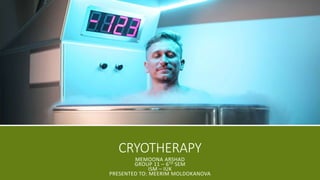
CRYOTHERAPY
MEMOONA ARSHAD
GROUP 11 – 6TH SEM
ISM – IUK
PRESENTED TO: MEERIM MOLDOKANOVA
WHAT IS CRYOTHERAPY?
▪ Cryotherapy is the use of extreme cold
to freeze and remove abnormal tissue.
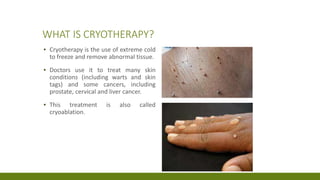
▪ Doctors use it to treat many skin
conditions (including warts and skin
tags) and some cancers, including
prostate, cervical and liver cancer.
▪ This treatment is also called
cryoablation.
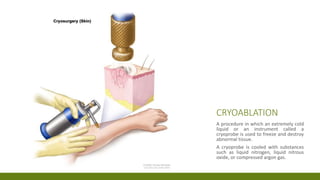
CRYOABLATION
A procedure in which an extremely cold
liquid or an instrument called a
cryoprobe is used to freeze and destroy
abnormal tissue.
A cryoprobe is cooled with substances
such as liquid nitrogen, liquid nitrous
oxide, or compressed argon gas.
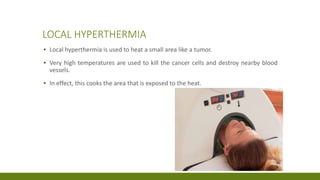
LOCAL HYPERTHERMIA
▪ Local hyperthermia is used to heat a small area like a tumor.
▪ Very high temperatures are used to kill the cancer cells and destroy nearby blood
vessels.
▪ In effect, this cooks the area that is exposed to the heat.
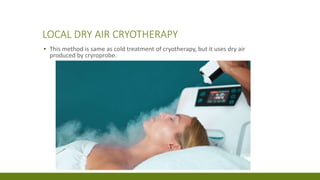
LOCAL DRY AIR CRYOTHERAPY
▪ This method is same as cold treatment of cryotherapy, but it uses dry air
produced by cryroprobe.
WHY DO DOCTORS USE CRYOTHERAPY?
▪ Cryotherapy is a minimally invasive therapy.
▪ This type of treatment removes damaged or diseased tissue that comes from a variety of
medical conditions.
▪ Cryotherapy is usually done without open surgery.
▪ Most people recover quickly from the procedure and with little pain.
▪ Your provider might recommend cryotherapy for:
▪ Bone cancer.
▪ Cervical cancer, liver cancer or prostate cancer.
▪ Precancerous cells in the cervix (lower end of the uterus).
▪ Precancerous skin conditions and early-stage skin cancers, including squamous cell carcinoma
and basal cell carcinoma.
▪ Retinoblastoma (cancer of the retina in children).
▪ Skin conditions like warts, skin tags or dark spots.
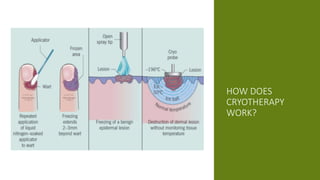
HOW DOES CRYOTHERAPY WORK?
▪ During cryotherapy, the healthcare provider applies extreme cold to abnormal
tissue.
▪ Cells can’t survive this severe cold and die after treatment.
▪ Your healthcare provider can use a few different substances to create the intense
cold used in cryotherapy.
▪ These substances can include:
▪ Liquid nitrogen.
▪ Liquid nitrous oxide.
▪ Argon gas.
HOW DOES
CRYOTHERAPY
WORK?
WHY CRYOTHERAPY METHOD WILL HEALTHCARE
PROVIDER USE?
▪ There are different cryotherapy methods to freeze tissue. The way your healthcare
provider applies the cold depends on the location of the abnormal tissue.
▪ External
▪ If the tissue is located on your skin, your provider will typically use a spraying device or a cotton
swab to apply the freezing agent.
▪ Internal
▪ To treat conditions inside the body, like precancerous cells or a tumor, your provider will use an
instrument called a cryoprobe.
▪ This probe is inserted through a small incision (cut) in your skin.
▪ External cryotherapy causes frozen skin to blister and peel off so that healthy new
skin can grow.
▪ When abnormal cells freeze and die during internal cryotherapy, your immune
system helps clear the tissue out of the body.
HOW SHOULD WE PREPARE FOR CRYOTHERAPY?
▪ Most people don’t need to do anything special to prepare for cryotherapy on the
skin.
▪ Your healthcare provider will give you instructions before internal cryotherapy to
help you prepare.
▪ You may have to stop taking certain medications, such as aspirin or blood thinners, a
few days before internal cryosurgery.
▪ Other special instructions may include:
▪ Limiting how much you eat or drink before the procedure.
▪ Planning for someone to drive you home after the procedure.
WHAT SHOULD WE EXPECT DURING
CRYOTHERAPY?
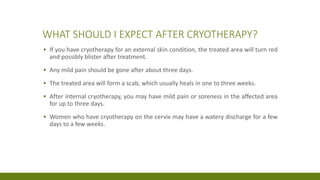
▪ If you have external cryotherapy, your healthcare
provider will apply the cold with a spraying device or
cotton swab.
▪ Providers usually use liquid nitrogen for this type of
treatment.
▪ For internal cryotherapy, the cryoprobe is inserted
through a small incision in your skin.
▪ Your healthcare provider may use ultrasound imaging
to guide the cryoprobe to the tissue to be frozen.
▪ Depending on the location of the abnormal cells, you
may be given either local anesthesia or general
anesthesia.
▪ Local anesthesia works to numb a specific spot, while
a general anesthesia is used during surgeries to put
you to sleep.
WHAT SHOULD I EXPECT AFTER CRYOTHERAPY?
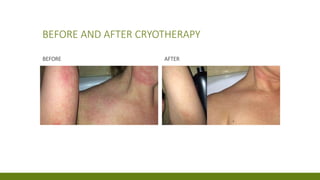
▪ If you have cryotherapy for an external skin condition, the treated area will turn red
and possibly blister after treatment.
▪ Any mild pain should be gone after about three days.
▪ The treated area will form a scab, which usually heals in one to three weeks.
▪ After internal cryotherapy, you may have mild pain or soreness in the affected area
for up to three days.
▪ Women who have cryotherapy on the cervix may have a watery discharge for a few
days to a few weeks.
BEFORE AND AFTER CRYOTHERAPY
BEFORE AFTER
PROS & CONS OF CRYOTHERAPY
▪ Cryosurgery is a minimally invasive treatment.
▪ Compared to traditional surgery, it usually has less pain and bleeding and a lower
risk of damaging healthy tissue near the abnormal cells.
▪ The risks of cryotherapy are small, but complications can occur.
▪ These complications may include:
▪ Bleeding, cramping or pain after cryotherapy around the cervix.
▪ Bone fractures.
▪ Nerve damage resulting in loss of feeling.
▪ Swelling, scarring and skin infection.
WHAT IS THE OUTLOOK FOR PEOPLE WHO HAVE
CRYOTHERAPY?
▪ Healthcare providers successfully treat many problems with cryotherapy.
▪ Most skin conditions treated with cryotherapy do not require any special care after
treatment.
▪ Some people who have internal cryotherapy need to limit their activity for a few
days after the procedure.
▪ Your provider will let you know when you can return to your regular routine.
▪ You may need more than one cryotherapy treatment to remove all the abnormal
tissue.
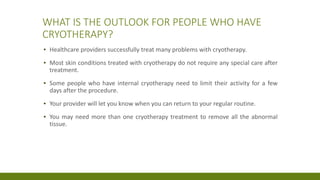
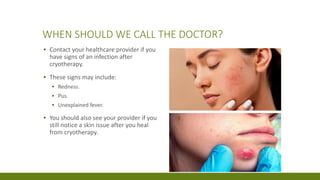
WHEN SHOULD WE CALL THE DOCTOR?
▪ Contact your healthcare provider if you
have signs of an infection after
cryotherapy.
▪ These signs may include:
▪ Redness.
▪ Pus.
▪ Unexplained fever.
▪ You should also see your provider if you
still notice a skin issue after you heal
from cryotherapy.
REFERENCES
▪ Cryotherapy: Uses, Procedure, Risks & Benefits (clevelandclinic.org)
▪ Hyperthermia to Treat Cancer
 THANK YOU 

Cryotherapy

  • 1.
    CRYOTHERAPY MEMOONA ARSHAD GROUP 11– 6TH SEM ISM – IUK PRESENTED TO: MEERIM MOLDOKANOVA
  • 2.
    WHAT IS CRYOTHERAPY? ▪Cryotherapy is the use of extreme cold to freeze and remove abnormal tissue. ▪ Doctors use it to treat many skin conditions (including warts and skin tags) and some cancers, including prostate, cervical and liver cancer. ▪ This treatment is also called cryoablation.
  • 3.
    CRYOABLATION A procedure inwhich an extremely cold liquid or an instrument called a cryoprobe is used to freeze and destroy abnormal tissue. A cryoprobe is cooled with substances such as liquid nitrogen, liquid nitrous oxide, or compressed argon gas.
  • 4.
    LOCAL HYPERTHERMIA ▪ Localhyperthermia is used to heat a small area like a tumor. ▪ Very high temperatures are used to kill the cancer cells and destroy nearby blood vessels. ▪ In effect, this cooks the area that is exposed to the heat.
  • 5.
    LOCAL DRY AIRCRYOTHERAPY ▪ This method is same as cold treatment of cryotherapy, but it uses dry air produced by cryroprobe.
  • 6.
    WHY DO DOCTORSUSE CRYOTHERAPY? ▪ Cryotherapy is a minimally invasive therapy. ▪ This type of treatment removes damaged or diseased tissue that comes from a variety of medical conditions. ▪ Cryotherapy is usually done without open surgery. ▪ Most people recover quickly from the procedure and with little pain. ▪ Your provider might recommend cryotherapy for: ▪ Bone cancer. ▪ Cervical cancer, liver cancer or prostate cancer. ▪ Precancerous cells in the cervix (lower end of the uterus). ▪ Precancerous skin conditions and early-stage skin cancers, including squamous cell carcinoma and basal cell carcinoma. ▪ Retinoblastoma (cancer of the retina in children). ▪ Skin conditions like warts, skin tags or dark spots.
  • 7.
    HOW DOES CRYOTHERAPYWORK? ▪ During cryotherapy, the healthcare provider applies extreme cold to abnormal tissue. ▪ Cells can’t survive this severe cold and die after treatment. ▪ Your healthcare provider can use a few different substances to create the intense cold used in cryotherapy. ▪ These substances can include: ▪ Liquid nitrogen. ▪ Liquid nitrous oxide. ▪ Argon gas.
  • 8.
  • 9.
    WHY CRYOTHERAPY METHODWILL HEALTHCARE PROVIDER USE? ▪ There are different cryotherapy methods to freeze tissue. The way your healthcare provider applies the cold depends on the location of the abnormal tissue. ▪ External ▪ If the tissue is located on your skin, your provider will typically use a spraying device or a cotton swab to apply the freezing agent. ▪ Internal ▪ To treat conditions inside the body, like precancerous cells or a tumor, your provider will use an instrument called a cryoprobe. ▪ This probe is inserted through a small incision (cut) in your skin. ▪ External cryotherapy causes frozen skin to blister and peel off so that healthy new skin can grow. ▪ When abnormal cells freeze and die during internal cryotherapy, your immune system helps clear the tissue out of the body.
  • 10.
    HOW SHOULD WEPREPARE FOR CRYOTHERAPY? ▪ Most people don’t need to do anything special to prepare for cryotherapy on the skin. ▪ Your healthcare provider will give you instructions before internal cryotherapy to help you prepare. ▪ You may have to stop taking certain medications, such as aspirin or blood thinners, a few days before internal cryosurgery. ▪ Other special instructions may include: ▪ Limiting how much you eat or drink before the procedure. ▪ Planning for someone to drive you home after the procedure.
  • 11.
    WHAT SHOULD WEEXPECT DURING CRYOTHERAPY? ▪ If you have external cryotherapy, your healthcare provider will apply the cold with a spraying device or cotton swab. ▪ Providers usually use liquid nitrogen for this type of treatment. ▪ For internal cryotherapy, the cryoprobe is inserted through a small incision in your skin. ▪ Your healthcare provider may use ultrasound imaging to guide the cryoprobe to the tissue to be frozen. ▪ Depending on the location of the abnormal cells, you may be given either local anesthesia or general anesthesia. ▪ Local anesthesia works to numb a specific spot, while a general anesthesia is used during surgeries to put you to sleep.
  • 12.
    WHAT SHOULD IEXPECT AFTER CRYOTHERAPY? ▪ If you have cryotherapy for an external skin condition, the treated area will turn red and possibly blister after treatment. ▪ Any mild pain should be gone after about three days. ▪ The treated area will form a scab, which usually heals in one to three weeks. ▪ After internal cryotherapy, you may have mild pain or soreness in the affected area for up to three days. ▪ Women who have cryotherapy on the cervix may have a watery discharge for a few days to a few weeks.
  • 13.
    BEFORE AND AFTERCRYOTHERAPY BEFORE AFTER
  • 14.
    PROS & CONSOF CRYOTHERAPY ▪ Cryosurgery is a minimally invasive treatment. ▪ Compared to traditional surgery, it usually has less pain and bleeding and a lower risk of damaging healthy tissue near the abnormal cells. ▪ The risks of cryotherapy are small, but complications can occur. ▪ These complications may include: ▪ Bleeding, cramping or pain after cryotherapy around the cervix. ▪ Bone fractures. ▪ Nerve damage resulting in loss of feeling. ▪ Swelling, scarring and skin infection.
  • 15.
    WHAT IS THEOUTLOOK FOR PEOPLE WHO HAVE CRYOTHERAPY? ▪ Healthcare providers successfully treat many problems with cryotherapy. ▪ Most skin conditions treated with cryotherapy do not require any special care after treatment. ▪ Some people who have internal cryotherapy need to limit their activity for a few days after the procedure. ▪ Your provider will let you know when you can return to your regular routine. ▪ You may need more than one cryotherapy treatment to remove all the abnormal tissue.
  • 16.
    WHEN SHOULD WECALL THE DOCTOR? ▪ Contact your healthcare provider if you have signs of an infection after cryotherapy. ▪ These signs may include: ▪ Redness. ▪ Pus. ▪ Unexplained fever. ▪ You should also see your provider if you still notice a skin issue after you heal from cryotherapy.
  • 17.
    REFERENCES ▪ Cryotherapy: Uses,Procedure, Risks & Benefits (clevelandclinic.org) ▪ Hyperthermia to Treat Cancer
  • 18.