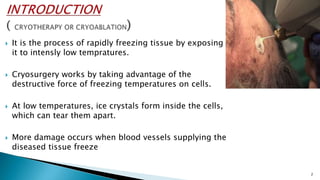
Cryosurgery, also known as cryotherapy, involves using intensely cold temperatures to destroy diseased or damaged tissue. It works by forming ice crystals inside cells when exposed to freezing temperatures, which can tear the cells apart. More damage occurs when blood vessels supplying the diseased tissue freeze as well. Liquid nitrogen is commonly used to rapidly freeze the tissue through direct application with probes, sprays, or swabs. The freezing damages cells through several mechanisms including ice crystal formation, thermal shock, electrolyte disruption, and enzyme inhibition. Precise control of factors like temperature, cooling and thawing rates, freeze duration, and repetitive cycles is important for effective treatment.