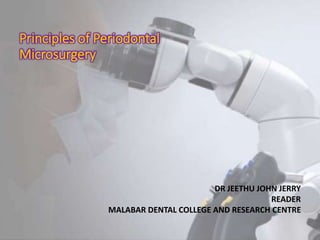
Principles of Periodontal
Microsurgery
DR JEETHU JOHN JERRY
READER
MALABAR DENTAL COLLEGE AND RESEARCH CENTRE
Contents
• Introduction
• Definitions
• Micro surgical triad
• Principles of periodontal microsurgery
• Improving motor skills
• passive wound closure with exact primary opposition
• microsurgical instrumentation and suturing to reduce tissue trauma
• Conclusion
INTRODUCTION
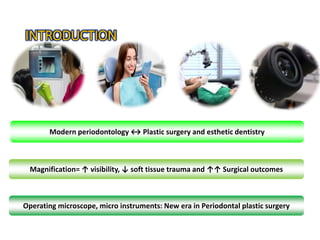
Modern periodontology ↔ Plastic surgery and esthetic dentistry
Magnification= ↑ visibility, ↓ soft tissue trauma and ↑↑ Surgical outcomes
Operating microscope, micro instruments: New era in Periodontal plastic surgery
Definition
• Daniel (1979): A surgery performed under magnification by the microscope
• Stefan (1980): Described that it’s a methodology wherein modification and
refinement of existing surgical techniques is done using magnification to
improve visualization, with applications to all facilities
• Tibbetti (1998): Periodontal microsurgery is the refinement of basic surgical
techniques made possible by improvement in visual acuity gained by the
use of surgical microscope
Illumination
InstrumentsMagnification
Microsurgical Triad
Illumination
• Natural light and Operative chair light act as source of light for simple and
compound loupes
• Need for additional light at magnification levels of 4.0X or greater
• Loupes with large fields of view have brighter illumination and brighter
images than those with narrow fields of view
• Brightness and illumination can also be improved by increasing the working
distance
• Microscopes come with inbuilt excellent coaxial fiber optic illumination
Magnification
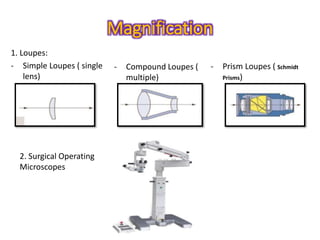
1. Loupes:
- Simple Loupes ( single
lens)
- Compound Loupes (
multiple)
- Prism Loupes ( Schmidt
Prisms)
2. Surgical Operating
Microscopes
Instruments
Microsurgical
Scissors
Microsurgical
Sutures
Microsurgical
Needles
Microsurgical
Needle Holders
Microsurgical
Knives
Principles
1. Improving motor skills, thereby enhancing surgical ability
2. An emphasis on passive wound closure with exact primary opposition
of the wound edge
3. The application of microsurgical instrumentation and suturing to
reduce tissue trauma
1. Improving motor skills, thereby enhancing surgical ability:
• Physiologic tremor is the uncontrolled movement arising from both the
intended and unintended actions
• Awareness of its effect is magnified by visual enhancement
• To minimize tremors, a micro surgeon must have a relaxed state of mind,
comfortable posture, well- supported arms, and a stable instrument-
holding position
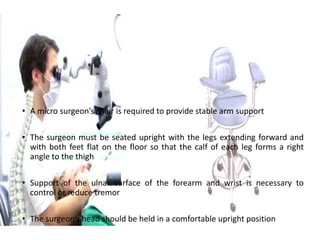
• A micro surgeon’s chair is required to provide stable arm support
• The surgeon must be seated upright with the legs extending forward and
with both feet flat on the floor so that the calf of each leg forms a right
angle to the thigh
• Support of the ulnar surface of the forearm and wrist is necessary to
control or reduce tremor
• The surgeon’s head should be held in a comfortable upright position
• Patient and chair position must be adjusted to optimum position for
functioning of both the surgeon and the microscope
• The micro surgeon's hand should either directly or indirectly rest on an
immovable surface while only the fingertips move, otherwise unwanted
movements will occur
• All movements should be efficient, and should be made with a unity of
effort toward purposeful, deliberate motions
Hand Grips:
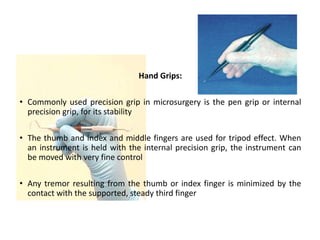
• Commonly used precision grip in microsurgery is the pen grip or internal
precision grip, for its stability
• The thumb and index and middle fingers are used for tripod effect. When
an instrument is held with the internal precision grip, the instrument can
be moved with very fine control
• Any tremor resulting from the thumb or index finger is minimized by the
contact with the supported, steady third finger
Hand Grips:
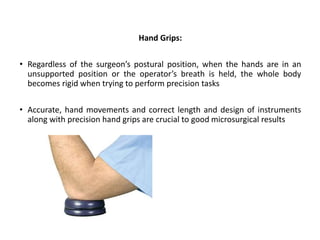
• Regardless of the surgeon’s postural position, when the hands are in an
unsupported position or the operator’s breath is held, the whole body
becomes rigid when trying to perform precision tasks
• Accurate, hand movements and correct length and design of instruments
along with precision hand grips are crucial to good microsurgical results
2. Emphasis on passive wound closure with exact primary opposition of the
wound edge:
Here the desired result is exact primary apposition of the wound edge. Ideally the
incisions should be almost indiscernible and closed with precisely placed small
sutures with minimal tissue damage and least bleeding
With all the surgical subspecialties, suture materials and techniques have evolved
to the point that sutures are designed and developed for specific procedures
With magnification a surgeon is able to scrutinize discrepancies that occur
with microsurgery and embrace a more efficient approach to wound closure
Most periodontal surgeries are sutured with 4- 0 suture and 3/8th circle
reverse cutting needle while most periodontal microsurgical suturing is done
with sutures ranging in size from 6-0 to 9-0
The microsurgical approach is dependent on careful atraumatic entry
incisions and dissection to allow passive wound closure
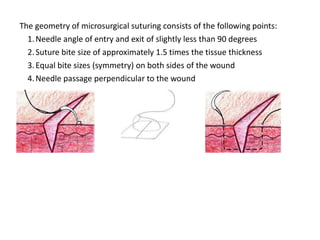
The geometry of microsurgical suturing consists of the following points:
1.Needle angle of entry and exit of slightly less than 90 degrees
2.Suture bite size of approximately 1.5 times the tissue thickness
3.Equal bite sizes (symmetry) on both sides of the wound
4.Needle passage perpendicular to the wound
Cooptation of the wound using the above geometric standards prevents
either incomplete wound closure or overlapping of the wound
The results of geometric, perpendicular suturing are uncomplicated wound
closure, as compared to when sutures pass across an incision line at an
oblique or acute angle, resulting in dead spaces or microgaps with longer
post- operative healing
3. The application of microsurgical instrumentation and suturing to reduce
tissue trauma
It is a known factor that the incision and suturing instruments that are
developed for the field of medicine subsequently make their way into
dentistry
To utilize microsurgical principles requires knowledge of the tissue healing
characteristics and biologic characteristics of various suture materials being
used
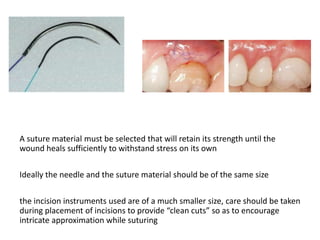
A suture material must be selected that will retain its strength until the
wound heals sufficiently to withstand stress on its own
Ideally the needle and the suture material should be of the same size
the incision instruments used are of a much smaller size, care should be taken
during placement of incisions to provide “clean cuts” so as to encourage
intricate approximation while suturing
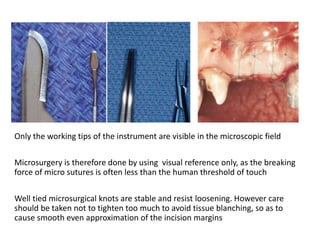
Only the working tips of the instrument are visible in the microscopic field
Microsurgery is therefore done by using visual reference only, as the breaking
force of micro sutures is often less than the human threshold of touch
Well tied microsurgical knots are stable and resist loosening. However care
should be taken not to tighten too much to avoid tissue blanching, so as to
cause smooth even approximation of the incision margins
Conclusion
Periodontal microsurgery has several applications and benefits. Its applications and benefits
will likely make it a treatment standard in the years to come. It is technique sensitive and more
precision demanding than periodontal conventional surgeries, but results in more rapid healing
and is more comfortable to the patient as it is less invasive and less traumatic. These
procedures will provide a natural evolution in the future of the field of periodontology.
References
• Tibbetts, L.S. and Shanelec, D., 1998. Periodontal microsurgery. Dental Clinics of North
America, 42(2), pp.339-359.
• Shanelec, D.A., 1992. Optical principles of loupes. Journal of the California Dental
Association, 20(11), pp.25-32.
• Shanelec, D.A. and Tibbetts, L.S., 1996. A perspective on the future of periodontal
microsurgery. Periodontology 2000, 11(1), pp.58-64.
• Sullivan, H.C., 1968. Free autogenous gingival grafts. I. Principles of successfull
grafting. Periodontics, 6, pp.121-129.
• Sullivan, H.C. and Atkins, J.H., 1968. Free autogenous gingival grafts. 3. Utilization of grafts
in the treatment of gingival recession. Periodontics, 6(4), pp.152-160.
• Shanelec, D., 2004. Principles of periodontal plastic surgery. Rose L, Mealey B, Genco R,
Cohen D (eds). Periodontics: Medicine, Surgery, and Implants. St Louis: Mosby.
• Daniel, R.K., 1979. Microsurgery: through the looking glass. New England Journal of
Medicine, 300(22), pp.1251-1257.
Microsurgery

Microsurgery

  • 1.
    Principles of Periodontal Microsurgery DRJEETHU JOHN JERRY READER MALABAR DENTAL COLLEGE AND RESEARCH CENTRE
  • 2.
    Contents • Introduction • Definitions •Micro surgical triad • Principles of periodontal microsurgery • Improving motor skills • passive wound closure with exact primary opposition • microsurgical instrumentation and suturing to reduce tissue trauma • Conclusion
  • 3.
    INTRODUCTION Modern periodontology ↔Plastic surgery and esthetic dentistry Magnification= ↑ visibility, ↓ soft tissue trauma and ↑↑ Surgical outcomes Operating microscope, micro instruments: New era in Periodontal plastic surgery
  • 4.
    Definition • Daniel (1979):A surgery performed under magnification by the microscope • Stefan (1980): Described that it’s a methodology wherein modification and refinement of existing surgical techniques is done using magnification to improve visualization, with applications to all facilities • Tibbetti (1998): Periodontal microsurgery is the refinement of basic surgical techniques made possible by improvement in visual acuity gained by the use of surgical microscope
  • 5.
  • 6.
    Illumination • Natural lightand Operative chair light act as source of light for simple and compound loupes • Need for additional light at magnification levels of 4.0X or greater • Loupes with large fields of view have brighter illumination and brighter images than those with narrow fields of view • Brightness and illumination can also be improved by increasing the working distance • Microscopes come with inbuilt excellent coaxial fiber optic illumination
  • 7.
    Magnification 1. Loupes: - SimpleLoupes ( single lens) - Compound Loupes ( multiple) - Prism Loupes ( Schmidt Prisms) 2. Surgical Operating Microscopes
  • 8.
  • 9.
    Principles 1. Improving motorskills, thereby enhancing surgical ability 2. An emphasis on passive wound closure with exact primary opposition of the wound edge 3. The application of microsurgical instrumentation and suturing to reduce tissue trauma
  • 10.
    1. Improving motorskills, thereby enhancing surgical ability: • Physiologic tremor is the uncontrolled movement arising from both the intended and unintended actions • Awareness of its effect is magnified by visual enhancement • To minimize tremors, a micro surgeon must have a relaxed state of mind, comfortable posture, well- supported arms, and a stable instrument- holding position
  • 11.
    • A microsurgeon’s chair is required to provide stable arm support • The surgeon must be seated upright with the legs extending forward and with both feet flat on the floor so that the calf of each leg forms a right angle to the thigh • Support of the ulnar surface of the forearm and wrist is necessary to control or reduce tremor • The surgeon’s head should be held in a comfortable upright position
  • 12.
    • Patient andchair position must be adjusted to optimum position for functioning of both the surgeon and the microscope • The micro surgeon's hand should either directly or indirectly rest on an immovable surface while only the fingertips move, otherwise unwanted movements will occur • All movements should be efficient, and should be made with a unity of effort toward purposeful, deliberate motions
  • 13.
    Hand Grips: • Commonlyused precision grip in microsurgery is the pen grip or internal precision grip, for its stability • The thumb and index and middle fingers are used for tripod effect. When an instrument is held with the internal precision grip, the instrument can be moved with very fine control • Any tremor resulting from the thumb or index finger is minimized by the contact with the supported, steady third finger
  • 14.
    Hand Grips: • Regardlessof the surgeon’s postural position, when the hands are in an unsupported position or the operator’s breath is held, the whole body becomes rigid when trying to perform precision tasks • Accurate, hand movements and correct length and design of instruments along with precision hand grips are crucial to good microsurgical results
  • 15.
    2. Emphasis onpassive wound closure with exact primary opposition of the wound edge: Here the desired result is exact primary apposition of the wound edge. Ideally the incisions should be almost indiscernible and closed with precisely placed small sutures with minimal tissue damage and least bleeding With all the surgical subspecialties, suture materials and techniques have evolved to the point that sutures are designed and developed for specific procedures
  • 16.
    With magnification asurgeon is able to scrutinize discrepancies that occur with microsurgery and embrace a more efficient approach to wound closure Most periodontal surgeries are sutured with 4- 0 suture and 3/8th circle reverse cutting needle while most periodontal microsurgical suturing is done with sutures ranging in size from 6-0 to 9-0 The microsurgical approach is dependent on careful atraumatic entry incisions and dissection to allow passive wound closure
  • 17.
    The geometry ofmicrosurgical suturing consists of the following points: 1.Needle angle of entry and exit of slightly less than 90 degrees 2.Suture bite size of approximately 1.5 times the tissue thickness 3.Equal bite sizes (symmetry) on both sides of the wound 4.Needle passage perpendicular to the wound
  • 18.
    Cooptation of thewound using the above geometric standards prevents either incomplete wound closure or overlapping of the wound The results of geometric, perpendicular suturing are uncomplicated wound closure, as compared to when sutures pass across an incision line at an oblique or acute angle, resulting in dead spaces or microgaps with longer post- operative healing
  • 19.
    3. The applicationof microsurgical instrumentation and suturing to reduce tissue trauma It is a known factor that the incision and suturing instruments that are developed for the field of medicine subsequently make their way into dentistry To utilize microsurgical principles requires knowledge of the tissue healing characteristics and biologic characteristics of various suture materials being used
  • 20.
    A suture materialmust be selected that will retain its strength until the wound heals sufficiently to withstand stress on its own Ideally the needle and the suture material should be of the same size the incision instruments used are of a much smaller size, care should be taken during placement of incisions to provide “clean cuts” so as to encourage intricate approximation while suturing
  • 21.
    Only the workingtips of the instrument are visible in the microscopic field Microsurgery is therefore done by using visual reference only, as the breaking force of micro sutures is often less than the human threshold of touch Well tied microsurgical knots are stable and resist loosening. However care should be taken not to tighten too much to avoid tissue blanching, so as to cause smooth even approximation of the incision margins
  • 22.
    Conclusion Periodontal microsurgery hasseveral applications and benefits. Its applications and benefits will likely make it a treatment standard in the years to come. It is technique sensitive and more precision demanding than periodontal conventional surgeries, but results in more rapid healing and is more comfortable to the patient as it is less invasive and less traumatic. These procedures will provide a natural evolution in the future of the field of periodontology.
  • 23.
    References • Tibbetts, L.S.and Shanelec, D., 1998. Periodontal microsurgery. Dental Clinics of North America, 42(2), pp.339-359. • Shanelec, D.A., 1992. Optical principles of loupes. Journal of the California Dental Association, 20(11), pp.25-32. • Shanelec, D.A. and Tibbetts, L.S., 1996. A perspective on the future of periodontal microsurgery. Periodontology 2000, 11(1), pp.58-64. • Sullivan, H.C., 1968. Free autogenous gingival grafts. I. Principles of successfull grafting. Periodontics, 6, pp.121-129. • Sullivan, H.C. and Atkins, J.H., 1968. Free autogenous gingival grafts. 3. Utilization of grafts in the treatment of gingival recession. Periodontics, 6(4), pp.152-160. • Shanelec, D., 2004. Principles of periodontal plastic surgery. Rose L, Mealey B, Genco R, Cohen D (eds). Periodontics: Medicine, Surgery, and Implants. St Louis: Mosby. • Daniel, R.K., 1979. Microsurgery: through the looking glass. New England Journal of Medicine, 300(22), pp.1251-1257.

Editor's Notes

  • #4 There has been tremendous advancement : patient’s expectations : much desired therapeutic goals. Microsurgery is an advanced surgical technique in which the normal vision is enhanced through magnification. Modern periodontology is closely linked to both plastic surgery and esthetic dentistry. Periodontal microsurgery incorporates the use of a surgical magnification in an attempt to increase visibility, thereby minimizing soft tissue trauma and enhance surgical results.
  • #6 The philosophy be summed up triangle Working under proper illumination and magnification leads to improved efficiency translating to improved surgical skills
  • #8 Schmidt/ Rooftop
  • #9 8-0 nylon, 7-0 propylene, 6-0 polypropylene, 4-0 vicryl
  • #10 As a treatment philosophy, micro-surgery incorporates three important principles: