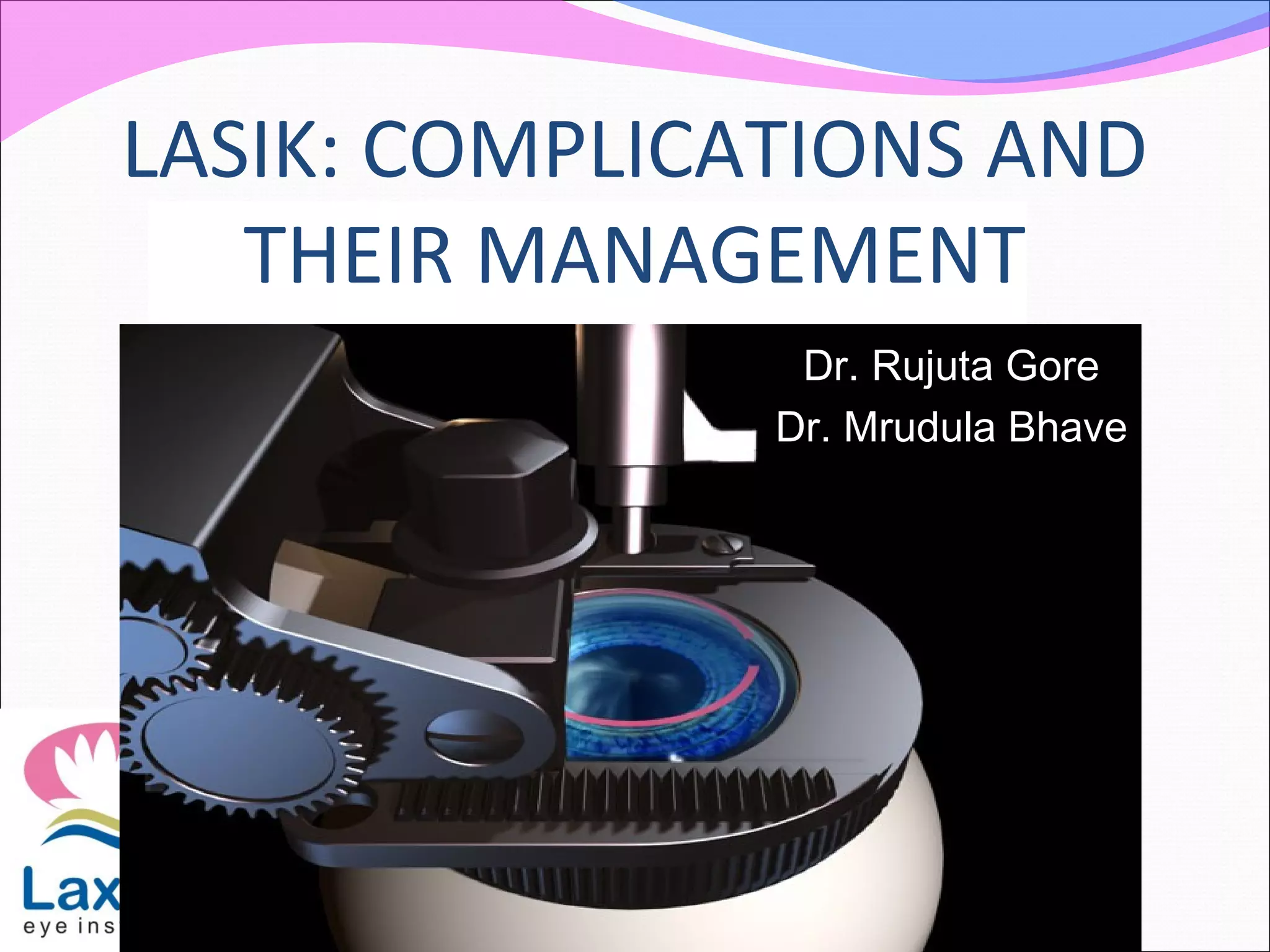
LASIK: COMPLICATIONS AND
THEIR MANAGEMENT
Dr. Rujuta GoreDr. Rujuta Gore
Dr. Mrudula BhaveDr. Mrudula Bhave
LASIK: Possible complications
Intraoperative
Microkeratome related
Flap related
Early postoperative
Late postoperative
Refractive complications
Intraoperative complications
Inadequate exposure
Inadequate suction
Incomplete Cut
A lamellar cut that does not reach the limit scheduled by
the operating program
Causes:
Loss of suction
Block of keratome by drape or dust in its gears
Power failure
Prevention:
Precise preoperative check of the instrumentation
Adequate exposure
Continuous power supply
Mx Incomplete Cut
Unexpected stop- reverse the run direction, remove the
suction ring
Complete block- suspend the suction, gently remove
microkeratome and suction ring in a direction away from
hinge
Sufficient room for refractive ablation- proceed
If insufficient- replace the flap; postpone by 3-6 months
Thin/ Perforated cut (buttonhole)
Mechanical Causes:
Inadequate suction
Incorrect ring size
Poor blade quality
Excessively dry cornea
Loose epithelium
Edematous epithelium
Anatomical causes:
Very steep corneas
Irregular astigmatism
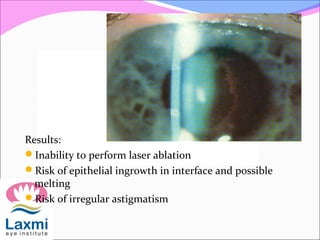
Results:
Inability to perform laser ablation
Risk of epithelial ingrowth in interface and possible
melting
Risk of irregular astigmatism
Mx Thin Cut
Prevention:
Avoid excessive use of anaesthetic eyedrops that may weaken
the epithelium
Change the blade after every cut
If flap can be raised, ablation can be performed, paying
attention to alignment, avoiding folds while repositioning
Mx Thin Cut
Management:
Minimal manipulation
Replace the thin flap or buttonholed flap while carefully
managing the epithelial edge
Inspect the flap and verify adherence
Wash the interface carefully
Therapeutic contact lens
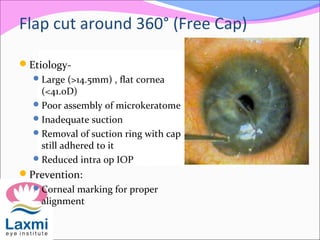
Flap cut around 360° (Free Cap)
Etiology-
Large (>14.5mm) , flat cornea
(<41.0D)
Poor assembly of microkeratome
Inadequate suction
Removal of suction ring with cap
still adhered to it
Reduced intra op IOP
Prevention:
Corneal marking for proper
alignment
Mx Free Cap
Keep the flap in antidessication chamber, epithelial side
down
Proceed with ablation
Stromal surface should not be hydrated
Align flap with preop markings
Sutures not required
OR Flap may be discarded; apply a contact lens to aid
epithelial regrowth
Early Postoperative
Complications
Flap related complications
Causes:
Excessive dehydration due to prolonged surgical time
Manipulation with forceps, swabs and other instruments
not suitable for LASIK
Prevention:
Alleviate anxiety
Flap must not be allowed to dry
Time between lifting and reposition minimum
Avoid excessive interface irrigation
Speculum removal-gentle
Protect the hinge when OZ is large
Flap Complications
Displacement of flap
Wrinkled flap (micro and macrostriations)
Interface debris
Flap edema
Flap shrinkage
Flap stretching
Decentration
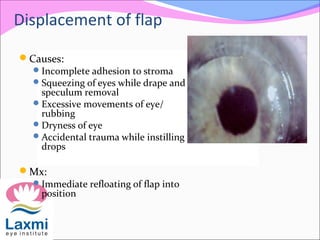
Displacement of flap
Causes:
Incomplete adhesion to stroma
Squeezing of eyes while drape and
speculum removal
Excessive movements of eye/
rubbing
Dryness of eye
Accidental trauma while instilling
drops
Mx:
Immediate refloating of flap into
position
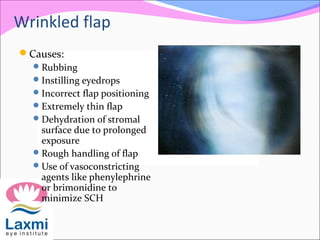
Wrinkled flap
Causes:
Rubbing
Instilling eyedrops
Incorrect flap positioning
Extremely thin flap
Dehydration of stromal
surface due to prolonged
exposure
Rough handling of flap
Use of vasoconstricting
agents like phenylephrine
or brimonidine to
minimize SCH
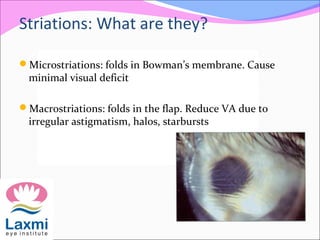
Striations: What are they?
Microstriations: folds in Bowman’s membrane. Cause
minimal visual deficit
Macrostriations: folds in the flap. Reduce VA due to
irregular astigmatism, halos, starbursts
Mx Striations
Micro- can be observed
Macro- Flap should be lifted again, interface should be
washed and flap replaced
Flap should be smoothed with a Merocel soaked in BSS,
perpendicular to orientation of striations
Contact lens may be applied
Striations: consequences and Mx
Striae become permanent as epithelium fills the spaces in
the folds
Mx
Soak the epithelial surface by instilling distilled water. This
creates edema and loosens the cells for removal
Remove the epithelium with a spatula
Then raise the flap and irrigate the interface with BSS, and
distilled water
Reposition
Apply contact lens
Persistent striations
May apply continuous 10-0 Nylon suture to mechanically
smoothen the flap
PTK to remove epithelium between striae
PTK (10μm) on stromal surface of flap
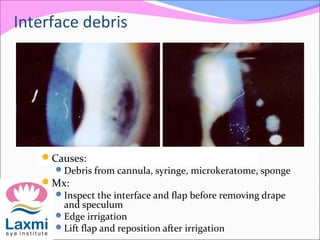
Interface debris
Causes:
Debris from cannula, syringe, microkeratome, sponge
Mx:
Inspect the interface and flap before removing drape
and speculum
Edge irrigation
Lift flap and reposition after irrigation
Microbial Keratitis
Rare but potentially devastating complication
Incidence: 1:5000(0.02% to 1%)
Common organisms:
Staph aureus (early onset infections)
Mycobacterium chelonae (late onset infections)
Candida, Fusarium (later onset)
Predisposing factors:
Poor steririlization
Poor compliance to postop instructions
Poor hygiene
Symptoms:
Increased light sensitivity
Pain
Redness
Foreign body sensation
Decreased vision
Microbial Keratitis
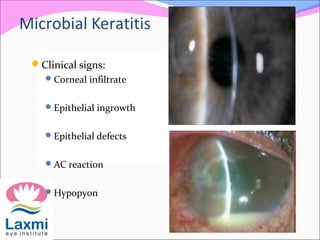
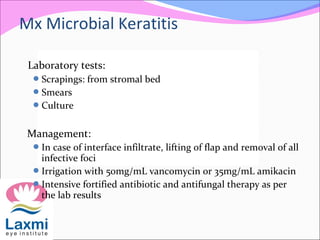
Clinical signs:
Corneal infiltrate
Epithelial ingrowth
Epithelial defects
AC reaction
Hypopyon
Microbial Keratitis
Laboratory tests:
Scrapings: from stromal bed
Smears
Culture
Management:
In case of interface infiltrate, lifting of flap and removal of all
infective foci
Irrigation with 50mg/mL vancomycin or 35mg/mL amikacin
Intensive fortified antibiotic and antifungal therapy as per
the lab results
Mx Microbial Keratitis
In cases of resistant bacterial infection, flap removal and
intensive medical therapy has been found useful
In cases of resistant fungal infection, an aggressive
approach consisting of amputation of the flap, daily
debridemant of the bed, intensive topical and systemic
antifungals may be required
Eyes not responding to medical therapy and those
presenting late with large infiltrates may need ALK or TPK
Mx Microbial Keratitis
Prevention:
Treatment of blepharitis preoperatively
Sterile technique
Careful clearing of all cannulas and syringes using fresh
sterile distilled water
Prophylactic postop topical antibiotic
Avoid swimming for 1month postoperatively
Microbial Keratitis
Diffuse lamellar keratitis
Also known as ‘Sand of Sahara’
Non infectious complication
Infiltration of inflammatory cells in interface
Possible causes:
 Retained meibomian secretions
 Metallic debris
 Talc from gloves
 Lubricants on the microkeratome or blades
 Topical medications such as anesthetics
 Endotoxins
 IL 1 released from corneal epithelial cells following cell
injury or death
Linebarger staging of DLK
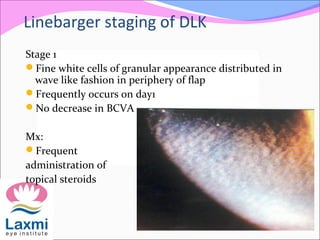
Stage 1
Fine white cells of granular appearance distributed in
wave like fashion in periphery of flap
Frequently occurs on day1
No decrease in BCVA
Mx:
Frequent
administration of
topical steroids
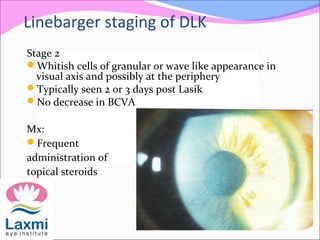
Stage 2
Whitish cells of granular or wave like appearance in
visual axis and possibly at the periphery
Typically seen 2 or 3 days post Lasik
No decrease in BCVA
Mx:
Frequent
administration of
topical steroids
Linebarger staging of DLK
Stage 3
Increased density of cells in visual axis, more clumped
than wave like
Transparent peripheral cornea
Seen on day 3 0r 4
Patient may describe fogginess of vision
Linebarger staging of DLK
Mx:
Raise the flap and
thoroughly irrigate
with BSS
Frequent
administration of
topical steroids
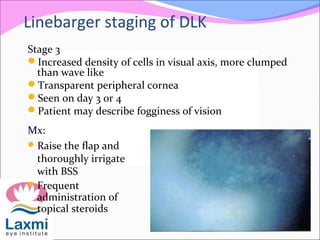
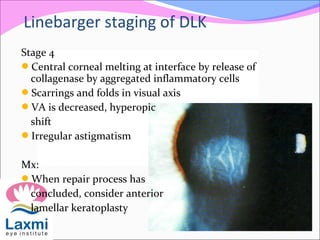
Stage 4
Central corneal melting at interface by release of
collagenase by aggregated inflammatory cells
Scarrings and folds in visual axis
VA is decreased, hyperopic
shift
Irregular astigmatism
Mx:
When repair process has
concluded, consider anterior
lamellar keratoplasty
Linebarger staging of DLK
Late Postoperative
Complications
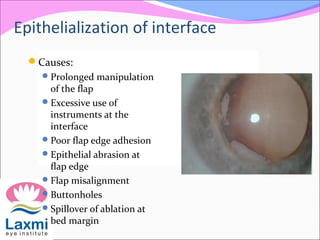
Epithelialization of interface
Causes:
Prolonged manipulation
of the flap
Excessive use of
instruments at the
interface
Poor flap edge adhesion
Epithelial abrasion at
flap edge
Flap misalignment
Buttonholes
Spillover of ablation at
bed margin
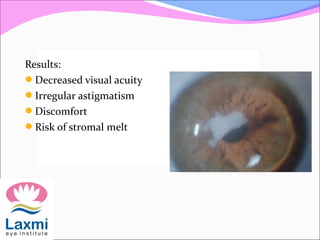
Results:
Decreased visual acuity
Irregular astigmatism
Discomfort
Risk of stromal melt
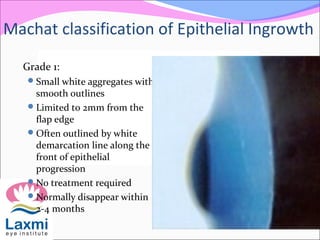
Machat classification of Epithelial Ingrowth
Grade 1:
Small white aggregates with
smooth outlines
Limited to 2mm from the
flap edge
Often outlined by white
demarcation line along the
front of epithelial
progression
No treatment required
Normally disappear within
2-4 months
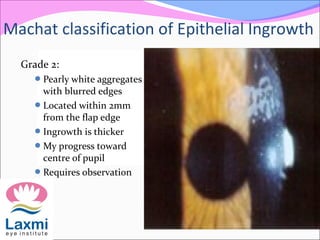
Grade 2:
Pearly white aggregates
with blurred edges
Located within 2mm
from the flap edge
Ingrowth is thicker
My progress toward
centre of pupil
Requires observation
Machat classification of Epithelial Ingrowth
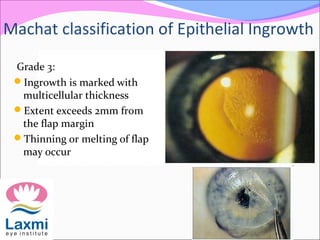
Grade 3:
Ingrowth is marked with
multicellular thickness
Extent exceeds 2mm from
the flap margin
Thinning or melting of flap
may occur
Machat classification of Epithelial Ingrowth
Prevention:
Avoid prolonged manipulation of flap
Clear any epithelium, tags, or debris from stromal bed
prior to flap reposition
Shield hinge area
Apply contact lens when epithelial defects are observed
Femtosecond laser flap is better
Mx
For peripheral few aggregates: NdYAG laser
30-40 pulses; 0.6-1.2mJ; beam focussed slightly
posteriorly with respect to the epithelial growth
Sufficient for blocking progression
Mx
For extensive aggregates:
Raise the flap closest to epithelial growth
Debride the stromal surface and undersurface of flap edges
with microspatula
In severe ingrowth with melting and folds it is better to
remove the flap and allow healing
Refractive Complications
Irregular astigmatism
Causes:
Wrinkles or folds in flap
Interface debris
Epithelial ingrowth
Decentration
Results:
VA decreased by 2 or more lines
Mx:
Retreatment is directed to underlying cause
Undercorrection
There is residual, unexpected refractive error in first
postoperative month
More frequent in high myopia above 10 to 12D
It is easier to correct residual myopia than to correct
hyperopia from overcorrection
Causes of undercorrection:
Incorrect preoperative refraction (most common)
Difficulty in performing precise refractive
evaluation(severe myopia with staphyloma)
Incorrect laser calibration
Environmental condition in OT
Incorrect data entry
Incomplete or decentered ablation
Incorrect interpretation of nomogram
Unstable ametropia
Undercorrection
Mx:
 Retreatment should be considered 2 to 3 months
later, after refractive stability
 Preferably under aberrometric guidance
Options:
 Lifting the flap and reablation
 Usually performed within 3 to 4mths of first treatment
 Lamellar technique or recutting a new flap(for
myopia greater than 10D)
 Performed atleast 6months after initial treatment
 May not be possible due to already thinned cornea
 Surface ablation technique(PRK)
Overcorrection
1 month after surgery ,there is refractive correction
that exceeds the expected value
Causes:
Incorrect preoperative refraction
Incorrect data entry
Poor control of humidity levels in laser room(too
dry)
Mx:
 Lifting the flap and reablation
 It is possible to repeat the treatment for hyperopic
values in 2 to 3months
 Paraperipheral ablation of anterior stromal bed is
done
 Hyperopic surface photoablation
 Hyperopia of 1 to 3D can be corrected
 Conductive keratoplasty
Regression
Indicates that the refractive result of Lasik is not
stable with continuing loss of effect over a few
months
Normally stops between 1 and 3 mths after surgery
More frequent in myopia >10D
Frequently seen in severe hyperopia and astigmatism
Causes:
May be due to combination of epithelial hyperplasia
and remodeling of stroma
Management:
Treatment options as for undercorrection
Enhancement procedures to be considered only after
refraction is stable
Regression
Corneal Ectasia
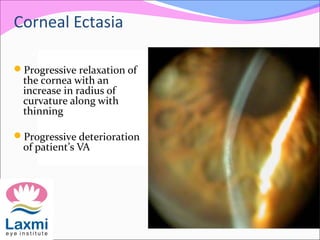
Progressive relaxation of
the cornea with an
increase in radius of
curvature along with
thinning
Progressive deterioration
of patient’s VA
Pathophysiology:
Collagen fibres in anterior third of cornea have greater
tensile strength
In LASIK, cut is performed in the anterior third
Corneal weakening by 0-33%
Ectasia: delamination and interfibril fracture
Corneal Ectasia
Risk factors-
Keratoconus
Pellucid marginal degeneration
Forme fruste keratoconus
Residual stromal bed less than 250μm in diseased corneas
Refractive instability and family history of keratoconus
should arouse suspicion
Corneal Ectasia
Results:
Thinning and bulging of cornea
Myopic shift
Irregular astigmatism
Reduced UCVA and BCVA
Corneal Ectasia
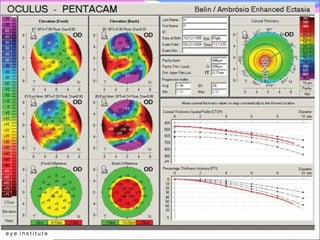
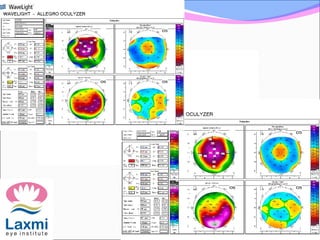
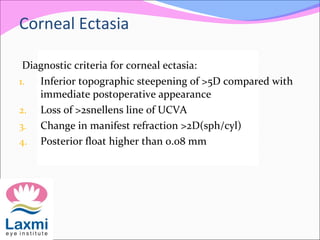
Diagnostic criteria for corneal ectasia:
1. Inferior topographic steepening of >5D compared with
immediate postoperative appearance
2. Loss of >2snellens line of UCVA
3. Change in manifest refraction >2D(sph/cyl)
4. Posterior float higher than 0.08 mm
Corneal Ectasia
Prevention:
Alternative approach- PRK/ Phakic IOL
Preoperative:
Topography:
In asymmetric cornea –test should be repeated several times
CL wearers should stop using CL 2-3wks before topography
Rule out keratoconus
Pachymetry:
Most important to plan ablation
Corneal Ectasia
Intraoperative:
Measure flap thickness and posterior stroma during
surgery, both before and after the ablation
Corneal Ectasia
Mx:
Collagen crosslinking
RGP contact lens
Intrastromal rings
Lamellar keratoplasty
Penetrating keratoplasty
Corneal Ectasia
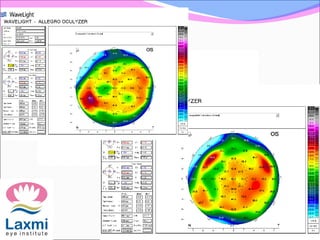
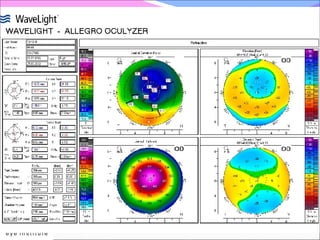
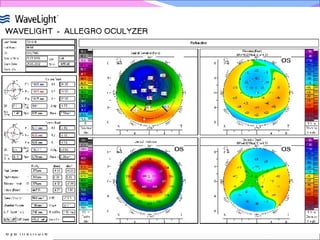
Decentered Ablation
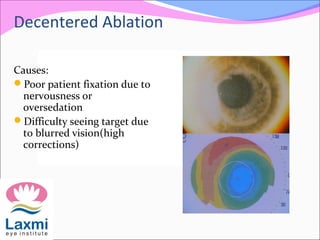
Causes:
Poor patient fixation due to
nervousness or
oversedation
Difficulty seeing target due
to blurred vision(high
corrections)
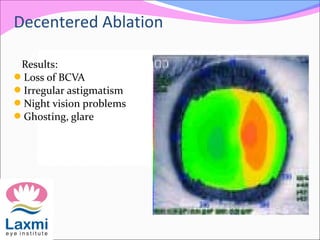
Results:
Loss of BCVA
Irregular astigmatism
Night vision problems
Ghosting, glare
Decentered Ablation
Treatment:
For mild degrees of decentration, a small diameter
ablation may be performed at the edge of the original
optical zone to enlarge the optical zone in pupillary axis
A series of 3 small diameter ablations may be placed at the
edge of decentered ablation followed by PTK smoothing
Decentered Ablation
LASIK: COMPLICATIONS AND THEIR MANAGEMENT

LASIK: COMPLICATIONS AND THEIR MANAGEMENT

  • 1.
    LASIK: COMPLICATIONS AND THEIRMANAGEMENT Dr. Rujuta GoreDr. Rujuta Gore Dr. Mrudula BhaveDr. Mrudula Bhave
  • 2.
    LASIK: Possible complications Intraoperative Microkeratomerelated Flap related Early postoperative Late postoperative Refractive complications
  • 3.
  • 4.
    Incomplete Cut A lamellarcut that does not reach the limit scheduled by the operating program Causes: Loss of suction Block of keratome by drape or dust in its gears Power failure Prevention: Precise preoperative check of the instrumentation Adequate exposure Continuous power supply
  • 5.
    Mx Incomplete Cut Unexpectedstop- reverse the run direction, remove the suction ring Complete block- suspend the suction, gently remove microkeratome and suction ring in a direction away from hinge Sufficient room for refractive ablation- proceed If insufficient- replace the flap; postpone by 3-6 months
  • 6.
    Thin/ Perforated cut(buttonhole) Mechanical Causes: Inadequate suction Incorrect ring size Poor blade quality Excessively dry cornea Loose epithelium Edematous epithelium Anatomical causes: Very steep corneas Irregular astigmatism
  • 7.
    Results: Inability to performlaser ablation Risk of epithelial ingrowth in interface and possible melting Risk of irregular astigmatism
  • 8.
    Mx Thin Cut Prevention: Avoidexcessive use of anaesthetic eyedrops that may weaken the epithelium Change the blade after every cut If flap can be raised, ablation can be performed, paying attention to alignment, avoiding folds while repositioning
  • 9.
    Mx Thin Cut Management: Minimalmanipulation Replace the thin flap or buttonholed flap while carefully managing the epithelial edge Inspect the flap and verify adherence Wash the interface carefully Therapeutic contact lens
  • 10.
    Flap cut around360° (Free Cap) Etiology- Large (>14.5mm) , flat cornea (<41.0D) Poor assembly of microkeratome Inadequate suction Removal of suction ring with cap still adhered to it Reduced intra op IOP Prevention: Corneal marking for proper alignment
  • 11.
    Mx Free Cap Keepthe flap in antidessication chamber, epithelial side down Proceed with ablation Stromal surface should not be hydrated Align flap with preop markings Sutures not required OR Flap may be discarded; apply a contact lens to aid epithelial regrowth
  • 13.
  • 14.
    Flap related complications Causes: Excessivedehydration due to prolonged surgical time Manipulation with forceps, swabs and other instruments not suitable for LASIK Prevention: Alleviate anxiety Flap must not be allowed to dry Time between lifting and reposition minimum Avoid excessive interface irrigation Speculum removal-gentle Protect the hinge when OZ is large
  • 15.
    Flap Complications Displacement offlap Wrinkled flap (micro and macrostriations) Interface debris Flap edema Flap shrinkage Flap stretching Decentration
  • 16.
    Displacement of flap Causes: Incompleteadhesion to stroma Squeezing of eyes while drape and speculum removal Excessive movements of eye/ rubbing Dryness of eye Accidental trauma while instilling drops Mx: Immediate refloating of flap into position
  • 17.
    Wrinkled flap Causes: Rubbing Instilling eyedrops Incorrectflap positioning Extremely thin flap Dehydration of stromal surface due to prolonged exposure Rough handling of flap Use of vasoconstricting agents like phenylephrine or brimonidine to minimize SCH
  • 18.
    Striations: What arethey? Microstriations: folds in Bowman’s membrane. Cause minimal visual deficit Macrostriations: folds in the flap. Reduce VA due to irregular astigmatism, halos, starbursts
  • 19.
    Mx Striations Micro- canbe observed Macro- Flap should be lifted again, interface should be washed and flap replaced Flap should be smoothed with a Merocel soaked in BSS, perpendicular to orientation of striations Contact lens may be applied
  • 20.
    Striations: consequences andMx Striae become permanent as epithelium fills the spaces in the folds Mx Soak the epithelial surface by instilling distilled water. This creates edema and loosens the cells for removal Remove the epithelium with a spatula Then raise the flap and irrigate the interface with BSS, and distilled water Reposition Apply contact lens
  • 21.
    Persistent striations May applycontinuous 10-0 Nylon suture to mechanically smoothen the flap PTK to remove epithelium between striae PTK (10μm) on stromal surface of flap
  • 22.
    Interface debris Causes: Debris fromcannula, syringe, microkeratome, sponge Mx: Inspect the interface and flap before removing drape and speculum Edge irrigation Lift flap and reposition after irrigation
  • 23.
    Microbial Keratitis Rare butpotentially devastating complication Incidence: 1:5000(0.02% to 1%) Common organisms: Staph aureus (early onset infections) Mycobacterium chelonae (late onset infections) Candida, Fusarium (later onset) Predisposing factors: Poor steririlization Poor compliance to postop instructions Poor hygiene
  • 24.
    Symptoms: Increased light sensitivity Pain Redness Foreignbody sensation Decreased vision Microbial Keratitis
  • 25.
    Clinical signs: Corneal infiltrate Epithelialingrowth Epithelial defects AC reaction Hypopyon Microbial Keratitis
  • 26.
    Laboratory tests: Scrapings: fromstromal bed Smears Culture Management: In case of interface infiltrate, lifting of flap and removal of all infective foci Irrigation with 50mg/mL vancomycin or 35mg/mL amikacin Intensive fortified antibiotic and antifungal therapy as per the lab results Mx Microbial Keratitis
  • 27.
    In cases ofresistant bacterial infection, flap removal and intensive medical therapy has been found useful In cases of resistant fungal infection, an aggressive approach consisting of amputation of the flap, daily debridemant of the bed, intensive topical and systemic antifungals may be required Eyes not responding to medical therapy and those presenting late with large infiltrates may need ALK or TPK Mx Microbial Keratitis
  • 28.
    Prevention: Treatment of blepharitispreoperatively Sterile technique Careful clearing of all cannulas and syringes using fresh sterile distilled water Prophylactic postop topical antibiotic Avoid swimming for 1month postoperatively Microbial Keratitis
  • 29.
    Diffuse lamellar keratitis Alsoknown as ‘Sand of Sahara’ Non infectious complication Infiltration of inflammatory cells in interface
  • 30.
    Possible causes:  Retainedmeibomian secretions  Metallic debris  Talc from gloves  Lubricants on the microkeratome or blades  Topical medications such as anesthetics  Endotoxins  IL 1 released from corneal epithelial cells following cell injury or death
  • 31.
    Linebarger staging ofDLK Stage 1 Fine white cells of granular appearance distributed in wave like fashion in periphery of flap Frequently occurs on day1 No decrease in BCVA Mx: Frequent administration of topical steroids
  • 32.
    Stage 2 Whitish cellsof granular or wave like appearance in visual axis and possibly at the periphery Typically seen 2 or 3 days post Lasik No decrease in BCVA Mx: Frequent administration of topical steroids Linebarger staging of DLK
  • 33.
    Stage 3 Increased densityof cells in visual axis, more clumped than wave like Transparent peripheral cornea Seen on day 3 0r 4 Patient may describe fogginess of vision Linebarger staging of DLK Mx: Raise the flap and thoroughly irrigate with BSS Frequent administration of topical steroids
  • 34.
    Stage 4 Central cornealmelting at interface by release of collagenase by aggregated inflammatory cells Scarrings and folds in visual axis VA is decreased, hyperopic shift Irregular astigmatism Mx: When repair process has concluded, consider anterior lamellar keratoplasty Linebarger staging of DLK
  • 35.
  • 36.
    Epithelialization of interface Causes: Prolongedmanipulation of the flap Excessive use of instruments at the interface Poor flap edge adhesion Epithelial abrasion at flap edge Flap misalignment Buttonholes Spillover of ablation at bed margin
  • 37.
    Results: Decreased visual acuity Irregularastigmatism Discomfort Risk of stromal melt
  • 38.
    Machat classification ofEpithelial Ingrowth Grade 1: Small white aggregates with smooth outlines Limited to 2mm from the flap edge Often outlined by white demarcation line along the front of epithelial progression No treatment required Normally disappear within 2-4 months
  • 39.
    Grade 2: Pearly whiteaggregates with blurred edges Located within 2mm from the flap edge Ingrowth is thicker My progress toward centre of pupil Requires observation Machat classification of Epithelial Ingrowth
  • 40.
    Grade 3: Ingrowth ismarked with multicellular thickness Extent exceeds 2mm from the flap margin Thinning or melting of flap may occur Machat classification of Epithelial Ingrowth
  • 41.
    Prevention: Avoid prolonged manipulationof flap Clear any epithelium, tags, or debris from stromal bed prior to flap reposition Shield hinge area Apply contact lens when epithelial defects are observed Femtosecond laser flap is better
  • 42.
    Mx For peripheral fewaggregates: NdYAG laser 30-40 pulses; 0.6-1.2mJ; beam focussed slightly posteriorly with respect to the epithelial growth Sufficient for blocking progression
  • 43.
    Mx For extensive aggregates: Raisethe flap closest to epithelial growth Debride the stromal surface and undersurface of flap edges with microspatula In severe ingrowth with melting and folds it is better to remove the flap and allow healing
  • 45.
  • 46.
    Irregular astigmatism Causes: Wrinkles orfolds in flap Interface debris Epithelial ingrowth Decentration Results: VA decreased by 2 or more lines Mx: Retreatment is directed to underlying cause
  • 47.
    Undercorrection There is residual,unexpected refractive error in first postoperative month More frequent in high myopia above 10 to 12D It is easier to correct residual myopia than to correct hyperopia from overcorrection
  • 48.
    Causes of undercorrection: Incorrectpreoperative refraction (most common) Difficulty in performing precise refractive evaluation(severe myopia with staphyloma) Incorrect laser calibration Environmental condition in OT Incorrect data entry Incomplete or decentered ablation Incorrect interpretation of nomogram Unstable ametropia Undercorrection
  • 49.
    Mx:  Retreatment shouldbe considered 2 to 3 months later, after refractive stability  Preferably under aberrometric guidance Options:  Lifting the flap and reablation  Usually performed within 3 to 4mths of first treatment  Lamellar technique or recutting a new flap(for myopia greater than 10D)  Performed atleast 6months after initial treatment  May not be possible due to already thinned cornea  Surface ablation technique(PRK)
  • 50.
    Overcorrection 1 month aftersurgery ,there is refractive correction that exceeds the expected value Causes: Incorrect preoperative refraction Incorrect data entry Poor control of humidity levels in laser room(too dry)
  • 51.
    Mx:  Lifting theflap and reablation  It is possible to repeat the treatment for hyperopic values in 2 to 3months  Paraperipheral ablation of anterior stromal bed is done  Hyperopic surface photoablation  Hyperopia of 1 to 3D can be corrected  Conductive keratoplasty
  • 52.
    Regression Indicates that therefractive result of Lasik is not stable with continuing loss of effect over a few months Normally stops between 1 and 3 mths after surgery More frequent in myopia >10D Frequently seen in severe hyperopia and astigmatism
  • 53.
    Causes: May be dueto combination of epithelial hyperplasia and remodeling of stroma Management: Treatment options as for undercorrection Enhancement procedures to be considered only after refraction is stable Regression
  • 54.
    Corneal Ectasia Progressive relaxationof the cornea with an increase in radius of curvature along with thinning Progressive deterioration of patient’s VA
  • 55.
    Pathophysiology: Collagen fibres inanterior third of cornea have greater tensile strength In LASIK, cut is performed in the anterior third Corneal weakening by 0-33% Ectasia: delamination and interfibril fracture Corneal Ectasia
  • 56.
    Risk factors- Keratoconus Pellucid marginaldegeneration Forme fruste keratoconus Residual stromal bed less than 250μm in diseased corneas Refractive instability and family history of keratoconus should arouse suspicion Corneal Ectasia
  • 57.
    Results: Thinning and bulgingof cornea Myopic shift Irregular astigmatism Reduced UCVA and BCVA Corneal Ectasia
  • 60.
    Diagnostic criteria forcorneal ectasia: 1. Inferior topographic steepening of >5D compared with immediate postoperative appearance 2. Loss of >2snellens line of UCVA 3. Change in manifest refraction >2D(sph/cyl) 4. Posterior float higher than 0.08 mm Corneal Ectasia
  • 61.
    Prevention: Alternative approach- PRK/Phakic IOL Preoperative: Topography: In asymmetric cornea –test should be repeated several times CL wearers should stop using CL 2-3wks before topography Rule out keratoconus Pachymetry: Most important to plan ablation Corneal Ectasia
  • 62.
    Intraoperative: Measure flap thicknessand posterior stroma during surgery, both before and after the ablation Corneal Ectasia
  • 63.
    Mx: Collagen crosslinking RGP contactlens Intrastromal rings Lamellar keratoplasty Penetrating keratoplasty Corneal Ectasia
  • 64.
    Decentered Ablation Causes: Poor patientfixation due to nervousness or oversedation Difficulty seeing target due to blurred vision(high corrections)
  • 65.
    Results: Loss of BCVA Irregularastigmatism Night vision problems Ghosting, glare Decentered Ablation
  • 68.
    Treatment: For mild degreesof decentration, a small diameter ablation may be performed at the edge of the original optical zone to enlarge the optical zone in pupillary axis A series of 3 small diameter ablations may be placed at the edge of decentered ablation followed by PTK smoothing Decentered Ablation

Editor's Notes

  • #9 Use of good microkeratomes
  • #13 Stuti Shrimali- free flap
  • #21 If not diagnosed early
  • #31 Speculations only, not proven
  • #41 Presence of white area of necrotic epithelial cells without demarcation line. Edges of flap are thickened , white or gray
  • #45 Pradeep Karade- Epi ingrowth
  • #47 Talk about treatment of each cause in brief, as already described
  • #49 E
  • #68 Pt Hemi Sayani RE