INDEX
 INTRODUCTON
 CRYOGENIC FLUIDS
 LIQUIFACTION OF GASES
 APPLICATION
 REFFERENCES
Cryogenic Technology:-
INTRODUCTION :-
Cryogenic is defined as science and technology of temperature bellow 123 k
The reason for temperature limit of 123k that it includes the normal boiling
points of the main atmospheric gases as well as methane.
Cryogenic deals with low temperatures from about 100k to absolute 0.
Cryogenic fluids –
The permanent gases such as oxygen, hydrogen, nitrogen, helium refer to
earlier change from gas to liquid at atmospheric pressure at normal
boiling point such liquids are known as cryogenic fluids or cryogens.
HYDROGEN :-
Hydrogen and helium are special cryogens
Hydrogen has its normal boiling point at 20.27k and it has a
pressure 1 atm. Also critical temperature and pressure are 33.19k
and 13.15 atm. Respectively
Hydrogen has 3 isotopes viz. hydrogen deuterium and tritium
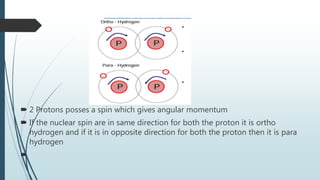
Hydrogen exist in two molecular forms ortho and para
It has 2 protons and 2 electrons
 2 Protons posses a spin which gives angular momentum
 If the nuclear spin are in same direction for both the proton it is ortho
hydrogen and if it is in opposite direction for both the proton then it is para
hydrogen

Helium
 Helium is a inert gas and exist in mono atomic state
 It has got a boiling point of 4.25k
 Critical temperature and critical pressure for helium gas are 5.25k and
2.27bars resp.
 Helium exist in two isotopes helium 4 and 3 as liquid helium is further
cool bellow particular temperature 2.17k a new liquid phase Lhe-II
emerges out.
 The 2 liquids Lhe-I and Lhe-II are obtained.
 They are differentiate on the basis of viscosity
 Lhe-II exhibits property like 0 viscosity and large thermal
conductivity it also has a some effects such as 1)Thermo mechanical
effect 2) Mechano caloric effect 3) fountain effect 4)Rollin effect
Oxygen :-
 The air contained 20% oxygen
 It has boiling temperature at one atmospheric pressure is 90.2k
 Its critical pressure is 5.08 atm.
 Oxygen is slightly magnetic and exist in 3 stable isotopes O16, O17,O18
 Oxygen is magnetic and this property is utilizes to separate something
or to remove the magnetic materials from some area.
 Because of the unique properties of oxygen there is no substituted for
oxygen in any of its uses.
Liquid Nitrogen
 The nitrogen in air is 80%
 Its boiling temperature at atmospheric pressure is 77.4k
 It has a critical temperature and critical pressure are 126k and
33.9atm resp.
 It exist in 2 stable isotopes N14 and N15
 Air as we assume to be composed of nitrogen and oxygen by
fractional distillation of air it will be separated
Liquefaction of gases:-
 SIMPLE LINDE - HAMPSON SYSTEM :-
 Linde hampson cycle consist of compressor , heat exchanger and a J-T
expansion device
 The heat exchanger is use to conserved the cold that is produce at the
end the cold gas which goes back to compressor precools the
incoming hot gas so , whatever cold is produce is conserved in this
cycle
 DIAGRAME
 J-T expansion valve is used for reducing temperature with the J-T
expansion process
 It is an isenthalpic process means has constant enthalpy and initial
temperature of the gas should be less than inversion temperature to
have a cooling effect.
Claude-System:-
Claude – System :-
 In order to achieved a better performance and to approach ideality
the expansion proses should be reversible process
 For any gas , isentropic expansion results in lower temperature
respective of its inversion temperature
 The CLAUDE system consist of a compressor three 2 fluid heat
exchangers, a J-T expansion device and a make up gas connection
 The system also has an expansion engine operating across the 2nd
heat exchanger
 In this system the energy contained in the gas is removed by
allowing it to do some work in an expansion device
 This liquefaction proses will be explained by T-S diagram
Collins System :-
 Collins system is consider as one of the biggest milestone in
cryogenic engineering
 This system is an extension to Claude system
 The system has a compressor , a J-T expansion device ,a make up
gas connection five 2 fluid heat exchanger and two turbo expander
 expansion engines are used to removed the heat from the gas and
their by to reach lower and lower temperature
Application :-
Superconductivity
 The NMR (nuclear magnetic resonances )is used by pharmaceutical
industries to study the molecular structure
 The MRI ( magnetic resonances imagine)machines are used for body
scanning
 In maglev locomotion and SC transformer and generator
SPACE :-
 Rocket propulsion
 Cooling of infra red sensor
 Space simulation
MEDICINES :-
 Cryosurgery
 Cell preservation
 Food preservation
CRYONICS :-
 Cryonics is the practice of preserving human bodies in extremely cool
temperature with the hope of reviving them some time in the future.
References :-

Ashuu

  • 1.
    INDEX  INTRODUCTON  CRYOGENICFLUIDS  LIQUIFACTION OF GASES  APPLICATION  REFFERENCES
  • 2.
    Cryogenic Technology:- INTRODUCTION :- Cryogenicis defined as science and technology of temperature bellow 123 k The reason for temperature limit of 123k that it includes the normal boiling points of the main atmospheric gases as well as methane. Cryogenic deals with low temperatures from about 100k to absolute 0.
  • 3.
    Cryogenic fluids – Thepermanent gases such as oxygen, hydrogen, nitrogen, helium refer to earlier change from gas to liquid at atmospheric pressure at normal boiling point such liquids are known as cryogenic fluids or cryogens.
  • 4.
    HYDROGEN :- Hydrogen andhelium are special cryogens Hydrogen has its normal boiling point at 20.27k and it has a pressure 1 atm. Also critical temperature and pressure are 33.19k and 13.15 atm. Respectively Hydrogen has 3 isotopes viz. hydrogen deuterium and tritium Hydrogen exist in two molecular forms ortho and para It has 2 protons and 2 electrons
  • 5.
     2 Protonsposses a spin which gives angular momentum  If the nuclear spin are in same direction for both the proton it is ortho hydrogen and if it is in opposite direction for both the proton then it is para hydrogen 
  • 6.
    Helium  Helium isa inert gas and exist in mono atomic state  It has got a boiling point of 4.25k  Critical temperature and critical pressure for helium gas are 5.25k and 2.27bars resp.  Helium exist in two isotopes helium 4 and 3 as liquid helium is further cool bellow particular temperature 2.17k a new liquid phase Lhe-II emerges out.
  • 7.
     The 2liquids Lhe-I and Lhe-II are obtained.  They are differentiate on the basis of viscosity  Lhe-II exhibits property like 0 viscosity and large thermal conductivity it also has a some effects such as 1)Thermo mechanical effect 2) Mechano caloric effect 3) fountain effect 4)Rollin effect
  • 8.
    Oxygen :-  Theair contained 20% oxygen  It has boiling temperature at one atmospheric pressure is 90.2k  Its critical pressure is 5.08 atm.  Oxygen is slightly magnetic and exist in 3 stable isotopes O16, O17,O18  Oxygen is magnetic and this property is utilizes to separate something or to remove the magnetic materials from some area.  Because of the unique properties of oxygen there is no substituted for oxygen in any of its uses.
  • 9.
    Liquid Nitrogen  Thenitrogen in air is 80%  Its boiling temperature at atmospheric pressure is 77.4k  It has a critical temperature and critical pressure are 126k and 33.9atm resp.  It exist in 2 stable isotopes N14 and N15  Air as we assume to be composed of nitrogen and oxygen by fractional distillation of air it will be separated
  • 10.
    Liquefaction of gases:- SIMPLE LINDE - HAMPSON SYSTEM :-  Linde hampson cycle consist of compressor , heat exchanger and a J-T expansion device  The heat exchanger is use to conserved the cold that is produce at the end the cold gas which goes back to compressor precools the incoming hot gas so , whatever cold is produce is conserved in this cycle
  • 11.
  • 12.
     J-T expansionvalve is used for reducing temperature with the J-T expansion process  It is an isenthalpic process means has constant enthalpy and initial temperature of the gas should be less than inversion temperature to have a cooling effect.
  • 13.
  • 14.
    Claude – System:-  In order to achieved a better performance and to approach ideality the expansion proses should be reversible process  For any gas , isentropic expansion results in lower temperature respective of its inversion temperature  The CLAUDE system consist of a compressor three 2 fluid heat exchangers, a J-T expansion device and a make up gas connection  The system also has an expansion engine operating across the 2nd heat exchanger  In this system the energy contained in the gas is removed by allowing it to do some work in an expansion device
  • 15.
     This liquefactionproses will be explained by T-S diagram
  • 16.
    Collins System :- Collins system is consider as one of the biggest milestone in cryogenic engineering  This system is an extension to Claude system  The system has a compressor , a J-T expansion device ,a make up gas connection five 2 fluid heat exchanger and two turbo expander  expansion engines are used to removed the heat from the gas and their by to reach lower and lower temperature
  • 17.
    Application :- Superconductivity  TheNMR (nuclear magnetic resonances )is used by pharmaceutical industries to study the molecular structure  The MRI ( magnetic resonances imagine)machines are used for body scanning  In maglev locomotion and SC transformer and generator
  • 18.
    SPACE :-  Rocketpropulsion  Cooling of infra red sensor  Space simulation
  • 19.
    MEDICINES :-  Cryosurgery Cell preservation  Food preservation
  • 20.
    CRYONICS :-  Cryonicsis the practice of preserving human bodies in extremely cool temperature with the hope of reviving them some time in the future.
  • 21.