CRYOGENICS
What is CRYOGENICS ?
 Kryo – Very cold (frost)
 Genics – to produce
 “Science and art of producing very cold”
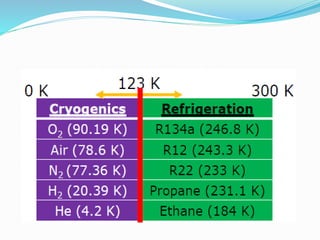
 Cryogenics is the science and technology associated
with generation of low temperature below 123 K.
 National bureau of Standards, Colorado.
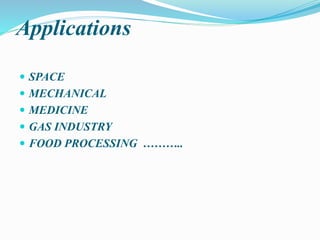
Applications
 SPACE
 MECHANICAL
 MEDICINE
 GAS INDUSTRY
 FOOD PROCESSING ………..
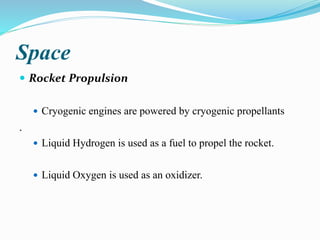
Space
 Rocket Propulsion
 Cryogenic engines are powered by cryogenic propellants
.
 Liquid Hydrogen is used as a fuel to propel the rocket.
 Liquid Oxygen is used as an oxidizer.
Space
 Cooling of Infra-Red (IR) sensor
 Cooling of IR detectors, Telescopes, Cold probes etc.
 Development of miniature and small cryocoolers for
satellites for an improved accuracy and reliability of earth
observation.
 Space simulations chambers are realistic environment for
air/space craft. The cold space is simulated at cryogenic
temperatures by use of LN2.
Space
 The levels of vacuum required in space simulation
chambers are very high.
 This is achieved by the use of cryopumps and turbo
molecular pumps.
Mechanical
Magnetic Separation
 Magnetic separation technique is used in variety of
applications like enhancing the brightness of kaolin,
improving the quality of ultra-high purity quartz etc.-
Superconducting Magnet ensures proper separation.
Mechanical
 Heat Treatment:
 The lives of the tools die castings & their dies, forgings,
jigs & fixtures etc, increase when subjected to cryogenic
heat treatment.
 The life of guitar strings increases by 4 to 5times with no
need for tuning.
Mechanical
 Cryogenic recycling:
 Turns the scrap into raw material by subjecting it to
cryogenics temperatures. This is mostly used for PVC,
rubbers.
Medicine
Cryo Surgery
 When a live tissue is frozen and maintained for
sometime in a frozen state, the blood supply to this
tissue is stopped and it dies due to lack of oxygen.
 When thawed the tissue turns into a blister and is slowly
eliminated either by dropping off as scab or getting
excreted.
Cryo Surgery
 Cryosurgery is a technique in which the harmful tissues
are destroyed by freezing them to cryogenic
temperature.
 Cryosurgery has shorter hospital stay, less blood loss,
and small recovery time.
 It is generally used in patients with localized prostate
and kidney cancer, skin disorders, retinal problems, etc.
Cryo Surgery
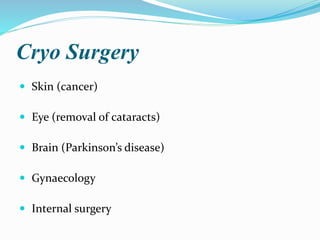
 Skin (cancer)
 Eye (removal of cataracts)
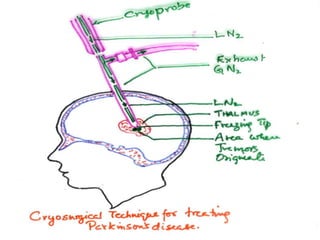
 Brain (Parkinson’s disease)
 Gynaecology
 Internal surgery
Cryo Surgery
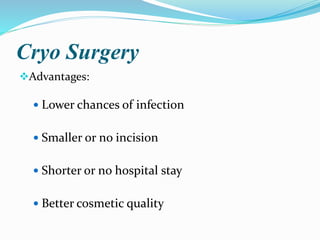
Advantages:
 Lower chances of infection
 Smaller or no incision
 Shorter or no hospital stay
 Better cosmetic quality
Medicine
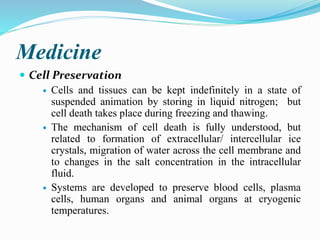
 Cell Preservation
 Cells and tissues can be kept indefinitely in a state of
suspended animation by storing in liquid nitrogen; but
cell death takes place during freezing and thawing.
 The mechanism of cell death is fully understood, but
related to formation of extracellular/ intercellular ice
crystals, migration of water across the cell membrane and
to changes in the salt concentration in the intracellular
fluid.
 Systems are developed to preserve blood cells, plasma
cells, human organs and animal organs at cryogenic
temperatures.
Medicine
 Still some cells can be frozen and thawed with high viability rate
by:
 Following a strict temperature – time protocol.
 Adding certain chemicals like glycerol .
 Applications
 Human erythrocytes and platelets
 Bull sperms
 Cattle and other livestock embryos
 Eye cornea and skin
 Many bacteria and fungi
Food Processing
 Preserving food at low temperature is a well-known
technique.
 Cooling of sea foods, meat (sea export), and milk products
for long time preservation is achieved by use of LN2.
Food Processing
 Freezing of marine products
 Faster cooling
 (cryo freezing, all cells are cooled simultaneously, water in the
material is frozen not the surroundings)
 Smaller ice crystals
 Low drip loss
 Better taste and flavor
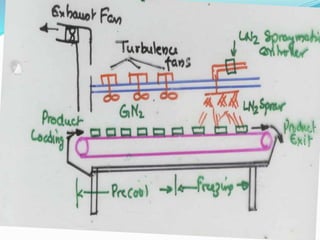
 Individual Quick Freezing
 No additional freezing load
 Better consumer acceptance
 Simpler and lighter equipment
Food Processing
 Transportation of frozen foods
 Liquid N2 is sprayed on the top of the cabin
 Simpler and lighter equipments
 Better temperature control
Gas Industry
 Production of industrial gases-Cryogenic liquefaction and
distillation of air
 The transportation of gases across the world is done in liquid
state. This is done by storing the liquid at cryogenic temperature.
 The use of inert gases in welding industry has initiated higher
demand for gas production in the recent past.
 Cryogens like LOX, LH2 are used in rocket propulsion while
LH2 is being considered for automobile
 Liquid nitrogen is used as pre-coolant in most of the cryogenic
systems.
Gas Industry
 Steel industry – Oxygen is used in the production of steel.
Basic Oxygen Furnace (BOF)uses oxygen instead of air.
 Nitrogen and argon are primarily used to provide an inert
atmosphere in chemical, metallurgical and welding
industries.
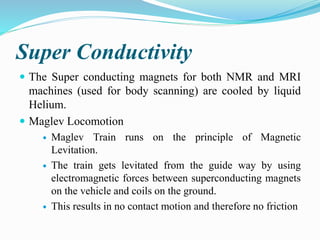
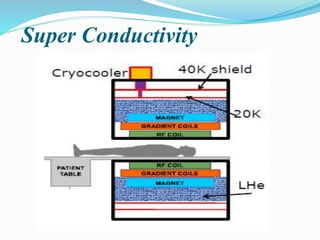
Super Conductivity
 The Super conducting magnets for both NMR and MRI
machines (used for body scanning) are cooled by liquid
Helium.
 Maglev Locomotion
 Maglev Train runs on the principle of Magnetic
Levitation.
 The train gets levitated from the guide way by using
electromagnetic forces between superconducting magnets
on the vehicle and coils on the ground.
 This results in no contact motion and therefore no friction
Super Conductivity
High Energy Physics
 CERN is an organization for nuclear research in Europe which was
founded in 1954.
 It consists of a 27Km accelerator ring with four detectors.
 All the magnet systems (SC) and its accessories are kept at 1.9 K
using the liquid Helium.
 A liquid nitrogen layer (77 K) is used as shielding for liquid helium.
 It is an experiment seeking answers to Big Bang theory and
collision of atomic particles.
High Energy Physics
 ITER (International Thermonuclear Experimental Reactor)
is an engineering project for nuclear fusion reactor.
 The superconducting magnets are maintained at 4 K by
liquid helium.
 The experiments are carried out to enable mankind to
generate energy for future.

1 intro and applications Cryogenics.pptx

  • 1.
  • 2.
    What is CRYOGENICS?  Kryo – Very cold (frost)  Genics – to produce  “Science and art of producing very cold”  Cryogenics is the science and technology associated with generation of low temperature below 123 K.  National bureau of Standards, Colorado.
  • 6.
    Applications  SPACE  MECHANICAL MEDICINE  GAS INDUSTRY  FOOD PROCESSING ………..
  • 7.
    Space  Rocket Propulsion Cryogenic engines are powered by cryogenic propellants .  Liquid Hydrogen is used as a fuel to propel the rocket.  Liquid Oxygen is used as an oxidizer.
  • 8.
    Space  Cooling ofInfra-Red (IR) sensor  Cooling of IR detectors, Telescopes, Cold probes etc.  Development of miniature and small cryocoolers for satellites for an improved accuracy and reliability of earth observation.  Space simulations chambers are realistic environment for air/space craft. The cold space is simulated at cryogenic temperatures by use of LN2.
  • 9.
    Space  The levelsof vacuum required in space simulation chambers are very high.  This is achieved by the use of cryopumps and turbo molecular pumps.
  • 10.
    Mechanical Magnetic Separation  Magneticseparation technique is used in variety of applications like enhancing the brightness of kaolin, improving the quality of ultra-high purity quartz etc.- Superconducting Magnet ensures proper separation.
  • 11.
    Mechanical  Heat Treatment: The lives of the tools die castings & their dies, forgings, jigs & fixtures etc, increase when subjected to cryogenic heat treatment.  The life of guitar strings increases by 4 to 5times with no need for tuning.
  • 12.
    Mechanical  Cryogenic recycling: Turns the scrap into raw material by subjecting it to cryogenics temperatures. This is mostly used for PVC, rubbers.
  • 13.
  • 14.
    Cryo Surgery  Whena live tissue is frozen and maintained for sometime in a frozen state, the blood supply to this tissue is stopped and it dies due to lack of oxygen.  When thawed the tissue turns into a blister and is slowly eliminated either by dropping off as scab or getting excreted.
  • 15.
    Cryo Surgery  Cryosurgeryis a technique in which the harmful tissues are destroyed by freezing them to cryogenic temperature.  Cryosurgery has shorter hospital stay, less blood loss, and small recovery time.  It is generally used in patients with localized prostate and kidney cancer, skin disorders, retinal problems, etc.
  • 16.
    Cryo Surgery  Skin(cancer)  Eye (removal of cataracts)  Brain (Parkinson’s disease)  Gynaecology  Internal surgery
  • 18.
    Cryo Surgery Advantages:  Lowerchances of infection  Smaller or no incision  Shorter or no hospital stay  Better cosmetic quality
  • 19.
    Medicine  Cell Preservation Cells and tissues can be kept indefinitely in a state of suspended animation by storing in liquid nitrogen; but cell death takes place during freezing and thawing.  The mechanism of cell death is fully understood, but related to formation of extracellular/ intercellular ice crystals, migration of water across the cell membrane and to changes in the salt concentration in the intracellular fluid.  Systems are developed to preserve blood cells, plasma cells, human organs and animal organs at cryogenic temperatures.
  • 20.
    Medicine  Still somecells can be frozen and thawed with high viability rate by:  Following a strict temperature – time protocol.  Adding certain chemicals like glycerol .  Applications  Human erythrocytes and platelets  Bull sperms  Cattle and other livestock embryos  Eye cornea and skin  Many bacteria and fungi
  • 21.
    Food Processing  Preservingfood at low temperature is a well-known technique.  Cooling of sea foods, meat (sea export), and milk products for long time preservation is achieved by use of LN2.
  • 22.
    Food Processing  Freezingof marine products  Faster cooling  (cryo freezing, all cells are cooled simultaneously, water in the material is frozen not the surroundings)  Smaller ice crystals  Low drip loss  Better taste and flavor  Individual Quick Freezing  No additional freezing load  Better consumer acceptance  Simpler and lighter equipment
  • 24.
    Food Processing  Transportationof frozen foods  Liquid N2 is sprayed on the top of the cabin  Simpler and lighter equipments  Better temperature control
  • 26.
    Gas Industry  Productionof industrial gases-Cryogenic liquefaction and distillation of air  The transportation of gases across the world is done in liquid state. This is done by storing the liquid at cryogenic temperature.  The use of inert gases in welding industry has initiated higher demand for gas production in the recent past.  Cryogens like LOX, LH2 are used in rocket propulsion while LH2 is being considered for automobile  Liquid nitrogen is used as pre-coolant in most of the cryogenic systems.
  • 27.
    Gas Industry  Steelindustry – Oxygen is used in the production of steel. Basic Oxygen Furnace (BOF)uses oxygen instead of air.  Nitrogen and argon are primarily used to provide an inert atmosphere in chemical, metallurgical and welding industries.
  • 28.
    Super Conductivity  TheSuper conducting magnets for both NMR and MRI machines (used for body scanning) are cooled by liquid Helium.  Maglev Locomotion  Maglev Train runs on the principle of Magnetic Levitation.  The train gets levitated from the guide way by using electromagnetic forces between superconducting magnets on the vehicle and coils on the ground.  This results in no contact motion and therefore no friction
  • 29.
  • 30.
    High Energy Physics CERN is an organization for nuclear research in Europe which was founded in 1954.  It consists of a 27Km accelerator ring with four detectors.  All the magnet systems (SC) and its accessories are kept at 1.9 K using the liquid Helium.  A liquid nitrogen layer (77 K) is used as shielding for liquid helium.  It is an experiment seeking answers to Big Bang theory and collision of atomic particles.
  • 31.
    High Energy Physics ITER (International Thermonuclear Experimental Reactor) is an engineering project for nuclear fusion reactor.  The superconducting magnets are maintained at 4 K by liquid helium.  The experiments are carried out to enable mankind to generate energy for future.