DESIGN, FABRICATION AND
TESTING OF
FLAT PLATE SOLAR THERMAL
COLLECTOR
PRESENTED BY:
BIPIN GUPTA
INTRODUCTION..
SOLAR THERMAL COLLECTOR..
A SOLAR THERMAL COLLECTORS are special kind
of heat exchangers that transform solar radiation
energy to internal energy of the transport medium.
The major component of any solar system is the
solar collector.
SOLAR COLLECTORS:
Collector is a device which absorbs the incoming solar
radiation, converts it into heat, and transfers this heat to a
fluid (usually air, water, or oil)flowing through the
collector.
 The solar energy thus collected is carried from the
circulating fluid either directly to the hot water or space
conditioning equipment, or to a thermal energy storage
tank from which can be drawn for use at night and/or
cloudy days.
TYPES OF SOLAR THERMAL
COLLECTORS
Solar collectors are either Non-concentrating or
Concentrating.
In the Non-concentrating type, the collector area (i.e.,
the area that intercepts the solar radiation) is the same as
the absorber area (i.e., the area absorbing the radiation).
In these types the whole solar panel absorbs light.
 Concentrating collectors have a bigger interceptor than
absorber.
 For domestic/ industrial water heating and
space heating purposes the solar thermal collectors
are classified as..
1. FLAT PLATE SOLAR COLLECTORS.
AND
2. EVACUATED TUBE SOLAR COLLECTORS.
FLAT PLATE SOLAR COLLECTOR
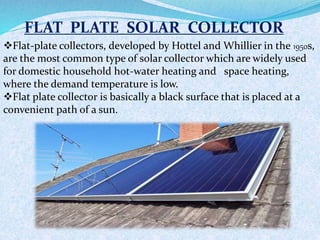
Flat-plate collectors, developed by Hottel and Whillier in the 1950s,
are the most common type of solar collector which are widely used
for domestic household hot-water heating and space heating,
where the demand temperature is low.
Flat plate collector is basically a black surface that is placed at a
convenient path of a sun.
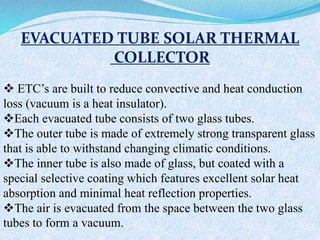
 ETC’s are built to reduce convective and heat conduction
loss (vacuum is a heat insulator).
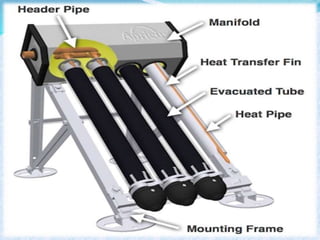
Each evacuated tube consists of two glass tubes.
The outer tube is made of extremely strong transparent glass
that is able to withstand changing climatic conditions.
The inner tube is also made of glass, but coated with a
special selective coating which features excellent solar heat
absorption and minimal heat reflection properties.
The air is evacuated from the space between the two glass
tubes to form a vacuum.
EVACUATED TUBE SOLAR THERMAL
COLLECTOR
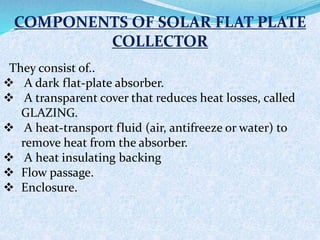
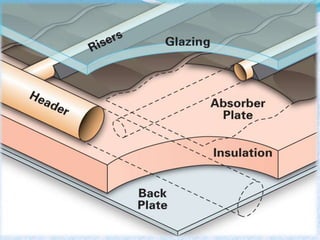
COMPONENTS OF SOLAR FLAT PLATE
COLLECTOR
They consist of..
 A dark flat-plate absorber.
 A transparent cover that reduces heat losses, called
GLAZING.
 A heat-transport fluid (air, antifreeze or water) to
remove heat from the absorber.
 A heat insulating backing
 Flow passage.
 Enclosure.
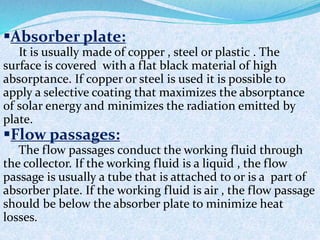
Absorber plate:
It is usually made of copper , steel or plastic . The
surface is covered with a flat black material of high
absorptance. If copper or steel is used it is possible to
apply a selective coating that maximizes the absorptance
of solar energy and minimizes the radiation emitted by
plate.
Flow passages:
The flow passages conduct the working fluid through
the collector. If the working fluid is a liquid , the flow
passage is usually a tube that is attached to or is a part of
absorber plate. If the working fluid is air , the flow passage
should be below the absorber plate to minimize heat
losses.
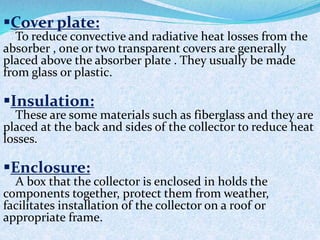
Cover plate:
To reduce convective and radiative heat losses from the
absorber , one or two transparent covers are generally
placed above the absorber plate . They usually be made
from glass or plastic.
Insulation:
These are some materials such as fiberglass and they are
placed at the back and sides of the collector to reduce heat
losses.
Enclosure:
A box that the collector is enclosed in holds the
components together, protect them from weather,
facilitates installation of the collector on a roof or
appropriate frame.
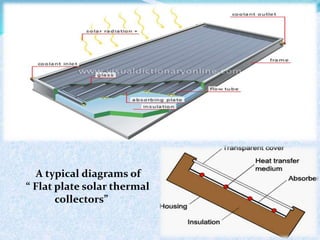
A typical diagrams of
“ Flat plate solar thermal
collectors”
A A.Absorber plate & Flow passages
 Copper , which has high conductivity and is corrosion-
resistant, is the material for absorber plates, but because
copper is expensive, steel is also widely used. For a
copper plate 0.05 cm thick with 1.25-cm tubes spaced 15
cm apart in good thermal contact with the copper, the
fin efficiency is better than 97 percent [1].
 The surface of the absorber plate determines how
much of the incident solar radiation is absorbed and
how much is emitted at a given temperature. Flat black
paint which is widely used as a coating has an
absorptance of about 95 percent for incident shortwave
solar radiation. It is durable and easy to apply [1] .
Here a table about matters that absorber plate may be
made from:
Table : Characteristics of absorptive coatings.[1]
Material Absorptance
()
Emittance
()
Break down
temparature
(°C)
Comments
Black silicon
paint
0.86-0.94 0.83-0.89 350 Slicone
binder
Black silicon
paint
0.9 0.5 300 Stable at
high
temperature
Black copper
over copper
0.85-0.9 0.08-0.12 450 Patinates
with moisture
Black
chorome
over nickel
0.92-0.94 0.07-0.12 450 Stable at high
temperatures
Here in figure we can see absorber plate and flow
passages
Figure: Cross section of a absorber plate&flow passages of a flat
plate solar collector [4] .
B. Cover plates
 A cover plate for a collector should have a high
transmittance for solar radiation and should not
detoriate with time. The material most commonly used
is glass. A 0.32-cm thick sheet of window glass ( iron
content, 0.12 percent ) transmits 85 percent of solar
energy at normal incidence. And all glass is practically
opaque to long-wavelength radiation emitted by the
absorber plate.
 Some plastic materials can be used for collector
glazing.They are cheaper and lighter than glass and,
because they can be used in very thin sheets, they often
have higher transmittance. However, they are not as
durable as glass and they often degrade with exposure to
ultraviolet radiation or high temperatures .
Here a table about matters that cover plate may be made from:
Table: Charactericts of cover plate materials.[1]
Test Polyvinly
floride
Polyethylene
terephthatalet
or polyster
Polycarbonate Fiberglass
rein forced
plastics
Solar
Transmission, %
92-94 85 82-89 77-90
Maximu
operating
temperature ° C
110 100 120-135 95
Thermal
Expansion
Coefficient
43 27 68 32-40
Thickness,
mm
0.1 0.025 3.2 1.0
Length of
life, years
In 5 years 95%
retains
4 4-5 7-20
Here in figure we can see cover part.
Figure: Cross section of a cover part of a flat-plate collector [4].
C. Enclosure / Insulation
 The collector enclosure is usually made from steel, aliminium or
fiber glass.And order to prevent heat from escaping through the
back of the collector, a layer of insulation is placed behind the
absorber plate.
Table: Characteristics of insulation materials .[1]
Material Density Kg/m3 Thermal
conductivity at
95 °C (W/mK)
Temperature
limits °C
Fiber glass with
organic binder
11 0.059 175
“ 16 0.050 175
“ 24 0.045 175
“ 48 0.43 175
Here in figure we can see insulation part.
Figure: Cross Section of an Insulation Part of a Flat-Plate Collector [4].
WORKING PRINCIPLE OF FLAT PLATE
COLLECTORS
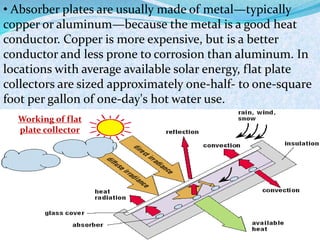
In FLAT PLATE COLLECTORS Sunlight passes through
the glazing and strikes the absorber plate, which heats up,
changing solar energy into heat energy. Thus the heat is
transferred to the fluid {liquid (water or oil) or gas(air) }
passing through pipes attached to the absorber plate by
means of convective heat transfer.
• Absorber plates are commonly painted with "selective
coatings," which absorb and retain heat better than
ordinary black paint.
• Absorber plates are usually made of metal—typically
copper or aluminum—because the metal is a good heat
conductor. Copper is more expensive, but is a better
conductor and less prone to corrosion than aluminum. In
locations with average available solar energy, flat plate
collectors are sized approximately one-half- to one-square
foot per gallon of one-day's hot water use.
Working of flat
plate collector
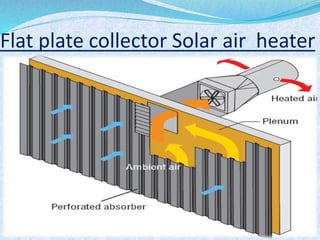
Flat plate collector Solar air heater
COLLECTOR PERFORMANCE
 The thermal performance of a collector can be
calculated from a first-law energy balance. according to
the first law of thermodynamics, for a simple flat-plate
collector an instantaneous steady-state energy balance
is[1] :
 Useful energy = energy absorbed heat loss to
gain (Qu) by the collector surroundings
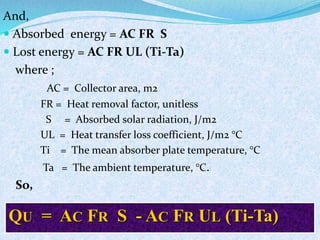
And,
 Absorbed energy = AC FR S
 Lost energy = AC FR UL (Ti-Ta)
where ;
AC = Collector area, m2
FR = Heat removal factor, unitless
S = Absorbed solar radiation, J/m2
UL = Heat transfer loss coefficient, J/m2 °C
Ti = The mean absorber plate temperature, °C
Ta = The ambient temperature, °C.
So,
QU = AC FR S - AC FR UL (Ti-Ta)
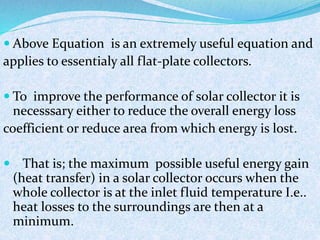
 Above Equation is an extremely useful equation and
applies to essentialy all flat-plate collectors.
 To improve the performance of solar collector it is
necesssary either to reduce the overall energy loss
coefficient or reduce area from which energy is lost.
 That is; the maximum possible useful energy gain
(heat transfer) in a solar collector occurs when the
whole collector is at the inlet fluid temperature I.e..
heat losses to the surroundings are then at a
minimum.
COLLECTOR EFFICIENCY
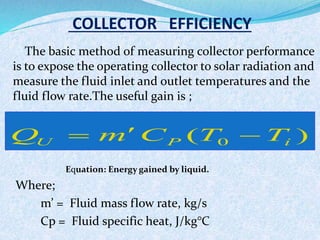
The basic method of measuring collector performance
is to expose the operating collector to solar radiation and
measure the fluid inlet and outlet temperatures and the
fluid flow rate.The useful gain is ;
Equation: Energy gained by liquid.
Where;
m’ = Fluid mass flow rate, kg/s
Cp = Fluid specific heat, J/kg°C
)( 0 iPU TTCmQ 
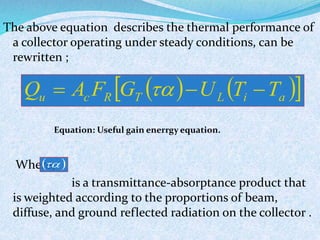
The above equation describes the thermal performance of
a collector operating under steady conditions, can be
rewritten ;
Equation: Useful gain enerrgy equation.
Where,
is a transmittance-absorptance product that
is weighted according to the proportions of beam,
diffuse, and ground reflected radiation on the collector .
    aiLTRcu TTUGFAQ  
 
And finally; instantaneous efficiency can be defined
as :
That is;
   
T
aiLR
R
Tc
u
i
G
TTUF
F
GA
Q
n

 
 
Tc
ip
i
GA
TTCm
n


0'
APPLICATIONS
Flat plate collectors are used for both;
A) Domestic applications
B) Commercial applications
 Flate plate collectors mainly used in residential
buildings where the demand for hot water has a large
impact on energy bills. This generally means a situation
with a large family, or a situation in which the hot water
demand is excessive due to frequent laundry washing[2]
 For instance, a family of 4 members consumes on an
average 100 litre of hot water a day at 60 ˚C. Hot water of
100 litre capacity at 60 ˚C approximate can be delivered
by a single collector system of 2 m² area.[6]
 The solar water heating systems are generally provided
with auxiliary backup in the insulated hot storage tank
for the rainy and heavily overcast cloudy days.
A) Domestic applications
Here we can see solar flat-plate collectors used for
heating buildings.
Figure: Flat plate collectors used for heating buildings [7] .
B) Commercial applications
 Commercial applications include laundromats, car
washes, military laundry facilities and eating
establishments. Solar water heating systems are most
likely to be cost effective for facilities with water heating
systems that are expensive to operate, or with operations
such as laundries or kitchens that require large
quantities of hot water.
• And unglazed liquid collectors are commonly used to
heat water for swimming pools. Because these collectors
need not withstand high temperatures, they can use less
expensive materials such as plastic or rubber. They also
do not require freeze-proofing because swimming pools
are generally used onlyin warm weather or can be
drained easily during cold weather .
Here we can see solar flat-plate collectors used for
heating swimming pools.
Figure: Flat-plate collectors used for heating swimming pools [8].
CONCLUSION
 Flat-plate collectors which are used for water heating,
are long lasting, and also in long term they are cheaper
than other water heating systems.However,they requires
large areas if high energy output is a requirement. Also
solar energy is free if we do not include the initial
cost for installation and the maintenance.
 Finally; bessides these we should remember by using
solar energy we can protect nature
Solar flat plate collector

Solar flat plate collector

  • 1.
    DESIGN, FABRICATION AND TESTINGOF FLAT PLATE SOLAR THERMAL COLLECTOR PRESENTED BY: BIPIN GUPTA
  • 2.
    INTRODUCTION.. SOLAR THERMAL COLLECTOR.. ASOLAR THERMAL COLLECTORS are special kind of heat exchangers that transform solar radiation energy to internal energy of the transport medium. The major component of any solar system is the solar collector.
  • 3.
    SOLAR COLLECTORS: Collector isa device which absorbs the incoming solar radiation, converts it into heat, and transfers this heat to a fluid (usually air, water, or oil)flowing through the collector.  The solar energy thus collected is carried from the circulating fluid either directly to the hot water or space conditioning equipment, or to a thermal energy storage tank from which can be drawn for use at night and/or cloudy days.
  • 4.
    TYPES OF SOLARTHERMAL COLLECTORS Solar collectors are either Non-concentrating or Concentrating. In the Non-concentrating type, the collector area (i.e., the area that intercepts the solar radiation) is the same as the absorber area (i.e., the area absorbing the radiation). In these types the whole solar panel absorbs light.  Concentrating collectors have a bigger interceptor than absorber.
  • 5.
     For domestic/industrial water heating and space heating purposes the solar thermal collectors are classified as.. 1. FLAT PLATE SOLAR COLLECTORS. AND 2. EVACUATED TUBE SOLAR COLLECTORS.
  • 6.
    FLAT PLATE SOLARCOLLECTOR Flat-plate collectors, developed by Hottel and Whillier in the 1950s, are the most common type of solar collector which are widely used for domestic household hot-water heating and space heating, where the demand temperature is low. Flat plate collector is basically a black surface that is placed at a convenient path of a sun.
  • 7.
     ETC’s arebuilt to reduce convective and heat conduction loss (vacuum is a heat insulator). Each evacuated tube consists of two glass tubes. The outer tube is made of extremely strong transparent glass that is able to withstand changing climatic conditions. The inner tube is also made of glass, but coated with a special selective coating which features excellent solar heat absorption and minimal heat reflection properties. The air is evacuated from the space between the two glass tubes to form a vacuum. EVACUATED TUBE SOLAR THERMAL COLLECTOR
  • 9.
    COMPONENTS OF SOLARFLAT PLATE COLLECTOR They consist of..  A dark flat-plate absorber.  A transparent cover that reduces heat losses, called GLAZING.  A heat-transport fluid (air, antifreeze or water) to remove heat from the absorber.  A heat insulating backing  Flow passage.  Enclosure.
  • 11.
    Absorber plate: It isusually made of copper , steel or plastic . The surface is covered with a flat black material of high absorptance. If copper or steel is used it is possible to apply a selective coating that maximizes the absorptance of solar energy and minimizes the radiation emitted by plate. Flow passages: The flow passages conduct the working fluid through the collector. If the working fluid is a liquid , the flow passage is usually a tube that is attached to or is a part of absorber plate. If the working fluid is air , the flow passage should be below the absorber plate to minimize heat losses.
  • 12.
    Cover plate: To reduceconvective and radiative heat losses from the absorber , one or two transparent covers are generally placed above the absorber plate . They usually be made from glass or plastic. Insulation: These are some materials such as fiberglass and they are placed at the back and sides of the collector to reduce heat losses. Enclosure: A box that the collector is enclosed in holds the components together, protect them from weather, facilitates installation of the collector on a roof or appropriate frame.
  • 13.
    A typical diagramsof “ Flat plate solar thermal collectors”
  • 14.
    A A.Absorber plate& Flow passages  Copper , which has high conductivity and is corrosion- resistant, is the material for absorber plates, but because copper is expensive, steel is also widely used. For a copper plate 0.05 cm thick with 1.25-cm tubes spaced 15 cm apart in good thermal contact with the copper, the fin efficiency is better than 97 percent [1].  The surface of the absorber plate determines how much of the incident solar radiation is absorbed and how much is emitted at a given temperature. Flat black paint which is widely used as a coating has an absorptance of about 95 percent for incident shortwave solar radiation. It is durable and easy to apply [1] .
  • 15.
    Here a tableabout matters that absorber plate may be made from: Table : Characteristics of absorptive coatings.[1] Material Absorptance () Emittance () Break down temparature (°C) Comments Black silicon paint 0.86-0.94 0.83-0.89 350 Slicone binder Black silicon paint 0.9 0.5 300 Stable at high temperature Black copper over copper 0.85-0.9 0.08-0.12 450 Patinates with moisture Black chorome over nickel 0.92-0.94 0.07-0.12 450 Stable at high temperatures
  • 16.
    Here in figurewe can see absorber plate and flow passages Figure: Cross section of a absorber plate&flow passages of a flat plate solar collector [4] .
  • 17.
    B. Cover plates A cover plate for a collector should have a high transmittance for solar radiation and should not detoriate with time. The material most commonly used is glass. A 0.32-cm thick sheet of window glass ( iron content, 0.12 percent ) transmits 85 percent of solar energy at normal incidence. And all glass is practically opaque to long-wavelength radiation emitted by the absorber plate.  Some plastic materials can be used for collector glazing.They are cheaper and lighter than glass and, because they can be used in very thin sheets, they often have higher transmittance. However, they are not as durable as glass and they often degrade with exposure to ultraviolet radiation or high temperatures .
  • 18.
    Here a tableabout matters that cover plate may be made from: Table: Charactericts of cover plate materials.[1] Test Polyvinly floride Polyethylene terephthatalet or polyster Polycarbonate Fiberglass rein forced plastics Solar Transmission, % 92-94 85 82-89 77-90 Maximu operating temperature ° C 110 100 120-135 95 Thermal Expansion Coefficient 43 27 68 32-40 Thickness, mm 0.1 0.025 3.2 1.0 Length of life, years In 5 years 95% retains 4 4-5 7-20
  • 19.
    Here in figurewe can see cover part. Figure: Cross section of a cover part of a flat-plate collector [4].
  • 20.
    C. Enclosure /Insulation  The collector enclosure is usually made from steel, aliminium or fiber glass.And order to prevent heat from escaping through the back of the collector, a layer of insulation is placed behind the absorber plate. Table: Characteristics of insulation materials .[1] Material Density Kg/m3 Thermal conductivity at 95 °C (W/mK) Temperature limits °C Fiber glass with organic binder 11 0.059 175 “ 16 0.050 175 “ 24 0.045 175 “ 48 0.43 175
  • 21.
    Here in figurewe can see insulation part. Figure: Cross Section of an Insulation Part of a Flat-Plate Collector [4].
  • 22.
    WORKING PRINCIPLE OFFLAT PLATE COLLECTORS In FLAT PLATE COLLECTORS Sunlight passes through the glazing and strikes the absorber plate, which heats up, changing solar energy into heat energy. Thus the heat is transferred to the fluid {liquid (water or oil) or gas(air) } passing through pipes attached to the absorber plate by means of convective heat transfer. • Absorber plates are commonly painted with "selective coatings," which absorb and retain heat better than ordinary black paint.
  • 23.
    • Absorber platesare usually made of metal—typically copper or aluminum—because the metal is a good heat conductor. Copper is more expensive, but is a better conductor and less prone to corrosion than aluminum. In locations with average available solar energy, flat plate collectors are sized approximately one-half- to one-square foot per gallon of one-day's hot water use. Working of flat plate collector
  • 25.
    Flat plate collectorSolar air heater
  • 26.
    COLLECTOR PERFORMANCE  Thethermal performance of a collector can be calculated from a first-law energy balance. according to the first law of thermodynamics, for a simple flat-plate collector an instantaneous steady-state energy balance is[1] :  Useful energy = energy absorbed heat loss to gain (Qu) by the collector surroundings
  • 27.
    And,  Absorbed energy= AC FR S  Lost energy = AC FR UL (Ti-Ta) where ; AC = Collector area, m2 FR = Heat removal factor, unitless S = Absorbed solar radiation, J/m2 UL = Heat transfer loss coefficient, J/m2 °C Ti = The mean absorber plate temperature, °C Ta = The ambient temperature, °C. So, QU = AC FR S - AC FR UL (Ti-Ta)
  • 28.
     Above Equationis an extremely useful equation and applies to essentialy all flat-plate collectors.  To improve the performance of solar collector it is necesssary either to reduce the overall energy loss coefficient or reduce area from which energy is lost.  That is; the maximum possible useful energy gain (heat transfer) in a solar collector occurs when the whole collector is at the inlet fluid temperature I.e.. heat losses to the surroundings are then at a minimum.
  • 29.
    COLLECTOR EFFICIENCY The basicmethod of measuring collector performance is to expose the operating collector to solar radiation and measure the fluid inlet and outlet temperatures and the fluid flow rate.The useful gain is ; Equation: Energy gained by liquid. Where; m’ = Fluid mass flow rate, kg/s Cp = Fluid specific heat, J/kg°C )( 0 iPU TTCmQ 
  • 30.
    The above equationdescribes the thermal performance of a collector operating under steady conditions, can be rewritten ; Equation: Useful gain enerrgy equation. Where, is a transmittance-absorptance product that is weighted according to the proportions of beam, diffuse, and ground reflected radiation on the collector .     aiLTRcu TTUGFAQ    
  • 31.
    And finally; instantaneousefficiency can be defined as : That is;     T aiLR R Tc u i G TTUF F GA Q n      Tc ip i GA TTCm n   0'
  • 32.
    APPLICATIONS Flat plate collectorsare used for both; A) Domestic applications B) Commercial applications
  • 33.
     Flate platecollectors mainly used in residential buildings where the demand for hot water has a large impact on energy bills. This generally means a situation with a large family, or a situation in which the hot water demand is excessive due to frequent laundry washing[2]  For instance, a family of 4 members consumes on an average 100 litre of hot water a day at 60 ˚C. Hot water of 100 litre capacity at 60 ˚C approximate can be delivered by a single collector system of 2 m² area.[6]  The solar water heating systems are generally provided with auxiliary backup in the insulated hot storage tank for the rainy and heavily overcast cloudy days. A) Domestic applications
  • 34.
    Here we cansee solar flat-plate collectors used for heating buildings. Figure: Flat plate collectors used for heating buildings [7] .
  • 35.
    B) Commercial applications Commercial applications include laundromats, car washes, military laundry facilities and eating establishments. Solar water heating systems are most likely to be cost effective for facilities with water heating systems that are expensive to operate, or with operations such as laundries or kitchens that require large quantities of hot water. • And unglazed liquid collectors are commonly used to heat water for swimming pools. Because these collectors need not withstand high temperatures, they can use less expensive materials such as plastic or rubber. They also do not require freeze-proofing because swimming pools are generally used onlyin warm weather or can be drained easily during cold weather .
  • 36.
    Here we cansee solar flat-plate collectors used for heating swimming pools. Figure: Flat-plate collectors used for heating swimming pools [8].
  • 37.
    CONCLUSION  Flat-plate collectorswhich are used for water heating, are long lasting, and also in long term they are cheaper than other water heating systems.However,they requires large areas if high energy output is a requirement. Also solar energy is free if we do not include the initial cost for installation and the maintenance.  Finally; bessides these we should remember by using solar energy we can protect nature