Content
• History Of Carnot Cycle
• Mechanism of Carnot engine
• Efficiency factors
• Applications of Carnot Cycle
• Summary
• References
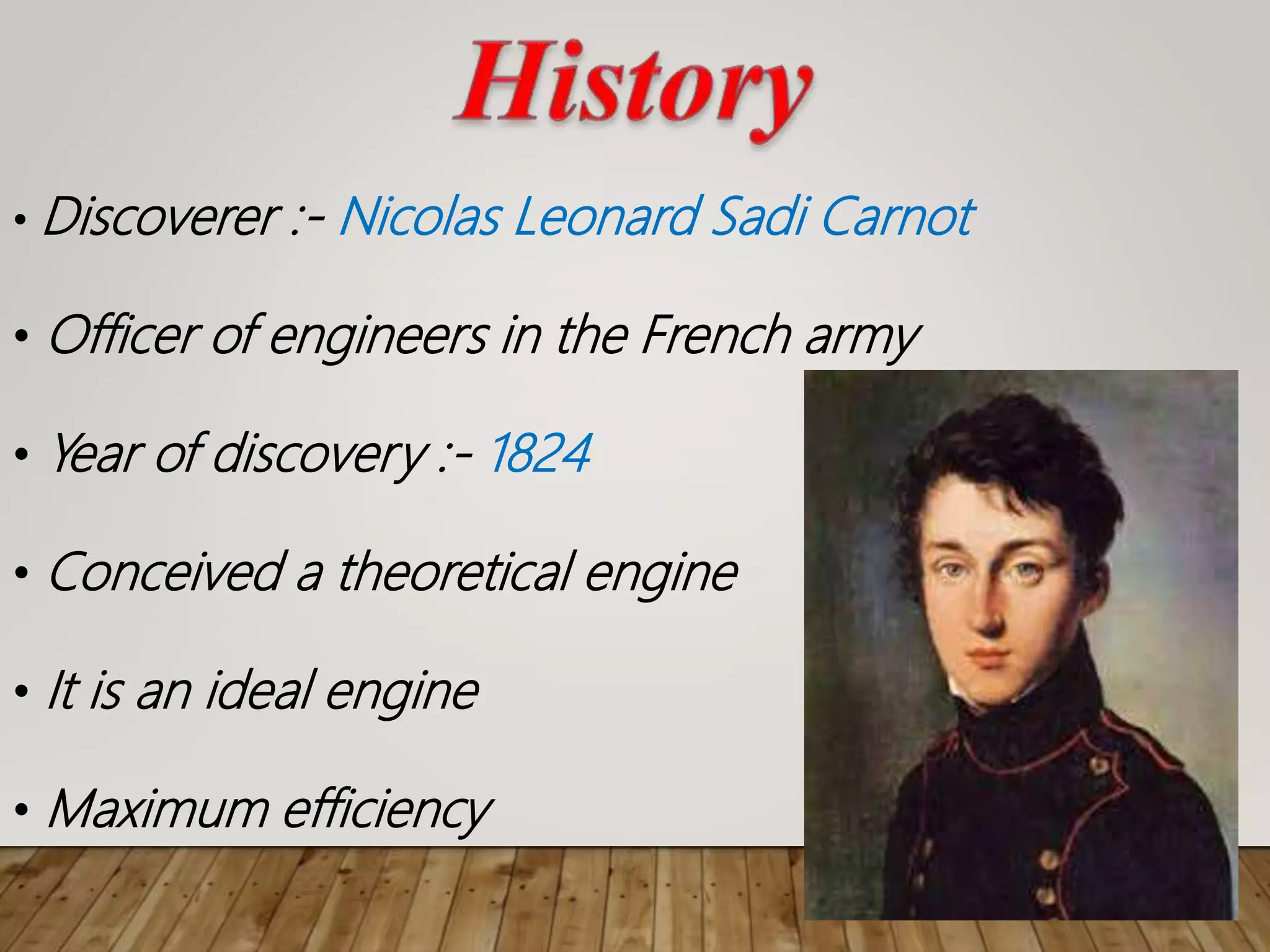
• Discoverer :- Nicolas Leonard Sadi Carnot
• Officer of engineers in the French army
• Year of discovery :- 1824
• Conceived a theoretical engine
• It is an ideal engine
• Maximum efficiency
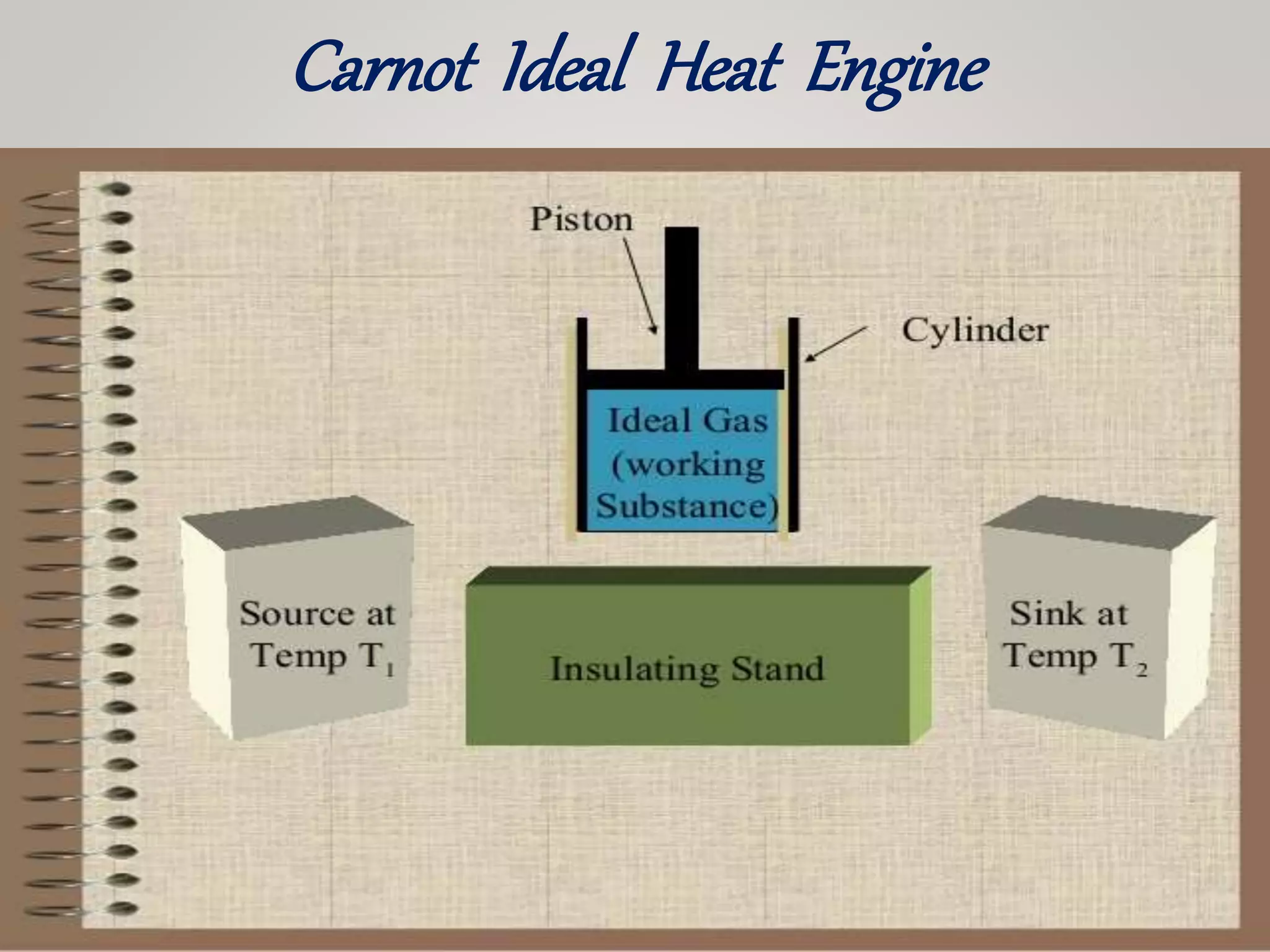
Carnot Ideal Heat Engine
Carnot Cycle
Cyclic stepwise Process
Step1 :- Isothermal Reversible Expansion
Step 2 :- Adiabatic Reversible Expansion
Step 3 :- Isothermal Reversible Compression
Step 4 :- Adiabatic Reversible Compression
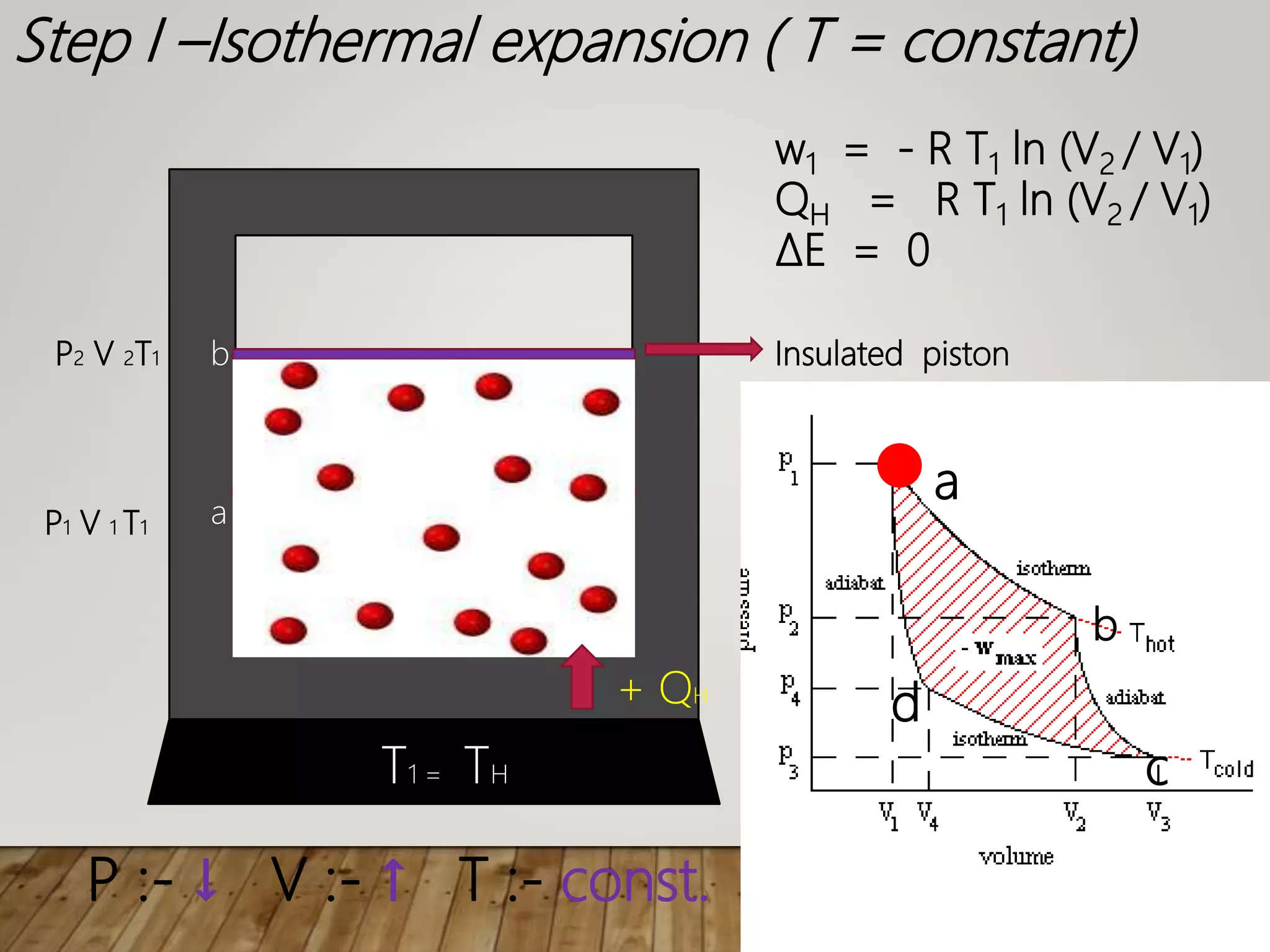
Step I –Isothermal expansion ( T = constant)
a
b Insulated pistonP2 V 2T1
P1 V 1 T1
T1 = TH
+ QH
a
b
c
d
P :- ↓ V :- ↑ T :- const.
w1 = - R T1 ln (V2 / V1)
QH = R T1 ln (V2 / V1)
∆E = 0
+ QH
b
c Insulated pistonP3 V 3T2
P2 V 2 T1
+ QH
Step II –Adiabatic Expansion (Q = 0 )
a
b
c
d
P :- ↓ V :- ↑ T :- ↓
w2 = Cv (T2 - T1)
∆E = Cv (T2 - T1)
q = 0
Step III –Isothermal Compression ( T = constant)
d
c Insulated pistonP3 V 3T2
P4 V 4 T2
T2 = TC
- Qc
a
b
c
d
P :- ↑ V :- ↓ T :- const.
w3 = - R T2 ln (V4 /
V3)
QC = R T2 ln (V4 / V3)
∆E = 0
Step IV –Adiabatic Compression
a
d Insulated pistonP4 V 4T2
P1 V 1 T1
( Q = 0 )
a
b
c
d
w4 = Cv (T1 - T2)
∆E = Cv (T1 - T2)
q = 0
P :- ↑ V :- ↓ T
:- ↑
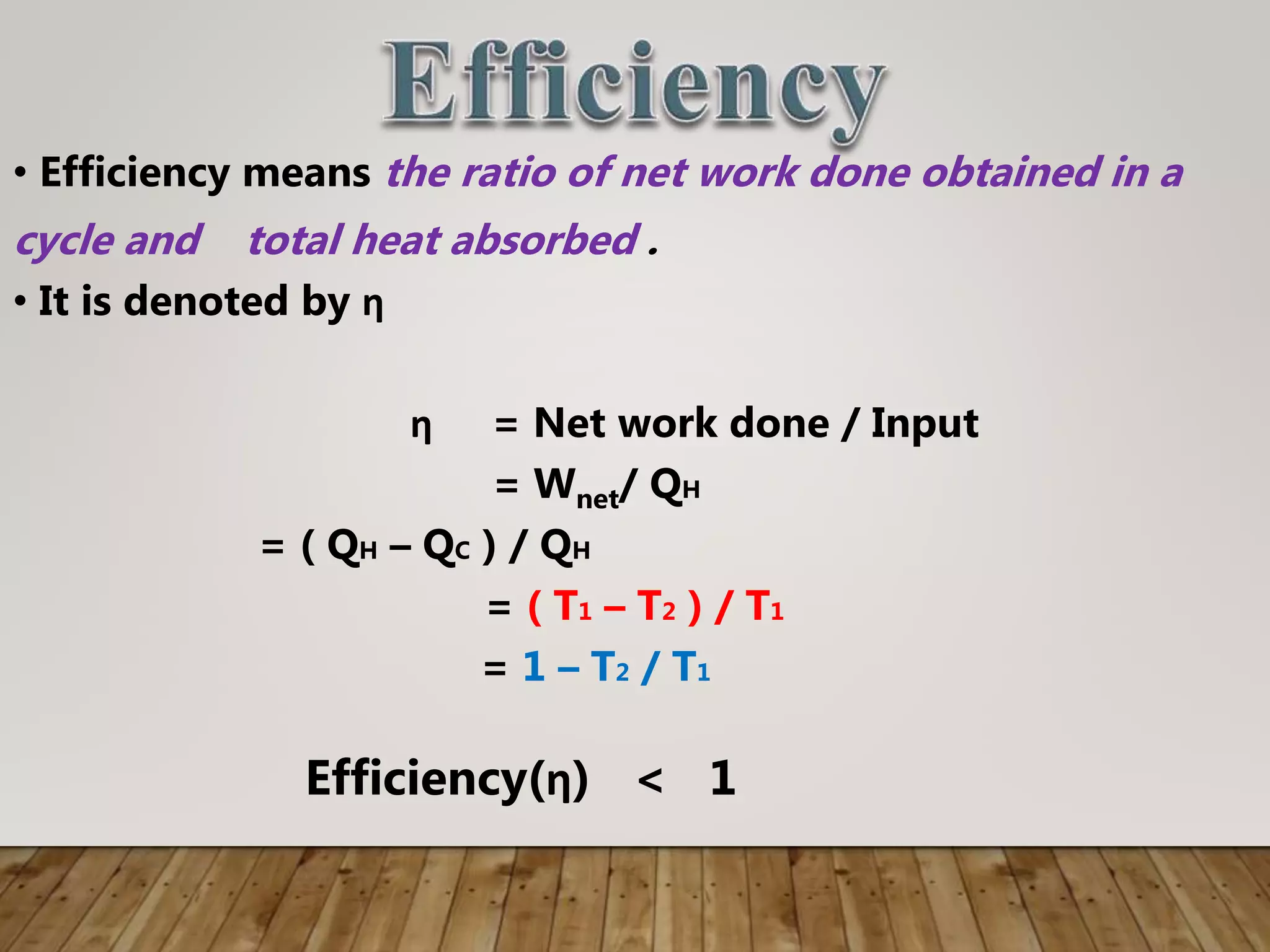
• Efficiency means the ratio of net work done obtained in a
cycle and total heat absorbed .
• It is denoted by η
η = Net work done / Input
= Wnet/ QH
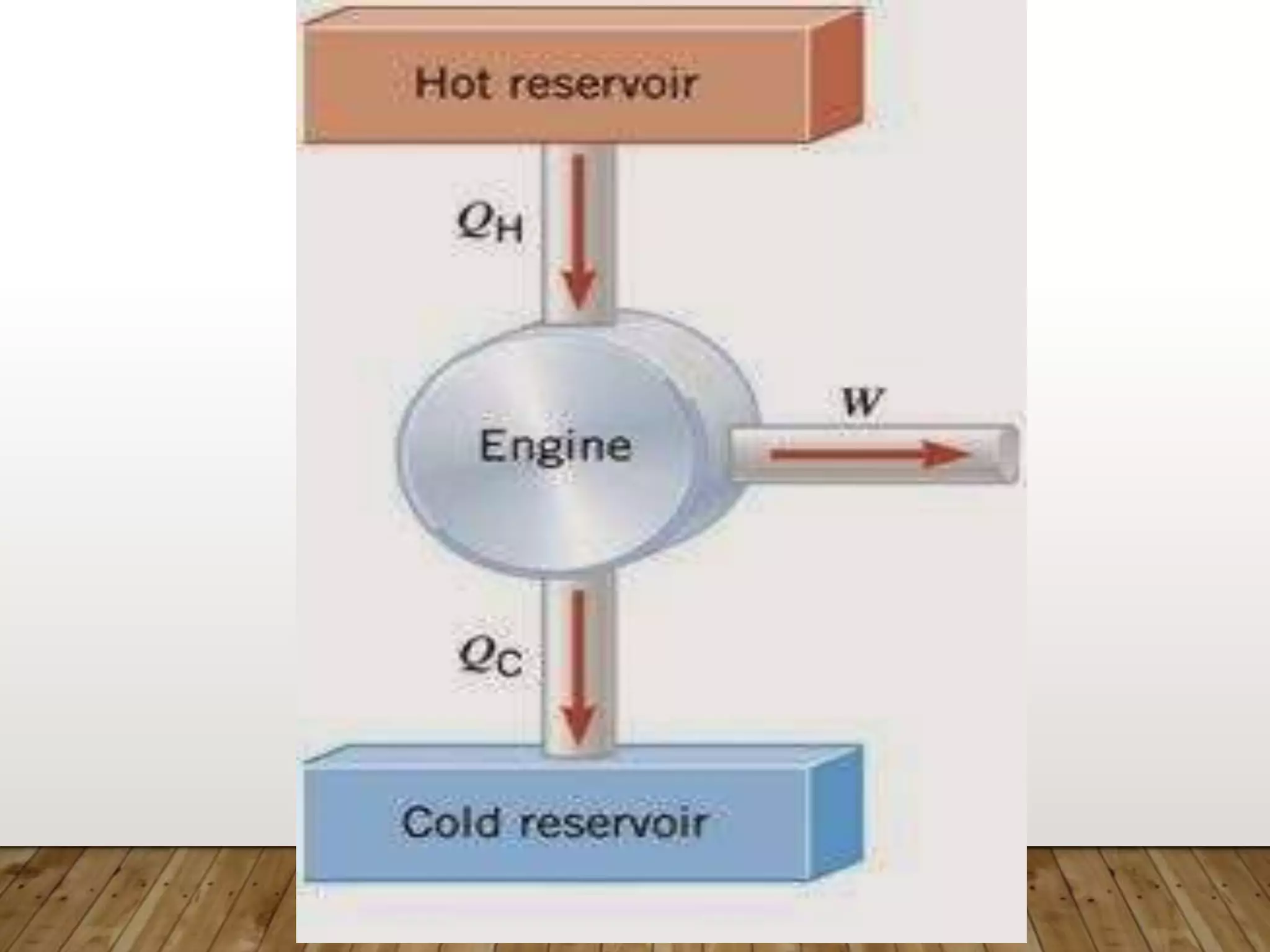
= ( QH – QC ) / QH
= ( T1 – T2 ) / T1
= 1 – T2 / T1
Efficiency(η) < 1
η = 1 – T2 / T1
• Heat source constant at T1 and lowering sink
temperature
• Sink constant at T2 and increasing source
temperature
• Diesel engine
• Heat
engine
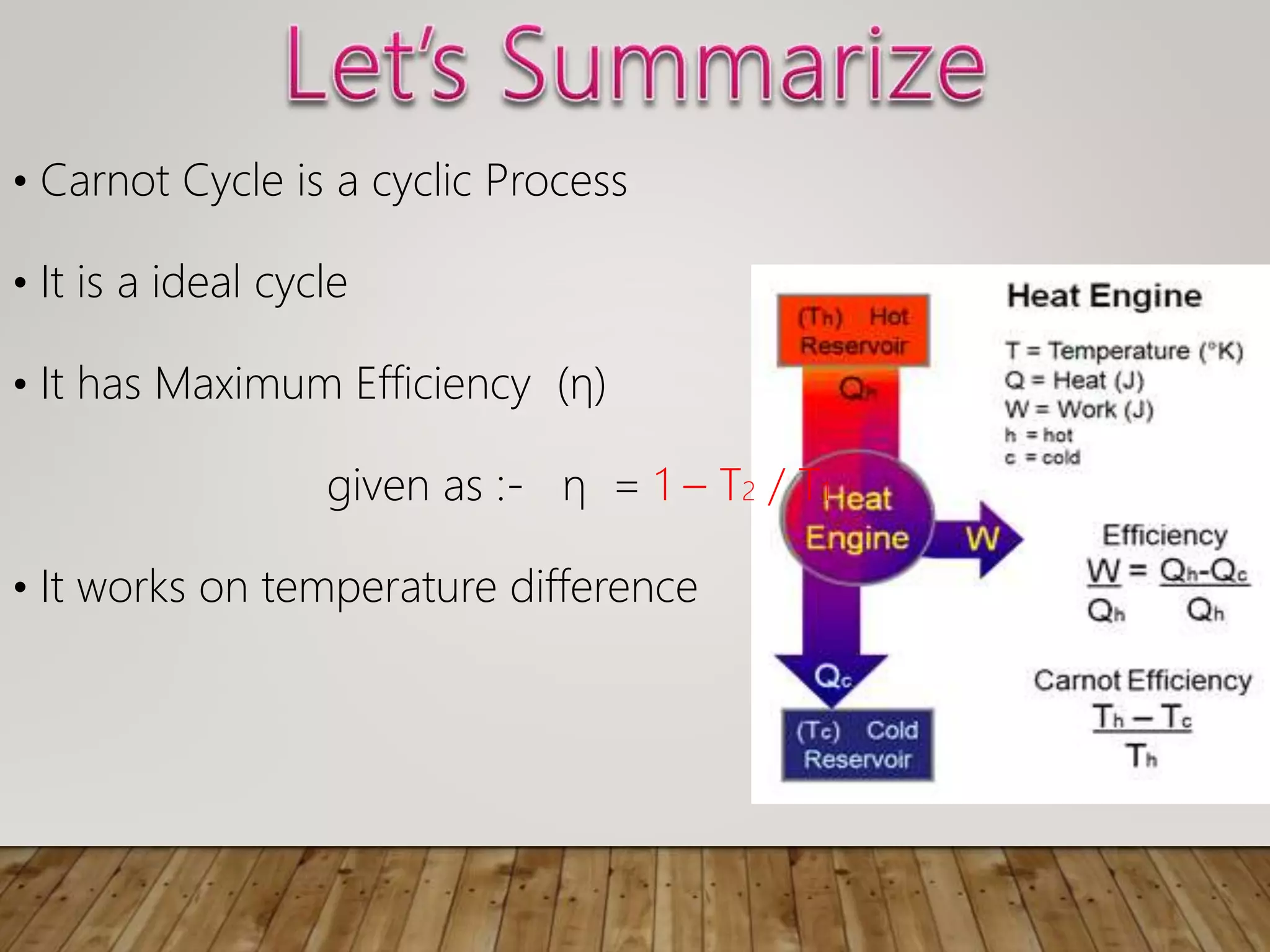
• Carnot Cycle is a cyclic Process
• It is a ideal cycle
• It has Maximum Efficiency (η)
given as :- η = 1 – T2 / T1
• It works on temperature difference
• Atkins’ Physical Chemistry
By:- Peter Atkins
Julio De Paula
• Advanced Physical Chemistry
By :- J.N. Gurtu
A. Gurtu
• Heat Thermodynamics and statistical physics { S. Chand}
By :- Brij lal
N. Subrahmanyam
P.S. Hemne
• Concepts of physics 2
By:- H C Verma
Carnot Cycle (Thermodynamics)

Carnot Cycle (Thermodynamics)

  • 2.
    Content • History OfCarnot Cycle • Mechanism of Carnot engine • Efficiency factors • Applications of Carnot Cycle • Summary • References
  • 3.
    • Discoverer :-Nicolas Leonard Sadi Carnot • Officer of engineers in the French army • Year of discovery :- 1824 • Conceived a theoretical engine • It is an ideal engine • Maximum efficiency
  • 4.
  • 6.
    Carnot Cycle Cyclic stepwiseProcess Step1 :- Isothermal Reversible Expansion Step 2 :- Adiabatic Reversible Expansion Step 3 :- Isothermal Reversible Compression Step 4 :- Adiabatic Reversible Compression
  • 7.
    Step I –Isothermalexpansion ( T = constant) a b Insulated pistonP2 V 2T1 P1 V 1 T1 T1 = TH + QH a b c d P :- ↓ V :- ↑ T :- const. w1 = - R T1 ln (V2 / V1) QH = R T1 ln (V2 / V1) ∆E = 0 + QH
  • 8.
    b c Insulated pistonP3V 3T2 P2 V 2 T1 + QH Step II –Adiabatic Expansion (Q = 0 ) a b c d P :- ↓ V :- ↑ T :- ↓ w2 = Cv (T2 - T1) ∆E = Cv (T2 - T1) q = 0
  • 9.
    Step III –IsothermalCompression ( T = constant) d c Insulated pistonP3 V 3T2 P4 V 4 T2 T2 = TC - Qc a b c d P :- ↑ V :- ↓ T :- const. w3 = - R T2 ln (V4 / V3) QC = R T2 ln (V4 / V3) ∆E = 0
  • 10.
    Step IV –AdiabaticCompression a d Insulated pistonP4 V 4T2 P1 V 1 T1 ( Q = 0 ) a b c d w4 = Cv (T1 - T2) ∆E = Cv (T1 - T2) q = 0 P :- ↑ V :- ↓ T :- ↑
  • 11.
    • Efficiency meansthe ratio of net work done obtained in a cycle and total heat absorbed . • It is denoted by η η = Net work done / Input = Wnet/ QH = ( QH – QC ) / QH = ( T1 – T2 ) / T1 = 1 – T2 / T1 Efficiency(η) < 1
  • 12.
    η = 1– T2 / T1 • Heat source constant at T1 and lowering sink temperature • Sink constant at T2 and increasing source temperature
  • 14.
  • 15.
  • 16.
    • Carnot Cycleis a cyclic Process • It is a ideal cycle • It has Maximum Efficiency (η) given as :- η = 1 – T2 / T1 • It works on temperature difference
  • 17.
    • Atkins’ PhysicalChemistry By:- Peter Atkins Julio De Paula • Advanced Physical Chemistry By :- J.N. Gurtu A. Gurtu • Heat Thermodynamics and statistical physics { S. Chand} By :- Brij lal N. Subrahmanyam P.S. Hemne • Concepts of physics 2 By:- H C Verma