Second Sound
in
Superfluid Helium
Superfluids
“Superfluid” describes a phase of matter. In this
phase, a liquid has no viscosity and may exhibit
several “unusual” effects. Liquid Helium-4
transitions into a superfluid state at
temperatures below 2.17 K, and is a good
subject because of its weak intermolecular
forces.
“Strange” Superfluid Effects
The primary effect in which we are interested is
“second sound.” This is a phenomenon in which
heat travels as a compressional wave (as sound
does), rather than through diffusion.
The heat wave can reach speeds of ~20 m/s!*
*Lane, C.T., Fairbank, H.A., and Fairbank, W.M. Second Sound in Liquid
Helium II (1947) Phys. Rev. 71, 600 - 605
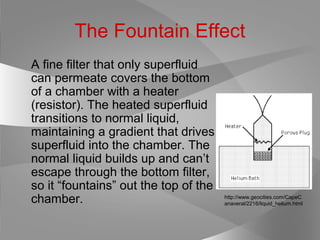
The Fountain Effect
A fine filter that only superfluid
can permeate covers the bottom
of a chamber with a heater
(resistor). The heated superfluid
transitions to normal liquid,
maintaining a gradient that drives
superfluid into the chamber. The
normal liquid builds up and can’t
escape through the bottom filter,
so it “fountains” out the top of the
chamber. http://www.geocities.com/CapeC
anaveral/2216/liquid_helium.html
Experimental Design
• To observe second sound, we started with a thin
stainless steel tube, and wired a resistor into the
bottom of the tube. This resistor will serve as the
heater.
• We then installed two Cernox thermistors 7 cm
and 14 cm along the tube from the heater. Their
resistance increases as temperature decreases,
so temperature changes can be measured by
running a constant current and noting the
change in voltage.
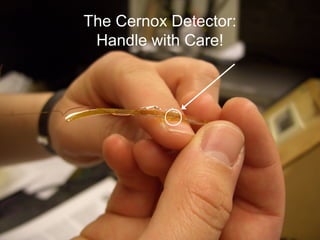
The Cernox Detector:
Handle with Care!
Getting Everything Cold
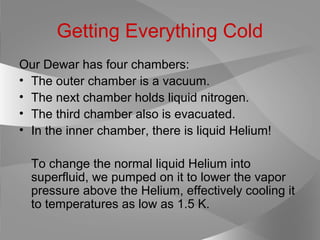
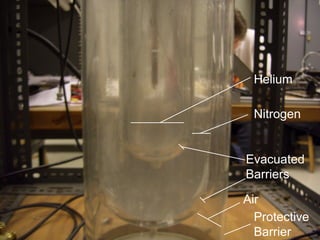
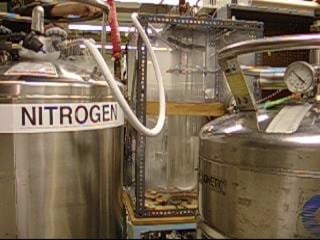
Our Dewar has four chambers:
• The outer chamber is a vacuum.
• The next chamber holds liquid nitrogen.
• The third chamber also is evacuated.
• In the inner chamber, there is liquid Helium!
To change the normal liquid Helium into
superfluid, we pumped on it to lower the vapor
pressure above the Helium, effectively cooling it
to temperatures as low as 1.5 K.
Evacuated
Barriers
Nitrogen
Air
Protective
Barrier
Helium
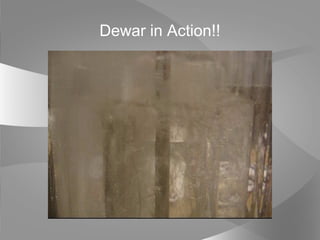
Dewar in Action!!
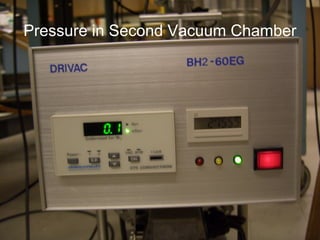
Pressure in Second Vacuum Chamber
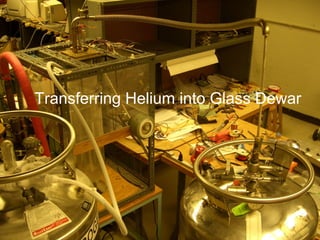
Transferring Helium into Glass Dewar
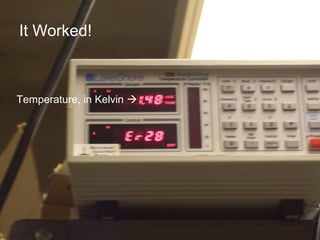
It Worked!
Temperature, in Kelvin 
Obtaining Measurements
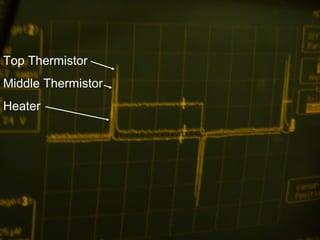
We used a voltage source to drive the resistor at
a variable frequency, and used an oscilloscope
to find the time lag between the responses of the
two detectors. We read out the voltage of the
two temperature sensors and used a signal
analyzer to take the Fourier transform of their
voltages to see if the superfluid’s temperature
was varying at the same frequency as the
voltage source.
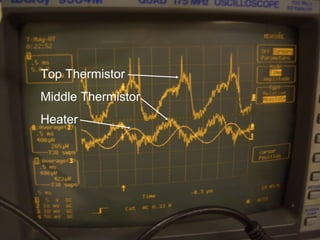
Top Thermistor
Middle Thermistor
Heater
Top Thermistor
Middle Thermistor
Heater
Results
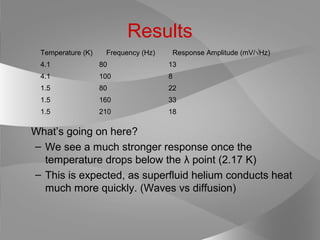
What’s going on here?
– We see a much stronger response once the
temperature drops below the λ point (2.17 K)
– This is expected, as superfluid helium conducts heat
much more quickly. (Waves vs diffusion)
Temperature (K) Frequency (Hz) Response Amplitude (mV/√Hz)
4.1 80 13
4.1 100 8
1.5 80 22
1.5 160 33
1.5 210 18
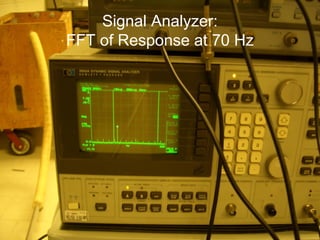
Signal Analyzer:
FFT of Response at 70 Hz
Results
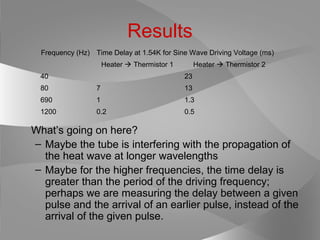
What’s going on here?
– Maybe the tube is interfering with the propagation of
the heat wave at longer wavelengths
– Maybe for the higher frequencies, the time delay is
greater than the period of the driving frequency;
perhaps we are measuring the delay between a given
pulse and the arrival of an earlier pulse, instead of the
arrival of the given pulse.
Frequency (Hz) Time Delay at 1.54K for Sine Wave Driving Voltage (ms)
Heater  Thermistor 1 Heater  Thermistor 2
40 23
80 7 13
690 1 1.3
1200 0.2 0.5
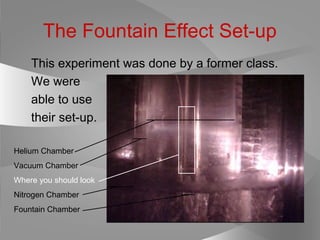
The Fountain Effect Set-up
This experiment was done by a former class.
We were
able to use
their set-up.
Helium Chamber
Vacuum Chamber
Where you should look
Nitrogen Chamber
Fountain Chamber
Conclusions
• Heat travels faster in superfluid, which agrees
with the theory of second sound.
• We were not able to experimentally measure the
exact speed of second sound.
• The fountain effect was observed.
Second Sound

Second Sound

  • 1.
  • 2.
    Superfluids “Superfluid” describes aphase of matter. In this phase, a liquid has no viscosity and may exhibit several “unusual” effects. Liquid Helium-4 transitions into a superfluid state at temperatures below 2.17 K, and is a good subject because of its weak intermolecular forces.
  • 4.
    “Strange” Superfluid Effects Theprimary effect in which we are interested is “second sound.” This is a phenomenon in which heat travels as a compressional wave (as sound does), rather than through diffusion. The heat wave can reach speeds of ~20 m/s!* *Lane, C.T., Fairbank, H.A., and Fairbank, W.M. Second Sound in Liquid Helium II (1947) Phys. Rev. 71, 600 - 605
  • 5.
    The Fountain Effect Afine filter that only superfluid can permeate covers the bottom of a chamber with a heater (resistor). The heated superfluid transitions to normal liquid, maintaining a gradient that drives superfluid into the chamber. The normal liquid builds up and can’t escape through the bottom filter, so it “fountains” out the top of the chamber. http://www.geocities.com/CapeC anaveral/2216/liquid_helium.html
  • 6.
    Experimental Design • Toobserve second sound, we started with a thin stainless steel tube, and wired a resistor into the bottom of the tube. This resistor will serve as the heater. • We then installed two Cernox thermistors 7 cm and 14 cm along the tube from the heater. Their resistance increases as temperature decreases, so temperature changes can be measured by running a constant current and noting the change in voltage.
  • 7.
  • 8.
    Getting Everything Cold OurDewar has four chambers: • The outer chamber is a vacuum. • The next chamber holds liquid nitrogen. • The third chamber also is evacuated. • In the inner chamber, there is liquid Helium! To change the normal liquid Helium into superfluid, we pumped on it to lower the vapor pressure above the Helium, effectively cooling it to temperatures as low as 1.5 K.
  • 9.
  • 10.
  • 11.
    Pressure in SecondVacuum Chamber
  • 12.
  • 13.
  • 14.
    Obtaining Measurements We useda voltage source to drive the resistor at a variable frequency, and used an oscilloscope to find the time lag between the responses of the two detectors. We read out the voltage of the two temperature sensors and used a signal analyzer to take the Fourier transform of their voltages to see if the superfluid’s temperature was varying at the same frequency as the voltage source.
  • 15.
  • 16.
  • 17.
    Results What’s going onhere? – We see a much stronger response once the temperature drops below the λ point (2.17 K) – This is expected, as superfluid helium conducts heat much more quickly. (Waves vs diffusion) Temperature (K) Frequency (Hz) Response Amplitude (mV/√Hz) 4.1 80 13 4.1 100 8 1.5 80 22 1.5 160 33 1.5 210 18
  • 18.
    Signal Analyzer: FFT ofResponse at 70 Hz
  • 19.
    Results What’s going onhere? – Maybe the tube is interfering with the propagation of the heat wave at longer wavelengths – Maybe for the higher frequencies, the time delay is greater than the period of the driving frequency; perhaps we are measuring the delay between a given pulse and the arrival of an earlier pulse, instead of the arrival of the given pulse. Frequency (Hz) Time Delay at 1.54K for Sine Wave Driving Voltage (ms) Heater  Thermistor 1 Heater  Thermistor 2 40 23 80 7 13 690 1 1.3 1200 0.2 0.5
  • 20.
    The Fountain EffectSet-up This experiment was done by a former class. We were able to use their set-up. Helium Chamber Vacuum Chamber Where you should look Nitrogen Chamber Fountain Chamber
  • 21.
    Conclusions • Heat travelsfaster in superfluid, which agrees with the theory of second sound. • We were not able to experimentally measure the exact speed of second sound. • The fountain effect was observed.