1
EXPERIMENT: HEAT CONDUCTION
Nomenclature
Name Symbol SI unit
Radius of Disk R [m]
Heat transfer area A [m2
]
Wall thickness (distance) L [m]
Constant Value (k/A) C
Electrical power to heating element Q [W]
Heat transfer rate per unit time (heat flow) Q [W]
Temperature measured Ta (eg. T1) [°C]
Temperature at hot interface Thotface [°C]
Temperature at cold interface Tcoldface [°C]
Temperature gradient Grad (eg. Gradhot) [W/m°C]
Thermal conductivity k [W/m°C]
Time t [secs] α
2
1. OBJECT
The purpose of this experiment is to determine the constant of proportionality (the thermal
conductivity k) for one-dimensional steady flow of heat.
2. INTRODUCTION
Thermal conduction is the transfer of heat energy in a material due to the temperature gradient
within it. It always takes place from a region of higher temperature to a region of lower
temperature. A solid is chosen for the experiment of pure conduction because both liquids and
gasses exhibit excessive convective heat transfer. For practical situation, heat conduction occurs in
three dimensions, a complexity which often requires extensive computation to analyze. For
experiment, a single dimensional approach is required to demonstrate the basic law that relates rate
of heat flow to temperature gradient and area.
3. THEORY
3.1. LINEAR HEAT CONDUCTION
According to Fourier’s law of heat conduction: If a plane wall of thickness ( L
 ) and area (A)
supports a temperature difference ( T
 ) then the heat transfer rate per unit time (Q) by conduction
through the wall is found to be:
( )
b a
T
Q A where L L L
L


   

If the material of the wall is homogeneous and has a thermal conductivity k (the constant of
proportionality) then:
( )
a b
T
Q kA where T T T
L

    

It should be noted that heat flow is positive in the direction of temperature fall hence the negative
sign in the equation. For convenience the equation can ve rearranged to avoid the negative sign as
follows:
( )
b a
T
Q kA where T T T
L

   

Note: In this exercise k and A are constant.
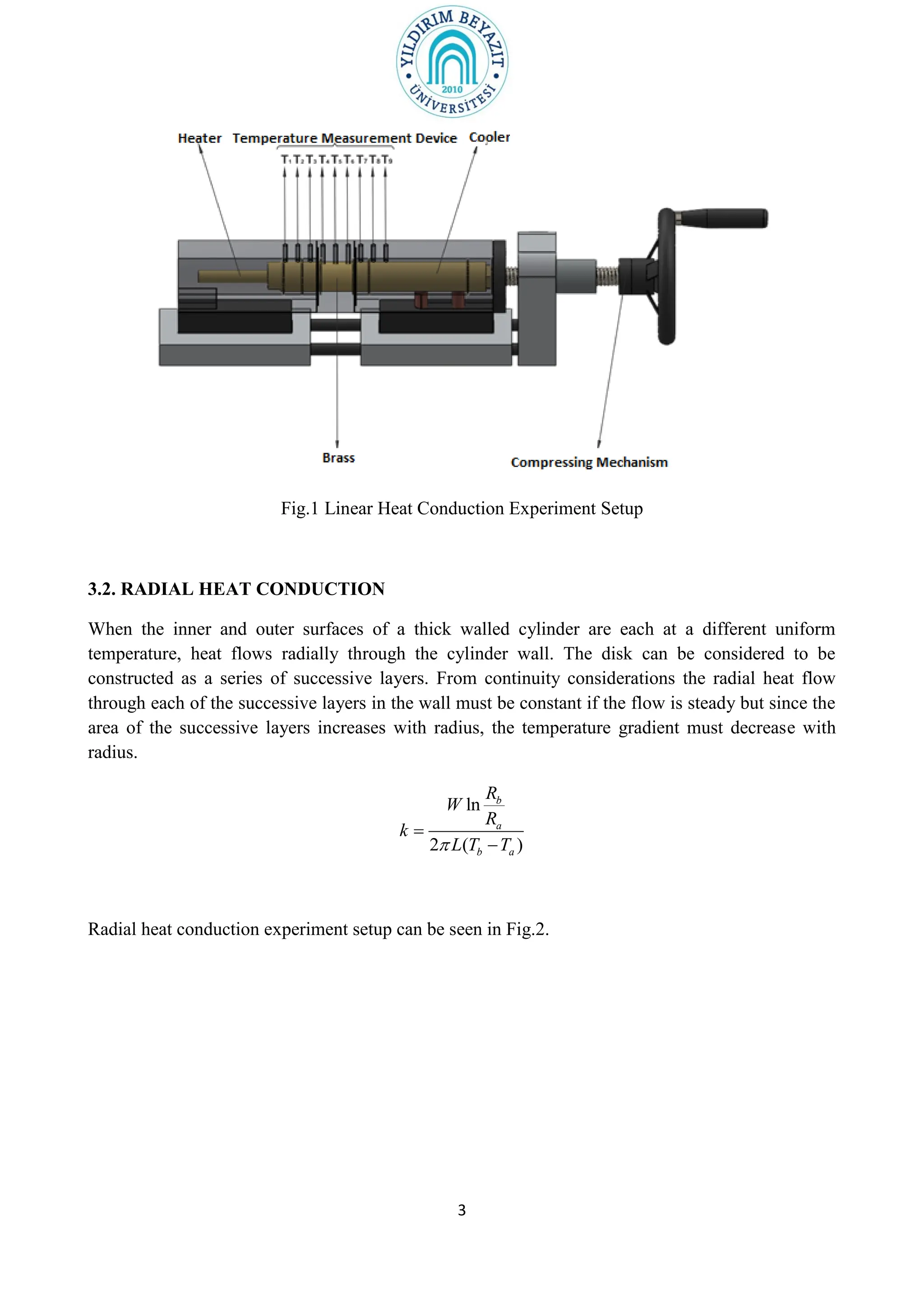
Linear heat conduction experiment setup can be seen in Fig.1.
3
Fig.1 Linear Heat Conduction Experiment Setup
3.2. RADIAL HEAT CONDUCTION
When the inner and outer surfaces of a thick walled cylinder are each at a different uniform
temperature, heat flows radially through the cylinder wall. The disk can be considered to be
constructed as a series of successive layers. From continuity considerations the radial heat flow
through each of the successive layers in the wall must be constant if the flow is steady but since the
area of the successive layers increases with radius, the temperature gradient must decrease with
radius.
ln
2 ( )
b
a
b a
R
W
R
k
L T T



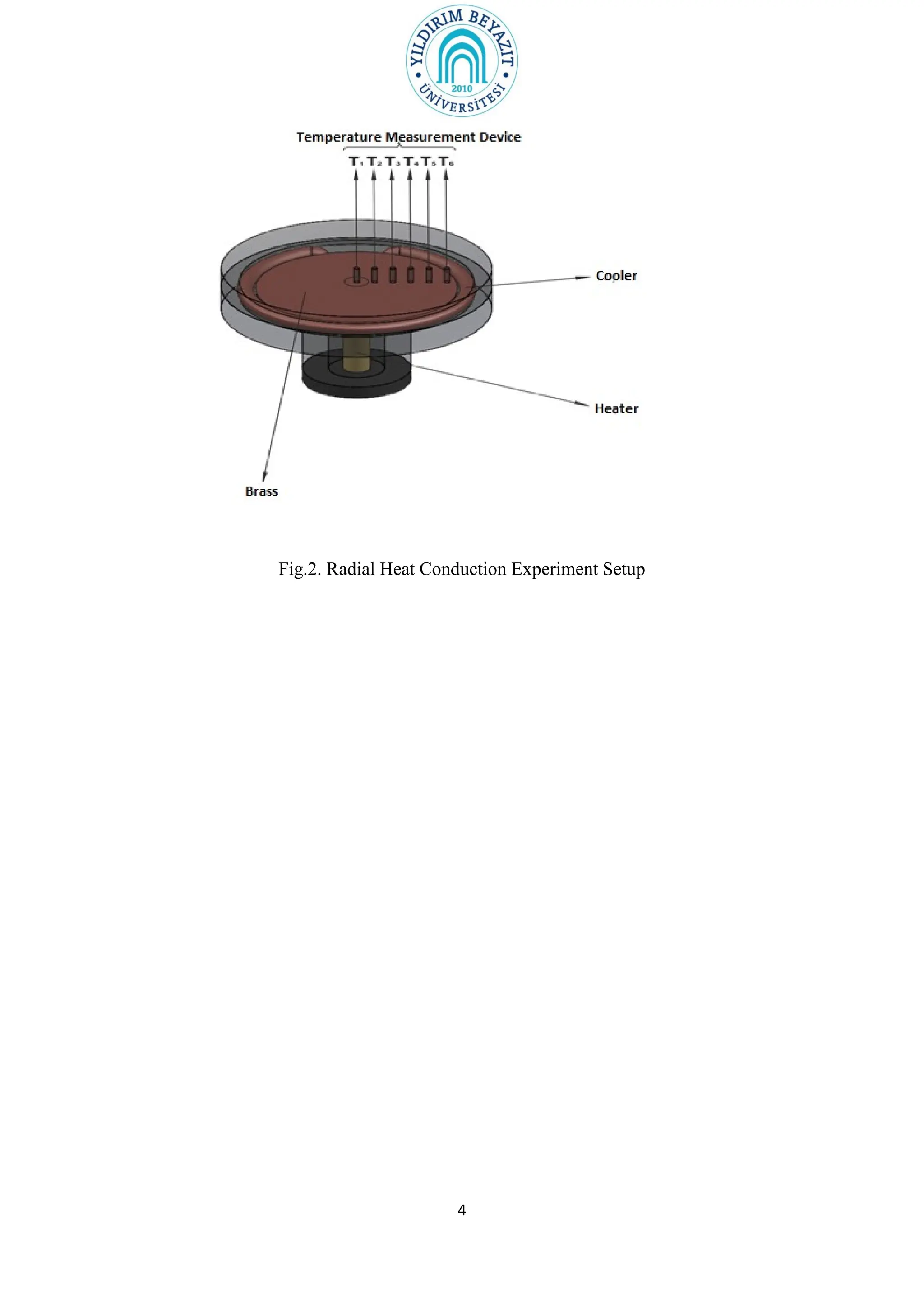
Radial heat conduction experiment setup can be seen in Fig.2.
4
Fig.2. Radial Heat Conduction Experiment Setup
5
4. EXPERIMENTS TO BE PERFORMED
The test unit will be introduced in the laboratory before the experiment by the relevant assistant.
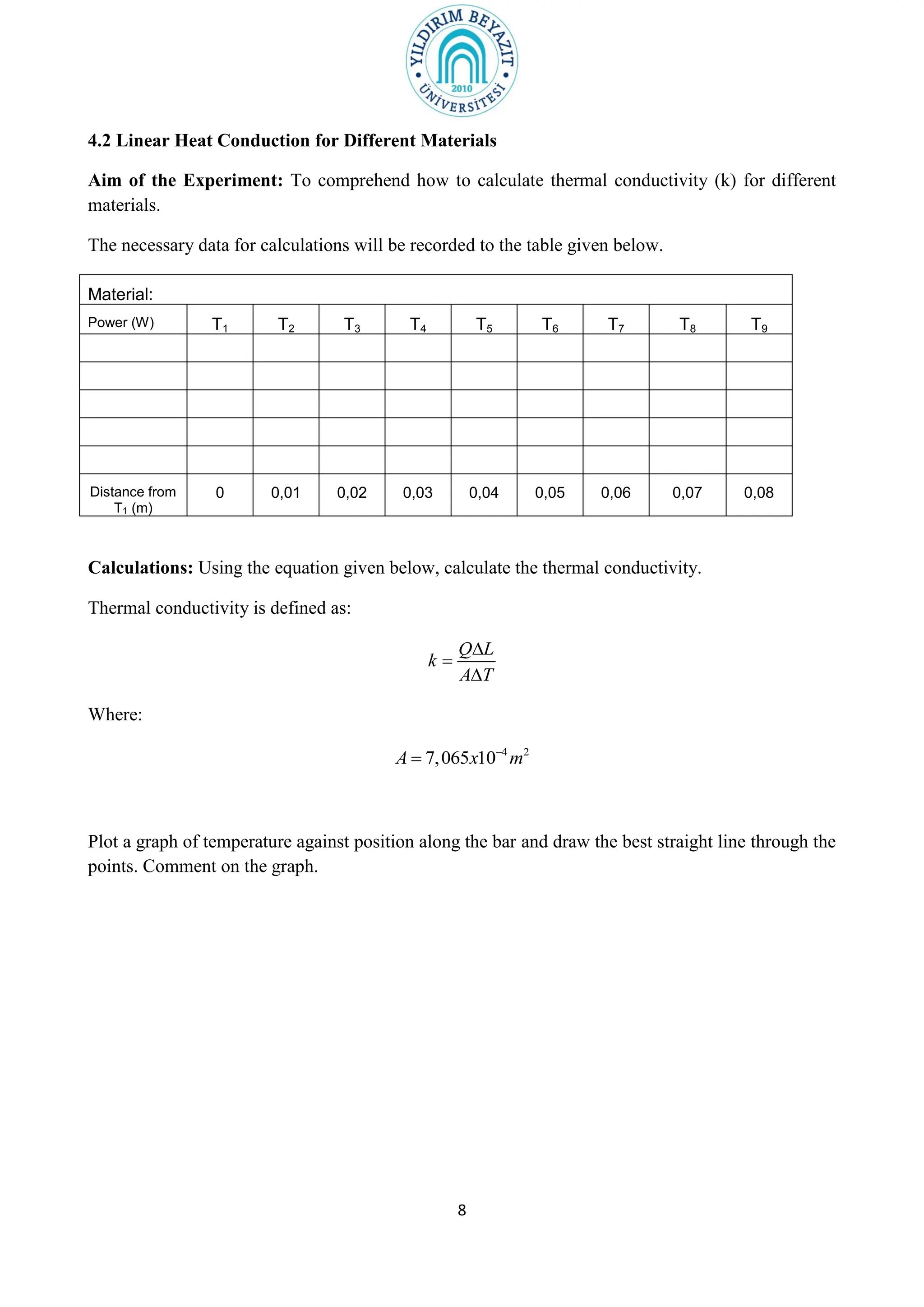
4.1 Linear Heat Conduction
Aim of the Experiment: To comprehend how to calculate thermal conductivity(k)
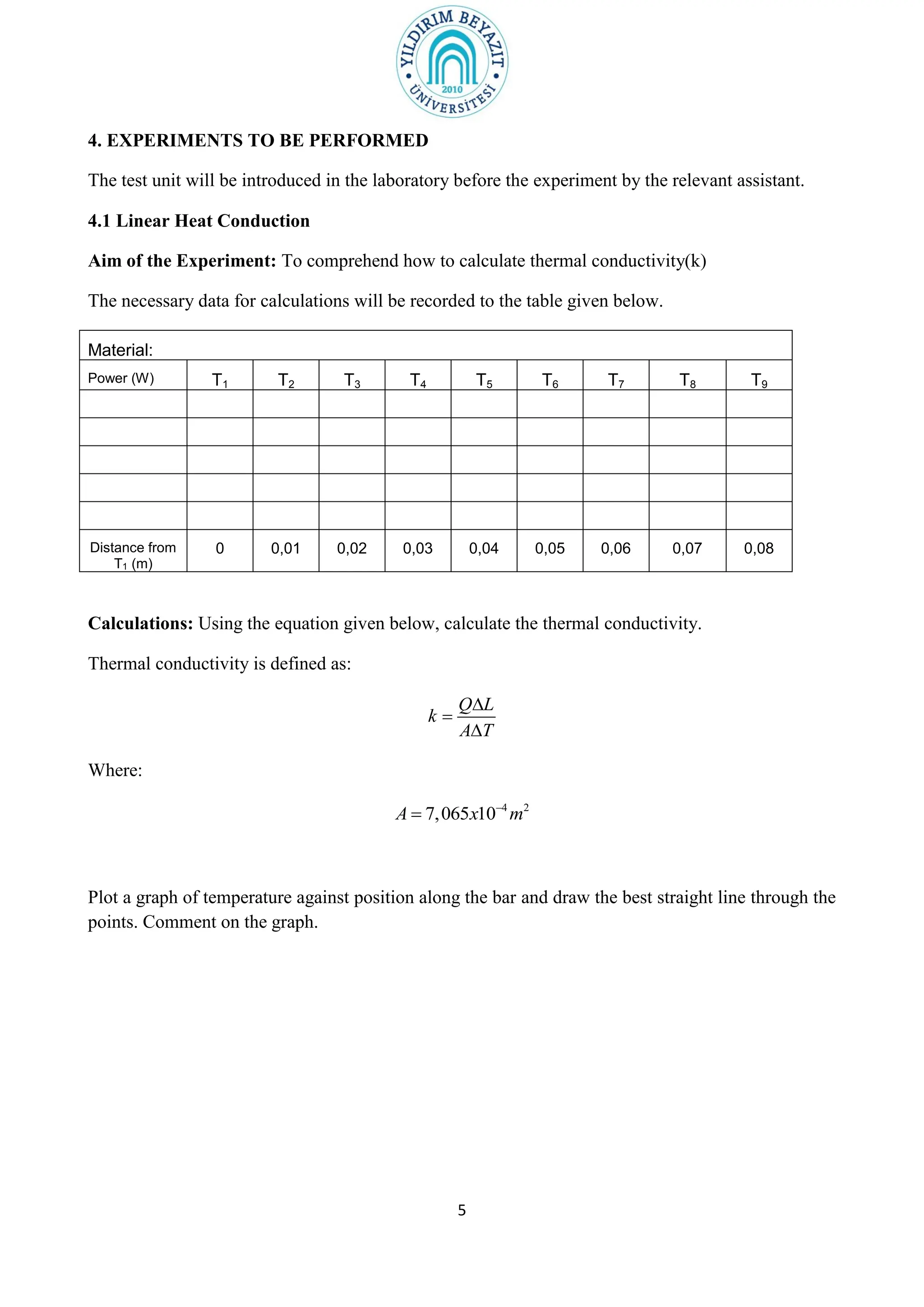
The necessary data for calculations will be recorded to the table given below.
Material:
Power (W) T1 T2 T3 T4 T5 T6 T7 T8 T9
Distance from
T1 (m)
0 0,01 0,02 0,03 0,04 0,05 0,06 0,07 0,08
Calculations: Using the equation given below, calculate the thermal conductivity.
Thermal conductivity is defined as:
Q L
k
A T



Where:
4 2
7,065 10
A x m


Plot a graph of temperature against position along the bar and draw the best straight line through the
points. Comment on the graph.
6
A sample graph of temperature against position along the bar can be seen.
Compare your result with Table 1.
0
10
20
30
40
50
60
70
80
0 1 2 3 4 5 6 7 8
Temperature
[°C]
Distance [m]
Thotface Tcoldface
7
Table 1. Thermal Conductivities for Different Material Types
Materials in Normal Conditions (298 K, 24.85 °C) Thermal Conductivity (k) W/m°C
Metals
Pure Aluminium 205-237
Aluminium Alloy (6082) 170
Brass (CZ 121 ) 123
Brass (63% Copper) 125
Brass (70% Copper) 109-121
Pure Copper 353-386
Copper (C101) 388
Light Steel 50
Stainless Steel 16
Gas
Air 0.0234
Hydrogen 0.172
Others
Asbestos 0.28
Glass 0.8
Water 0.6
Wood 0.07-0.2
8
4.2 Linear Heat Conduction for Different Materials
Aim of the Experiment: To comprehend how to calculate thermal conductivity (k) for different
materials.
The necessary data for calculations will be recorded to the table given below.
Material:
Power (W) T1 T2 T3 T4 T5 T6 T7 T8 T9
Distance from
T1 (m)
0 0,01 0,02 0,03 0,04 0,05 0,06 0,07 0,08
Calculations: Using the equation given below, calculate the thermal conductivity.
Thermal conductivity is defined as:
Q L
k
A T



Where:
4 2
7,065 10
A x m


Plot a graph of temperature against position along the bar and draw the best straight line through the
points. Comment on the graph.
9
Compare your result with Table 1.
0
10
20
30
40
50
60
70
80
0 1 2 3 4 5 6 7 8
Temperature
[°C]
Distance [m]
10
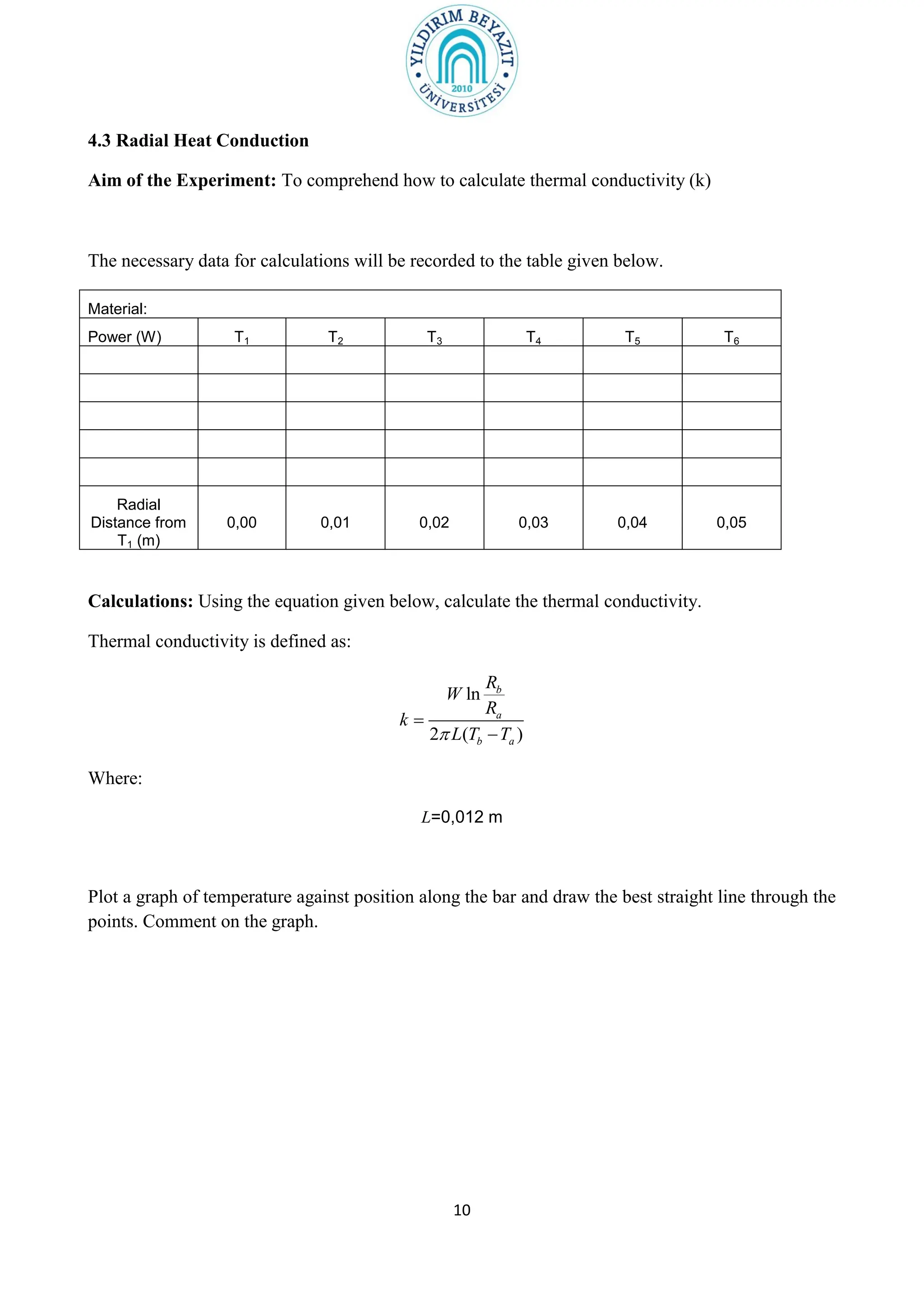
4.3 Radial Heat Conduction
Aim of the Experiment: To comprehend how to calculate thermal conductivity (k)
The necessary data for calculations will be recorded to the table given below.
Material:
Power (W) T1 T2 T3 T4 T5 T6
Radial
Distance from
T1 (m)
0,00 0,01 0,02 0,03 0,04 0,05
Calculations: Using the equation given below, calculate the thermal conductivity.
Thermal conductivity is defined as:
ln
2 ( )
b
a
b a
R
W
R
k
L T T



Where:
L=0,012 m
Plot a graph of temperature against position along the bar and draw the best straight line through the
points. Comment on the graph.
11
0
10
20
30
40
50
60
70
80
0 1 2 3 4 5 6 7 8
Temperature
[°C]
Radial Distance [m]
12
5. REPORT
In your laboratory reports must have the followings;
a) Cover
b) A short introduction
c) All the necessary calculations using measured data.
d) Discussion of your results and a conclusion.

EXPERIMENT HEAT-CONDUCTION.pdf

  • 1.
    1 EXPERIMENT: HEAT CONDUCTION Nomenclature NameSymbol SI unit Radius of Disk R [m] Heat transfer area A [m2 ] Wall thickness (distance) L [m] Constant Value (k/A) C Electrical power to heating element Q [W] Heat transfer rate per unit time (heat flow) Q [W] Temperature measured Ta (eg. T1) [°C] Temperature at hot interface Thotface [°C] Temperature at cold interface Tcoldface [°C] Temperature gradient Grad (eg. Gradhot) [W/m°C] Thermal conductivity k [W/m°C] Time t [secs] α
  • 2.
    2 1. OBJECT The purposeof this experiment is to determine the constant of proportionality (the thermal conductivity k) for one-dimensional steady flow of heat. 2. INTRODUCTION Thermal conduction is the transfer of heat energy in a material due to the temperature gradient within it. It always takes place from a region of higher temperature to a region of lower temperature. A solid is chosen for the experiment of pure conduction because both liquids and gasses exhibit excessive convective heat transfer. For practical situation, heat conduction occurs in three dimensions, a complexity which often requires extensive computation to analyze. For experiment, a single dimensional approach is required to demonstrate the basic law that relates rate of heat flow to temperature gradient and area. 3. THEORY 3.1. LINEAR HEAT CONDUCTION According to Fourier’s law of heat conduction: If a plane wall of thickness ( L  ) and area (A) supports a temperature difference ( T  ) then the heat transfer rate per unit time (Q) by conduction through the wall is found to be: ( ) b a T Q A where L L L L        If the material of the wall is homogeneous and has a thermal conductivity k (the constant of proportionality) then: ( ) a b T Q kA where T T T L        It should be noted that heat flow is positive in the direction of temperature fall hence the negative sign in the equation. For convenience the equation can ve rearranged to avoid the negative sign as follows: ( ) b a T Q kA where T T T L       Note: In this exercise k and A are constant. Linear heat conduction experiment setup can be seen in Fig.1.
  • 3.
    3 Fig.1 Linear HeatConduction Experiment Setup 3.2. RADIAL HEAT CONDUCTION When the inner and outer surfaces of a thick walled cylinder are each at a different uniform temperature, heat flows radially through the cylinder wall. The disk can be considered to be constructed as a series of successive layers. From continuity considerations the radial heat flow through each of the successive layers in the wall must be constant if the flow is steady but since the area of the successive layers increases with radius, the temperature gradient must decrease with radius. ln 2 ( ) b a b a R W R k L T T    Radial heat conduction experiment setup can be seen in Fig.2.
  • 4.
    4 Fig.2. Radial HeatConduction Experiment Setup
  • 5.
    5 4. EXPERIMENTS TOBE PERFORMED The test unit will be introduced in the laboratory before the experiment by the relevant assistant. 4.1 Linear Heat Conduction Aim of the Experiment: To comprehend how to calculate thermal conductivity(k) The necessary data for calculations will be recorded to the table given below. Material: Power (W) T1 T2 T3 T4 T5 T6 T7 T8 T9 Distance from T1 (m) 0 0,01 0,02 0,03 0,04 0,05 0,06 0,07 0,08 Calculations: Using the equation given below, calculate the thermal conductivity. Thermal conductivity is defined as: Q L k A T    Where: 4 2 7,065 10 A x m   Plot a graph of temperature against position along the bar and draw the best straight line through the points. Comment on the graph.
  • 6.
    6 A sample graphof temperature against position along the bar can be seen. Compare your result with Table 1. 0 10 20 30 40 50 60 70 80 0 1 2 3 4 5 6 7 8 Temperature [°C] Distance [m] Thotface Tcoldface
  • 7.
    7 Table 1. ThermalConductivities for Different Material Types Materials in Normal Conditions (298 K, 24.85 °C) Thermal Conductivity (k) W/m°C Metals Pure Aluminium 205-237 Aluminium Alloy (6082) 170 Brass (CZ 121 ) 123 Brass (63% Copper) 125 Brass (70% Copper) 109-121 Pure Copper 353-386 Copper (C101) 388 Light Steel 50 Stainless Steel 16 Gas Air 0.0234 Hydrogen 0.172 Others Asbestos 0.28 Glass 0.8 Water 0.6 Wood 0.07-0.2
  • 8.
    8 4.2 Linear HeatConduction for Different Materials Aim of the Experiment: To comprehend how to calculate thermal conductivity (k) for different materials. The necessary data for calculations will be recorded to the table given below. Material: Power (W) T1 T2 T3 T4 T5 T6 T7 T8 T9 Distance from T1 (m) 0 0,01 0,02 0,03 0,04 0,05 0,06 0,07 0,08 Calculations: Using the equation given below, calculate the thermal conductivity. Thermal conductivity is defined as: Q L k A T    Where: 4 2 7,065 10 A x m   Plot a graph of temperature against position along the bar and draw the best straight line through the points. Comment on the graph.
  • 9.
    9 Compare your resultwith Table 1. 0 10 20 30 40 50 60 70 80 0 1 2 3 4 5 6 7 8 Temperature [°C] Distance [m]
  • 10.
    10 4.3 Radial HeatConduction Aim of the Experiment: To comprehend how to calculate thermal conductivity (k) The necessary data for calculations will be recorded to the table given below. Material: Power (W) T1 T2 T3 T4 T5 T6 Radial Distance from T1 (m) 0,00 0,01 0,02 0,03 0,04 0,05 Calculations: Using the equation given below, calculate the thermal conductivity. Thermal conductivity is defined as: ln 2 ( ) b a b a R W R k L T T    Where: L=0,012 m Plot a graph of temperature against position along the bar and draw the best straight line through the points. Comment on the graph.
  • 11.
    11 0 10 20 30 40 50 60 70 80 0 1 23 4 5 6 7 8 Temperature [°C] Radial Distance [m]
  • 12.
    12 5. REPORT In yourlaboratory reports must have the followings; a) Cover b) A short introduction c) All the necessary calculations using measured data. d) Discussion of your results and a conclusion.