Koya University
Faculty of Engineering
Chemical Engineering Department
3rd Stage (2021-2022)
Reactor Laboratory
Lab Report
Number of Experiment: 13
Experiment Name:
Experimental Residence Time in CSTR Test (23 o
C)
Experiment Date: 30/03/2022
Submitted on: 06/04/2021
Instructor: Mr. Ahmed Abdulkareem Ahmed
Group: A1
Prepared by:
Safeen Yaseen Jafar
Ahmed Mamand Aziz
Ibrahim Ali
Rokan Mohammad Omer
Rivan Dler Ali
Ramazan Shkur Kakl
1
1. Aim of Experiment
➢ Determine Conversion.
➢ Estimate the residence time (space time) of the continuous stirred tank
reactor (CSTR) at three condition 23, 22, and 22 o
C, and on three reactors in
different height (length) 7 cm, 5 cm, and 4 cm.
2. Procedure
1. Prepare 1 L and 0.05 M of NaOH (solution). after it, we need to prepare second reactant
for reaction occur prepare 1 L and 0.05 M of CH3COOHC2H5 (solution) .
2. First of all, in the service units close all valve if open. After that put the bottles in specific
places in service unit. And be careful to that the pipes and valves are connected as well.
3. Turn on the switch control box (power supply).
4. In this experiment we don’t use water bath because it operates under room temperature (20
oC in this experiment).
5. Set the limited flow rate of the reagents before run the steps.
6. Switch on pumps of reactants.
7. Take the reactants from their containers.
8. We fill the reactor by both reactant liquids and the flow rate should be limited at both
flow meters in the control box.
9. Switch on the stirrer from the power supply box.
10. Turn on the conductivity meter (which connected to the reactor).
11. Feeds continuously enter the reactor and out from the reactor.
12. By conductivity measurements (Conductivity Meter) should be use while change of the
conductivity reach the constant value.
13. Steps from 7 to 12 should be repeat for all three reactors (7 cm, 5cm and 4 cm).
2
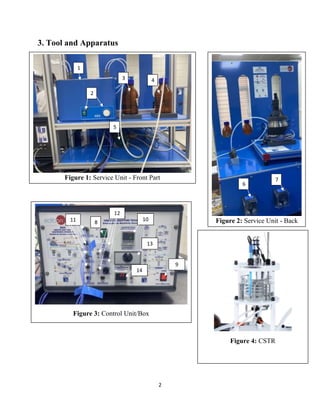
3. Tool and Apparatus
Figure 2: Service Unit - Back
Part
Figure 1: Service Unit - Front Part
1
2
4
3
5
6
7
Figure 3: Control Unit/Box
8
10
11
12
Figure 4: CSTR
13
9
14
3
Service Unit, control unit and its parts:
1. Water Bath: is the tank which contain water it used for control temperature of reactants.
2. Water Bath temperature switch button and controllers.
3. Reactant Container 1: For storage reactant 1.
4. Reactant Container 2: For storage reactant 2.
5. Water Pump AB-1: it used for pumping water.
6. Pump AB-2: It used for pump the reactant 1.
7. Pump AB-3: It used for pump the reactant 2.
8. Pump AB-1 on/off button: It used for switch on or switch of pump AB-1.
9. Power Button: Used to turn on control unit.
10. Temperature Display: For displaying the temperatures
11. Temperature Sensor: for record or estimate temperature.
12. Volumetric Switch Button and Controller: For control the flowrate of reactant.
13. Sensor Selector: it used for select the temperature sensor that you want.
14. Temperature Controller: It can be used when we want to select specified temperature
or control temperature in water bath that we want.
CSTR parts:
1. Coil: for control the temperature of the reaction.
2. Conductivity Sensor: for record the conductivity.
3. Temperature sensor: to read or record the temperature of the reaction.
4. Vessel: it is the closed tank that contain reactants and the reaction happen in it.
5. Stirrer: for mix the reactants and make a collision for reactants.
6. Overflow valve: to out the product at the end of reaction.
7. Drain valve: to empty the vessel at the end of experiment.
4
4. Calculation and Results
We obtained conductivity (λ) value from recording by conductivity meter in lab.
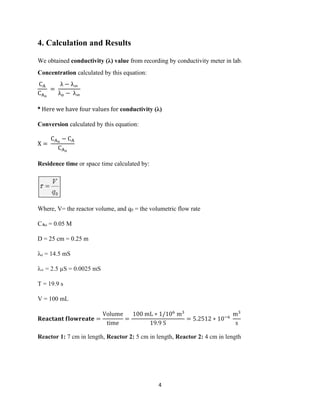
Concentration calculated by this equation:
CA
CAo
=
λ − λ∞
λo − λ∞
* Here we have four values for conductivity (λ)
Conversion calculated by this equation:
X =
CAo
− CA
CAo
Residence time or space time calculated by:
Where, V= the reactor volume, and q0 = the volumetric flow rate
CAo = 0.05 M
D = 25 cm = 0.25 m
λo = 14.5 mS
λ∞ = 2.5 µS = 0.0025 mS
T = 19.9 s
V = 100 mL
𝐑𝐞𝐚𝐜𝐭𝐚𝐧𝐭 𝐟𝐥𝐨𝐰𝐫𝐞𝐚𝐭𝐞 =
Volume
time
=
100 mL ∗ 1/106
m3
19.9 S
= 5.2512 ∗ 10−6
m3
s
Reactor 1: 7 cm in length, Reactor 2: 5 cm in length, Reactor 2: 4 cm in length
5
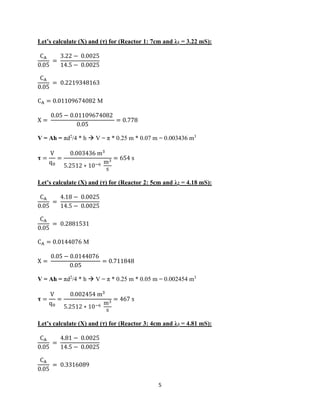
Let’s calculate (X) and (τ) for (Reactor 1: 7cm and λ1 = 3.22 mS):
CA
0.05
=
3.22 − 0.0025
14.5 − 0.0025
CA
0.05
= 0.2219348163
CA = 0.01109674082 M
X =
0.05 − 0.01109674082
0.05
= 0.778
V = Ah = πd2
/4 * h → V = π * 0.25 m * 0.07 m = 0.003436 m3
𝛕 =
V
q0
=
0.003436 m3
5.2512 ∗ 10−6 m3
s
= 654 s
Let’s calculate (X) and (τ) for (Reactor 2: 5cm and λ2 = 4.18 mS):
CA
0.05
=
4.18 − 0.0025
14.5 − 0.0025
CA
0.05
= 0.2881531
CA = 0.0144076 M
X =
0.05 − 0.0144076
0.05
= 0.711848
V = Ah = πd2
/4 * h → V = π * 0.25 m * 0.05 m = 0.002454 m3
𝛕 =
V
q0
=
0.002454 m3
5.2512 ∗ 10−6 m3
s
= 467 s
Let’s calculate (X) and (τ) for (Reactor 3: 4cm and λ3 = 4.81 mS):
CA
0.05
=
4.81 − 0.0025
14.5 − 0.0025
CA
0.05
= 0.3316089
6
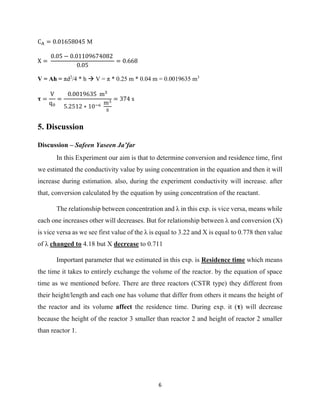
CA = 0.01658045 M
X =
0.05 − 0.01109674082
0.05
= 0.668
V = Ah = πd2
/4 * h → V = π * 0.25 m * 0.04 m = 0.0019635 m3
𝛕 =
V
q0
=
0.0019635 m3
5.2512 ∗ 10−6 m3
s
= 374 s
5. Discussion
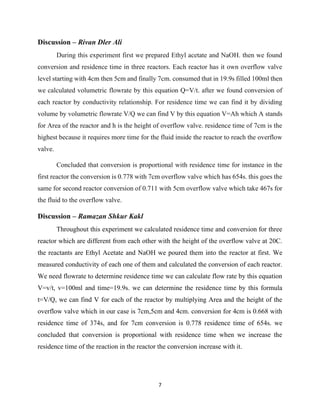
Discussion – Safeen Yaseen Ja’far
In this Experiment our aim is that to determine conversion and residence time, first
we estimated the conductivity value by using concentration in the equation and then it will
increase during estimation. also, during the experiment conductivity will increase. after
that, conversion calculated by the equation by using concentration of the reactant.
The relationship between concentration and λ in this exp. is vice versa, means while
each one increases other will decreases. But for relationship between λ and conversion (X)
is vice versa as we see first value of the λ is equal to 3.22 and X is equal to 0.778 then value
of λ changed to 4.18 but X decrease to 0.711
Important parameter that we estimated in this exp. is Residence time which means
the time it takes to entirely exchange the volume of the reactor. by the equation of space
time as we mentioned before. There are three reactors (CSTR type) they different from
their height/length and each one has volume that differ from others it means the height of
the reactor and its volume affect the residence time. During exp. it (𝛕) will decrease
because the height of the reactor 3 smaller than reactor 2 and height of reactor 2 smaller
than reactor 1.
7
Discussion – Rivan Dler Ali
During this experiment first we prepared Ethyl acetate and NaOH. then we found
conversion and residence time in three reactors. Each reactor has it own overflow valve
level starting with 4cm then 5cm and finally 7cm. consumed that in 19.9s filled 100ml then
we calculated volumetric flowrate by this equation Q=V/t. after we found conversion of
each reactor by conductivity relationship. For residence time we can find it by dividing
volume by volumetric flowrate V/Q we can find V by this equation V=Ah which A stands
for Area of the reactor and h is the height of overflow valve. residence time of 7cm is the
highest because it requires more time for the fluid inside the reactor to reach the overflow
valve.
Concluded that conversion is proportional with residence time for instance in the
first reactor the conversion is 0.778 with 7cm overflow valve which has 654s. this goes the
same for second reactor conversion of 0.711 with 5cm overflow valve which take 467s for
the fluid to the overflow valve.
Discussion – Ramazan Shkur Kakl
Throughout this experiment we calculated residence time and conversion for three
reactor which are different from each other with the height of the overflow valve at 20C.
the reactants are Ethyl Acetate and NaOH we poured them into the reactor at first. We
measured conductivity of each one of them and calculated the conversion of each reactor.
We need flowrate to determine residence time we can calculate flow rate by this equation
V=v/t, v=100ml and time=19.9s. we can determine the residence time by this formula
t=V/Q, we can find V for each of the reactor by multiplying Area and the height of the
overflow valve which in our case is 7cm,5cm and 4cm. conversion for 4cm is 0.668 with
residence time of 374s, and for 7cm conversion is 0.778 residence time of 654s. we
concluded that conversion is proportional with residence time when we increase the
residence time of the reaction in the reactor the conversion increase with it.
8
Discussion – Ahmed Mamend Aziz
Throughout this experiment is about continuous stirred tank reactor (CSTR) to
determine the conductivity & conversion and residence time by using three reactors in
different height 7cm, 5cm, and 4cm at three condition 23, 22, and 22 oC, the solution of
reactant was between {Sodium hydroxide and Ethyl acetate} in the reactant input tube.
Each reactant prepared in 1 L contain of 0.05M. Read the value of conductivity-by-
conductivity meter and by it we can find the conversion, so about residence time we can
find it by dividing reactor volume by volumetric flow rate (V/qo). And these values are
given λ∞=0.0025mS, λo=14.5mS, at first reactor 7cm λ = 3.22mS by this and CA the
conversion could find that 0.778, the reactor volume by πd2/4 * h = 0.003436m3 and by
dividing this to volumetric flow rate 𝛕=654 s. And for other two reactors repeated this
procedure again.
As a result, when the height of the reactor is decreasing the conversion also decrease
according to volume low the volume also decreases and by dividing smaller value by flow
rate the residence time decrease also.
Discussion – Ibrahim Ali
In this experiment we want to determine the residence time of the continuous stirred
tank reactor (CSTR) at three condition 23, 22, and 22 o
C, and on three reactors in different
height (length) 7 cm, 5 cm, and 4 cm.so during the experiment we can determine the
conversion and residence time for each of the CSTR in the first reactor with height of 7cm
the conversion is 0.778 and residence time is 654s and in the second reactor with height of
5cm the conversion is 0.711848 and residence time is 467s and in the final reactor the
conversion is 0.668 and residence time is 374s so final we can understand when we
decrease the height of reactor in this experiment the conversion and residence time is
decrease so we can note the relationship between conversion and residence time is
proportional.
9
Discussion – Rokan Mohammad Omer
This experiment about CSTR, and aim of our experiment is that to calculate the
conversion (X) and residence time. We used three different height reactors (7cm at 23o
C,
5cm at 22o
C, 4cm at 22o
C), we used NaOH and Ethyl Acetate 1L and 0.05 M. Then we
recorded conductivity value by using conductivity meter and we find the CA and also find
conversion (X). we have already had a value of λ∞=0.0025mS and λo=14.5. By these
values of conductivity that we found in experiment to each reactor we will calculate the CA
and also them Conversion for first reactor 7cm: the conversion1 = 0.778 and the volume =
0.003436m3
and the 𝛕 =654 s, for second reactor 5cm: X2=0.711848, V= 0.002454m3
𝛕 =
467s, for third reactor 4cm: the conversion3 =0.668 and V= 0.0019635 m3
and 𝛕 = 374 s.
according to these values when the height of reactor decreases the residence time also
decrease and the conversion like them also decrease. As a result, if we try to decrease
residence time, we can decrease the height of reactor be this can be a problem with
conversion because the conversion is decrease by this reason.

RD Lab - Exp-13 - G-A1.pdf

  • 1.
    Koya University Faculty ofEngineering Chemical Engineering Department 3rd Stage (2021-2022) Reactor Laboratory Lab Report Number of Experiment: 13 Experiment Name: Experimental Residence Time in CSTR Test (23 o C) Experiment Date: 30/03/2022 Submitted on: 06/04/2021 Instructor: Mr. Ahmed Abdulkareem Ahmed Group: A1 Prepared by: Safeen Yaseen Jafar Ahmed Mamand Aziz Ibrahim Ali Rokan Mohammad Omer Rivan Dler Ali Ramazan Shkur Kakl
  • 2.
    1 1. Aim ofExperiment ➢ Determine Conversion. ➢ Estimate the residence time (space time) of the continuous stirred tank reactor (CSTR) at three condition 23, 22, and 22 o C, and on three reactors in different height (length) 7 cm, 5 cm, and 4 cm. 2. Procedure 1. Prepare 1 L and 0.05 M of NaOH (solution). after it, we need to prepare second reactant for reaction occur prepare 1 L and 0.05 M of CH3COOHC2H5 (solution) . 2. First of all, in the service units close all valve if open. After that put the bottles in specific places in service unit. And be careful to that the pipes and valves are connected as well. 3. Turn on the switch control box (power supply). 4. In this experiment we don’t use water bath because it operates under room temperature (20 oC in this experiment). 5. Set the limited flow rate of the reagents before run the steps. 6. Switch on pumps of reactants. 7. Take the reactants from their containers. 8. We fill the reactor by both reactant liquids and the flow rate should be limited at both flow meters in the control box. 9. Switch on the stirrer from the power supply box. 10. Turn on the conductivity meter (which connected to the reactor). 11. Feeds continuously enter the reactor and out from the reactor. 12. By conductivity measurements (Conductivity Meter) should be use while change of the conductivity reach the constant value. 13. Steps from 7 to 12 should be repeat for all three reactors (7 cm, 5cm and 4 cm).
  • 3.
    2 3. Tool andApparatus Figure 2: Service Unit - Back Part Figure 1: Service Unit - Front Part 1 2 4 3 5 6 7 Figure 3: Control Unit/Box 8 10 11 12 Figure 4: CSTR 13 9 14
  • 4.
    3 Service Unit, controlunit and its parts: 1. Water Bath: is the tank which contain water it used for control temperature of reactants. 2. Water Bath temperature switch button and controllers. 3. Reactant Container 1: For storage reactant 1. 4. Reactant Container 2: For storage reactant 2. 5. Water Pump AB-1: it used for pumping water. 6. Pump AB-2: It used for pump the reactant 1. 7. Pump AB-3: It used for pump the reactant 2. 8. Pump AB-1 on/off button: It used for switch on or switch of pump AB-1. 9. Power Button: Used to turn on control unit. 10. Temperature Display: For displaying the temperatures 11. Temperature Sensor: for record or estimate temperature. 12. Volumetric Switch Button and Controller: For control the flowrate of reactant. 13. Sensor Selector: it used for select the temperature sensor that you want. 14. Temperature Controller: It can be used when we want to select specified temperature or control temperature in water bath that we want. CSTR parts: 1. Coil: for control the temperature of the reaction. 2. Conductivity Sensor: for record the conductivity. 3. Temperature sensor: to read or record the temperature of the reaction. 4. Vessel: it is the closed tank that contain reactants and the reaction happen in it. 5. Stirrer: for mix the reactants and make a collision for reactants. 6. Overflow valve: to out the product at the end of reaction. 7. Drain valve: to empty the vessel at the end of experiment.
  • 5.
    4 4. Calculation andResults We obtained conductivity (λ) value from recording by conductivity meter in lab. Concentration calculated by this equation: CA CAo = λ − λ∞ λo − λ∞ * Here we have four values for conductivity (λ) Conversion calculated by this equation: X = CAo − CA CAo Residence time or space time calculated by: Where, V= the reactor volume, and q0 = the volumetric flow rate CAo = 0.05 M D = 25 cm = 0.25 m λo = 14.5 mS λ∞ = 2.5 µS = 0.0025 mS T = 19.9 s V = 100 mL 𝐑𝐞𝐚𝐜𝐭𝐚𝐧𝐭 𝐟𝐥𝐨𝐰𝐫𝐞𝐚𝐭𝐞 = Volume time = 100 mL ∗ 1/106 m3 19.9 S = 5.2512 ∗ 10−6 m3 s Reactor 1: 7 cm in length, Reactor 2: 5 cm in length, Reactor 2: 4 cm in length
  • 6.
    5 Let’s calculate (X)and (τ) for (Reactor 1: 7cm and λ1 = 3.22 mS): CA 0.05 = 3.22 − 0.0025 14.5 − 0.0025 CA 0.05 = 0.2219348163 CA = 0.01109674082 M X = 0.05 − 0.01109674082 0.05 = 0.778 V = Ah = πd2 /4 * h → V = π * 0.25 m * 0.07 m = 0.003436 m3 𝛕 = V q0 = 0.003436 m3 5.2512 ∗ 10−6 m3 s = 654 s Let’s calculate (X) and (τ) for (Reactor 2: 5cm and λ2 = 4.18 mS): CA 0.05 = 4.18 − 0.0025 14.5 − 0.0025 CA 0.05 = 0.2881531 CA = 0.0144076 M X = 0.05 − 0.0144076 0.05 = 0.711848 V = Ah = πd2 /4 * h → V = π * 0.25 m * 0.05 m = 0.002454 m3 𝛕 = V q0 = 0.002454 m3 5.2512 ∗ 10−6 m3 s = 467 s Let’s calculate (X) and (τ) for (Reactor 3: 4cm and λ3 = 4.81 mS): CA 0.05 = 4.81 − 0.0025 14.5 − 0.0025 CA 0.05 = 0.3316089
  • 7.
    6 CA = 0.01658045M X = 0.05 − 0.01109674082 0.05 = 0.668 V = Ah = πd2 /4 * h → V = π * 0.25 m * 0.04 m = 0.0019635 m3 𝛕 = V q0 = 0.0019635 m3 5.2512 ∗ 10−6 m3 s = 374 s 5. Discussion Discussion – Safeen Yaseen Ja’far In this Experiment our aim is that to determine conversion and residence time, first we estimated the conductivity value by using concentration in the equation and then it will increase during estimation. also, during the experiment conductivity will increase. after that, conversion calculated by the equation by using concentration of the reactant. The relationship between concentration and λ in this exp. is vice versa, means while each one increases other will decreases. But for relationship between λ and conversion (X) is vice versa as we see first value of the λ is equal to 3.22 and X is equal to 0.778 then value of λ changed to 4.18 but X decrease to 0.711 Important parameter that we estimated in this exp. is Residence time which means the time it takes to entirely exchange the volume of the reactor. by the equation of space time as we mentioned before. There are three reactors (CSTR type) they different from their height/length and each one has volume that differ from others it means the height of the reactor and its volume affect the residence time. During exp. it (𝛕) will decrease because the height of the reactor 3 smaller than reactor 2 and height of reactor 2 smaller than reactor 1.
  • 8.
    7 Discussion – RivanDler Ali During this experiment first we prepared Ethyl acetate and NaOH. then we found conversion and residence time in three reactors. Each reactor has it own overflow valve level starting with 4cm then 5cm and finally 7cm. consumed that in 19.9s filled 100ml then we calculated volumetric flowrate by this equation Q=V/t. after we found conversion of each reactor by conductivity relationship. For residence time we can find it by dividing volume by volumetric flowrate V/Q we can find V by this equation V=Ah which A stands for Area of the reactor and h is the height of overflow valve. residence time of 7cm is the highest because it requires more time for the fluid inside the reactor to reach the overflow valve. Concluded that conversion is proportional with residence time for instance in the first reactor the conversion is 0.778 with 7cm overflow valve which has 654s. this goes the same for second reactor conversion of 0.711 with 5cm overflow valve which take 467s for the fluid to the overflow valve. Discussion – Ramazan Shkur Kakl Throughout this experiment we calculated residence time and conversion for three reactor which are different from each other with the height of the overflow valve at 20C. the reactants are Ethyl Acetate and NaOH we poured them into the reactor at first. We measured conductivity of each one of them and calculated the conversion of each reactor. We need flowrate to determine residence time we can calculate flow rate by this equation V=v/t, v=100ml and time=19.9s. we can determine the residence time by this formula t=V/Q, we can find V for each of the reactor by multiplying Area and the height of the overflow valve which in our case is 7cm,5cm and 4cm. conversion for 4cm is 0.668 with residence time of 374s, and for 7cm conversion is 0.778 residence time of 654s. we concluded that conversion is proportional with residence time when we increase the residence time of the reaction in the reactor the conversion increase with it.
  • 9.
    8 Discussion – AhmedMamend Aziz Throughout this experiment is about continuous stirred tank reactor (CSTR) to determine the conductivity & conversion and residence time by using three reactors in different height 7cm, 5cm, and 4cm at three condition 23, 22, and 22 oC, the solution of reactant was between {Sodium hydroxide and Ethyl acetate} in the reactant input tube. Each reactant prepared in 1 L contain of 0.05M. Read the value of conductivity-by- conductivity meter and by it we can find the conversion, so about residence time we can find it by dividing reactor volume by volumetric flow rate (V/qo). And these values are given λ∞=0.0025mS, λo=14.5mS, at first reactor 7cm λ = 3.22mS by this and CA the conversion could find that 0.778, the reactor volume by πd2/4 * h = 0.003436m3 and by dividing this to volumetric flow rate 𝛕=654 s. And for other two reactors repeated this procedure again. As a result, when the height of the reactor is decreasing the conversion also decrease according to volume low the volume also decreases and by dividing smaller value by flow rate the residence time decrease also. Discussion – Ibrahim Ali In this experiment we want to determine the residence time of the continuous stirred tank reactor (CSTR) at three condition 23, 22, and 22 o C, and on three reactors in different height (length) 7 cm, 5 cm, and 4 cm.so during the experiment we can determine the conversion and residence time for each of the CSTR in the first reactor with height of 7cm the conversion is 0.778 and residence time is 654s and in the second reactor with height of 5cm the conversion is 0.711848 and residence time is 467s and in the final reactor the conversion is 0.668 and residence time is 374s so final we can understand when we decrease the height of reactor in this experiment the conversion and residence time is decrease so we can note the relationship between conversion and residence time is proportional.
  • 10.
    9 Discussion – RokanMohammad Omer This experiment about CSTR, and aim of our experiment is that to calculate the conversion (X) and residence time. We used three different height reactors (7cm at 23o C, 5cm at 22o C, 4cm at 22o C), we used NaOH and Ethyl Acetate 1L and 0.05 M. Then we recorded conductivity value by using conductivity meter and we find the CA and also find conversion (X). we have already had a value of λ∞=0.0025mS and λo=14.5. By these values of conductivity that we found in experiment to each reactor we will calculate the CA and also them Conversion for first reactor 7cm: the conversion1 = 0.778 and the volume = 0.003436m3 and the 𝛕 =654 s, for second reactor 5cm: X2=0.711848, V= 0.002454m3 𝛕 = 467s, for third reactor 4cm: the conversion3 =0.668 and V= 0.0019635 m3 and 𝛕 = 374 s. according to these values when the height of reactor decreases the residence time also decrease and the conversion like them also decrease. As a result, if we try to decrease residence time, we can decrease the height of reactor be this can be a problem with conversion because the conversion is decrease by this reason.