Koya University
Faculty of Engineering
Chemical Engineering Department
3rd Stage (2021-2022)
Heat Transfer Laboratory
Lab Report
Number of Experiment: 2a
Experiment Name:
Shell & Tube Heat Exchanger – Uniflow Current
Experiment Date: 30/01/2022
Submission Date: 06/02/2022
Instructor: Mr. Soran Dlawar Jalal
Group: A2
Prepared by:
Safeen Yaseen Jafar
Ramazan Shkur Kakl
Rokan Mohammad Omer
Ibrahim Ali
Ahmed Mamand Aziz
Rivan Dler Ali
Rekan Kazm
Rekar Hamza
Anas Yousif
Table of Content
1. Purpose of the Experiment.....................................................................................................................1
2. Theory/Introduction ...............................................................................................................................2
3. Tools and Apparatus...............................................................................................................................3
4. Procedure.................................................................................................................................................5
5. Table of Reading (Data Sheet)...............................................................................................................6
5. Calculation and Results..........................................................................................................................7
6. References................................................................................................................................................9
1
1. Purpose of the Experiment
To calculate the overall heat transfer coefficient (U) in counter current.
2
2. Theory/Introduction
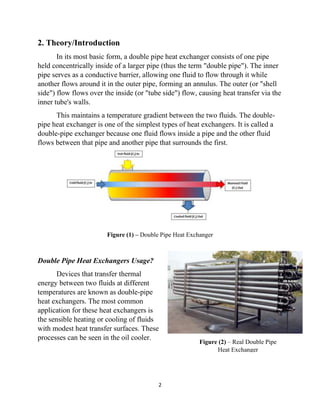
In its most basic form, a double pipe heat exchanger consists of one pipe
held concentrically inside of a larger pipe (thus the term "double pipe"). The inner
pipe serves as a conductive barrier, allowing one fluid to flow through it while
another flows around it in the outer pipe, forming an annulus. The outer (or "shell
side") flow flows over the inside (or "tube side") flow, causing heat transfer via the
inner tube's walls.
This maintains a temperature gradient between the two fluids. The double-
pipe heat exchanger is one of the simplest types of heat exchangers. It is called a
double-pipe exchanger because one fluid flows inside a pipe and the other fluid
flows between that pipe and another pipe that surrounds the first.
Figure (1) – Double Pipe Heat Exchanger
Double Pipe Heat Exchangers Usage?
Devices that transfer thermal
energy between two fluids at different
temperatures are known as double-pipe
heat exchangers. The most common
application for these heat exchangers is
the sensible heating or cooling of fluids
with modest heat transfer surfaces. These
processes can be seen in the oil cooler.
Figure (2) – Real Double Pipe
Heat Exchanger
3
3. Tools and Apparatus
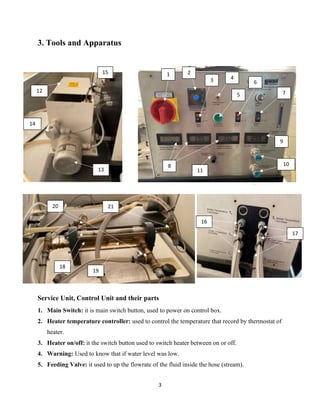
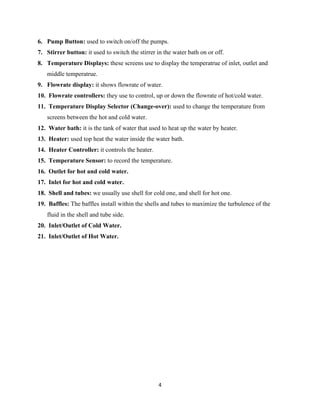
Service Unit, Control Unit and their parts
1. Main Switch: it is main switch button, used to power on control box.
2. Heater temperature controller: used to control the temperature that record by thermostat of
heater.
3. Heater on/off: it the switch button used to switch heater between on or off.
4. Warning: Used to know that if water level was low.
5. Feeding Valve: it used to up the flowrate of the fluid inside the hose (stream).
TEMP 4, 5 and 6 Display respectively
1 2
4
1
3
5
6
8
11
9
10
7
13
12
14
15
17
16
21
20
19
18
4
6. Pump Button: used to switch on/off the pumps.
7. Stirrer button: it used to switch the stirrer in the water bath on or off.
8. Temperature Displays: these screens use to display the temperatrue of inlet, outlet and
middle temperatrue.
9. Flowrate display: it shows flowrate of water.
10. Flowrate controllers: they use to control, up or down the flowrate of hot/cold water.
11. Temperature Display Selector (Change-over): used to change the temperature from
screens between the hot and cold water.
12. Water bath: it is the tank of water that used to heat up the water by heater.
13. Heater: used top heat the water inside the water bath.
14. Heater Controller: it controls the heater.
15. Temperature Sensor: to record the temperature.
16. Outlet for hot and cold water.
17. Inlet for hot and cold water.
18. Shell and tubes: we usually use shell for cold one, and shell for hot one.
19. Baffles: The baffles install within the shells and tubes to maximize the turbulence of the
fluid in the shell and tube side.
20. Inlet/Outlet of Cold Water.
21. Inlet/Outlet of Hot Water.
5
4. Procedure
First of all, we need to clean the heat exchanger so as to remove all impurities.
Experiment Procedure Steps:
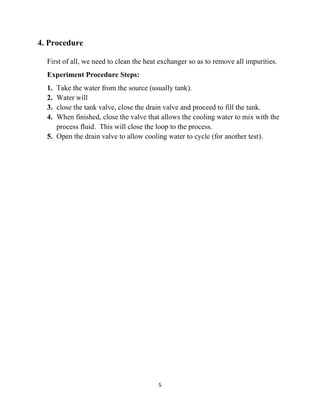
1. Take the water from the source (usually tank).
2. Water will
3. close the tank valve, close the drain valve and proceed to fill the tank.
4. When finished, close the valve that allows the cooling water to mix with the
process fluid. This will close the loop to the process.
5. Open the drain valve to allow cooling water to cycle (for another test).
6
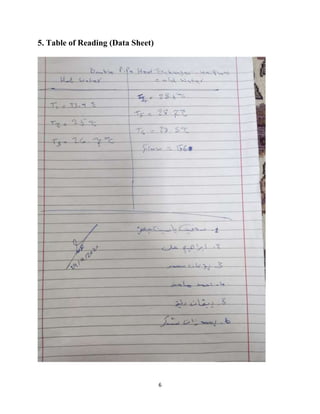
5. Table of Reading (Data Sheet)
7
5. Calculation and Results
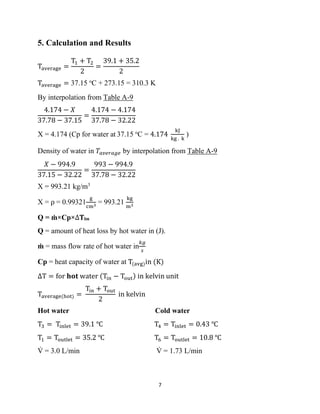
Taverage =
T1 + T2
2
=
39.1 + 35.2
2
Taverage = 37.15 o
C + 273.15 = 310.3 K
By interpolation from Table A-9
4.174 − 𝑋
37.78 − 37.15
=
4.174 − 4.174
37.78 − 32.22
X = 4.174 (Cp for water at 37.15 o
C = 4.174
kJ
kg . k
)
Density of water in 𝑇𝑎𝑣𝑒𝑟𝑎𝑔𝑒 by interpolation from Table A-9
𝑋 − 994.9
37.15 − 32.22
=
993 − 994.9
37.78 − 32.22
X = 993.21 kg/m3
X = ρ = 0.99321
g
cm3
= 993.21
kg
m3
Q = ṁ×Cp×∆𝐓lm
Q = amount of heat loss by hot water in (J).
ṁ = mass flow rate of hot water in
𝑘𝑔
𝑠
Cp = heat capacity of water at T(avg)in (K)
∆T = for 𝐡𝐨𝐭 water (Tin − Tout) in kelvin unit
Taverage(hot) =
Tin + Tout
2
in kelvin
Hot water Cold water
T3 = Tinlet = 39.1 ℃ T4 = Tinlet = 0.43 ℃
T1 = Toutlet = 35.2 ℃ T6 = Toutlet = 10.8 ℃
V
̇ = 3.0 L/min V
̇ = 1.73 L/min
8
V
̇ = 3
𝑙 ×
1𝑚3
1000𝑙
𝑚𝑖𝑛×
60𝑠
1𝑚𝑖𝑛
= 5 × 10⁻⁵ 𝑚3
𝑠
, V
̇ = 1.73
𝑙 ×
1𝑚3
1000𝑙
𝑚𝑖𝑛×
60𝑠
1𝑚𝑖𝑛
= 2.8 × 10⁻⁵ 𝑚3
𝑠
∆Tlm =
(T1 − t2) − (T2 − t1)
ln
(T1 − t2)
(T2 − t1)
=
(39.1 − 10.8) − (35.2 − 0.43)
ln
(39.1 − 10.8)
(35.2 − 0.43)
∆Tlm = 31.42 o
C
ρ =
m
v
ṁ = ρ × V
̇ = (For hot water)
ṁ = 993.21 × 5 × 10−5
= 0.04967
kg
s
q = 0.04967 × 4.174[(312.25) − (308.35)] = 0.808 kW = 808 W
q = U×A×∆Tlm
U =
q
A × ∆T𝑙𝑚
=
808
0.02 × 31.42
= 1285.8
w
m2. k
9
6. References
1. Cavallo, C. (2021). All About Double Pipe Heat Exchangers - What You
Need To Know. [online] www.thomasnet.com. Available at:
https://www.thomasnet.com/articles/process-equipment/double-pipe-heat-
exchangers/. [Accessed 30 Sep. 2021].
2. Ghani, S., Gamaledin, S.M.A., Rashwan, M.M. and Atieh, M.A. (2018).
Experimental investigation of double-pipe heat exchangers in air
conditioning applications. Energy and Buildings, [online] 158, pp.801–811.
Available at:
https://www.sciencedirect.com/science/article/pii/S0378778817311866
[Accessed 1 Oct. 2021].

HTR Lab - Exp-02a - G-A2.pdf

  • 1.
    Koya University Faculty ofEngineering Chemical Engineering Department 3rd Stage (2021-2022) Heat Transfer Laboratory Lab Report Number of Experiment: 2a Experiment Name: Shell & Tube Heat Exchanger – Uniflow Current Experiment Date: 30/01/2022 Submission Date: 06/02/2022 Instructor: Mr. Soran Dlawar Jalal Group: A2 Prepared by: Safeen Yaseen Jafar Ramazan Shkur Kakl Rokan Mohammad Omer Ibrahim Ali Ahmed Mamand Aziz Rivan Dler Ali Rekan Kazm Rekar Hamza Anas Yousif
  • 2.
    Table of Content 1.Purpose of the Experiment.....................................................................................................................1 2. Theory/Introduction ...............................................................................................................................2 3. Tools and Apparatus...............................................................................................................................3 4. Procedure.................................................................................................................................................5 5. Table of Reading (Data Sheet)...............................................................................................................6 5. Calculation and Results..........................................................................................................................7 6. References................................................................................................................................................9
  • 3.
    1 1. Purpose ofthe Experiment To calculate the overall heat transfer coefficient (U) in counter current.
  • 4.
    2 2. Theory/Introduction In itsmost basic form, a double pipe heat exchanger consists of one pipe held concentrically inside of a larger pipe (thus the term "double pipe"). The inner pipe serves as a conductive barrier, allowing one fluid to flow through it while another flows around it in the outer pipe, forming an annulus. The outer (or "shell side") flow flows over the inside (or "tube side") flow, causing heat transfer via the inner tube's walls. This maintains a temperature gradient between the two fluids. The double- pipe heat exchanger is one of the simplest types of heat exchangers. It is called a double-pipe exchanger because one fluid flows inside a pipe and the other fluid flows between that pipe and another pipe that surrounds the first. Figure (1) – Double Pipe Heat Exchanger Double Pipe Heat Exchangers Usage? Devices that transfer thermal energy between two fluids at different temperatures are known as double-pipe heat exchangers. The most common application for these heat exchangers is the sensible heating or cooling of fluids with modest heat transfer surfaces. These processes can be seen in the oil cooler. Figure (2) – Real Double Pipe Heat Exchanger
  • 5.
    3 3. Tools andApparatus Service Unit, Control Unit and their parts 1. Main Switch: it is main switch button, used to power on control box. 2. Heater temperature controller: used to control the temperature that record by thermostat of heater. 3. Heater on/off: it the switch button used to switch heater between on or off. 4. Warning: Used to know that if water level was low. 5. Feeding Valve: it used to up the flowrate of the fluid inside the hose (stream). TEMP 4, 5 and 6 Display respectively 1 2 4 1 3 5 6 8 11 9 10 7 13 12 14 15 17 16 21 20 19 18
  • 6.
    4 6. Pump Button:used to switch on/off the pumps. 7. Stirrer button: it used to switch the stirrer in the water bath on or off. 8. Temperature Displays: these screens use to display the temperatrue of inlet, outlet and middle temperatrue. 9. Flowrate display: it shows flowrate of water. 10. Flowrate controllers: they use to control, up or down the flowrate of hot/cold water. 11. Temperature Display Selector (Change-over): used to change the temperature from screens between the hot and cold water. 12. Water bath: it is the tank of water that used to heat up the water by heater. 13. Heater: used top heat the water inside the water bath. 14. Heater Controller: it controls the heater. 15. Temperature Sensor: to record the temperature. 16. Outlet for hot and cold water. 17. Inlet for hot and cold water. 18. Shell and tubes: we usually use shell for cold one, and shell for hot one. 19. Baffles: The baffles install within the shells and tubes to maximize the turbulence of the fluid in the shell and tube side. 20. Inlet/Outlet of Cold Water. 21. Inlet/Outlet of Hot Water.
  • 7.
    5 4. Procedure First ofall, we need to clean the heat exchanger so as to remove all impurities. Experiment Procedure Steps: 1. Take the water from the source (usually tank). 2. Water will 3. close the tank valve, close the drain valve and proceed to fill the tank. 4. When finished, close the valve that allows the cooling water to mix with the process fluid. This will close the loop to the process. 5. Open the drain valve to allow cooling water to cycle (for another test).
  • 8.
    6 5. Table ofReading (Data Sheet)
  • 9.
    7 5. Calculation andResults Taverage = T1 + T2 2 = 39.1 + 35.2 2 Taverage = 37.15 o C + 273.15 = 310.3 K By interpolation from Table A-9 4.174 − 𝑋 37.78 − 37.15 = 4.174 − 4.174 37.78 − 32.22 X = 4.174 (Cp for water at 37.15 o C = 4.174 kJ kg . k ) Density of water in 𝑇𝑎𝑣𝑒𝑟𝑎𝑔𝑒 by interpolation from Table A-9 𝑋 − 994.9 37.15 − 32.22 = 993 − 994.9 37.78 − 32.22 X = 993.21 kg/m3 X = ρ = 0.99321 g cm3 = 993.21 kg m3 Q = ṁ×Cp×∆𝐓lm Q = amount of heat loss by hot water in (J). ṁ = mass flow rate of hot water in 𝑘𝑔 𝑠 Cp = heat capacity of water at T(avg)in (K) ∆T = for 𝐡𝐨𝐭 water (Tin − Tout) in kelvin unit Taverage(hot) = Tin + Tout 2 in kelvin Hot water Cold water T3 = Tinlet = 39.1 ℃ T4 = Tinlet = 0.43 ℃ T1 = Toutlet = 35.2 ℃ T6 = Toutlet = 10.8 ℃ V ̇ = 3.0 L/min V ̇ = 1.73 L/min
  • 10.
    8 V ̇ = 3 𝑙× 1𝑚3 1000𝑙 𝑚𝑖𝑛× 60𝑠 1𝑚𝑖𝑛 = 5 × 10⁻⁵ 𝑚3 𝑠 , V ̇ = 1.73 𝑙 × 1𝑚3 1000𝑙 𝑚𝑖𝑛× 60𝑠 1𝑚𝑖𝑛 = 2.8 × 10⁻⁵ 𝑚3 𝑠 ∆Tlm = (T1 − t2) − (T2 − t1) ln (T1 − t2) (T2 − t1) = (39.1 − 10.8) − (35.2 − 0.43) ln (39.1 − 10.8) (35.2 − 0.43) ∆Tlm = 31.42 o C ρ = m v ṁ = ρ × V ̇ = (For hot water) ṁ = 993.21 × 5 × 10−5 = 0.04967 kg s q = 0.04967 × 4.174[(312.25) − (308.35)] = 0.808 kW = 808 W q = U×A×∆Tlm U = q A × ∆T𝑙𝑚 = 808 0.02 × 31.42 = 1285.8 w m2. k
  • 11.
    9 6. References 1. Cavallo,C. (2021). All About Double Pipe Heat Exchangers - What You Need To Know. [online] www.thomasnet.com. Available at: https://www.thomasnet.com/articles/process-equipment/double-pipe-heat- exchangers/. [Accessed 30 Sep. 2021]. 2. Ghani, S., Gamaledin, S.M.A., Rashwan, M.M. and Atieh, M.A. (2018). Experimental investigation of double-pipe heat exchangers in air conditioning applications. Energy and Buildings, [online] 158, pp.801–811. Available at: https://www.sciencedirect.com/science/article/pii/S0378778817311866 [Accessed 1 Oct. 2021].