CRYOGENIC MACHINING
PRESENTED BY:
CHETAN B. HIWASE
INTRODUCTION
 Conventional cutting fluid serves both as a coolant and
lubricant. In cryogenic machining, liquid nitrogen (LN2) is
recognized as an effective coolant due to its low temperature.
 Because LN2 has different properties than the conventional
cutting fluid, the method of applying it to the cutting process
must be adjusted to gain the maximum benefit from LN2.
 Cryogenic machining, with liquid nitrogen as the coolant, has
been shown to be an effective method to significantly improve
the surface integrity of manufactured components in terms of
surface and surface hardness, microstructure modification,
phase transformation, residual stress, fatigue life etc.
2
HISTORY OF CRYOGENIC MACHINING
 Cryogenic machining was first investigated around 1953 by
Bartley who used Liquid carbon dioxide as the coolant
(Chattopadhyay et al 1985). Hollis (1961) has studied the
effect of cryogenic cooling on the wear process of carbide
tipped tools during the machining of titanium. . They were
sprayed in the general cutting area or were applied to the work
piece before cutting in a prechill. This method however
consumed excessive amounts of cryogenic fluid and had no
lubrication effect. Additionally this reflects high costs and
present high complexity in delivering of cryo fluid to the
cutting zone
3
TODAY’S SCENARIO OF CRYOGENIC
MACHINING
 Today the process of liquefaction and storage system
becomes more affordable, and there is a need to develop
and rise the cryogenic machining on an industrial level.
Due to price availability, temperature, etc. related to
machining process
characteristics and requirements, in this work as a
cryogenic fluid liquid nitrogen (LN) is going to be used.
4
LIQUID NITROGEN PRODUCTION.
 Liquefaction of air is done.
 Compressor or generator compresses ,expanded and
cooled the air.
 Nitrogen boils at different temperature than oxygen the
nitrogen can be distilled out of liquid air recompressed
and then again re-liquefied.
 liquid nitrogen is removed from the distillation chamber ,
it is stored either in a pressurized tank or a well insulated
Dewar Flask.
5
6
FIG.1 LIQUID NITROGEN PRODUCTION
7
FIG 2 BENIFITS OF LN2
CRYOGENIC MACHINING
• Cryogenic machining presents a method of cooling
the cutting tool and/or part during the machining
process. More specifically, it relates to delivering of
cryogenic (instead of an oil-based CLF) to the local
cutting region of the cutting tool, which is exposed to
the highest temperature during the machining process,
or to the part in order to change the material
characteristics and improve machining performance.
• The cryogenic coolant used in this work is nitrogen
fluid.
8
Schematic Diagram of Cryogenic Machining
9
FIG 3 CRYOGENIC MACHINING SETUP
10
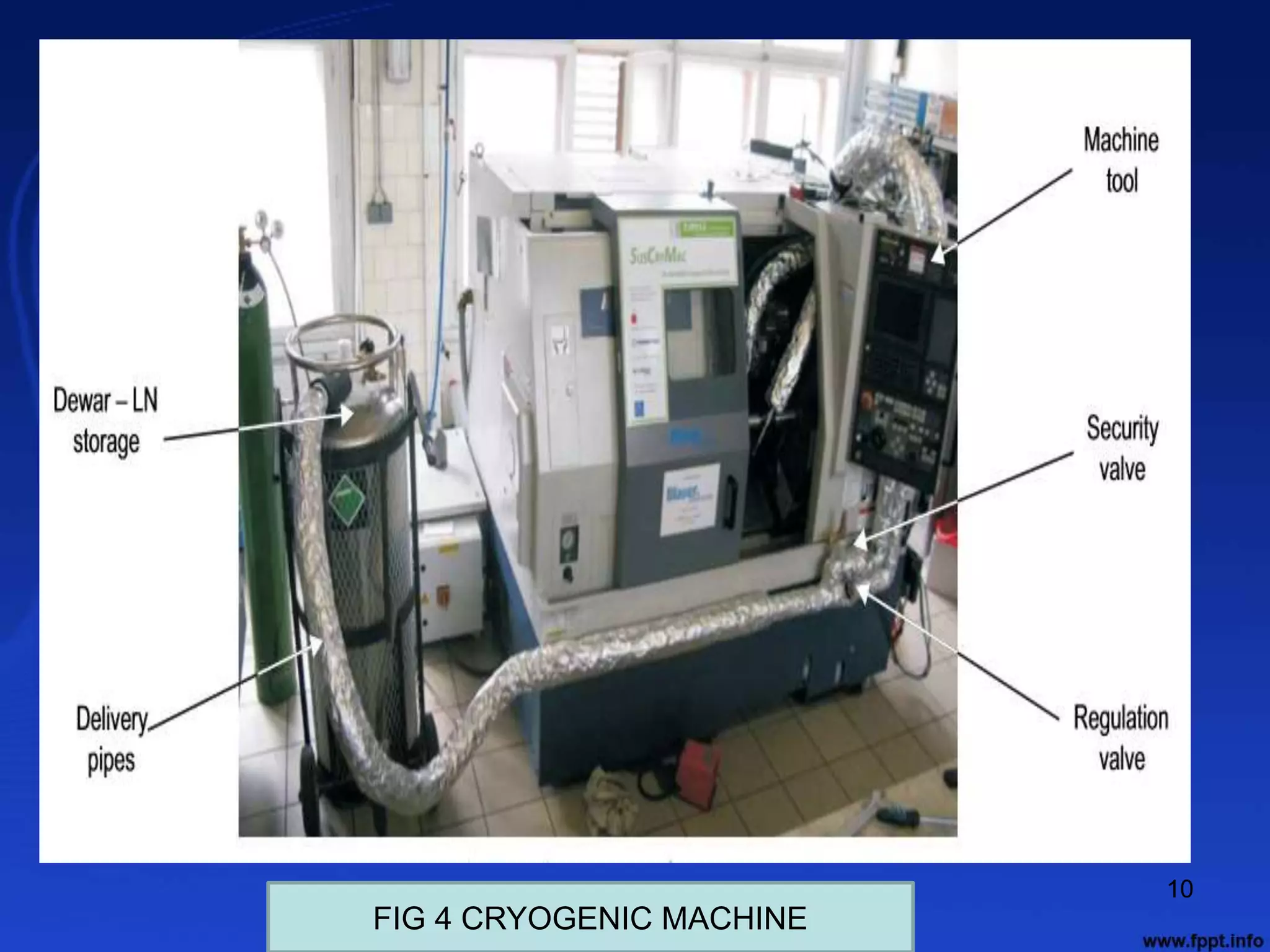
FIG 4 CRYOGENIC MACHINE
11
FIG 5
12FIG 6 NOZZLE
BENEFITS OF CRYOGENIC MACHINING
• sustainable machining methods (cleaner, safer,
environment friendly, more health acceptable,
etc.) to eliminate numerous costs associated
with conventional cutting fluids and clean-up
operations,
• increase of material removal rate without
increases in worn tool and tool change over
costs
• increase of productivity, - increasing cutting
speeds without increases in worn tool and tool
change over costs,
• increasing of tool life due to lower abrasion and
chemical wear,
13
• machining of hard parts and hard to machine
alloys, which in the past, could have been
produced only via expensive grinding
operations,
• surface roughness of machined work piece
improvement,
• produced parts quality improvement by
preventing mechanical and chemical
degradation of machined surface,
• potentially lower investment costs due to
reduction in number of machine tools required,
• improvement of manufacturing flexibility due to
reduced production times and high output,etc. 14
DUE TO
• Lower cutting temperatures in cutting zone,
• Improvement of chip breakability,
• Decreased BUE formation probability,
• Decreased of burr appearance probability,
• Inert environment assurance,
• No oil-based emulsion used,
• No additional processes needed,
• liquid nitrogen specifications,
• changes in material characteristics at lower
temperatures etc.
15
USE OF CRYOGENIC MACHINING.
 Steel and Iron harder than 45 HRC.
 Sinter-hardened or heat-treated powdered metals.
 Hard metal-matrix composites.
 Cobalt Chromium and other dfficult materials for medical
implants, especially where it is desirable to avoid the
possible contamination effects of metal cutting fluids.
 Polymers and plastics that machine better when frozen,
especially those intended for medical use. 16
ADVANTAGE
 Eco friendly
 High production rate are possible through higher material
removal rate.
 Tool life increases.
 Better surface finish
 Reduce machining time.
17
THE 5M'S OF EFFICIENCY
OF CRYOGENIC MACHINING
 MAN
Since liquid nitrogen evaporates into a non-toxic, non-
greenhouse gas, your workforce can breath easy in a clean
environment.
 MATERIAL
Perfect for difficult-to-machine materials, cryogenics offer
an amazing -400 degree cooling advantage over traditional
coolants.
 MACHINE
With 5ME's patented technology, almost any machine can
be retrofit to include state-of-the-art cryogenic cooling
technology. 18
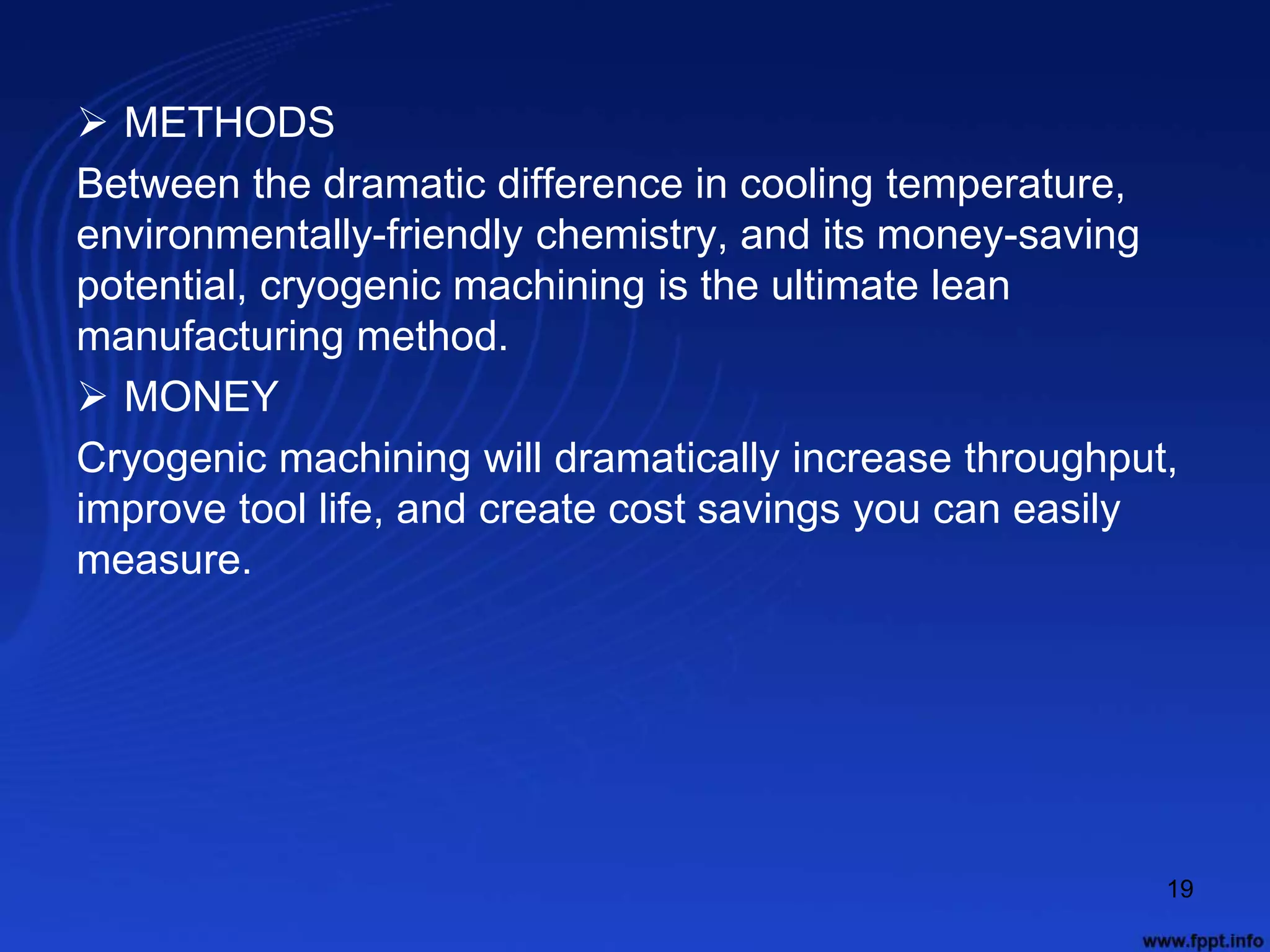
 METHODS
Between the dramatic difference in cooling temperature,
environmentally-friendly chemistry, and its money-saving
potential, cryogenic machining is the ultimate lean
manufacturing method.
 MONEY
Cryogenic machining will dramatically increase throughput,
improve tool life, and create cost savings you can easily
measure.
19
20
FIG 7 PARAMETER MEASUREMENT SETUP
TOOL-WEAR
• the commonly-known wear mechanisms are abrasive
wear, adhesive wear, diffusion wear, micro chipping,
fatigue, delamination wear.
• But only two wear play important role i.e abrasion
wear and build up edge wear.
• when the cutting speed is 50 m/min and feed rate is
0.125 mm/rev. Observing from the tool-wear images,
the abrasive flank wear is found in the nose areas for
all the three machining conditions.
• From fig it is clear that flank and nose wear is very
smaller.
21
8
22
FIG 8 TOOL WEAR OF MACHINING Ti ALLOY AT 50 m/min CUTTING
SPEED AND 0.125 mm/rev FEED RATE
FORCES
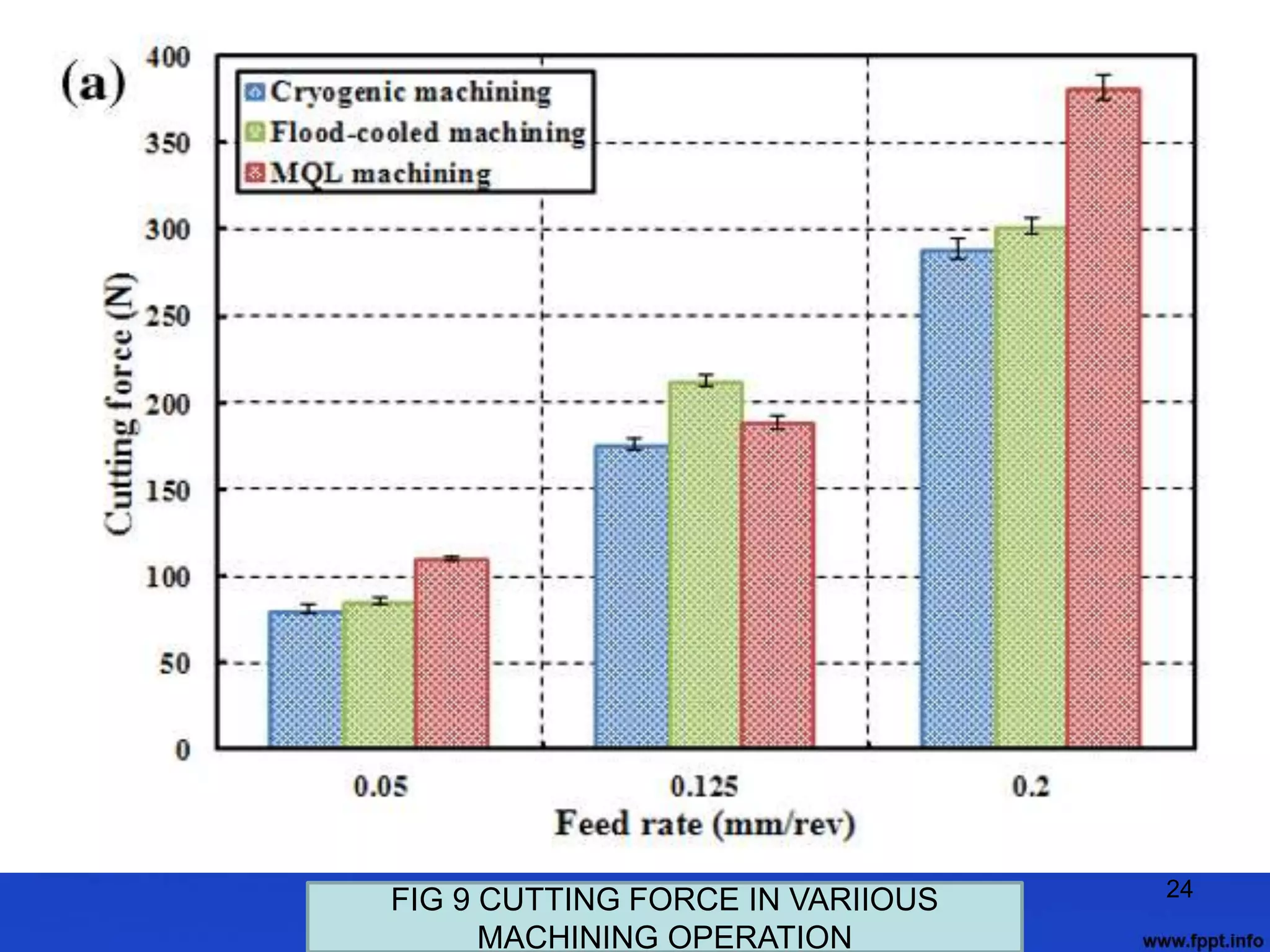
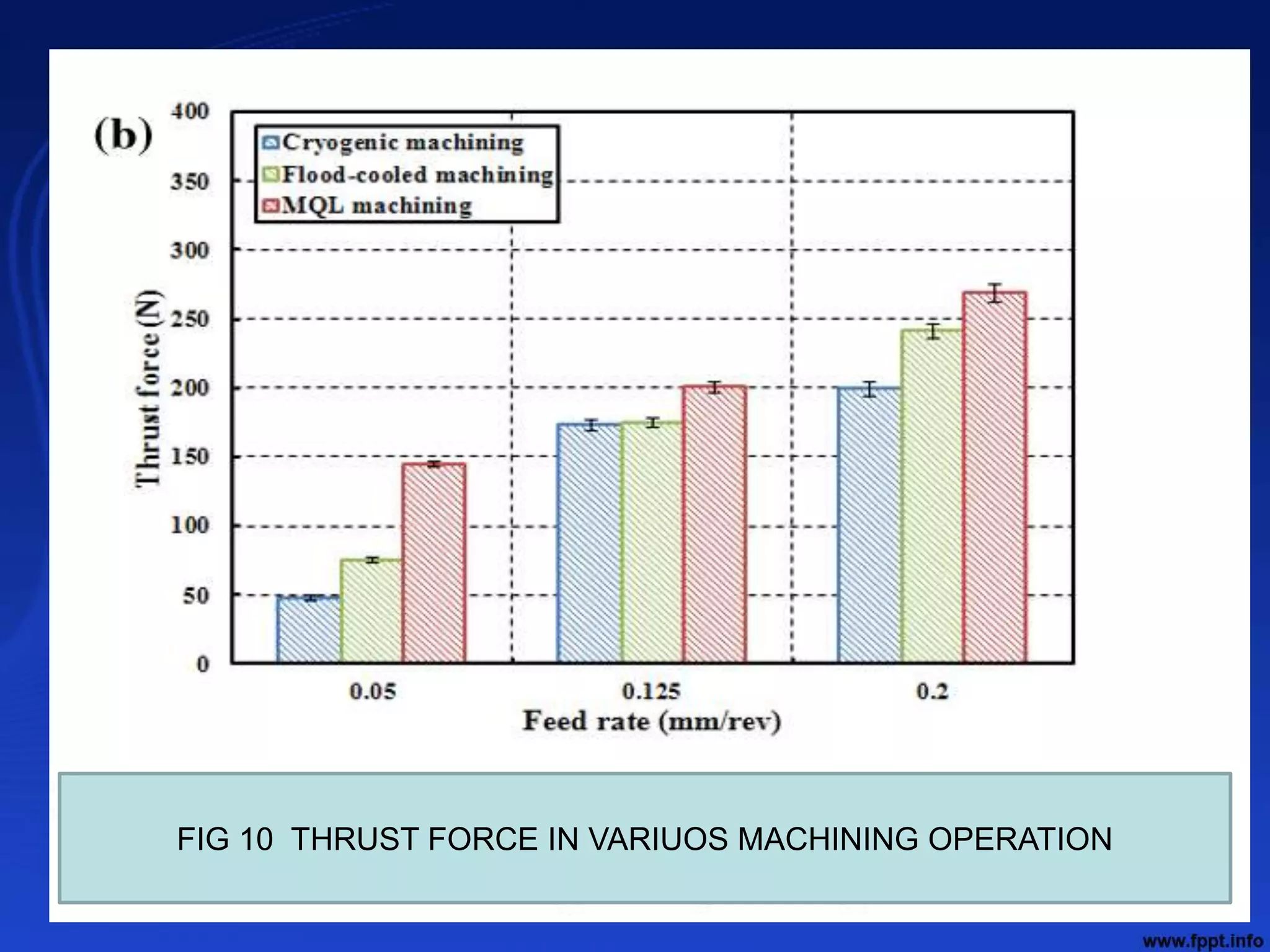
• Two force components are presented in this paper,
including cutting force parallel to the direction of cutting
speed and thrust force perpendicular to the cutting
speed direction. Three sets of the cutting and thrust
forces were measured when the cutting speed was 50
m/min and the feed rate were 0.05, 0.125 and 0.2
mm/rev under the flood-cooled, MQL and cryogenic
condition.
• The cutting force from cryogenic machining were
decreased by 6.3, 20.7 and 4.5%, respectively, but for
understanding we take reading at 0.2 mm/rev feed rate.
Dry cutting Flank cooling Rake cooling Both rake and flank
Measured 865 447 335 208
23
24
FIG 9 CUTTING FORCE IN VARIIOUS
MACHINING OPERATION
25
FIG 10 THRUST FORCE IN VARIUOS MACHINING OPERATION
SURFACE ROUGHNESS
• the distributions of surface roughness at three
different feed rates of 0.05, 0.125 and 0.2
mm/rev and the cutting speed of 50 m/min.
• The surface roughness increased with the
increasing feet rates in all the three cooling
conditions.
• The geometric expression shown by equation
Ra= f²/(32R)
• For low feed rates, the surface roughness
measured on the sample from cryogenic
machining is higher than that of flood cooled and
MQL machining.
26
27
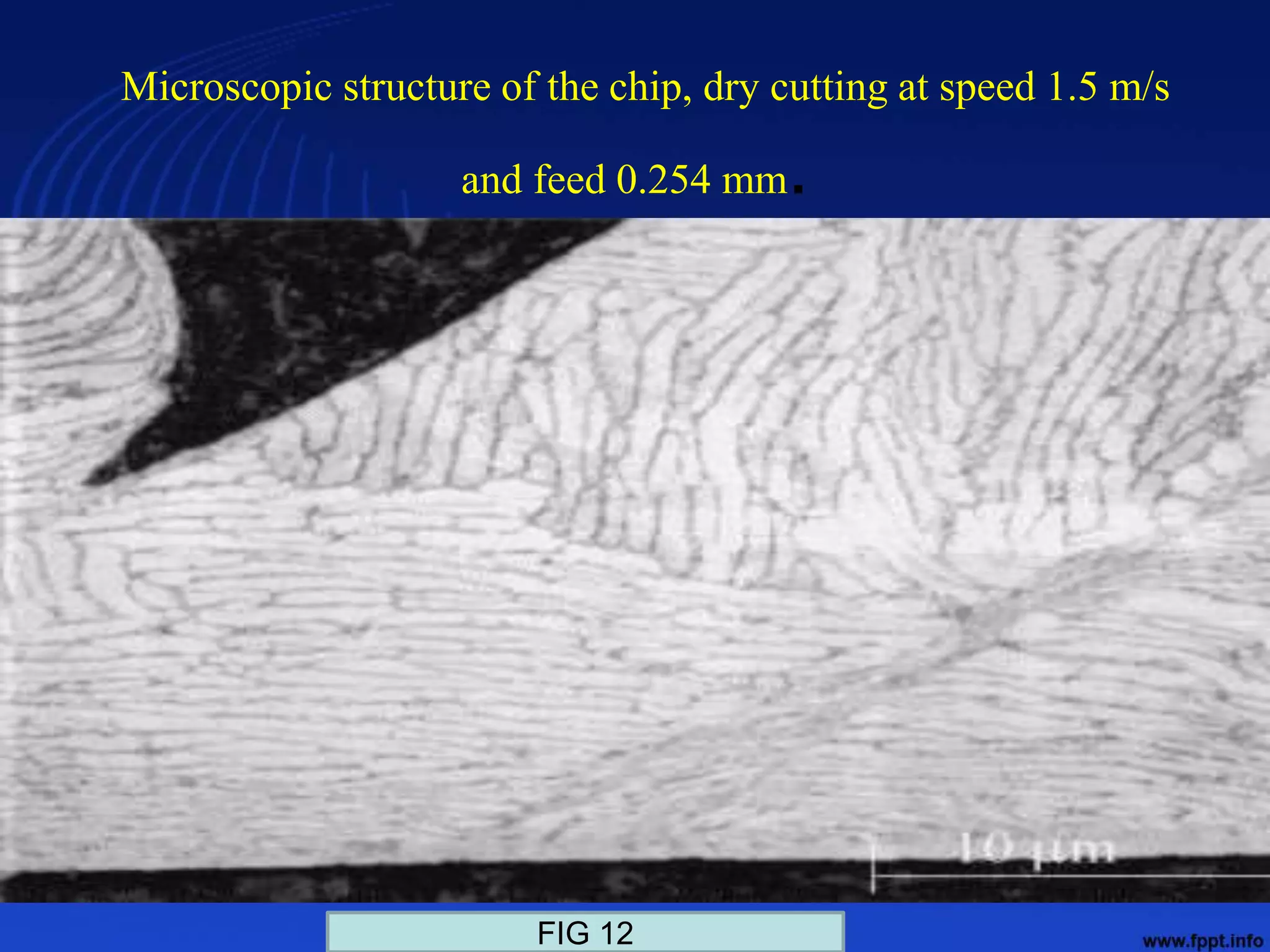
FIG 11
Microscopic structure of the chip, dry cutting at speed 1.5 m/s
and feed 0.254 mm.
28
FIG 12
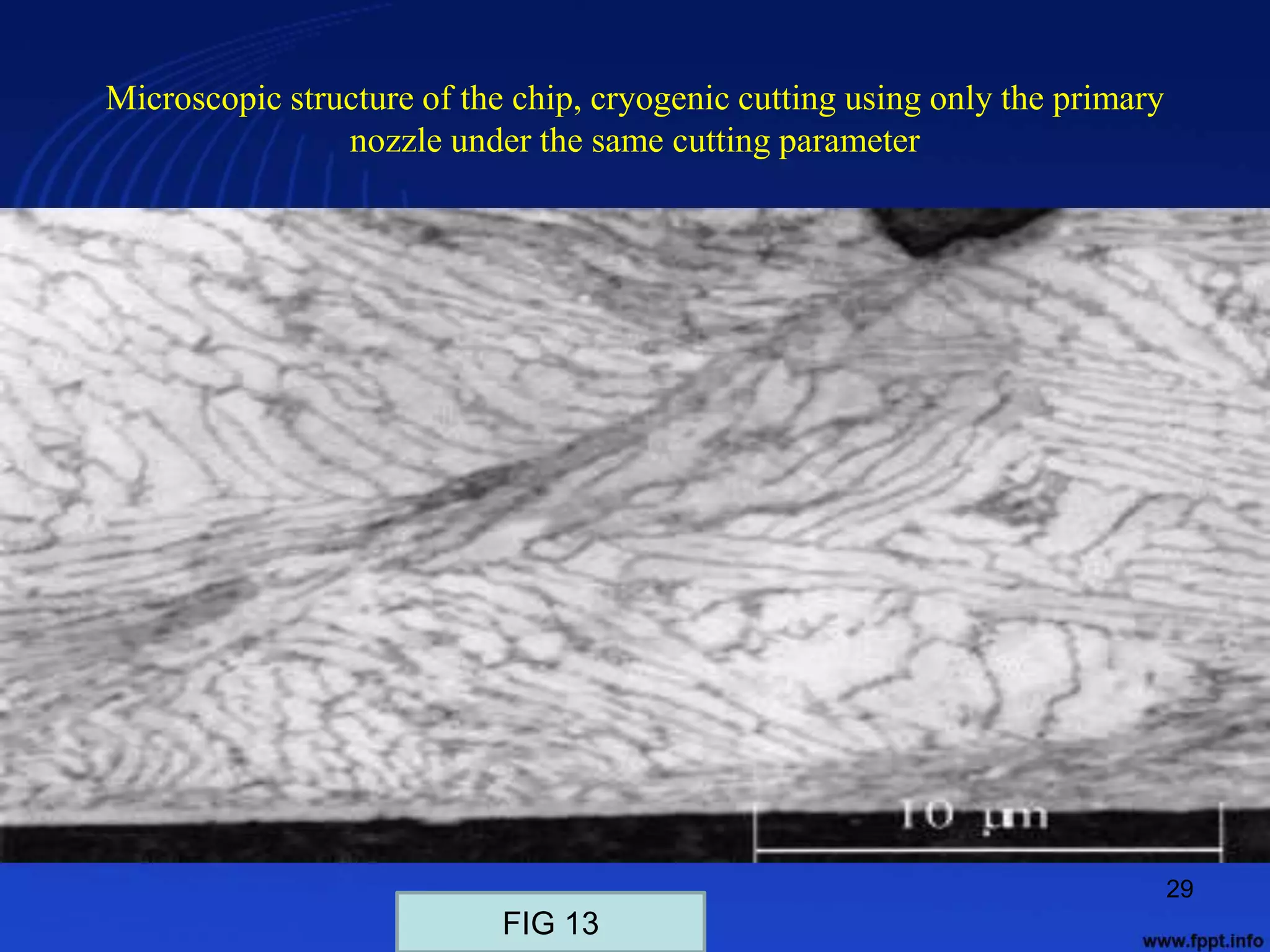
Microscopic structure of the chip, cryogenic cutting using only the primary
nozzle under the same cutting parameter
29
FIG 13
TOOL LIFE
• Table 1. Highest temperatures at the cutting tool insert
measured by the imbedded thermal couple at the tool
insert and obtained by finite element (FE) analysis and
their corresponding tool lives
• Cooling approach Measured (°C) LN2 flow rate (kg/min) Tool life (s)
• Dry cutting 865 N/A 167
Emulsion cooling 524 N/A 290
Cooling tool back 648 0.91 N/A
Pre-cooling 481 0.91 N/A
• workpiece by LN2
• 1 LN2 jet to flank 447 0.43 238
1 LN2 jet to rake 335 0.49 547
2 LN2 nozzles on 208 0.65 948
30
31
FIG 14
Coefficient of friction
32
FIG 15
ECONOMY
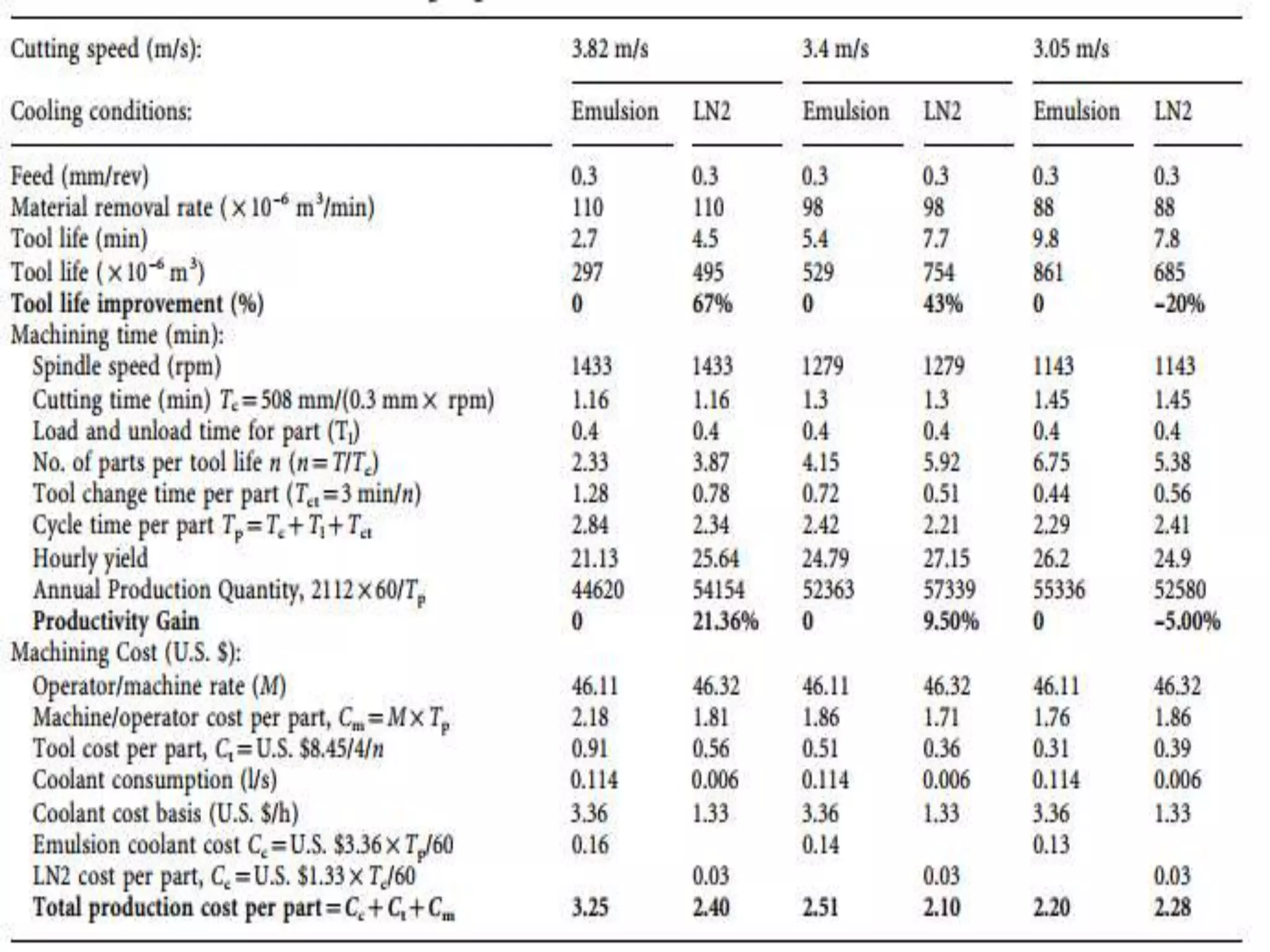
• Table 1. Production Rate and Production Cost Analysis In
Machining AISI304 Stainless Steel. Work piece
Specification: 304 stainless steel bar; diameter, 50.8 mm;
cutting length, 508 mm; cutting depth, 1.6 mm; Total volume
removal: 1.3!10–4 m3 ; Cutting condition: feed, 0.3 mm;
depth of cut, 1.6 mm; speed, as indicated.
33
34
35
FIG 16
RESULT
• cryogenic machining approach yields the best tool life
compared with any machining method from current
known sources.
• cryogenic machining there is reductions of feed force,
cutting force effective coefficient of friction between the
chip and the tool face.
• using cryogenic conditions and gaining higher
performances, lower environmental and health
influences, increased safety, etc
• Nose wear of the insert was improved in cryogenic
machining due to reduced material adhesion.
36
REFERENCE
• New cooling approach and tool life improvement in cryogenic
machining of titanium alloy Ti-6Al-4V Author links open
overlay panel Shane Y Hong Irel Markus Woo-cheol Jeong
• S. Hong, Economical and ecological cryogenic machining, J.
Manuf. Sci. Eng. 123 (2001).
• Friction and cutting forces in cryogenic machining of Ti–6Al–
4V by Shane YHongYuchengDingWoo-cheolJeong
• The role of cryogenics in machining processes franci pu avec,
antun stoi , janez kopa
• Enhanced Machinability of Ti-5553Alloy from Cryogenic
Machining: Comparison with MQL and Flood-cooled
Machining and Modeling Y. Suna*, B. Huanga, D.A. Puleob,
I.S. Jawahira
37
Thank you
38

Cryogenic ppt

  • 1.
  • 2.
    INTRODUCTION  Conventional cuttingfluid serves both as a coolant and lubricant. In cryogenic machining, liquid nitrogen (LN2) is recognized as an effective coolant due to its low temperature.  Because LN2 has different properties than the conventional cutting fluid, the method of applying it to the cutting process must be adjusted to gain the maximum benefit from LN2.  Cryogenic machining, with liquid nitrogen as the coolant, has been shown to be an effective method to significantly improve the surface integrity of manufactured components in terms of surface and surface hardness, microstructure modification, phase transformation, residual stress, fatigue life etc. 2
  • 3.
    HISTORY OF CRYOGENICMACHINING  Cryogenic machining was first investigated around 1953 by Bartley who used Liquid carbon dioxide as the coolant (Chattopadhyay et al 1985). Hollis (1961) has studied the effect of cryogenic cooling on the wear process of carbide tipped tools during the machining of titanium. . They were sprayed in the general cutting area or were applied to the work piece before cutting in a prechill. This method however consumed excessive amounts of cryogenic fluid and had no lubrication effect. Additionally this reflects high costs and present high complexity in delivering of cryo fluid to the cutting zone 3
  • 4.
    TODAY’S SCENARIO OFCRYOGENIC MACHINING  Today the process of liquefaction and storage system becomes more affordable, and there is a need to develop and rise the cryogenic machining on an industrial level. Due to price availability, temperature, etc. related to machining process characteristics and requirements, in this work as a cryogenic fluid liquid nitrogen (LN) is going to be used. 4
  • 5.
    LIQUID NITROGEN PRODUCTION. Liquefaction of air is done.  Compressor or generator compresses ,expanded and cooled the air.  Nitrogen boils at different temperature than oxygen the nitrogen can be distilled out of liquid air recompressed and then again re-liquefied.  liquid nitrogen is removed from the distillation chamber , it is stored either in a pressurized tank or a well insulated Dewar Flask. 5
  • 6.
  • 7.
  • 8.
    CRYOGENIC MACHINING • Cryogenicmachining presents a method of cooling the cutting tool and/or part during the machining process. More specifically, it relates to delivering of cryogenic (instead of an oil-based CLF) to the local cutting region of the cutting tool, which is exposed to the highest temperature during the machining process, or to the part in order to change the material characteristics and improve machining performance. • The cryogenic coolant used in this work is nitrogen fluid. 8
  • 9.
    Schematic Diagram ofCryogenic Machining 9 FIG 3 CRYOGENIC MACHINING SETUP
  • 10.
  • 11.
  • 12.
  • 13.
    BENEFITS OF CRYOGENICMACHINING • sustainable machining methods (cleaner, safer, environment friendly, more health acceptable, etc.) to eliminate numerous costs associated with conventional cutting fluids and clean-up operations, • increase of material removal rate without increases in worn tool and tool change over costs • increase of productivity, - increasing cutting speeds without increases in worn tool and tool change over costs, • increasing of tool life due to lower abrasion and chemical wear, 13
  • 14.
    • machining ofhard parts and hard to machine alloys, which in the past, could have been produced only via expensive grinding operations, • surface roughness of machined work piece improvement, • produced parts quality improvement by preventing mechanical and chemical degradation of machined surface, • potentially lower investment costs due to reduction in number of machine tools required, • improvement of manufacturing flexibility due to reduced production times and high output,etc. 14
  • 15.
    DUE TO • Lowercutting temperatures in cutting zone, • Improvement of chip breakability, • Decreased BUE formation probability, • Decreased of burr appearance probability, • Inert environment assurance, • No oil-based emulsion used, • No additional processes needed, • liquid nitrogen specifications, • changes in material characteristics at lower temperatures etc. 15
  • 16.
    USE OF CRYOGENICMACHINING.  Steel and Iron harder than 45 HRC.  Sinter-hardened or heat-treated powdered metals.  Hard metal-matrix composites.  Cobalt Chromium and other dfficult materials for medical implants, especially where it is desirable to avoid the possible contamination effects of metal cutting fluids.  Polymers and plastics that machine better when frozen, especially those intended for medical use. 16
  • 17.
    ADVANTAGE  Eco friendly High production rate are possible through higher material removal rate.  Tool life increases.  Better surface finish  Reduce machining time. 17
  • 18.
    THE 5M'S OFEFFICIENCY OF CRYOGENIC MACHINING  MAN Since liquid nitrogen evaporates into a non-toxic, non- greenhouse gas, your workforce can breath easy in a clean environment.  MATERIAL Perfect for difficult-to-machine materials, cryogenics offer an amazing -400 degree cooling advantage over traditional coolants.  MACHINE With 5ME's patented technology, almost any machine can be retrofit to include state-of-the-art cryogenic cooling technology. 18
  • 19.
     METHODS Between thedramatic difference in cooling temperature, environmentally-friendly chemistry, and its money-saving potential, cryogenic machining is the ultimate lean manufacturing method.  MONEY Cryogenic machining will dramatically increase throughput, improve tool life, and create cost savings you can easily measure. 19
  • 20.
    20 FIG 7 PARAMETERMEASUREMENT SETUP
  • 21.
    TOOL-WEAR • the commonly-knownwear mechanisms are abrasive wear, adhesive wear, diffusion wear, micro chipping, fatigue, delamination wear. • But only two wear play important role i.e abrasion wear and build up edge wear. • when the cutting speed is 50 m/min and feed rate is 0.125 mm/rev. Observing from the tool-wear images, the abrasive flank wear is found in the nose areas for all the three machining conditions. • From fig it is clear that flank and nose wear is very smaller. 21
  • 22.
    8 22 FIG 8 TOOLWEAR OF MACHINING Ti ALLOY AT 50 m/min CUTTING SPEED AND 0.125 mm/rev FEED RATE
  • 23.
    FORCES • Two forcecomponents are presented in this paper, including cutting force parallel to the direction of cutting speed and thrust force perpendicular to the cutting speed direction. Three sets of the cutting and thrust forces were measured when the cutting speed was 50 m/min and the feed rate were 0.05, 0.125 and 0.2 mm/rev under the flood-cooled, MQL and cryogenic condition. • The cutting force from cryogenic machining were decreased by 6.3, 20.7 and 4.5%, respectively, but for understanding we take reading at 0.2 mm/rev feed rate. Dry cutting Flank cooling Rake cooling Both rake and flank Measured 865 447 335 208 23
  • 24.
    24 FIG 9 CUTTINGFORCE IN VARIIOUS MACHINING OPERATION
  • 25.
    25 FIG 10 THRUSTFORCE IN VARIUOS MACHINING OPERATION
  • 26.
    SURFACE ROUGHNESS • thedistributions of surface roughness at three different feed rates of 0.05, 0.125 and 0.2 mm/rev and the cutting speed of 50 m/min. • The surface roughness increased with the increasing feet rates in all the three cooling conditions. • The geometric expression shown by equation Ra= f²/(32R) • For low feed rates, the surface roughness measured on the sample from cryogenic machining is higher than that of flood cooled and MQL machining. 26
  • 27.
  • 28.
    Microscopic structure ofthe chip, dry cutting at speed 1.5 m/s and feed 0.254 mm. 28 FIG 12
  • 29.
    Microscopic structure ofthe chip, cryogenic cutting using only the primary nozzle under the same cutting parameter 29 FIG 13
  • 30.
    TOOL LIFE • Table1. Highest temperatures at the cutting tool insert measured by the imbedded thermal couple at the tool insert and obtained by finite element (FE) analysis and their corresponding tool lives • Cooling approach Measured (°C) LN2 flow rate (kg/min) Tool life (s) • Dry cutting 865 N/A 167 Emulsion cooling 524 N/A 290 Cooling tool back 648 0.91 N/A Pre-cooling 481 0.91 N/A • workpiece by LN2 • 1 LN2 jet to flank 447 0.43 238 1 LN2 jet to rake 335 0.49 547 2 LN2 nozzles on 208 0.65 948 30
  • 31.
  • 32.
  • 33.
    ECONOMY • Table 1.Production Rate and Production Cost Analysis In Machining AISI304 Stainless Steel. Work piece Specification: 304 stainless steel bar; diameter, 50.8 mm; cutting length, 508 mm; cutting depth, 1.6 mm; Total volume removal: 1.3!10–4 m3 ; Cutting condition: feed, 0.3 mm; depth of cut, 1.6 mm; speed, as indicated. 33
  • 34.
  • 35.
  • 36.
    RESULT • cryogenic machiningapproach yields the best tool life compared with any machining method from current known sources. • cryogenic machining there is reductions of feed force, cutting force effective coefficient of friction between the chip and the tool face. • using cryogenic conditions and gaining higher performances, lower environmental and health influences, increased safety, etc • Nose wear of the insert was improved in cryogenic machining due to reduced material adhesion. 36
  • 37.
    REFERENCE • New coolingapproach and tool life improvement in cryogenic machining of titanium alloy Ti-6Al-4V Author links open overlay panel Shane Y Hong Irel Markus Woo-cheol Jeong • S. Hong, Economical and ecological cryogenic machining, J. Manuf. Sci. Eng. 123 (2001). • Friction and cutting forces in cryogenic machining of Ti–6Al– 4V by Shane YHongYuchengDingWoo-cheolJeong • The role of cryogenics in machining processes franci pu avec, antun stoi , janez kopa • Enhanced Machinability of Ti-5553Alloy from Cryogenic Machining: Comparison with MQL and Flood-cooled Machining and Modeling Y. Suna*, B. Huanga, D.A. Puleob, I.S. Jawahira 37
  • 38.