



Mansoor Masjedi MD
Associate prof. of anesthesia , Critical care consultant
Instructor of AHA , ICU BASIC course & Instructor potential of ATLS
Director and Founder of BLS & ACLS courses @ Shiraz University of Medical
Sciences
Head of the 1st dedicated , standard , university affiliated CPR Training Center in
Iran
2nd june 2020
CPR in the COVID 19 era
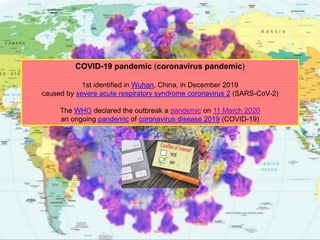
COVID-19 pandemic (coronavirus pandemic)
1st identified in Wuhan, China, in December 2019
caused by severe acute respiratory syndrome coronavirus 2 (SARS-CoV-2)
The WHO declared the outbreak a pandemic on 11 March 2020
an ongoing pandemic of coronavirus disease 2019 (COVID-19)
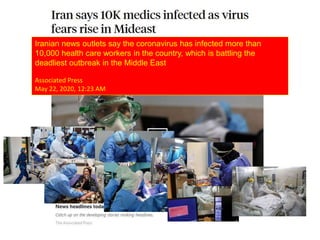
Iranian news outlets say the coronavirus has infected more than
10,000 health care workers in the country, which is battling the
deadliest outbreak in the Middle East
Associated Press
May 22, 2020, 12:23 AM
Ok ,
What should we get into our
heads regarding
CPR in the COVID 19 era
Abbreviations used in this presentation
 ILCOR: International Liaison Committee on
Resuscitation
 AHA : American Heart Association
 ERC : European Resuscitation Council
 FCTC : Fars Cardiopulmonary Resuscitation
Training Center
 OHCA : Out of Hospital Cardiac Arrest
 IHCA : In Hospital Cardiac Arrest
 BLS : Basic Life Support
 ACLS : Advanced Cardiovascular Life
Support
 PALS : Pediatric Advanced Life Support
 NRP : Neonatal Resuscitation Program
 HCW : Health Care Worker
 AGP : Aerosol Generating Procedure
 ROSC : Return Of Spontaneous Circulation
 HEPA : High- efficiency particulate air
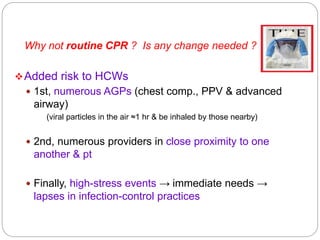
Added risk to HCWs
 1st, numerous AGPs (chest comp., PPV & advanced
airway)
(viral particles in the air ≈1 hr & be inhaled by those nearby)
 2nd, numerous providers in close proximity to one
another & pt
 Finally, high-stress events → immediate needs →
lapses in infection-control practices
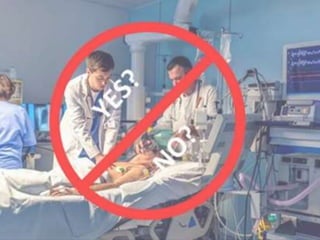
Why not routine CPR ? Is any change needed ?
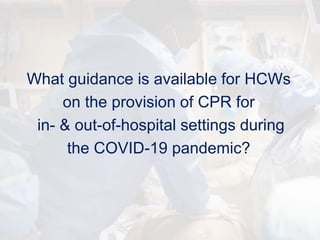
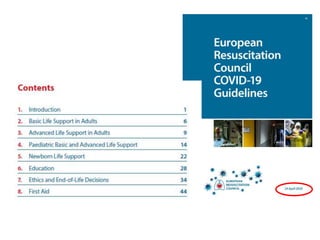
What guidance is available for HCWs
on the provision of CPR for
in- & out-of-hospital settings during
the COVID-19 pandemic?
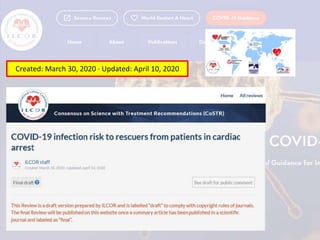
Created: March 30, 2020 · Updated: April 10, 2020
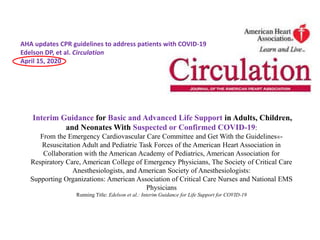
AHA updates CPR guidelines to address patients with COVID-19
Edelson DP, et al. Circulation
April 15, 2020
Interim Guidance for Basic and Advanced Life Support in Adults, Children,
and Neonates With Suspected or Confirmed COVID-19:
From the Emergency Cardiovascular Care Committee and Get With the Guidelines®-
Resuscitation Adult and Pediatric Task Forces of the American Heart Association in
Collaboration with the American Academy of Pediatrics, American Association for
Respiratory Care, American College of Emergency Physicians, The Society of Critical Care
Anesthesiologists, and American Society of Anesthesiologists:
Supporting Organizations: American Association of Critical Care Nurses and National EMS
Physicians
Running Title: Edelson et al.: Interim Guidance for Life Support for COVID-19
Guidances are based on expert opinion & limited studies
so
needs to be adapted locally
based on
current disease burden & resource availability
General Principles for Resuscitation in
Suspected & Confirmed COVID-19 Pts
WHO describe two modes for transmission of COVID-19
droplet & airborne
1. Droplet : direct contact with the pt or indirect contact with surrounding environment
2. Airborne : during aerosol generating procedures
CPR is
an AGP
• 12-19% of COVID positive pts – require hospitalization
• 3-6% - critically ill
• 2-3% - die
• Common causes of Cardiac arrest :
• Hypoxemic respiratory failure secondary to ARDS
• myocardial injury
• ventricular arrhythmias
• Shock
• Some treatments, such as hydroxychloroquine and azithromycin
(QT prolongation )
1/ COVID-19 / background
2 / Reduction of Risk to Rescuers
a) Anticipation & Prevention of Cardiac Arrest
b) Appropriateness of Starting & Continuing Resuscitation Efforts
c) Effective Communication
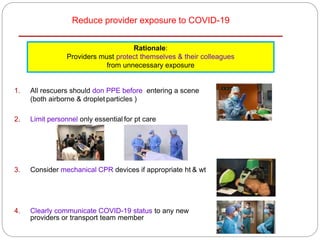
Reduce provider exposure to COVID-19
1. All rescuers should don PPE before entering a scene
(both airborne & droplet particles )
2. Limit personnel only essential for pt care
3. Consider mechanical CPR devices if appropriate ht & wt
4. Clearly communicate COVID-19 status to any new
providers or transport team member
Rationale:
Providers must protect themselves & their colleagues
from unnecessary exposure
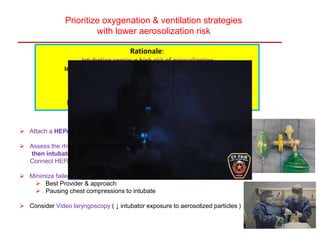
Prioritize oxygenation & ventilation strategies
with lower aerosolization risk
Rationale:
Intubation carries a high risk of aerosolization
Intubated pt. with a cuffed ETT connected to a ventilator
with a HEPA filter in the path of exhaled gas &
an in-line suction catheter
lower risk of aerosolization than any other form of PPV
 Attach a HEPA filter to any manual or mechanical ventilation device
 Assess the rhythm & defibrillate any vent. arrhythmias,
then intubate with a cuffed tube ASAP
Connect HEPA f. to ETT
 Minimize failed intubation by
 Best Provider & approach
 Pausing chest compressions to intubate
 Consider Video laryngoscopy ( ↓ intubator exposure to aerosolized particles )
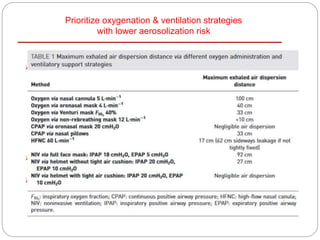
Prioritize oxygenation & ventilation strategies
with lower aerosolization risk
 Before intubation
 Use a bag-mask device (or T-piece in neonates) with a HEPA
filter & a tight seal or
 Passive oxygenation with non-rebreathing face mask (NRFM),
covered by a surgical mask
 Delayed intubation → SGA or BVM with a HEPA f.
 Once on a closed circuit, minimize disconnections
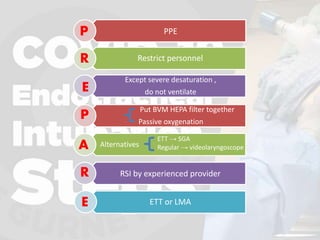
PPE
Restrict personnel
Except severe desaturation ,
do not ventilate
Put BVM HEPA filter together
Passive oxygenation
Alternatives
RSI by experienced provider
ETT or LMA
P
R
E
P
A
R
E
ETT → SGA
Regular → videolaryngoscope
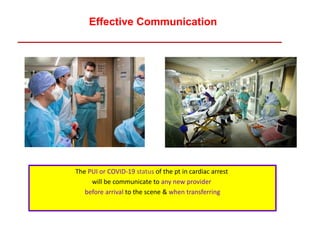
Effective Communication
The PUI or COVID-19 status of the pt in cardiac arrest
will be communicate to any new provider
before arrival to the scene & when transferring
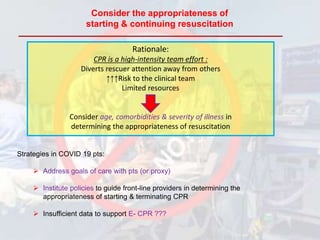
Consider the appropriateness of
starting & continuing resuscitation
Rationale:
CPR is a high-intensity team effort :
Diverts rescuer attention away from others
↑↑↑Risk to the clinical team
Limited resources
Consider age, comorbidities & severity of illness in
determining the appropriateness of resuscitation
Strategies in COVID 19 pts:
 Address goals of care with pts (or proxy)
 Institute policies to guide front-line providers in determining the
appropriateness of starting & terminating CPR
 Insufficient data to support E- CPR ???
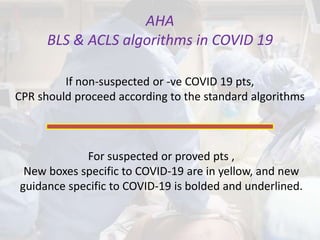
If non-suspected or -ve COVID 19 pts,
CPR should proceed according to the standard algorithms
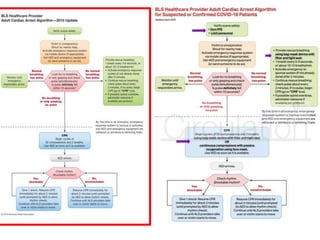
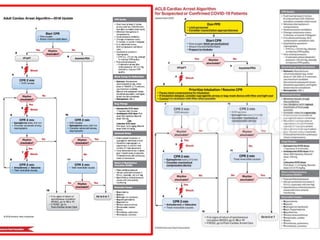
For suspected or proved pts ,
New boxes specific to COVID-19 are in yellow, and new
guidance specific to COVID-19 is bolded and underlined.
AHA
BLS & ACLS algorithms in COVID 19
Situation- & Setting-
Specific Considerations
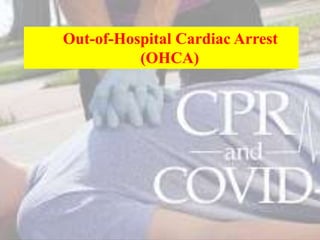
Out-of-Hospital Cardiac Arrest
(OHCA)
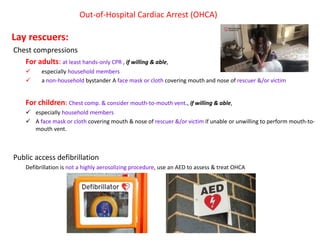
Out-of-Hospital Cardiac Arrest (OHCA)
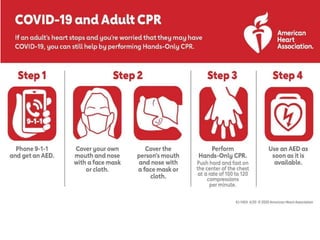
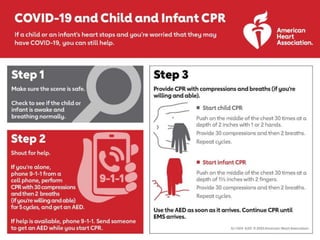
Lay rescuers:
Chest compressions
For adults: at least hands-only CPR , if willing & able,
 especially household members
 a non-household bystander A face mask or cloth covering mouth and nose of rescuer &/or victim
For children: Chest comp. & consider mouth-to-mouth vent., if willing & able,
 especially household members
 A face mask or cloth covering mouth & nose of rescuer &/or victim if unable or unwilling to perform mouth-to-
mouth vent.
Public access defibrillation
Defibrillation is not a highly aerosolizing procedure, use an AED to assess & treat OHCA
Out-of-Hospital Cardiac Arrest (OHCA)
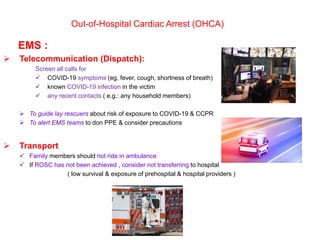
EMS :
 Telecommunication (Dispatch):
Screen all calls for
 COVID-19 symptoms (eg, fever, cough, shortness of breath)
 known COVID-19 infection in the victim
 any recent contacts ( e.g.: any household members)
 To guide lay rescuers about risk of exposure to COVID-19 & CCPR
 To alert EMS teams to don PPE & consider precautions
 Transport
 Family members should not ride in ambulance
 If ROSC has not been achieved , consider not transferring to hospital
( low survival & exposure of prehospital & hospital providers )
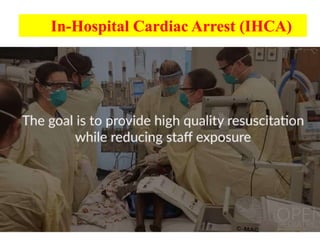
In-Hospital Cardiac Arrest (IHCA)
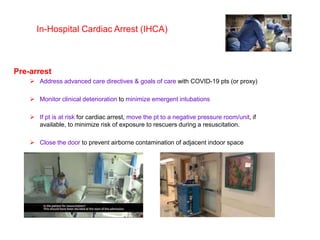
Pre-arrest
 Address advanced care directives & goals of care with COVID-19 pts (or proxy)
 Monitor clinical deterioration to minimize emergent intubations
 If pt is at risk for cardiac arrest, move the pt to a negative pressure room/unit, if
available, to minimize risk of exposure to rescuers during a resuscitation.
 Close the door to prevent airborne contamination of adjacent indoor space
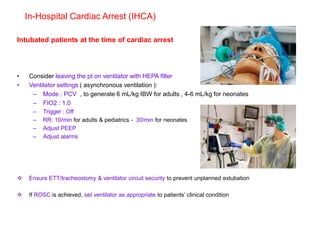
Intubated patients at the time of cardiac arrest
• Consider leaving the pt on ventilator with HEPA filter
• Ventilator settings ( asynchronous ventilation ):
– Mode : PCV , to generate 6 mL/kg IBW for adults , 4-6 mL/kg for neonates
– FIO2 : 1.0
– Trigger : Off
– RR: 10/min for adults & pediatrics - 30/min for neonates
– Adjust PEEP
– Adjust alarms
 Ensure ETT/tracheostomy & ventilator circuit security to prevent unplanned extubation
 If ROSC is achieved, set ventilator as appropriate to patients’ clinical condition
In-Hospital Cardiac Arrest (IHCA)
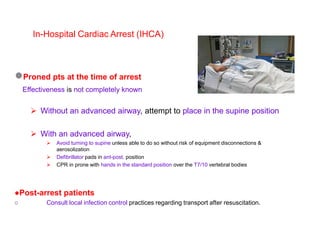
●Proned pts at the time of arrest
Effectiveness is not completely known
 Without an advanced airway, attempt to place in the supine position
 With an advanced airway,
 Avoid turning to supine unless able to do so without risk of equipment disconnections &
aerosolization
 Defibrillator pads in ant-post. position
 CPR in prone with hands in the standard position over the T7/10 vertebral bodies
●Post-arrest patients
○ Consult local infection control practices regarding transport after resuscitation.
MATERNAL AND NEONATAL
CONSIDERATIONS
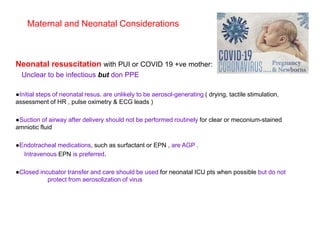
Neonatal resuscitation with PUI or COVID 19 +ve mother:
Unclear to be infectious but don PPE
●Initial steps of neonatal resus. are unlikely to be aerosol-generating ( drying, tactile stimulation,
assessment of HR , pulse oximetry & ECG leads )
●Suction of airway after delivery should not be performed routinely for clear or meconium-stained
amniotic fluid
●Endotracheal medications, such as surfactant or EPN , are AGP .
Intravenous EPN is preferred.
●Closed incubator transfer and care should be used for neonatal ICU pts when possible but do not
protect from aerosolization of virus
Maternal and Neonatal Considerations
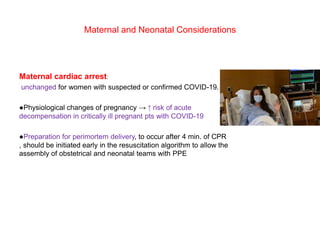
Maternal cardiac arrest:
unchanged for women with suspected or confirmed COVID-19.
●Physiological changes of pregnancy → ↑ risk of acute
decompensation in critically ill pregnant pts with COVID-19
●Preparation for perimortem delivery, to occur after 4 min. of CPR
, should be initiated early in the resuscitation algorithm to allow the
assembly of obstetrical and neonatal teams with PPE
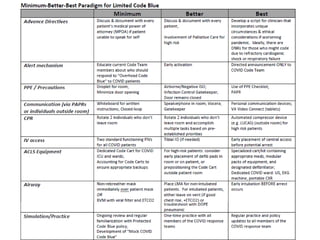
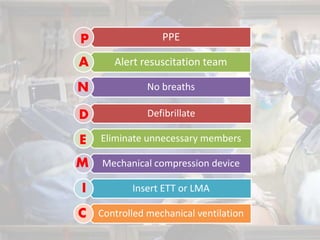
Wrap it up
PPE
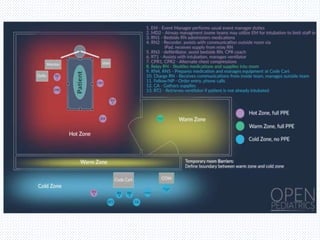
Alert resuscitation team
No breaths
Defibrillate
Eliminate unnecessary members
Mechanical compression device
Insert ETT or LMA
Controlled mechanical ventilation
P
A
N
D
E
M
I
C
Some Valuable & Reliable Sites
• https://www.ilcor.org/
• https://www.heart.org/en/coronavirus
• https://www.erc.edu/
we all together will conquer covid 19

CPR during the COVID-19 era

  • 1.
    Mansoor Masjedi MD Associateprof. of anesthesia , Critical care consultant Instructor of AHA , ICU BASIC course & Instructor potential of ATLS Director and Founder of BLS & ACLS courses @ Shiraz University of Medical Sciences Head of the 1st dedicated , standard , university affiliated CPR Training Center in Iran 2nd june 2020 CPR in the COVID 19 era
  • 2.
    COVID-19 pandemic (coronaviruspandemic) 1st identified in Wuhan, China, in December 2019 caused by severe acute respiratory syndrome coronavirus 2 (SARS-CoV-2) The WHO declared the outbreak a pandemic on 11 March 2020 an ongoing pandemic of coronavirus disease 2019 (COVID-19)
  • 4.
    Iranian news outletssay the coronavirus has infected more than 10,000 health care workers in the country, which is battling the deadliest outbreak in the Middle East Associated Press May 22, 2020, 12:23 AM
  • 6.
    Ok , What shouldwe get into our heads regarding CPR in the COVID 19 era
  • 7.
    Abbreviations used inthis presentation  ILCOR: International Liaison Committee on Resuscitation  AHA : American Heart Association  ERC : European Resuscitation Council  FCTC : Fars Cardiopulmonary Resuscitation Training Center  OHCA : Out of Hospital Cardiac Arrest  IHCA : In Hospital Cardiac Arrest  BLS : Basic Life Support  ACLS : Advanced Cardiovascular Life Support  PALS : Pediatric Advanced Life Support  NRP : Neonatal Resuscitation Program  HCW : Health Care Worker  AGP : Aerosol Generating Procedure  ROSC : Return Of Spontaneous Circulation  HEPA : High- efficiency particulate air
  • 8.
    Added risk toHCWs  1st, numerous AGPs (chest comp., PPV & advanced airway) (viral particles in the air ≈1 hr & be inhaled by those nearby)  2nd, numerous providers in close proximity to one another & pt  Finally, high-stress events → immediate needs → lapses in infection-control practices Why not routine CPR ? Is any change needed ?
  • 9.
    What guidance isavailable for HCWs on the provision of CPR for in- & out-of-hospital settings during the COVID-19 pandemic?
  • 10.
    Created: March 30,2020 · Updated: April 10, 2020
  • 11.
    AHA updates CPRguidelines to address patients with COVID-19 Edelson DP, et al. Circulation April 15, 2020 Interim Guidance for Basic and Advanced Life Support in Adults, Children, and Neonates With Suspected or Confirmed COVID-19: From the Emergency Cardiovascular Care Committee and Get With the Guidelines®- Resuscitation Adult and Pediatric Task Forces of the American Heart Association in Collaboration with the American Academy of Pediatrics, American Association for Respiratory Care, American College of Emergency Physicians, The Society of Critical Care Anesthesiologists, and American Society of Anesthesiologists: Supporting Organizations: American Association of Critical Care Nurses and National EMS Physicians Running Title: Edelson et al.: Interim Guidance for Life Support for COVID-19
  • 13.
    Guidances are basedon expert opinion & limited studies so needs to be adapted locally based on current disease burden & resource availability
  • 14.
    General Principles forResuscitation in Suspected & Confirmed COVID-19 Pts
  • 15.
    WHO describe twomodes for transmission of COVID-19 droplet & airborne 1. Droplet : direct contact with the pt or indirect contact with surrounding environment 2. Airborne : during aerosol generating procedures CPR is an AGP
  • 16.
    • 12-19% ofCOVID positive pts – require hospitalization • 3-6% - critically ill • 2-3% - die • Common causes of Cardiac arrest : • Hypoxemic respiratory failure secondary to ARDS • myocardial injury • ventricular arrhythmias • Shock • Some treatments, such as hydroxychloroquine and azithromycin (QT prolongation ) 1/ COVID-19 / background
  • 17.
    2 / Reductionof Risk to Rescuers a) Anticipation & Prevention of Cardiac Arrest b) Appropriateness of Starting & Continuing Resuscitation Efforts c) Effective Communication
  • 18.
    Reduce provider exposureto COVID-19 1. All rescuers should don PPE before entering a scene (both airborne & droplet particles ) 2. Limit personnel only essential for pt care 3. Consider mechanical CPR devices if appropriate ht & wt 4. Clearly communicate COVID-19 status to any new providers or transport team member Rationale: Providers must protect themselves & their colleagues from unnecessary exposure
  • 19.
    Prioritize oxygenation &ventilation strategies with lower aerosolization risk Rationale: Intubation carries a high risk of aerosolization Intubated pt. with a cuffed ETT connected to a ventilator with a HEPA filter in the path of exhaled gas & an in-line suction catheter lower risk of aerosolization than any other form of PPV  Attach a HEPA filter to any manual or mechanical ventilation device  Assess the rhythm & defibrillate any vent. arrhythmias, then intubate with a cuffed tube ASAP Connect HEPA f. to ETT  Minimize failed intubation by  Best Provider & approach  Pausing chest compressions to intubate  Consider Video laryngoscopy ( ↓ intubator exposure to aerosolized particles )
  • 20.
    Prioritize oxygenation &ventilation strategies with lower aerosolization risk  Before intubation  Use a bag-mask device (or T-piece in neonates) with a HEPA filter & a tight seal or  Passive oxygenation with non-rebreathing face mask (NRFM), covered by a surgical mask  Delayed intubation → SGA or BVM with a HEPA f.  Once on a closed circuit, minimize disconnections
  • 21.
    PPE Restrict personnel Except severedesaturation , do not ventilate Put BVM HEPA filter together Passive oxygenation Alternatives RSI by experienced provider ETT or LMA P R E P A R E ETT → SGA Regular → videolaryngoscope
  • 22.
    Effective Communication The PUIor COVID-19 status of the pt in cardiac arrest will be communicate to any new provider before arrival to the scene & when transferring
  • 24.
    Consider the appropriatenessof starting & continuing resuscitation Rationale: CPR is a high-intensity team effort : Diverts rescuer attention away from others ↑↑↑Risk to the clinical team Limited resources Consider age, comorbidities & severity of illness in determining the appropriateness of resuscitation Strategies in COVID 19 pts:  Address goals of care with pts (or proxy)  Institute policies to guide front-line providers in determining the appropriateness of starting & terminating CPR  Insufficient data to support E- CPR ???
  • 26.
    If non-suspected or-ve COVID 19 pts, CPR should proceed according to the standard algorithms For suspected or proved pts , New boxes specific to COVID-19 are in yellow, and new guidance specific to COVID-19 is bolded and underlined. AHA BLS & ACLS algorithms in COVID 19
  • 29.
  • 30.
  • 31.
    Out-of-Hospital Cardiac Arrest(OHCA) Lay rescuers: Chest compressions For adults: at least hands-only CPR , if willing & able,  especially household members  a non-household bystander A face mask or cloth covering mouth and nose of rescuer &/or victim For children: Chest comp. & consider mouth-to-mouth vent., if willing & able,  especially household members  A face mask or cloth covering mouth & nose of rescuer &/or victim if unable or unwilling to perform mouth-to- mouth vent. Public access defibrillation Defibrillation is not a highly aerosolizing procedure, use an AED to assess & treat OHCA
  • 32.
    Out-of-Hospital Cardiac Arrest(OHCA) EMS :  Telecommunication (Dispatch): Screen all calls for  COVID-19 symptoms (eg, fever, cough, shortness of breath)  known COVID-19 infection in the victim  any recent contacts ( e.g.: any household members)  To guide lay rescuers about risk of exposure to COVID-19 & CCPR  To alert EMS teams to don PPE & consider precautions  Transport  Family members should not ride in ambulance  If ROSC has not been achieved , consider not transferring to hospital ( low survival & exposure of prehospital & hospital providers )
  • 33.
  • 34.
    In-Hospital Cardiac Arrest(IHCA) Pre-arrest  Address advanced care directives & goals of care with COVID-19 pts (or proxy)  Monitor clinical deterioration to minimize emergent intubations  If pt is at risk for cardiac arrest, move the pt to a negative pressure room/unit, if available, to minimize risk of exposure to rescuers during a resuscitation.  Close the door to prevent airborne contamination of adjacent indoor space
  • 35.
    Intubated patients atthe time of cardiac arrest • Consider leaving the pt on ventilator with HEPA filter • Ventilator settings ( asynchronous ventilation ): – Mode : PCV , to generate 6 mL/kg IBW for adults , 4-6 mL/kg for neonates – FIO2 : 1.0 – Trigger : Off – RR: 10/min for adults & pediatrics - 30/min for neonates – Adjust PEEP – Adjust alarms  Ensure ETT/tracheostomy & ventilator circuit security to prevent unplanned extubation  If ROSC is achieved, set ventilator as appropriate to patients’ clinical condition In-Hospital Cardiac Arrest (IHCA)
  • 36.
    In-Hospital Cardiac Arrest(IHCA) ●Proned pts at the time of arrest Effectiveness is not completely known  Without an advanced airway, attempt to place in the supine position  With an advanced airway,  Avoid turning to supine unless able to do so without risk of equipment disconnections & aerosolization  Defibrillator pads in ant-post. position  CPR in prone with hands in the standard position over the T7/10 vertebral bodies ●Post-arrest patients ○ Consult local infection control practices regarding transport after resuscitation.
  • 37.
  • 38.
    Neonatal resuscitation withPUI or COVID 19 +ve mother: Unclear to be infectious but don PPE ●Initial steps of neonatal resus. are unlikely to be aerosol-generating ( drying, tactile stimulation, assessment of HR , pulse oximetry & ECG leads ) ●Suction of airway after delivery should not be performed routinely for clear or meconium-stained amniotic fluid ●Endotracheal medications, such as surfactant or EPN , are AGP . Intravenous EPN is preferred. ●Closed incubator transfer and care should be used for neonatal ICU pts when possible but do not protect from aerosolization of virus Maternal and Neonatal Considerations
  • 39.
    Maternal and NeonatalConsiderations Maternal cardiac arrest: unchanged for women with suspected or confirmed COVID-19. ●Physiological changes of pregnancy → ↑ risk of acute decompensation in critically ill pregnant pts with COVID-19 ●Preparation for perimortem delivery, to occur after 4 min. of CPR , should be initiated early in the resuscitation algorithm to allow the assembly of obstetrical and neonatal teams with PPE
  • 40.
  • 46.
    PPE Alert resuscitation team Nobreaths Defibrillate Eliminate unnecessary members Mechanical compression device Insert ETT or LMA Controlled mechanical ventilation P A N D E M I C
  • 47.
    Some Valuable &Reliable Sites • https://www.ilcor.org/ • https://www.heart.org/en/coronavirus • https://www.erc.edu/
  • 48.
    we all togetherwill conquer covid 19