Hemo filtration &
Blood conservation
technique
MANU JACOB
PERFUSIONIST
KMCT MCH
CALICUT
Concept of ultrafiltration
• To remove large volume of fluid from the
intravascular space in short duration
• Movement of water across a membrane due to
hydrostatic pressure gradient
• No dialysate required
• The fluid removed is called ultrafiltrate
Concept of dialysis
• It is a process in which blood is separated from
crystalloid solution by a semipermiable membrane
• A solute concentration gradient exsists b/w the blood
and dialysate
purpose
• Effective removal of edema fluid in over hydrarted
patients.
• In renal impairment.
• To concentrate hemodiluted blood.
• Blood conservation through preservation of platelets
and coagulation factors.
• Reduced post cpb inflamatory response.
Purpose contd.,
• Decreases complement activation and inflamatory
response.
• Improves pulmonary cardiac and neurologic function
• Moderates temperature elevations by removing
circulating pyrogens
Advantages of Hemofiltration
• Advantages of Hemofiltration:
• Removal of water.
• -Reduces tissue edema .
• - Increase Hct
• Increase Coagulation factors
• Removal of inflammatory mediators
• -(tissue necrosis factor,C3a,
interleukins –1 & 6 etc)
• Removal of any solutes < Cut off
value(60,000daltons)
Physiologic principles
• “Selective seperation of plasma water and low
molecular weight solutes from intravascular cellular
components and plasma protiens of blood using a
semipermiable membrane filter”
The Equation
• TMP = Pa + Pv/2 + Ps
• Tmp = Transmembrane pressure
• Pa = inlet blood pressure
• Pv = outlet blood pressure
• Ps = Suction pressure
Efficacy of ultrafilter
• Efficacy is determined by the equation
Qf = Uc X TMP _ IP
Qf – ablity to remove fluid
Uc- Ultrafiltration coefficent
Ip- Protien oncotic pressure
Factors affecting the
filtration:
• Factors affecting the filtration:
• Diameter of pores(10-35A)
• Number of pores
• Thickness of membrane
• Viscocity of blood, Hct, Protein levels
• Temperature
• Absolute ultration can be increased by:
• Increasing inlet pressure
• Clamping outlet partially
• Increasing filtrate side negative pressure
• Increasing blood flow
Effect of CUF with temperature & Hct
RATE OF FILTRATION
Efficacy contd.,
• The efficiency of the ultrafiltration will depend on
• HB concentration
• Temperature
• Rate of blood flow
• Serum protien concentration
• Membrane structure
Sieving co-efficient
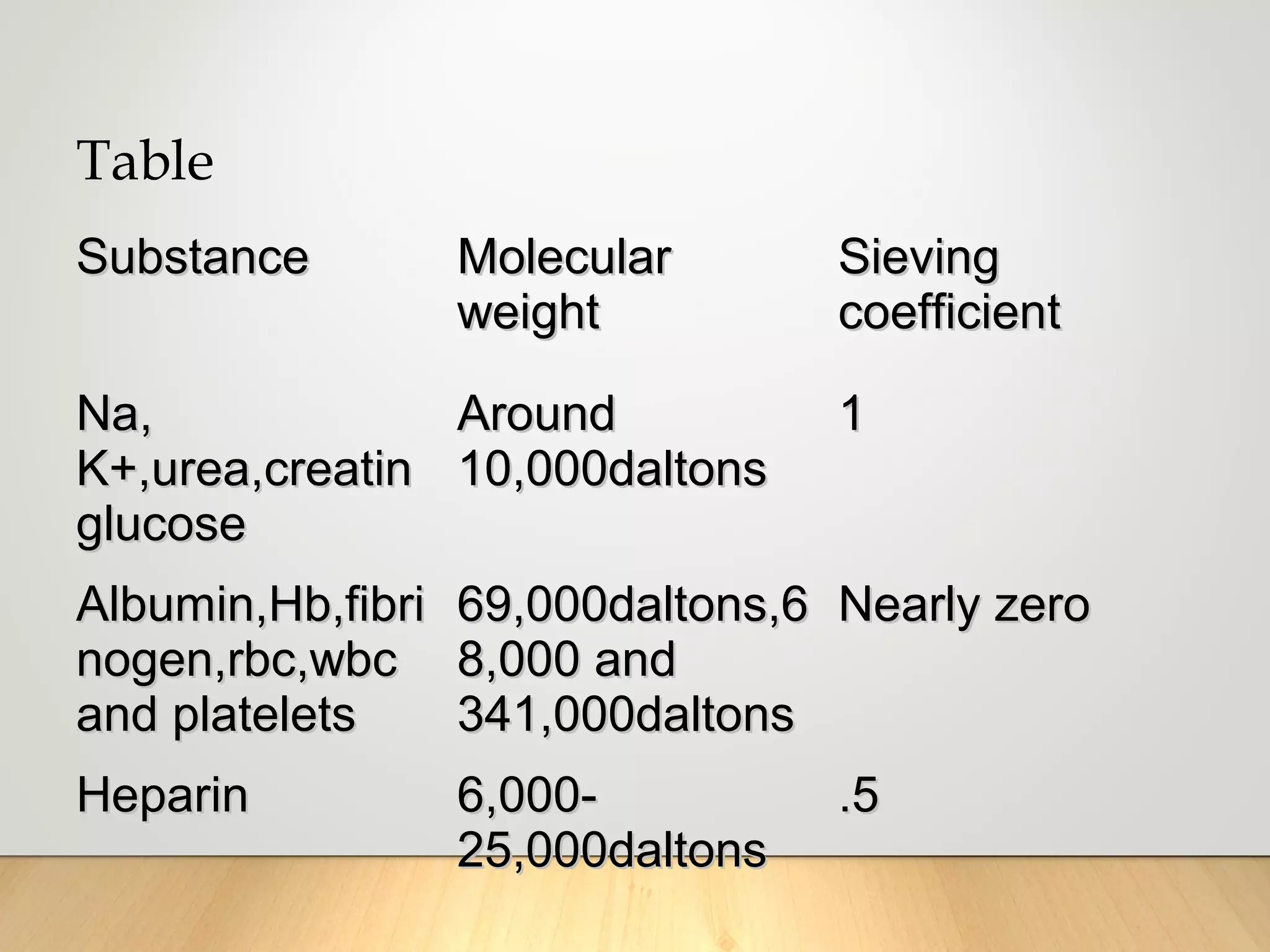
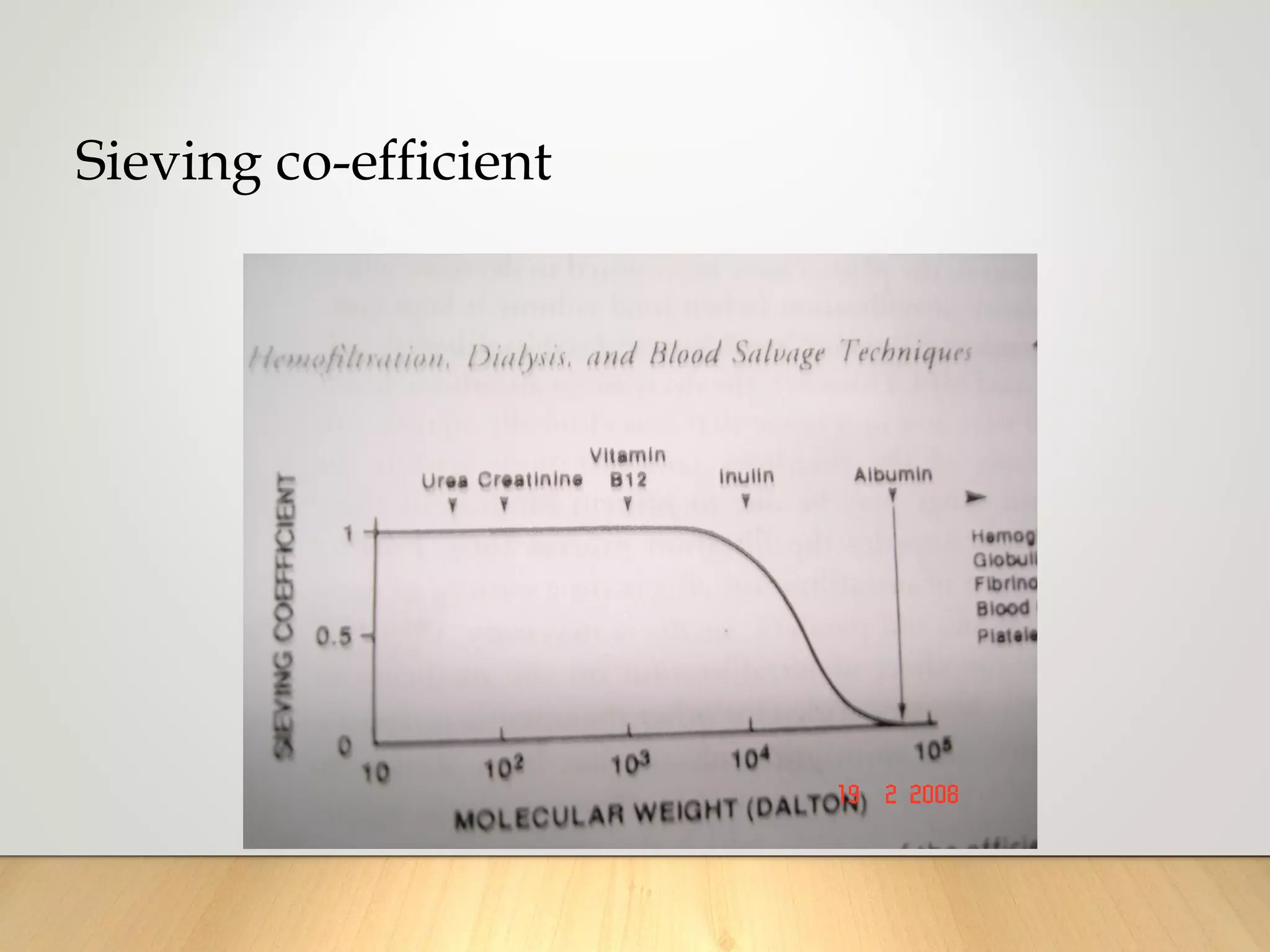
• The efficiency of an ultrafiltration device to remove a
soluble molecule is called sieving coefficient and is
directly related to molecular size.
• The larger the molecular size the less eficient the
ultrafiltration device
Table
SubstanceSubstance MolecularMolecular
weightweight
SievingSieving
coefficientcoefficient
Na,Na,
K+,urea,creatinK+,urea,creatin
glucoseglucose
AroundAround
10,000daltons10,000daltons
11
Albumin,Hb,fibriAlbumin,Hb,fibri
nogen,rbc,wbcnogen,rbc,wbc
and plateletsand platelets
69,000daltons,669,000daltons,6
8,000 and8,000 and
341,000daltons341,000daltons
Nearly zeroNearly zero
HeparinHeparin 6,000-6,000-
25,000daltons25,000daltons
.5.5
Sieving co-efficient
Effect of ultrafiltration on drugs
• Heparin
• Decreases serum level of anesthetic agents
• Decreases aprotinin level
• Removes pharmacological agents with low molecular
weight
Technical Aspects
• Hollow fiber construction
• Materials:-
1. Polysulfone
2. Polyacrylonitrite
3. Cellulose acetate
• Pore size 180 to 200micrometers in dia
• Pores of the microporous membrane 5 to 10 nm
• Placement in extracorporeal circuit
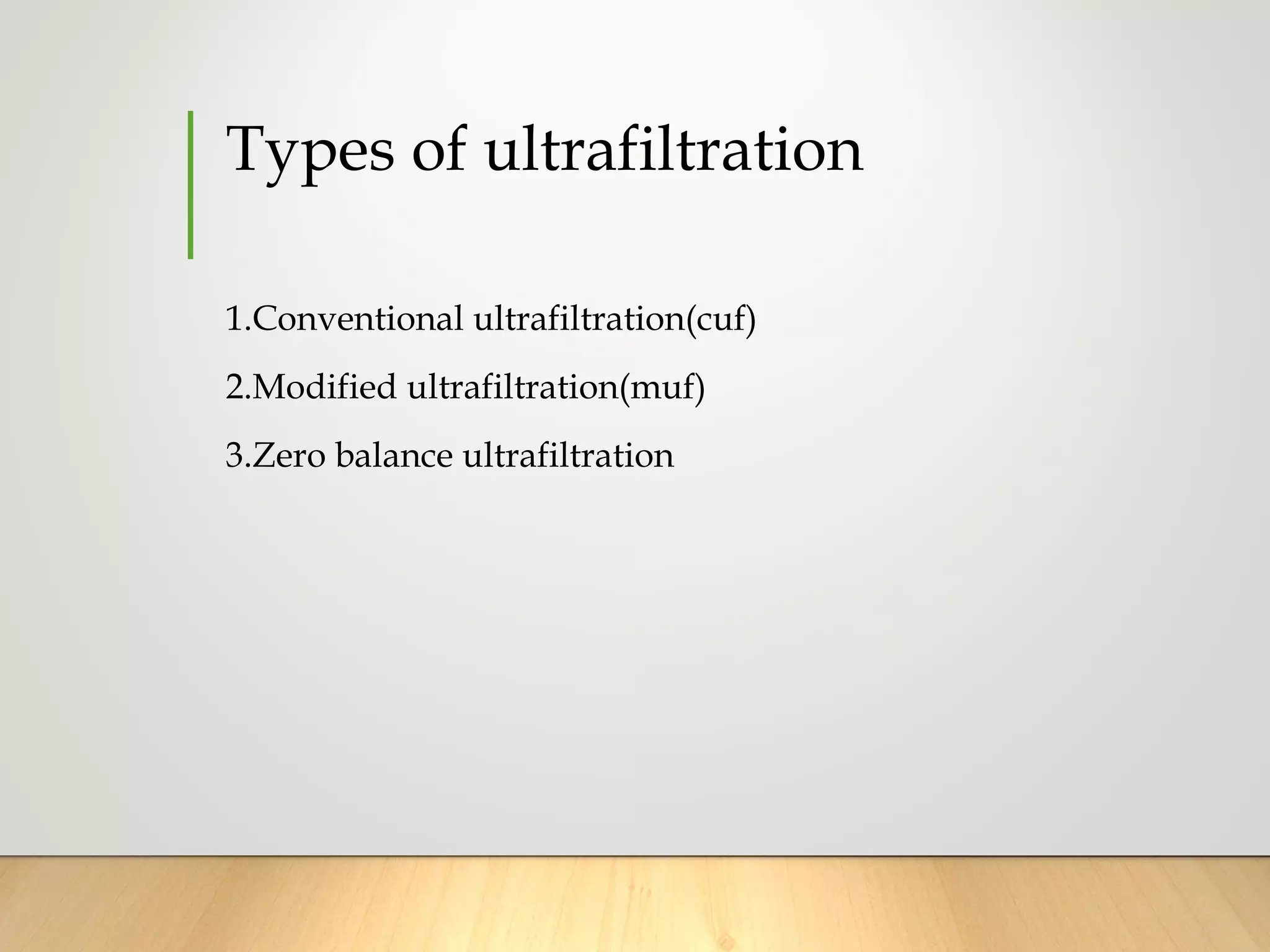
Types of ultrafiltration
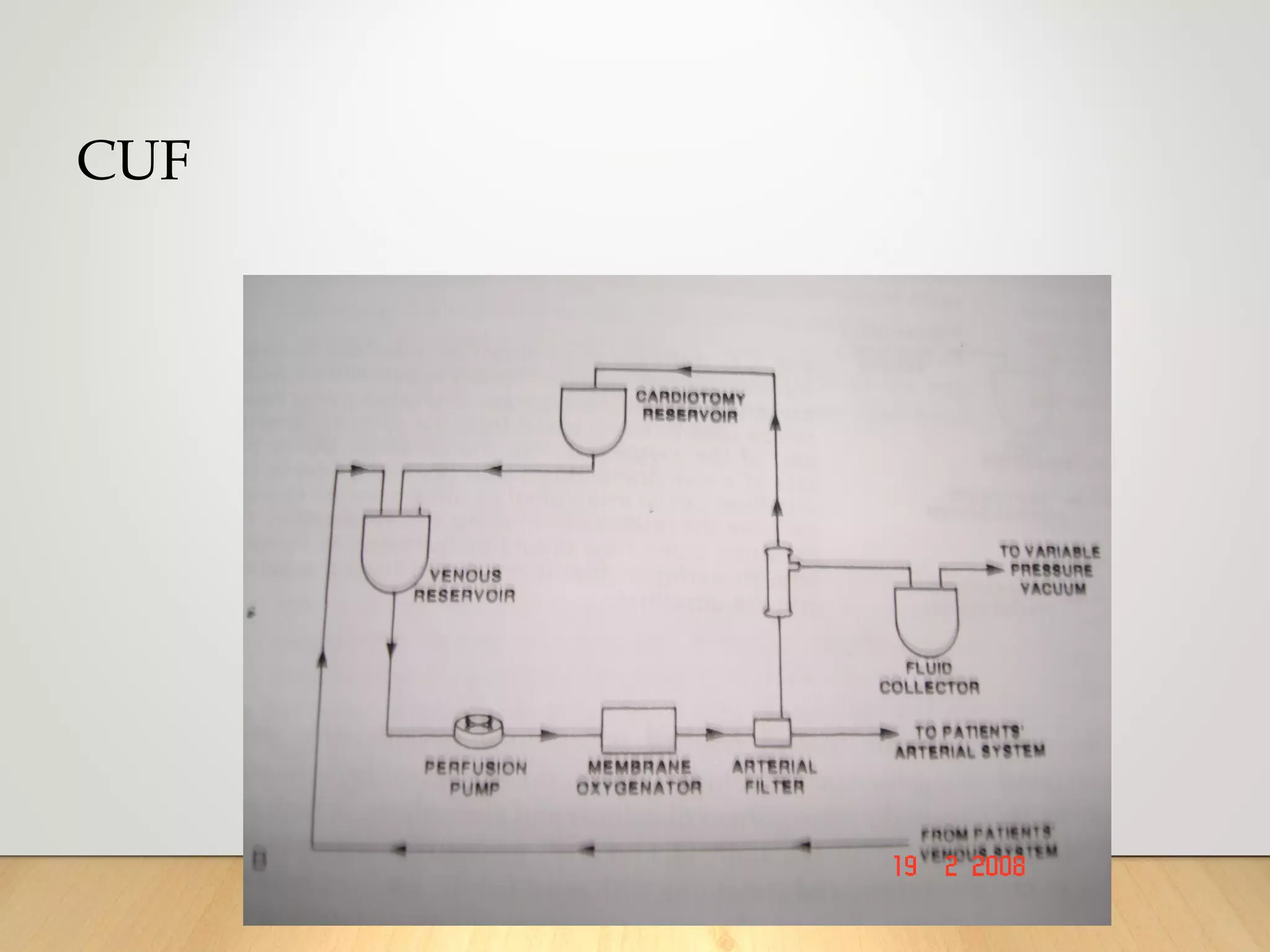
1.Conventional ultrafiltration(cuf)
2.Modified ultrafiltration(muf)
3.Zero balance ultrafiltration
CUF
CUF
Indications
1. Free water removal
2. Compromised renal function
3. Preservation of hemostasis
4. To reduce alterations of immune function
Contraindications
• No absolute contraindications.
• Theoritically increased rbc damage
• Extra cost
Organ effects
• Reduction in PVR, Lung water, Increase in Lung
compliance
• Reduction in HR, Increase Systolic Pressure,
• Inrease in CI
• Better renal function(secondary to removal of mediators)
• Reduced cerebral edema
• Increased cerebral oxygen delivery
MUF advantages
• Immediate responses:
• HCt Increase (by 60-70%)
• RA Decrease (by 50-60%)
• LA Decrease (by 25-35%)
• Tidal Volume Increase (by 20—40%)
• P A Decrease (by 30-50%)
• Contractility Improved
• Haemostasis Improved
• Heart size Reduced (to be correlated)
• Blood Sugar Levels Decreased(40-50%)
• Blood transfusion No R C required
MUF diaadvantages
• Disadvantages:
• Time Delay
• Temperature drift if Heat Exchanger is not
available
• Homodynamic instability in the initial period
• Air embolism
• -Proper snugger around Aortic Cannula
• -Isolate Oxygenator from MUF circuit
• Disposable Cost
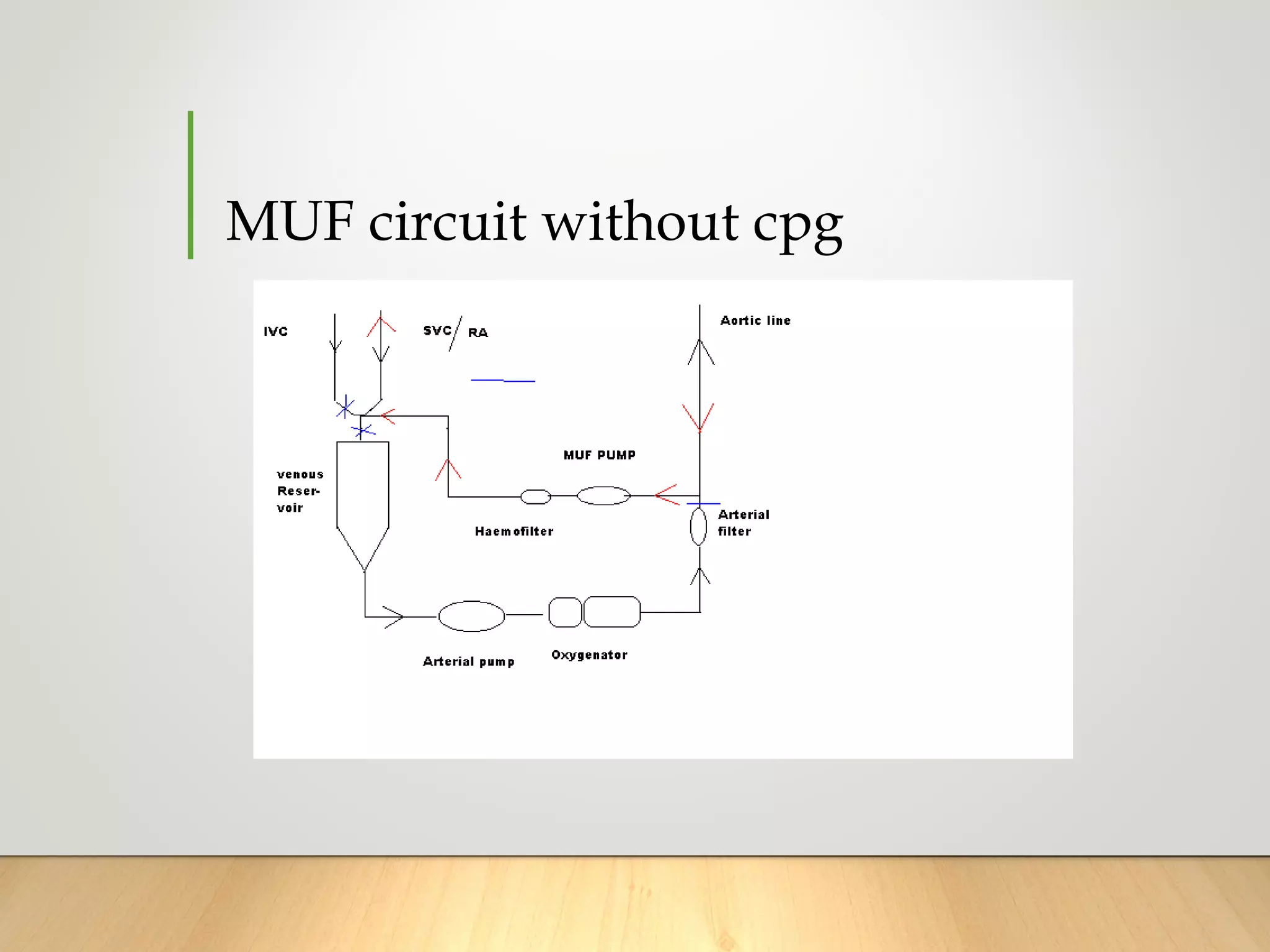
MUF circuit without cpg
MUF without cpg
Hemodialysis during CPB
• Membrane material is similar to ultrafilter
• The difference is dialysate is passed through the
nonblood side of membrane
• Removes diffusible solutes based on concentration
gradient by the dialysate soln
• Water and solutes are removed by convection
Circuit design for dialysis in
CPB
• Hemodialysis machine not used in CPB
• Dialyser positioned parallel to the ECC
• Dialysate solution - .9%NS
• Dialysate can be configured so as to achieve efficient
diffusion rate
• Dialysate flow should be 3 times the blood flow
Advantages
• Hemodialysis is effective in removing potassium and
small molecular wt solutes
• Small molecules like urea and electrolytes can be
removed.
• Hemofiltration is better for middle molecules .
(because of convection rather than diffusion)
Blood conservation Techniques
• Cardiac surgery has propensity of excess blood usage
due to
• Extensive intervention involving major vascular
structures
• Destruction of rbc and coagulation factors during
CPB resulting in increased need of blood
• Extracorporeal circuit
Blood conservation stratagies
1. Retropriming and reduction in priming volume
2. Autologus donation
3. Scavenging of shed blood(cell savers)
Cell saver outline
Retroprime

4.hemo filtration &amp; blood conservation technique

  • 1.
    Hemo filtration & Bloodconservation technique MANU JACOB PERFUSIONIST KMCT MCH CALICUT
  • 2.
    Concept of ultrafiltration •To remove large volume of fluid from the intravascular space in short duration • Movement of water across a membrane due to hydrostatic pressure gradient • No dialysate required • The fluid removed is called ultrafiltrate
  • 3.
    Concept of dialysis •It is a process in which blood is separated from crystalloid solution by a semipermiable membrane • A solute concentration gradient exsists b/w the blood and dialysate
  • 4.
    purpose • Effective removalof edema fluid in over hydrarted patients. • In renal impairment. • To concentrate hemodiluted blood. • Blood conservation through preservation of platelets and coagulation factors. • Reduced post cpb inflamatory response.
  • 5.
    Purpose contd., • Decreasescomplement activation and inflamatory response. • Improves pulmonary cardiac and neurologic function • Moderates temperature elevations by removing circulating pyrogens
  • 6.
    Advantages of Hemofiltration •Advantages of Hemofiltration: • Removal of water. • -Reduces tissue edema . • - Increase Hct • Increase Coagulation factors • Removal of inflammatory mediators • -(tissue necrosis factor,C3a, interleukins –1 & 6 etc) • Removal of any solutes < Cut off value(60,000daltons)
  • 7.
    Physiologic principles • “Selectiveseperation of plasma water and low molecular weight solutes from intravascular cellular components and plasma protiens of blood using a semipermiable membrane filter”
  • 8.
    The Equation • TMP= Pa + Pv/2 + Ps • Tmp = Transmembrane pressure • Pa = inlet blood pressure • Pv = outlet blood pressure • Ps = Suction pressure
  • 9.
    Efficacy of ultrafilter •Efficacy is determined by the equation Qf = Uc X TMP _ IP Qf – ablity to remove fluid Uc- Ultrafiltration coefficent Ip- Protien oncotic pressure
  • 10.
    Factors affecting the filtration: •Factors affecting the filtration: • Diameter of pores(10-35A) • Number of pores • Thickness of membrane • Viscocity of blood, Hct, Protein levels • Temperature • Absolute ultration can be increased by: • Increasing inlet pressure • Clamping outlet partially • Increasing filtrate side negative pressure • Increasing blood flow
  • 11.
    Effect of CUFwith temperature & Hct
  • 12.
  • 13.
    Efficacy contd., • Theefficiency of the ultrafiltration will depend on • HB concentration • Temperature • Rate of blood flow • Serum protien concentration • Membrane structure
  • 14.
    Sieving co-efficient • Theefficiency of an ultrafiltration device to remove a soluble molecule is called sieving coefficient and is directly related to molecular size. • The larger the molecular size the less eficient the ultrafiltration device
  • 15.
  • 16.
  • 17.
    Effect of ultrafiltrationon drugs • Heparin • Decreases serum level of anesthetic agents • Decreases aprotinin level • Removes pharmacological agents with low molecular weight
  • 18.
    Technical Aspects • Hollowfiber construction • Materials:- 1. Polysulfone 2. Polyacrylonitrite 3. Cellulose acetate • Pore size 180 to 200micrometers in dia • Pores of the microporous membrane 5 to 10 nm • Placement in extracorporeal circuit
  • 19.
    Types of ultrafiltration 1.Conventionalultrafiltration(cuf) 2.Modified ultrafiltration(muf) 3.Zero balance ultrafiltration
  • 20.
  • 21.
  • 22.
    Indications 1. Free waterremoval 2. Compromised renal function 3. Preservation of hemostasis 4. To reduce alterations of immune function
  • 23.
    Contraindications • No absolutecontraindications. • Theoritically increased rbc damage • Extra cost
  • 24.
    Organ effects • Reductionin PVR, Lung water, Increase in Lung compliance • Reduction in HR, Increase Systolic Pressure, • Inrease in CI • Better renal function(secondary to removal of mediators) • Reduced cerebral edema • Increased cerebral oxygen delivery
  • 25.
    MUF advantages • Immediateresponses: • HCt Increase (by 60-70%) • RA Decrease (by 50-60%) • LA Decrease (by 25-35%) • Tidal Volume Increase (by 20—40%) • P A Decrease (by 30-50%) • Contractility Improved • Haemostasis Improved • Heart size Reduced (to be correlated) • Blood Sugar Levels Decreased(40-50%) • Blood transfusion No R C required
  • 26.
    MUF diaadvantages • Disadvantages: •Time Delay • Temperature drift if Heat Exchanger is not available • Homodynamic instability in the initial period • Air embolism • -Proper snugger around Aortic Cannula • -Isolate Oxygenator from MUF circuit • Disposable Cost
  • 27.
  • 28.
  • 29.
    Hemodialysis during CPB •Membrane material is similar to ultrafilter • The difference is dialysate is passed through the nonblood side of membrane • Removes diffusible solutes based on concentration gradient by the dialysate soln • Water and solutes are removed by convection
  • 30.
    Circuit design fordialysis in CPB • Hemodialysis machine not used in CPB • Dialyser positioned parallel to the ECC • Dialysate solution - .9%NS • Dialysate can be configured so as to achieve efficient diffusion rate • Dialysate flow should be 3 times the blood flow
  • 31.
    Advantages • Hemodialysis iseffective in removing potassium and small molecular wt solutes • Small molecules like urea and electrolytes can be removed. • Hemofiltration is better for middle molecules . (because of convection rather than diffusion)
  • 32.
    Blood conservation Techniques •Cardiac surgery has propensity of excess blood usage due to • Extensive intervention involving major vascular structures • Destruction of rbc and coagulation factors during CPB resulting in increased need of blood • Extracorporeal circuit
  • 33.
    Blood conservation stratagies 1.Retropriming and reduction in priming volume 2. Autologus donation 3. Scavenging of shed blood(cell savers)
  • 34.
  • 35.