Continuous Renal Replacement
Therapy (CRRT)
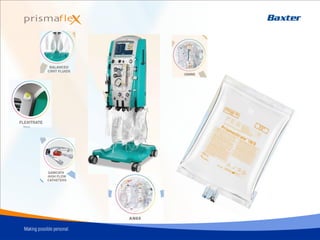
with Prismaflex System
15th -16th January 2024
HSIS Serdang
Overview
• CRRT Modalities
• CRRT with Prismaflex®
• Components
• CRRT Initiation
• Optimal Dose for CRRT
CRRT Modalities
Continuous Renal Replacement Therapy
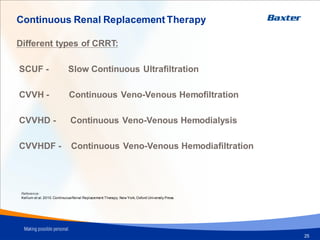
Different types of CRRT:
SCUF - Slow Continuous Ultrafiltration
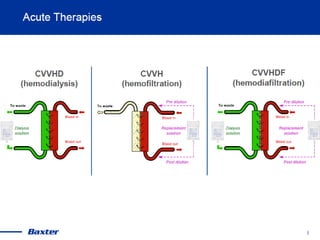
CVVH - Continuous Veno-Venous Hemofiltration
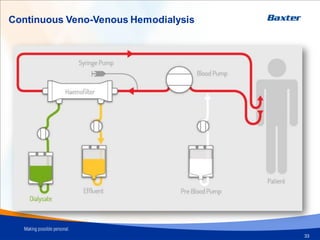
CVVHD - Continuous Veno-Venous Hemodialysis
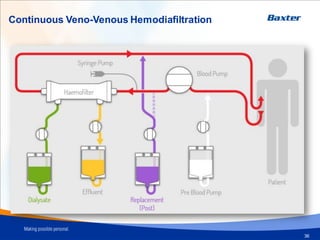
CVVHDF - Continuous Veno-Venous Hemodiafiltration
Reference:
Kellum et al. 2010.ContinuousRenal Replacement Therapy. New York, Oxford University Press.
25
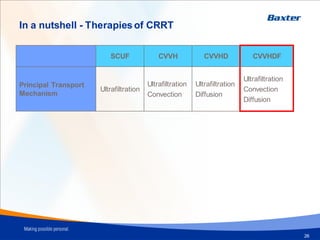
In a nutshell - Therapies of CRRT
SCUF CVVH CVVHD CVVHDF
Principal Transport
Mechanism
Ultrafiltration
Ultrafiltration
Convection
Ultrafiltration
Diffusion
Ultrafiltration
Convection
Diffusion
26
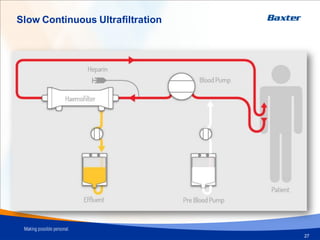
Slow Continuous Ultrafiltration
27
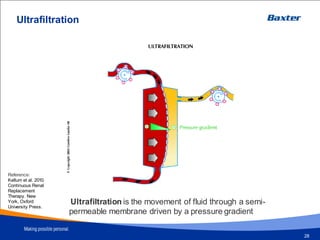
Ultrafiltration
Ultrafiltration is the movement of fluid
through a semi-permeable membrane drive
by a pressure gradient
Ultrafiltration is the movement of fluid through a semi-
permeable membrane driven by a pressure gradient
Reference:
Kellum et al. 2010.
Continuous Renal
Replacement
Therapy. New
York, Oxford
University Press.
Ultrafiltration
28
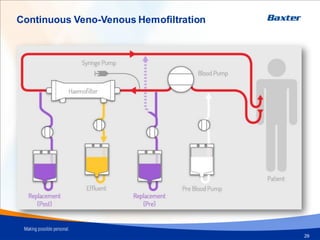
Continuous Veno Venous Haemofiltration
Continuous Veno-Venous Hemofiltration
29
Convection
Reference:
Kellum et al. 2010.
Continuous Renal
Replacement Therapy. New
York, Oxford University
Press.
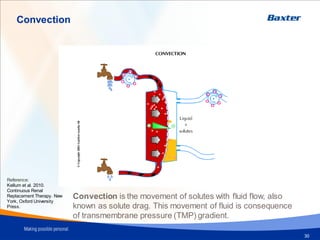
Convection is the movement of solutes with fluid flow, also
known as solute drag. This movement of fluid is consequence
of transmembrane pressure (TMP) gradient.
Convection
30
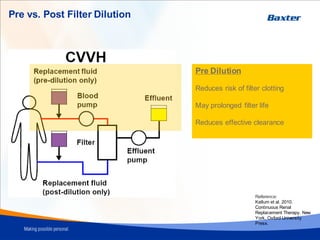
Pre vs. Post Filter Dilution
Pre Dilution
Reduces risk of filter clotting
May prolonged filter life
Reduces effective clearance
Reference:
Kellum et al. 2010.
Continuous Renal
Replacement Therapy. New
York, Oxford University
Press.
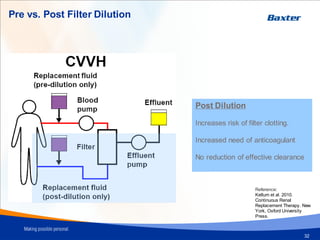
Pre vs. Post Filter Dilution
Post Dilution
Increases risk of filter clotting.
Increased need of anticoagulant
No reduction of effective clearance
Reference:
Kellum et al. 2010.
Continuous Renal
Replacement Therapy. New
York, Oxford University
Press.
32
Continuous Veno Venous Haemodialysis
Continuous Veno-Venous Hemodialysis
33
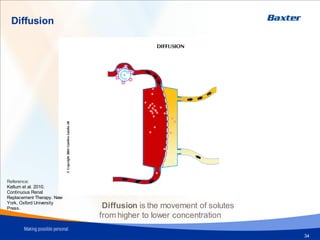
Diffusion
Reference:
Kellum et al. 2010.
Continuous Renal
Replacement Therapy. New
York, Oxford University
Press. Diffusion is the movement of solutes
from higher to lower concentration
Diffusion
34
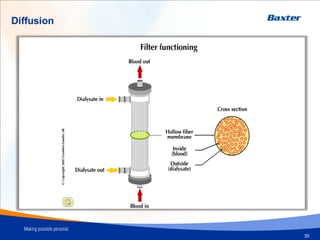
Dialysis Compartment
Diffusion
35
Continuous Veno Venous Haemodiafiltration
Continuous Veno-Venous Hemodiafiltration
36
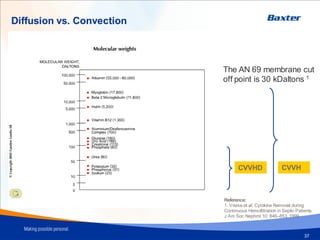
Diffusion vs. Convection
CVVHD CVVH
The AN 69 membrane cut
off point is 30 kDaltons 1
Reference:
1. Vriese et al. Cytokine Removal during
Continuous Hemofiltration in Septic Patients.
J Am Soc Nephrol 10: 846–853, 1999
37
|
CRRT with Prismaflex®
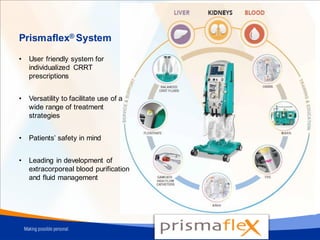
Prismaflex® System
• User friendly system for
individualized CRRT
prescriptions
• Versatility to facilitate use of a
wide range of treatment
strategies
• Patients’ safety in mind
• Leading in development of
extracorporeal blood purification
and fluid management
Why choose Prismaflex® system?
1. Slow, gentle and continuous
– Well tolerated by hemodynamically unstable patient
– Prevent further damage to kidney tissue
2. Removes small molecules (urea and creatinine) and larger molecules
(beta 2 microglobulin & inflammatory mediators)
3. More control of electrolytes & acid-base balance
4. Removes large amounts of fluid and waste products over time
– Allow other supportive measures, i.e. nutrition
Reference:
1. Bellomo, Ronco. Continoushemofiltration in theintensive care unit. Crit Care, 2000; 4(6) ): 339–345.
2. Schneider, et al. Choice of renal replacementtherapy modality and dialysisdependence after acute kidney injury: a systemati c review and meta-analysis.
Intensive Care Medicine. Published online: 27 February 2013
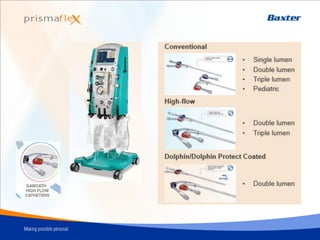
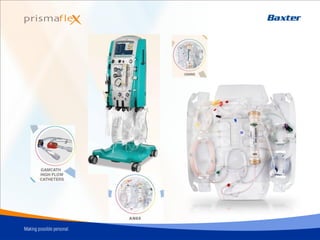
System Components
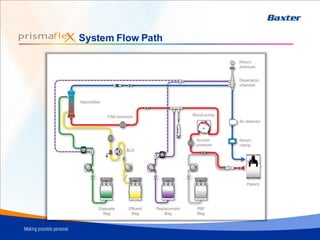
System Flow Path
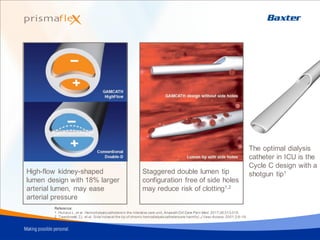
High-flow kidney-shaped
lumen design with 18% larger
arterial lumen, may ease
arterial pressure
Staggered double lumen tip
configuration free of side holes
may reduce risk of clotting1,2
Reference:
1. Huriaux L, et al. Hemodialysiscathetersin the intensive care unit, Anaesth Crit Care Pain Med. 2017;36:313-319.
2. Twardowski ZJ, et al. Side holesat the tip of chronic hemodialysiscathetersare harmful,J Vasc Access. 2001;2:8–16.
The optimal dialysis
catheter in ICU is the
Cycle C design with a
shotgun tip1
Purpose
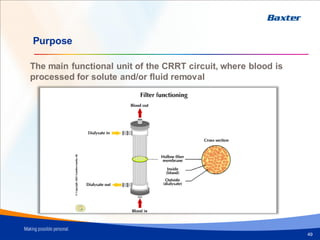
The main functional unit of the CRRT circuit, where blood is
processed for solute and/or fluid removal
49
Haemofilter
50
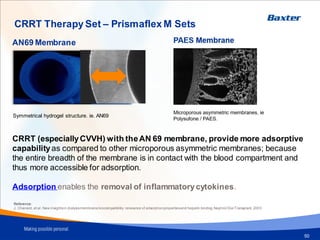
AN69 Membrane
Microporous asymmetric membranes, ie
Polysufone / PAES.
Symmetrical hydrogel structure. ie. AN69
Reference:
J. Chanard, et al. New insightsin dialysismembranebiocompatibility: relevance of adsorptionpropertiesand heparin binding.Nephrol Dial Transplant, 2003
PAES Membrane
CRRT (especiallyCVVH) with theAN 69 membrane, provide more adsorptive
capabilityas compared to other microporous asymmetric membranes; because
the entire breadth of the membrane is in contact with the blood compartment and
thus more accessible for adsorption.
Adsorption enables the removal of inflammatorycytokines.
CRRT Therapy Set – Prismaflex M Sets
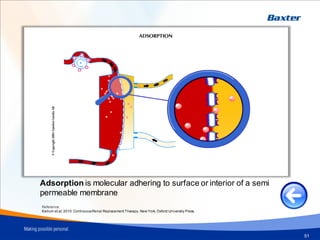
Transport Mechanism - Adsorption
51
Adsorption is molecular adhering to surface or interior of a semi
permeable membrane
Reference:
Kellum et al. 2010.ContinuousRenal Replacement Therapy. New York, Oxford University Press.
`
52
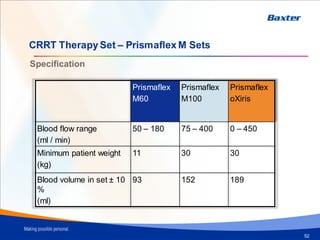
Prismaflex
M60
Prismaflex
M100
Prismaflex
oXiris
Blood flow range
(ml / min)
50 – 180 75 – 400 0 – 450
Minimum patient weight
(kg)
11 30 30
Blood volume in set ± 10
%
(ml)
93 152 189
CRRT Therapy Set – Prismaflex M Sets
Specification
53
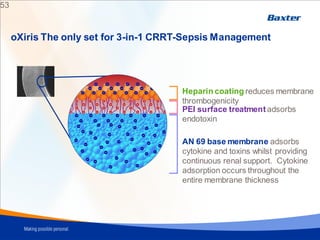
Heparin coating reduces membrane
thrombogenicity
PEI surface treatmentadsorbs
endotoxin
AN 69 base membrane adsorbs
cytokine and toxins whilst providing
continuous renal support. Cytokine
adsorption occurs throughout the
entire membrane thickness
oXiris The only set for 3-in-1 CRRT-Sepsis Management
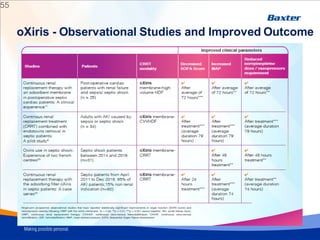
55
oXiris - Observational Studies and Improved Outcome
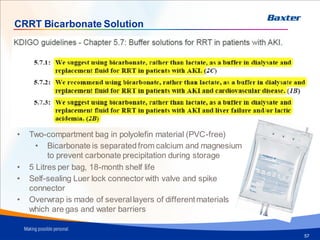
Bicarbonate solution
57
CRRT Bicarbonate Solution
• Two-compartment bag in polyolefin material (PVC-free)
• Bicarbonate is separatedfrom calcium and magnesium
to prevent carbonate precipitation during storage
• 5 Litres per bag, 18-month shelf life
• Self-sealing Luer lock connector with valve and spike
connector
• Overwrap is made of severallayers of different materials
which are gas and water barriers
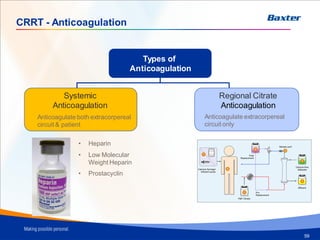
CRRT - Anticoagulation
Types of
Anticoagulation
Systemic
Anticoagulation
Regional Citrate
Anticoagulation
• Heparin
• Low Molecular
Weight Heparin
• Prostacyclin
Anticoagulate both extracorpereal
circuit & patient
Anticoagulate extracorpereal
circuit only
59
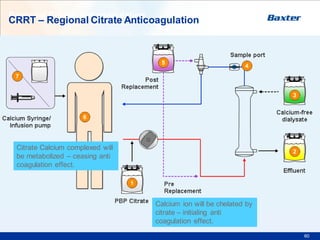
Regional Citrate Anticoagulation
Calcium ion will be chelated by
citrate – initialing anti
coagulation effect.
CRRT – Regional Citrate Anticoagulation
60
Citrate Calcium complexed will
be metabolized – ceasing anti
coagulation effect.
CRRT Initiation
62
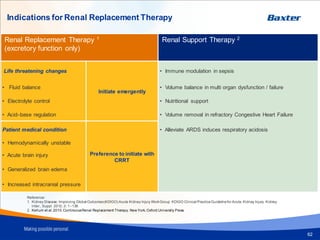
Renal Replacement Therapy 1
(excretory function only)
Renal Support Therapy 2
Life threatening changes
Initiate emergently
• Immune modulation in sepsis
• Fluid balance • Volume balance in multi organ dysfunction / failure
• Electrolyte control • Nutritional support
• Acid–base regulation • Volume removal in refractory Congestive Heart Failure
Patient medical condition
Preference to initiate with
CRRT
• Alleviate ARDS induces respiratory acidosis
• Hemodynamically unstable
• Acute brain injury
• Generalized brain edema
• Increased intracranial pressure
Reference:
1. Kidney Disease: Improving Global Outcomes(KDIGO) Acute Kidney Injury WorkGroup. KDIGO Clinical PracticeGuidelinefor Acute Kidney Injury. Kidney
inter., Suppl. 2012; 2: 1–138.
2. Kellum et al. 2010.ContinuousRenal Replacement Therapy. New York, Oxford University Press.
Indications for Renal Replacement Therapy
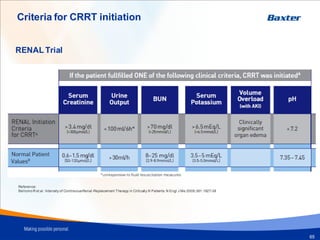
Criteria for CRRT initiation
RENAL Trial
Reference:
BellomoR et al. Intensity of ContinuousRenal-Replacement Therapy in Critically Ill Patients. N Engl J Me 2009;361:1627-38
65
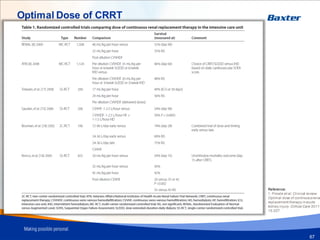
Optimal Dose for CRRT
Optimal Dose of CRRT
Reference:
1. Prowle et al. Clinical review:
Optimal dose of continuousrena
replacement therapy inacute
kidney injury. Critical Care 2011,
15:207
67
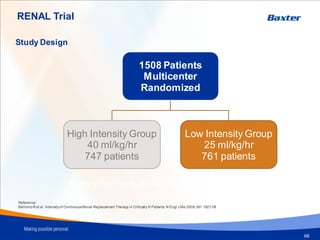
RENAL Trial
68
Study Design
1508 Patients
Multicenter
Randomized
High Intensity Group
40 ml/kg/hr
747 patients
Low Intensity Group
25 ml/kg/hr
761 patients
Reference:
BellomoR et al. Intensity of ContinuousRenal-Replacement Therapy in Critically Ill Patients. N Engl J Me 2009;361:1627-38
Primary End Point: 90 days mortality
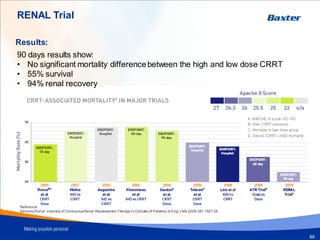
RENAL Trial
90 days results show:
• No significant mortality differencebetween the high and low dose CRRT
• 55% survival
• 94% renal recovery
Results:
Reference:
Bellomo R et al. Intensity of ContinuousRenal-Replacement Therapy in Critically Ill Patients. N Engl J Me 2009;361:1627-38
69
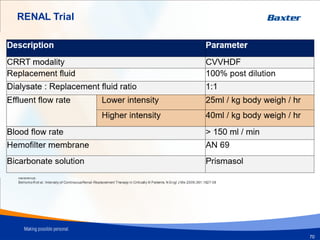
RENAL Trial
Description Parameter
CRRT modality CVVHDF
Replacement fluid 100% post dilution
Dialysate : Replacement fluid ratio 1:1
Effluent flow rate Lower intensity 25ml / kg body weigh / hr
Higher intensity 40ml / kg body weigh / hr
Blood flow rate > 150 ml / min
Hemofilter membrane AN 69
Bicarbonate solution Prismasol
Reference:
BellomoR et al. Intensity of ContinuousRenal-Replacement Therapy in Critically Ill Patients. N Engl J Me 2009;361:1627-38
70
Effluent Dose
71
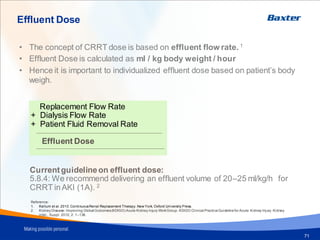
• The concept of CRRT dose is based on effluent flow rate. 1
• Effluent Dose is calculated as ml / kg body weight / hour
• Hence it is important to individualized effluent dose based on patient’s body
weigh.
Replacement Flow Rate
+ Dialysis Flow Rate
+ Patient Fluid Removal Rate
Effluent Dose
Currentguidelineon effluent dose:
5.8.4: We recommend delivering an effluent volume of 20–25 ml/kg/h for
CRRT inAKI (1A). 2
Reference:
1. Kellum et al. 2010.ContinuousRenal Replacement Therapy. New York, Oxford University Press.
2. Kidney Disease: Improving Global Outcomes(KDIGO) Acute Kidney Injury WorkGroup. KDIGO Clinical PracticeGuidelinefor Acute Kidney Injury. Kidney
inter., Suppl. 2012; 2: 1–138.
Prescribed vs Delivered Effluent Dose
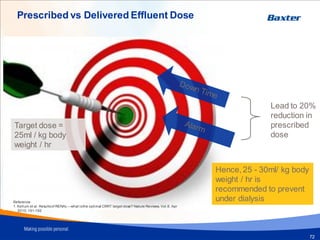
Target dose =
25ml / kg body
weight / hr
Hence, 25 - 30ml/ kg body
weight / hr is
recommended to prevent
under dialysis
Lead to 20%
reduction in
prescribed
dose
Reference:
1. Kellum et al. Resultsof RENAL—what isthe optimal CRRT target dose? Nature Reviews. Vol.6. Apr
2010: 191-192
72
Calculation of Dialysis & Replacement Flow Rate
73
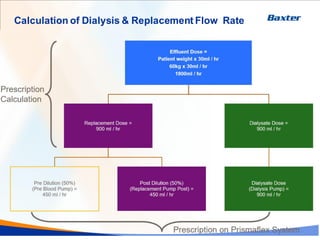
Effluent Dose =
Patient weight x 30ml / hr
60kg x 30ml / hr
1800ml / hr
Replacement Dose =
900 ml / hr
Pre Dilution (50%)
(Pre Blood Pump) =
450 ml / hr
Post Dilution (50%)
(Replacement Pump Post) =
450 ml / hr
Dialysate Dose =
900 ml / hr
Dialysate Dose
(Dialysis Pump) =
900 ml / hr
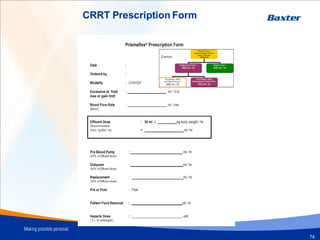
Prescription
Calculation
Prescriptionon Prismaflex System
CRRT Prescription Form
74
CRRT2U website
https://www.baxterglobal.com/CRRT_2U_MY/
Making Possible Personal

CRRT with Prismaflex slides renal replacement.pdf

  • 1.
    Continuous Renal Replacement Therapy(CRRT) with Prismaflex System 15th -16th January 2024 HSIS Serdang
  • 2.
    Overview • CRRT Modalities •CRRT with Prismaflex® • Components • CRRT Initiation • Optimal Dose for CRRT
  • 3.
  • 4.
    Continuous Renal ReplacementTherapy Different types of CRRT: SCUF - Slow Continuous Ultrafiltration CVVH - Continuous Veno-Venous Hemofiltration CVVHD - Continuous Veno-Venous Hemodialysis CVVHDF - Continuous Veno-Venous Hemodiafiltration Reference: Kellum et al. 2010.ContinuousRenal Replacement Therapy. New York, Oxford University Press. 25
  • 5.
    In a nutshell- Therapies of CRRT SCUF CVVH CVVHD CVVHDF Principal Transport Mechanism Ultrafiltration Ultrafiltration Convection Ultrafiltration Diffusion Ultrafiltration Convection Diffusion 26
  • 6.
    Slow Continuous Ultrafiltration SlowContinuous Ultrafiltration 27
  • 7.
    Ultrafiltration Ultrafiltration is themovement of fluid through a semi-permeable membrane drive by a pressure gradient Ultrafiltration is the movement of fluid through a semi- permeable membrane driven by a pressure gradient Reference: Kellum et al. 2010. Continuous Renal Replacement Therapy. New York, Oxford University Press. Ultrafiltration 28
  • 8.
    Continuous Veno VenousHaemofiltration Continuous Veno-Venous Hemofiltration 29
  • 9.
    Convection Reference: Kellum et al.2010. Continuous Renal Replacement Therapy. New York, Oxford University Press. Convection is the movement of solutes with fluid flow, also known as solute drag. This movement of fluid is consequence of transmembrane pressure (TMP) gradient. Convection 30
  • 10.
    Pre vs. PostFilter Dilution Pre Dilution Reduces risk of filter clotting May prolonged filter life Reduces effective clearance Reference: Kellum et al. 2010. Continuous Renal Replacement Therapy. New York, Oxford University Press.
  • 11.
    Pre vs. PostFilter Dilution Post Dilution Increases risk of filter clotting. Increased need of anticoagulant No reduction of effective clearance Reference: Kellum et al. 2010. Continuous Renal Replacement Therapy. New York, Oxford University Press. 32
  • 12.
    Continuous Veno VenousHaemodialysis Continuous Veno-Venous Hemodialysis 33
  • 13.
    Diffusion Reference: Kellum et al.2010. Continuous Renal Replacement Therapy. New York, Oxford University Press. Diffusion is the movement of solutes from higher to lower concentration Diffusion 34
  • 14.
  • 15.
    Continuous Veno VenousHaemodiafiltration Continuous Veno-Venous Hemodiafiltration 36
  • 16.
    Diffusion vs. Convection CVVHDCVVH The AN 69 membrane cut off point is 30 kDaltons 1 Reference: 1. Vriese et al. Cytokine Removal during Continuous Hemofiltration in Septic Patients. J Am Soc Nephrol 10: 846–853, 1999 37
  • 17.
  • 18.
  • 19.
    Prismaflex® System • Userfriendly system for individualized CRRT prescriptions • Versatility to facilitate use of a wide range of treatment strategies • Patients’ safety in mind • Leading in development of extracorporeal blood purification and fluid management
  • 20.
    Why choose Prismaflex®system? 1. Slow, gentle and continuous – Well tolerated by hemodynamically unstable patient – Prevent further damage to kidney tissue 2. Removes small molecules (urea and creatinine) and larger molecules (beta 2 microglobulin & inflammatory mediators) 3. More control of electrolytes & acid-base balance 4. Removes large amounts of fluid and waste products over time – Allow other supportive measures, i.e. nutrition Reference: 1. Bellomo, Ronco. Continoushemofiltration in theintensive care unit. Crit Care, 2000; 4(6) ): 339–345. 2. Schneider, et al. Choice of renal replacementtherapy modality and dialysisdependence after acute kidney injury: a systemati c review and meta-analysis. Intensive Care Medicine. Published online: 27 February 2013
  • 21.
  • 22.
  • 24.
    High-flow kidney-shaped lumen designwith 18% larger arterial lumen, may ease arterial pressure Staggered double lumen tip configuration free of side holes may reduce risk of clotting1,2 Reference: 1. Huriaux L, et al. Hemodialysiscathetersin the intensive care unit, Anaesth Crit Care Pain Med. 2017;36:313-319. 2. Twardowski ZJ, et al. Side holesat the tip of chronic hemodialysiscathetersare harmful,J Vasc Access. 2001;2:8–16. The optimal dialysis catheter in ICU is the Cycle C design with a shotgun tip1
  • 26.
    Purpose The main functionalunit of the CRRT circuit, where blood is processed for solute and/or fluid removal 49
  • 27.
    Haemofilter 50 AN69 Membrane Microporous asymmetricmembranes, ie Polysufone / PAES. Symmetrical hydrogel structure. ie. AN69 Reference: J. Chanard, et al. New insightsin dialysismembranebiocompatibility: relevance of adsorptionpropertiesand heparin binding.Nephrol Dial Transplant, 2003 PAES Membrane CRRT (especiallyCVVH) with theAN 69 membrane, provide more adsorptive capabilityas compared to other microporous asymmetric membranes; because the entire breadth of the membrane is in contact with the blood compartment and thus more accessible for adsorption. Adsorption enables the removal of inflammatorycytokines. CRRT Therapy Set – Prismaflex M Sets
  • 28.
    Transport Mechanism -Adsorption 51 Adsorption is molecular adhering to surface or interior of a semi permeable membrane Reference: Kellum et al. 2010.ContinuousRenal Replacement Therapy. New York, Oxford University Press.
  • 29.
    ` 52 Prismaflex M60 Prismaflex M100 Prismaflex oXiris Blood flow range (ml/ min) 50 – 180 75 – 400 0 – 450 Minimum patient weight (kg) 11 30 30 Blood volume in set ± 10 % (ml) 93 152 189 CRRT Therapy Set – Prismaflex M Sets Specification
  • 30.
    53 Heparin coating reducesmembrane thrombogenicity PEI surface treatmentadsorbs endotoxin AN 69 base membrane adsorbs cytokine and toxins whilst providing continuous renal support. Cytokine adsorption occurs throughout the entire membrane thickness oXiris The only set for 3-in-1 CRRT-Sepsis Management
  • 31.
    55 oXiris - ObservationalStudies and Improved Outcome
  • 33.
    Bicarbonate solution 57 CRRT BicarbonateSolution • Two-compartment bag in polyolefin material (PVC-free) • Bicarbonate is separatedfrom calcium and magnesium to prevent carbonate precipitation during storage • 5 Litres per bag, 18-month shelf life • Self-sealing Luer lock connector with valve and spike connector • Overwrap is made of severallayers of different materials which are gas and water barriers
  • 35.
    CRRT - Anticoagulation Typesof Anticoagulation Systemic Anticoagulation Regional Citrate Anticoagulation • Heparin • Low Molecular Weight Heparin • Prostacyclin Anticoagulate both extracorpereal circuit & patient Anticoagulate extracorpereal circuit only 59
  • 36.
    Regional Citrate Anticoagulation Calciumion will be chelated by citrate – initialing anti coagulation effect. CRRT – Regional Citrate Anticoagulation 60 Citrate Calcium complexed will be metabolized – ceasing anti coagulation effect.
  • 37.
  • 38.
    62 Renal Replacement Therapy1 (excretory function only) Renal Support Therapy 2 Life threatening changes Initiate emergently • Immune modulation in sepsis • Fluid balance • Volume balance in multi organ dysfunction / failure • Electrolyte control • Nutritional support • Acid–base regulation • Volume removal in refractory Congestive Heart Failure Patient medical condition Preference to initiate with CRRT • Alleviate ARDS induces respiratory acidosis • Hemodynamically unstable • Acute brain injury • Generalized brain edema • Increased intracranial pressure Reference: 1. Kidney Disease: Improving Global Outcomes(KDIGO) Acute Kidney Injury WorkGroup. KDIGO Clinical PracticeGuidelinefor Acute Kidney Injury. Kidney inter., Suppl. 2012; 2: 1–138. 2. Kellum et al. 2010.ContinuousRenal Replacement Therapy. New York, Oxford University Press. Indications for Renal Replacement Therapy
  • 39.
    Criteria for CRRTinitiation RENAL Trial Reference: BellomoR et al. Intensity of ContinuousRenal-Replacement Therapy in Critically Ill Patients. N Engl J Me 2009;361:1627-38 65
  • 40.
  • 41.
    Optimal Dose ofCRRT Reference: 1. Prowle et al. Clinical review: Optimal dose of continuousrena replacement therapy inacute kidney injury. Critical Care 2011, 15:207 67
  • 42.
    RENAL Trial 68 Study Design 1508Patients Multicenter Randomized High Intensity Group 40 ml/kg/hr 747 patients Low Intensity Group 25 ml/kg/hr 761 patients Reference: BellomoR et al. Intensity of ContinuousRenal-Replacement Therapy in Critically Ill Patients. N Engl J Me 2009;361:1627-38 Primary End Point: 90 days mortality
  • 43.
    RENAL Trial 90 daysresults show: • No significant mortality differencebetween the high and low dose CRRT • 55% survival • 94% renal recovery Results: Reference: Bellomo R et al. Intensity of ContinuousRenal-Replacement Therapy in Critically Ill Patients. N Engl J Me 2009;361:1627-38 69
  • 44.
    RENAL Trial Description Parameter CRRTmodality CVVHDF Replacement fluid 100% post dilution Dialysate : Replacement fluid ratio 1:1 Effluent flow rate Lower intensity 25ml / kg body weigh / hr Higher intensity 40ml / kg body weigh / hr Blood flow rate > 150 ml / min Hemofilter membrane AN 69 Bicarbonate solution Prismasol Reference: BellomoR et al. Intensity of ContinuousRenal-Replacement Therapy in Critically Ill Patients. N Engl J Me 2009;361:1627-38 70
  • 45.
    Effluent Dose 71 • Theconcept of CRRT dose is based on effluent flow rate. 1 • Effluent Dose is calculated as ml / kg body weight / hour • Hence it is important to individualized effluent dose based on patient’s body weigh. Replacement Flow Rate + Dialysis Flow Rate + Patient Fluid Removal Rate Effluent Dose Currentguidelineon effluent dose: 5.8.4: We recommend delivering an effluent volume of 20–25 ml/kg/h for CRRT inAKI (1A). 2 Reference: 1. Kellum et al. 2010.ContinuousRenal Replacement Therapy. New York, Oxford University Press. 2. Kidney Disease: Improving Global Outcomes(KDIGO) Acute Kidney Injury WorkGroup. KDIGO Clinical PracticeGuidelinefor Acute Kidney Injury. Kidney inter., Suppl. 2012; 2: 1–138.
  • 46.
    Prescribed vs DeliveredEffluent Dose Target dose = 25ml / kg body weight / hr Hence, 25 - 30ml/ kg body weight / hr is recommended to prevent under dialysis Lead to 20% reduction in prescribed dose Reference: 1. Kellum et al. Resultsof RENAL—what isthe optimal CRRT target dose? Nature Reviews. Vol.6. Apr 2010: 191-192 72
  • 47.
    Calculation of Dialysis& Replacement Flow Rate 73 Effluent Dose = Patient weight x 30ml / hr 60kg x 30ml / hr 1800ml / hr Replacement Dose = 900 ml / hr Pre Dilution (50%) (Pre Blood Pump) = 450 ml / hr Post Dilution (50%) (Replacement Pump Post) = 450 ml / hr Dialysate Dose = 900 ml / hr Dialysate Dose (Dialysis Pump) = 900 ml / hr Prescription Calculation Prescriptionon Prismaflex System
  • 48.
  • 49.
  • 50.