Designing The Task, Work Place,
And Work System For People
Ergonomics
Human Machine Interface
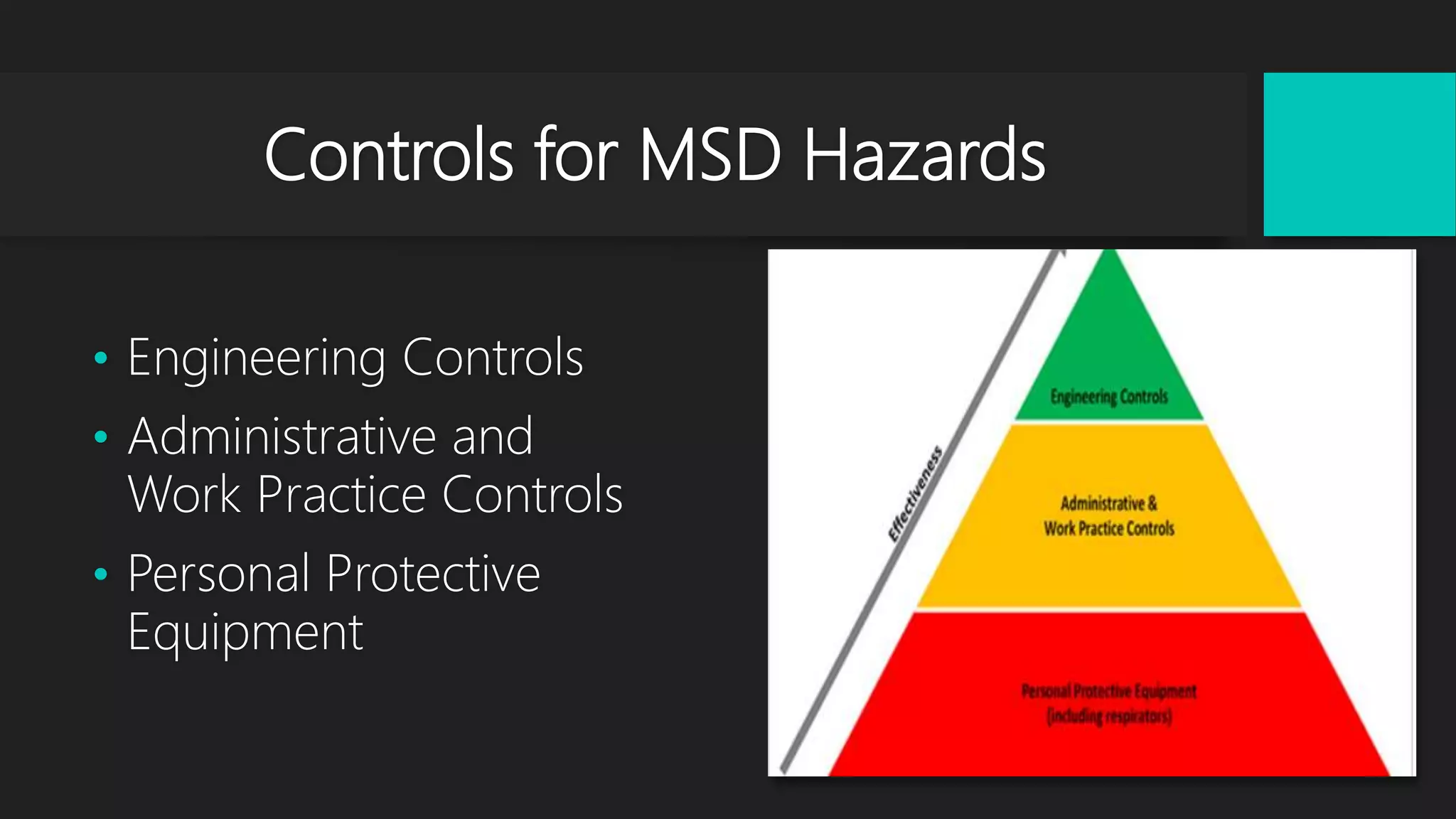
Controls for MSD Hazards
• Engineering Controls
• Administrative and
Work Practice Controls
• Personal Protective
Equipment
Engineering Controls
Implement physical change to the workplace, which eliminates/reduces the hazard on the job/task
 Use a device to lift and reposition heavy objects to limit force exertion
 Reduce the weight of a load to limit force exertion
 Reposition a work table to eliminate a long/excessive reach and enable working in neutral
postures
 Use diverging conveyors off a main line so that tasks are less repetitive
 Install diverters on conveyors to direct materials toward the worker to eliminate excessive
leaning or reaching
 Redesign tools to enable neutral postures
Administrative and Work Practice Controls
 Require that heavy loads are only lifted by two people to limit force exertion
 Establish systems so workers are rotated away from tasks to minimize the duration of continual
exertion, repetitive motions, and awkward postures. Design a job rotation system in which
employees rotate between jobs that use different muscle groups
 Staff "floaters" to provide periodic breaks between scheduled breaks
 Properly use and maintain pneumatic and power tools
Personal Protective Equipment
Use padding to reduce direct contact with hard, sharp, or
vibrating surfaces
Wear good fitting thermal gloves to help with cold
conditions while maintaining the ability to grasp items
easily
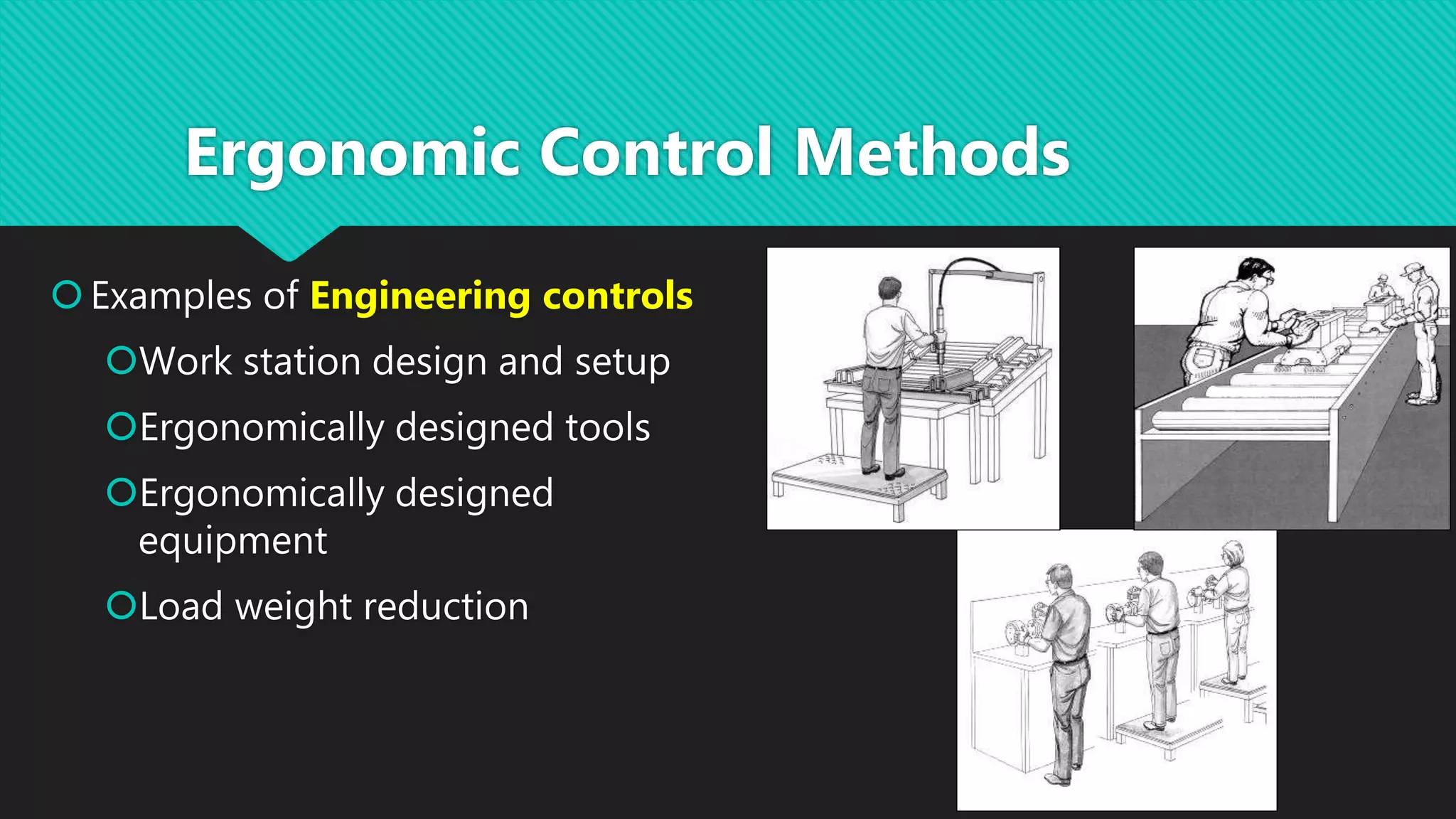
Examples of Engineering controls
Work station design and setup
Ergonomically designed tools
Ergonomically designed
equipment
Load weight reduction
Ergonomic Control Methods
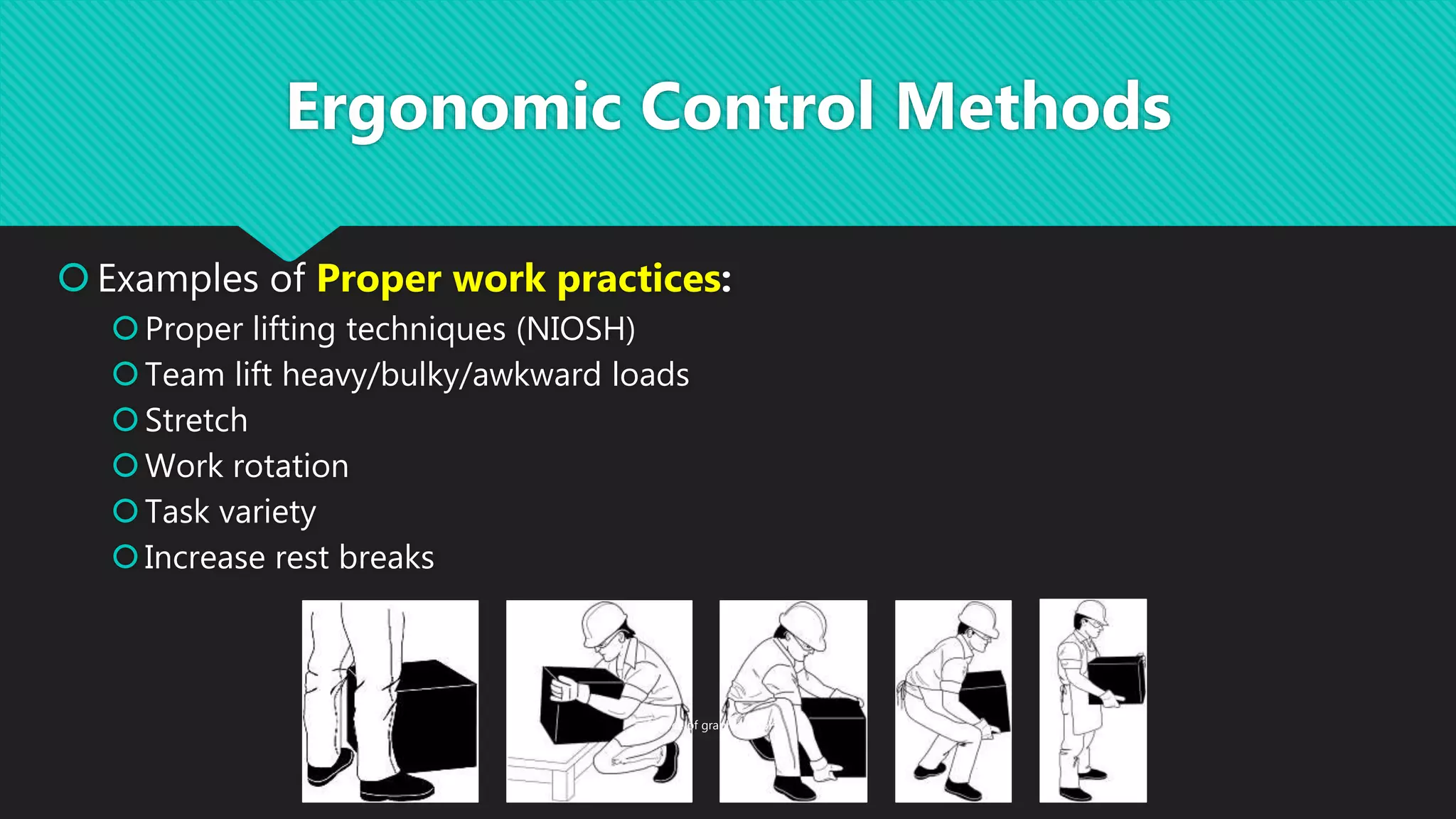
Examples of Proper work practices:
Proper lifting techniques (NIOSH)
Team lift heavy/bulky/awkward loads
Stretch
Work rotation
Task variety
Increase rest breaks
Source of graphics: OSHA
Ergonomic Control Methods
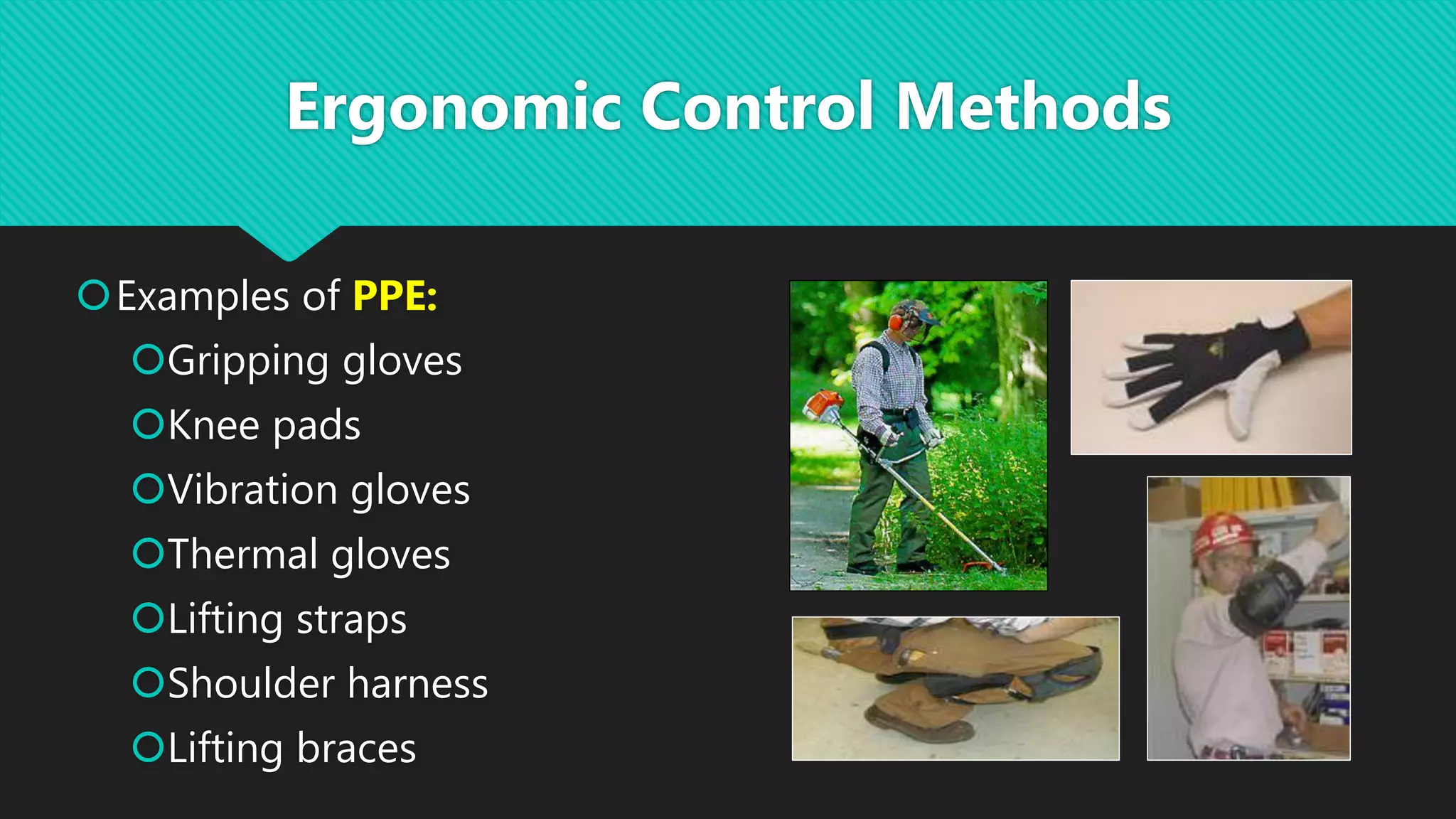
Examples of PPE:
Gripping gloves
Knee pads
Vibration gloves
Thermal gloves
Lifting straps
Shoulder harness
Lifting braces
Ergonomic Control Methods
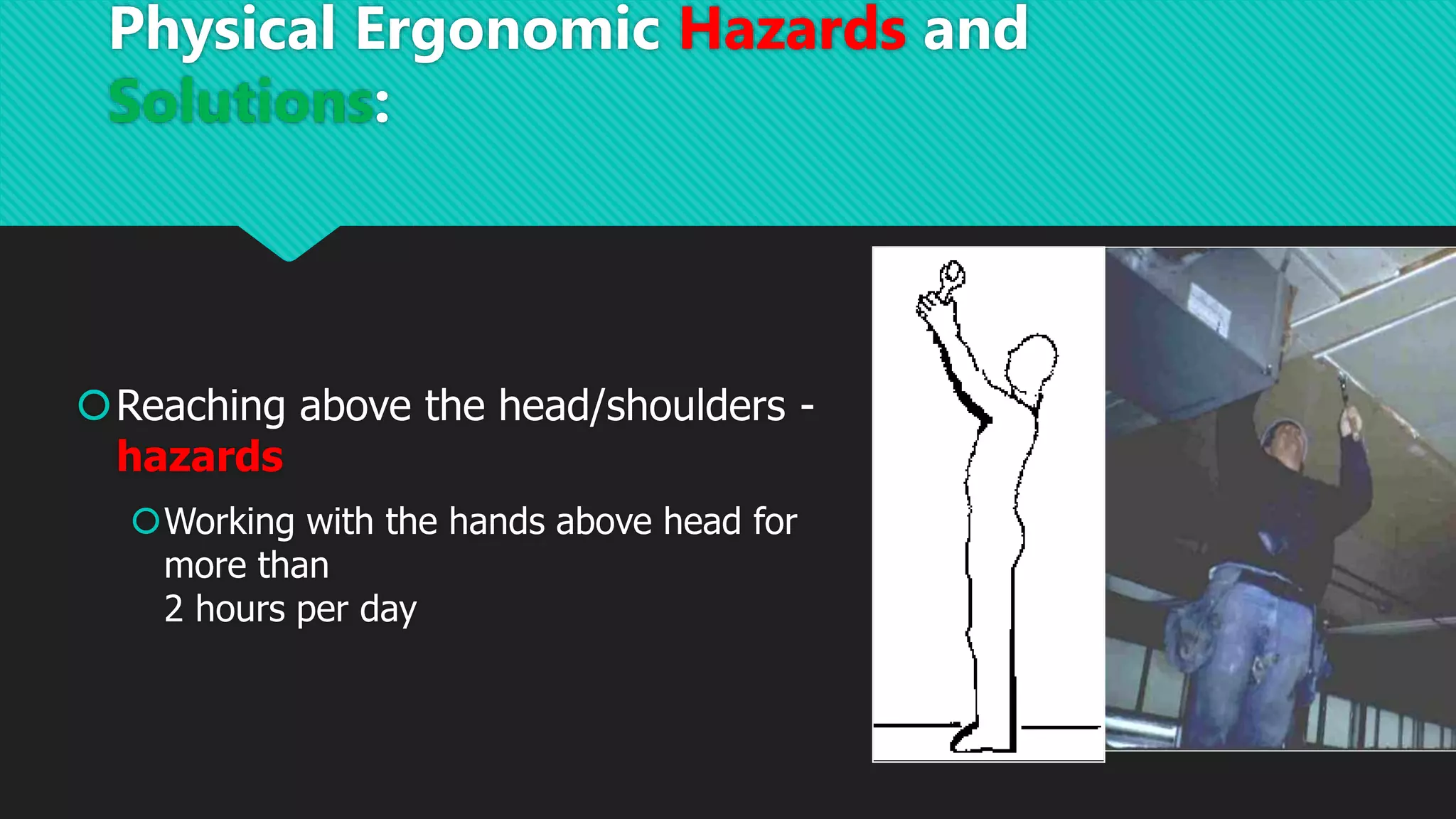
Reaching above the head/shoulders -
hazards
Working with the hands above head for
more than
2 hours per day
Physical Ergonomic Hazards and
Solutions:
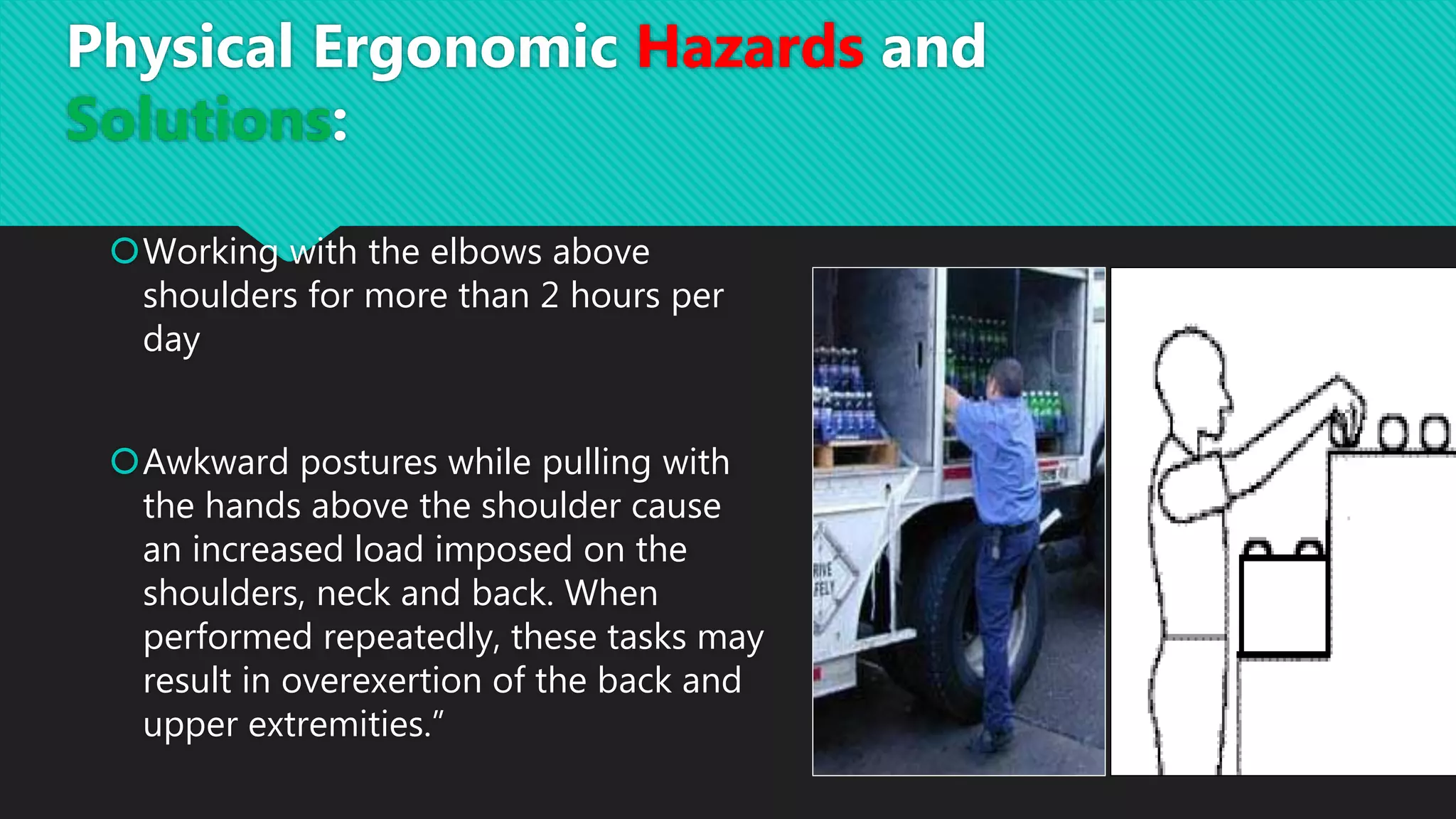
Working with the elbows above
shoulders for more than 2 hours per
day
Awkward postures while pulling with
the hands above the shoulder cause
an increased load imposed on the
shoulders, neck and back. When
performed repeatedly, these tasks may
result in overexertion of the back and
upper extremities.”
Physical Ergonomic Hazards and
Solutions:
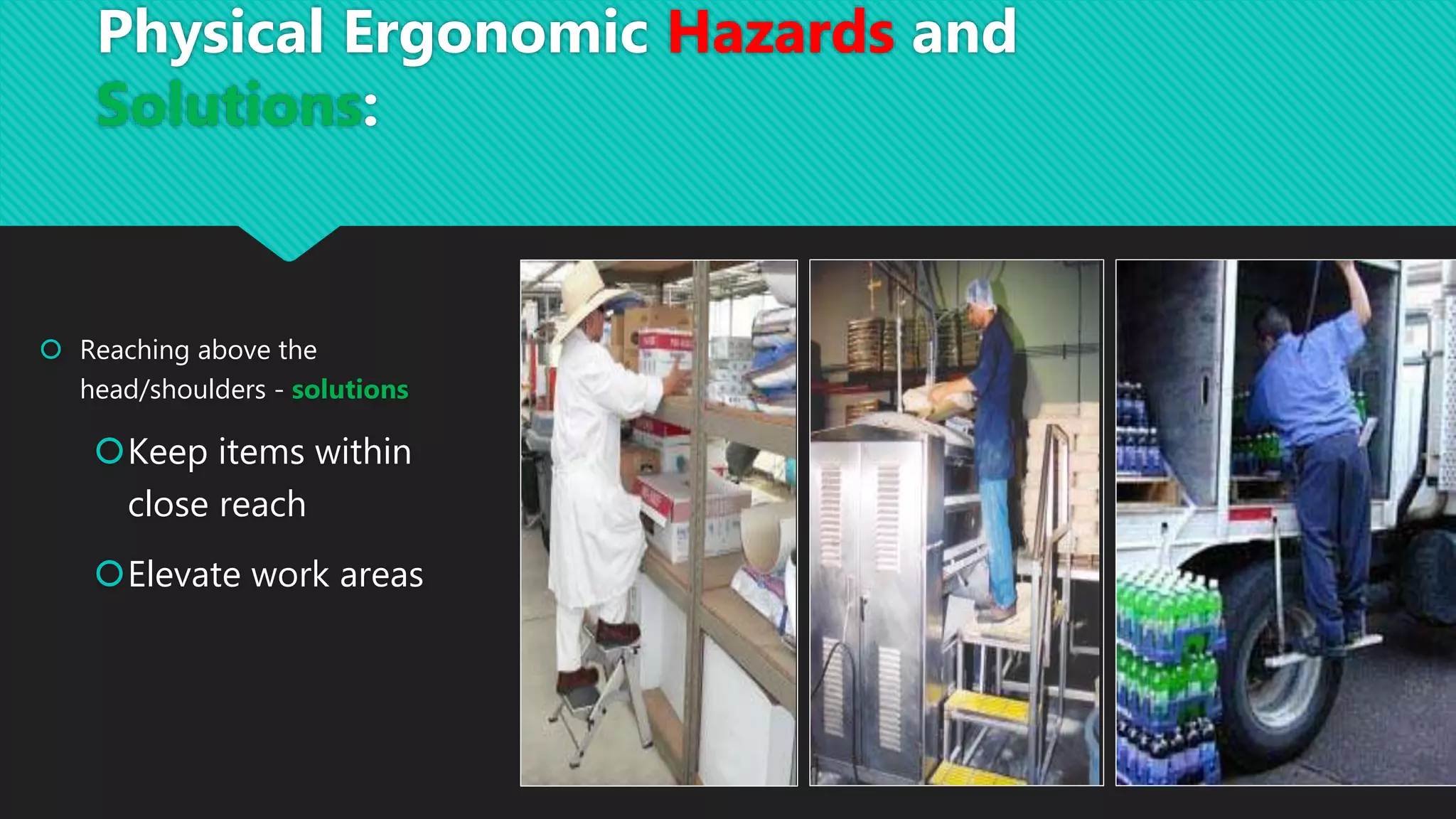
 Reaching above the
head/shoulders - solutions
Keep items within
close reach
Elevate work areas
Physical Ergonomic Hazards and
Solutions:
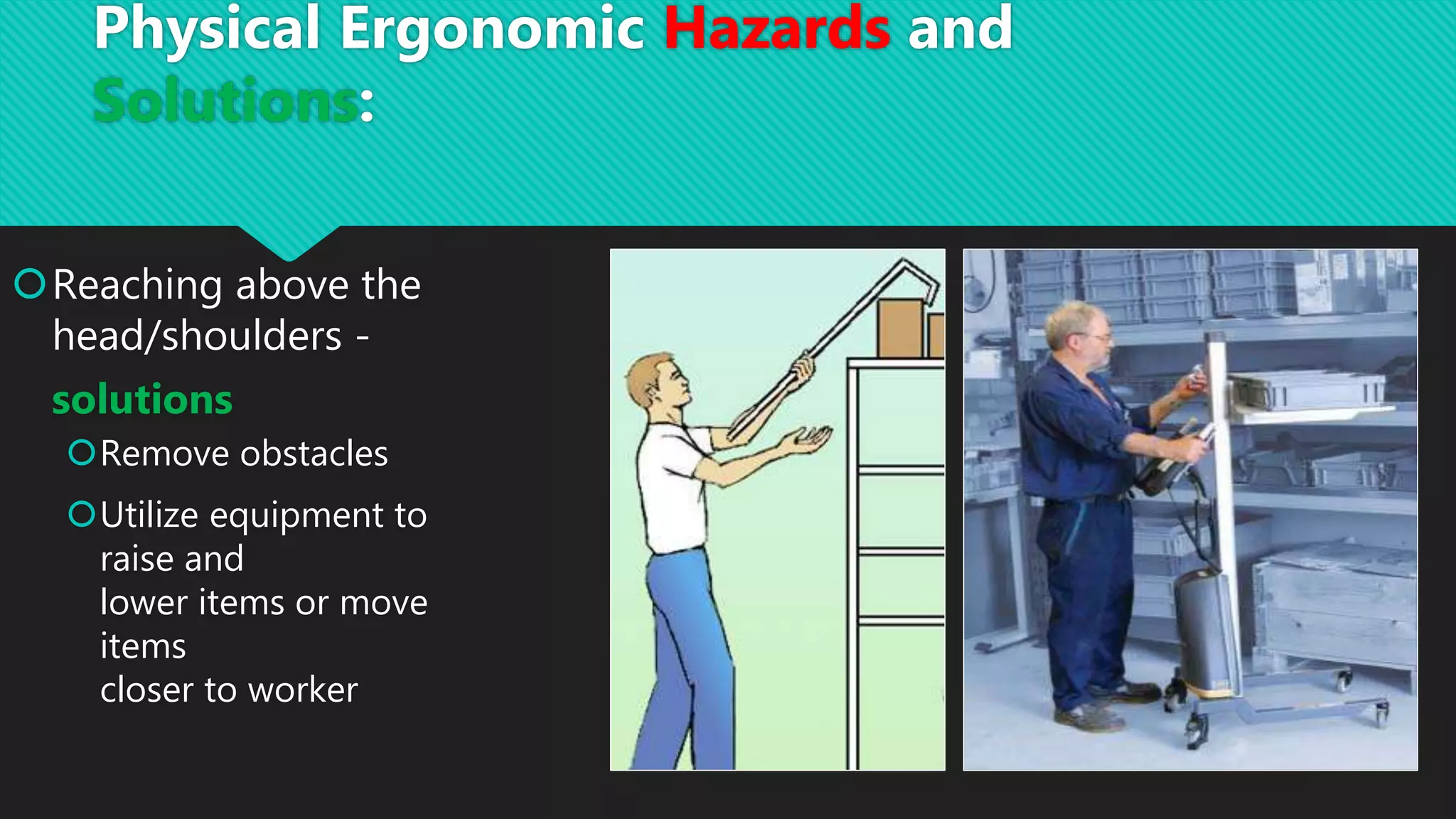
Reaching above the
head/shoulders -
solutions
Remove obstacles
Utilize equipment to
raise and
lower items or move
items
closer to worker
Physical Ergonomic Hazards and
Solutions:
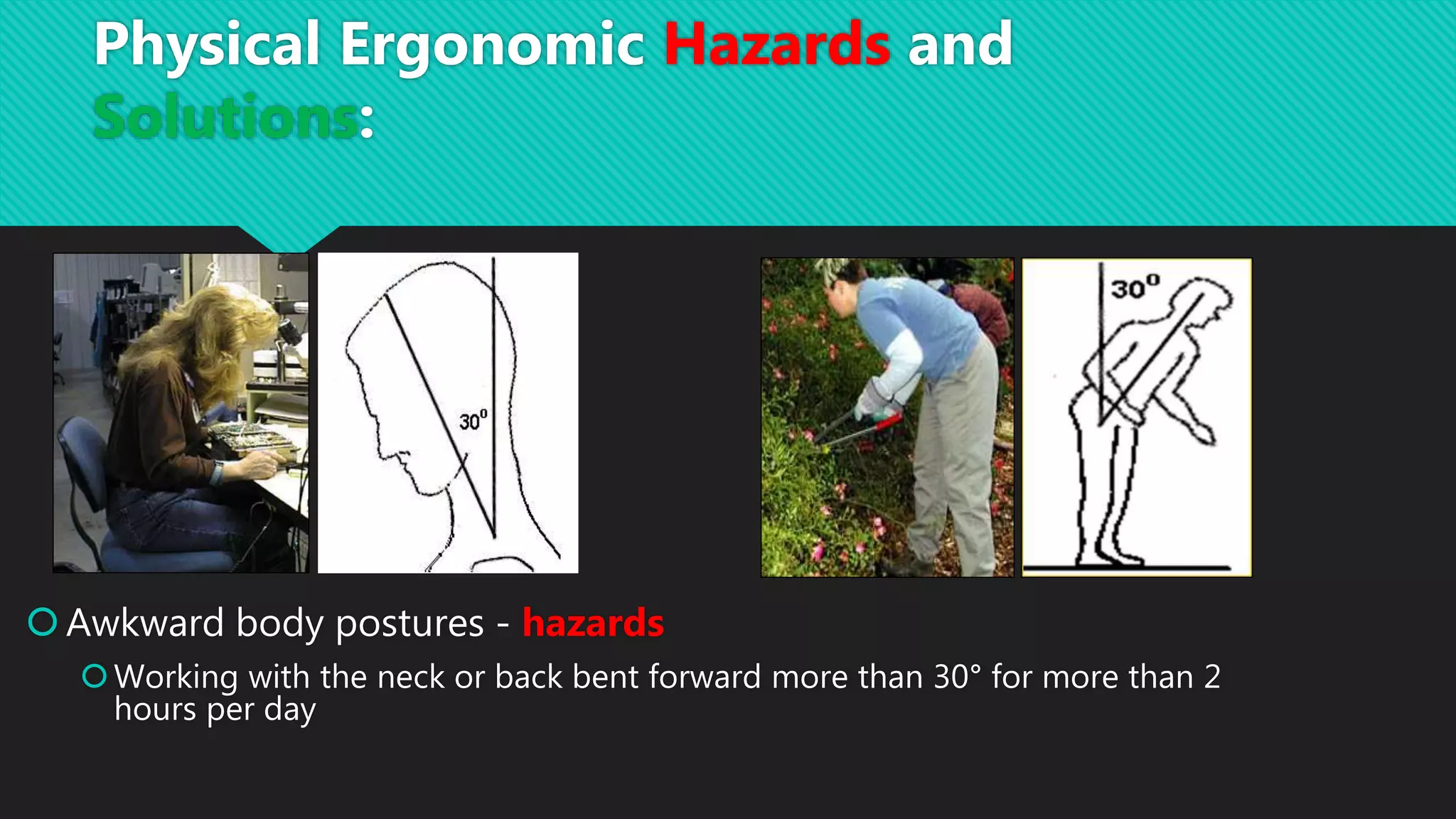
Awkward body postures - hazards
Working with the neck or back bent forward more than 30° for more than 2
hours per day
Physical Ergonomic Hazards and
Solutions:
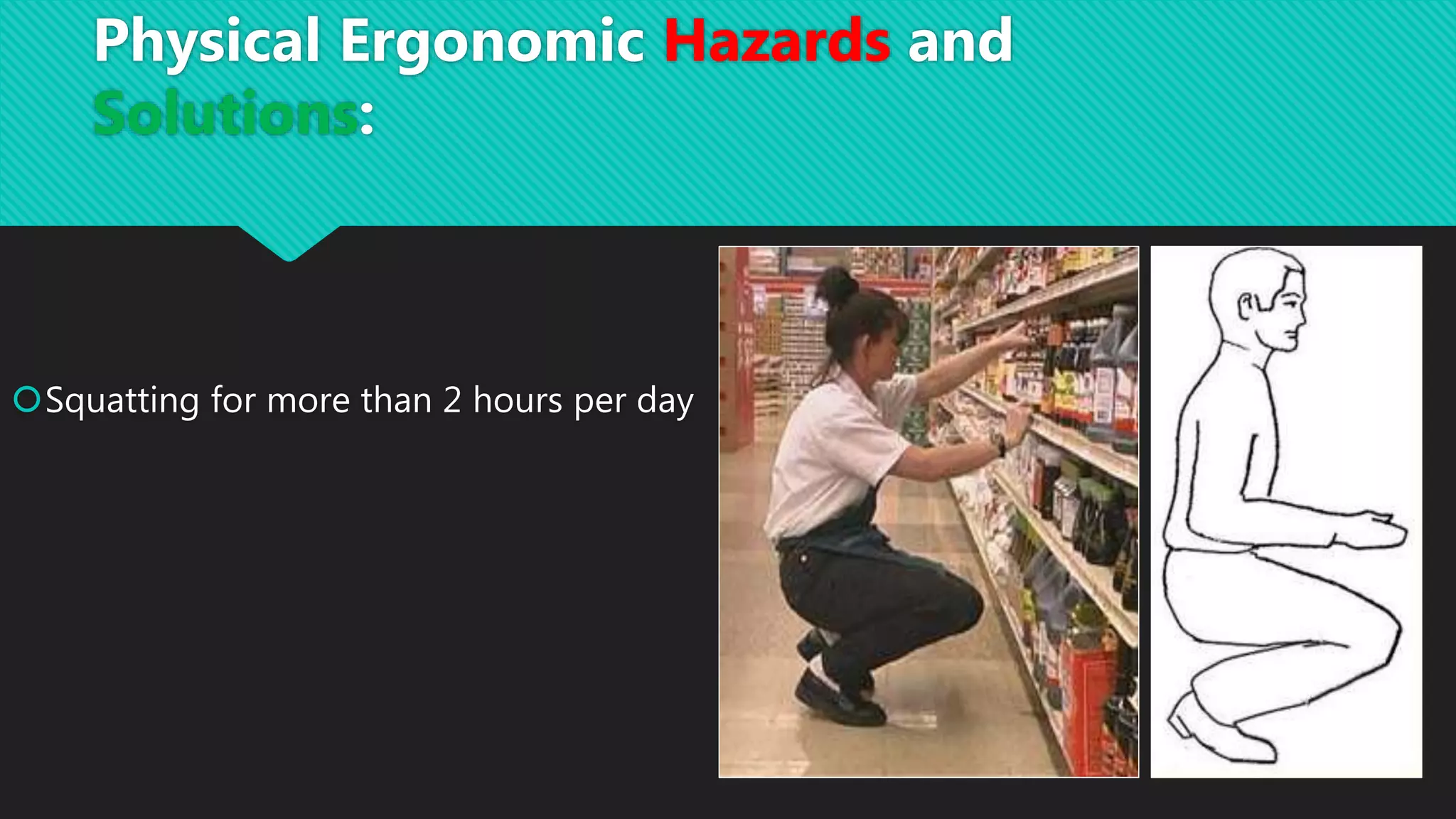
Squatting for more than 2 hours per day
Physical Ergonomic Hazards and
Solutions:
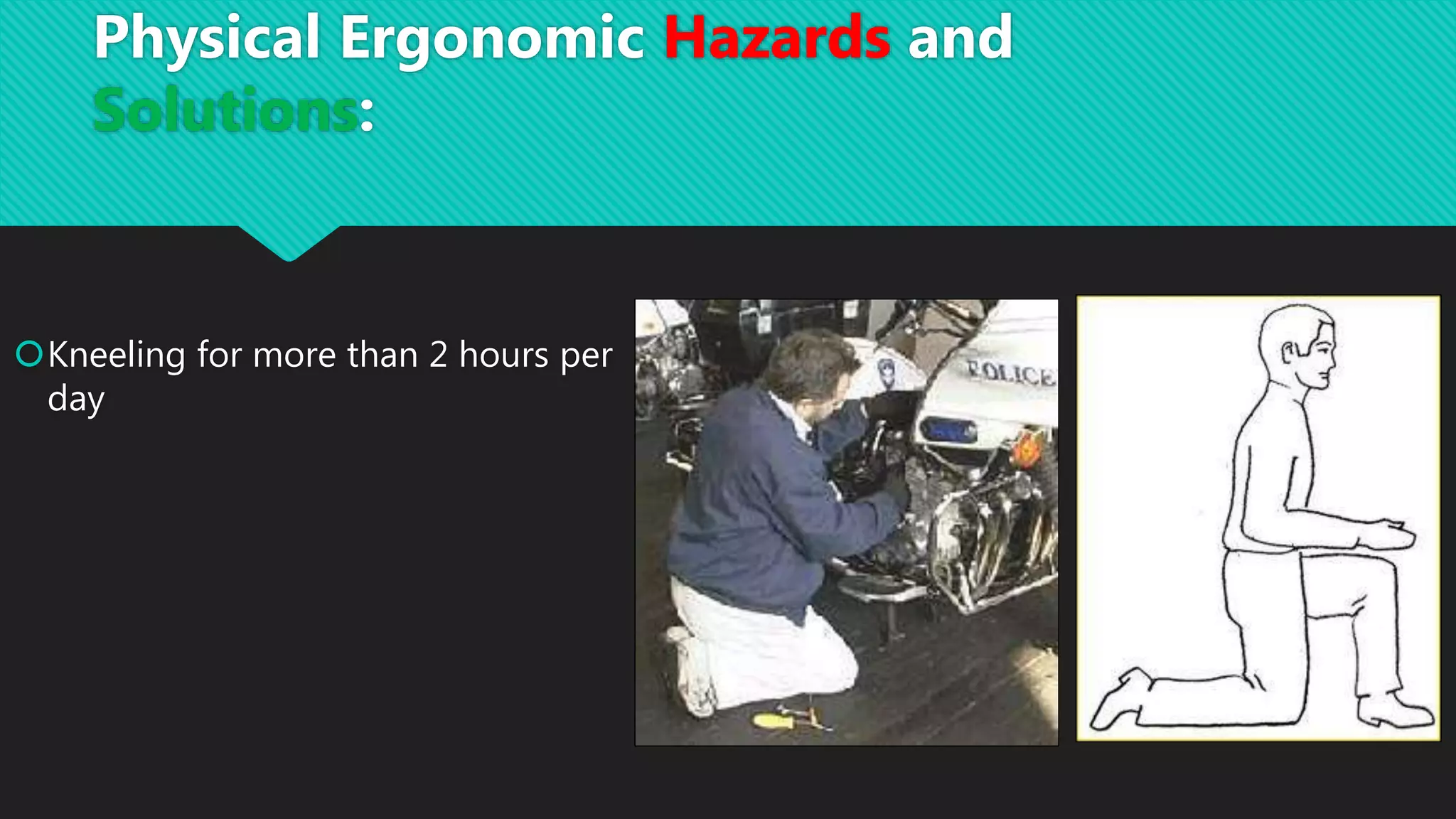
Kneeling for more than 2 hours per
day
Physical Ergonomic Hazards and
Solutions:
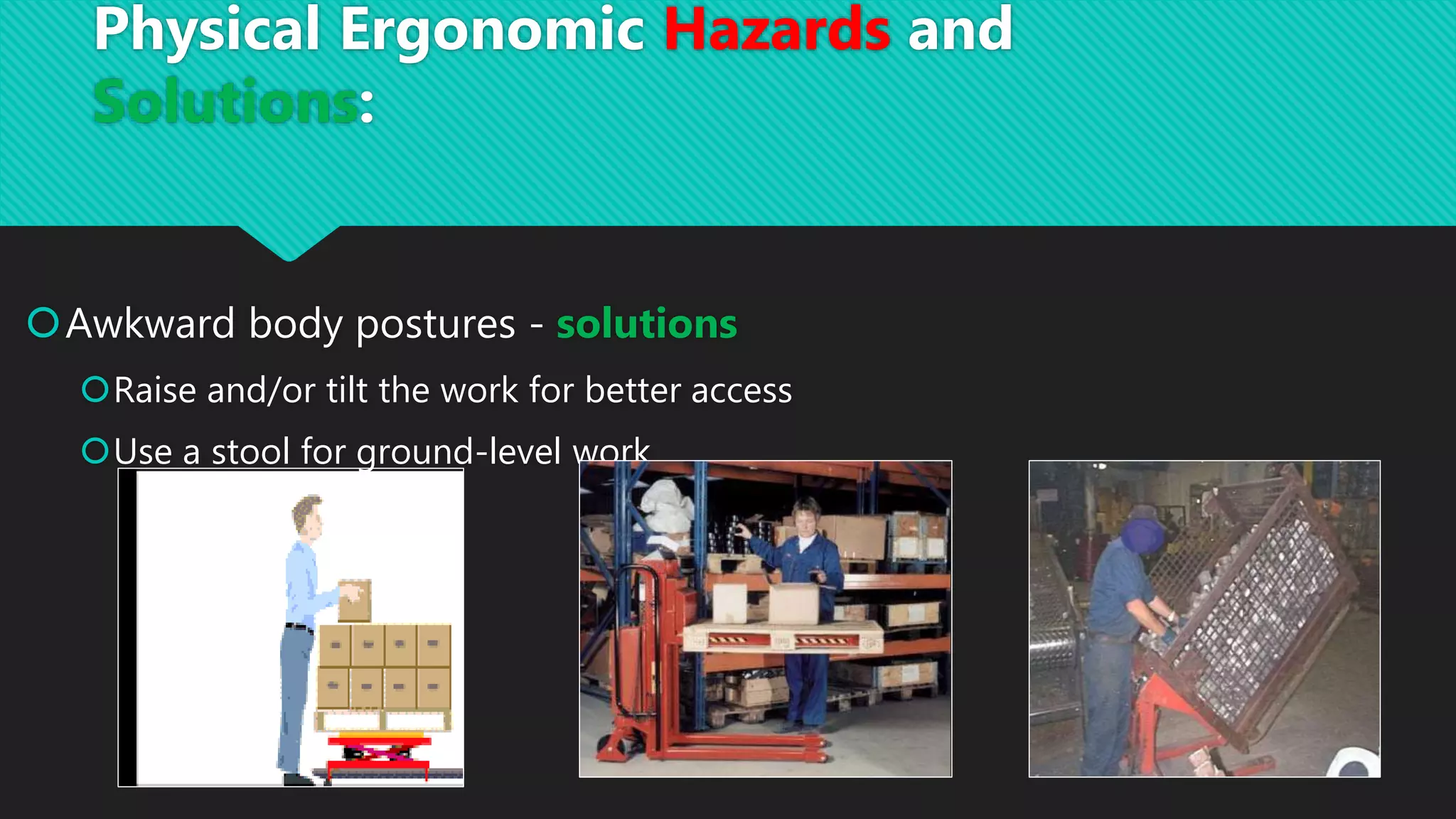
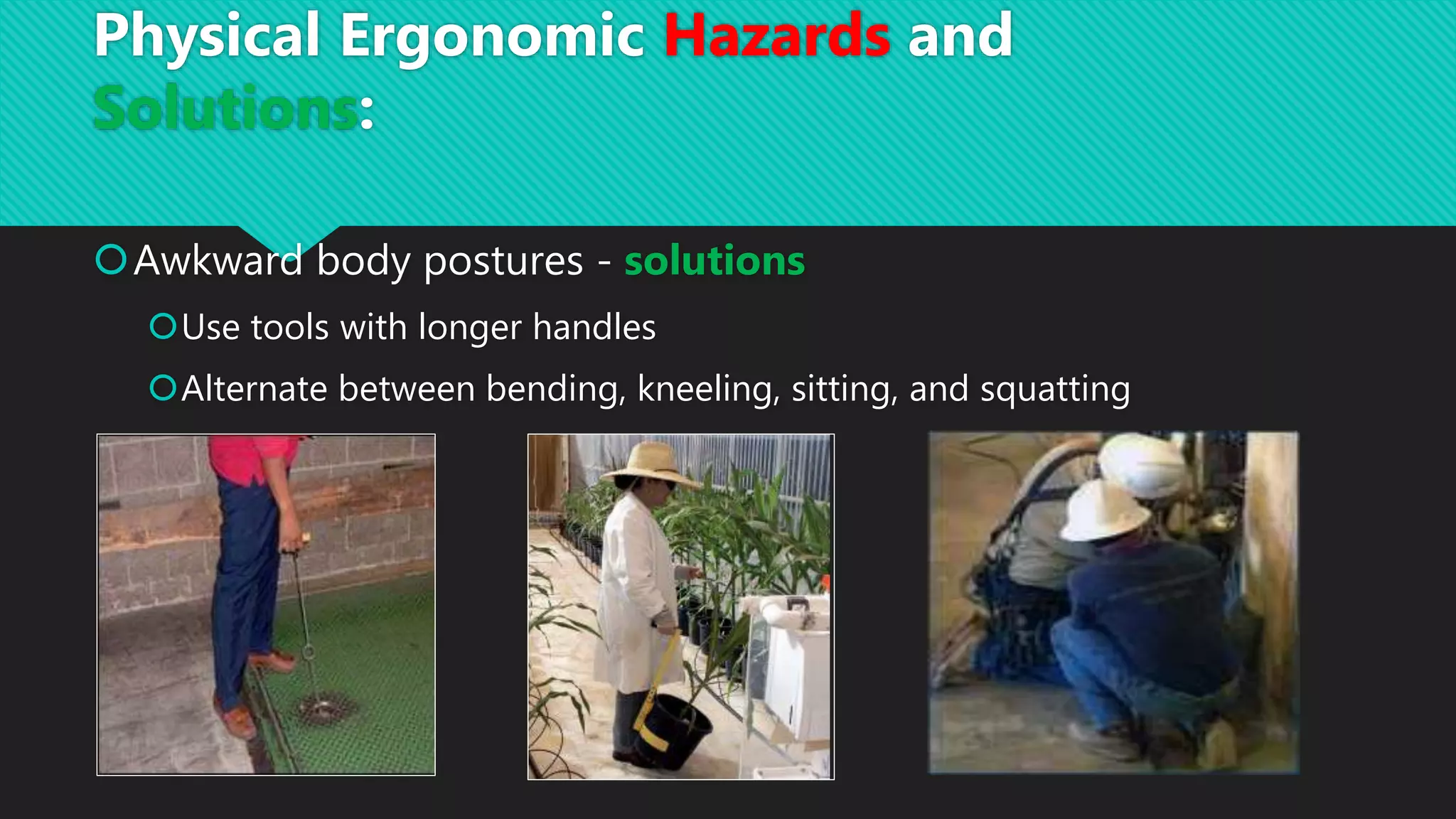
Awkward body postures - solutions
Raise and/or tilt the work for better access
Use a stool for ground-level work
Physical Ergonomic Hazards and
Solutions:
Awkward body postures - solutions
Use tools with longer handles
Alternate between bending, kneeling, sitting, and squatting
Physical Ergonomic Hazards and
Solutions:
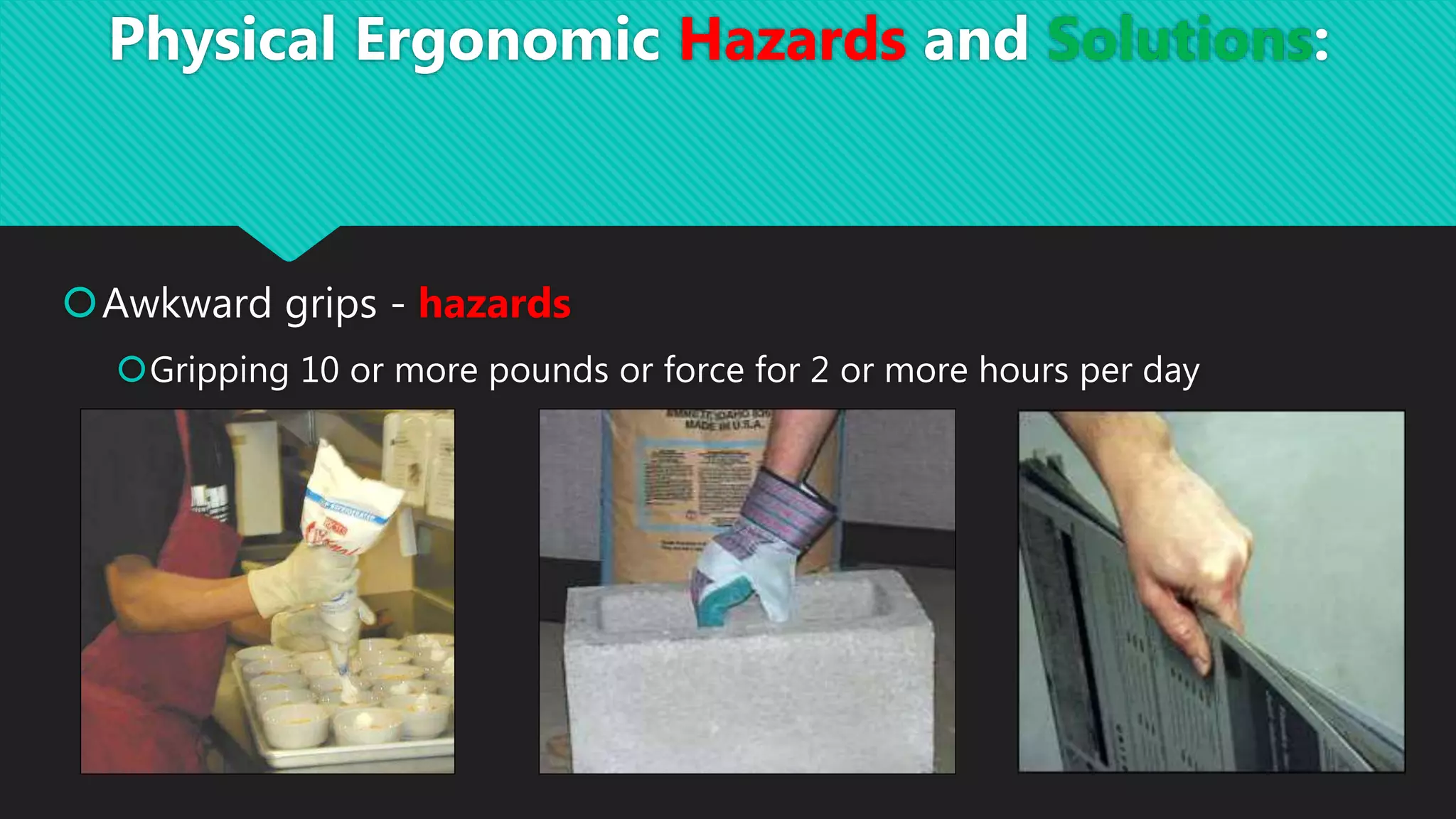
Awkward grips - hazards
Gripping 10 or more pounds or force for 2 or more hours per day
Physical Ergonomic Hazards and Solutions:
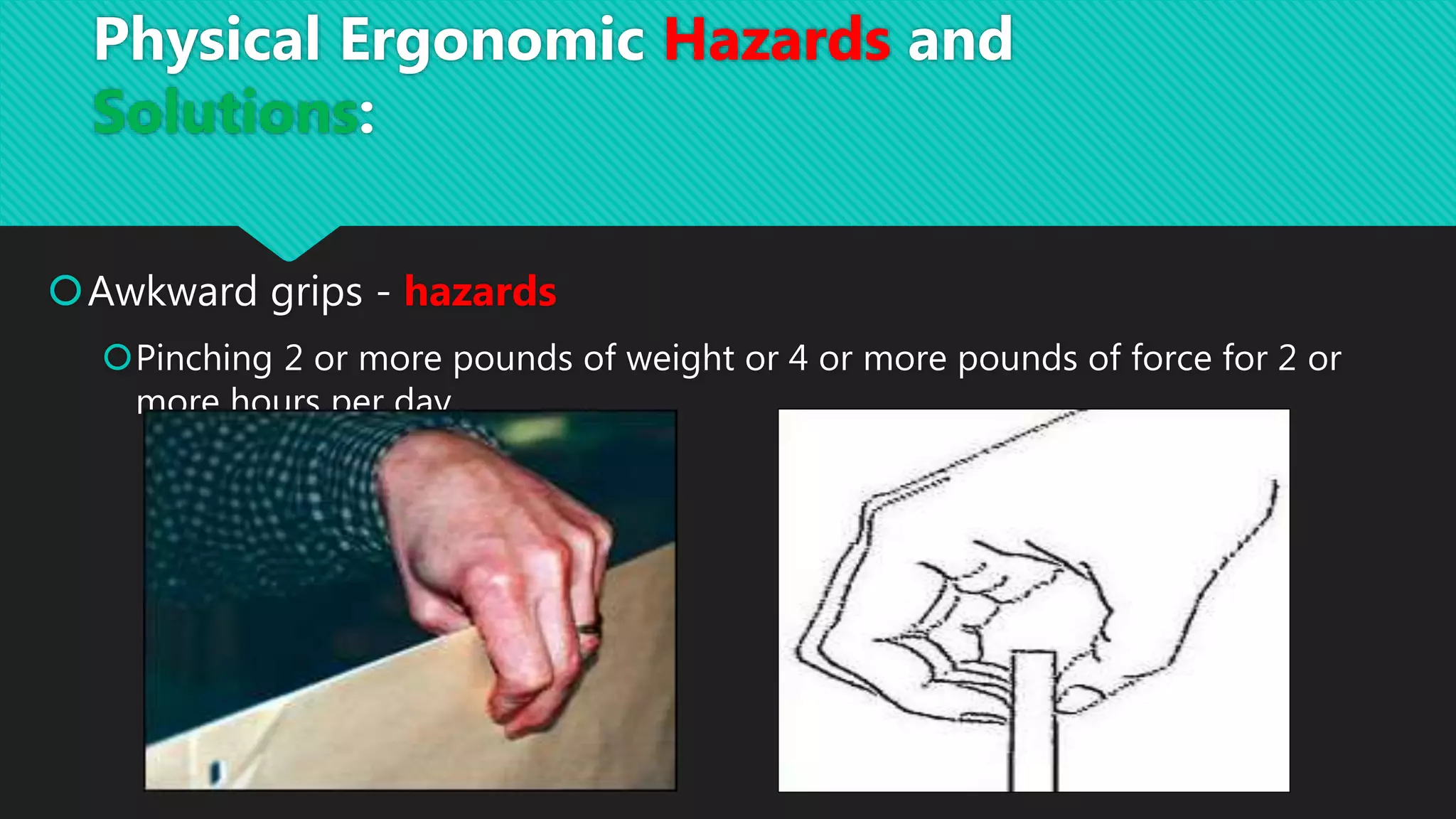
Awkward grips - hazards
Pinching 2 or more pounds of weight or 4 or more pounds of force for 2 or
more hours per day
Physical Ergonomic Hazards and
Solutions:
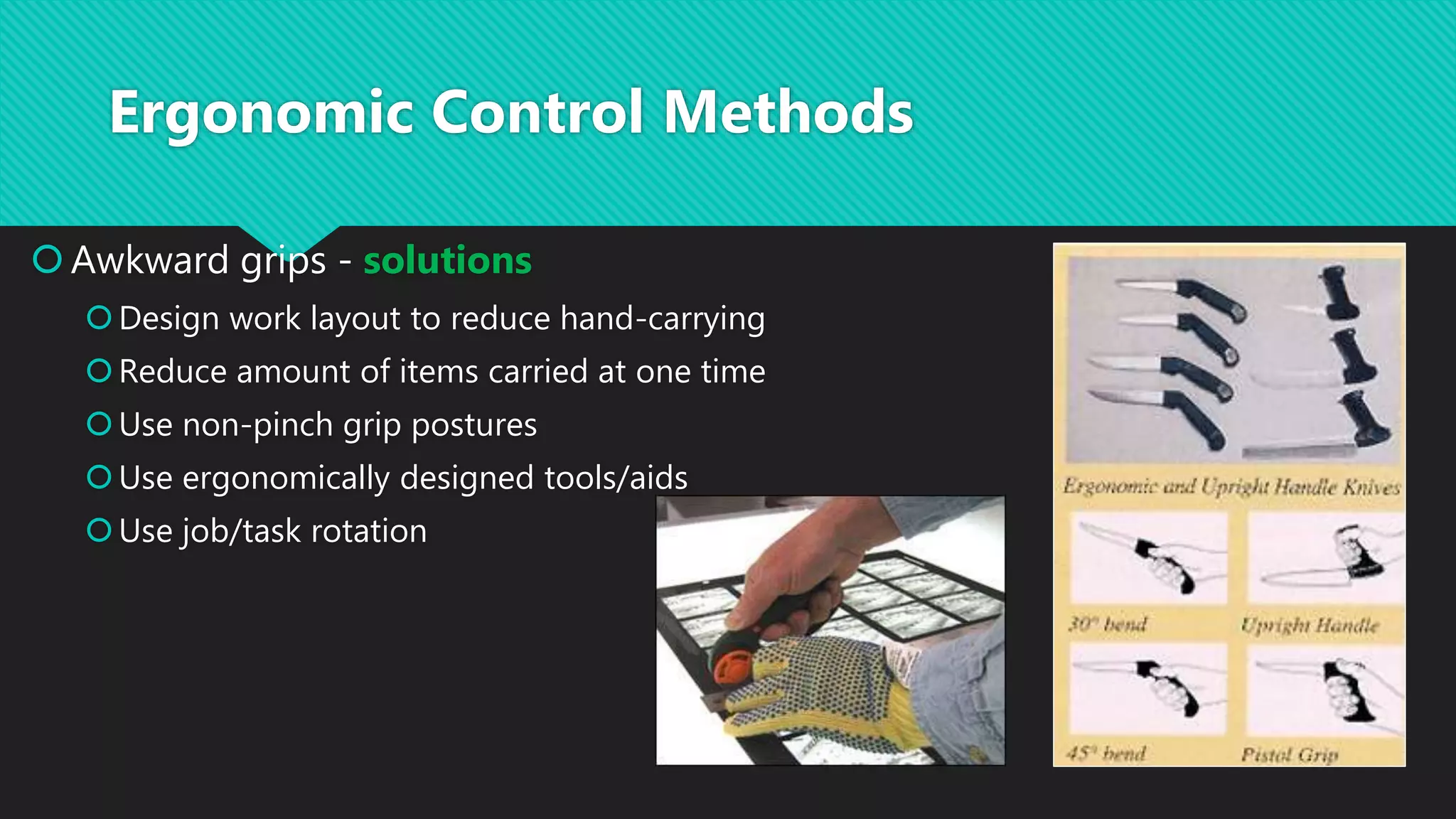
Awkward grips - solutions
Design work layout to reduce hand-carrying
Reduce amount of items carried at one time
Use non-pinch grip postures
Use ergonomically designed tools/aids
Use job/task rotation
Ergonomic Control Methods
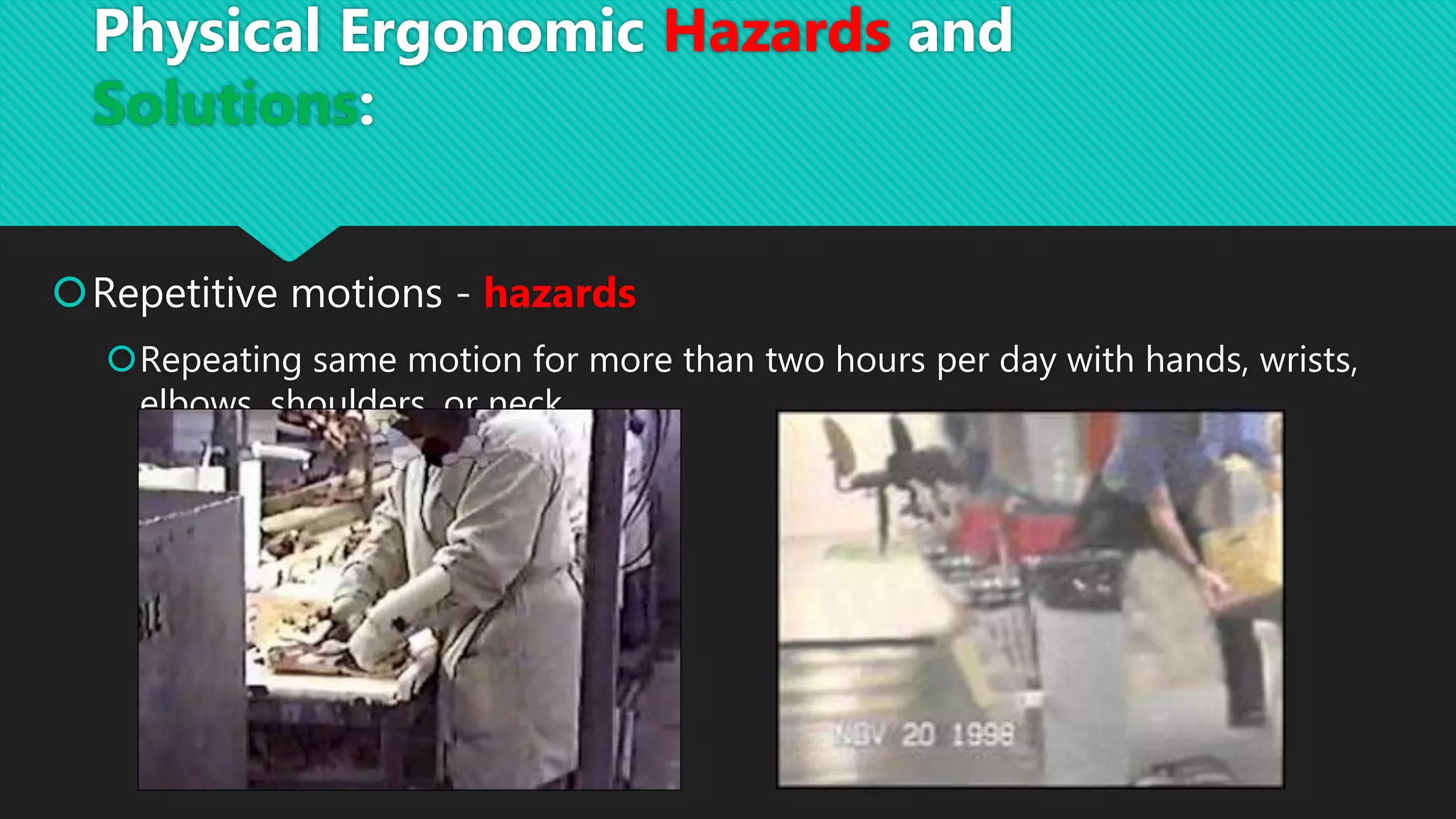
Repetitive motions - hazards
Repeating same motion for more than two hours per day with hands, wrists,
elbows, shoulders, or neck
Physical Ergonomic Hazards and
Solutions:
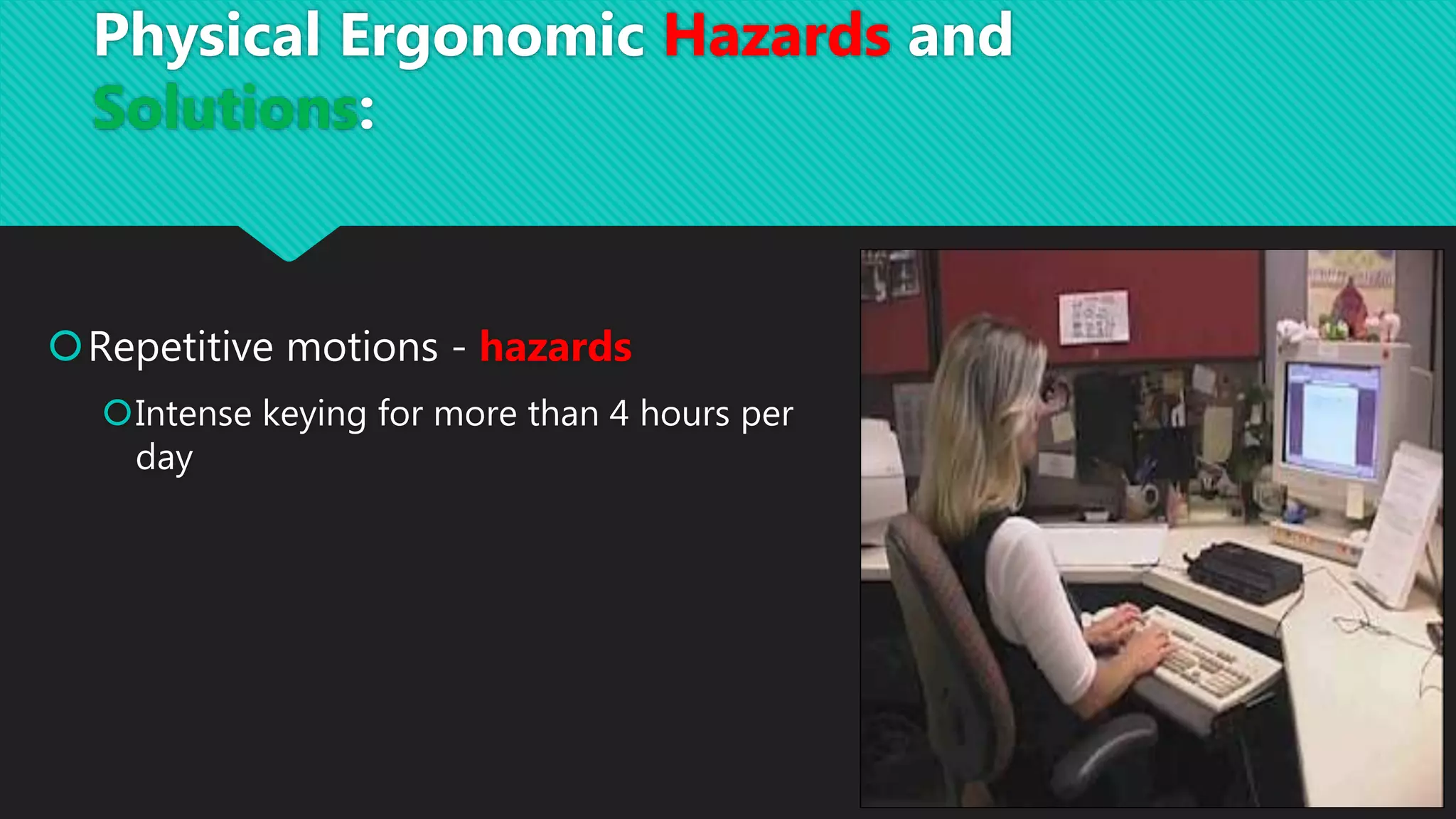
Repetitive motions - hazards
Intense keying for more than 4 hours per
day
Physical Ergonomic Hazards and
Solutions:
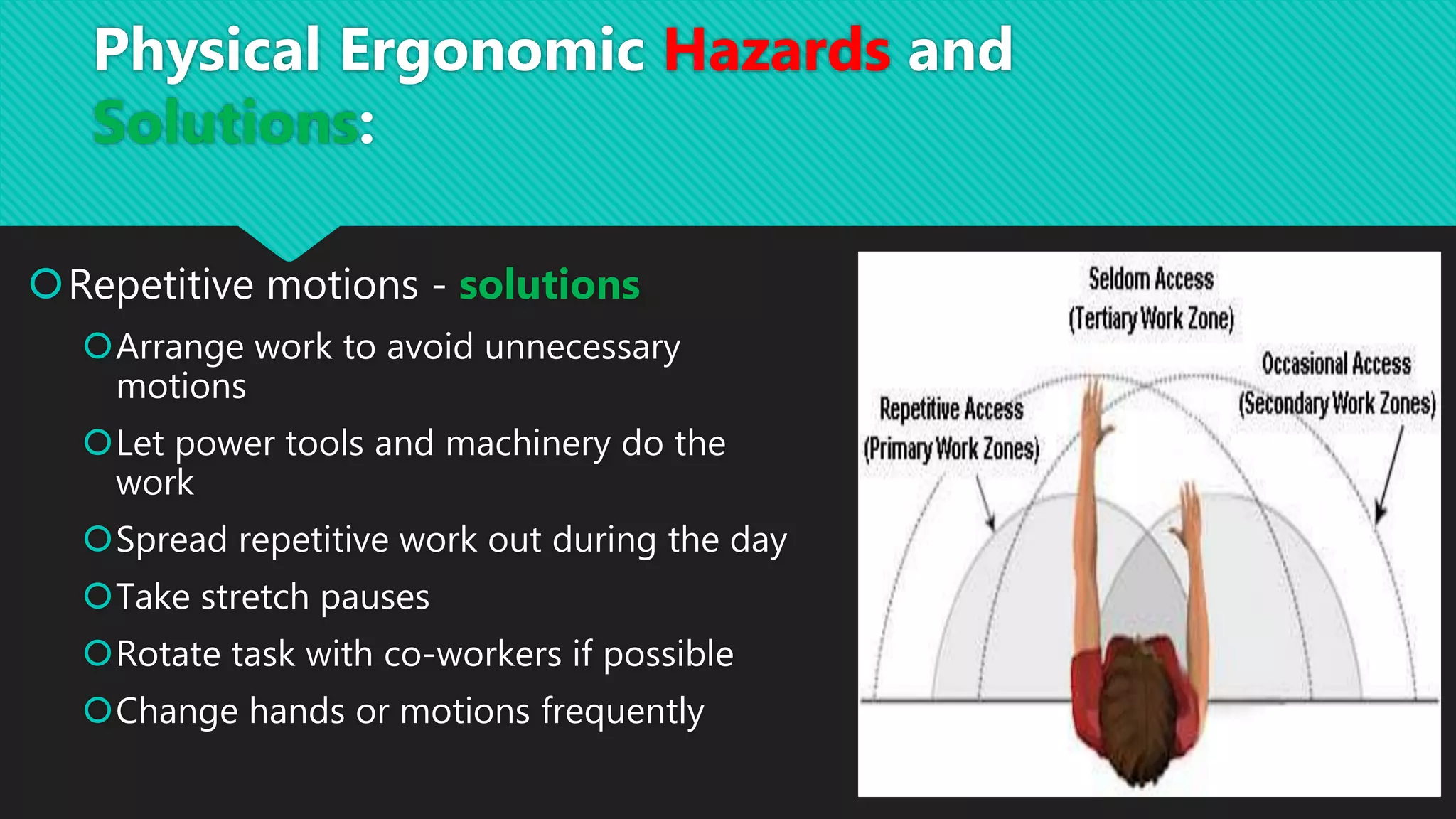
Repetitive motions - solutions
Arrange work to avoid unnecessary
motions
Let power tools and machinery do the
work
Spread repetitive work out during the day
Take stretch pauses
Rotate task with co-workers if possible
Change hands or motions frequently
Physical Ergonomic Hazards and
Solutions:
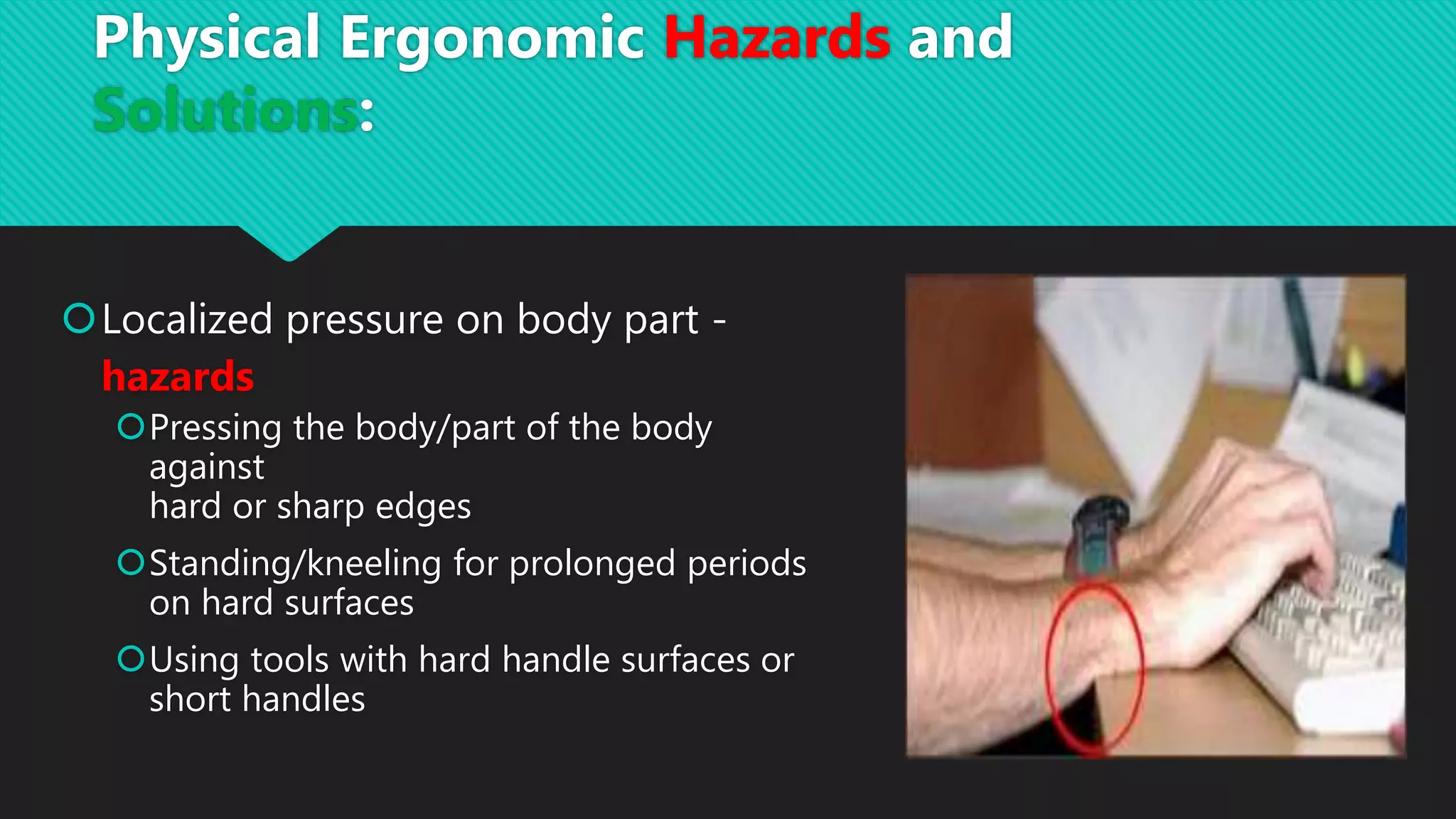
Localized pressure on body part -
hazards
Pressing the body/part of the body
against
hard or sharp edges
Standing/kneeling for prolonged periods
on hard surfaces
Using tools with hard handle surfaces or
short handles
Physical Ergonomic Hazards and
Solutions:
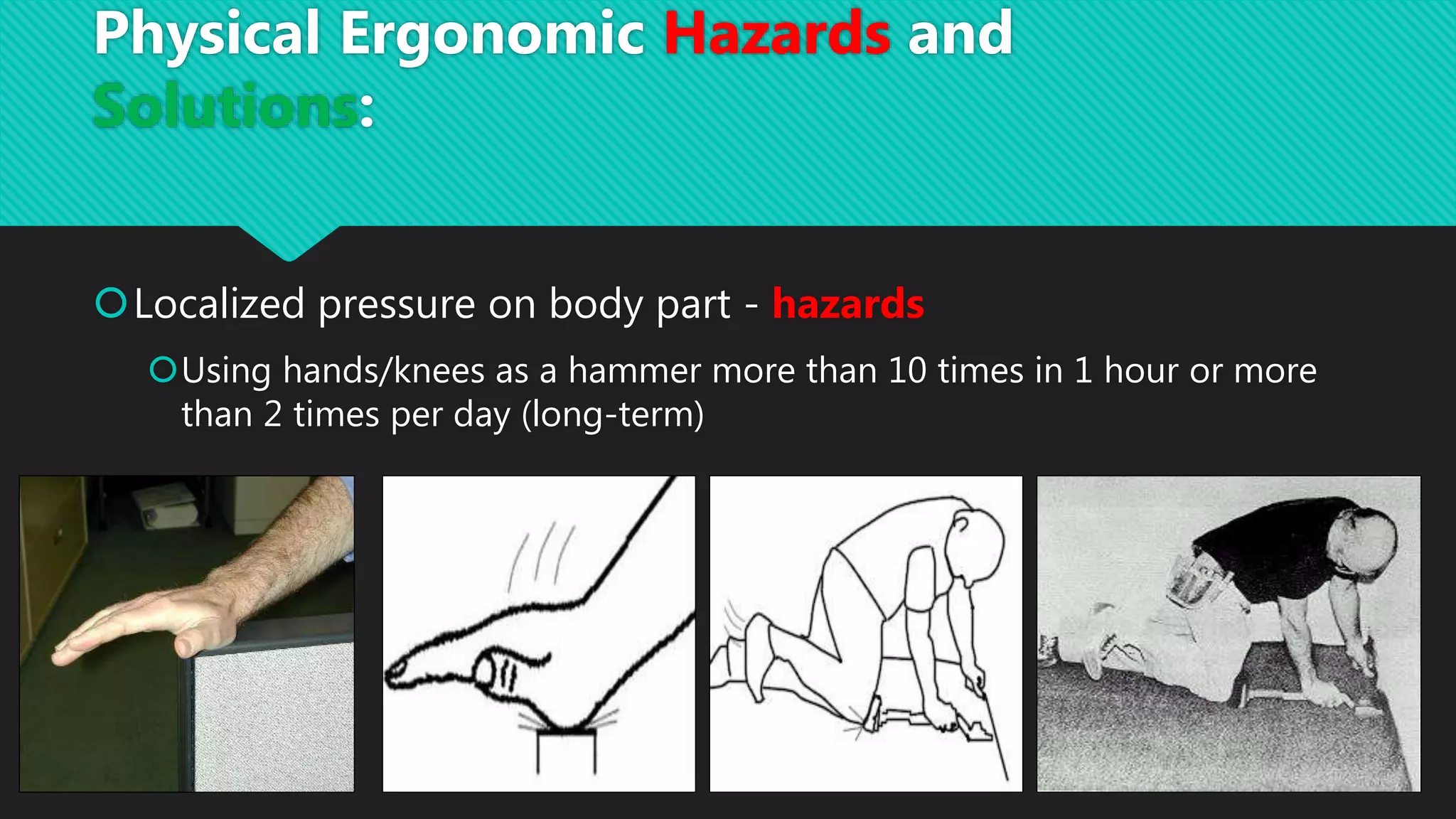
Localized pressure on body part - hazards
Using hands/knees as a hammer more than 10 times in 1 hour or more
than 2 times per day (long-term)
Physical Ergonomic Hazards and
Solutions:
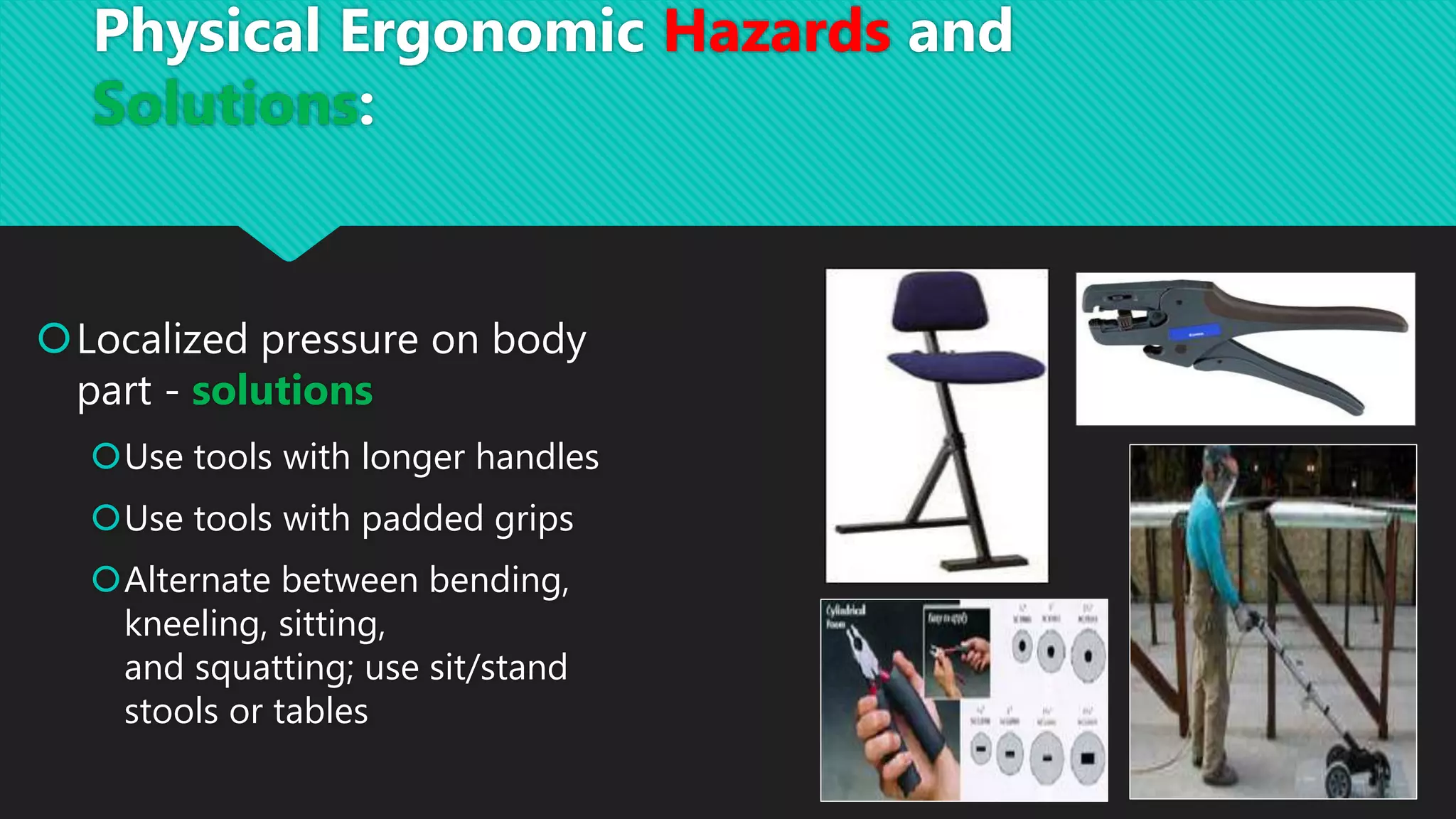
Localized pressure on body
part - solutions
Use tools with longer handles
Use tools with padded grips
Alternate between bending,
kneeling, sitting,
and squatting; use sit/stand
stools or tables
Physical Ergonomic Hazards and
Solutions:
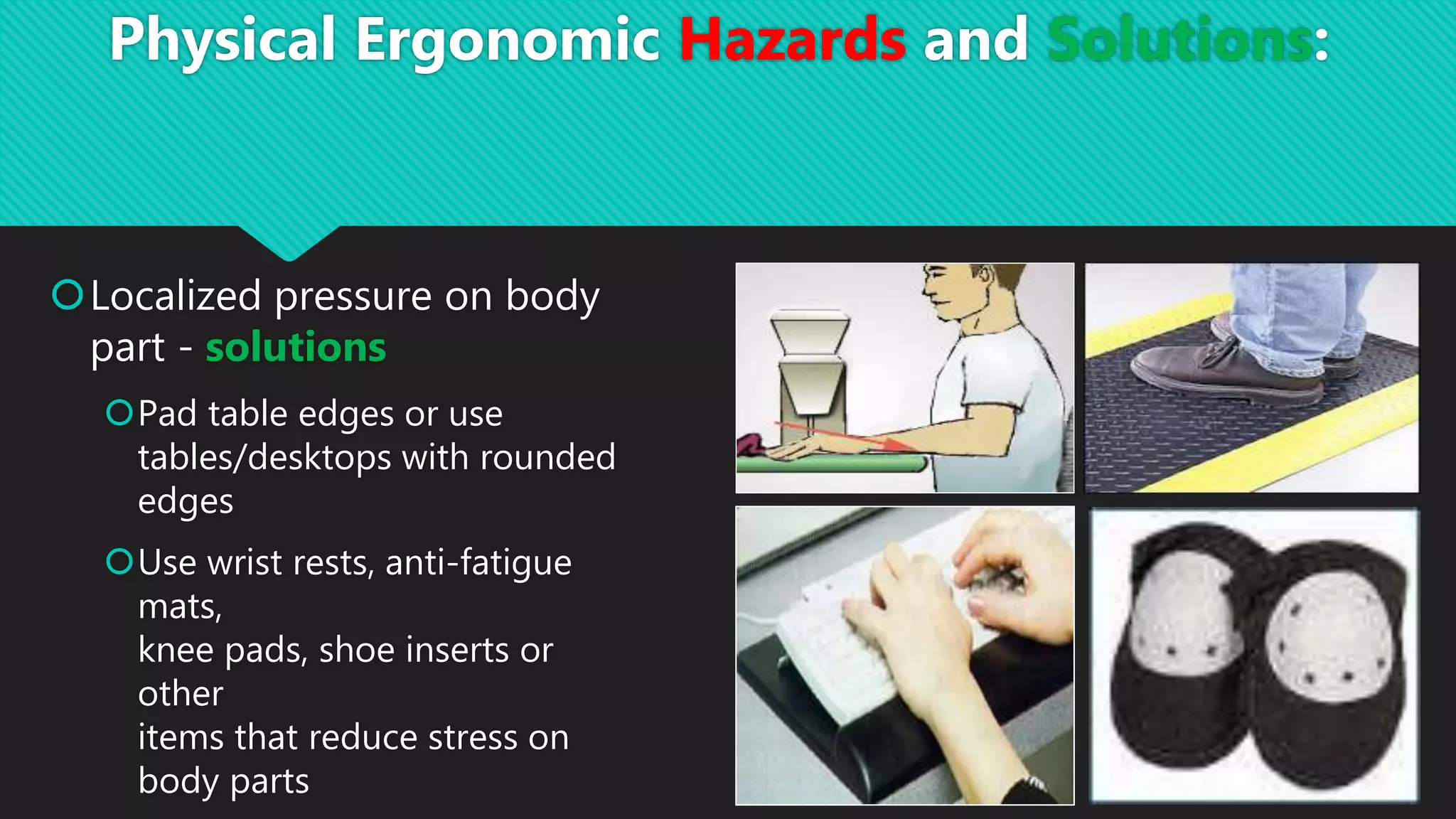
Localized pressure on body
part - solutions
Pad table edges or use
tables/desktops with rounded
edges
Use wrist rests, anti-fatigue
mats,
knee pads, shoe inserts or
other
items that reduce stress on
body parts
Physical Ergonomic Hazards and Solutions:
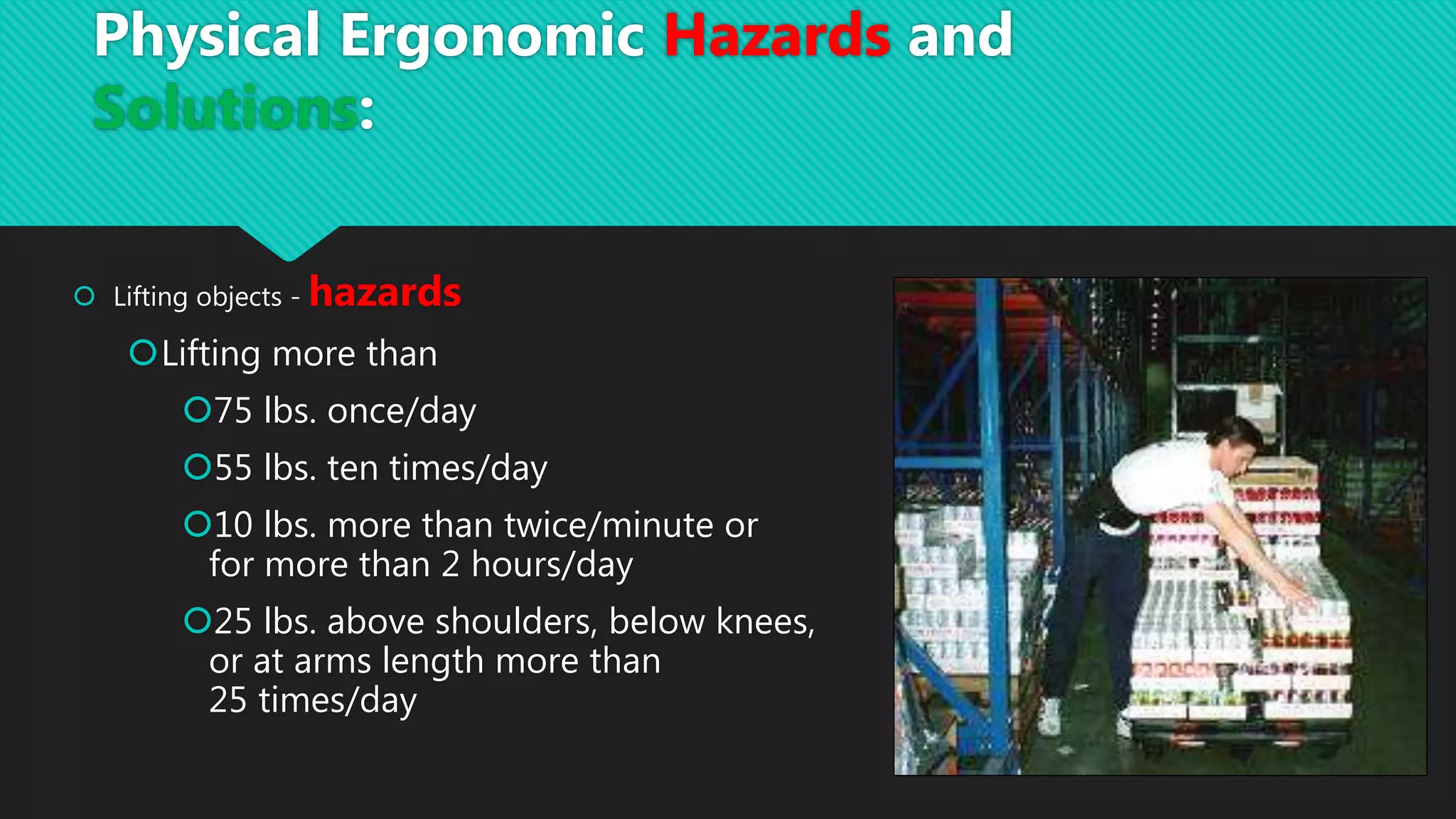
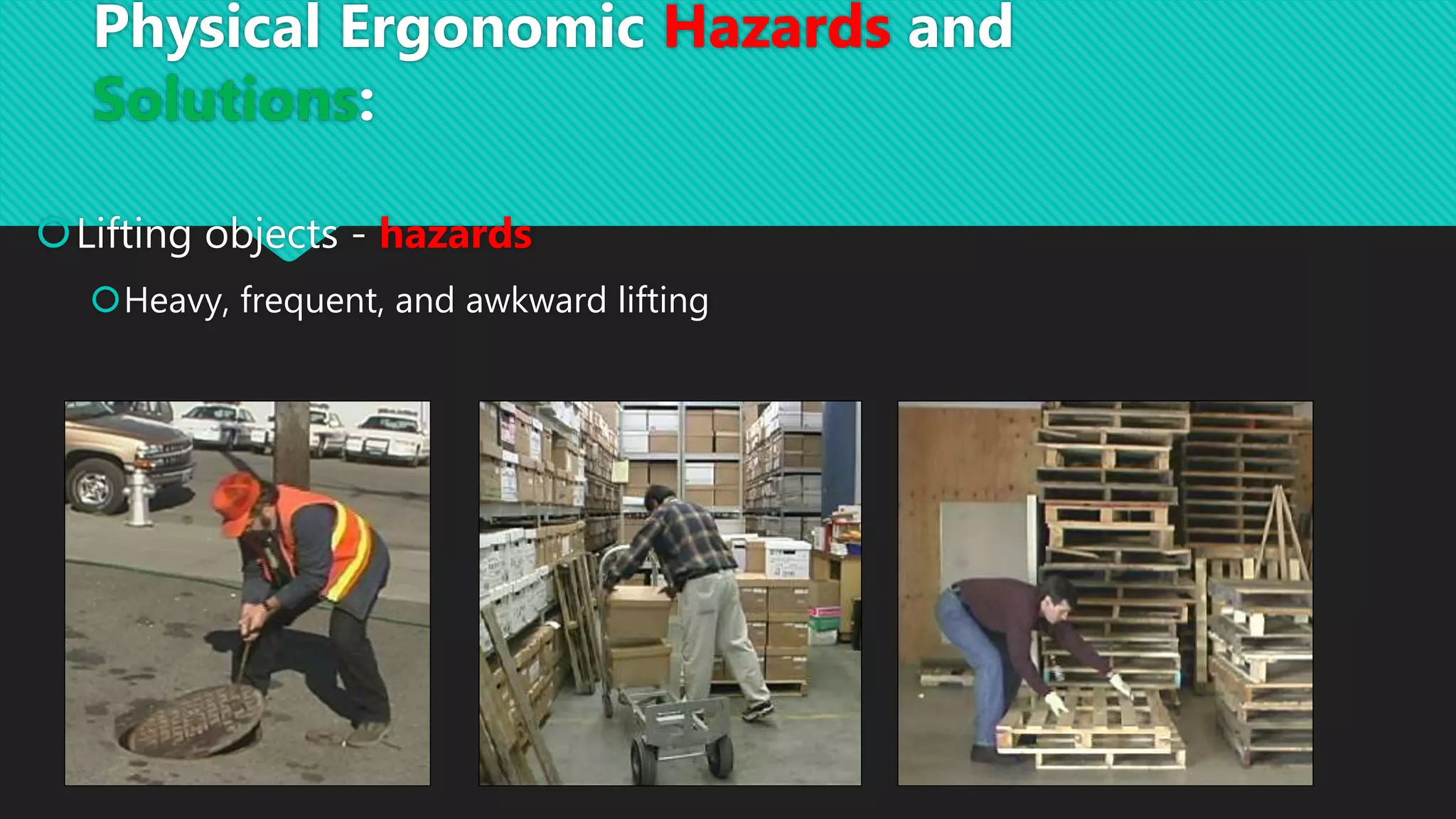
 Lifting objects - hazards
Lifting more than
75 lbs. once/day
55 lbs. ten times/day
10 lbs. more than twice/minute or
for more than 2 hours/day
25 lbs. above shoulders, below knees,
or at arms length more than
25 times/day
Physical Ergonomic Hazards and
Solutions:
Lifting objects - hazards
Heavy, frequent, and awkward lifting
Physical Ergonomic Hazards and
Solutions:
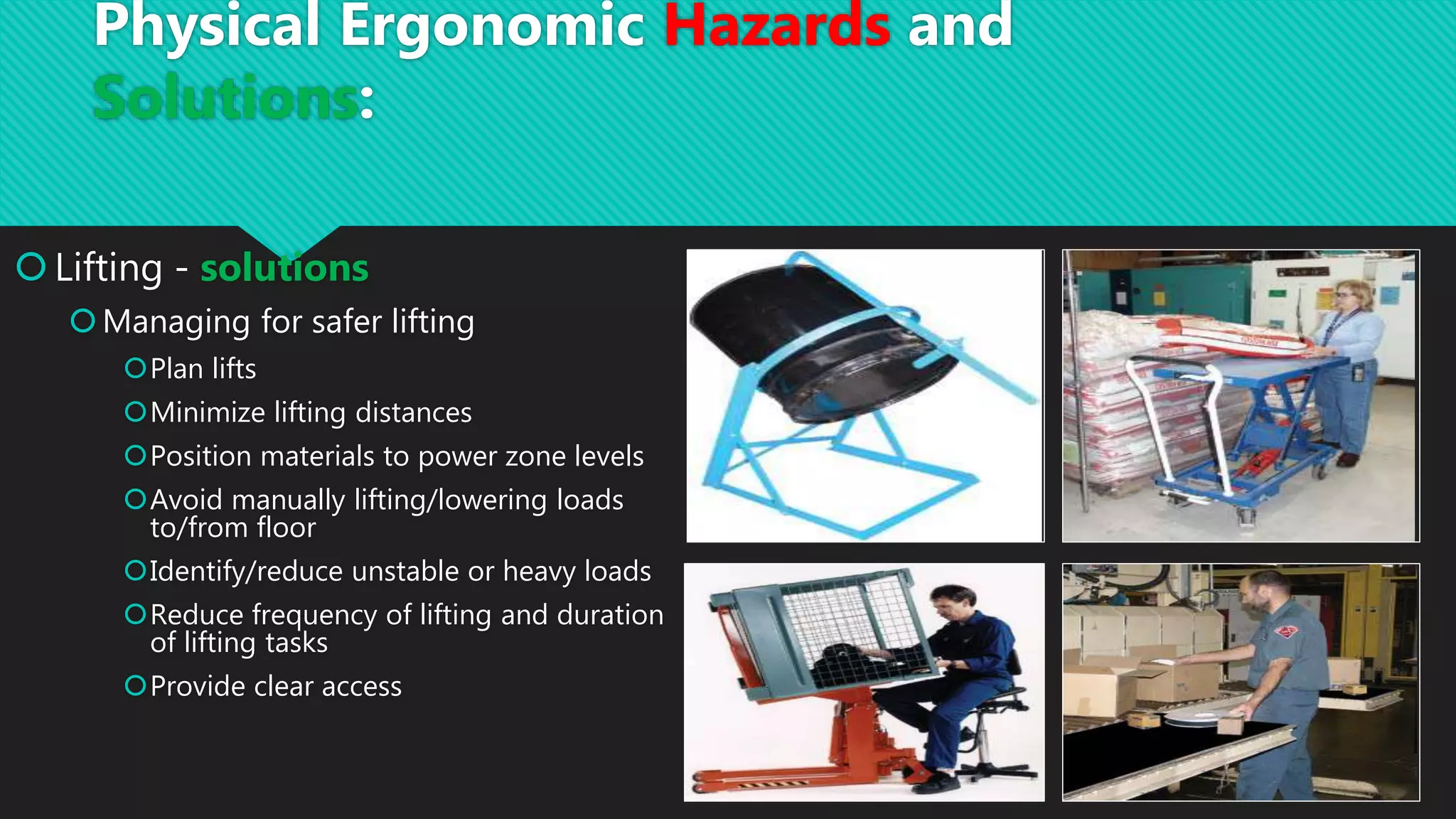
Lifting - solutions
Managing for safer lifting
Plan lifts
Minimize lifting distances
Position materials to power zone levels
Avoid manually lifting/lowering loads
to/from floor
Identify/reduce unstable or heavy loads
Reduce frequency of lifting and duration
of lifting tasks
Provide clear access
Physical Ergonomic Hazards and
Solutions:
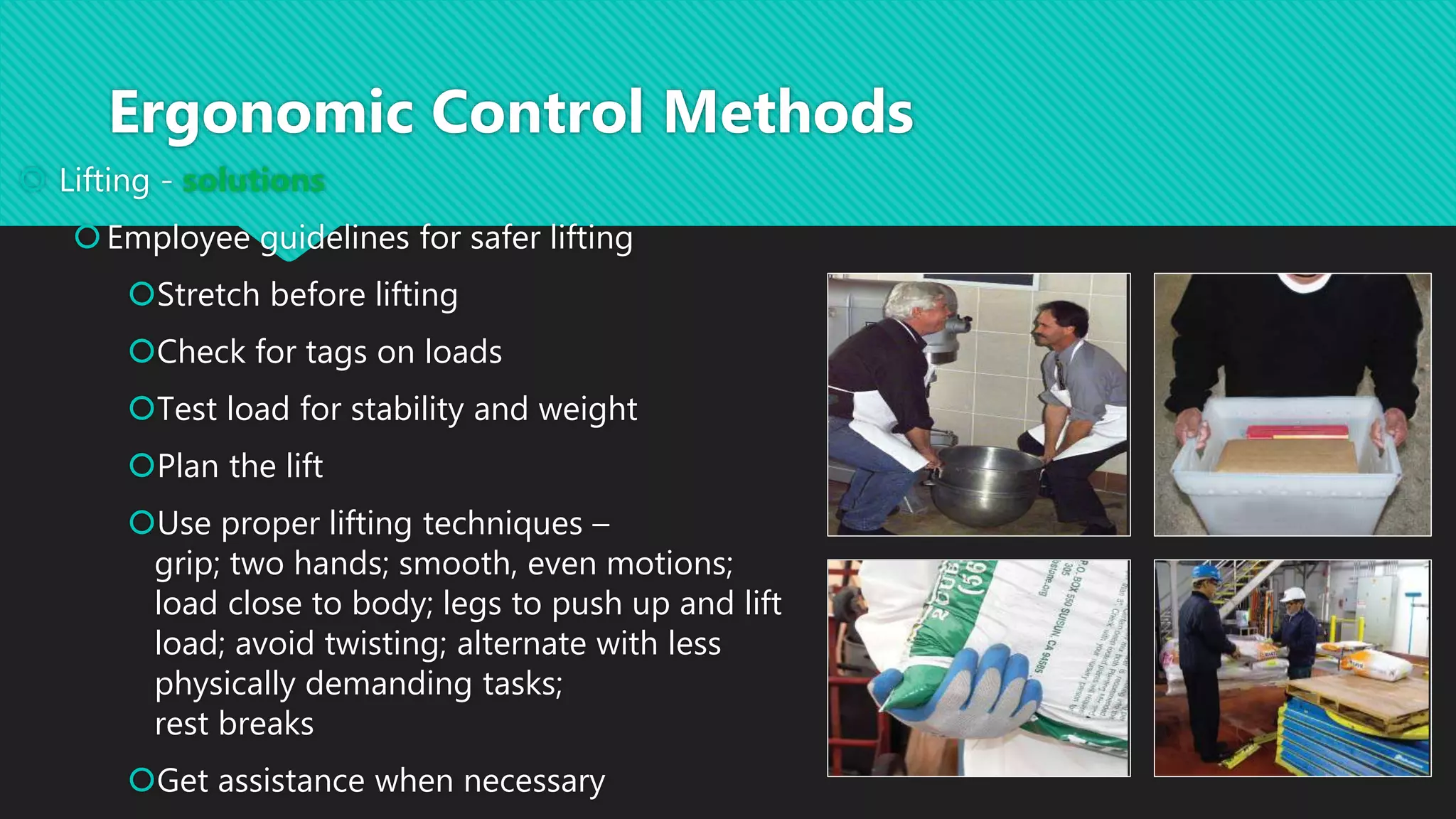
 Lifting - solutions
Employee guidelines for safer lifting
Stretch before lifting
Check for tags on loads
Test load for stability and weight
Plan the lift
Use proper lifting techniques –
grip; two hands; smooth, even motions;
load close to body; legs to push up and lift
load; avoid twisting; alternate with less
physically demanding tasks;
rest breaks
Get assistance when necessary
Ergonomic Control Methods
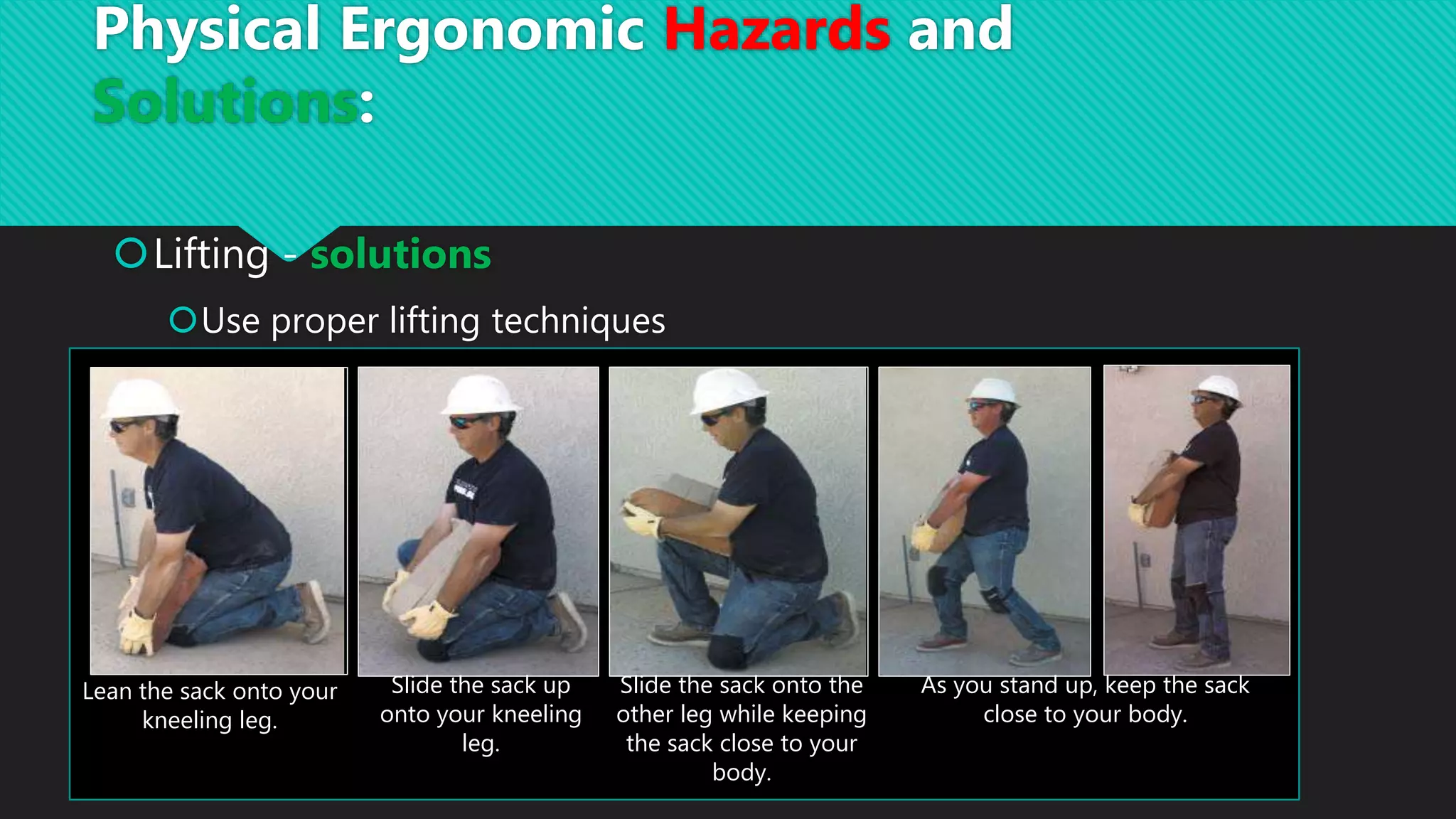
Lifting - solutions
Use proper lifting techniques
Lean the sack onto your
kneeling leg.
Slide the sack up
onto your kneeling
leg.
Slide the sack onto the
other leg while keeping
the sack close to your
body.
As you stand up, keep the sack
close to your body.
Physical Ergonomic Hazards and
Solutions:
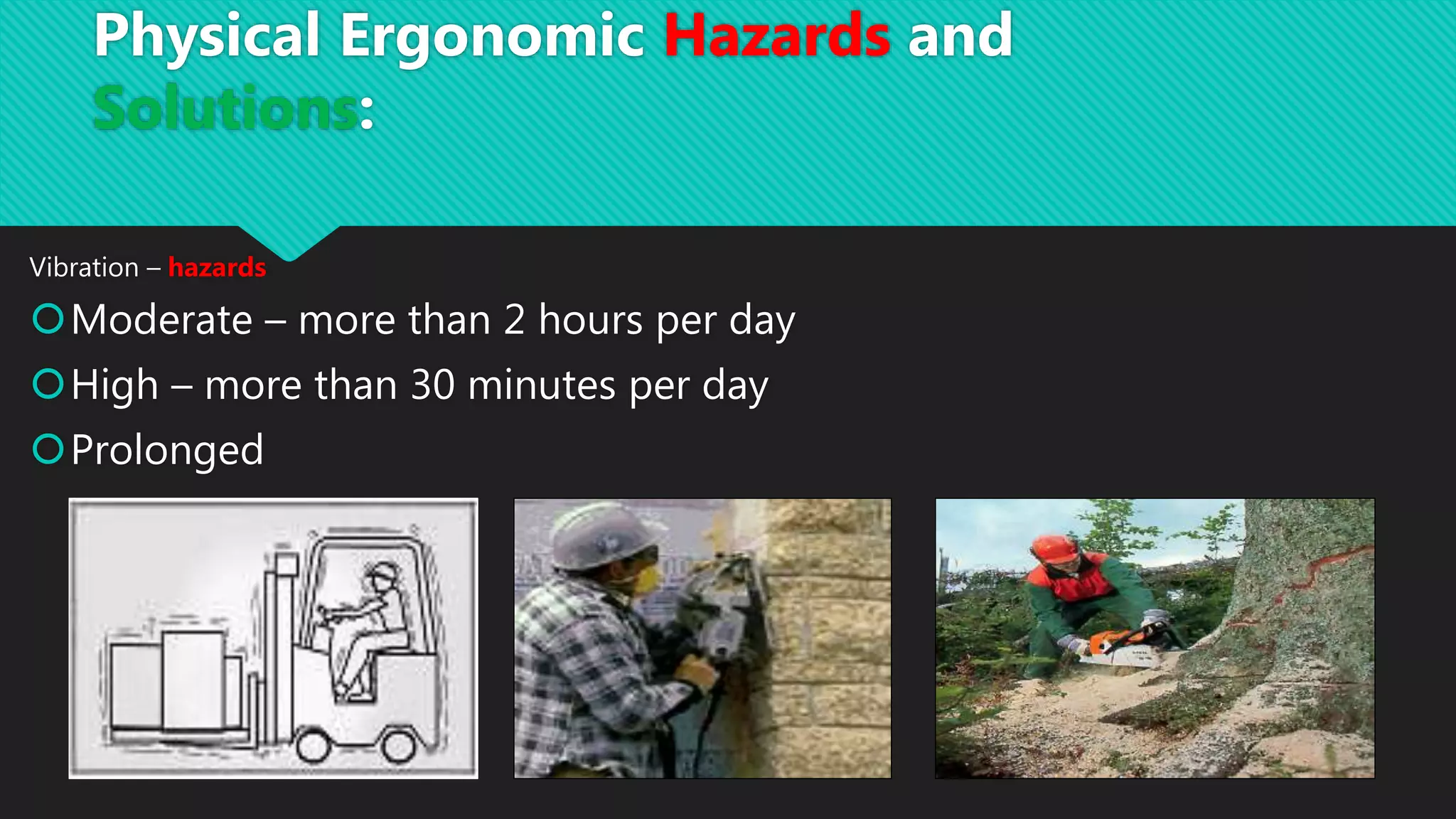
Vibration – hazards
Moderate – more than 2 hours per day
High – more than 30 minutes per day
Prolonged
Physical Ergonomic Hazards and
Solutions:
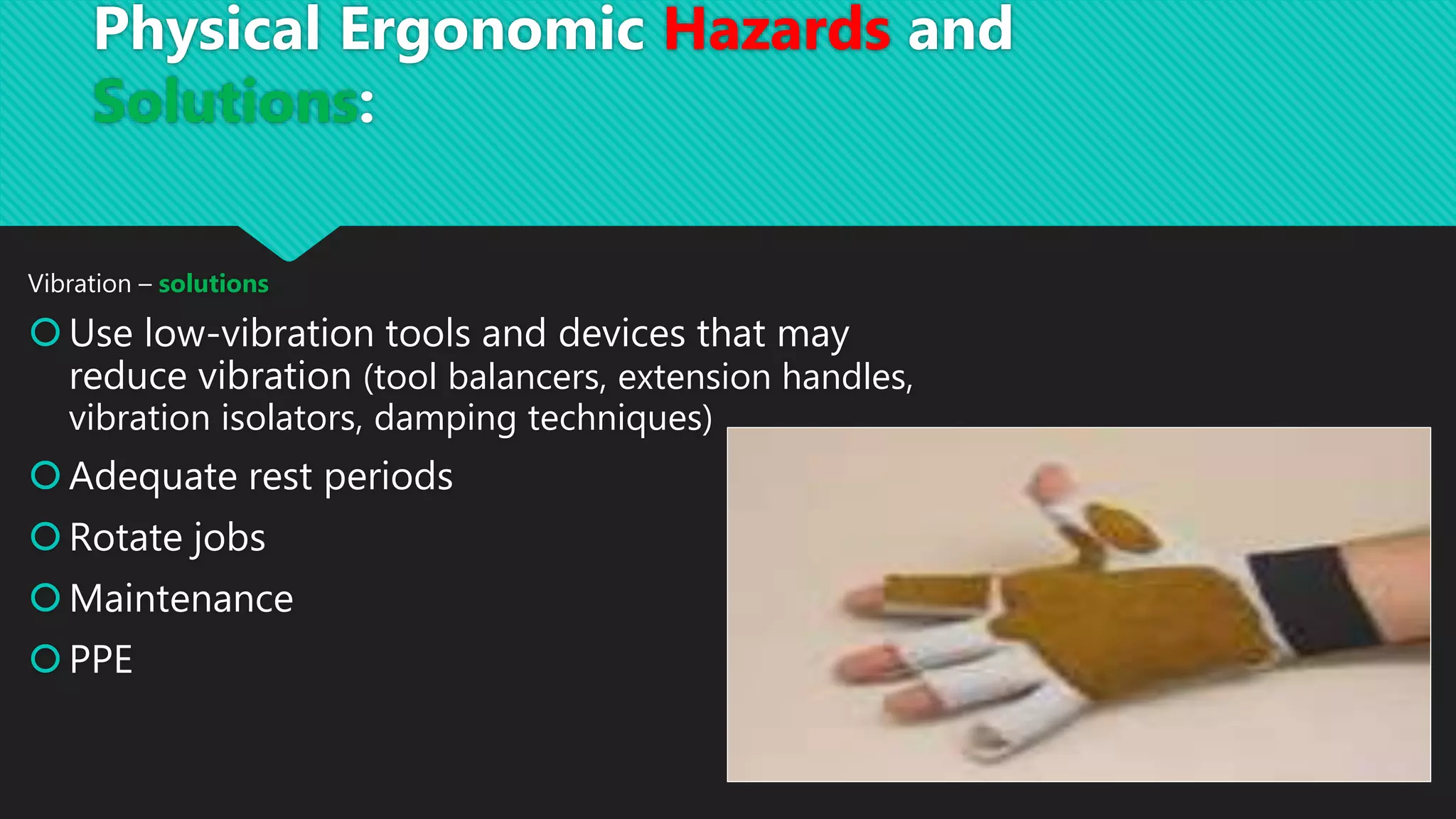
Vibration – solutions
Use low-vibration tools and devices that may
reduce vibration (tool balancers, extension handles,
vibration isolators, damping techniques)
Adequate rest periods
Rotate jobs
Maintenance
PPE
Physical Ergonomic Hazards and
Solutions:

Control methods

  • 2.
    Designing The Task,Work Place, And Work System For People Ergonomics Human Machine Interface
  • 3.
    Controls for MSDHazards • Engineering Controls • Administrative and Work Practice Controls • Personal Protective Equipment
  • 4.
    Engineering Controls Implement physicalchange to the workplace, which eliminates/reduces the hazard on the job/task  Use a device to lift and reposition heavy objects to limit force exertion  Reduce the weight of a load to limit force exertion  Reposition a work table to eliminate a long/excessive reach and enable working in neutral postures  Use diverging conveyors off a main line so that tasks are less repetitive  Install diverters on conveyors to direct materials toward the worker to eliminate excessive leaning or reaching  Redesign tools to enable neutral postures
  • 5.
    Administrative and WorkPractice Controls  Require that heavy loads are only lifted by two people to limit force exertion  Establish systems so workers are rotated away from tasks to minimize the duration of continual exertion, repetitive motions, and awkward postures. Design a job rotation system in which employees rotate between jobs that use different muscle groups  Staff "floaters" to provide periodic breaks between scheduled breaks  Properly use and maintain pneumatic and power tools
  • 6.
    Personal Protective Equipment Usepadding to reduce direct contact with hard, sharp, or vibrating surfaces Wear good fitting thermal gloves to help with cold conditions while maintaining the ability to grasp items easily
  • 7.
    Examples of Engineeringcontrols Work station design and setup Ergonomically designed tools Ergonomically designed equipment Load weight reduction Ergonomic Control Methods
  • 8.
    Examples of Properwork practices: Proper lifting techniques (NIOSH) Team lift heavy/bulky/awkward loads Stretch Work rotation Task variety Increase rest breaks Source of graphics: OSHA Ergonomic Control Methods
  • 9.
    Examples of PPE: Grippinggloves Knee pads Vibration gloves Thermal gloves Lifting straps Shoulder harness Lifting braces Ergonomic Control Methods
  • 10.
    Reaching above thehead/shoulders - hazards Working with the hands above head for more than 2 hours per day Physical Ergonomic Hazards and Solutions:
  • 11.
    Working with theelbows above shoulders for more than 2 hours per day Awkward postures while pulling with the hands above the shoulder cause an increased load imposed on the shoulders, neck and back. When performed repeatedly, these tasks may result in overexertion of the back and upper extremities.” Physical Ergonomic Hazards and Solutions:
  • 12.
     Reaching abovethe head/shoulders - solutions Keep items within close reach Elevate work areas Physical Ergonomic Hazards and Solutions:
  • 13.
    Reaching above the head/shoulders- solutions Remove obstacles Utilize equipment to raise and lower items or move items closer to worker Physical Ergonomic Hazards and Solutions:
  • 14.
    Awkward body postures- hazards Working with the neck or back bent forward more than 30° for more than 2 hours per day Physical Ergonomic Hazards and Solutions:
  • 15.
    Squatting for morethan 2 hours per day Physical Ergonomic Hazards and Solutions:
  • 16.
    Kneeling for morethan 2 hours per day Physical Ergonomic Hazards and Solutions:
  • 17.
    Awkward body postures- solutions Raise and/or tilt the work for better access Use a stool for ground-level work Physical Ergonomic Hazards and Solutions:
  • 18.
    Awkward body postures- solutions Use tools with longer handles Alternate between bending, kneeling, sitting, and squatting Physical Ergonomic Hazards and Solutions:
  • 19.
    Awkward grips -hazards Gripping 10 or more pounds or force for 2 or more hours per day Physical Ergonomic Hazards and Solutions:
  • 20.
    Awkward grips -hazards Pinching 2 or more pounds of weight or 4 or more pounds of force for 2 or more hours per day Physical Ergonomic Hazards and Solutions:
  • 21.
    Awkward grips -solutions Design work layout to reduce hand-carrying Reduce amount of items carried at one time Use non-pinch grip postures Use ergonomically designed tools/aids Use job/task rotation Ergonomic Control Methods
  • 22.
    Repetitive motions -hazards Repeating same motion for more than two hours per day with hands, wrists, elbows, shoulders, or neck Physical Ergonomic Hazards and Solutions:
  • 23.
    Repetitive motions -hazards Intense keying for more than 4 hours per day Physical Ergonomic Hazards and Solutions:
  • 24.
    Repetitive motions -solutions Arrange work to avoid unnecessary motions Let power tools and machinery do the work Spread repetitive work out during the day Take stretch pauses Rotate task with co-workers if possible Change hands or motions frequently Physical Ergonomic Hazards and Solutions:
  • 25.
    Localized pressure onbody part - hazards Pressing the body/part of the body against hard or sharp edges Standing/kneeling for prolonged periods on hard surfaces Using tools with hard handle surfaces or short handles Physical Ergonomic Hazards and Solutions:
  • 26.
    Localized pressure onbody part - hazards Using hands/knees as a hammer more than 10 times in 1 hour or more than 2 times per day (long-term) Physical Ergonomic Hazards and Solutions:
  • 27.
    Localized pressure onbody part - solutions Use tools with longer handles Use tools with padded grips Alternate between bending, kneeling, sitting, and squatting; use sit/stand stools or tables Physical Ergonomic Hazards and Solutions:
  • 28.
    Localized pressure onbody part - solutions Pad table edges or use tables/desktops with rounded edges Use wrist rests, anti-fatigue mats, knee pads, shoe inserts or other items that reduce stress on body parts Physical Ergonomic Hazards and Solutions:
  • 29.
     Lifting objects- hazards Lifting more than 75 lbs. once/day 55 lbs. ten times/day 10 lbs. more than twice/minute or for more than 2 hours/day 25 lbs. above shoulders, below knees, or at arms length more than 25 times/day Physical Ergonomic Hazards and Solutions:
  • 30.
    Lifting objects -hazards Heavy, frequent, and awkward lifting Physical Ergonomic Hazards and Solutions:
  • 31.
    Lifting - solutions Managingfor safer lifting Plan lifts Minimize lifting distances Position materials to power zone levels Avoid manually lifting/lowering loads to/from floor Identify/reduce unstable or heavy loads Reduce frequency of lifting and duration of lifting tasks Provide clear access Physical Ergonomic Hazards and Solutions:
  • 32.
     Lifting -solutions Employee guidelines for safer lifting Stretch before lifting Check for tags on loads Test load for stability and weight Plan the lift Use proper lifting techniques – grip; two hands; smooth, even motions; load close to body; legs to push up and lift load; avoid twisting; alternate with less physically demanding tasks; rest breaks Get assistance when necessary Ergonomic Control Methods
  • 33.
    Lifting - solutions Useproper lifting techniques Lean the sack onto your kneeling leg. Slide the sack up onto your kneeling leg. Slide the sack onto the other leg while keeping the sack close to your body. As you stand up, keep the sack close to your body. Physical Ergonomic Hazards and Solutions:
  • 34.
    Vibration – hazards Moderate– more than 2 hours per day High – more than 30 minutes per day Prolonged Physical Ergonomic Hazards and Solutions:
  • 35.
    Vibration – solutions Uselow-vibration tools and devices that may reduce vibration (tool balancers, extension handles, vibration isolators, damping techniques) Adequate rest periods Rotate jobs Maintenance PPE Physical Ergonomic Hazards and Solutions: