MICROFILTRATION 
Cross-flow microfiltration
Microfiltration 
The microfiltration process is a membrane solids separation technique that 
can be used to remove particles and suspended solids from for colloidal and 
suspended solutions. 
Two distinct flow configurations are commonly employed for microfiltration 
systems, Cross Flow Microfiltration and Dead End Microfiltration.
• Particle size in the range of 0.05-10 microns. On molecular weigh basis , the particles 
are separated or rejected. Passage of particles through membrane is usually a 
function of particle geometry (i.e; particles shape and size). 
• Microfiltration is suited to separate larger sizes, such as suspended solids, particulates, 
and microorganisms and reduction of turbidity . Commercially available 
microfiltration membranes are made from a variety of materials including organic 
polymers, such as polypropylene, ceramics and metal alloys. systems are operated at 
much lower feed pressures than reverse osmosis or ultra filtration due to the greater 
effective pore size.
The Dead-end Process 
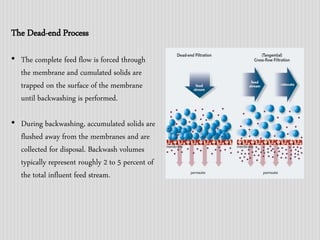
• The complete feed flow is forced through 
the membrane and cumulated solids are 
trapped on the surface of the membrane 
until backwashing is performed. 
• During backwashing, accumulated solids are 
flushed away from the membranes and are 
collected for disposal. Backwash volumes 
typically represent roughly 2 to 5 percent of 
the total influent feed stream.
Factors influencing performance are; 
• Raw water characteristics 
• Trans-membrane pressure 
• Temperature 
• Regular monitoring and maintenance. 
Pretreatment 
A self backwashing 100 um strainer is often necessary to protect the membranes and 
moderate particulate loading. Depending on the raw water, a coagulant such as ferric 
chloride may be added to form pin flocs and help improve rejection.
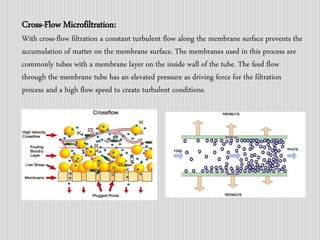
Cross-Flow Microfiltration: 
With cross-flow filtration a constant turbulent flow along the membrane surface prevents the 
accumulation of matter on the membrane surface. The membranes used in this process are 
commonly tubes with a membrane layer on the inside wall of the tube. The feed flow 
through the membrane tube has an elevated pressure as driving force for the filtration 
process and a high flow speed to create turbulent conditions.
• The process is referred to as "cross-flow", because the feed flow and filtration flow 
direction have a 90 degrees angle. Cross-flow filtration is an excellent way to filter 
liquids with a high concentration of filterable matter. In cross-flow microfiltration 
(CFMF), the suspension is pumped tangentially over the filtration medium. 
• Clear liquid permeates the filtration medium and is recovered as the permeate, 
while the solids accumulate at the filtration barrier to form a fouling layer, or cake. 
• The cake, constituting an increase in hydraulic resistance, decreases the permeate 
flux. 
• The tangential suspension flow tends to limit the growth of the cake termed as 
sweeping. 
• Correspondingly, after an initial rapid decrease, the permeate flux levels off and 
either attains a steady-state, or exhibits a slow, long-term decline with time.
Examples of micro filtration applications 
They are; 
• Cold sterilization of beverages and pharmaceuticals 
• Clearing of fruit juice, wines and beer Separation of bacteria from water (biological 
wastewater treatment) 
• Separation of oil/ water emulsions 
• Pre-treatment of water for nano filtration or Reverse Osmosis 
• fermentation, broth clarification 
• pre-treatment of water for nanofiltration

Microfiltration

  • 1.
  • 2.
    Microfiltration The microfiltrationprocess is a membrane solids separation technique that can be used to remove particles and suspended solids from for colloidal and suspended solutions. Two distinct flow configurations are commonly employed for microfiltration systems, Cross Flow Microfiltration and Dead End Microfiltration.
  • 3.
    • Particle sizein the range of 0.05-10 microns. On molecular weigh basis , the particles are separated or rejected. Passage of particles through membrane is usually a function of particle geometry (i.e; particles shape and size). • Microfiltration is suited to separate larger sizes, such as suspended solids, particulates, and microorganisms and reduction of turbidity . Commercially available microfiltration membranes are made from a variety of materials including organic polymers, such as polypropylene, ceramics and metal alloys. systems are operated at much lower feed pressures than reverse osmosis or ultra filtration due to the greater effective pore size.
  • 4.
    The Dead-end Process • The complete feed flow is forced through the membrane and cumulated solids are trapped on the surface of the membrane until backwashing is performed. • During backwashing, accumulated solids are flushed away from the membranes and are collected for disposal. Backwash volumes typically represent roughly 2 to 5 percent of the total influent feed stream.
  • 5.
    Factors influencing performanceare; • Raw water characteristics • Trans-membrane pressure • Temperature • Regular monitoring and maintenance. Pretreatment A self backwashing 100 um strainer is often necessary to protect the membranes and moderate particulate loading. Depending on the raw water, a coagulant such as ferric chloride may be added to form pin flocs and help improve rejection.
  • 6.
    Cross-Flow Microfiltration: Withcross-flow filtration a constant turbulent flow along the membrane surface prevents the accumulation of matter on the membrane surface. The membranes used in this process are commonly tubes with a membrane layer on the inside wall of the tube. The feed flow through the membrane tube has an elevated pressure as driving force for the filtration process and a high flow speed to create turbulent conditions.
  • 7.
    • The processis referred to as "cross-flow", because the feed flow and filtration flow direction have a 90 degrees angle. Cross-flow filtration is an excellent way to filter liquids with a high concentration of filterable matter. In cross-flow microfiltration (CFMF), the suspension is pumped tangentially over the filtration medium. • Clear liquid permeates the filtration medium and is recovered as the permeate, while the solids accumulate at the filtration barrier to form a fouling layer, or cake. • The cake, constituting an increase in hydraulic resistance, decreases the permeate flux. • The tangential suspension flow tends to limit the growth of the cake termed as sweeping. • Correspondingly, after an initial rapid decrease, the permeate flux levels off and either attains a steady-state, or exhibits a slow, long-term decline with time.
  • 8.
    Examples of microfiltration applications They are; • Cold sterilization of beverages and pharmaceuticals • Clearing of fruit juice, wines and beer Separation of bacteria from water (biological wastewater treatment) • Separation of oil/ water emulsions • Pre-treatment of water for nano filtration or Reverse Osmosis • fermentation, broth clarification • pre-treatment of water for nanofiltration