COMMUNICATION SKILLS
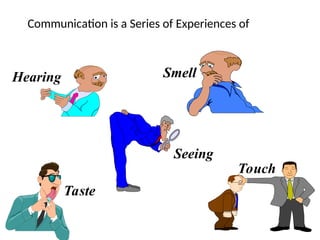
Communication is a Series of Experiences of
Hearing Smell
Seeing
Touch
Taste
COMMUNICATION :
Communication...
• The exchange of thoughts messages, or the
like, as by speech, signs or writing.
• To express oneself in such a way that one is
willingly and clearly understood.
• Communication is shared feeling/shared
understanding.
Communication
• The word ‘communication’ is derived from
Latin word ‘communis’, which means
common. It is a process of exchange of facts,
ideas, opinions and a means that individuals
or organizations share the meaning and
understanding with one another.
Communication...
• we use it every day, in every interaction. In
fact, we are communicating even when we
are not consciously interacting with anyone.
Effective communication is key to our success
in building relationships (personal and
professional), our ability to develop and
maintain performing team dynamics, and
engage customers.
• A process of transferring and receiving verbal
and non-verbal information.
• Communication is also a skill we can develop and enhance
with strategies, willingness and practice.
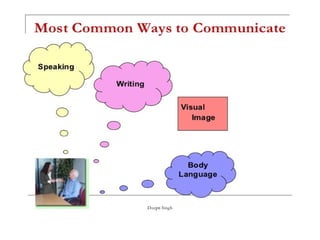
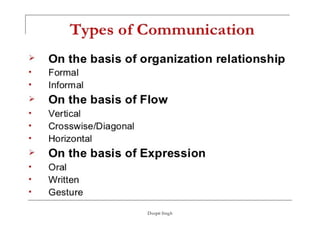
Communication may be verbal or non-verbal.
VERBAL:
Includes ORAL and WRITTEN communication like
Talking to someone, writing a letter to friend and SMS etc.
Non-VERBAL:
It is a more stronger medium of communication.
In non verbal communication neither we speak nor we
write like gesture, facial expressions, outlook, Eye contact,
Sound etc.
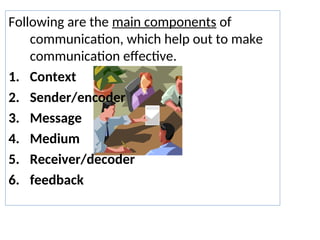
Following are the main components of
communication, which help out to make
communication effective.
1. Context
2. Sender/encoder
3. Message
4. Medium
5. Receiver/decoder
6. feedback
Brief description of above mentioned components is as:
• Context:
Means your playfield before writing/speaking first
word you define context of communication.
• Sender:
Is a person who initiate message. Sender is a
Basic component for effective communication.
• Message:
It is a core idea which you wants to
communicate.
• Medium:
It means channel, through which we
communicate, we have two mediums i.e ORAL & WRITTEN.
• Receiver:
Is a person to whom message is conveyed.
• Feedback (reaction)
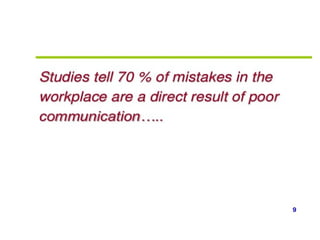
Feedback is that, which comes in result of your
conveyed message. Feedback can be positive or
negative but cannot be zero “0”.
Delayed reaction is “feedback”
Immediate reaction is “response”
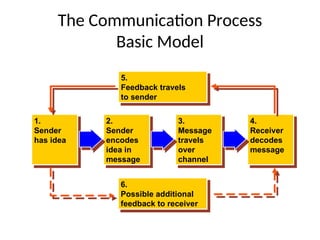
The Communication Process
Basic Model
2.
Sender
encodes
idea in
message
3.
Message
travels
over
channel
1.
Sender
has idea
4.
Receiver
decodes
message
6.
Possible additional
feedback to receiver
5.
Feedback travels
to sender
Perception
• Perception is the process of selecting, organizing, and interpreting data from our senses. This is an inherently
subjective process with much potential for error both in the perception of self and perception of others. Our
self-concept and self-esteem are protected by the self-serving bias. Our perception of others is biased by the
primacy effect, negativity bias, attribution error, and stereotyping. Our perception of self and others is a
fundamental starting point of human communication. We reveal who we are to others by self-disclosing. To
be a competent communicator, monitor your perceptual biases, recognize cultural differences, manage the
impressions you make with others, practice empathy, and check your perceptions with others.
• Language is a structured system of symbols for communicating meaning. It is our unique communication system. All languages
have phonological, morphological, syntactic, and semantic sets of rules that allow us to share meaning with others. Every
language has structure, productivity, displacement, and self-reflexiveness capabilities. Language influences thought, perception,
and behavior in a wide variety of ways.
• Language is a window to our minds and a catalyst of behavior. It is our chief means of communicating with other human beings.
As Pinker (1999) so nicely puts it, to notice the "deep parallels in the languages of the French and the Germans, the Arabs and
the Israelis, the East and the West, people living in the Age of the Internet and people living in the Stone Age, is to catch a
glimpse of the psychic unity of humankind" (p. 239). Language is our connection to the world, and we pay dearly for misusing it.
We need to replace gender-biased language with gender-neutral references, signal reactions with semantic reactions, abusive
language with non-abusive terminology, false dichotomies with pluralistic thinking, dead-level abstracting with flexible language
use, mislabeling with accurate operational definitions, inferential errors with more reliable conclusions based on high quantity
and quality information, and we need to use jargon, euphemisms, and slang clearly and carefully.
•
LEVELS OF COMMUNICATION
LEVELS OF COMMUNICATION:
we have use different levels of
communication in their professional role. The
nurse’s communication skills need to include
techniques that reflect competence in each
level. These are following:
• Intrapersonal communication.
• Interpersonal communication.
• impersonal communication.
Intrapersonal communication
• This takes place within the individual.
•Sender = Our relevant organ/brain.
•Receiver = Our brain.
•Feed back by brain.
Inter personal communication
•Communication at this level refers to the sharing of
information among people
•Inter personal communication can be formal or
informal.
For eg. The interaction with family members , friends
and different kind of people.
•It depends upon variety of factors like , psychology
of two parties , relation between them.
Interpersonal Communication (IPC)
Interpersonal communication is a person to person,
two-way, verbal and non verbal interaction that
includes the sharing of information and feelings
between individuals or in small groups that establish
trusting relationships.
IPC in health care settings takes place between
service providers and their clients and members of
the community and is a key element in maximizing
access to quality care. IPC includes the process of
education, motivation and counseling and starts
with understanding the critical role of good client
service.
Education is the process of providing factual
information and clarification about a topic to
an individual or group.
Counseling is the act of helping a client to
make her or his own decision, by providing
unbiased information and asking questions
about what the client wants and what the
client thinks that he or she can do.
Counseling is a special process. It is a confidential
dialogue between a medical provider and a client
that helps a client to define his or her feelings and to
cope with stress. Usually people need training to be a
good counselor.
Counseling is different from education, although
education can be an important part of counseling.
Counseling is NOT solving the client’s problem for him
or her or giving advice. In the counseling process, the
medical provider avoids taking on the client’s
problem or telling him or her how to solve the
problem or what decision or action to take.
Impersonal Communication
• Largely impersonal as the participants are
unknown to each other.
• eg. When an individual is giving an interview
in front of panel.
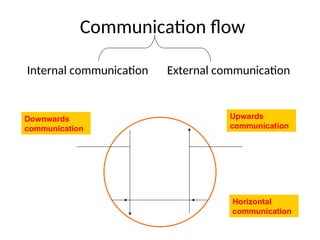
Communication flow
Internal communication External communication
Downwards
communication
Horizontal
communication
Upwards
communication
VERBAL COMMUNICATION:
Verbal or oral communication is the most
common form of communication used by
executive who spend 50% of their time in
communication. In nursing management
oral or verbal communication is used to:
• Give and receive information.
• Report/results.
• Give directions.
• Provide feed back.
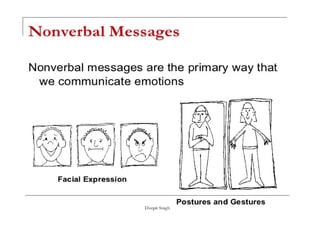
NON VERBAL COMMUNICATION:
All non verbal communication that transmits
information about the message and the
relationship of the communication is non
verbal communication such as:
• Body movements.
• Body gestures.
• Eye contact.
• Facial expression.
• Posture.
• Mode of dressing and grooming.
• Silence.
• Sound.
WRITTEN COMMUNICATION:
Writing is common medium or way of
communication not only in nursing but
in society in general. Most written
communication in management is formal
and included e.g. letter, fax and computer.
• Preparation of employee record.
• Job description, performance appraisal.
• Documentation of activity reports.
• Justification reports.
• Record of committee activities.
• Development of written policies and
procedures for unit or institution
IMPORTANCE OF COMMUNICATION:
• Communication clearly and effectively is
critical because managers report spending
80% to 90% of the day communication.
• It is at the core of our humanness.
• We all depend on our communication skills
to help us to meet our needs, find
happiness.
IMPORTANCE OF COMMUNICATION:
• Communication clearly and effectively is
critical because managers report spending
80% to 90% of the day through
communication.
• It is at the core of our humanness.
• We all depend on our communication skills
to help us to meet our needs, find
happiness.
• From birth to death many types of
communication are an integral part of life.
• Without communication we would be unable to
function.
• Communication is our link to the best of
humanity.
• Our communication skills help our personal, social
work and professional relationships.
• Communication is basic to human feelings and
intellect without it the human race could not
service.
• It allows people to be unique
BARIERS TO EFFECTIVE COMMUNICATION:
1. Filtering.
2. Selective perception.
3. Emotion.
4. Language.
5. Culture.
6. Environment.
Barriers to Effective Communication
Filtering
Sender manipulate
info so that it will be
seen more favorably
by the receivers.
Selective Perception
People selectively
interpret what they see
on the basis of their
interests, background,
experience, and
attitude.
Information Overload
A condition in which information
inflow exceeds an individual’s
processing capacity.
Barriers to… (cont.)
Communication Apprehension
Undue tension and anxiety about oral
communication, written communication, or both.
Emotions
How a receiver feels at
the time a message is
received will influence
how the message is
interpreted.
Language
Words have different
meanings to different
people.
Perception
• Perception is the process of selecting, organizing, and interpreting data
from our senses. This is an inherently subjective process with much
potential for error both in the perception of self and perception of others.
Our self-concept and self-esteem are protected by the self-serving bias.
Our perception of others is biased by the primacy effect, negativity bias,
attribution error, and stereotyping. Our perception of self and others is a
fundamental starting point of human communication. We reveal who we
are to others by self-disclosing. To be a competent communicator,
monitor your perceptual biases, recognize cultural differences, manage
the impressions you make with others, practice empathy, and check your
perceptions with others.
Language
• is a structured system of symbols for communicating meaning. It is our
unique communication system. All languages have phonological,
morphological, syntactic, and semantic sets of rules that allow us to share
meaning with others. Every language has structure, productivity,
displacement, and self-reflexiveness capabilities. Language influences
thought, perception, and behavior in a wide variety of ways.
OVERCOMING THE BARIERS:
• Use simple language.
• Constrain emotions.
• Active listening.
• Maintain eye contact.
• Keep the atmosphere quite.
• Sure the clients attention.
• Use feed back.
ROLE OF NURSE IN COMMUNICATION:
• Communicator.
• Thinker.
• Writer.
• Observer.
• Listener.
• Speaker.
• Educator.
• Motivator.
• Advisor.
• Evaluator.
Effective Communication:
Seven Cs
For transmitting effective written or oral messages, Certain
principles must be followed. These principles are advocated by
Francis J. Bergin provide guidelines for choice of content and style of presentation
adapted to the purpose of the receiver of the messag
They are also called the seven Cs of communication.
They are:
1.Completeness
2.Conciseness
3.Clarity
4.Correctness
5.Consideration
6.Courtesy
7.Concreteness
Completeness
Every communication must be complete and adequate.
Incomplete messages keep the receiver guessing, create
misunderstanding and delay actions.
Every person should, therefore, be provided with all the required facts
and figures.
For example, when factory supervisor instructs workers to produce, he
must specify the exact size, shape, quality and cost of the product. Any
assumptions behind the messages should also be clarified.
While answering a letter, all the questions raised in the letter must be
replied.
Conciseness
In business communication, you should be brief and be able to
say whatever you have to say in fewest possible words without
sacrificing the other C qualities. Conciseness is desired because
of the following benefits:
1. A concise message saves time and expense for both sender
and receiver.
2. Conciseness contributes to emphasis; by eliminating
unnecessary words, you let important ideas stand out.
Clarity
1. Clarity means getting your message across so the receiver will
understand what you are trying to convey.
2. You want that person to interpret your words with the same
meaning you have in mind.
3. Accomplishing that goal is difficult because, as you know, individual
experiences are never identical, and words have different meanings to
different persons.
Here are some specific ways to help make your messages clear:
1. Choose short, familiar, conversational words.
2. Construct effective sentences and paragraphs.
3. Achieve appropriate readability (and listenability).
4. Include examples, pictures, and other visual aids, when desirable.
Correctness
1. The term correctness as applied to business messages means right
level of language and accuracy of facts, figures and words.
2. If the information is not correctly conveyed, the sender will lose
credibility.
3. Transmission of incorrect information to superiors will vitiate
decision making process.
4. Transmission of incorrect information to outsiders will spoil the
public image of the firm.
5. To convey correct messages, grammatical errors should also be
avoided.
6. You should not transmit any message unless you are absolutely sure
of its correctness.
Consideration
1. Consideration means that you prepare every message with the
recipient in mind and try to put yourself in his or her place.
2. Then handle the matter from their point of view
3. This thoughtful consideration is also called "you-attitude," empathy,
the human touch, and understanding of human nature. (It does not
mean, however, that you should overlook the needs of your
organization.)
Consideration
1. Consideration underlies the other six C's of good business
communication
2. You adapt your language and message content to your receiver's
needs when you make your message complete, concise, concrete, clear,
courteous, and correct.
However, in four specific ways you can indicate you are considerate:
• Focus on "you" instead of "I" and "we."
• Show reader benefit or interest in reader.
• Emphasize positive, pleasant facts.
• Apply integrity and ethic
Courtesy
• Courteous messages help to strengthen present business friendships,
as well as make new friends.
• Courtesy stems from sincere you-attitude.
• It is not merely politeness with mechanical insertions of "please's"
and "thank-you'd."
To be courteous, considerate communicators should
follow these suggestions regarding tone of the
communications.
• Be sincerely tactful, thoughtful, and appreciative.
• Omit expressions that irritate, hurt, or belittle.
• Grant and apologize good-naturedly.
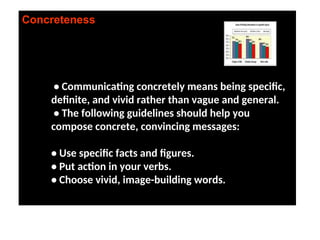
Concreteness
• Communicating concretely means being specific,
definite, and vivid rather than vague and general.
• The following guidelines should help you
compose concrete, convincing messages:
• Use specific facts and figures.
• Put action in your verbs.
• Choose vivid, image-building words.
Cultural and Social Norms
Culture
• Culture is defined as the meanings and
ways of life that characterize a society
including beliefs, values, norms,
sanctions, and symbols.
CULTURE
• Culture consist of a complex whole that
includes knowledge, ideas, beliefs, customs
morals opinions, law and any other
capabilities and habits acquired by man as a
member of society,
– Tylor.
Important definitions
• Culture: A shared, learned, symbolic system of value
s, beliefs and attitudes that shapes and influences pe
rception and behavior .
• Social norms: are ideal standards binding upon the
members of a certain group, which serve to guide or
control acceptable behavior in that group.
• Cultural norms: Expected behaviors' and attitudes in
a society.
Types of Social Norms
Folkways – are socially approved ways of
behaving in the society. These are ways
of life.
Mores- norms with a moral basis like
respect for parents, students to attend
classes regularly.
Laws - formal norms backed by authority
or having legal force. The violation of
law is called crime.
Social Institutions
• An institution is an established and
enduring pattern of social relationships.
• The five traditional institutions are:
– Family
– Religion
– Politics
– Economics
– Education
Elements of Culture
• Norms
–Socially defined rules of behavior.
• Sanctions
–Consequences for conforming to or
violating norms.
• Symbols
–Language, gestures, and objects whose
meaning is commonly understood by
the members of a society.
What is Public Relations?
Definition of PR :
“Public relations helps an organization
and its publics adapt mutually to each
other. Public relations is an
organization’s efforts to win the
cooperation of groups of people.”
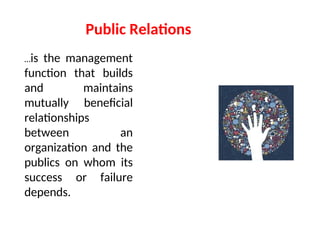
Public Relations
…is the management
function that builds
and maintains
mutually beneficial
relationships
between an
organization and the
publics on whom its
success or failure
depends.
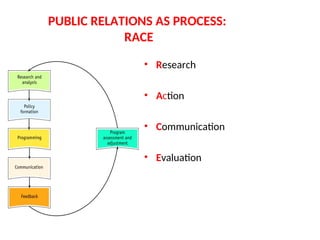
PUBLIC RELATIONS AS PROCESS:
RACE
• Research
• Action
• Communication
• Evaluation
The Components of Public Relations
• Counseling
• Research
• Media relations
• Publicity
• Employee/member relations
• Community relations
• Public affairs
• Government affairs
• Issues management
• Financial relations
• Industry relations
• Development
• Multicultural relations
• Special events
• Marketing communications
Careers in Public Relations
Five essential abilities:
1. Writing skill
2. Research ability
3. Planning expertise
4. Problem-solving ability
5. Business/economics competence
Ethical Issues
Ethics: A definition
•“Ethics is not about being better than
someone else; it’s about being the best we
can be.”
•Ethics is a personal matter because
every person has an individual
concept of what is good and what is
evil.
•These are systematic guides for
developing ethical behavior.
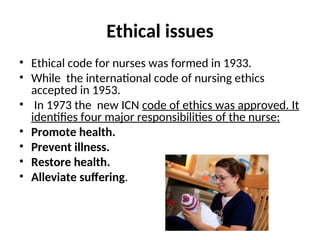
Ethical issues
• Ethical code for nurses was formed in 1933.
• While the international code of nursing ethics
accepted in 1953.
• In 1973 the new ICN code of ethics was approved. It
identifies four major responsibilities of the nurse:
• Promote health.
• Prevent illness.
• Restore health.
• Alleviate suffering.
Guidelines to be Observed
A Nurse must be…
Considered the individuality and totality
of patients when they administer care;
Respect the spiritual beliefs and
practices of patients regarding diet and
treatment;
• Take into consideration the culture and
values of patients in providing of nursing
care;
• Human life is inviolable.
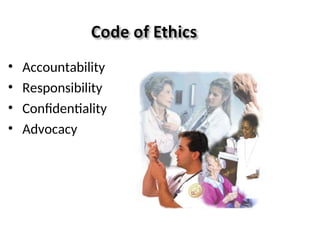
• Accountability
• Responsibility
• Confidentiality
• Advocacy
Accountability
Refers to the ability to answer for one's
own actions. you will learn to ensure that
your professional actions are explainable
to your patients and to your employer.
Health care institutions also play a role in
accountability by monitoring individual
and institutional compliance with
national standards.
Responsibility
Refers to a willingness to respect
obligations and to follow through on
promises. As a nurse, you are
responsible for your actions.
You play an active role in shaping your
practice, rather than a passive role.
You need to remain competent to practice
so that you are able to reliably follow
through on your responsibilities.
Confidentiality
This concept has widespread.
Health Insurance Portability and
Accountability Act of 1996 (HIPAA)
mandates the confidential protection of
patients, personal health information.
For example, you can not copy or
forward medical records without a
patient consent.
Advocacy
Refers to the support of a cause.
As a nurse, you advocate for the health,
safety, and rights of patients. You
safeguard the patient s, right to physical
and auditory privacy.
For example, you find a private place
for discussion with the client, s
diagnostic testing.
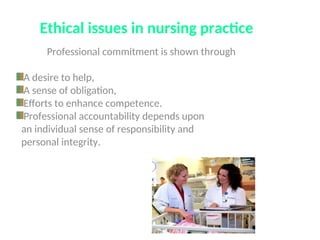
Ethical issues in nursing practice
Professional commitment is shown through
A desire to help,
A sense of obligation,
Efforts to enhance competence.
Professional accountability depends upon
an individual sense of responsibility and
personal integrity.
Acuity-adjusted Staffing…
Purpose
• To examine whether
acuity-adjusted
nurse staffing and
environments
contribute to
variation in VLBW
infant outcomes in
NICUs.
NURSE STAFFING/ SUPERVISION
Definition of nurse staffing
• Number of nurses or nursing hrs/
– the number of patients
– or patient days
• Skill mix of nurses
• Little scientific evidence of exact nurse-to-
patient-ratios needed
• Staffing adequacy is related to workload
Total Patient Care
• Nurse is responsible for planning, organizing, and
performing all care
• Common use areas—intensive care unit (ICU) and
post anesthetic care unit (PACU)
Current healthcare climate
 Nursing shortage
 Focus on capital & technology
improvements:
Nurse Staffing
• An estimate of the average of patient
needs on a particular units.
• No standardized method of selecting
nurse staffing levels.
Discuss the evidence on the
importance of nurse staffing for:
 Conceptual framework
 Patient quality and safety
 Staff satisfaction and health
 Financial performance
 Recommendations
Pathways of inadequate staffing
• Inadequate staffing/heavy workload
create a difficult work environment:
– Time constraints
– Inadequate knowledge or experience
– Inadequate supervision of support staff
– Inadequate communication
– Generally disordered or stressful
environment
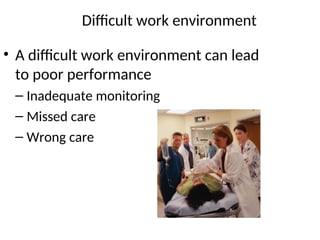
Difficult work environment
• A difficult work environment can lead
to poor performance
– Inadequate monitoring
– Missed care
– Wrong care
Impact of nurse staffing on outcomes:
conclusions
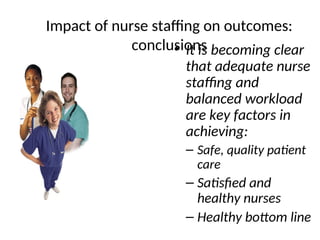
• It is becoming clear
that adequate nurse
staffing and
balanced workload
are key factors in
achieving:
– Safe, quality patient
care
– Satisfied and
healthy nurses
– Healthy bottom line
Promote adequate supply of nurses
• Fund and support
nursing education
• Develop partnerships
between educators,
employers, payers,
consumers and
regulatory bodies
 Improve knowledge
of nurses contributions to
patient safety and quality
Supervision
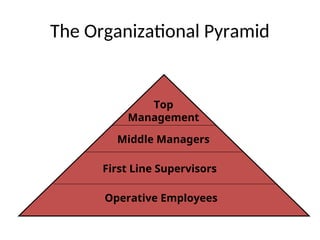
The Organizational Pyramid
Top
Management
Middle Managers
First Line Supervisors
Operative Employees
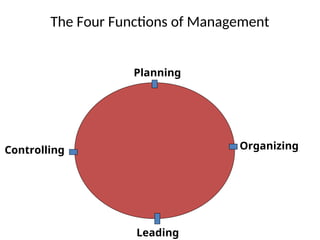
The Four Functions of Management
Planning
Organizing
Leading
Controlling
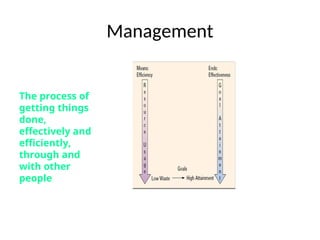
Management
The process of
getting things
done,
effectively and
efficiently,
through and
with other
people
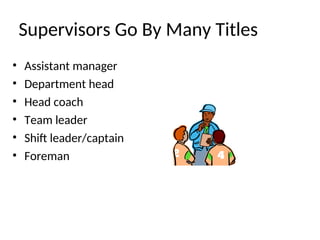
Supervisors Go By Many Titles
• Assistant manager
• Department head
• Head coach
• Team leader
• Shift leader/captain
• Foreman
Key Supervisory Tasks
• Motivate
• Provide feedback
• Resolve performance problems
• Blend employee goals with work requirements
• Improve communications and keep employees
informed
• Responsible for employee training and skills
What is a strategy?
• A plan of action designed to achieve a vision.
• All about gaining a position of advantage over adversaries
or best exploiting emerging possibilities.
• A detailed plan for achieving success in situations such as
war, politics, business, industry or sport.
Types of communications strategy
•Organisation – ideally reviewed annually
•Major, complex, long term project
•A major announcement – e.g. new endowment which will
fund a scholarship programme
•A big event – e.g. a conference
•Building and opening a new building
A comprehensive communications
strategy
• Research
• Mission
• Vision
• Aims
• Objectives
• Audiences
• Messages
• Channels
• Timing
• Resources
• Risks
• Evaluation
communication skills 2021.............ppt

communication skills 2021.............ppt

  • 1.
  • 2.
    Communication is aSeries of Experiences of Hearing Smell Seeing Touch Taste
  • 3.
    COMMUNICATION : Communication... • Theexchange of thoughts messages, or the like, as by speech, signs or writing. • To express oneself in such a way that one is willingly and clearly understood. • Communication is shared feeling/shared understanding.
  • 4.
    Communication • The word‘communication’ is derived from Latin word ‘communis’, which means common. It is a process of exchange of facts, ideas, opinions and a means that individuals or organizations share the meaning and understanding with one another.
  • 7.
    Communication... • we useit every day, in every interaction. In fact, we are communicating even when we are not consciously interacting with anyone. Effective communication is key to our success in building relationships (personal and professional), our ability to develop and maintain performing team dynamics, and engage customers. • A process of transferring and receiving verbal and non-verbal information.
  • 9.
    • Communication isalso a skill we can develop and enhance with strategies, willingness and practice. Communication may be verbal or non-verbal. VERBAL: Includes ORAL and WRITTEN communication like Talking to someone, writing a letter to friend and SMS etc. Non-VERBAL: It is a more stronger medium of communication. In non verbal communication neither we speak nor we write like gesture, facial expressions, outlook, Eye contact, Sound etc.
  • 10.
    Following are themain components of communication, which help out to make communication effective. 1. Context 2. Sender/encoder 3. Message 4. Medium 5. Receiver/decoder 6. feedback
  • 11.
    Brief description ofabove mentioned components is as: • Context: Means your playfield before writing/speaking first word you define context of communication. • Sender: Is a person who initiate message. Sender is a Basic component for effective communication. • Message: It is a core idea which you wants to communicate. • Medium: It means channel, through which we communicate, we have two mediums i.e ORAL & WRITTEN.
  • 12.
    • Receiver: Is aperson to whom message is conveyed. • Feedback (reaction) Feedback is that, which comes in result of your conveyed message. Feedback can be positive or negative but cannot be zero “0”. Delayed reaction is “feedback” Immediate reaction is “response”
  • 13.
    The Communication Process BasicModel 2. Sender encodes idea in message 3. Message travels over channel 1. Sender has idea 4. Receiver decodes message 6. Possible additional feedback to receiver 5. Feedback travels to sender
  • 14.
    Perception • Perception isthe process of selecting, organizing, and interpreting data from our senses. This is an inherently subjective process with much potential for error both in the perception of self and perception of others. Our self-concept and self-esteem are protected by the self-serving bias. Our perception of others is biased by the primacy effect, negativity bias, attribution error, and stereotyping. Our perception of self and others is a fundamental starting point of human communication. We reveal who we are to others by self-disclosing. To be a competent communicator, monitor your perceptual biases, recognize cultural differences, manage the impressions you make with others, practice empathy, and check your perceptions with others. • Language is a structured system of symbols for communicating meaning. It is our unique communication system. All languages have phonological, morphological, syntactic, and semantic sets of rules that allow us to share meaning with others. Every language has structure, productivity, displacement, and self-reflexiveness capabilities. Language influences thought, perception, and behavior in a wide variety of ways. • Language is a window to our minds and a catalyst of behavior. It is our chief means of communicating with other human beings. As Pinker (1999) so nicely puts it, to notice the "deep parallels in the languages of the French and the Germans, the Arabs and the Israelis, the East and the West, people living in the Age of the Internet and people living in the Stone Age, is to catch a glimpse of the psychic unity of humankind" (p. 239). Language is our connection to the world, and we pay dearly for misusing it. We need to replace gender-biased language with gender-neutral references, signal reactions with semantic reactions, abusive language with non-abusive terminology, false dichotomies with pluralistic thinking, dead-level abstracting with flexible language use, mislabeling with accurate operational definitions, inferential errors with more reliable conclusions based on high quantity and quality information, and we need to use jargon, euphemisms, and slang clearly and carefully. •
  • 15.
  • 16.
    LEVELS OF COMMUNICATION: wehave use different levels of communication in their professional role. The nurse’s communication skills need to include techniques that reflect competence in each level. These are following: • Intrapersonal communication. • Interpersonal communication. • impersonal communication.
  • 17.
    Intrapersonal communication • Thistakes place within the individual. •Sender = Our relevant organ/brain. •Receiver = Our brain. •Feed back by brain.
  • 18.
    Inter personal communication •Communicationat this level refers to the sharing of information among people •Inter personal communication can be formal or informal. For eg. The interaction with family members , friends and different kind of people. •It depends upon variety of factors like , psychology of two parties , relation between them.
  • 19.
    Interpersonal Communication (IPC) Interpersonalcommunication is a person to person, two-way, verbal and non verbal interaction that includes the sharing of information and feelings between individuals or in small groups that establish trusting relationships. IPC in health care settings takes place between service providers and their clients and members of the community and is a key element in maximizing access to quality care. IPC includes the process of education, motivation and counseling and starts with understanding the critical role of good client service.
  • 20.
    Education is theprocess of providing factual information and clarification about a topic to an individual or group. Counseling is the act of helping a client to make her or his own decision, by providing unbiased information and asking questions about what the client wants and what the client thinks that he or she can do.
  • 21.
    Counseling is aspecial process. It is a confidential dialogue between a medical provider and a client that helps a client to define his or her feelings and to cope with stress. Usually people need training to be a good counselor. Counseling is different from education, although education can be an important part of counseling. Counseling is NOT solving the client’s problem for him or her or giving advice. In the counseling process, the medical provider avoids taking on the client’s problem or telling him or her how to solve the problem or what decision or action to take.
  • 22.
    Impersonal Communication • Largelyimpersonal as the participants are unknown to each other. • eg. When an individual is giving an interview in front of panel.
  • 24.
    Communication flow Internal communicationExternal communication Downwards communication Horizontal communication Upwards communication
  • 25.
    VERBAL COMMUNICATION: Verbal ororal communication is the most common form of communication used by executive who spend 50% of their time in communication. In nursing management oral or verbal communication is used to: • Give and receive information. • Report/results. • Give directions. • Provide feed back.
  • 27.
    NON VERBAL COMMUNICATION: Allnon verbal communication that transmits information about the message and the relationship of the communication is non verbal communication such as: • Body movements. • Body gestures. • Eye contact. • Facial expression. • Posture. • Mode of dressing and grooming. • Silence. • Sound.
  • 28.
    WRITTEN COMMUNICATION: Writing iscommon medium or way of communication not only in nursing but in society in general. Most written communication in management is formal and included e.g. letter, fax and computer. • Preparation of employee record. • Job description, performance appraisal. • Documentation of activity reports. • Justification reports.
  • 29.
    • Record ofcommittee activities. • Development of written policies and procedures for unit or institution
  • 31.
    IMPORTANCE OF COMMUNICATION: •Communication clearly and effectively is critical because managers report spending 80% to 90% of the day communication. • It is at the core of our humanness. • We all depend on our communication skills to help us to meet our needs, find happiness.
  • 32.
    IMPORTANCE OF COMMUNICATION: •Communication clearly and effectively is critical because managers report spending 80% to 90% of the day through communication. • It is at the core of our humanness. • We all depend on our communication skills to help us to meet our needs, find happiness.
  • 33.
    • From birthto death many types of communication are an integral part of life. • Without communication we would be unable to function. • Communication is our link to the best of humanity. • Our communication skills help our personal, social work and professional relationships. • Communication is basic to human feelings and intellect without it the human race could not service. • It allows people to be unique
  • 34.
    BARIERS TO EFFECTIVECOMMUNICATION: 1. Filtering. 2. Selective perception. 3. Emotion. 4. Language. 5. Culture. 6. Environment.
  • 35.
    Barriers to EffectiveCommunication Filtering Sender manipulate info so that it will be seen more favorably by the receivers. Selective Perception People selectively interpret what they see on the basis of their interests, background, experience, and attitude. Information Overload A condition in which information inflow exceeds an individual’s processing capacity.
  • 36.
    Barriers to… (cont.) CommunicationApprehension Undue tension and anxiety about oral communication, written communication, or both. Emotions How a receiver feels at the time a message is received will influence how the message is interpreted. Language Words have different meanings to different people.
  • 37.
    Perception • Perception isthe process of selecting, organizing, and interpreting data from our senses. This is an inherently subjective process with much potential for error both in the perception of self and perception of others. Our self-concept and self-esteem are protected by the self-serving bias. Our perception of others is biased by the primacy effect, negativity bias, attribution error, and stereotyping. Our perception of self and others is a fundamental starting point of human communication. We reveal who we are to others by self-disclosing. To be a competent communicator, monitor your perceptual biases, recognize cultural differences, manage the impressions you make with others, practice empathy, and check your perceptions with others.
  • 38.
    Language • is astructured system of symbols for communicating meaning. It is our unique communication system. All languages have phonological, morphological, syntactic, and semantic sets of rules that allow us to share meaning with others. Every language has structure, productivity, displacement, and self-reflexiveness capabilities. Language influences thought, perception, and behavior in a wide variety of ways.
  • 39.
    OVERCOMING THE BARIERS: •Use simple language. • Constrain emotions. • Active listening. • Maintain eye contact. • Keep the atmosphere quite. • Sure the clients attention. • Use feed back.
  • 40.
    ROLE OF NURSEIN COMMUNICATION: • Communicator. • Thinker. • Writer. • Observer. • Listener. • Speaker. • Educator. • Motivator. • Advisor. • Evaluator.
  • 41.
  • 42.
    For transmitting effectivewritten or oral messages, Certain principles must be followed. These principles are advocated by Francis J. Bergin provide guidelines for choice of content and style of presentation adapted to the purpose of the receiver of the messag They are also called the seven Cs of communication. They are: 1.Completeness 2.Conciseness 3.Clarity 4.Correctness 5.Consideration 6.Courtesy 7.Concreteness
  • 43.
    Completeness Every communication mustbe complete and adequate. Incomplete messages keep the receiver guessing, create misunderstanding and delay actions. Every person should, therefore, be provided with all the required facts and figures. For example, when factory supervisor instructs workers to produce, he must specify the exact size, shape, quality and cost of the product. Any assumptions behind the messages should also be clarified. While answering a letter, all the questions raised in the letter must be replied.
  • 44.
    Conciseness In business communication,you should be brief and be able to say whatever you have to say in fewest possible words without sacrificing the other C qualities. Conciseness is desired because of the following benefits: 1. A concise message saves time and expense for both sender and receiver. 2. Conciseness contributes to emphasis; by eliminating unnecessary words, you let important ideas stand out.
  • 45.
    Clarity 1. Clarity meansgetting your message across so the receiver will understand what you are trying to convey. 2. You want that person to interpret your words with the same meaning you have in mind. 3. Accomplishing that goal is difficult because, as you know, individual experiences are never identical, and words have different meanings to different persons. Here are some specific ways to help make your messages clear: 1. Choose short, familiar, conversational words. 2. Construct effective sentences and paragraphs. 3. Achieve appropriate readability (and listenability). 4. Include examples, pictures, and other visual aids, when desirable.
  • 46.
    Correctness 1. The termcorrectness as applied to business messages means right level of language and accuracy of facts, figures and words. 2. If the information is not correctly conveyed, the sender will lose credibility. 3. Transmission of incorrect information to superiors will vitiate decision making process. 4. Transmission of incorrect information to outsiders will spoil the public image of the firm. 5. To convey correct messages, grammatical errors should also be avoided. 6. You should not transmit any message unless you are absolutely sure of its correctness.
  • 47.
    Consideration 1. Consideration meansthat you prepare every message with the recipient in mind and try to put yourself in his or her place. 2. Then handle the matter from their point of view 3. This thoughtful consideration is also called "you-attitude," empathy, the human touch, and understanding of human nature. (It does not mean, however, that you should overlook the needs of your organization.)
  • 48.
    Consideration 1. Consideration underliesthe other six C's of good business communication 2. You adapt your language and message content to your receiver's needs when you make your message complete, concise, concrete, clear, courteous, and correct. However, in four specific ways you can indicate you are considerate: • Focus on "you" instead of "I" and "we." • Show reader benefit or interest in reader. • Emphasize positive, pleasant facts. • Apply integrity and ethic
  • 49.
    Courtesy • Courteous messageshelp to strengthen present business friendships, as well as make new friends. • Courtesy stems from sincere you-attitude. • It is not merely politeness with mechanical insertions of "please's" and "thank-you'd." To be courteous, considerate communicators should follow these suggestions regarding tone of the communications. • Be sincerely tactful, thoughtful, and appreciative. • Omit expressions that irritate, hurt, or belittle. • Grant and apologize good-naturedly.
  • 50.
    Concreteness • Communicating concretelymeans being specific, definite, and vivid rather than vague and general. • The following guidelines should help you compose concrete, convincing messages: • Use specific facts and figures. • Put action in your verbs. • Choose vivid, image-building words.
  • 51.
  • 52.
    Culture • Culture isdefined as the meanings and ways of life that characterize a society including beliefs, values, norms, sanctions, and symbols.
  • 53.
    CULTURE • Culture consistof a complex whole that includes knowledge, ideas, beliefs, customs morals opinions, law and any other capabilities and habits acquired by man as a member of society, – Tylor.
  • 54.
    Important definitions • Culture:A shared, learned, symbolic system of value s, beliefs and attitudes that shapes and influences pe rception and behavior . • Social norms: are ideal standards binding upon the members of a certain group, which serve to guide or control acceptable behavior in that group. • Cultural norms: Expected behaviors' and attitudes in a society.
  • 55.
    Types of SocialNorms Folkways – are socially approved ways of behaving in the society. These are ways of life. Mores- norms with a moral basis like respect for parents, students to attend classes regularly. Laws - formal norms backed by authority or having legal force. The violation of law is called crime.
  • 56.
    Social Institutions • Aninstitution is an established and enduring pattern of social relationships. • The five traditional institutions are: – Family – Religion – Politics – Economics – Education
  • 57.
    Elements of Culture •Norms –Socially defined rules of behavior. • Sanctions –Consequences for conforming to or violating norms. • Symbols –Language, gestures, and objects whose meaning is commonly understood by the members of a society.
  • 58.
    What is PublicRelations?
  • 59.
    Definition of PR: “Public relations helps an organization and its publics adapt mutually to each other. Public relations is an organization’s efforts to win the cooperation of groups of people.”
  • 60.
    Public Relations …is themanagement function that builds and maintains mutually beneficial relationships between an organization and the publics on whom its success or failure depends.
  • 61.
    PUBLIC RELATIONS ASPROCESS: RACE • Research • Action • Communication • Evaluation
  • 62.
    The Components ofPublic Relations • Counseling • Research • Media relations • Publicity • Employee/member relations • Community relations • Public affairs • Government affairs • Issues management • Financial relations • Industry relations • Development • Multicultural relations • Special events • Marketing communications
  • 63.
    Careers in PublicRelations Five essential abilities: 1. Writing skill 2. Research ability 3. Planning expertise 4. Problem-solving ability 5. Business/economics competence
  • 64.
  • 65.
    Ethics: A definition •“Ethicsis not about being better than someone else; it’s about being the best we can be.” •Ethics is a personal matter because every person has an individual concept of what is good and what is evil. •These are systematic guides for developing ethical behavior.
  • 66.
    Ethical issues • Ethicalcode for nurses was formed in 1933. • While the international code of nursing ethics accepted in 1953. • In 1973 the new ICN code of ethics was approved. It identifies four major responsibilities of the nurse: • Promote health. • Prevent illness. • Restore health. • Alleviate suffering.
  • 67.
    Guidelines to beObserved A Nurse must be… Considered the individuality and totality of patients when they administer care; Respect the spiritual beliefs and practices of patients regarding diet and treatment;
  • 68.
    • Take intoconsideration the culture and values of patients in providing of nursing care; • Human life is inviolable.
  • 69.
    • Accountability • Responsibility •Confidentiality • Advocacy
  • 70.
    Accountability Refers to theability to answer for one's own actions. you will learn to ensure that your professional actions are explainable to your patients and to your employer. Health care institutions also play a role in accountability by monitoring individual and institutional compliance with national standards.
  • 71.
    Responsibility Refers to awillingness to respect obligations and to follow through on promises. As a nurse, you are responsible for your actions. You play an active role in shaping your practice, rather than a passive role. You need to remain competent to practice so that you are able to reliably follow through on your responsibilities.
  • 72.
    Confidentiality This concept haswidespread. Health Insurance Portability and Accountability Act of 1996 (HIPAA) mandates the confidential protection of patients, personal health information. For example, you can not copy or forward medical records without a patient consent.
  • 73.
    Advocacy Refers to thesupport of a cause. As a nurse, you advocate for the health, safety, and rights of patients. You safeguard the patient s, right to physical and auditory privacy. For example, you find a private place for discussion with the client, s diagnostic testing.
  • 74.
    Ethical issues innursing practice Professional commitment is shown through A desire to help, A sense of obligation, Efforts to enhance competence. Professional accountability depends upon an individual sense of responsibility and personal integrity.
  • 75.
    Acuity-adjusted Staffing… Purpose • Toexamine whether acuity-adjusted nurse staffing and environments contribute to variation in VLBW infant outcomes in NICUs.
  • 76.
  • 77.
    Definition of nursestaffing • Number of nurses or nursing hrs/ – the number of patients – or patient days • Skill mix of nurses • Little scientific evidence of exact nurse-to- patient-ratios needed • Staffing adequacy is related to workload Total Patient Care • Nurse is responsible for planning, organizing, and performing all care • Common use areas—intensive care unit (ICU) and post anesthetic care unit (PACU)
  • 78.
    Current healthcare climate Nursing shortage  Focus on capital & technology improvements: Nurse Staffing • An estimate of the average of patient needs on a particular units. • No standardized method of selecting nurse staffing levels.
  • 79.
    Discuss the evidenceon the importance of nurse staffing for:  Conceptual framework  Patient quality and safety  Staff satisfaction and health  Financial performance  Recommendations
  • 80.
    Pathways of inadequatestaffing • Inadequate staffing/heavy workload create a difficult work environment: – Time constraints – Inadequate knowledge or experience – Inadequate supervision of support staff – Inadequate communication – Generally disordered or stressful environment
  • 81.
    Difficult work environment •A difficult work environment can lead to poor performance – Inadequate monitoring – Missed care – Wrong care
  • 82.
    Impact of nursestaffing on outcomes: conclusions • It is becoming clear that adequate nurse staffing and balanced workload are key factors in achieving: – Safe, quality patient care – Satisfied and healthy nurses – Healthy bottom line
  • 83.
    Promote adequate supplyof nurses • Fund and support nursing education • Develop partnerships between educators, employers, payers, consumers and regulatory bodies  Improve knowledge of nurses contributions to patient safety and quality
  • 84.
  • 85.
    The Organizational Pyramid Top Management MiddleManagers First Line Supervisors Operative Employees
  • 86.
    The Four Functionsof Management Planning Organizing Leading Controlling
  • 87.
    Management The process of gettingthings done, effectively and efficiently, through and with other people
  • 88.
    Supervisors Go ByMany Titles • Assistant manager • Department head • Head coach • Team leader • Shift leader/captain • Foreman
  • 89.
    Key Supervisory Tasks •Motivate • Provide feedback • Resolve performance problems • Blend employee goals with work requirements • Improve communications and keep employees informed • Responsible for employee training and skills
  • 90.
    What is astrategy? • A plan of action designed to achieve a vision. • All about gaining a position of advantage over adversaries or best exploiting emerging possibilities. • A detailed plan for achieving success in situations such as war, politics, business, industry or sport.
  • 91.
    Types of communicationsstrategy •Organisation – ideally reviewed annually •Major, complex, long term project •A major announcement – e.g. new endowment which will fund a scholarship programme •A big event – e.g. a conference •Building and opening a new building
  • 92.
    A comprehensive communications strategy •Research • Mission • Vision • Aims • Objectives • Audiences • Messages • Channels • Timing • Resources • Risks • Evaluation

Editor's Notes

  • #85 Top management – a group of people responsible for establishing an organization’s overall objectives and developing policies to achieve those objectives Middle managers – next level down, manage other managers. They are responsible for establishing and meeting specific departmental or unit goals Supervisors – oversee the work of operative employees Operative employees – employees who physically produce an organization’s goods or services by working on specific tasks
  • #86 Planning – defining goals, establishing an overall strategy to achieve the goals, developing a comprehensive set of plans to integrate and coordinate activities Organizing – the division of labor, determining what tasks are to be done, who does them, how tasks are grouped, who reports to whom, when decisions are made Leading – directing, motivating, communicating and resolving conflicts Controlling – monitoring/measuring an organizations performance, comparing results to plans, if needed correcting actual performance
  • #87 Efficiency – doing a task right, refers to the relationship between inputs and outputs Effectiveness – doing the right task; Translates into goal attainment