A PROJECT ON
Submitted to :-
Mrs. BHASHA SHUKLA
2013-2014
 Cross-cultural communication is a field of study that
looks at how people from differing cultural
backgrounds communicate, in similar and different
ways among themselves, and how they Endeavour
to communicate across cultures.
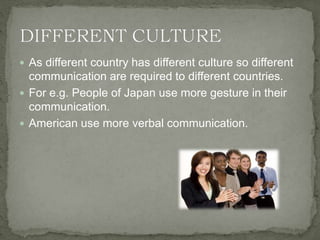
 As different country has different culture so different
communication are required to different countries.
 For e.g. People of Japan use more gesture in their
communication.
 American use more verbal communication.
 Role of written communication
 Role of meetings
 Patterns of reasoning and argumentation
 Level of formality in inter-personal Communications
 Oral presentation style
 Non-verbal communication behaviors
 Globalization
 Business opportunity
 Job opportunity
 Improve the contribution of employees in diverse
workforce
 Sharing of views and ideas
 Talent improvisation
 An understanding of diverse market.
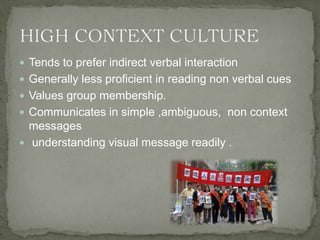
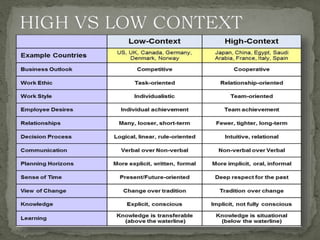
 Tends to prefer indirect verbal interaction
 Generally less proficient in reading non verbal cues
 Values group membership.
 Communicates in simple ,ambiguous, non context
messages
 understanding visual message readily .
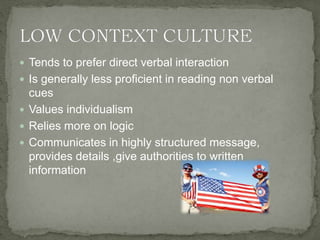
 Tends to prefer direct verbal interaction
 Is generally less proficient in reading non verbal
cues
 Values individualism
 Relies more on logic
 Communicates in highly structured message,
provides details ,give authorities to written
information
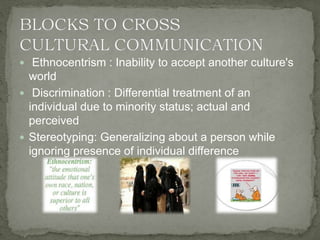
 Ethnocentrism : Inability to accept another culture's
world
 Discrimination : Differential treatment of an
individual due to minority status; actual and
perceived
 Stereotyping: Generalizing about a person while
ignoring presence of individual difference
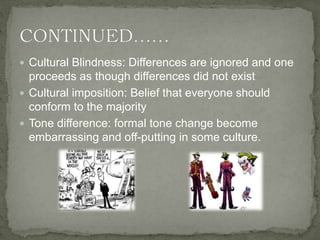
 Cultural Blindness: Differences are ignored and one
proceeds as though differences did not exist
 Cultural imposition: Belief that everyone should
conform to the majority
 Tone difference: formal tone change become
embarrassing and off-putting in some culture.
 Frequency of eye Contact
 Use of Hands While Talking
 Physical Distance Between Communicators
 Speed of Speech
 Volume of Speech
 Use of Facial Expressions
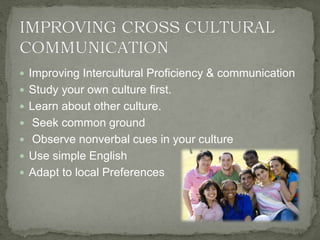
 Improving Intercultural Proficiency & communication
 Study your own culture first.
 Learn about other culture.
 Seek common ground
 Observe nonverbal cues in your culture
 Use simple English
 Adapt to local Preferences
 DEWANSH SHRIVASTAVA
 DHARMENDRA PATEL
 DIVYANSH MODI
 DURGESH INGLE
 DURGESH KUSHRE
Cross culturalcommunication

Cross culturalcommunication

  • 1.
    A PROJECT ON Submittedto :- Mrs. BHASHA SHUKLA 2013-2014
  • 3.
     Cross-cultural communicationis a field of study that looks at how people from differing cultural backgrounds communicate, in similar and different ways among themselves, and how they Endeavour to communicate across cultures.
  • 4.
     As differentcountry has different culture so different communication are required to different countries.  For e.g. People of Japan use more gesture in their communication.  American use more verbal communication.
  • 5.
     Role ofwritten communication  Role of meetings  Patterns of reasoning and argumentation  Level of formality in inter-personal Communications  Oral presentation style  Non-verbal communication behaviors
  • 6.
     Globalization  Businessopportunity  Job opportunity  Improve the contribution of employees in diverse workforce  Sharing of views and ideas  Talent improvisation  An understanding of diverse market.
  • 7.
     Tends toprefer indirect verbal interaction  Generally less proficient in reading non verbal cues  Values group membership.  Communicates in simple ,ambiguous, non context messages  understanding visual message readily .
  • 8.
     Tends toprefer direct verbal interaction  Is generally less proficient in reading non verbal cues  Values individualism  Relies more on logic  Communicates in highly structured message, provides details ,give authorities to written information
  • 10.
     Ethnocentrism :Inability to accept another culture's world  Discrimination : Differential treatment of an individual due to minority status; actual and perceived  Stereotyping: Generalizing about a person while ignoring presence of individual difference
  • 11.
     Cultural Blindness:Differences are ignored and one proceeds as though differences did not exist  Cultural imposition: Belief that everyone should conform to the majority  Tone difference: formal tone change become embarrassing and off-putting in some culture.
  • 12.
     Frequency ofeye Contact  Use of Hands While Talking  Physical Distance Between Communicators  Speed of Speech  Volume of Speech  Use of Facial Expressions
  • 13.
     Improving InterculturalProficiency & communication  Study your own culture first.  Learn about other culture.  Seek common ground  Observe nonverbal cues in your culture  Use simple English  Adapt to local Preferences
  • 15.
     DEWANSH SHRIVASTAVA DHARMENDRA PATEL  DIVYANSH MODI  DURGESH INGLE  DURGESH KUSHRE