INTERCULTURAL
COMMUNICATION
“…one of the world’s most significant problems: intercultural relations…”
Edward T. Hall
THE NATURE OF
INTERCULTURAL
COMMUNICATION
DEFINITION
Intercultural communication is:
communication between or at least two
people from different cultures.
WHY STUDY INTERCULTURAL COMMUNICATION?
Increasing interaction between people due to
globalization
Increasing diversity in workplaces
Increasing need to develop caring, responsible
and ethical business leaders
What is ‘culture’ in
Intercultural communication?
DOMAINS OF CULTURAL
DIFFERENCES
DOMAINS: Verbal
Choice of words
Organization of messages
DOMAINS: Non-verbal
Body
language
Eye contact
Laughter
Touch
Tone, volume
and speed
Turn-taking and
silence
STEP TOWARDS
EFFECTIVE COMMUNICATION
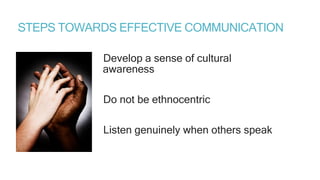
STEPS TOWARDS EFFECTIVE COMMUNICATION
Develop a sense of cultural
awareness
Do not be ethnocentric
Listen genuinely when others speak
Do not lapse into your own language while
in the presence of others who do not speak
it
Take responsibility for the communication
(e.g., if miscommunication happens, it is not always the
other person’s fault)
DO NOT STEREOTYPE
Characteristics of Competent
Intercultural Communicators
1. flexibility and the ability to tolerate high levels of uncertainty
2. reflectiveness or mindfulness
3. open-mindedness
4. sensitivity
5. adaptability
6. ability to engage in divergent thinking (or thinking creatively)
and systems-level thinking (or thinking how each one in a
system or organization influences each other)
7. politeness
The Developmental Model of Intercultural
Sensitivity
The Developmental Model of Intercultural Sensitivity (DMIS) offers a
structure that explores how people experience cultural differences.
According to Bennett and Bennett (2004), it has six stages. These are the
following:
Stage 1: Denial. The individual does not recognize cultural differences.
An individual in the denial stage might be heard saying:
“All cities are the same; they all have tall buildings, fast food chains, and
coffee shops.”
Stage 2: Defense. The individual starts to recognize cultural differences
and is intimidated by them, resulting in either a superior view on own
culture or an unjustified high regard for the new one.
An individual in the defense stage might be heard saying:
“This culture does not view life the way we do; our culture is certainly
better.”
“Their ways are better than my own; I wish I were one of them.”
Stage 3: Minimization. Although individuals see cultural differences, they
bank more on the universality of ideas rather than on cultural differences.
An individual in the minimization stage might be heard saying:
“Once we see through the cultural differences, we really are just the
same!”
Stage 4: Acceptance. The individual begins to appreciate important
cultural differences in behaviors and eventually in values.
An individual in the acceptance stage might be heard saying:
“These people and I have different values and experiences, and I think
we can learn from one another.”
Stage 5: Adaptation. The individual is very open to world views
when accepting new perspectives.
An individual in the adaptation stage might be heard saying:
“To address our issue, I have to adjust my approach to consider
both my own and my counterpart’s background.”
Stage 6: Integration. Individuals start to go beyond their own
cultures and see themselves and their actions based on
multifarious cultural viewpoints.
An individual in the integration stage might be heard saying:
“I can look at things from the perspective of various cultures.”
CONCLUSION
Intercultural communication:
 respects people as part of a group AND as
individuals.
 is not about interaction between national cultures
only.
CONCLUSION
Intercultural competence:
 helps you deliver your messages clearly,
appropriately and persuasively.
 enables you, as a business leader, to contribute
to
a just and equitable world.
Write T before each number if the statement is true and F if the statement is false.
1. Intercultural communication occurs when there is interaction and negotiation between or
among individuals from different cultural backgrounds.
2. Intercultural communication refers only to communication that happens between or
among individuals from different nations.
3. Communication that exists between or among individuals from different ethnic, religious,
and regional backgrounds and sexual orientations is not considered as intercultural.
4. The DMIS by Bennett and Bennett (2004) can be used to understand those who do not
recognize other cultures and cannot communicate interculturally.
5. The denial stage could be interpreted as distrust towards other cultures.
6. The acceptance stage refers to recognition of cultural differences.
7. In the adaptation stage, individuals begin to integrate with other cultures.
8. Cultural sensitivity matters in intercultural communication.
9. One character trait of a competent communicator is sensitivity to nonverbal cues in other
cultures.
10. A competent communicator is a person who is effective in intercultural communication.
Read each statement. If it displays bias or insensitivity, write the group/element being
misrepresented (gender, social status, age, religion, culture). If not, write “OK.” Once done,
compare and discuss your answers with a partner.
1. “Each employee must wear his ID at all times.”
2. “You won’t understand if I explain; you’re too young.”
3. “Japanese people are so rigid and stoic!”
4. “Don’t buy those shades; only low-class people wear those.”
5. “Lolo, this is an iPhone. ‘i-Phone.’ It is a very complicated device, but I’ll explain it to you
simply. It is used to talk to people from other places.”
6. “All staff members have to submit their leave requests before the day ends.”
7. “My belief is the absolute truth. Other religions simply got it wrong.”
8. “Manang, let’s go, I’ll treat you. I bet you haven’t eaten sushi in your entire life.”
9. “Catholics and Protestants do have big differences, but we must respect each other’s
beliefs.”
10. “You’re the youngest person in the family, but I trust that you can handle the situation
well.”
Homework
Form five groups. Each group will represent a particular
country (Japan, France, China, Philippines, and Mexico).
Imagine yourselves as the ambassadors of the country
assigned to your group.
Research information, work together and come up with some
interesting data about your country.
Intercultural Communication

Intercultural Communication

  • 1.
    INTERCULTURAL COMMUNICATION “…one of theworld’s most significant problems: intercultural relations…” Edward T. Hall
  • 2.
  • 3.
    DEFINITION Intercultural communication is: communicationbetween or at least two people from different cultures.
  • 4.
    WHY STUDY INTERCULTURALCOMMUNICATION? Increasing interaction between people due to globalization Increasing diversity in workplaces Increasing need to develop caring, responsible and ethical business leaders
  • 5.
    What is ‘culture’in Intercultural communication?
  • 6.
  • 7.
    DOMAINS: Verbal Choice ofwords Organization of messages
  • 8.
  • 11.
  • 12.
    STEPS TOWARDS EFFECTIVECOMMUNICATION Develop a sense of cultural awareness Do not be ethnocentric Listen genuinely when others speak
  • 13.
    Do not lapseinto your own language while in the presence of others who do not speak it Take responsibility for the communication (e.g., if miscommunication happens, it is not always the other person’s fault) DO NOT STEREOTYPE
  • 16.
    Characteristics of Competent InterculturalCommunicators 1. flexibility and the ability to tolerate high levels of uncertainty 2. reflectiveness or mindfulness 3. open-mindedness 4. sensitivity 5. adaptability 6. ability to engage in divergent thinking (or thinking creatively) and systems-level thinking (or thinking how each one in a system or organization influences each other) 7. politeness
  • 17.
    The Developmental Modelof Intercultural Sensitivity The Developmental Model of Intercultural Sensitivity (DMIS) offers a structure that explores how people experience cultural differences. According to Bennett and Bennett (2004), it has six stages. These are the following:
  • 18.
    Stage 1: Denial.The individual does not recognize cultural differences. An individual in the denial stage might be heard saying: “All cities are the same; they all have tall buildings, fast food chains, and coffee shops.” Stage 2: Defense. The individual starts to recognize cultural differences and is intimidated by them, resulting in either a superior view on own culture or an unjustified high regard for the new one. An individual in the defense stage might be heard saying: “This culture does not view life the way we do; our culture is certainly better.” “Their ways are better than my own; I wish I were one of them.”
  • 19.
    Stage 3: Minimization.Although individuals see cultural differences, they bank more on the universality of ideas rather than on cultural differences. An individual in the minimization stage might be heard saying: “Once we see through the cultural differences, we really are just the same!” Stage 4: Acceptance. The individual begins to appreciate important cultural differences in behaviors and eventually in values. An individual in the acceptance stage might be heard saying: “These people and I have different values and experiences, and I think we can learn from one another.”
  • 20.
    Stage 5: Adaptation.The individual is very open to world views when accepting new perspectives. An individual in the adaptation stage might be heard saying: “To address our issue, I have to adjust my approach to consider both my own and my counterpart’s background.” Stage 6: Integration. Individuals start to go beyond their own cultures and see themselves and their actions based on multifarious cultural viewpoints. An individual in the integration stage might be heard saying: “I can look at things from the perspective of various cultures.”
  • 21.
    CONCLUSION Intercultural communication:  respectspeople as part of a group AND as individuals.  is not about interaction between national cultures only.
  • 22.
    CONCLUSION Intercultural competence:  helpsyou deliver your messages clearly, appropriately and persuasively.  enables you, as a business leader, to contribute to a just and equitable world.
  • 24.
    Write T beforeeach number if the statement is true and F if the statement is false. 1. Intercultural communication occurs when there is interaction and negotiation between or among individuals from different cultural backgrounds. 2. Intercultural communication refers only to communication that happens between or among individuals from different nations. 3. Communication that exists between or among individuals from different ethnic, religious, and regional backgrounds and sexual orientations is not considered as intercultural. 4. The DMIS by Bennett and Bennett (2004) can be used to understand those who do not recognize other cultures and cannot communicate interculturally. 5. The denial stage could be interpreted as distrust towards other cultures. 6. The acceptance stage refers to recognition of cultural differences. 7. In the adaptation stage, individuals begin to integrate with other cultures. 8. Cultural sensitivity matters in intercultural communication. 9. One character trait of a competent communicator is sensitivity to nonverbal cues in other cultures. 10. A competent communicator is a person who is effective in intercultural communication.
  • 26.
    Read each statement.If it displays bias or insensitivity, write the group/element being misrepresented (gender, social status, age, religion, culture). If not, write “OK.” Once done, compare and discuss your answers with a partner. 1. “Each employee must wear his ID at all times.” 2. “You won’t understand if I explain; you’re too young.” 3. “Japanese people are so rigid and stoic!” 4. “Don’t buy those shades; only low-class people wear those.” 5. “Lolo, this is an iPhone. ‘i-Phone.’ It is a very complicated device, but I’ll explain it to you simply. It is used to talk to people from other places.” 6. “All staff members have to submit their leave requests before the day ends.” 7. “My belief is the absolute truth. Other religions simply got it wrong.” 8. “Manang, let’s go, I’ll treat you. I bet you haven’t eaten sushi in your entire life.” 9. “Catholics and Protestants do have big differences, but we must respect each other’s beliefs.” 10. “You’re the youngest person in the family, but I trust that you can handle the situation well.”
  • 27.
    Homework Form five groups.Each group will represent a particular country (Japan, France, China, Philippines, and Mexico). Imagine yourselves as the ambassadors of the country assigned to your group. Research information, work together and come up with some interesting data about your country.