


CROSS-CULTURAL
COMMUNICATION
ICS
Manish H. Champaneri
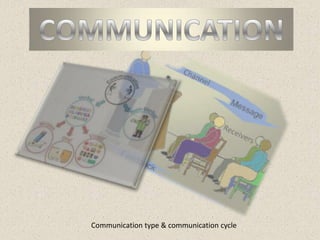
Communication type & communication cycle
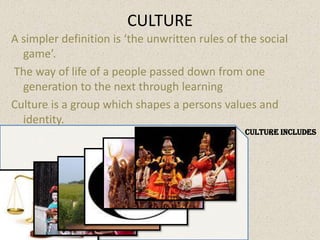
A simpler definition is ‘the unwritten rules of the social
game’.
The way of life of a people passed down from one
generation to the next through learning
Culture is a group which shapes a persons values and
identity.
CULTURE
Culture Includes
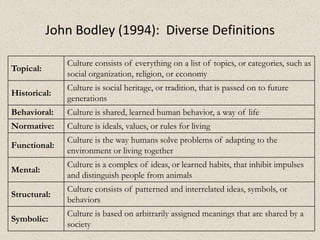
John Bodley (1994): Diverse Definitions
Topical:
Culture consists of everything on a list of topics, or categories, such as
social organization, religion, or economy
Historical:
Culture is social heritage, or tradition, that is passed on to future
generations
Behavioral: Culture is shared, learned human behavior, a way of life
Normative: Culture is ideals, values, or rules for living
Functional:
Culture is the way humans solve problems of adapting to the
environment or living together
Mental:
Culture is a complex of ideas, or learned habits, that inhibit impulses
and distinguish people from animals
Structural:
Culture consists of patterned and interrelated ideas, symbols, or
behaviors
Symbolic:
Culture is based on arbitrarily assigned meanings that are shared by a
society
Cross Culture Communication
Intercultural Communication is the process of
sending and receiving messages between
people whose cultural background could lead
them to interpret verbal and non-verbal signs
differently.
Aims of cross-cultural analysis
Cross-cultural communication or inter
cultural communication looks at how people
from different cultural backgrounds try to
communicate. It also tries to produce some
guidelines, which help people from different
cultures to better communicate with each
other.
Why Cross Culture
Communication is important ?
◦ Business Opportunities
◦ Job Opportunities
◦ Sharing of views and ideas
◦ Talent improvisation
◦ An understanding of diverse market
Globalization: Cross border movement of people, goods and data brings more
and more cultures into contact with one another and increases the potential of
cross culture communication.
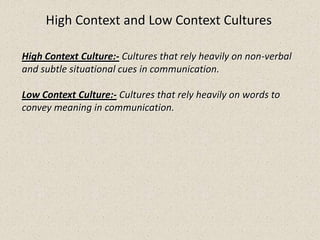
High Context and Low Context Cultures
High Context Culture:- Cultures that rely heavily on non-verbal
and subtle situational cues in communication.
Low Context Culture:- Cultures that rely heavily on words to
convey meaning in communication.
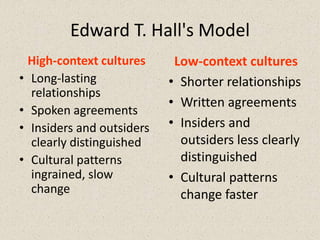
Edward T. Hall's Model
High-context cultures
• Long-lasting
relationships
• Spoken agreements
• Insiders and outsiders
clearly distinguished
• Cultural patterns
ingrained, slow
change
Low-context cultures
• Shorter relationships
• Written agreements
• Insiders and
outsiders less clearly
distinguished
• Cultural patterns
change faster
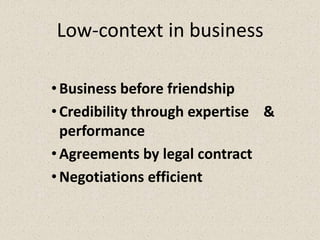
Low-context in business
•Business before friendship
•Credibility through expertise &
performance
•Agreements by legal contract
•Negotiations efficient
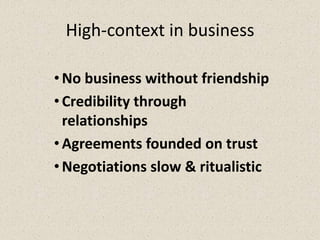
High-context in business
•No business without friendship
•Credibility through
relationships
•Agreements founded on trust
•Negotiations slow & ritualistic
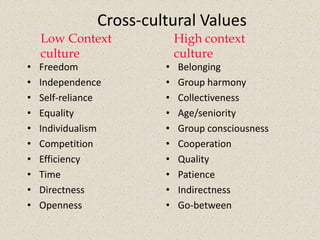
Cross-cultural Values
• Freedom
• Independence
• Self-reliance
• Equality
• Individualism
• Competition
• Efficiency
• Time
• Directness
• Openness
• Belonging
• Group harmony
• Collectiveness
• Age/seniority
• Group consciousness
• Cooperation
• Quality
• Patience
• Indirectness
• Go-between
Low Context
culture
High context
culture
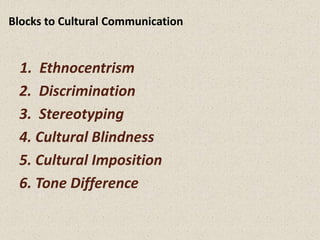
Blocks to Cultural Communication
1. Ethnocentrism
2. Discrimination
3. Stereotyping
4. Cultural Blindness
5. Cultural Imposition
6. Tone Difference
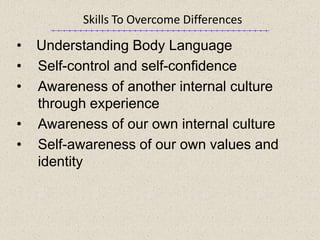
Skills To Overcome Differences
• Understanding Body Language
• Self-control and self-confidence
• Awareness of another internal culture
through experience
• Awareness of our own internal culture
• Self-awareness of our own values and
identity
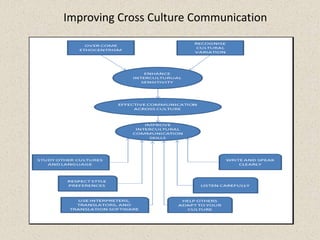
Improving Cross Culture Communication
Cross cultural communication ...

Cross cultural communication ...

  • 1.
  • 2.
    Communication type &communication cycle
  • 4.
    A simpler definitionis ‘the unwritten rules of the social game’. The way of life of a people passed down from one generation to the next through learning Culture is a group which shapes a persons values and identity. CULTURE Culture Includes
  • 5.
    John Bodley (1994):Diverse Definitions Topical: Culture consists of everything on a list of topics, or categories, such as social organization, religion, or economy Historical: Culture is social heritage, or tradition, that is passed on to future generations Behavioral: Culture is shared, learned human behavior, a way of life Normative: Culture is ideals, values, or rules for living Functional: Culture is the way humans solve problems of adapting to the environment or living together Mental: Culture is a complex of ideas, or learned habits, that inhibit impulses and distinguish people from animals Structural: Culture consists of patterned and interrelated ideas, symbols, or behaviors Symbolic: Culture is based on arbitrarily assigned meanings that are shared by a society
  • 6.
    Cross Culture Communication InterculturalCommunication is the process of sending and receiving messages between people whose cultural background could lead them to interpret verbal and non-verbal signs differently.
  • 7.
    Aims of cross-culturalanalysis Cross-cultural communication or inter cultural communication looks at how people from different cultural backgrounds try to communicate. It also tries to produce some guidelines, which help people from different cultures to better communicate with each other.
  • 8.
    Why Cross Culture Communicationis important ? ◦ Business Opportunities ◦ Job Opportunities ◦ Sharing of views and ideas ◦ Talent improvisation ◦ An understanding of diverse market Globalization: Cross border movement of people, goods and data brings more and more cultures into contact with one another and increases the potential of cross culture communication.
  • 10.
    High Context andLow Context Cultures High Context Culture:- Cultures that rely heavily on non-verbal and subtle situational cues in communication. Low Context Culture:- Cultures that rely heavily on words to convey meaning in communication.
  • 11.
    Edward T. Hall'sModel High-context cultures • Long-lasting relationships • Spoken agreements • Insiders and outsiders clearly distinguished • Cultural patterns ingrained, slow change Low-context cultures • Shorter relationships • Written agreements • Insiders and outsiders less clearly distinguished • Cultural patterns change faster
  • 12.
    Low-context in business •Businessbefore friendship •Credibility through expertise & performance •Agreements by legal contract •Negotiations efficient
  • 13.
    High-context in business •Nobusiness without friendship •Credibility through relationships •Agreements founded on trust •Negotiations slow & ritualistic
  • 14.
    Cross-cultural Values • Freedom •Independence • Self-reliance • Equality • Individualism • Competition • Efficiency • Time • Directness • Openness • Belonging • Group harmony • Collectiveness • Age/seniority • Group consciousness • Cooperation • Quality • Patience • Indirectness • Go-between Low Context culture High context culture
  • 15.
    Blocks to CulturalCommunication 1. Ethnocentrism 2. Discrimination 3. Stereotyping 4. Cultural Blindness 5. Cultural Imposition 6. Tone Difference
  • 16.
    Skills To OvercomeDifferences • Understanding Body Language • Self-control and self-confidence • Awareness of another internal culture through experience • Awareness of our own internal culture • Self-awareness of our own values and identity
  • 17.

Editor's Notes

  • #5 Eating manners, giving respect when talking with the elders…. 2) Examples are various days… 3) culture includes