CROP
When plants of same kind are grown and cultivated at
one place on a large scale, it is called a crop.
TYPES OF CROPS
Kharif Crop:- The crops which are sown in rainy season are
kharif crops.
Examples: Paddy, maize, soyabean, groundnut, cotton etc.
Rabi Crop:- The crops grown in the winter season are
called rabi crops.
Examples: Wheat, gram, pea, mustard, linseed etc.
BASIC PRACTICES OF CROP
PRODUCTION
 Preparation of Soil
 Sowing
 Adding manure and fertilisers
 Irrigation
 Protecting from weeds
 Harvesting
 Storage
SOWING
*The process of scattering or putting seeds into the
ground is called sowing.
*Before sowing good quality seeds are selected.
Good quality seeds are clean and healthy, free from
infection and diseases.
*There are two methods of sowing seeds-
SOWING BY HAND and SOWING WITH A SEED DRILL.
*Sowing with a seed drill is considered better than
sowing with hand because-
1. The seeds are in regular rows
2. it saves time and labour.
Manures-
1. A manure is a natural substance
obtained by the decomposition of
animal wastes like cow dung, human
waste and animal residue.
2. Manure can be prepared in the
fields.
3. A manure provides a lot of
organic matter like humus to the
soil.
Fertilisers-
1. A fertiliser is a salt or an
organic compound.
2. Fertilisers are prepared in
factories.
3. A fertiliser does not
provide any humus to the
soil.
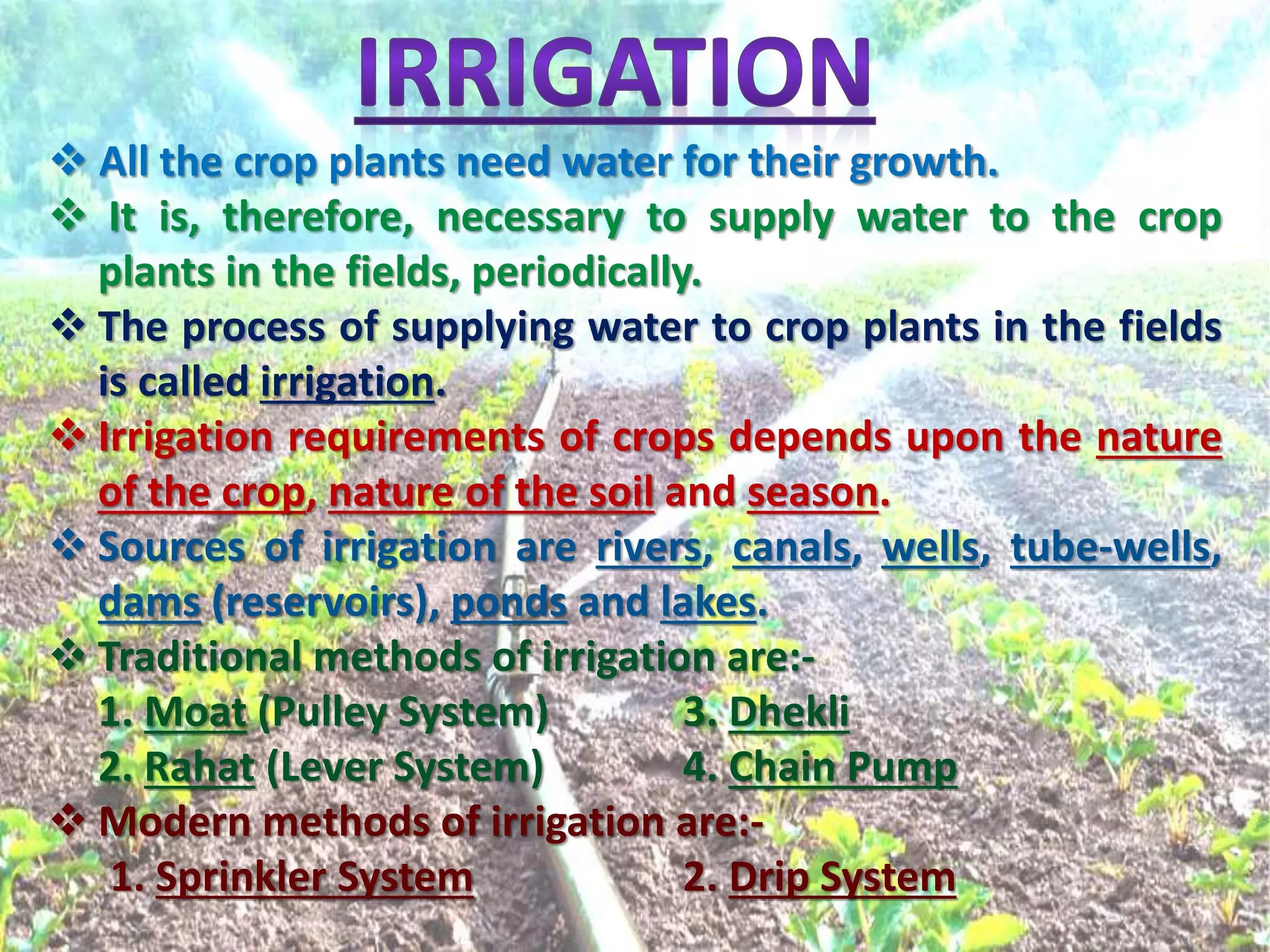
 All the crop plants need water for their growth.
 It is, therefore, necessary to supply water to the crop
plants in the fields, periodically.
 The process of supplying water to crop plants in the fields
is called irrigation.
 Irrigation requirements of crops depends upon the nature
of the crop, nature of the soil and season.
 Sources of irrigation are rivers, canals, wells, tube-wells,
dams (reservoirs), ponds and lakes.
 Traditional methods of irrigation are:-
1. Moat (Pulley System) 3. Dhekli
2. Rahat (Lever System) 4. Chain Pump
 Modern methods of irrigation are:-
1. Sprinkler System 2. Drip System
 The unwanted plants which grow alongwith a cultivated
crop are called weeds.
 The process of removing weeds from a crop field is called
weeding.
 The best time for the removal of weeds is before they
produce flowers and seeds.
 The various methods of weeding are:-
1. Removal of weeds by pulling them out with hand.
2. Removal of weeds by using a trowel.
3. Destroying the weeds by spraying special chemicals
called weedicides.
HARVESTING
The cutting and gathering
of the matured food crop
is called harvesting. It is
done either by hand using
a sickle or by a motorised
machine called harvester.
STORAGE OF
FOOD GRAINS
The practice or means of
keeping grain until it is sold
or used is called storage.
The large scale storage of
food grains is done in gunny
bags and in grain silos.
MADE BY-
1. Gouri Gusain(6)
2. Gracy Kaur(7)
3. Ishita Singh(9)
4. Jemimol Solomon(10)

crop production and management class 8 science

  • 2.
    CROP When plants ofsame kind are grown and cultivated at one place on a large scale, it is called a crop. TYPES OF CROPS Kharif Crop:- The crops which are sown in rainy season are kharif crops. Examples: Paddy, maize, soyabean, groundnut, cotton etc. Rabi Crop:- The crops grown in the winter season are called rabi crops. Examples: Wheat, gram, pea, mustard, linseed etc.
  • 3.
    BASIC PRACTICES OFCROP PRODUCTION  Preparation of Soil  Sowing  Adding manure and fertilisers  Irrigation  Protecting from weeds  Harvesting  Storage
  • 5.
    SOWING *The process ofscattering or putting seeds into the ground is called sowing. *Before sowing good quality seeds are selected. Good quality seeds are clean and healthy, free from infection and diseases. *There are two methods of sowing seeds- SOWING BY HAND and SOWING WITH A SEED DRILL. *Sowing with a seed drill is considered better than sowing with hand because- 1. The seeds are in regular rows 2. it saves time and labour.
  • 6.
    Manures- 1. A manureis a natural substance obtained by the decomposition of animal wastes like cow dung, human waste and animal residue. 2. Manure can be prepared in the fields. 3. A manure provides a lot of organic matter like humus to the soil. Fertilisers- 1. A fertiliser is a salt or an organic compound. 2. Fertilisers are prepared in factories. 3. A fertiliser does not provide any humus to the soil.
  • 7.
     All thecrop plants need water for their growth.  It is, therefore, necessary to supply water to the crop plants in the fields, periodically.  The process of supplying water to crop plants in the fields is called irrigation.  Irrigation requirements of crops depends upon the nature of the crop, nature of the soil and season.  Sources of irrigation are rivers, canals, wells, tube-wells, dams (reservoirs), ponds and lakes.  Traditional methods of irrigation are:- 1. Moat (Pulley System) 3. Dhekli 2. Rahat (Lever System) 4. Chain Pump  Modern methods of irrigation are:- 1. Sprinkler System 2. Drip System
  • 8.
     The unwantedplants which grow alongwith a cultivated crop are called weeds.  The process of removing weeds from a crop field is called weeding.  The best time for the removal of weeds is before they produce flowers and seeds.  The various methods of weeding are:- 1. Removal of weeds by pulling them out with hand. 2. Removal of weeds by using a trowel. 3. Destroying the weeds by spraying special chemicals called weedicides.
  • 9.
    HARVESTING The cutting andgathering of the matured food crop is called harvesting. It is done either by hand using a sickle or by a motorised machine called harvester. STORAGE OF FOOD GRAINS The practice or means of keeping grain until it is sold or used is called storage. The large scale storage of food grains is done in gunny bags and in grain silos.
  • 10.
    MADE BY- 1. GouriGusain(6) 2. Gracy Kaur(7) 3. Ishita Singh(9) 4. Jemimol Solomon(10)