General Science
(Biology)
CLASS VIII
Subject Teacher
CHAPTER 02
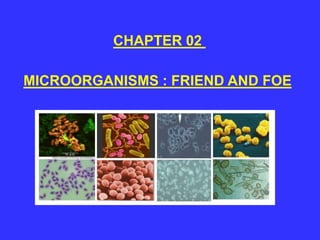
MICROORGANISMS : FRIEND AND FOE
INTRODUCTION
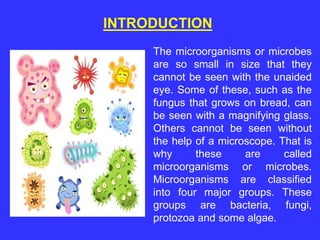
The microorganisms or microbes
are so small in size that they
cannot be seen with the unaided
eye. Some of these, such as the
fungus that grows on bread, can
be seen with a magnifying glass.
Others cannot be seen without
the help of a microscope. That is
why these are called
microorganisms or microbes.
Microorganisms are classified
into four major groups. These
groups are bacteria, fungi,
protozoa and some algae.
ACTIVITY - 1
Collect some moist soil from the field in a beaker and
add water to it. After soil particles have settled,
observe a drop of water from the beaker under a
microscope. What do you see ?
ACTIVITY - 2
Take a few drops of water from a pond. Spread on a
glass slide and observe through a microscope.
Do you find tiny organisms moving around?
OBSERVATIONS
Those small things you observe through the
microscope are called a microorganisms. Some of
the pictorial example are given in the next section.
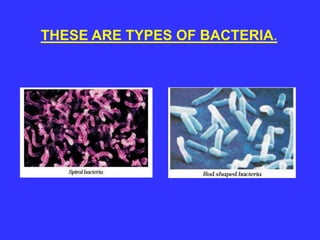
THESE ARE TYPES OF BACTERIA.
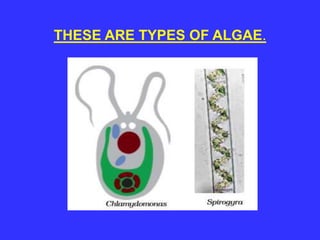
THESE ARE TYPES OF ALGAE.
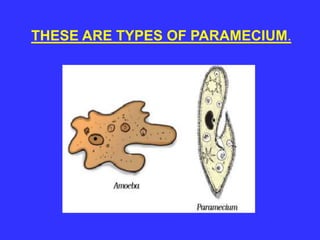
THESE ARE TYPES OF PARAMECIUM.
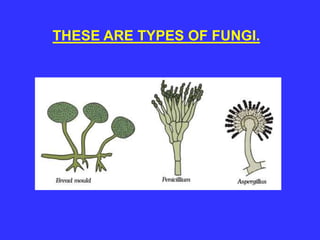
THESE ARE TYPES OF FUNGI.
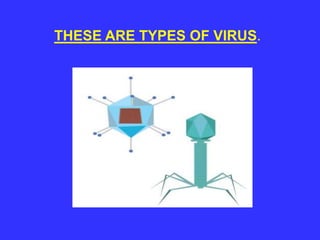
THESE ARE TYPES OF VIRUS.
Microorganisms may be single-celled like bacteria,
some algae and protozoa, or multicellular, such as
algae and fungi. They can survive under all types of
environment, ranging from ice cold climate to hot
springs and deserts to marshy lands. They are also
found inside the bodies of animals including humans.
Some microorganisms grow on other organisms
while others exist freely. Microorganisms like
amoeba can live alone, while fungi and bacteria may
live in colonies.
WHERE DO MICROORGANISMS LIVE?
FRIENDLY MICROORGANISMS
Microorganisms are used for various purposes.
They are used in the preparation of curd, bread and
cake.
They are also used in cleaning up of the
environment. For example, the organic wastes
(vegetable peels, remains of animals, faeces, etc.)
are broken down into harmless and usable
substances by bacteria. Recall that bacteria are
also used in the preparation of medicines. In
agriculture they are used to increase soil fertility by
fixing nitrogen.
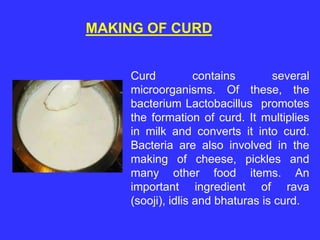
MAKING OF CURD
Curd contains several
microorganisms. Of these, the
bacterium Lactobacillus promotes
the formation of curd. It multiplies
in milk and converts it into curd.
Bacteria are also involved in the
making of cheese, pickles and
many other food items. An
important ingredient of rava
(sooji), idlis and bhaturas is curd.
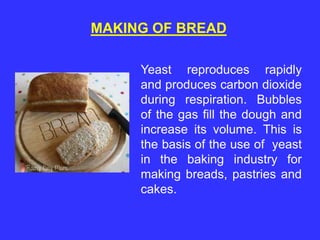
Yeast reproduces rapidly
and produces carbon dioxide
during respiration. Bubbles
of the gas fill the dough and
increase its volume. This is
the basis of the use of yeast
in the baking industry for
making breads, pastries and
cakes.
MAKING OF BREAD
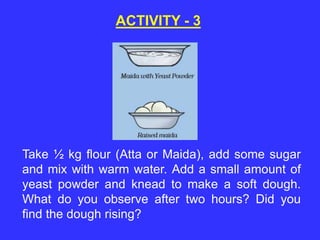
ACTIVITY - 3
Take ½ kg flour (Atta or Maida), add some sugar
and mix with warm water. Add a small amount of
yeast powder and knead to make a soft dough.
What do you observe after two hours? Did you
find the dough rising?
Yeast reproduces rapidly and produces carbon
dioxide during respiration. Bubbles of the gas fill the
dough and increase its volume . This is the basis of
the use of yeast in the baking industry for making
breads, pastries and cakes.
OBSERVATION
COMMERCIAL USE OF MICROORGANISMS
Microorganisms are used for the large scale
production of alcohol, wine and acetic acid
(vinegar). Yeast is used for commercial production
of alcohol and wine. For this purpose yeast is
grown on natural sugars present in grains like
barley, wheat, rice and crushed fruit juices, etc.
The process of conversion of sugar into alcohol is
known as fermentation.
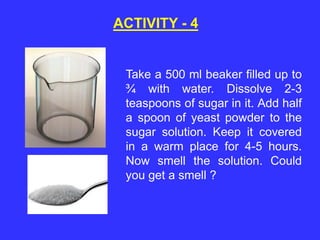
ACTIVITY - 4
Take a 500 ml beaker filled up to
¾ with water. Dissolve 2-3
teaspoons of sugar in it. Add half
a spoon of yeast powder to the
sugar solution. Keep it covered
in a warm place for 4-5 hours.
Now smell the solution. Could
you get a smell ?
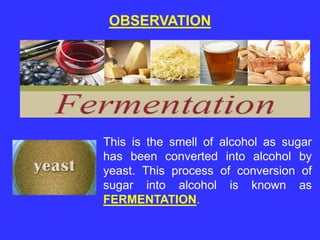
OBSERVATION
This is the smell of alcohol as sugar
has been converted into alcohol by
yeast. This process of conversion of
sugar into alcohol is known as
FERMENTATION.
MEDICINAL USE OF MICROORGANISMS
Whenever you fall ill the doctor may give you some
antibiotic tablets, capsules or injections such as of
penicillin. The source of these medicines is
microorganisms. These medicines kill or stop the
growth of the disease-causing microorganisms.
Such medicines are called antibiotics. These days
a number of antibiotics are being produced from
bacteria and fungi. Streptomycin, tetracycline and
erythromycin are some of the commonly known
antibiotics which are made from fungi and bacteria.
Continued in next slide…
MEDICINAL USE OF MICROORGANISMS
The antibiotics are manufactured by growing
specific microorganisms and are used to cure a
variety of diseases. Antibiotics are even mixed
with the feed of livestock and poultry to check
microbial infection in animals. They are also
used to control many plant diseases.
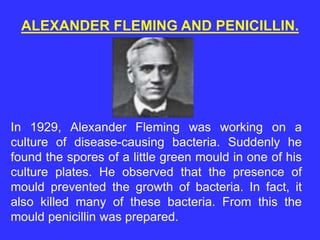
In 1929, Alexander Fleming was working on a
culture of disease-causing bacteria. Suddenly he
found the spores of a little green mould in one of his
culture plates. He observed that the presence of
mould prevented the growth of bacteria. In fact, it
also killed many of these bacteria. From this the
mould penicillin was prepared.
ALEXANDER FLEMING AND PENICILLIN.
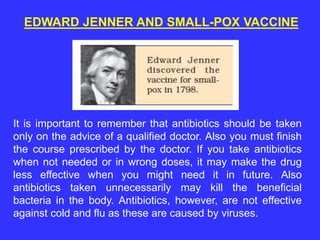
EDWARD JENNER AND SMALL-POX VACCINE
It is important to remember that antibiotics should be taken
only on the advice of a qualified doctor. Also you must finish
the course prescribed by the doctor. If you take antibiotics
when not needed or in wrong doses, it may make the drug
less effective when you might need it in future. Also
antibiotics taken unnecessarily may kill the beneficial
bacteria in the body. Antibiotics, however, are not effective
against cold and flu as these are caused by viruses.
When a disease-carrying microbe enters our body,
the body produces antibodies to fight the invader.
The body also remembers how to fight the microbe
if it enters again. So, if dead or weakened microbes
are introduced in a healthy body, the body fights
and kills them by producing suitable antibodies. The
antibodies remain in the body and we are protected
from the disease-causing microbes. This is how a
vaccine works. Several diseases, including cholera,
tuberculosis, smallpox and hepatitis can be
prevented by vaccination
WHY ARE CHILDREN AND INFANTS GIVEN
VACCINATION?
Continued in next slide...
In your childhood, you must have been given
injections to protect yourself against several
diseases. Can you prepare a list of these diseases?
You may take help from your parents. It is essential
to protect all children against these diseases.
Necessary vaccines are available in the nearby
hospitals. You might have seen the advertisement
on T.V. and newspapers regarding protection of
children against polio under Pulse Polio Program.
WHY ARE CHILDREN AND INFANTS GIVEN
VACCINATION?
Polio drops given to children are actually a vaccine.
A worldwide campaign against smallpox has finally
led to its eradication from most parts of the world.
These days vaccines are made on a large scale
from microorganisms to protect humans and other
animals from several diseases.
WHY ARE CHILDREN AND INFANTS GIVEN
VACCINATION?
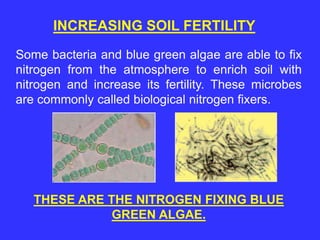
Some bacteria and blue green algae are able to fix
nitrogen from the atmosphere to enrich soil with
nitrogen and increase its fertility. These microbes
are commonly called biological nitrogen fixers.
INCREASING SOIL FERTILITY
THESE ARE THE NITROGEN FIXING BLUE
GREEN ALGAE.
Take two pots and fill each pot half with soil. Mark
them A and B. Put plant waste in pot A and things
like polythene bags, empty glass bottles and broken
plastic toys in pot B. Put the pots aside. Observe
them after 3-4 weeks. Do you find any difference in
the contents of the two pots? If so, what is the
difference?
ACTIVITY - 5
You will find that plant waste in pot A, has been
decomposed. How could this happen? The plant
waste has been converted into manure by the action
of microbes. The nutrients released in the process
could be used by the plants again. Did you notice
that in pot B, the polythene bags, empty glasses,
bottles and broken toy parts did not undergo any
such change? The microbes could not ‘act’ on them
and convert them into manure.
OBSERVATION
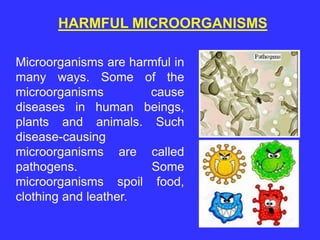
Microorganisms are harmful in
many ways. Some of the
microorganisms cause
diseases in human beings,
plants and animals. Such
disease-causing
microorganisms are called
pathogens. Some
microorganisms spoil food,
clothing and leather.
HARMFUL MICROORGANISMS
Pathogens enter our body through the air we
breathe, the water we drink or the food we eat.
They can also get transmitted by direct contact
with an infected person or carried through an
animal. Microbial diseases that can spread from
an infected person to a healthy person through air,
water, food or physical contact are called
communicable diseases. Examples of such
diseases include cholera, common cold, chicken
pox and tuberculosis.
DISEASE- CAUSING MICROORGANISMS
IN HUMANS
When a person suffering from common cold
sneezes, fine droplets of moisture carrying
thousands of viruses are spread in the air. The
virus may enter the body of a healthy person while
breathing.
DISEASE- CAUSING MICROORGANISMS
IN HUMANS
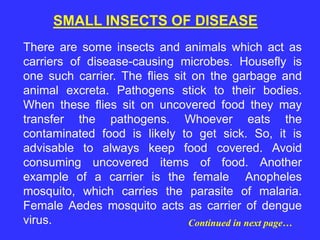
There are some insects and animals which act as
carriers of disease-causing microbes. Housefly is
one such carrier. The flies sit on the garbage and
animal excreta. Pathogens stick to their bodies.
When these flies sit on uncovered food they may
transfer the pathogens. Whoever eats the
contaminated food is likely to get sick. So, it is
advisable to always keep food covered. Avoid
consuming uncovered items of food. Another
example of a carrier is the female Anopheles
mosquito, which carries the parasite of malaria.
Female Aedes mosquito acts as carrier of dengue
virus.
SMALL INSECTS OF DISEASE
Continued in next page…
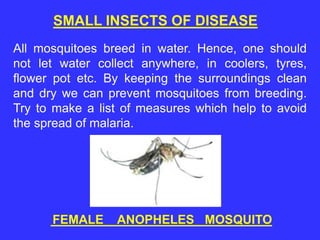
All mosquitoes breed in water. Hence, one should
not let water collect anywhere, in coolers, tyres,
flower pot etc. By keeping the surroundings clean
and dry we can prevent mosquitoes from breeding.
Try to make a list of measures which help to avoid
the spread of malaria.
FEMALE ANOPHELES MOSQUITO
SMALL INSECTS OF DISEASE
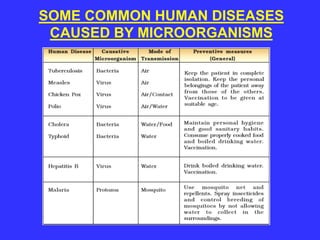
SOME COMMON HUMAN DISEASES
CAUSED BY MICROORGANISMS
DISEASE- CAUSING MICROORGANISMS
IN PLANTS
Several microorganisms cause diseases in plants
like wheat, rice, potato, sugarcane, orange, apple
and others. The diseases reduce the yield of crops.
They can be controlled by the use of certain
chemicals which kill the microbes
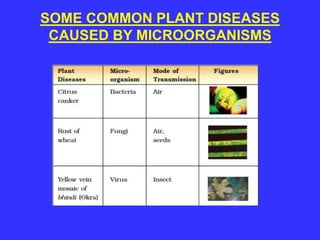
SOME COMMON PLANT DISEASES
CAUSED BY MICROORGANISMS
CHEMICAL METHOD
Salts and edible oils are the common chemicals
generally used to check the growth of
microorganisms. Therefore they are called
preservatives. We add salt or acid preservatives
to pickles to prevent the attack of microbes.
Sodium benzoate and sodium meta bisulphite
are common preservatives. These are also used
in the jams and squashes to check their spoilage.
PRESERVATION BY COMMON SALT
Common salt has been used to preserve meat and fish for
ages. Meat and fish are covered with dry salt to check the
growth of bacteria. Salting is also used to preserve amla,
raw mangoes, tamarind, etc.
PRESERVATION BY OIL AND VINEGAR
Use of oil and vinegar prevents spoilage of pickles because
bacteria cannot live in such an environment. Vegetables,
fruits, fish and meat are often preserved by this method.
PRESERVATION BY SUGAR
Jams, jellies and squashes are preserved by sugar. Sugar
reduces the moisture content which inhibits the growth of
bacteria which spoil food.
HEAT AND COLD TREATMENTS
You must have observed your mother boiling milk before it is
stored or used. Boiling kills many microorganisms. Similarly,
we keep our food in the refrigerator. Low temperature
inhibits the growth of microbes.
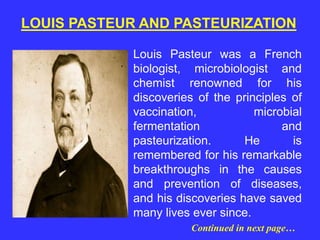
Louis Pasteur was a French
biologist, microbiologist and
chemist renowned for his
discoveries of the principles of
vaccination, microbial
fermentation and
pasteurization. He is
remembered for his remarkable
breakthroughs in the causes
and prevention of diseases,
and his discoveries have saved
many lives ever since.
LOUIS PASTEUR AND PASTEURIZATION
Continued in next page…
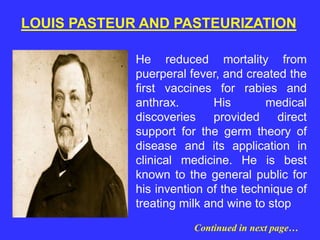
He reduced mortality from
puerperal fever, and created the
first vaccines for rabies and
anthrax. His medical
discoveries provided direct
support for the germ theory of
disease and its application in
clinical medicine. He is best
known to the general public for
his invention of the technique of
treating milk and wine to stop
LOUIS PASTEUR AND PASTEURIZATION
Continued in next page…
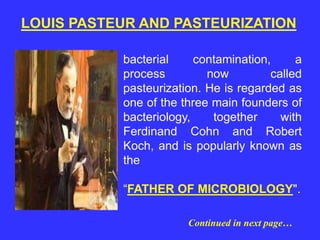
bacterial contamination, a
process now called
pasteurization. He is regarded as
one of the three main founders of
bacteriology, together with
Ferdinand Cohn and Robert
Koch, and is popularly known as
the
“FATHER OF MICROBIOLOGY".
LOUIS PASTEUR AND PASTEURIZATION
Continued in next page…
Pasteurized milk can be consumed without boiling as it
is free from harmful microbes. The milk is heated to
about 700 C for 15 to 30 seconds and then suddenly
chilled and stored. By doing so, it prevents the growth
of microbes. This process was also discovered by
Louis Pasteur. It is called pasteurization.
STORAGE AND PACKING
These days dry fruits and even vegetables are sold
in sealed air tight packets to prevent the attack of
microbes.
LOUIS PASTEUR AND PASTEURIZATION
NITROGEN FIXATION
You have learnt about the bacterium Rhizobium in
Classes VI and VII. It is involved in the fixation of
nitrogen in leguminous plants (pulses). Recall that
Rhizobium lives in the root nodules of leguminous
plants , such as beans and peas, with which it has
a symbiotic relationship. Sometimes nitrogen gets
fixed through the action of lightning. But you know
that the amount of nitrogen in the atmosphere
remains constant. You may wonder how? Let us
understand this in the next section.
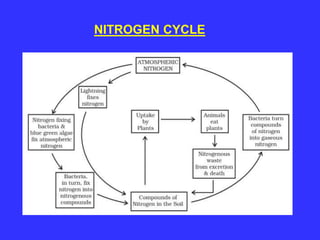
NITROGEN CYCLE
Our atmosphere has 78% nitrogen gas. Nitrogen is one
of the essential constituents of all living organisms as
part of proteins, chlorophyll, nucleic acids and vitamins.
The atmospheric nitrogen cannot be taken directly by
plants and animals. Certain bacteria and blue green
algae present in the soil fix nitrogen from the
atmosphere and convert into compounds of nitrogen.
Once nitrogen is converted into these usable
compounds, it can be utilised by plants from the soil
through their root system. Nitrogen is then used for the
synthesis of plant proteins and other compounds.
Animals feeding on plants get these proteins and other
nitrogen compounds.
Continued in next page…
When plants and animals die, bacteria and fungi
present in the soil convert the nitrogenous wastes
into nitrogenous compounds to be used by plants
again. Certain other bacteria convert some part of
them to nitrogen gas which goes back into the
atmosphere. As a result, the percentage of nitrogen
in the atmosphere remains more or less constant.
Diagram continued in next page…
NITROGEN CYCLE
NITROGEN CYCLE
1. Algae
2. Antibiotics
3. Antibodies
4. Bacteria
5. Carrier
6. Communicable diseases
7. Fermentation
8. Fungi
9. Lactobacillus
10.Microorganism
KEYWORDS
11.Nitrogen cycle
12.Nitrogen fixation
13.Pasteurization
14.Pathogen
15.Preservation
16.Protozoa
17.Rhizobium
18.Vaccine
19.Virus
20.Yeast
Any Questions Please…
Prepared By
IT CLUB, Sainik School Amaravathinagar
Club I/c
Praveen M Jigajinni
DCSc & Engg,PGDCA,ADCA,MCA,MSc(IT),MTech(IT), M.Phil (Comp Sci)
For Any Queries Please feel free to contact:
Email Id : praveenkumarjigajinni@gmail.com
9431453730
SER ROLL NO NAME CLASS HOUSE
1 5988 R Dharani Tharan XC Pandya
2 6378 M Arish XA Pallava
3 5982 R Sarvesh XC Chera
4 5957 RS Sharan Yogesh XC Pallava
5 5956 S Varun Selva XA Chera
6 5938 Aman Kumar XD Pandya
7 5901 AR Sachin Prasad XC Chola
8 5906 M Erin Churchill XC Chola
9 5887 KM Sourabh XC Pandya
10 5954 K Kishore Kumar XC Pandya
11 5896 M Eric Churchill XA Pallava
12 6074 Dheeraj Kumar IXA Chola
13 6054 Vishal Kumar IXA Pallava
14 6024 MA Sri Kavi Priyan IXA Chola
15 6018 Ankush Kumar IXA Chera
16 6071 Kabiram Kumar IXC Chera
17 5826 V Surya XIC Chola
18 5824 B Poovendhan XIA Chera
19 6107 SK Kannan IXA Chola
20 5839 M Arrush XIB Pallava
21 5752 B Madana Nateshwar XIB Pallava
22 5832 E Manoj XIB Chola
23 5815 C Rujesh Kumar XIA Chera
24 5879 V Logesh XIB Pandya
25 5797 Bhupendra Singh XIC Pallava
Club Members
THANK YOU

Chapter 02 microorganisms friend & foe

  • 1.
  • 2.
  • 3.
    INTRODUCTION The microorganisms ormicrobes are so small in size that they cannot be seen with the unaided eye. Some of these, such as the fungus that grows on bread, can be seen with a magnifying glass. Others cannot be seen without the help of a microscope. That is why these are called microorganisms or microbes. Microorganisms are classified into four major groups. These groups are bacteria, fungi, protozoa and some algae.
  • 4.
    ACTIVITY - 1 Collectsome moist soil from the field in a beaker and add water to it. After soil particles have settled, observe a drop of water from the beaker under a microscope. What do you see ?
  • 5.
    ACTIVITY - 2 Takea few drops of water from a pond. Spread on a glass slide and observe through a microscope. Do you find tiny organisms moving around?
  • 6.
    OBSERVATIONS Those small thingsyou observe through the microscope are called a microorganisms. Some of the pictorial example are given in the next section.
  • 7.
    THESE ARE TYPESOF BACTERIA.
  • 8.
    THESE ARE TYPESOF ALGAE.
  • 9.
    THESE ARE TYPESOF PARAMECIUM.
  • 10.
    THESE ARE TYPESOF FUNGI.
  • 11.
    THESE ARE TYPESOF VIRUS.
  • 12.
    Microorganisms may besingle-celled like bacteria, some algae and protozoa, or multicellular, such as algae and fungi. They can survive under all types of environment, ranging from ice cold climate to hot springs and deserts to marshy lands. They are also found inside the bodies of animals including humans. Some microorganisms grow on other organisms while others exist freely. Microorganisms like amoeba can live alone, while fungi and bacteria may live in colonies. WHERE DO MICROORGANISMS LIVE?
  • 13.
    FRIENDLY MICROORGANISMS Microorganisms areused for various purposes. They are used in the preparation of curd, bread and cake. They are also used in cleaning up of the environment. For example, the organic wastes (vegetable peels, remains of animals, faeces, etc.) are broken down into harmless and usable substances by bacteria. Recall that bacteria are also used in the preparation of medicines. In agriculture they are used to increase soil fertility by fixing nitrogen.
  • 14.
    MAKING OF CURD Curdcontains several microorganisms. Of these, the bacterium Lactobacillus promotes the formation of curd. It multiplies in milk and converts it into curd. Bacteria are also involved in the making of cheese, pickles and many other food items. An important ingredient of rava (sooji), idlis and bhaturas is curd.
  • 15.
    Yeast reproduces rapidly andproduces carbon dioxide during respiration. Bubbles of the gas fill the dough and increase its volume. This is the basis of the use of yeast in the baking industry for making breads, pastries and cakes. MAKING OF BREAD
  • 16.
    ACTIVITY - 3 Take½ kg flour (Atta or Maida), add some sugar and mix with warm water. Add a small amount of yeast powder and knead to make a soft dough. What do you observe after two hours? Did you find the dough rising?
  • 17.
    Yeast reproduces rapidlyand produces carbon dioxide during respiration. Bubbles of the gas fill the dough and increase its volume . This is the basis of the use of yeast in the baking industry for making breads, pastries and cakes. OBSERVATION
  • 18.
    COMMERCIAL USE OFMICROORGANISMS Microorganisms are used for the large scale production of alcohol, wine and acetic acid (vinegar). Yeast is used for commercial production of alcohol and wine. For this purpose yeast is grown on natural sugars present in grains like barley, wheat, rice and crushed fruit juices, etc. The process of conversion of sugar into alcohol is known as fermentation.
  • 19.
    ACTIVITY - 4 Takea 500 ml beaker filled up to ¾ with water. Dissolve 2-3 teaspoons of sugar in it. Add half a spoon of yeast powder to the sugar solution. Keep it covered in a warm place for 4-5 hours. Now smell the solution. Could you get a smell ?
  • 20.
    OBSERVATION This is thesmell of alcohol as sugar has been converted into alcohol by yeast. This process of conversion of sugar into alcohol is known as FERMENTATION.
  • 21.
    MEDICINAL USE OFMICROORGANISMS Whenever you fall ill the doctor may give you some antibiotic tablets, capsules or injections such as of penicillin. The source of these medicines is microorganisms. These medicines kill or stop the growth of the disease-causing microorganisms. Such medicines are called antibiotics. These days a number of antibiotics are being produced from bacteria and fungi. Streptomycin, tetracycline and erythromycin are some of the commonly known antibiotics which are made from fungi and bacteria. Continued in next slide…
  • 22.
    MEDICINAL USE OFMICROORGANISMS The antibiotics are manufactured by growing specific microorganisms and are used to cure a variety of diseases. Antibiotics are even mixed with the feed of livestock and poultry to check microbial infection in animals. They are also used to control many plant diseases.
  • 23.
    In 1929, AlexanderFleming was working on a culture of disease-causing bacteria. Suddenly he found the spores of a little green mould in one of his culture plates. He observed that the presence of mould prevented the growth of bacteria. In fact, it also killed many of these bacteria. From this the mould penicillin was prepared. ALEXANDER FLEMING AND PENICILLIN.
  • 24.
    EDWARD JENNER ANDSMALL-POX VACCINE It is important to remember that antibiotics should be taken only on the advice of a qualified doctor. Also you must finish the course prescribed by the doctor. If you take antibiotics when not needed or in wrong doses, it may make the drug less effective when you might need it in future. Also antibiotics taken unnecessarily may kill the beneficial bacteria in the body. Antibiotics, however, are not effective against cold and flu as these are caused by viruses.
  • 25.
    When a disease-carryingmicrobe enters our body, the body produces antibodies to fight the invader. The body also remembers how to fight the microbe if it enters again. So, if dead or weakened microbes are introduced in a healthy body, the body fights and kills them by producing suitable antibodies. The antibodies remain in the body and we are protected from the disease-causing microbes. This is how a vaccine works. Several diseases, including cholera, tuberculosis, smallpox and hepatitis can be prevented by vaccination WHY ARE CHILDREN AND INFANTS GIVEN VACCINATION? Continued in next slide...
  • 26.
    In your childhood,you must have been given injections to protect yourself against several diseases. Can you prepare a list of these diseases? You may take help from your parents. It is essential to protect all children against these diseases. Necessary vaccines are available in the nearby hospitals. You might have seen the advertisement on T.V. and newspapers regarding protection of children against polio under Pulse Polio Program. WHY ARE CHILDREN AND INFANTS GIVEN VACCINATION?
  • 27.
    Polio drops givento children are actually a vaccine. A worldwide campaign against smallpox has finally led to its eradication from most parts of the world. These days vaccines are made on a large scale from microorganisms to protect humans and other animals from several diseases. WHY ARE CHILDREN AND INFANTS GIVEN VACCINATION?
  • 28.
    Some bacteria andblue green algae are able to fix nitrogen from the atmosphere to enrich soil with nitrogen and increase its fertility. These microbes are commonly called biological nitrogen fixers. INCREASING SOIL FERTILITY THESE ARE THE NITROGEN FIXING BLUE GREEN ALGAE.
  • 29.
    Take two potsand fill each pot half with soil. Mark them A and B. Put plant waste in pot A and things like polythene bags, empty glass bottles and broken plastic toys in pot B. Put the pots aside. Observe them after 3-4 weeks. Do you find any difference in the contents of the two pots? If so, what is the difference? ACTIVITY - 5
  • 30.
    You will findthat plant waste in pot A, has been decomposed. How could this happen? The plant waste has been converted into manure by the action of microbes. The nutrients released in the process could be used by the plants again. Did you notice that in pot B, the polythene bags, empty glasses, bottles and broken toy parts did not undergo any such change? The microbes could not ‘act’ on them and convert them into manure. OBSERVATION
  • 31.
    Microorganisms are harmfulin many ways. Some of the microorganisms cause diseases in human beings, plants and animals. Such disease-causing microorganisms are called pathogens. Some microorganisms spoil food, clothing and leather. HARMFUL MICROORGANISMS
  • 32.
    Pathogens enter ourbody through the air we breathe, the water we drink or the food we eat. They can also get transmitted by direct contact with an infected person or carried through an animal. Microbial diseases that can spread from an infected person to a healthy person through air, water, food or physical contact are called communicable diseases. Examples of such diseases include cholera, common cold, chicken pox and tuberculosis. DISEASE- CAUSING MICROORGANISMS IN HUMANS
  • 33.
    When a personsuffering from common cold sneezes, fine droplets of moisture carrying thousands of viruses are spread in the air. The virus may enter the body of a healthy person while breathing. DISEASE- CAUSING MICROORGANISMS IN HUMANS
  • 34.
    There are someinsects and animals which act as carriers of disease-causing microbes. Housefly is one such carrier. The flies sit on the garbage and animal excreta. Pathogens stick to their bodies. When these flies sit on uncovered food they may transfer the pathogens. Whoever eats the contaminated food is likely to get sick. So, it is advisable to always keep food covered. Avoid consuming uncovered items of food. Another example of a carrier is the female Anopheles mosquito, which carries the parasite of malaria. Female Aedes mosquito acts as carrier of dengue virus. SMALL INSECTS OF DISEASE Continued in next page…
  • 35.
    All mosquitoes breedin water. Hence, one should not let water collect anywhere, in coolers, tyres, flower pot etc. By keeping the surroundings clean and dry we can prevent mosquitoes from breeding. Try to make a list of measures which help to avoid the spread of malaria. FEMALE ANOPHELES MOSQUITO SMALL INSECTS OF DISEASE
  • 36.
    SOME COMMON HUMANDISEASES CAUSED BY MICROORGANISMS
  • 37.
    DISEASE- CAUSING MICROORGANISMS INPLANTS Several microorganisms cause diseases in plants like wheat, rice, potato, sugarcane, orange, apple and others. The diseases reduce the yield of crops. They can be controlled by the use of certain chemicals which kill the microbes
  • 38.
    SOME COMMON PLANTDISEASES CAUSED BY MICROORGANISMS
  • 39.
    CHEMICAL METHOD Salts andedible oils are the common chemicals generally used to check the growth of microorganisms. Therefore they are called preservatives. We add salt or acid preservatives to pickles to prevent the attack of microbes. Sodium benzoate and sodium meta bisulphite are common preservatives. These are also used in the jams and squashes to check their spoilage.
  • 40.
    PRESERVATION BY COMMONSALT Common salt has been used to preserve meat and fish for ages. Meat and fish are covered with dry salt to check the growth of bacteria. Salting is also used to preserve amla, raw mangoes, tamarind, etc. PRESERVATION BY OIL AND VINEGAR Use of oil and vinegar prevents spoilage of pickles because bacteria cannot live in such an environment. Vegetables, fruits, fish and meat are often preserved by this method.
  • 41.
    PRESERVATION BY SUGAR Jams,jellies and squashes are preserved by sugar. Sugar reduces the moisture content which inhibits the growth of bacteria which spoil food. HEAT AND COLD TREATMENTS You must have observed your mother boiling milk before it is stored or used. Boiling kills many microorganisms. Similarly, we keep our food in the refrigerator. Low temperature inhibits the growth of microbes.
  • 42.
    Louis Pasteur wasa French biologist, microbiologist and chemist renowned for his discoveries of the principles of vaccination, microbial fermentation and pasteurization. He is remembered for his remarkable breakthroughs in the causes and prevention of diseases, and his discoveries have saved many lives ever since. LOUIS PASTEUR AND PASTEURIZATION Continued in next page…
  • 43.
    He reduced mortalityfrom puerperal fever, and created the first vaccines for rabies and anthrax. His medical discoveries provided direct support for the germ theory of disease and its application in clinical medicine. He is best known to the general public for his invention of the technique of treating milk and wine to stop LOUIS PASTEUR AND PASTEURIZATION Continued in next page…
  • 44.
    bacterial contamination, a processnow called pasteurization. He is regarded as one of the three main founders of bacteriology, together with Ferdinand Cohn and Robert Koch, and is popularly known as the “FATHER OF MICROBIOLOGY". LOUIS PASTEUR AND PASTEURIZATION Continued in next page…
  • 45.
    Pasteurized milk canbe consumed without boiling as it is free from harmful microbes. The milk is heated to about 700 C for 15 to 30 seconds and then suddenly chilled and stored. By doing so, it prevents the growth of microbes. This process was also discovered by Louis Pasteur. It is called pasteurization. STORAGE AND PACKING These days dry fruits and even vegetables are sold in sealed air tight packets to prevent the attack of microbes. LOUIS PASTEUR AND PASTEURIZATION
  • 46.
    NITROGEN FIXATION You havelearnt about the bacterium Rhizobium in Classes VI and VII. It is involved in the fixation of nitrogen in leguminous plants (pulses). Recall that Rhizobium lives in the root nodules of leguminous plants , such as beans and peas, with which it has a symbiotic relationship. Sometimes nitrogen gets fixed through the action of lightning. But you know that the amount of nitrogen in the atmosphere remains constant. You may wonder how? Let us understand this in the next section.
  • 47.
    NITROGEN CYCLE Our atmospherehas 78% nitrogen gas. Nitrogen is one of the essential constituents of all living organisms as part of proteins, chlorophyll, nucleic acids and vitamins. The atmospheric nitrogen cannot be taken directly by plants and animals. Certain bacteria and blue green algae present in the soil fix nitrogen from the atmosphere and convert into compounds of nitrogen. Once nitrogen is converted into these usable compounds, it can be utilised by plants from the soil through their root system. Nitrogen is then used for the synthesis of plant proteins and other compounds. Animals feeding on plants get these proteins and other nitrogen compounds. Continued in next page…
  • 48.
    When plants andanimals die, bacteria and fungi present in the soil convert the nitrogenous wastes into nitrogenous compounds to be used by plants again. Certain other bacteria convert some part of them to nitrogen gas which goes back into the atmosphere. As a result, the percentage of nitrogen in the atmosphere remains more or less constant. Diagram continued in next page… NITROGEN CYCLE
  • 49.
  • 50.
    1. Algae 2. Antibiotics 3.Antibodies 4. Bacteria 5. Carrier 6. Communicable diseases 7. Fermentation 8. Fungi 9. Lactobacillus 10.Microorganism KEYWORDS 11.Nitrogen cycle 12.Nitrogen fixation 13.Pasteurization 14.Pathogen 15.Preservation 16.Protozoa 17.Rhizobium 18.Vaccine 19.Virus 20.Yeast
  • 51.
  • 52.
    Prepared By IT CLUB,Sainik School Amaravathinagar Club I/c Praveen M Jigajinni DCSc & Engg,PGDCA,ADCA,MCA,MSc(IT),MTech(IT), M.Phil (Comp Sci) For Any Queries Please feel free to contact: Email Id : praveenkumarjigajinni@gmail.com 9431453730
  • 53.
    SER ROLL NONAME CLASS HOUSE 1 5988 R Dharani Tharan XC Pandya 2 6378 M Arish XA Pallava 3 5982 R Sarvesh XC Chera 4 5957 RS Sharan Yogesh XC Pallava 5 5956 S Varun Selva XA Chera 6 5938 Aman Kumar XD Pandya 7 5901 AR Sachin Prasad XC Chola 8 5906 M Erin Churchill XC Chola 9 5887 KM Sourabh XC Pandya 10 5954 K Kishore Kumar XC Pandya 11 5896 M Eric Churchill XA Pallava 12 6074 Dheeraj Kumar IXA Chola 13 6054 Vishal Kumar IXA Pallava 14 6024 MA Sri Kavi Priyan IXA Chola 15 6018 Ankush Kumar IXA Chera 16 6071 Kabiram Kumar IXC Chera 17 5826 V Surya XIC Chola 18 5824 B Poovendhan XIA Chera 19 6107 SK Kannan IXA Chola 20 5839 M Arrush XIB Pallava 21 5752 B Madana Nateshwar XIB Pallava 22 5832 E Manoj XIB Chola 23 5815 C Rujesh Kumar XIA Chera 24 5879 V Logesh XIB Pandya 25 5797 Bhupendra Singh XIC Pallava Club Members
  • 54.

Editor's Notes

  • #35 How do you prevent the spread of communicable diseases? We should keep a handkerchief on the nose and mouth while sneezing. It is better to keep a distance from infected persons.