CLASS-VIII
CHAPTER-1
MADE BY- MOHSINA KHAN(TGT SCIENCE)
 CROP- plants of the same kind grown at
one place on a large scale is called a crop.
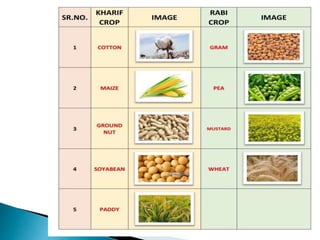
 Kharif crop
 Crops sown in rainy
season.
 Sown in june/july
harvested in
september/october
 E.g.-
rice,maize,soyabean
etc.
 Rabi crop
 Crops sown in winter
season.
 Sown in oct./nov.
harvested in
march/april.
 E.g.-
wheat,gram,pea,must
ard etc.
 Preparation of soil a)ploughing b)levelling
 Selection and sowing of seeds
 Replenishment of nutrients in soil (manuring)
 Irrigation
 Crop protection
 Harvesting
 Storage
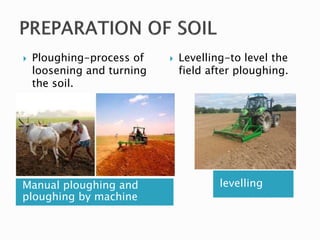
Manual ploughing and
ploughing by machine
levelling
 Ploughing-process of
loosening and turning
the soil.
 Levelling-to level the
field after ploughing.
 Ploughing
 More air spaces for roots
to breathe
 Holds more water
 Roots penetrate deeper
 Easily mixes manure and
fertilizer
 Removes weeds
 Promotes microbial
growth
 Nutrient rich soil comes
up.
 Levelling
 Soil crumbs are
crushed
 Prevents soil erosion
 Helps in uniform
distribuition of water
and manure.
 Selection means to
select healthy seeds
 Precautions while
selecting:-
 1)clean,healthy,and
disease free seeds.
 2)seeds should be
treated with
fungicides.
 Sowing means
placing seeds in the
soil
 Seeds have to be
sown-:
 1) at the right
depth
 2) at right intervals
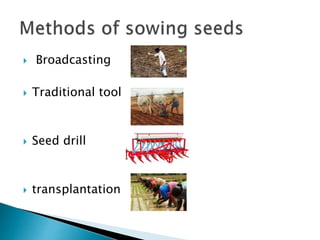
 Broadcasting
 Traditional tool
 Seed drill
 transplantation
 Natural methods to restore soil fertility
 Fallowing
 Crop rotation
 Mixed cropping
 Manure
 Natural organic
 Man-Made in fields
 Provides humus
 Less nutrients
 Cheap
 E.g.- urea,potash etc.
Fertiliser
 Inorganic salt
 Prepared in factories
 Does not add humus
 Rich in nutrients
 Costly
 E.g.- cowdung,sesbania
etc.
 Time and frequency of irrigation depends
upon –:
 Nature of crop plants (crop-based irrigation)
 Nature of soil (soil-based irrigation)
 Season when the crop grows (season-based
irrigation)
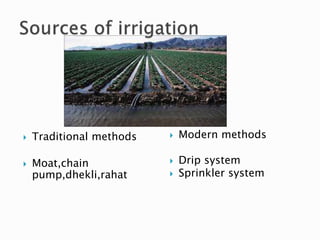
 Traditional methods
 Moat,chain
pump,dhekli,rahat
 Modern methods
 Drip system
 Sprinkler system
 Drip system  Sprinkler system
 Protecion from weeds
 Weeds- the unwanted
plants that grow along
with a cultivated crop
in a field.
 E.g.
 1) amaranthus (chaulai)
 2) chenopodium
(bathua)
 Protection from pests
 Pests- are organisms
that attack and
damage crops.
 E.g. 1) rodents (rats)
 2) insects (locusts,
weevils & termites
 The process of cutting and gathering of crop
after its maturation is called HARVESTING.
 Methods-
 1) manually by sickle
 2) by machine (harvester)
 Separation of grain
from chaff.
 Methods-
 1) Manually
 2) by machine
Thresher and
combine (large
farms)
 Separation of grain from the husk with the
help of wind.
 Methods –
 1) manually
 2) winnowing machine
 SMALL SCALE
 Jute bags or
metallic bins
 LARGE OR
COMMERCIAL SCALE
 Gunny bags in
granaries or silos
technique used for
developing new
varieties of crops
by cross breeding
two different
varieties.
 Science that deals
with breeding
feeding and caring
of domestic
animals.
crop production ppt.pptx

crop production ppt.pptx

  • 1.
  • 2.
     CROP- plantsof the same kind grown at one place on a large scale is called a crop.
  • 3.
     Kharif crop Crops sown in rainy season.  Sown in june/july harvested in september/october  E.g.- rice,maize,soyabean etc.  Rabi crop  Crops sown in winter season.  Sown in oct./nov. harvested in march/april.  E.g.- wheat,gram,pea,must ard etc.
  • 5.
     Preparation ofsoil a)ploughing b)levelling  Selection and sowing of seeds  Replenishment of nutrients in soil (manuring)  Irrigation  Crop protection  Harvesting  Storage
  • 6.
    Manual ploughing and ploughingby machine levelling  Ploughing-process of loosening and turning the soil.  Levelling-to level the field after ploughing.
  • 7.
     Ploughing  Moreair spaces for roots to breathe  Holds more water  Roots penetrate deeper  Easily mixes manure and fertilizer  Removes weeds  Promotes microbial growth  Nutrient rich soil comes up.  Levelling  Soil crumbs are crushed  Prevents soil erosion  Helps in uniform distribuition of water and manure.
  • 8.
     Selection meansto select healthy seeds  Precautions while selecting:-  1)clean,healthy,and disease free seeds.  2)seeds should be treated with fungicides.  Sowing means placing seeds in the soil  Seeds have to be sown-:  1) at the right depth  2) at right intervals
  • 9.
     Broadcasting  Traditionaltool  Seed drill  transplantation
  • 10.
     Natural methodsto restore soil fertility  Fallowing  Crop rotation  Mixed cropping
  • 11.
     Manure  Naturalorganic  Man-Made in fields  Provides humus  Less nutrients  Cheap  E.g.- urea,potash etc. Fertiliser  Inorganic salt  Prepared in factories  Does not add humus  Rich in nutrients  Costly  E.g.- cowdung,sesbania etc.
  • 12.
     Time andfrequency of irrigation depends upon –:  Nature of crop plants (crop-based irrigation)  Nature of soil (soil-based irrigation)  Season when the crop grows (season-based irrigation)
  • 13.
     Traditional methods Moat,chain pump,dhekli,rahat  Modern methods  Drip system  Sprinkler system
  • 15.
     Drip system Sprinkler system
  • 16.
     Protecion fromweeds  Weeds- the unwanted plants that grow along with a cultivated crop in a field.  E.g.  1) amaranthus (chaulai)  2) chenopodium (bathua)
  • 17.
     Protection frompests  Pests- are organisms that attack and damage crops.  E.g. 1) rodents (rats)  2) insects (locusts, weevils & termites
  • 18.
     The processof cutting and gathering of crop after its maturation is called HARVESTING.  Methods-  1) manually by sickle  2) by machine (harvester)
  • 19.
     Separation ofgrain from chaff.  Methods-  1) Manually  2) by machine Thresher and combine (large farms)
  • 20.
     Separation ofgrain from the husk with the help of wind.  Methods –  1) manually  2) winnowing machine
  • 21.
     SMALL SCALE Jute bags or metallic bins  LARGE OR COMMERCIAL SCALE  Gunny bags in granaries or silos
  • 22.
    technique used for developingnew varieties of crops by cross breeding two different varieties.
  • 23.
     Science thatdeals with breeding feeding and caring of domestic animals.