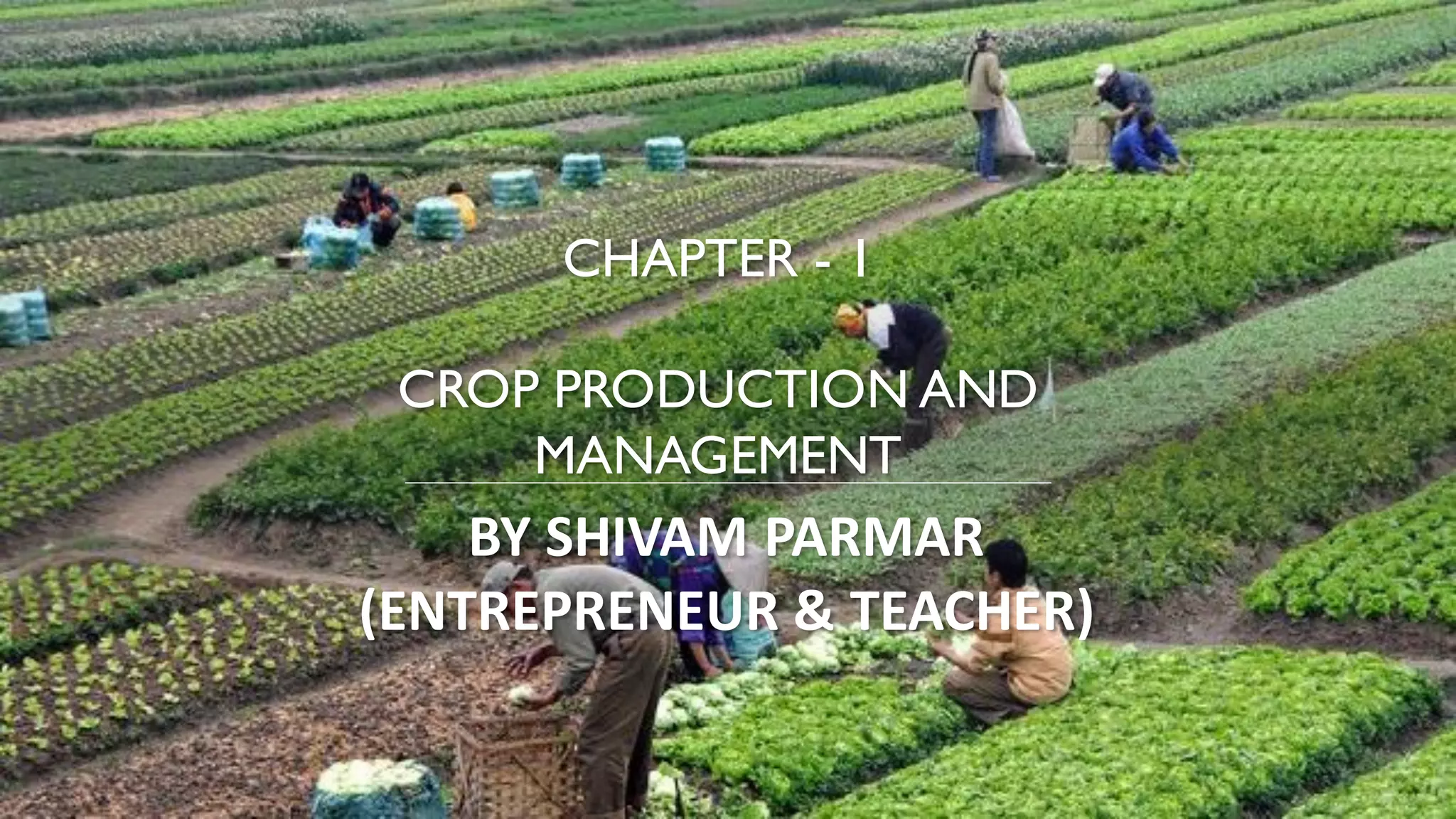

CHAPTER - 1
CROP PRODUCTION AND
MANAGEMENT
BY SHIVAM PARMAR
(ENTREPRENEUR & TEACHER)
INTRODUCTION
 All the living organisms require food for their life processes
like digestion, respiration,excretion etc. Plants can make
their own food by the process of photosynthesis and
animals including humans cannot make their food so they
are dependent on plants and other animals.
 In order to provide food for a large population - regular
production,proper management and distribution of food is
necessary.
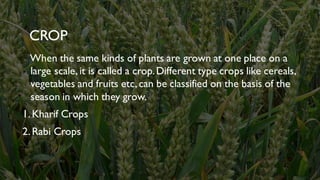
CROP
When the same kinds of plants are grown at one place on a
large scale, it is called a crop.Different type crops like cereals,
vegetables and fruits etc, can be classified on the basis of the
season in which they grow.
1. Kharif Crops
2. Rabi Crops
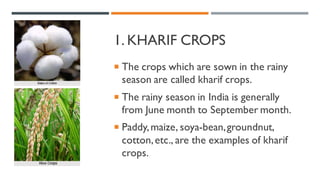
1. KHARIF CROPS
 The crops which are sown in the rainy
season are called kharif crops.
 The rainy season in India is generally
from June month to September month.
 Paddy,maize, soya-bean,groundnut,
cotton,etc., are the examples of kharif
crops.
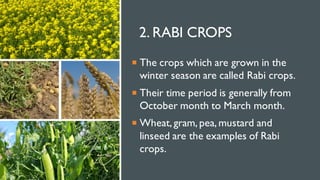
2. RABI CROPS
 The crops which are grown in the
winter season are called Rabi crops.
 Their time period is generally from
October month to March month.
 Wheat, gram, pea, mustard and
linseed are the examples of Rabi
crops.
BASIC PRACTICES OF CROP
PRODUCTION
 Preparation of Soil
 Sowing
 Adding manure and fertilizers
 Irrigation
 Protecting from weeds
 Harvesting
 Storage
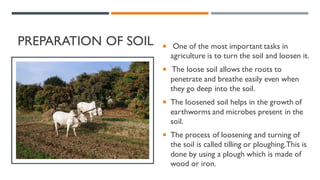
PREPARATION OF SOIL  One of the most important tasks in
agriculture is to turn the soil and loosen it.
 The loose soil allows the roots to
penetrate and breathe easily even when
they go deep into the soil.
 The loosened soil helps in the growth of
earthworms and microbes present in the
soil.
 The process of loosening and turning of
the soil is called tilling or ploughing.This is
done by using a plough which is made of
wood or iron.
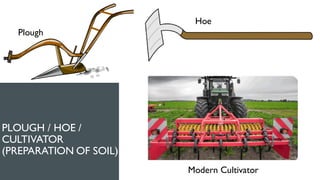
PLOUGH / HOE /
CULTIVATOR
(PREPARATION OF SOIL)
Plough
Hoe
Modern Cultivator
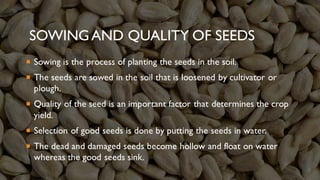
SOWINGAND QUALITY OF SEEDS
 Sowing is the process of planting the seeds in the soil.
 The seeds are sowed in the soil that is loosened by cultivator or
plough.
 Quality of the seed is an important factor that determines the crop
yield.
 Selection of good seeds is done by putting the seeds in water.
 The dead and damaged seeds become hollow and float on water
whereas the good seeds sink.
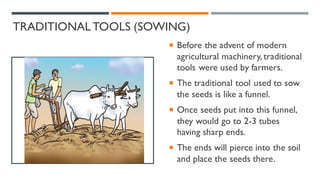
TRADITIONAL TOOLS (SOWING)
 Before the advent of modern
agricultural machinery, traditional
tools were used by farmers.
 The traditional tool used to sow
the seeds is like a funnel.
 Once seeds put into this funnel,
they would go to 2-3 tubes
having sharp ends.
 The ends will pierce into the soil
and place the seeds there.
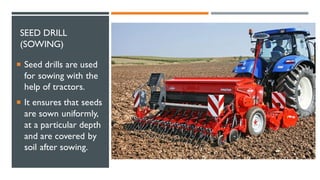
SEED DRILL
(SOWING)
 Seed drills are used
for sowing with the
help of tractors.
 It ensures that seeds
are sown uniformly,
at a particular depth
and are covered by
soil after sowing.
MANURE /
FERTILIZERS
 Manures and fertilizers are the substances that are
added to the soil to increase their fertility.
 While manures are made by decomposition of organic
substances, fertilizer is made of inorganic chemicals.
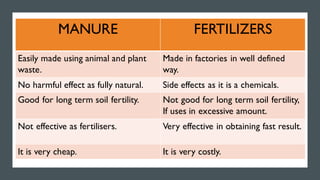
MANURE FERTILIZERS
Easily made using animal and plant
waste.
Made in factories in well defined
way.
No harmful effect as fully natural. Side effects as it is a chemicals.
Good for long term soil fertility. Not good for long term soil fertility,
If uses in excessive amount.
Not effective as fertilisers. Very effective in obtaining fast result.
It is very cheap. It is very costly.
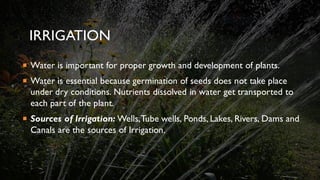
IRRIGATION
 Water is important for proper growth and development of plants.
 Water is essential because germination of seeds does not take place
under dry conditions. Nutrients dissolved in water get transported to
each part of the plant.
 Sources of Irrigation: Wells,Tube wells, Ponds, Lakes, Rivers, Dams and
Canals are the sources of Irrigation.
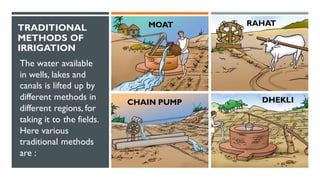
TRADITIONAL
METHODS OF
IRRIGATION
The water available
in wells, lakes and
canals is lifted up by
different methods in
different regions, for
taking it to the fields.
Here various
traditional methods
are :
MOAT
CHAIN PUMP DHEKLI
RAHAT
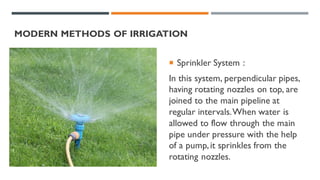
MODERN METHODS OF IRRIGATION
 Sprinkler System :
In this system, perpendicular pipes,
having rotating nozzles on top, are
joined to the main pipeline at
regular intervals.When water is
allowed to flow through the main
pipe under pressure with the help
of a pump,it sprinkles from the
rotating nozzles.
MODERN
METHODS OF
IRRIGATION
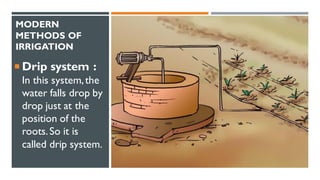
 Drip system :
In this system,the
water falls drop by
drop just at the
position of the
roots.So it is
called drip system.
WEEDS
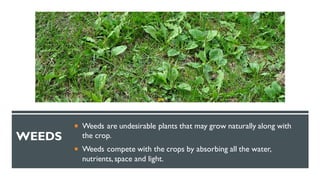
 Weeds are undesirable plants that may grow naturally along with
the crop.
 Weeds compete with the crops by absorbing all the water,
nutrients, space and light.
PROTECTING FROM WEEDS -
TILLING / MANUAL REMOVAL / WEEDICIDES
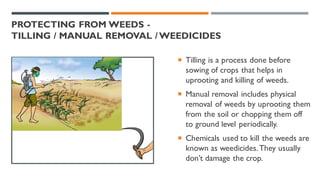
 Tilling is a process done before
sowing of crops that helps in
uprooting and killing of weeds.
 Manual removal includes physical
removal of weeds by uprooting them
from the soil or chopping them off
to ground level periodically.
 Chemicals used to kill the weeds are
known as weedicides.They usually
don’t damage the crop.
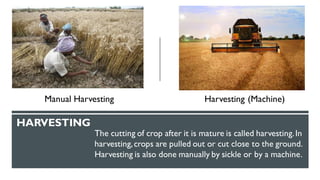
HARVESTING
The cutting of crop after it is mature is called harvesting.In
harvesting,crops are pulled out or cut close to the ground.
Harvesting is also done manually by sickle or by a machine.
Manual Harvesting Harvesting (Machine)
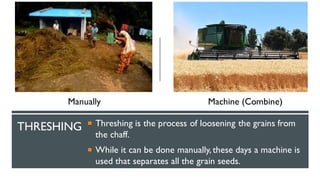
THRESHING  Threshing is the process of loosening the grains from
the chaff.
 While it can be done manually, these days a machine is
used that separates all the grain seeds.
Manually Machine (Combine)
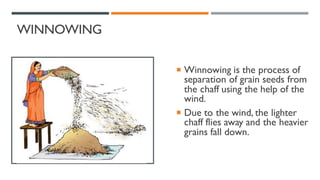
WINNOWING
 Winnowing is the process of
separation of grain seeds from
the chaff using the help of the
wind.
 Due to the wind, the lighter
chaff flies away and the heavier
grains fall down.
STORAGE
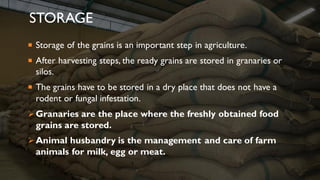
 Storage of the grains is an important step in agriculture.
 After harvesting steps, the ready grains are stored in granaries or
silos.
 The grains have to be stored in a dry place that does not have a
rodent or fungal infestation.
➢Granaries are the place where the freshly obtained food
grains are stored.
➢Animal husbandry is the management and care of farm
animals for milk, egg or meat.
THANKYOU

Chapter - 1, Crop Production and Management, Science, Class 8

  • 1.
    CHAPTER - 1 CROPPRODUCTION AND MANAGEMENT BY SHIVAM PARMAR (ENTREPRENEUR & TEACHER)
  • 2.
    INTRODUCTION  All theliving organisms require food for their life processes like digestion, respiration,excretion etc. Plants can make their own food by the process of photosynthesis and animals including humans cannot make their food so they are dependent on plants and other animals.  In order to provide food for a large population - regular production,proper management and distribution of food is necessary.
  • 3.
    CROP When the samekinds of plants are grown at one place on a large scale, it is called a crop.Different type crops like cereals, vegetables and fruits etc, can be classified on the basis of the season in which they grow. 1. Kharif Crops 2. Rabi Crops
  • 4.
    1. KHARIF CROPS The crops which are sown in the rainy season are called kharif crops.  The rainy season in India is generally from June month to September month.  Paddy,maize, soya-bean,groundnut, cotton,etc., are the examples of kharif crops.
  • 5.
    2. RABI CROPS The crops which are grown in the winter season are called Rabi crops.  Their time period is generally from October month to March month.  Wheat, gram, pea, mustard and linseed are the examples of Rabi crops.
  • 6.
    BASIC PRACTICES OFCROP PRODUCTION  Preparation of Soil  Sowing  Adding manure and fertilizers  Irrigation  Protecting from weeds  Harvesting  Storage
  • 7.
    PREPARATION OF SOIL One of the most important tasks in agriculture is to turn the soil and loosen it.  The loose soil allows the roots to penetrate and breathe easily even when they go deep into the soil.  The loosened soil helps in the growth of earthworms and microbes present in the soil.  The process of loosening and turning of the soil is called tilling or ploughing.This is done by using a plough which is made of wood or iron.
  • 8.
    PLOUGH / HOE/ CULTIVATOR (PREPARATION OF SOIL) Plough Hoe Modern Cultivator
  • 9.
    SOWINGAND QUALITY OFSEEDS  Sowing is the process of planting the seeds in the soil.  The seeds are sowed in the soil that is loosened by cultivator or plough.  Quality of the seed is an important factor that determines the crop yield.  Selection of good seeds is done by putting the seeds in water.  The dead and damaged seeds become hollow and float on water whereas the good seeds sink.
  • 10.
    TRADITIONAL TOOLS (SOWING) Before the advent of modern agricultural machinery, traditional tools were used by farmers.  The traditional tool used to sow the seeds is like a funnel.  Once seeds put into this funnel, they would go to 2-3 tubes having sharp ends.  The ends will pierce into the soil and place the seeds there.
  • 11.
    SEED DRILL (SOWING)  Seeddrills are used for sowing with the help of tractors.  It ensures that seeds are sown uniformly, at a particular depth and are covered by soil after sowing.
  • 12.
    MANURE / FERTILIZERS  Manuresand fertilizers are the substances that are added to the soil to increase their fertility.  While manures are made by decomposition of organic substances, fertilizer is made of inorganic chemicals.
  • 13.
    MANURE FERTILIZERS Easily madeusing animal and plant waste. Made in factories in well defined way. No harmful effect as fully natural. Side effects as it is a chemicals. Good for long term soil fertility. Not good for long term soil fertility, If uses in excessive amount. Not effective as fertilisers. Very effective in obtaining fast result. It is very cheap. It is very costly.
  • 14.
    IRRIGATION  Water isimportant for proper growth and development of plants.  Water is essential because germination of seeds does not take place under dry conditions. Nutrients dissolved in water get transported to each part of the plant.  Sources of Irrigation: Wells,Tube wells, Ponds, Lakes, Rivers, Dams and Canals are the sources of Irrigation.
  • 15.
    TRADITIONAL METHODS OF IRRIGATION The wateravailable in wells, lakes and canals is lifted up by different methods in different regions, for taking it to the fields. Here various traditional methods are : MOAT CHAIN PUMP DHEKLI RAHAT
  • 16.
    MODERN METHODS OFIRRIGATION  Sprinkler System : In this system, perpendicular pipes, having rotating nozzles on top, are joined to the main pipeline at regular intervals.When water is allowed to flow through the main pipe under pressure with the help of a pump,it sprinkles from the rotating nozzles.
  • 17.
    MODERN METHODS OF IRRIGATION  Dripsystem : In this system,the water falls drop by drop just at the position of the roots.So it is called drip system.
  • 18.
    WEEDS  Weeds areundesirable plants that may grow naturally along with the crop.  Weeds compete with the crops by absorbing all the water, nutrients, space and light.
  • 19.
    PROTECTING FROM WEEDS- TILLING / MANUAL REMOVAL / WEEDICIDES  Tilling is a process done before sowing of crops that helps in uprooting and killing of weeds.  Manual removal includes physical removal of weeds by uprooting them from the soil or chopping them off to ground level periodically.  Chemicals used to kill the weeds are known as weedicides.They usually don’t damage the crop.
  • 20.
    HARVESTING The cutting ofcrop after it is mature is called harvesting.In harvesting,crops are pulled out or cut close to the ground. Harvesting is also done manually by sickle or by a machine. Manual Harvesting Harvesting (Machine)
  • 21.
    THRESHING  Threshingis the process of loosening the grains from the chaff.  While it can be done manually, these days a machine is used that separates all the grain seeds. Manually Machine (Combine)
  • 22.
    WINNOWING  Winnowing isthe process of separation of grain seeds from the chaff using the help of the wind.  Due to the wind, the lighter chaff flies away and the heavier grains fall down.
  • 23.
    STORAGE  Storage ofthe grains is an important step in agriculture.  After harvesting steps, the ready grains are stored in granaries or silos.  The grains have to be stored in a dry place that does not have a rodent or fungal infestation. ➢Granaries are the place where the freshly obtained food grains are stored. ➢Animal husbandry is the management and care of farm animals for milk, egg or meat.
  • 24.