prepared by
RENU.S
Associate Professor
SP Fort College of Nursing ,
Thiruvananthapuram,
Kerala.
Evalution of care can be measured by quality in care ,
Nursing Audit and Nursing standards.
Definition
 Evaluation is decision making process that leads to
the suggestion for action to improve participants
effectiveness and program efficiency.
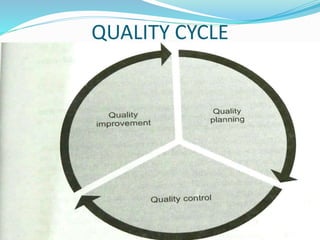
Quality
 Quality : is the degree to which care services
influences the probability of optimal patient
outcomes.
 Quality planning : involves determining who the
customers are and what their needs are, then
developing products based on those needs and
designing processes to produce those products.
 Quality control- is the evaluation of performance to
identify discrepancies between actual performances
and goals.
 Quality improvement ; establishes an infrastructure
and the project teams to carry out process
improvement.
Concept
 Concept of quality in health care were grounded in
the works of industrial experts
 Importance of quality first began to be in 1940’s and
1950
Historical perspective
 Quality assessment and quality control began to mid
– nineteenth century
 In 1842 ,Dr .Edwin Chadwin public activitist and
pioneer , reported unacceptable sanitatry condition -
urban and rural communities in Britain and also
recommended structural elements of public health -
Sanitary police to monitor the sanitary condition.
 In 1854, Florence nightingale during European
crimean war first notice positive correlation between
the introduction of adequate nursing care to
wounded solidiers and decrease in mortality rate
among group. She studied the relation between the
quality of care and positive outcome.
 In 1910, Abraham flexor pointed out education of
physician was directly related to quality of care the
patient received and needed education ,needed
substantial reforms, certification and licensure
became very important in qualifying a healthcare ,
proffessional and an educational organisation.
 In 1918, the American college of surgeon to create the
Hospital standard for Accreditation which later
adopted by Joint Commission of Accredation of
Hospitals (JCAH)
 In 1952, JCAH changed to joint commission of
Accreditation of Health care organisation published
its first list of accreditation standards with which
hospital has to carried out to receive accreditation
certificate.
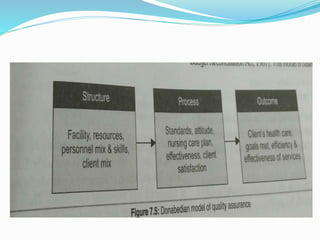
 In 1966, Dr Avedes Donobedian, a university physician
professor and physician introduced three measures to
asssess the quality of care –1 structure - input to
health care system include both human and physical
resources associated with delivery of care to the
patients .
2. process – include all the procedures and activities
required to deliver care providers and support system.
 Outcome – output include results.
Thereafter, in US, introduced
professor standards Review Organisation(PSRO’S)
in 1972
Health Maintenance organisation in 1974
Peer Review organisation in 1984
In 1986, India a consumers protection Act was
implemented in 1986.
Defintion
 Quality Assurance: is defined as all the arrangements
and activities that are meant to safeguard, maintain,
and promote the quality of care
Objectives
 To provide technical assistance in designing and
implementing effective strategies for monitoring
quality and correcting systemic deficiencies and
 To refine existing methods for ensuring optimal
quality health care throught appiled research
programme.
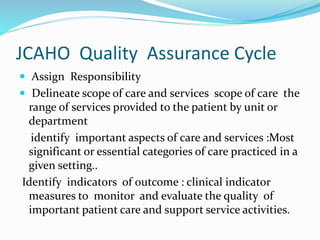
JCAHO Quality Assurance Cycle
 Assign Responsibility
 Delineate scope of care and services scope of care the
range of services provided to the patient by unit or
department
identify important aspects of care and services :Most
significant or essential categories of care practiced in a
given setting..
Identify indicators of outcome : clinical indicator
measures to monitor and evaluate the quality of
important patient care and support service activities.
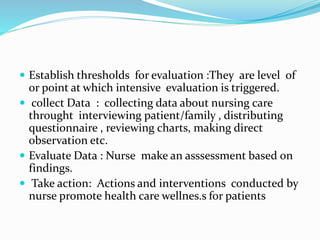
 Establish thresholds for evaluation :They are level of
or point at which intensive evaluation is triggered.
 collect Data : collecting data about nursing care
throught interviewing patient/family , distributing
questionnaire , reviewing charts, making direct
observation etc.
 Evaluate Data : Nurse make an asssessment based on
findings.
 Take action: Actions and interventions conducted by
nurse promote health care wellnes.s for patients
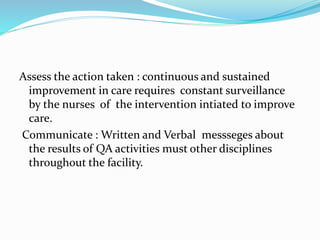
Assess the action taken : continuous and sustained
improvement in care requires constant surveillance
by the nurses of the intervention intiated to improve
care.
Communicate : Written and Verbal messseges about
the results of QA activities must other disciplines
throughout the facility.
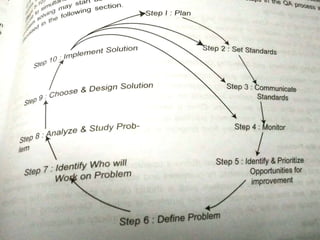
Quality Assurance Cycle
1.planning for quality assurance
prepares an organisation to carry out actions
2 setting standards and specfications
organisation must set its programmatic goals and
objective into operational procedures
3.Communicating guidelines and standards
perfomance standards communicate with staff
members and promote their use.
4. Monitoring quality
it is routine collection and review of data helps
to assess whether programs norms are being followed
or whether outcome improved
5Identifying problems and selecting opportunities
program managers monitors and evaluate
quality improvement activities.
6 Defining the problem
Having selected problem ,team must define it
difference between actual performance and
performance as prescribed by guidelines and
standards.
9 Developing solutions and actions for quality
improvement
problem solving team develop and potential
solutions
10 Implementing and evaluating quality improvement
efforts
For implementing requires
carefulplanning,necessary resources, time
frame,decicde who will be responsible and whether
pilot study wants to do or not.
 Choosing team
small team to address specific problem
Analyzing and studying the problem to identify the root
cause
Achieving meaningful and sustainable quality
improvement efforts put on basis of problem and its
root cause.
Fish bone Diagram
MODELS
 American Nurses Association Model
First proposed and accepted model in Quality
assurance by Long & Black in 1975.
Cyclic Model
Helps in self determination of patient and family,
nursing health orientation, patient’s right to quality of
care and nursing contribution
American Nurses Association
 Identify Value : looks such as issue as patient / client,
philosophy, needs and right from an economic , social ,
psychology and spiritual perspective and value
philosophy health care organisation and provider of
nursing services.
 identify structure , process, and outcome standards
and criteria : Identification of structure begins with
writing , philosophy and objectives of organisation.
process standards is quality of care given by agency
care provider.
Evaluation of outcome is end of nursing care
Secure measurement needed to determine degree of
attainment of criteria and standards : criteria and
standards of measurement can be evaluated by data
collection, nursing Audit, utilisation of reviews, self
studies and review of physical facilities.
Make Interpretation: basis interpolation about
strengths and weakness
Identify course of action : if compliance level is high or
above normalpostive feedback or below normal , it is
essential to improve.
 Choose Action : alternative course of action are
available to remedy a deficiency
 Take Action : it is essential to answer questions of
who will do? What? By when?
 Revaluation: final steps of QA process involves on
evaluation of the result of the action.
DONABEDIAN MODEL
 DONABEDIAN quality frame work is recognized as a
method of measuring quality as structure , process,
and outcome
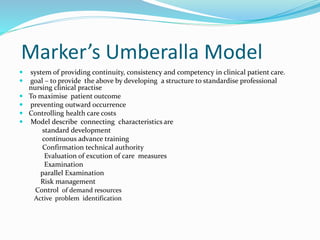
Marker’s Umberalla Model
 system of providing continuity, consistency and competency in clinical patient care.
 goal – to provide the above by developing a structure to standardise professional
nursing clinical practise
 To maximise patient outcome
 preventing outward occurrence
 Controlling health care costs
 Model describe connecting characteristics are
standard development
continuous advance training
Confirmation technical authority
Evaluation of excution of care measures
Examination
parallel Examination
Risk management
Control of demand resources
Active problem identification
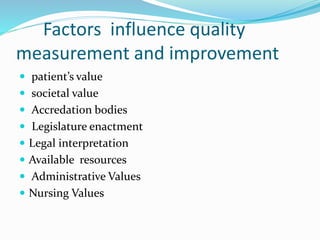
Factors influence quality
measurement and improvement
 patient’s value
 societal value
 Accredation bodies
 Legislature enactment
 Legal interpretation
 Available resources
 Administrative Values
 Nursing Values
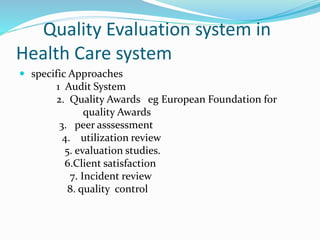
Quality Evaluation system in
Health Care system
 specific Approaches
1 Audit System
2. Quality Awards eg European Foundation for
quality Awards
3. peer asssessment
4. utilization review
5. evaluation studies.
6.Client satisfaction
7. Incident review
8. quality control
 Regulatory Approaches
Licensure
Accreditation
certification
credentialing
Total quality Management
 Refers to the continuous improvement in the quality
of work of all employees with the focus on satisfaction
of the customers
 Elements
Meeting customers requirements
continuous improvement
Empowering of employees
QUALITY CYCLE

Evaluation of care in Nursing

  • 1.
    prepared by RENU.S Associate Professor SPFort College of Nursing , Thiruvananthapuram, Kerala.
  • 2.
    Evalution of carecan be measured by quality in care , Nursing Audit and Nursing standards.
  • 3.
    Definition  Evaluation isdecision making process that leads to the suggestion for action to improve participants effectiveness and program efficiency.
  • 4.
    Quality  Quality :is the degree to which care services influences the probability of optimal patient outcomes.  Quality planning : involves determining who the customers are and what their needs are, then developing products based on those needs and designing processes to produce those products.
  • 5.
     Quality control-is the evaluation of performance to identify discrepancies between actual performances and goals.  Quality improvement ; establishes an infrastructure and the project teams to carry out process improvement.
  • 6.
    Concept  Concept ofquality in health care were grounded in the works of industrial experts  Importance of quality first began to be in 1940’s and 1950
  • 7.
    Historical perspective  Qualityassessment and quality control began to mid – nineteenth century  In 1842 ,Dr .Edwin Chadwin public activitist and pioneer , reported unacceptable sanitatry condition - urban and rural communities in Britain and also recommended structural elements of public health - Sanitary police to monitor the sanitary condition.
  • 8.
     In 1854,Florence nightingale during European crimean war first notice positive correlation between the introduction of adequate nursing care to wounded solidiers and decrease in mortality rate among group. She studied the relation between the quality of care and positive outcome.
  • 9.
     In 1910,Abraham flexor pointed out education of physician was directly related to quality of care the patient received and needed education ,needed substantial reforms, certification and licensure became very important in qualifying a healthcare , proffessional and an educational organisation.
  • 10.
     In 1918,the American college of surgeon to create the Hospital standard for Accreditation which later adopted by Joint Commission of Accredation of Hospitals (JCAH)  In 1952, JCAH changed to joint commission of Accreditation of Health care organisation published its first list of accreditation standards with which hospital has to carried out to receive accreditation certificate.
  • 11.
     In 1966,Dr Avedes Donobedian, a university physician professor and physician introduced three measures to asssess the quality of care –1 structure - input to health care system include both human and physical resources associated with delivery of care to the patients . 2. process – include all the procedures and activities required to deliver care providers and support system.
  • 12.
     Outcome –output include results. Thereafter, in US, introduced professor standards Review Organisation(PSRO’S) in 1972 Health Maintenance organisation in 1974 Peer Review organisation in 1984 In 1986, India a consumers protection Act was implemented in 1986.
  • 13.
    Defintion  Quality Assurance:is defined as all the arrangements and activities that are meant to safeguard, maintain, and promote the quality of care
  • 14.
    Objectives  To providetechnical assistance in designing and implementing effective strategies for monitoring quality and correcting systemic deficiencies and  To refine existing methods for ensuring optimal quality health care throught appiled research programme.
  • 15.
    JCAHO Quality AssuranceCycle  Assign Responsibility  Delineate scope of care and services scope of care the range of services provided to the patient by unit or department identify important aspects of care and services :Most significant or essential categories of care practiced in a given setting.. Identify indicators of outcome : clinical indicator measures to monitor and evaluate the quality of important patient care and support service activities.
  • 16.
     Establish thresholdsfor evaluation :They are level of or point at which intensive evaluation is triggered.  collect Data : collecting data about nursing care throught interviewing patient/family , distributing questionnaire , reviewing charts, making direct observation etc.  Evaluate Data : Nurse make an asssessment based on findings.  Take action: Actions and interventions conducted by nurse promote health care wellnes.s for patients
  • 17.
    Assess the actiontaken : continuous and sustained improvement in care requires constant surveillance by the nurses of the intervention intiated to improve care. Communicate : Written and Verbal messseges about the results of QA activities must other disciplines throughout the facility.
  • 18.
  • 19.
    1.planning for qualityassurance prepares an organisation to carry out actions 2 setting standards and specfications organisation must set its programmatic goals and objective into operational procedures
  • 20.
    3.Communicating guidelines andstandards perfomance standards communicate with staff members and promote their use. 4. Monitoring quality it is routine collection and review of data helps to assess whether programs norms are being followed or whether outcome improved
  • 21.
    5Identifying problems andselecting opportunities program managers monitors and evaluate quality improvement activities. 6 Defining the problem Having selected problem ,team must define it difference between actual performance and performance as prescribed by guidelines and standards.
  • 22.
    9 Developing solutionsand actions for quality improvement problem solving team develop and potential solutions 10 Implementing and evaluating quality improvement efforts For implementing requires carefulplanning,necessary resources, time frame,decicde who will be responsible and whether pilot study wants to do or not.
  • 23.
     Choosing team smallteam to address specific problem Analyzing and studying the problem to identify the root cause Achieving meaningful and sustainable quality improvement efforts put on basis of problem and its root cause.
  • 24.
  • 25.
    MODELS  American NursesAssociation Model First proposed and accepted model in Quality assurance by Long & Black in 1975. Cyclic Model Helps in self determination of patient and family, nursing health orientation, patient’s right to quality of care and nursing contribution
  • 26.
  • 27.
     Identify Value: looks such as issue as patient / client, philosophy, needs and right from an economic , social , psychology and spiritual perspective and value philosophy health care organisation and provider of nursing services.  identify structure , process, and outcome standards and criteria : Identification of structure begins with writing , philosophy and objectives of organisation. process standards is quality of care given by agency care provider.
  • 28.
    Evaluation of outcomeis end of nursing care Secure measurement needed to determine degree of attainment of criteria and standards : criteria and standards of measurement can be evaluated by data collection, nursing Audit, utilisation of reviews, self studies and review of physical facilities. Make Interpretation: basis interpolation about strengths and weakness Identify course of action : if compliance level is high or above normalpostive feedback or below normal , it is essential to improve.
  • 29.
     Choose Action: alternative course of action are available to remedy a deficiency  Take Action : it is essential to answer questions of who will do? What? By when?  Revaluation: final steps of QA process involves on evaluation of the result of the action.
  • 30.
    DONABEDIAN MODEL  DONABEDIANquality frame work is recognized as a method of measuring quality as structure , process, and outcome
  • 32.
    Marker’s Umberalla Model system of providing continuity, consistency and competency in clinical patient care.  goal – to provide the above by developing a structure to standardise professional nursing clinical practise  To maximise patient outcome  preventing outward occurrence  Controlling health care costs  Model describe connecting characteristics are standard development continuous advance training Confirmation technical authority Evaluation of excution of care measures Examination parallel Examination Risk management Control of demand resources Active problem identification
  • 33.
    Factors influence quality measurementand improvement  patient’s value  societal value  Accredation bodies  Legislature enactment  Legal interpretation  Available resources  Administrative Values  Nursing Values
  • 34.
    Quality Evaluation systemin Health Care system  specific Approaches 1 Audit System 2. Quality Awards eg European Foundation for quality Awards 3. peer asssessment 4. utilization review 5. evaluation studies. 6.Client satisfaction 7. Incident review 8. quality control
  • 35.
  • 36.
    Total quality Management Refers to the continuous improvement in the quality of work of all employees with the focus on satisfaction of the customers  Elements Meeting customers requirements continuous improvement Empowering of employees
  • 37.