BrainstormingThe QuestionWhat if?The ReverseDeveloping a Thinking ToolboxManTar ICT Cluster Workshop 1Exploring strategies and tools for developing creative and critical thinking
AimsTo learn more about thinking strategies and skillsTo gain some practical classroom ideasTo discuss which thinking strategies and tools could be used at each level of the schoolTo share ideas about facilitation and to prepare a staff meeting workshop
Knowledge is now a processnot a thingKnowing how to do something is more valuable than memorising information21st Century life is about learning new skills, not new content.Success depends on learning new skills and applying them. What do you (and your students) need to learn when most of recorded knowledge is a mouse click away?
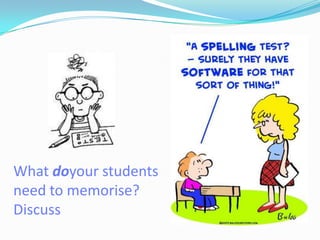
What doyour students need to memorise?Discuss
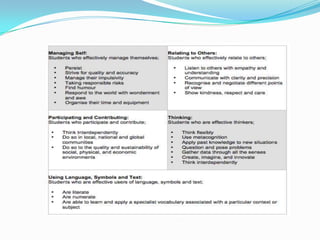
Key CompetenciesThinking
Relating to others
Using language symbols and texts
Managing self
Participating and contributingDefining these for your school.What is ‘Thinking’? Discuss
Thinking is about using creative, critical and metacognitive processes to make sense of information, experiences and ideas.These processes can be applied to purposes such as: developing understanding
 making decisions
 shaping actions
 constructing knowledge  (NZC Page 12)Intellectual curiosity is at the heart of this competency(NZC Page 12)
As educators we mustUnderstand what thinking is
 Know about strategies and tools which develop thinking skills
 Teach these strategies and tools to our students
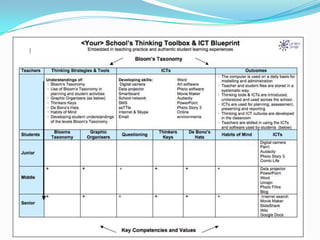
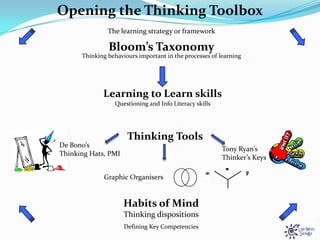
 Use them often in teaching and learningOpening the Thinking ToolboxBrainstormingThe QuestionWhat if?The ReverseDe Bono’sThinking Hats, PMITony Ryan’s Thinker’s KeysGraphic OrganisersONThe learning strategy or frameworkBloom’s TaxonomyThinking behaviours important in the processes of learningLearning to Learn skillsQuestioning and Info Literacy skills Thinking ToolsHabits of MindThinking dispositionsDefining Key Competencies
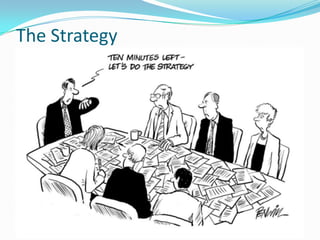
The StrategyAn elaborate and systematic plan of action designed to achieve a particular goalThe strategy provides a direction and keeps everything and everyone on track.
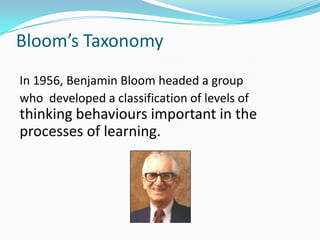
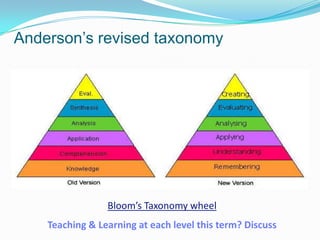
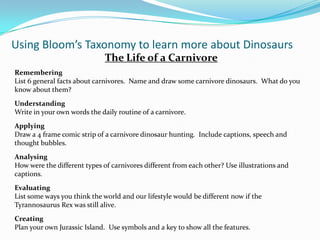
Bloom’s TaxonomyIn 1956, Benjamin Bloom headed a groupwho  developed a classification of levels of thinking behaviours important in the processes of learning.
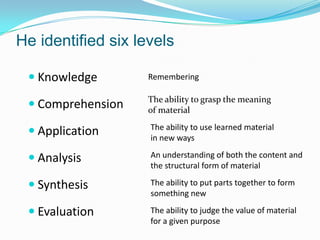
He identified six levelsKnowledgeComprehensionApplicationAnalysisSynthesisEvaluationRememberingThe ability to grasp the meaning of material The ability to use learned material in new ways An understanding of both the content and the structural form of material The ability to put parts together to form something newThe ability to judge the value of material for a given purpose
Anderson’s revised taxonomyBloom’s Taxonomy wheelTeaching & Learning at each level this term? Discuss
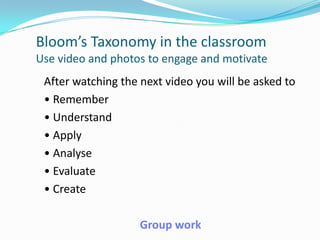
Bloom’s Taxonomy in the classroomUse video and photos to engage and motivateAfter watching the next video you will be asked to  Remember
 Understand
 Apply
 Analyse
 Evaluate
 CreateGroup work
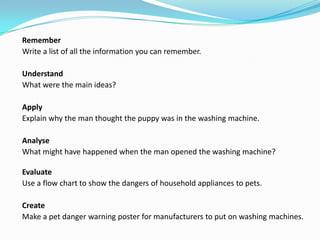
RememberWrite a list of all the information you can remember.  UnderstandWhat were the main ideas? ApplyExplain why the man thought the puppy was in the washing machine.AnalyseWhat might have happened when the man opened the washing machine?EvaluateUse a flow chart to show the dangers of household appliances to pets.CreateMake a pet danger warning poster for manufacturers to put on washing machines.
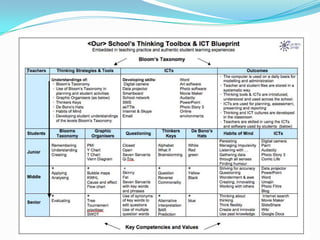
Bloom’s Wall PosterQuestion starters and activity suggestions

Thinking toolbox 1

  • 1.
    BrainstormingThe QuestionWhat if?TheReverseDeveloping a Thinking ToolboxManTar ICT Cluster Workshop 1Exploring strategies and tools for developing creative and critical thinking
  • 2.
    AimsTo learn moreabout thinking strategies and skillsTo gain some practical classroom ideasTo discuss which thinking strategies and tools could be used at each level of the schoolTo share ideas about facilitation and to prepare a staff meeting workshop
  • 5.
    Knowledge is nowa processnot a thingKnowing how to do something is more valuable than memorising information21st Century life is about learning new skills, not new content.Success depends on learning new skills and applying them. What do you (and your students) need to learn when most of recorded knowledge is a mouse click away?
  • 6.
    What doyour studentsneed to memorise?Discuss
  • 7.
  • 8.
  • 9.
  • 10.
  • 11.
    Participating and contributingDefiningthese for your school.What is ‘Thinking’? Discuss
  • 12.
    Thinking is aboutusing creative, critical and metacognitive processes to make sense of information, experiences and ideas.These processes can be applied to purposes such as: developing understanding
  • 13.
  • 14.
  • 15.
    constructing knowledge (NZC Page 12)Intellectual curiosity is at the heart of this competency(NZC Page 12)
  • 16.
    As educators wemustUnderstand what thinking is
  • 17.
    Know aboutstrategies and tools which develop thinking skills
  • 18.
    Teach thesestrategies and tools to our students
  • 19.
    Use themoften in teaching and learningOpening the Thinking ToolboxBrainstormingThe QuestionWhat if?The ReverseDe Bono’sThinking Hats, PMITony Ryan’s Thinker’s KeysGraphic OrganisersONThe learning strategy or frameworkBloom’s TaxonomyThinking behaviours important in the processes of learningLearning to Learn skillsQuestioning and Info Literacy skills Thinking ToolsHabits of MindThinking dispositionsDefining Key Competencies
  • 21.
    The StrategyAn elaborateand systematic plan of action designed to achieve a particular goalThe strategy provides a direction and keeps everything and everyone on track.
  • 22.
    Bloom’s TaxonomyIn 1956,Benjamin Bloom headed a groupwho developed a classification of levels of thinking behaviours important in the processes of learning.
  • 23.
    He identified sixlevelsKnowledgeComprehensionApplicationAnalysisSynthesisEvaluationRememberingThe ability to grasp the meaning of material The ability to use learned material in new ways An understanding of both the content and the structural form of material The ability to put parts together to form something newThe ability to judge the value of material for a given purpose
  • 24.
    Anderson’s revised taxonomyBloom’sTaxonomy wheelTeaching & Learning at each level this term? Discuss
  • 25.
    Bloom’s Taxonomy inthe classroomUse video and photos to engage and motivateAfter watching the next video you will be asked to Remember
  • 26.
  • 27.
  • 28.
  • 29.
  • 30.
  • 32.
    RememberWrite a listof all the information you can remember. UnderstandWhat were the main ideas? ApplyExplain why the man thought the puppy was in the washing machine.AnalyseWhat might have happened when the man opened the washing machine?EvaluateUse a flow chart to show the dangers of household appliances to pets.CreateMake a pet danger warning poster for manufacturers to put on washing machines.
  • 33.
    Bloom’s Wall PosterQuestionstarters and activity suggestions