Creative Thinking
for the 21st Century
Session 7.6, 1:40-2:40 pm
January 9, 2015
AFACCT ‘15 Conference
Carroll Community College, Westminster, MD
• This presentation examined how educators can embed 21st century skills into their
teaching curriculum.
• The goal was to show that by using innovative teaching and learning processes
students gain skills in collaboration and team building, enhanced communication
through presentation, and applied analysis of information.
• Teaching and learning strategies to engage students to think differently about their
own learning and to move beyond critical thinking to creative thinking was
emphasized.
edtechreview.in
–Jerome Bruner
“The first objective of any act of learning, over
and beyond the pleasure it may give, is that it
should serve us in the future.
Learning should not only take us somewhere; it
should allow us later to go further more easily.”
Critical thinking and problem solving have been
components of human progress throughout
history, from the development of early tools to
agricultural advancements
Global awareness and information literacy are
not new, at least not among the elites in different
societies
The need for mastery of different kinds of
knowledge, ranging from facts to complex
analysis, is also not new
In the Republic, Plato (380 BC) wrote about
four distinct levels of intellect, these may
have been the 3rd-century BCE Skills
www.educatethewholechild.org
“We’ve progressed from a society of farmers
(AGRICULTURAL AGE) to a society of factory
workers (INDUSTRIAL AGE) to a society of
knowledge workers (INFORMATION AGE). And
now we’re progressing yet again – to a society
of creators and empathizers, of pattern
recognizers and meaning makers
(CONCEPTUAL AGE).”
- Daniel Pink
What is new?
Changes in our
global economy and
how citizens interact
with the world…
…in the conceptual age
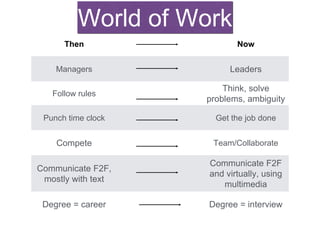
Then Now
Managers Leaders
Follow rules
Think, solve
problems, ambiguity
Punch time clock Get the job done
Compete Team/Collaborate
Communicate F2F,
mostly with text
Communicate F2F
and virtually, using
multimedia
Degree = career Degree = interview
World of Work
Creativity = Creating something original and useful
To be creative requires divergent thinking
(generating many unique ideas)
and then convergent thinking (combining those ideas into the
best result)
http://www.newsweek.com/creativity-crisis-74665
What does this mean for today’s educator?
A more deliberate approach to teaching
critical thinking, collaboration, and problem
solving to all students …
vhsip.pbworks.com
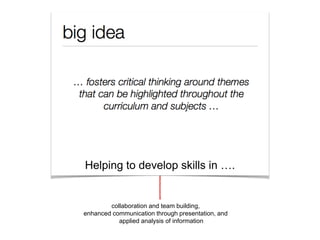
… by incorporating big ideas and active strategies
Helping to develop skills in ….
collaboration and team building,
enhanced communication through presentation, and
applied analysis of information
Can one be inhumane and civilized at the same
time? (Explain your answer)
Making Meaning
interplay of lower- and higher-order thinking
This means that the design of
curriculum and instruction needs
to set up this interplay
The last few decades have belonged to a certain kind of person
with a certain kind of mind—computer programmers who could
crack code, lawyers who could craft contracts, MBAs who could
crunch numbers. But the keys to the kingdom are changing
hands. The future belongs to a very different kind of person
with a very different kind of mind—creators and empathizers,
pattern recognizers, and meaning makers. These people—
artists, inventors, designers, storytellers, caregivers, consolers, big
picture thinkers—will now reap society’s richest rewards and share
its greatest joys. (p. 1)
The wealth of nations and the well-being of individuals now
depend on having artists in the room. In a world enriched by
abundance but disrupted by the automation and outsourcing of
white-collar work, everyone, regardless of profession, must
cultivate an artistic sensibility. . . . Today we must all be
designers. (p. 69)
A Whole New Mind: Moving From the Information Age to the Conceptual Age (Pink, 2005)
personal construction of meaning. Creative
thinking employs imagination and playful
tinkering with shapes, sounds, colors, words,
and ideas. Creative thinking is the birthplace for
unique and innovative products, cultural
expressions, and solutions to global problems
flexible; can examine situations, objects, and
issues from multiple perspectives; and can
propose novel solutions to persistent
problems
Creative Thinker
What does a Creative Mind look like?
How do you get a creative mind?
Ask big questions
Tap into the power of collaboration
Be intensely curious
Be open to always learning
See failure as one step closer to success
Seek out new experiences
Always be open to expressing yourself
collaboration and team building, enhanced communication through
presentation, and applied analysis of information
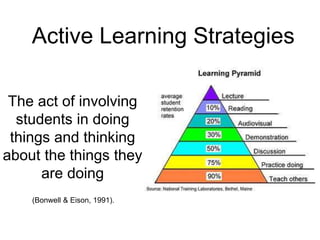
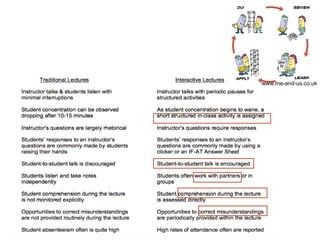
Active Learning Strategies
The act of involving
students in doing
things and thinking
about the things they
are doing
(Bonwell & Eison, 1991).
www.me-and-us.co.uk
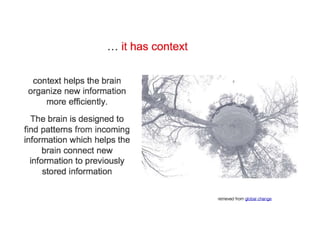
Our brain requires….
Building on prior knowledge and connecting to student interests
Projects are important but…
http://www.kumiyamashita.com/portfolio/buil
ding-blocks/
Perspectives on Learning
Active
(relationship, schema,
connections, patterns)
Our practice must incorporate all of these perspectives
Critical and Creative Thinking
means creating a Thinking Curriculum
Such as incorporating video into a lecture to
highlight a point
then
stopping the video to have students do something,
such as work in groups to solve a problem
coming together as a whole group to discuss
then
then
Creating thinking is not just
about a good idea, it is about
having the skills to make good
ideas happen
Paul Collard, Creative Partnerships
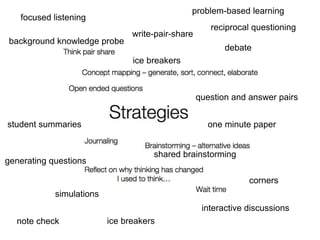
debate
simulations
interactive discussions
ice breakers
write-pair-share
student summaries
question and answer pairs
one minute paper
focused listening
problem-based learning
shared brainstorming
generating questions
note check
background knowledge probe
reciprocal questioning
corners
ice breakers
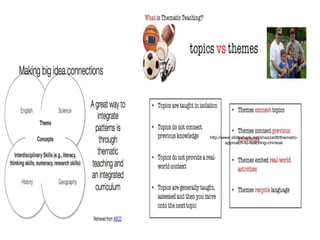
http://www.slideshare.net/shazza08/thematic-
approach-to-teaching-chinese
m.newshunt.com
breaking it down
http://youtu.be/nQlvZ24xRIo
Embed 21st century skills into your curriculum
What can you do to offer opportunities for creativity and how can you
embed these opportunities into your everyday practice?
3 things come to mind:
• how you present content
• how you model good practice
• how you encourage your students to be creative
You must provide opportunities in your classrooms
for your learners to feel empowered to "think for
themselves" and, as a result, become more
confident when tackling standard questions.
By building into your instruction room for your students to explore
and still covering everything that needs to be covered
Sharing
• Communal Bookmarking
• Photo/Video Sharing
• Social Networking
• Writers’ Workshops/Fanfiction
Thinking
• Blogs
• Podcasts
• Online Discussion Forums
Co-Creating
•Wikis/Collaborative File Creation
•Mashups/Collective Media Creation
•Collaborative Social Communities
Possibilitieswith
technology
Innovative teaching and learning
means teaching students skills in
collaboration and team building,
enhanced communication
through presentation, and applied
analysis of information using
real-world tools that are relevant
to your discipline
classrooms need to be student-centered
learning must be social
emotions are integral
learners are different
students need to be stretched, but not too much
assessments should be for learning not of learning
learning should be connected across disciplines
Understanding that….
Understanding Flow
Frustration
Boredom
Skill Level
Motivation
Curiosity
Interest
Engaged Learners
Deep
Learning
Flow also called "Optimal experience" is a concept developed by Mihaly Csikszentmihalyi, 1975.
Csikszentmihalyi (1993: 178-9) defined eight dimensions of the flow experience:
Element Details
challenge &
curiosity
• an activity should trigger curiosity and allow the learner at the same time to formulate goals, while preserving some element of surprise
regarding the outcome.
control • levels to play (in gaming), technical difficulties in project, some liberty to select goals strategies & tactics
fantasy • imagination and freedom (make believe + voluntary activity)
feedback • clear and immediate feedback should be provided if the goal or not has been reached.
self-esteem • tasks should be adapted (see above) and encouragement to learn & augment results should be provided.
Important constituent elements of the flow experience
flow experience = intrinsic motivation
flow – the state in which people are so
involved in an activity that nothing else
seems to matter; the experience itself is
so enjoyable that people will do it even
at great cost, for the sheer sake of doing
it (Csikzentmihalyi, 1991)
Withdrawn
Defiant
How can you change your teaching to
incorporate more critical and creative
thinking experiences for your students?

76coffman klinger

  • 1.
    Creative Thinking for the21st Century Session 7.6, 1:40-2:40 pm January 9, 2015 AFACCT ‘15 Conference Carroll Community College, Westminster, MD
  • 2.
    • This presentationexamined how educators can embed 21st century skills into their teaching curriculum. • The goal was to show that by using innovative teaching and learning processes students gain skills in collaboration and team building, enhanced communication through presentation, and applied analysis of information. • Teaching and learning strategies to engage students to think differently about their own learning and to move beyond critical thinking to creative thinking was emphasized. edtechreview.in
  • 3.
    –Jerome Bruner “The firstobjective of any act of learning, over and beyond the pleasure it may give, is that it should serve us in the future. Learning should not only take us somewhere; it should allow us later to go further more easily.”
  • 4.
    Critical thinking andproblem solving have been components of human progress throughout history, from the development of early tools to agricultural advancements
  • 5.
    Global awareness andinformation literacy are not new, at least not among the elites in different societies
  • 6.
    The need formastery of different kinds of knowledge, ranging from facts to complex analysis, is also not new In the Republic, Plato (380 BC) wrote about four distinct levels of intellect, these may have been the 3rd-century BCE Skills
  • 7.
    www.educatethewholechild.org “We’ve progressed froma society of farmers (AGRICULTURAL AGE) to a society of factory workers (INDUSTRIAL AGE) to a society of knowledge workers (INFORMATION AGE). And now we’re progressing yet again – to a society of creators and empathizers, of pattern recognizers and meaning makers (CONCEPTUAL AGE).” - Daniel Pink What is new? Changes in our global economy and how citizens interact with the world… …in the conceptual age
  • 8.
    Then Now Managers Leaders Followrules Think, solve problems, ambiguity Punch time clock Get the job done Compete Team/Collaborate Communicate F2F, mostly with text Communicate F2F and virtually, using multimedia Degree = career Degree = interview World of Work
  • 9.
    Creativity = Creatingsomething original and useful To be creative requires divergent thinking (generating many unique ideas) and then convergent thinking (combining those ideas into the best result) http://www.newsweek.com/creativity-crisis-74665
  • 10.
    What does thismean for today’s educator? A more deliberate approach to teaching critical thinking, collaboration, and problem solving to all students … vhsip.pbworks.com … by incorporating big ideas and active strategies
  • 11.
    Helping to developskills in …. collaboration and team building, enhanced communication through presentation, and applied analysis of information
  • 15.
    Can one beinhumane and civilized at the same time? (Explain your answer)
  • 16.
    Making Meaning interplay oflower- and higher-order thinking This means that the design of curriculum and instruction needs to set up this interplay
  • 17.
    The last fewdecades have belonged to a certain kind of person with a certain kind of mind—computer programmers who could crack code, lawyers who could craft contracts, MBAs who could crunch numbers. But the keys to the kingdom are changing hands. The future belongs to a very different kind of person with a very different kind of mind—creators and empathizers, pattern recognizers, and meaning makers. These people— artists, inventors, designers, storytellers, caregivers, consolers, big picture thinkers—will now reap society’s richest rewards and share its greatest joys. (p. 1) The wealth of nations and the well-being of individuals now depend on having artists in the room. In a world enriched by abundance but disrupted by the automation and outsourcing of white-collar work, everyone, regardless of profession, must cultivate an artistic sensibility. . . . Today we must all be designers. (p. 69) A Whole New Mind: Moving From the Information Age to the Conceptual Age (Pink, 2005)
  • 18.
    personal construction ofmeaning. Creative thinking employs imagination and playful tinkering with shapes, sounds, colors, words, and ideas. Creative thinking is the birthplace for unique and innovative products, cultural expressions, and solutions to global problems flexible; can examine situations, objects, and issues from multiple perspectives; and can propose novel solutions to persistent problems Creative Thinker What does a Creative Mind look like?
  • 19.
    How do youget a creative mind? Ask big questions Tap into the power of collaboration Be intensely curious Be open to always learning See failure as one step closer to success Seek out new experiences Always be open to expressing yourself collaboration and team building, enhanced communication through presentation, and applied analysis of information
  • 20.
    Active Learning Strategies Theact of involving students in doing things and thinking about the things they are doing (Bonwell & Eison, 1991).
  • 21.
  • 23.
  • 25.
    Building on priorknowledge and connecting to student interests
  • 29.
  • 31.
  • 32.
    Perspectives on Learning Active (relationship,schema, connections, patterns) Our practice must incorporate all of these perspectives
  • 33.
    Critical and CreativeThinking means creating a Thinking Curriculum
  • 36.
    Such as incorporatingvideo into a lecture to highlight a point then stopping the video to have students do something, such as work in groups to solve a problem coming together as a whole group to discuss then then
  • 40.
    Creating thinking isnot just about a good idea, it is about having the skills to make good ideas happen Paul Collard, Creative Partnerships
  • 42.
    debate simulations interactive discussions ice breakers write-pair-share studentsummaries question and answer pairs one minute paper focused listening problem-based learning shared brainstorming generating questions note check background knowledge probe reciprocal questioning corners ice breakers
  • 43.
  • 44.
  • 48.
  • 53.
  • 54.
    Embed 21st centuryskills into your curriculum What can you do to offer opportunities for creativity and how can you embed these opportunities into your everyday practice? 3 things come to mind: • how you present content • how you model good practice • how you encourage your students to be creative You must provide opportunities in your classrooms for your learners to feel empowered to "think for themselves" and, as a result, become more confident when tackling standard questions. By building into your instruction room for your students to explore and still covering everything that needs to be covered
  • 55.
    Sharing • Communal Bookmarking •Photo/Video Sharing • Social Networking • Writers’ Workshops/Fanfiction Thinking • Blogs • Podcasts • Online Discussion Forums Co-Creating •Wikis/Collaborative File Creation •Mashups/Collective Media Creation •Collaborative Social Communities Possibilitieswith technology
  • 56.
    Innovative teaching andlearning means teaching students skills in collaboration and team building, enhanced communication through presentation, and applied analysis of information using real-world tools that are relevant to your discipline
  • 57.
    classrooms need tobe student-centered learning must be social emotions are integral learners are different students need to be stretched, but not too much assessments should be for learning not of learning learning should be connected across disciplines Understanding that….
  • 58.
  • 59.
    Frustration Boredom Skill Level Motivation Curiosity Interest Engaged Learners Deep Learning Flowalso called "Optimal experience" is a concept developed by Mihaly Csikszentmihalyi, 1975. Csikszentmihalyi (1993: 178-9) defined eight dimensions of the flow experience: Element Details challenge & curiosity • an activity should trigger curiosity and allow the learner at the same time to formulate goals, while preserving some element of surprise regarding the outcome. control • levels to play (in gaming), technical difficulties in project, some liberty to select goals strategies & tactics fantasy • imagination and freedom (make believe + voluntary activity) feedback • clear and immediate feedback should be provided if the goal or not has been reached. self-esteem • tasks should be adapted (see above) and encouragement to learn & augment results should be provided. Important constituent elements of the flow experience flow experience = intrinsic motivation flow – the state in which people are so involved in an activity that nothing else seems to matter; the experience itself is so enjoyable that people will do it even at great cost, for the sheer sake of doing it (Csikzentmihalyi, 1991) Withdrawn Defiant
  • 60.
    How can youchange your teaching to incorporate more critical and creative thinking experiences for your students?