Critical Thinking
• 21st-century skill that enables a person to think rationally and
logically in order to reach a plausible conclusion.
• A critical thinker assesses facts and figures and data
objectively and determines what to believe and what not to
believe.
• Critical thinking skills empower a person to decipher complex
problems and make impartial and better decisions based on
effective information.
• Critical thinking skills cultivate habits of mind such as strategic
thinking, skepticism, discerning fallacy from the facts, asking
good questions and probing deep into the issues to find the
truth.
Critical Thinking
• Richard Paul (1988) - as reaching to the conclusion according to the objectives and
knowledge.
• Norris (1985) - mentions it as students’ application of previous knowledge and
changing it after valuation process (as cited in Demirel, 2012).
• Seferoglu & Akbıyık, 2006 -critical thinking is a kind of ability to look at events,
conditions or thoughts with a careful eye and making comments, decisions, studying
on the reliability and validity of the knowledge according to standards of logic and
the mind.
• Howard, Tang & Austion, 2015; Watson & Galser, 1980 -This higher order
thinking ability provides the opportunity to reason the existed knowledge or situation
to correct the mistakes and complete deficits in order to reach appropriate situations.
• Thurman, 2009 - critical thinking skills involve identification and analysis of informational
sources for credibility, indicating previous knowledge and making connections and deducing to
conclusions. Shortly, the general characteristics of critical thinking can be listed as the
following:
➢ Reasoning and suspecting
➢ Looking at situations from multiple perspectives and dimensions
➢ To be open to changes and innovations
➢ To look at thoughts without prejudices
➢ Being open minded
➢ Thinking analytically
➢ Paying attention to details
• Advantages of critical thinking;
➢ People who are critical thinkers think freely and independently
➢ People don’t behave without thinking
➢ Individuals can state the problem explicitly (Demirel, 2012).
Importance of Acquiring Critical Thinking
Skills
• Acquiring critical thinking skills was never as valuable as it is today
because of the prevalence of the modern knowledge economy.
• Today, information and technology are the driving forces behind the
global economy.
• To keep pace with ever-changing technology and new inventions, one has
to be flexible enough to embrace changes swiftly.
• Today critical thinking skills are one of the most sought-after
skills by the companies.
• In fact, critical thinking skills are paramount not only for active
learning and academic achievement but also for the
professional career of the students.
• The lack of critical thinking skills catalyzes memorization of the
topics without a deeper insight, egocentrism, closed-
mindedness, reduced student interest in the classroom and
not being able to make timely and better decisions.
Benefits of Critical Thinking Skills in Education
• It allows a student to decipher problems and think through the situations in a
disciplined and systematic manner
• Through a critical thinking ability, a student can comprehend the logical
correlation between distinct ideas
• The student is able to rethink and re-justify his beliefs and ideas based on facts
and figures
• Critical thinking skills make the students curious about things around them
Benefits of Critical Thinking Skills in
Education
• A student who is a critical thinker is creative and always strives to
come up with out of the box solutions to intricate problems
• Critical thinking skills assist in the enhanced student learning
experience in the classroom and prepares the students for lifelong
learning and success
• The critical thinking process is the foundation of new discoveries and
inventions in the world of science and technology
Benefits of Critical Thinking Skills in
Education
• The ability to think critically allows the students to think intellectually
and enhances their presentation skills, hence they can convey their
ideas and thoughts in a logical and convincing manner
• Critical thinking skills make students a terrific communicator because
they have logical reasons behind their ideas
Creative Thinking
• Creative thinking can be defined as the entire set of cognitive activities
used by individuals according to a specific object, problem and condition,
or a type of effort toward a particular event and the problem based on
the capacity of the individuals.
• They try to use their imagination, intelligence, insight, and ideas when
they face to such situations.
Creative Thinking
• In addition, they try to suggest an authentic and new design, generate
different hypotheses, solve the problem with the help of discovering
and finding new applications (Glass, 2004; Young & Balli, 2014) whereby
each individual realizes his/her knowledge deficits and tries to bridge this
gap while obtaining new viewpoints by looking at the problem from
multiple perspectives with the help of making unusual connections and
taking risks based on their insights to produce alternative solutions
toward the problem or situation with great patience and determination.
• Generally, creative thinking is correlated to critical thinking, and problem solving.
Actually, there are three dimensions of creative thinking as synthesising,
articulation and imagination having the following qualities (Aslan, 2007; Rhodes,
1961; Sternberg, 2009)
• ➢ Synthesising: This dimension includes various activities such as getting benefit
from analogous thinking, deducing original result from small parts, presenting novel
and authentic suggestions to the solution of the problem.
• ➢ Articulation: It involves forming the old and new knowledge or expanding the
current knowledge with the help of the new one, constructing unusual relationship to
produce authentic solutions and making thoughts concrete with the help of
imagination and use of the materials.
• ➢ Imagination: This dimension is consisted of constructing relationship between
valid and reliable thoughts, presenting flexible ways of thought with the help of
imagination, to come up with different insights during idea producing process.
Based on the dimensions of the creative thinking, its general characteristics
can be listed as the following (Gilhooly, Ball & Macchi, 2015; Kember & Leung, 2009; Liu, He & Li, 2015);
➢ Flexibility
➢ Authenticity
➢ Multiple thinking
➢ Wondering
➢ Thinking fast and independent
➢ To be open to criticism
➢ Rationalism
➢ Being suspicious
➢ To come up with different solutions
➢ To realize and define the problem
➢ To suggest possible solutions
• The conjecture that only particular types of people can be creative is
demoded thanks to educational developments because creative thinking
is not merely based on art-based activities such as dance, music,
drama,...etc., as previously assumed.
• In recent years, creativity has been valued as universal capability that
it can be applied in everyday situations.
• It is interpreted as capability of human intelligence instead of a
subject.
• Sternberg defines creativity as an imaginative action fashioned so as to
produce outcomes which are both original and of value (Craft et al.
2006; Sternberg, 2003; as cited in Robson, 2013).
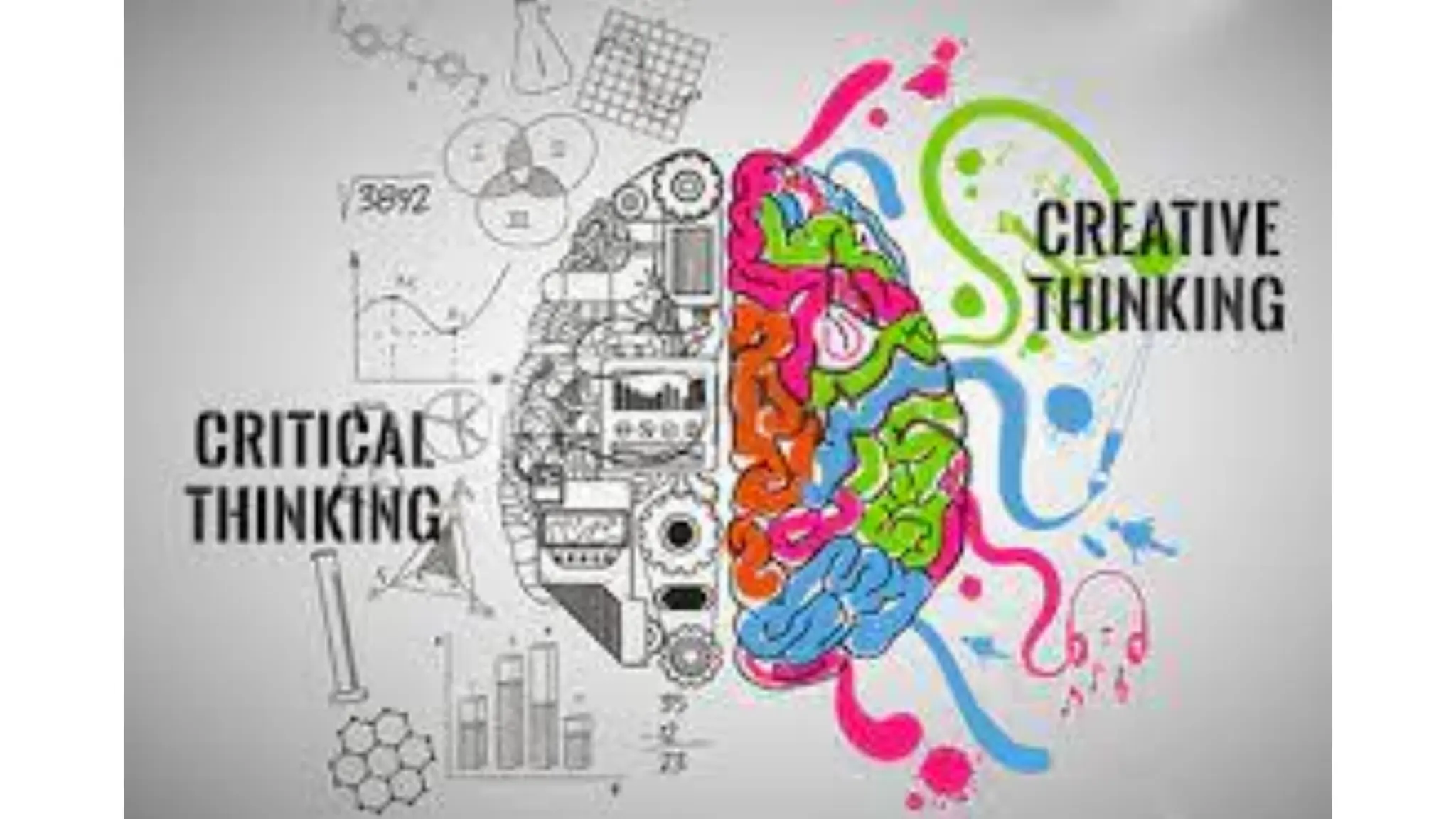
Creative And Critical Thinking
• Creative and critical thinking skills are the abilities, which can sometimes
be used interchangeably in definition
• . In fact, they have different constructs because they differentiate in
outcome of human behaviours.
• Also one of today’s requirements is that individuals should approach
everyday problems by using both competences. So, one of the helpful
tool for development of creativity and critical thinking skills proposed is
problem-based learning environments in classrooms
SOCIAL INNOVATION
• Social Innovation is about creating solutions that addresses the user’s needs. You cannot serve the
community to improve their lives if you do not understand them and work together with them. The key
words here is working WITH the community, immersing yourselves into the lives of the community to
understand what is needed.
The Growing Importance of Social Innovation
innovation – new ideas that work to meet pressing unmet needs and improve peoples’ lives.
Ex:
• Self-help health groups and self-build housing;
• Telephones
• neighbourhood nurseries and neighbourhood wardens
• Wikipedia and the Open University;
• complementary medicine, holistic health and hospices;
• Microcredit and consumer cooperatives;
• charity shops and the fair trade movement;
• zero carbon housing schemes
• community wind farms;
• restorative justice and community courts.

AGRI-INST-2-CREATIVE-AND-CRITICAL-THINKING.pdf

  • 2.
    Critical Thinking • 21st-centuryskill that enables a person to think rationally and logically in order to reach a plausible conclusion. • A critical thinker assesses facts and figures and data objectively and determines what to believe and what not to believe. • Critical thinking skills empower a person to decipher complex problems and make impartial and better decisions based on effective information.
  • 3.
    • Critical thinkingskills cultivate habits of mind such as strategic thinking, skepticism, discerning fallacy from the facts, asking good questions and probing deep into the issues to find the truth.
  • 4.
    Critical Thinking • RichardPaul (1988) - as reaching to the conclusion according to the objectives and knowledge. • Norris (1985) - mentions it as students’ application of previous knowledge and changing it after valuation process (as cited in Demirel, 2012). • Seferoglu & Akbıyık, 2006 -critical thinking is a kind of ability to look at events, conditions or thoughts with a careful eye and making comments, decisions, studying on the reliability and validity of the knowledge according to standards of logic and the mind. • Howard, Tang & Austion, 2015; Watson & Galser, 1980 -This higher order thinking ability provides the opportunity to reason the existed knowledge or situation to correct the mistakes and complete deficits in order to reach appropriate situations.
  • 5.
    • Thurman, 2009- critical thinking skills involve identification and analysis of informational sources for credibility, indicating previous knowledge and making connections and deducing to conclusions. Shortly, the general characteristics of critical thinking can be listed as the following: ➢ Reasoning and suspecting ➢ Looking at situations from multiple perspectives and dimensions ➢ To be open to changes and innovations ➢ To look at thoughts without prejudices ➢ Being open minded ➢ Thinking analytically ➢ Paying attention to details • Advantages of critical thinking; ➢ People who are critical thinkers think freely and independently ➢ People don’t behave without thinking ➢ Individuals can state the problem explicitly (Demirel, 2012).
  • 6.
    Importance of AcquiringCritical Thinking Skills • Acquiring critical thinking skills was never as valuable as it is today because of the prevalence of the modern knowledge economy. • Today, information and technology are the driving forces behind the global economy. • To keep pace with ever-changing technology and new inventions, one has to be flexible enough to embrace changes swiftly.
  • 7.
    • Today criticalthinking skills are one of the most sought-after skills by the companies. • In fact, critical thinking skills are paramount not only for active learning and academic achievement but also for the professional career of the students. • The lack of critical thinking skills catalyzes memorization of the topics without a deeper insight, egocentrism, closed- mindedness, reduced student interest in the classroom and not being able to make timely and better decisions.
  • 8.
    Benefits of CriticalThinking Skills in Education • It allows a student to decipher problems and think through the situations in a disciplined and systematic manner • Through a critical thinking ability, a student can comprehend the logical correlation between distinct ideas • The student is able to rethink and re-justify his beliefs and ideas based on facts and figures • Critical thinking skills make the students curious about things around them
  • 9.
    Benefits of CriticalThinking Skills in Education • A student who is a critical thinker is creative and always strives to come up with out of the box solutions to intricate problems • Critical thinking skills assist in the enhanced student learning experience in the classroom and prepares the students for lifelong learning and success • The critical thinking process is the foundation of new discoveries and inventions in the world of science and technology
  • 10.
    Benefits of CriticalThinking Skills in Education • The ability to think critically allows the students to think intellectually and enhances their presentation skills, hence they can convey their ideas and thoughts in a logical and convincing manner • Critical thinking skills make students a terrific communicator because they have logical reasons behind their ideas
  • 11.
    Creative Thinking • Creativethinking can be defined as the entire set of cognitive activities used by individuals according to a specific object, problem and condition, or a type of effort toward a particular event and the problem based on the capacity of the individuals. • They try to use their imagination, intelligence, insight, and ideas when they face to such situations.
  • 12.
    Creative Thinking • Inaddition, they try to suggest an authentic and new design, generate different hypotheses, solve the problem with the help of discovering and finding new applications (Glass, 2004; Young & Balli, 2014) whereby each individual realizes his/her knowledge deficits and tries to bridge this gap while obtaining new viewpoints by looking at the problem from multiple perspectives with the help of making unusual connections and taking risks based on their insights to produce alternative solutions toward the problem or situation with great patience and determination.
  • 13.
    • Generally, creativethinking is correlated to critical thinking, and problem solving. Actually, there are three dimensions of creative thinking as synthesising, articulation and imagination having the following qualities (Aslan, 2007; Rhodes, 1961; Sternberg, 2009) • ➢ Synthesising: This dimension includes various activities such as getting benefit from analogous thinking, deducing original result from small parts, presenting novel and authentic suggestions to the solution of the problem. • ➢ Articulation: It involves forming the old and new knowledge or expanding the current knowledge with the help of the new one, constructing unusual relationship to produce authentic solutions and making thoughts concrete with the help of imagination and use of the materials. • ➢ Imagination: This dimension is consisted of constructing relationship between valid and reliable thoughts, presenting flexible ways of thought with the help of imagination, to come up with different insights during idea producing process.
  • 14.
    Based on thedimensions of the creative thinking, its general characteristics can be listed as the following (Gilhooly, Ball & Macchi, 2015; Kember & Leung, 2009; Liu, He & Li, 2015); ➢ Flexibility ➢ Authenticity ➢ Multiple thinking ➢ Wondering ➢ Thinking fast and independent ➢ To be open to criticism ➢ Rationalism ➢ Being suspicious ➢ To come up with different solutions ➢ To realize and define the problem ➢ To suggest possible solutions
  • 15.
    • The conjecturethat only particular types of people can be creative is demoded thanks to educational developments because creative thinking is not merely based on art-based activities such as dance, music, drama,...etc., as previously assumed. • In recent years, creativity has been valued as universal capability that it can be applied in everyday situations. • It is interpreted as capability of human intelligence instead of a subject. • Sternberg defines creativity as an imaginative action fashioned so as to produce outcomes which are both original and of value (Craft et al. 2006; Sternberg, 2003; as cited in Robson, 2013).
  • 16.
    Creative And CriticalThinking • Creative and critical thinking skills are the abilities, which can sometimes be used interchangeably in definition • . In fact, they have different constructs because they differentiate in outcome of human behaviours. • Also one of today’s requirements is that individuals should approach everyday problems by using both competences. So, one of the helpful tool for development of creativity and critical thinking skills proposed is problem-based learning environments in classrooms
  • 17.
  • 18.
    • Social Innovationis about creating solutions that addresses the user’s needs. You cannot serve the community to improve their lives if you do not understand them and work together with them. The key words here is working WITH the community, immersing yourselves into the lives of the community to understand what is needed.
  • 19.
    The Growing Importanceof Social Innovation innovation – new ideas that work to meet pressing unmet needs and improve peoples’ lives. Ex: • Self-help health groups and self-build housing; • Telephones • neighbourhood nurseries and neighbourhood wardens • Wikipedia and the Open University; • complementary medicine, holistic health and hospices; • Microcredit and consumer cooperatives; • charity shops and the fair trade movement; • zero carbon housing schemes • community wind farms; • restorative justice and community courts.