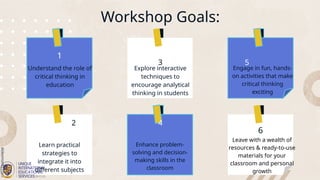
Workshop Goals:
Understand therole of
critical thinking in
education
Explore interactive
techniques to
encourage analytical
thinking in students
Engage in fun, hands-
on activities that make
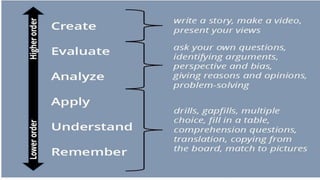
critical thinking
exciting
Learn practical
strategies to
integrate it into
different subjects
Enhance problem-
solving and decision-
making skills in the
classroom
Leave with a wealth of
resources & ready-to-use
materials for your
classroom and personal
growth
1
3 5
2 4
6
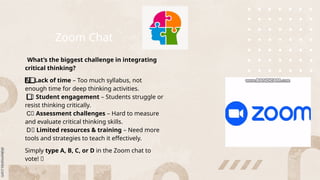
Zoom Chat
What’s thebiggest challenge in integrating
critical thinking?
A️
️
⃣
️
⃣
️
⃣
️
⃣
️
⃣
️
⃣
️
⃣
️
⃣
️
⃣
️
⃣
️
⃣
️
⃣
️
⃣
️
⃣Lack of time – Too much syllabus, not
enough time for deep thinking activities.
⃣
️
⃣
️️
️
️
️
️
️
️
️
️
️
️
️
️
Student engagement – Students struggle or
resist thinking critically.
⃣
C️
️️
️
️
️
️
️
️
️
️
️
️
️
️ Assessment challenges – Hard to measure
and evaluate critical thinking skills.
⃣
D️
️️
️
️
️
️
️
️
️
️
️
️
️
️ Limited resources & training – Need more
tools and strategies to teach it effectively.
Simply type A, B, C, or D in the Zoom chat to
vote! 🚀
7.
Understanding Critical
Thinking.
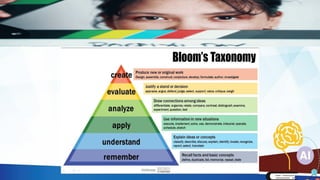
This sectionexplores the definition and significance of
critical thinking in today’s classrooms. Through an
interactive discussion, participants will reflect on student
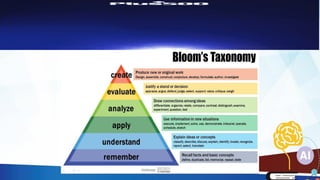
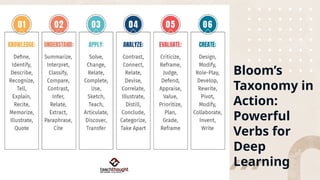
questioning, analyze Bloom’s Taxonomy, and learn how to
apply its verbs to foster deeper learning.Teachers will also
examine real-world examples of strong critical thinkers
and engage in a mini case study to see critical thinking in
action. Using the World Café Method, they will collaborate to
solve real classroom challenges, developing practical
strategies for encouraging analytical thinking in students.
8.
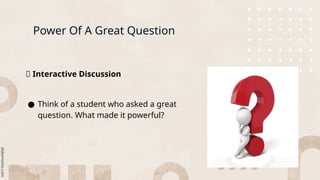
Power Of AGreat Question
📌 Interactive Discussion
● Think of a student who asked a great
question. What made it powerful?
9.
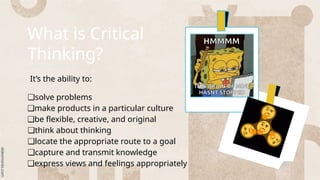
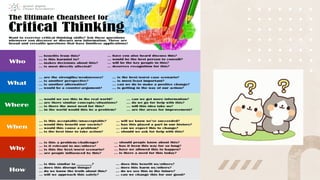
What is Critical
Thinking?
It’sthe ability to:
❑solve problems
❑make products in a particular culture
❑be flexible, creative, and original
❑think about thinking
❑locate the appropriate route to a goal
❑capture and transmit knowledge
❑express views and feelings appropriately
10.
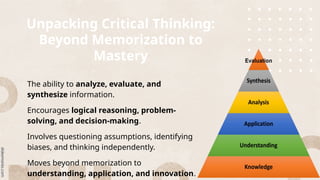
Unpacking Critical Thinking:
BeyondMemorization to
Mastery
The ability to analyze, evaluate, and
synthesize information.
Encourages logical reasoning, problem-
solving, and decision-making.
Involves questioning assumptions, identifying
biases, and thinking independently.
Moves beyond memorization to
understanding, application, and innovation.
11.
📌 Activity: “Critical Thinking Edition”
Raise Hand
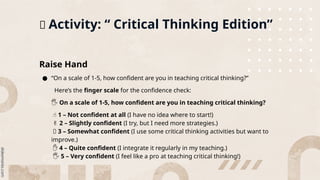
● “On a scale of 1-5, how confident are you in teaching critical thinking?”
Here’s the finger scale for the confidence check:
️
🖐️On a scale of 1-5, how confident are you in teaching critical thinking?
☝️1 – Not confident at all (I have no idea where to start!)
✌️2 – Slightly confident (I try, but I need more strategies.)
🤟 3 – Somewhat confident (I use some critical thinking activities but want to
improve.)
✋ 4 – Quite confident (I integrate it regularly in my teaching.)
️🖐️5 – Very confident (I feel like a pro at teaching critical thinking!)
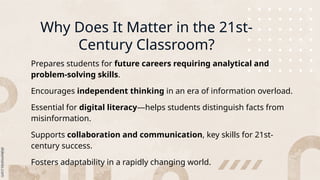
Why Does ItMatter in the 21st-
Century Classroom?
Prepares students for future careers requiring analytical and
problem-solving skills.
Encourages independent thinking in an era of information overload.
Essential for digital literacy—helps students distinguish facts from
misinformation.
Supports collaboration and communication, key skills for 21st-
century success.
Fosters adaptability in a rapidly changing world.
19.
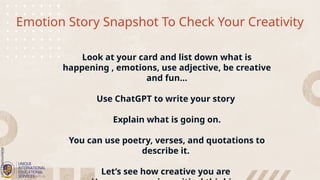
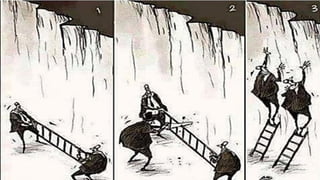
Emotion Story SnapshotTo Check Your Creativity
Look at your card and list down what is
happening , emotions, use adjective, be creative
and fun…
Use ChatGPT to write your story
Explain what is going on.
You can use poetry, verses, and quotations to
describe it.
Let’s see how creative you are
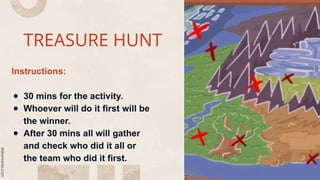
TREASURE HUNT
Instructions:
● 30mins for the activity.
● Whoever will do it first will be
the winner.
● After 30 mins all will gather
and check who did it all or
the team who did it first.
What is CriticalThinking?
It’s the ability to:
❑solve problems
❑make products in a particular culture
❑be flexible, creative, and original
❑think about thinking
❑locate the appropriate route to a goal
❑capture and transmit knowledge
❑express views and feelings appropriately
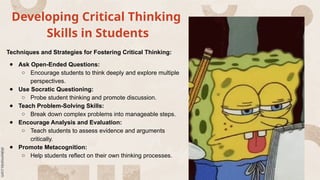
Developing Critical Thinking
Skillsin Students
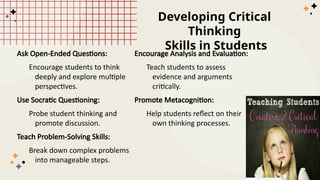
Techniques and Strategies for Fostering Critical Thinking:
● Ask Open-Ended Questions:
○ Encourage students to think deeply and explore multiple
perspectives.
● Use Socratic Questioning:
○ Probe student thinking and promote discussion.
● Teach Problem-Solving Skills:
○ Break down complex problems into manageable steps.
● Encourage Analysis and Evaluation:
○ Teach students to assess evidence and arguments
critically.
● Promote Metacognition:
○ Help students reflect on their own thinking processes.
54.
Examples of Critical
ThinkingActivities
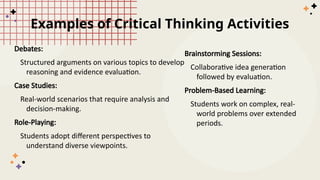
Debates:
● Structured arguments on various topics to develop reasoning and evidence evaluation.
Case Studies:
● Real-world scenarios that require analysis and decision-making.
Role-Playing:
● Students adopt different perspectives to understand diverse viewpoints.
Brainstorming Sessions:
● Collaborative idea generation followed by evaluation.
Problem-Based Learning:
● Students work on complex, real-world problems over extended periods.
55.
Integrating Critical Thinkinginto the
Curriculum
Cross-Disciplinary Approach:
● Embed critical thinking skills in all subjects.
Project-Based Learning:
● Use projects that require critical analysis and problem-solving.
Inquiry-Based Learning:
● Encourage students to ask questions and seek answers.
Assessment and Feedback:
● Design assessments that require critical thinking and provide
constructive feedback.
56.
Strategies for EncouragingCreative
Thinking
Techniques for Fostering Creativity:
● Create a Safe Environment:
○ Encourage risk-taking and accept mistakes as part of the learning process.
● Incorporate Divergent Thinking:
○ Encourage multiple solutions and perspectives.
● Use Creative Problem-Solving Models:
○ Introduce frameworks like SCAMPER (Substitute, Combine, Adapt, Modify,
Put to another use, Eliminate, Rearrange).
● Encourage Play and Exploration:
○ Use games and playful activities to stimulate creativity.
● Promote Collaboration:
○ Foster group work where students can share and build on each other's
ideas.
57.
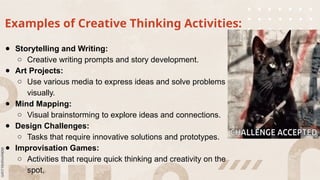
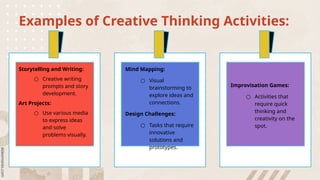
Examples of CreativeThinking Activities:
● Storytelling and Writing:
○ Creative writing prompts and story development.
● Art Projects:
○ Use various media to express ideas and solve problems
visually.
● Mind Mapping:
○ Visual brainstorming to explore ideas and connections.
● Design Challenges:
○ Tasks that require innovative solutions and prototypes.
● Improvisation Games:
○ Activities that require quick thinking and creativity on the
spot.
58.
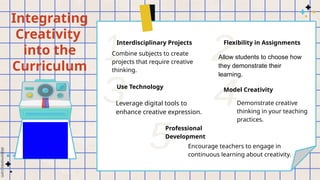
Integrating Creativity intothe Curriculum
Interdisciplinary Projects:
● Combine subjects to create projects that require creative thinking.
Flexibility in Assignments:
● Allow students to choose how they demonstrate their learning.
Use Technology:
● Leverage digital tools to enhance creative expression.
Model Creativity:
● Demonstrate creative thinking in your teaching practices.
Professional Development:
● Encourage teachers to engage in continuous learning about creativity.
59.
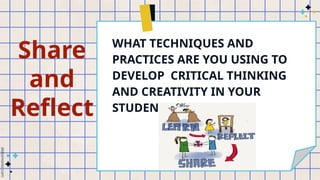
Share and Reflect
WHATTECHNIQUES
AND PRACTICES ARE
YOU USING TO DEVELOP
CRITICAL THINKING
AND CREATIVITY IN
YOUR STUDENTS?
Yesterday is history
Tomorrowis a mystery
Today is a gift that’s why it is called present
- Alice Morse Earle
We can’t let the perfect be the enemy of the good.
62.
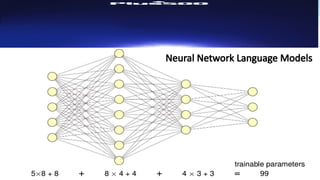
Large language modelssuch as GPT-4, short for
Generative Pre-trained Transformer, are
essentially big,powerful “word brains” trained on a
colossal amount of information from books, articles,
websites,and all sorts of written material.
63.
Chat GPT Formula
C-CONTEXT
S- SPECIFIC INFORMATION
I- INTENT
R- RESPONSE FORMAT
64.
● How manyof you have used Chat GPT 3.5 or 4.o ?
● What do you use it for?
● DO you think using it for assignments is plagiarism?
Our creativity gainsvalue when we are exposed to
the creativity of others. We become more creative
when we brainstorm with other creative people,
because we riff off one another and build off one
another’s thoughts. A generative AI world will only
accelerate this process.
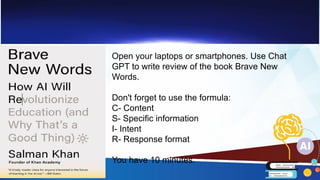
Brave New words
Salman Khan
CEO Khan Academy
Open your laptopsor smartphones. Use Chat
GPT to write review of the book Brave New
Words.
Don't forget to use the formula:
C- Content
S- Specific information
I- Intent
R- Response format
You have 10 minutes.
● AI can’treplace humans ------but humans with
AI can replace humans without AI. (Karim
Lakhani)
● Predicting the future is not magic its Artificial
Intelligence (Dave Waters)
81.
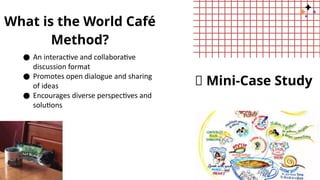
What is theWorld Café
Method?
● An interactive and collaborative
discussion format
● Promotes open dialogue and sharing
of ideas
● Encourages diverse perspectives and
solutions
📌 Mini-Case Study
82.
● It isa pair activity and each pair will
be given an Educational issue to
solve.
● You have 10 minutes to
think/discuss about the scenario
and then all pairs will share one by
one.
● While listening, other pairs can give
suggestions or ask counter
questions.
Discussion Guidelines
● Listen actively and respect
each other's viewpoints
● Encourage everyone to
participate
● Focus on generating ideas
and potential solutions
● Summarize key points and
note them down
83.
What is theWorld Café Method?
● An interactive and collaborative discussion format
● Promotes open dialogue and sharing of ideas
● Encourages diverse perspectives and solutions
85.
● All participantsare requested to group themselves in five
groups
● Each group will be given an Educational issue that they have
to solve.
● All groups have 10 minutes to think/discuss about their
scenario and then all groups will share one by one.
● While listening other groups can give suggestions or ask
counter questions.
86.
Discussion Guidelines
● Listenactively and respect each other's viewpoints
● Encourage everyone to participate
● Focus on generating ideas and potential solutions
● Summarize key points and note them down
87.
There is nouse talking about the
problem unless you talk about the
solution.
— Betty Williams
88.
Challenges
Limited individual attentionfor students
Increased classroom management
difficulties Strain on resources and
infrastructure
Discussion Points
Effective teaching strategies for large
classes Utilizing group work and peer
learning Classroom layout and seating
arrangements Leveraging technology to
engage all students
Dealing with
Overcrowded
Classrooms
89.
Strategies for
Reducing
Teacher Burnout
Challenges
•High workload and long hours
• Lack of professional support
and development
• Emotional strain from dealing
with student issues
Discussion Points
• Time management and
organizational skills
• Access to mental health resources
and
support
• Professional development
opportunities
90.
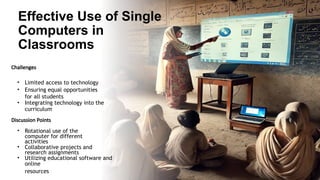
Effective Use ofSingle
Computers in
Classrooms
Challenges
• Limited access to technology
• Ensuring equal opportunities
for all students
• Integrating technology into the
curriculum
Discussion Points
• Rotational use of the
computer for different
activities
• Collaborative projects and
research assignments
• Utilizing educational software and
online
resources
91.
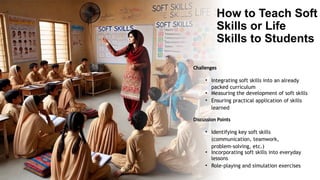
How to TeachSoft
Skills or Life
Skills to Students
Challenges
• Integrating soft skills into an already
packed curriculum
• Measuring the development of soft skills
• Ensuring practical application of skills
learned
Discussion Points
• Identifying key soft skills
(communication, teamwork,
problem-solving, etc.)
• Incorporating soft skills into everyday
lessons
• Role-playing and simulation exercises
92.
Fostering a Cultureof
Reading Among
Students
Challenges
• Limited access to diverse
reading materials
• Lack of motivation or interest in
reading
• Competing distractions
(technology, social media, etc.)
Discussion Points
• Creating a rich classroom library
• Implementing reading programs
and competitions
• Encouraging family
involvement in reading
activities
Subject-Specific Applications/Admin
Role/Creating SchoolCulture
This section focuses on practical strategies for integrating critical thinking across subjects and at the administrative level.
Through an interactive presentation and live demos, participants will explore subject-specific techniques:Math & Science –
Inquiry-based learning and real-world problem-solving.
English & Social Studies – Debates, Socratic questioning, and analyzing multiple perspectives.For school leaders and
administrators, this section highlights how to create a culture of inquiry and reflection, integrate critical and creative
thinking into the curriculum, and apply problem-solving strategies in day-to-day school operations. Real-world scenarios
will be used to demonstrate critical thinking in action, helping educators and administrators foster a learning environment
where students and teachers question, analyze, and innovate.
96.
Developing Critical
Thinking
Skills inStudents
Ask Open-Ended Questions:
Encourage students to think
deeply and explore multiple
perspectives.
Use Socratic Questioning:
Probe student thinking and
promote discussion.
Teach Problem-Solving Skills:
Break down complex problems
into manageable steps.
Encourage Analysis and Evaluation:
Teach students to assess
evidence and arguments
critically.
Promote Metacognition:
Help students reflect on their
own thinking processes.
97.
Examples of CriticalThinking Activities
Debates:
Structured arguments on various topics to develop
reasoning and evidence evaluation.
Case Studies:
Real-world scenarios that require analysis and
decision-making.
Role-Playing:
Students adopt different perspectives to
understand diverse viewpoints.
Brainstorming Sessions:
Collaborative idea generation
followed by evaluation.
Problem-Based Learning:
Students work on complex, real-
world problems over extended
periods.
98.
Integrating Critical Thinkinginto the
Curriculum
Cross-Disciplinary Approach:
Embed critical thinking skills in all
subjects.
Project-Based Learning:
Use projects that require critical
analysis and problem-solving.
Inquiry-Based Learning:
Encourage students to ask
questions and seek answers.
Assessment and Feedback:
Design assessments that require
critical thinking and provide
constructive feedback.
99.
Strategies for EncouragingCreative Thinking
Techniques for
Fostering Creativity:
● Create a Safe Environment:
○ Encourage risk-taking and
accept mistakes as part of the
learning process.
● Incorporate Divergent Thinking:
○ Encourage multiple solutions
and perspectives.
● Use Creative Problem-Solving
Models:
○ Introduce frameworks like
SCAMPER (Substitute, Combine,
Adapt, Modify, Put to another
use, Eliminate, Rearrange).
● Encourage Play and Exploration:
○ Use games and playful activities
to stimulate creativity.
● Promote Collaboration:
○ Foster group work where
students can share and build on
each other's ideas.
100.
Examples of CreativeThinking Activities:
Storytelling and Writing:
○ Creative writing
prompts and story
development.
Art Projects:
○ Use various media
to express ideas
and solve
problems visually.
Mind Mapping:
○ Visual
brainstorming to
explore ideas and
connections.
Design Challenges:
○ Tasks that require
innovative
solutions and
prototypes.
Improvisation Games:
○ Activities that
require quick
thinking and
creativity on the
spot.
101.
Integrating
Creativity
into the
Curriculum
Interdisciplinary Projects
Combinesubjects to create
projects that require creative
thinking.
Flexibility in Assignments
Allow students to choose how
they demonstrate their
learning.
Use Technology
Leverage digital tools to
enhance creative expression.
Demonstrate creative
thinking in your teaching
practices.
Model Creativity
Professional
Development
Encourage teachers to engage in
continuous learning about creativity.
102.
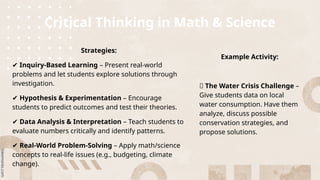
Critical Thinking inMath & Science
Strategies:
✔ Inquiry-Based Learning – Present real-world
problems and let students explore solutions through
investigation.
✔ Hypothesis & Experimentation – Encourage
students to predict outcomes and test their theories.
✔ Data Analysis & Interpretation – Teach students to
evaluate numbers critically and identify patterns.
✔ Real-World Problem-Solving – Apply math/science
concepts to real-life issues (e.g., budgeting, climate
change).
Example Activity:
🔹 The Water Crisis Challenge –
Give students data on local
water consumption. Have them
analyze, discuss possible
conservation strategies, and
propose solutions.
103.
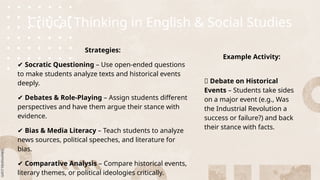
Critical Thinking inEnglish & Social Studies
Strategies:
✔ Socratic Questioning – Use open-ended questions
to make students analyze texts and historical events
deeply.
✔ Debates & Role-Playing – Assign students different
perspectives and have them argue their stance with
evidence.
✔ Bias & Media Literacy – Teach students to analyze
news sources, political speeches, and literature for
bias.
✔ Comparative Analysis – Compare historical events,
literary themes, or political ideologies critically.
Example Activity:
🔹 Debate on Historical
Events – Students take sides
on a major event (e.g., Was
the Industrial Revolution a
success or failure?) and back
their stance with facts.
104.
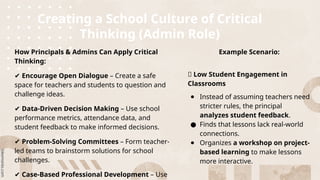
Creating a SchoolCulture of Critical
Thinking (Admin Role)
How Principals & Admins Can Apply Critical
Thinking:
✔ Encourage Open Dialogue – Create a safe
space for teachers and students to question and
challenge ideas.
✔ Data-Driven Decision Making – Use school
performance metrics, attendance data, and
student feedback to make informed decisions.
✔ Problem-Solving Committees – Form teacher-
led teams to brainstorm solutions for school
challenges.
✔ Case-Based Professional Development – Use
Example Scenario:
🔹 Low Student Engagement in
Classrooms
● Instead of assuming teachers need
stricter rules, the principal
analyzes student feedback.
● Finds that lessons lack real-world
connections.
● Organizes a workshop on project-
based learning to make lessons
more interactive.
105.
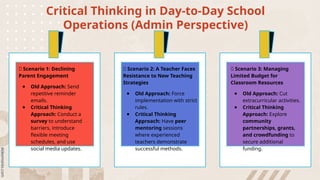
Critical Thinking inDay-to-Day School
Operations (Admin Perspective)
🔹 Scenario 1: Declining
Parent Engagement
● Old Approach: Send
repetitive reminder
emails.
● Critical Thinking
Approach: Conduct a
survey to understand
barriers, introduce
flexible meeting
schedules, and use
social media updates.
🔹 Scenario 2: A Teacher Faces
Resistance to New Teaching
Strategies
● Old Approach: Force
implementation with strict
rules.
● Critical Thinking
Approach: Have peer
mentoring sessions
where experienced
teachers demonstrate
successful methods.
🔹 Scenario 3: Managing
Limited Budget for
Classroom Resources
● Old Approach: Cut
extracurricular activities.
● Critical Thinking
Approach: Explore
community
partnerships, grants,
and crowdfunding to
secure additional
funding.
106.
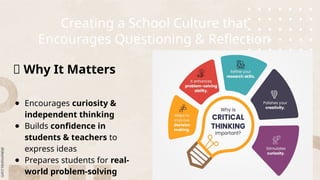
Creating a SchoolCulture that
Encourages Questioning & Reflection
🧠 Why It Matters
● Encourages curiosity &
independent thinking
● Builds confidence in
students & teachers to
express ideas
● Prepares students for real-
world problem-solving
107.
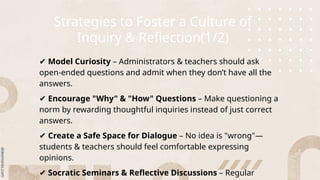
Strategies to Fostera Culture of
Inquiry & Reflection(1/2)
✔ Model Curiosity – Administrators & teachers should ask
open-ended questions and admit when they don’t have all the
answers.
✔ Encourage "Why" & "How" Questions – Make questioning a
norm by rewarding thoughtful inquiries instead of just correct
answers.
✔ Create a Safe Space for Dialogue – No idea is "wrong"—
students & teachers should feel comfortable expressing
opinions.
✔ Socratic Seminars & Reflective Discussions – Regular
108.
Strategies to Fostera Culture of
Inquiry & Reflection(2/2)
✔ Teach Metacognition (Thinking About Thinking) –
Encourage students & teachers to analyze their own thought
processes and decision-making.
✔ School-Wide "Big Question" Boards – Have a visible board
where students and teachers can post & explore complex
questions.
✔ Encourage Teacher Collaboration – Weekly teacher
reflection circles to discuss classroom challenges and strategies.
✔ Admin-Led Reflection – Principals can hold “Think &
Reflect” sessions where staff analyze school challenges and
109.
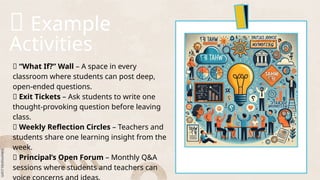
📌 Example
Activities
🔹 “WhatIf?” Wall – A space in every
classroom where students can post deep,
open-ended questions.
🔹 Exit Tickets – Ask students to write one
thought-provoking question before leaving
class.
🔹 Weekly Reflection Circles – Teachers and
students share one learning insight from the
week.
🔹 Principal’s Open Forum – Monthly Q&A
sessions where students and teachers can
110.
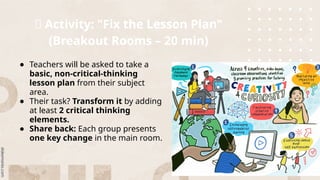
📌 Activity: "Fixthe Lesson Plan"
(Breakout Rooms – 20 min)
● Teachers will be asked to take a
basic, non-critical-thinking
lesson plan from their subject
area.
● Their task? Transform it by adding
at least 2 critical thinking
elements.
● Share back: Each group presents
one key change in the main room.
111.
Interactive Strategies for
EngagingStudents
This section introduces interactive digital tools that make
critical thinking more engaging and collaborative. Through a
quick demo, participants will explore:🖍 Jamboard/Padlet –
Creating collaborative mind maps to visually organize
thoughts.
💬 Mentimeter – Using live discussions & word clouds to
encourage student engagement.
✅ Google Forms/Quizzes – Designing critical thinking
check-ins to assess student progress.Participants will reflect
on how these tools enhance classroom discussions,
112.
Digital Tools forCritical Thinking – Why Use
Them?
💡 Why Integrate Digital Tools?
✔ Makes learning interactive &
engaging
✔ Encourages collaboration &
real-time feedback
✔ Helps students visualize
thinking processes
113.
Jamboard or Padlet– Collaborative Mind Maps
🌟 How to Use:
🔹 Create a Jamboard (Google) or Padlet
Board with a central question
🔹 Have students add sticky notes with
their ideas
🔹 Use different colors for categories of
thoughts
🔹 Example Activity:
📌 Science – “What are the possible effects
of climate change?” (Students brainstorm
different effects)
📌 English – “What themes can you
identify in this story?” (Collaborative mind
map of key themes)
114.
Mentimeter – LiveClass Discussions & Word Clouds
💡 How to Use:
Create a
1️
1️
1️
1️
1️
1️
1️
1️
1️
1️
1️
1️
1️
1️
1️ Mentimeter question (e.g.,
“What makes a strong argument?”)
Students respond live, creating a
2️
2️
2️
2️
2️
2️
2️
2️
2️
2️
2️
2️
2️
2️
2️ word
cloud
Discuss the most common words and
3️
3️
3️
3️
3️
3️
3️
3️
3️
3️
3️
3️
3️
3️
3️
why they matter
🔹 Example Activity:
📌 Social Studies – “What are the main
causes of revolutions?” (Live responses
create an instant word cloud)
📌 Math – “Biggest challenge in solving
algebraic equations?” (See most common
struggles)
115.
Google Forms/Quizzes –Critical Thinking Check-Ins
🎯 How to Use:
🔹 Create a Google Form with scenario-
based multiple-choice or short-answer
questions
🔹 Use branching options for different
student responses
🔹 Analyze responses for student
misconceptions.
🔹 Example Activity:
📌 Critical Thinking Challenge – Create a
mystery scenario and ask students:
● What information do you need to
solve this?
● What assumptions are you making?
📌 Exit Ticket – After a lesson,
students answer:
● “What’s one question you still have?”
● “How does this connect to real life?”
Wrap-Up & Takeaways
Thissection wraps up the session with a reflection poll, a fun critical
thinking challenge, and final takeaways. Participants will receive
free resources, share their key learnings, and engage in a lighthearted
exit activity. The session ends with movie recommendations that
showcase critical thinking in action.
118.
Did you know?
📌Activity: "Think Outside the
Box Challenge" (10 min)
● Present an unusual real-
world problem.
● Participants brainstorm
solutions in chat or a
shared document.
● Debrief: What types of
thinking were required?
📌 Live Q&A (10 min)
● Open floor for teachers to ask
about specific subject-related
challenges.
119.
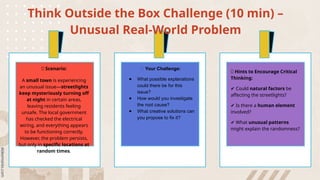
Think Outside theBox Challenge (10 min) –
Unusual Real-World Problem
🔹 Scenario:
A small town is experiencing
an unusual issue—streetlights
keep mysteriously turning off
at night in certain areas,
leaving residents feeling
unsafe. The local government
has checked the electrical
wiring, and everything appears
to be functioning correctly.
However, the problem persists,
but only in specific locations at
random times.
💡 Your Challenge:
● What possible explanations
could there be for this
issue?
● How would you investigate
the root cause?
● What creative solutions can
you propose to fix it?
🧐 Hints to Encourage Critical
Thinking:
✔ Could natural factors be
affecting the streetlights?
✔ Is there a human element
involved?
✔ What unusual patterns
might explain the randomness?
120.
Wrap-Up & Takeaways
📌Final Takeaways &
Free Resources
● Google Drive folder
with templates,
lesson plans, and
resource links.
● PDF guidebook on
critical thinking
strategies.
● Movie Suggestions.
📌 Fun Exit Ticket – "One
Word Wrap-Up"
● Participants drop one
word in chat that sums
up their learning
experience.
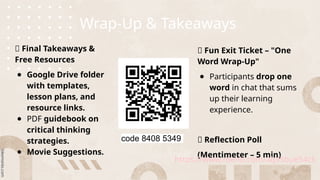
📌 Reflection Poll
(Mentimeter – 5 min)
https://www.menti.com/alpfsbue54ck
code 8408 5349
121.
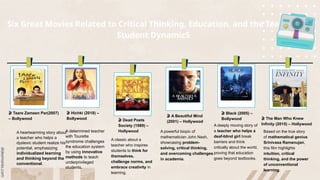
Six Great MoviesRelated to Critical Thinking, Education, and the Teacher-
Student DynamicS
A heartwarming story about
a teacher who helps a
dyslexic student realize his
potential, emphasizing
individualized learning
and thinking beyond the
conventional.
A determined teacher
with Tourette
syndrome challenges
the education system
by using innovative
methods to teach
underprivileged
students.
A classic about a
teacher who inspires
students to think for
themselves,
challenge norms, and
embrace creativity in
learning.
A powerful biopic of
mathematician John Nash,
showcasing problem-
solving, critical thinking,
and overcoming challenges
in academia.
Based on the true story
of mathematical genius
Srinivasa Ramanujan,
this film highlights
intuition, critical
thinking, and the power
of unconventional
learning.
🎬 Taare Zameen Par(2007)
– Bollywood
🎬 Hichki (2018) –
Bollywood 🎬 Dead Poets
Society (1989) –
Hollywood
🎬 A Beautiful Mind
(2001) – Hollywood
🎬 The Man Who Knew
Infinity (2015) – Hollywood
🎬 Black (2005) –
Bollywood
A deeply moving story of
a teacher who helps a
deaf-blind girl break
barriers and think
critically about the world,
proving that education
goes beyond textbooks.
122.
The essence of
theindependent
mind lies not in
what it thinks, but
in how it thinks.
— Christopher Hitchens
Fo
Feedback & Takeaways
Doyou have any questions?
Thank you!
https://drive.google.com/drive/
folders/1PTRfrU__WT-
2IMx_rn0i9Gt7djOLE0Wy?usp=sharing
Feedback Form
https://forms.gle/gFeipHSo5gaHq7cS6
Materials &
Resources
javeriauies@gmail.com
127.
Thank
you!
Do you haveany questions?
j.rana535@mybvc.ca
cafelearningbyjaveria@gmail.co
m
+92-349-8719013
j
129.
Free themes andtemplates for Google
Slides or PowerPoint
NOT to be sold as is or modified!
Read FAQ on slidesmania.com
Do not remove the slidesmania.com text on the sides.
Sharing is caring!