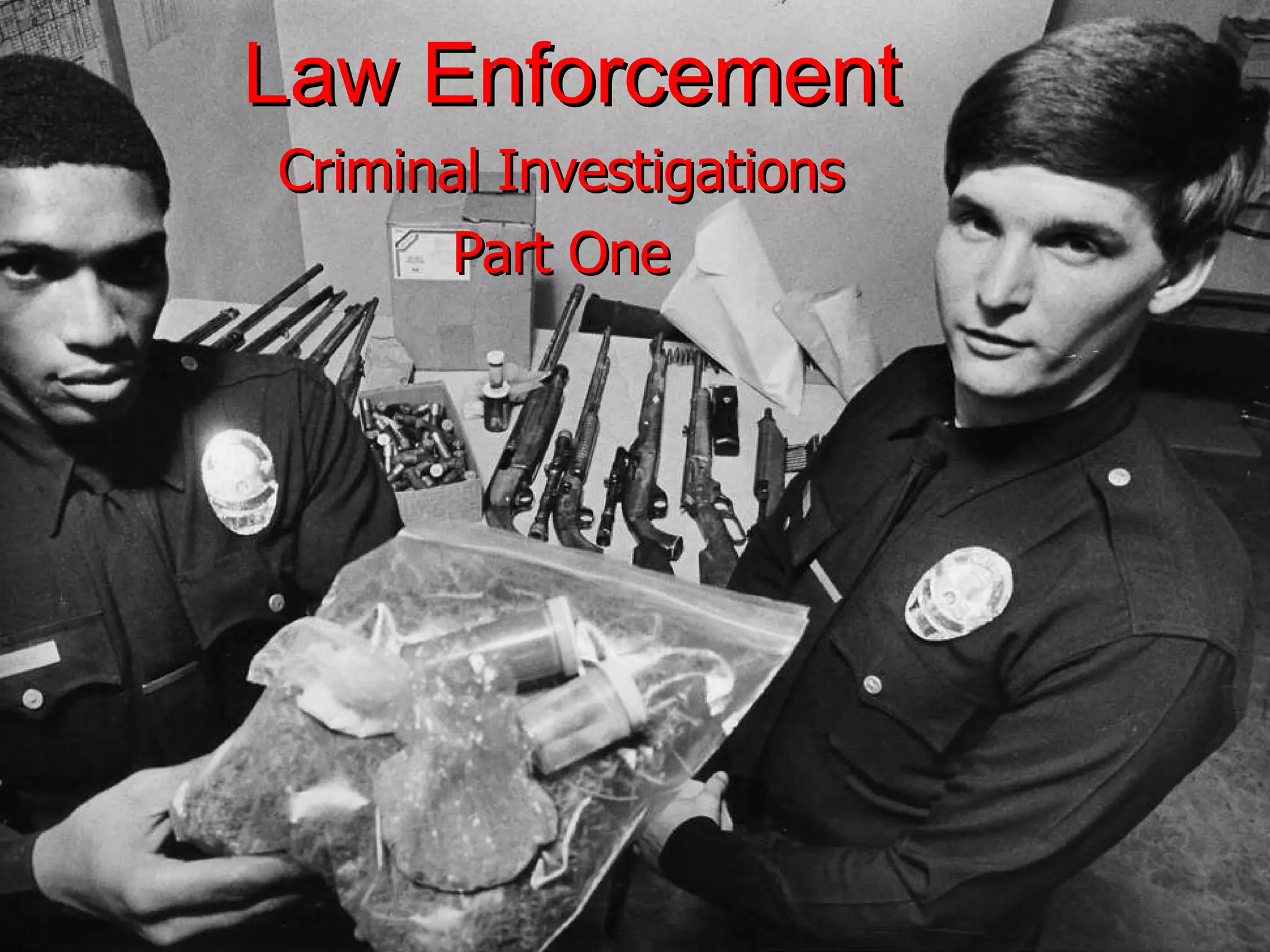
Law Enforcement Criminal Investigations Part One
Preliminary Investigations Recall from our discussion on Uniformed Patrol – the Alternative Strategy of Retroactive Investigation of Past Crimes by Detectives If the call involves a crime, the officer conducts a preliminary investigation and often refers the case to a detective who then conducts a follow up investigation of the crime

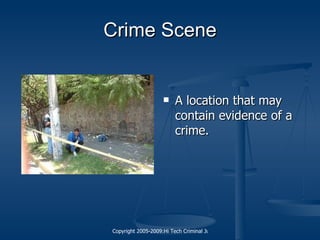
Crime Scene A location that may contain evidence of a crime.
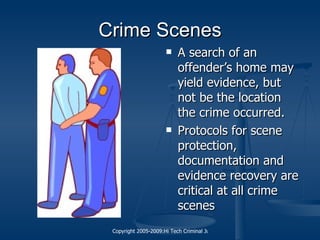
Crime Scenes A search of an offender’s home may yield evidence, but not be the location the crime occurred. Protocols for scene protection, documentation and evidence recovery are critical at all crime scenes
Initial Response Note/log information Be aware of any persons or vehicles leaving. Approach the scene cautiously, scan the entire area to thoroughly assess the scene, and note any possible secondary  crime scenes . Be aware of any persons and vehicles in the vicinity that may be related to the crime. Make initial observations (look, listen, smell) to assess the scene and ensure officer safety before proceeding. Remain alert and attentive. Assume the crime is ongoing until determined to be otherwise. Treat the location as a  crime scene  until assessed and determined to be otherwise.
Officer Safety The safety of officers and others, in and around the crime scene, is the first responder’s responsibility. After controlling any dangerous situations or persons, the next responsibility is ensuring medical attention is provided to injured persons while minimizing contamination of the scene.
Securing the Scene Boundaries of the scene start at a focal point, such as a body or point of entry and extend outward to include: Where the crime occurred. Potential points and paths of exit and entry of suspects and witnesses. Places where the victim/evidence may have been moved.
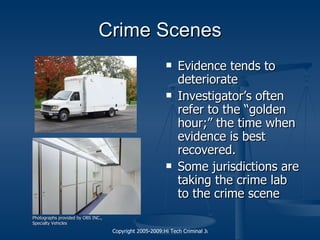
Crime Scenes Evidence tends to deteriorate Investigator’s often refer to the “golden hour;” the time when evidence is best recovered. Some jurisdictions are taking the crime lab to the crime scene Photographs provided by OBS INC., Specialty Vehicles
Evidence Collection Proper protocols and techniques for collecting evidence are very specific and critical. Generally, first responders preserve scenes and trained specialist collect and analysis evidence
Evidence Collection Chain of Custody Testimony and documentation that details the location and condition of evidence from seizure to trial. It assures the court that items entered into evidence are in the same condition as when they were seized. The chain of custody and the procedures used to analyze evidence are more often challenged than the science behind the analysis.
Forensic Science  and Criminalistics Forensic comes from the Latin word "forensis," meaning "of the forum," where the law courts of ancient Rome were held  Forensic science  is the application of any type of science, biological, social, physical or mathematical to legal matters.
Forensic Science and Criminalistics Forensic Science is the broader term, meaning the part of the science used to answer a legal question. Toxicology, ondontology, accounting, pathology, serology Criminalistics is a branch of  Forensic Science  dealing with the study of physical evidence related to a crime.
Daubert Test In order for the analysis of evidence to be used against a defendant, the court must accept the scientific conclusion as valid. The standard for accepting scientific analysis is the Daubert Test – from Daubert v Merrel Dow Pharmaceuticals, inc.
In the Daubert Test The Court asks -  Is the science derived by the scientific method? Has the science been subjected to peer review or publication? Does the relevant scientific community generally accept the science? What is the error rate of thee scientific technique used to gain the information? Are there standards for controlling the technology used to obtain the scientific evidence?
Transfer Theory Edmund Locard, a French Scientist developed the theory that contact between individuals or objects results in a transfer of material between them.
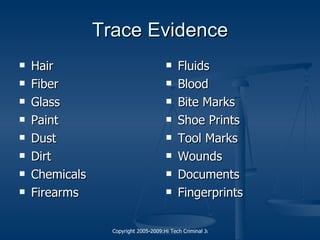
Trace Evidence Hair Fiber Glass Paint Dust Dirt Chemicals Firearms Fluids Blood Bite Marks Shoe Prints Tool Marks Wounds Documents Fingerprints
The First Major Systems of Personal Identification Anthropometery  exact measurements of an individuals body yields a characteristic formula for comparison. Dactlography  Fingerprints
 
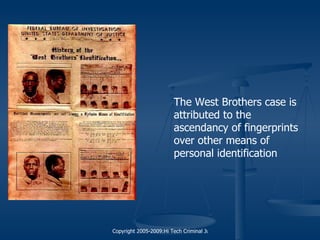
The West Brothers case is attributed to the ascendancy of fingerprints over other means of personal identification
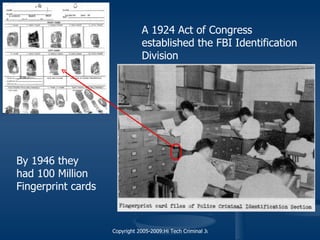
A 1924 Act of Congress established the FBI Identification Division By 1946 they had 100 Million Fingerprint cards
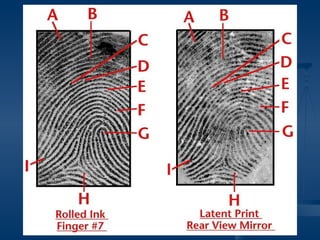
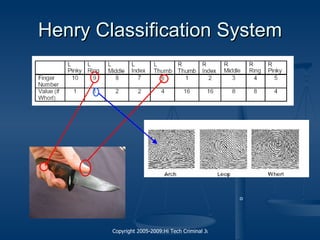
Henry Classification System
Lifting Prints Plastic – Found in a soft surface like wax, paint or putty. Visible – Contact with a wet fluid like blood. Latent – Meaning “Hidden” These prints are left by the oils secreted by our hands and are generally not visible.
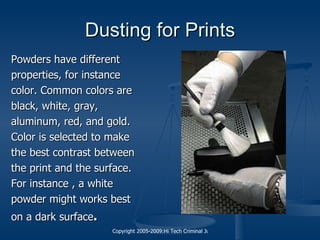
Dusting for Prints Powders have different properties, for instance color. Common colors are black, white, gray,  aluminum, red, and gold.  Color is selected to make  the best contrast between  the print and the surface.  For instance , a white powder might works best  on a dark surface .
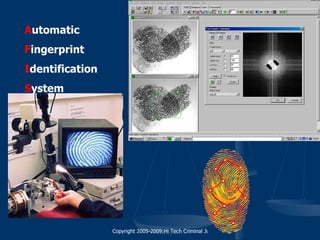
A utomatic F ingerprint I dentification S ystem
AFIS A combination of hardware and software used to scan and classify fingerprints so that they can be stored in a database. There are several regional, state and local AFIS databases: Western Identification Network Arizona DPS Ontario, CA police Department
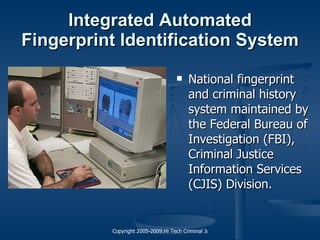
Integrated Automated Fingerprint Identification System National fingerprint and criminal history system maintained by the Federal Bureau of Investigation (FBI), Criminal Justice Information Services (CJIS) Division.
AFIS Maintains the largest  Biometric  database in the world, containing the fingerprints and corresponding criminal history information for more than 47 million subjects. The fingerprints and corresponding criminal history information are submitted voluntarily by state, local, and federal law enforcement agencies.
Biometrics The science of automatically identifying individuals based on a physiological or psychological characteristic: Fingerprint Retinal Scan Voice Print Facial Scan Thermal Image Handwriting, gait, and others
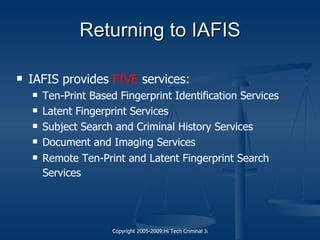
Returning to IAFIS IAFIS provides  FIVE  services: Ten-Print Based Fingerprint Identification Services  Latent Fingerprint Services  Subject Search and Criminal History Services  Document and Imaging Services  Remote Ten-Print and Latent Fingerprint Search Services
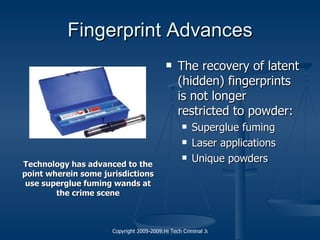
Fingerprint Advances The recovery of latent (hidden) fingerprints is not longer restricted to powder: Superglue fuming Laser applications Unique powders Technology has advanced to the point wherein some jurisdictions use superglue fuming wands at the crime scene
Fuming There are several types of fuming, the most recent is “ super glue fuming.”  Super glue contains the  chemical Cyanoacrylate.  When heated this  substance sticks to trace  oils, hardens and when  dry it is visible.
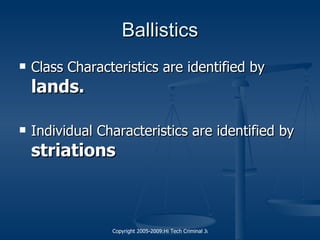
Ballistics Class Characteristics are identified by  lands. Individual Characteristics are identified by  striations
Firearms Identification
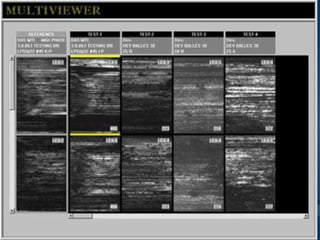
National Integrated Ballistic Identification System  In 1993, prior to NIBIN’s, the FBI (DRUGFIRE) and ATF (BULLETPROOF/CEASEFIRE) established separate computerized ballistics imaging systems. NIBIN was established in 1997 to unify these systems.  There are currently over 220 crime labs participating.
Criminal Investigations Part I Find more  police books  at www.police-writers.com

Criminal Investigations (Part One)

  • 1.
    Law Enforcement CriminalInvestigations Part One
  • 2.
    Preliminary Investigations Recallfrom our discussion on Uniformed Patrol – the Alternative Strategy of Retroactive Investigation of Past Crimes by Detectives If the call involves a crime, the officer conducts a preliminary investigation and often refers the case to a detective who then conducts a follow up investigation of the crime
  • 3.
    Crime Scene Alocation that may contain evidence of a crime.
  • 4.
    Crime Scenes Asearch of an offender’s home may yield evidence, but not be the location the crime occurred. Protocols for scene protection, documentation and evidence recovery are critical at all crime scenes
  • 5.
    Initial Response Note/loginformation Be aware of any persons or vehicles leaving. Approach the scene cautiously, scan the entire area to thoroughly assess the scene, and note any possible secondary crime scenes . Be aware of any persons and vehicles in the vicinity that may be related to the crime. Make initial observations (look, listen, smell) to assess the scene and ensure officer safety before proceeding. Remain alert and attentive. Assume the crime is ongoing until determined to be otherwise. Treat the location as a crime scene until assessed and determined to be otherwise.
  • 6.
    Officer Safety Thesafety of officers and others, in and around the crime scene, is the first responder’s responsibility. After controlling any dangerous situations or persons, the next responsibility is ensuring medical attention is provided to injured persons while minimizing contamination of the scene.
  • 7.
    Securing the SceneBoundaries of the scene start at a focal point, such as a body or point of entry and extend outward to include: Where the crime occurred. Potential points and paths of exit and entry of suspects and witnesses. Places where the victim/evidence may have been moved.
  • 8.
    Crime Scenes Evidencetends to deteriorate Investigator’s often refer to the “golden hour;” the time when evidence is best recovered. Some jurisdictions are taking the crime lab to the crime scene Photographs provided by OBS INC., Specialty Vehicles
  • 9.
    Evidence Collection Properprotocols and techniques for collecting evidence are very specific and critical. Generally, first responders preserve scenes and trained specialist collect and analysis evidence
  • 10.
    Evidence Collection Chainof Custody Testimony and documentation that details the location and condition of evidence from seizure to trial. It assures the court that items entered into evidence are in the same condition as when they were seized. The chain of custody and the procedures used to analyze evidence are more often challenged than the science behind the analysis.
  • 11.
    Forensic Science and Criminalistics Forensic comes from the Latin word "forensis," meaning "of the forum," where the law courts of ancient Rome were held Forensic science is the application of any type of science, biological, social, physical or mathematical to legal matters.
  • 12.
    Forensic Science andCriminalistics Forensic Science is the broader term, meaning the part of the science used to answer a legal question. Toxicology, ondontology, accounting, pathology, serology Criminalistics is a branch of Forensic Science dealing with the study of physical evidence related to a crime.
  • 13.
    Daubert Test Inorder for the analysis of evidence to be used against a defendant, the court must accept the scientific conclusion as valid. The standard for accepting scientific analysis is the Daubert Test – from Daubert v Merrel Dow Pharmaceuticals, inc.
  • 14.
    In the DaubertTest The Court asks - Is the science derived by the scientific method? Has the science been subjected to peer review or publication? Does the relevant scientific community generally accept the science? What is the error rate of thee scientific technique used to gain the information? Are there standards for controlling the technology used to obtain the scientific evidence?
  • 15.
    Transfer Theory EdmundLocard, a French Scientist developed the theory that contact between individuals or objects results in a transfer of material between them.
  • 16.
    Trace Evidence HairFiber Glass Paint Dust Dirt Chemicals Firearms Fluids Blood Bite Marks Shoe Prints Tool Marks Wounds Documents Fingerprints
  • 17.
    The First MajorSystems of Personal Identification Anthropometery exact measurements of an individuals body yields a characteristic formula for comparison. Dactlography Fingerprints
  • 18.
  • 19.
    The West Brotherscase is attributed to the ascendancy of fingerprints over other means of personal identification
  • 20.
    A 1924 Actof Congress established the FBI Identification Division By 1946 they had 100 Million Fingerprint cards
  • 21.
  • 22.
    Lifting Prints Plastic– Found in a soft surface like wax, paint or putty. Visible – Contact with a wet fluid like blood. Latent – Meaning “Hidden” These prints are left by the oils secreted by our hands and are generally not visible.
  • 23.
    Dusting for PrintsPowders have different properties, for instance color. Common colors are black, white, gray, aluminum, red, and gold. Color is selected to make the best contrast between the print and the surface. For instance , a white powder might works best on a dark surface .
  • 24.
    A utomatic Fingerprint I dentification S ystem
  • 25.
    AFIS A combinationof hardware and software used to scan and classify fingerprints so that they can be stored in a database. There are several regional, state and local AFIS databases: Western Identification Network Arizona DPS Ontario, CA police Department
  • 26.
    Integrated Automated FingerprintIdentification System National fingerprint and criminal history system maintained by the Federal Bureau of Investigation (FBI), Criminal Justice Information Services (CJIS) Division.
  • 27.
    AFIS Maintains thelargest Biometric database in the world, containing the fingerprints and corresponding criminal history information for more than 47 million subjects. The fingerprints and corresponding criminal history information are submitted voluntarily by state, local, and federal law enforcement agencies.
  • 28.
    Biometrics The scienceof automatically identifying individuals based on a physiological or psychological characteristic: Fingerprint Retinal Scan Voice Print Facial Scan Thermal Image Handwriting, gait, and others
  • 29.
    Returning to IAFISIAFIS provides FIVE services: Ten-Print Based Fingerprint Identification Services Latent Fingerprint Services Subject Search and Criminal History Services Document and Imaging Services Remote Ten-Print and Latent Fingerprint Search Services
  • 30.
    Fingerprint Advances Therecovery of latent (hidden) fingerprints is not longer restricted to powder: Superglue fuming Laser applications Unique powders Technology has advanced to the point wherein some jurisdictions use superglue fuming wands at the crime scene
  • 31.
    Fuming There areseveral types of fuming, the most recent is “ super glue fuming.” Super glue contains the chemical Cyanoacrylate. When heated this substance sticks to trace oils, hardens and when dry it is visible.
  • 32.
    Ballistics Class Characteristicsare identified by lands. Individual Characteristics are identified by striations
  • 33.
  • 34.
    National Integrated BallisticIdentification System In 1993, prior to NIBIN’s, the FBI (DRUGFIRE) and ATF (BULLETPROOF/CEASEFIRE) established separate computerized ballistics imaging systems. NIBIN was established in 1997 to unify these systems. There are currently over 220 crime labs participating.
  • 35.
    Criminal Investigations PartI Find more police books at www.police-writers.com

Editor's Notes

  • #2 For every officer, every hour of every shift is a criminal investigation.
  • #19 G. On June 19, 1892,  two children were murdered on the outskirts of the town of Necochea on the coast of Argentina.  This case is reported as the first murder solved by fingerprints thanks to the efforts of Juan Vucetich, a statistician employed by the Central Police Department in La Plata, Argentina. H. 1897 Edward Henry's assistant Azizul Haque comes up with a comprehensive system for classifying fingerprints, making practical their use without anthropometric measurements I. In the late 1800s a controversy broke out between William Herschel and Henry Faulds who both claimed to have discovered fingerprint identification as a means of identifying criminals. In 1892, Galton published the first definitive book on dactylography, Finger Prints. It presented statistical proof of the uniqueness of fingerprints and outlined many principles of identification by fingerprints.     In addition to ridge patterns, there are minute variations and irregularities in the ridges themselves. These are called RIDGE CHARACTERISTICS. Examples of ridge characteristics are RIDGE DOTS, BIFURCATIONS, SHORT RIDGES, RIDGE ENDS and CROSSINGS. Each print has its own unique combination of overall pattern and special ridge characteristics. No two prints have ever been found that were exactly alike . Even those of identical twins are different. Prints remain the same throughout life.
  • #20 K. Faurot and"James Jones" In 1904, New York City Detective Sergeant Joseph Faurot solved several hotel thefts by correctly identifying a suspect who claimed to be James Jones. Fingerprints correctly identified Jones as a thug with many prior convictions by the name of Daniel Nolan. L. The West Case In 1903 a fingerprint comparison of two Levenworth Penitentiary prisoners revealed that Will West and William West were two different individuals. This was despite the fact the two inmates had identical appearances and nearly identical Bertillon measurements. This showed the superiority of fingerprints to anthropometry as a system of identification.
  • #21 M. 1905 saw the use of fingerprints for the U.S. Army. Two years later the U.S. Navy started, and was joined the next year by the Marine Corp. During the next 25 years more and more law enforcement agencies join in the use of fingerprints as a means of personal identification. Many of these agencies began sending copies of their fingerprint cards to the National Bureau of Criminal Identification, which was established by the International Association of Police Chiefs. It was in 1918 when Edmond Locard wrote that if 12 points (Galton's Details) were the same between two fingerprints, it would suffice as a positive identification. This is where the often quoted (12 points) originated. Be aware though, there is "NO" required number of points necessary for an identification. Some countries have set their own standards which do include a minimum number of points, but not in the United States. In 1924, an act of congress established the Identification Division of the F.B.I.. The National Bureau and Leavenworth consolidated to form the nucleus of the F.B.I. fingerprint files. By 1946, the F.B.I. had processed 100 million fingerprint cards in manually maintained files; and by 1971, 200 million cards.
  • #22 1905 saw the use of fingerprints for the U.S. Army. Two years later the U.S. Navy started, and was joined the next year by the Marine Corp. During the next 25 years more and more law enforcement agencies join in the use of fingerprints as a means of personal identification. Many of these agencies began sending copies of their fingerprint cards to the National Bureau of Criminal Identification, which was established by the International Association of Police Chiefs. It was in 1918 when Edmond Locard wrote that if 12 points (Galton's Details) were the same between two fingerprints, it would suffice as a positive identification. This is where the often quoted (12 points) originated. Be aware though, there is "NO" required number of points necessary for an identification. Some countries have set their own standards which do include a minimum number of points, but not in the United States.
  • #25 By 1999, the FBI had planned to stop using paper fingerprint cards (at least for the newly arriving civil fingerprints) inside their new Integrated AFIS (IAFIS) site at Clarksburg, WV. IAFIS will initially have individual computerized fingerprint records for approximately 33 million criminals. Old paper fingerprint cards for the civil files are still manually maintained in a warehouse facility (rented shopping center space) in Fairmont, WV. Since the Gulf War, most military fingerprint enlistment cards received have been filed only alphabetically by name. The FBI hopes to someday classify and file these cards so they can be of value for unknown casualty (or amnesiac) identification (when no passenger/victim list from a flight, etc., is known). The characteristics of a fingerprints, ridges, etc are called minutiae. The distance between minutiae points is calculated and converted into a numerical value.
  • #33   C. All firearms, except shotguns have rifling in their barrels. Rifling is the process of drilling out the barrel used by each manufacture. This rifling creates grooves called lands, the distance between these is measured in hundredths of an inch or millimeters. The distance between the lands determines the caliber, therefore a .38 caliber revolver has lands that are .38 hundreds of an inch apart. Other components of the bullet, like the twist can tell the investigator the manufacturer, model and caliber of a weapon. D. Striations tell the investigator the individual characteristics of a firearm. These are small marks on the sides of a bullet which are made by passing through the barrel. These marks are caused by imperfections and differences made on the barrel during the rifling process. No two striations are the same.
  • #34 IV. Firearms Identification A. 1835 Henry Goddar, a Bow Street Runner, made the first successful attempt to identify a murderer from a bullet recovered from the body of a victim. B. Firearms identification includes identification of the types of ammunition, designing firearms, restoring obliterated serial numbers on weapons, estimating the distance between the firearms muzzle and the victim.