CSI Series
Presented by detective Mr. Sherlock Holmes
Edited by Nashwa Mostafa Mahmoud
Outlin
es•Definitions:
•Objectives:
•Processing the
crime scene;
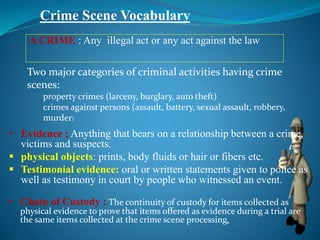
Crime Scene Vocabulary
• Chain of Custody : The continuity of custody for items collected as
physical evidence to prove that items offered as evidence during a trial are
the same items collected at the crime scene processing.
A CRIME : Any illegal act or any act against the law
• Evidence ; Anything that bears on a relationship between a crime,
victims and suspects.
 physical objects: prints, body fluids or hair or fibers etc.
 Testimonial evidence: oral or written statements given to police as
well as testimony in court by people who witnessed an event.
Two major categories of criminal activities having crime
scenes:
property crimes (larceny, burglary, auto theft)
crimes against persons (assault, battery, sexual assault, robbery,
murder)
Can be classified by:
Location of Criminal Activity
Size of Area
Type of Crime Committed
Physical Location of the Crime
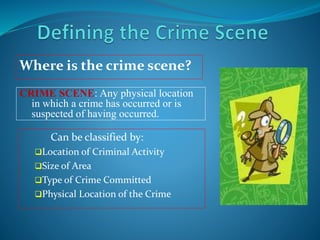
Where is the crime scene?
CRIME SCENE: Any physical location
in which a crime has occurred or is
suspected of having occurred.
Location of Criminal Activity
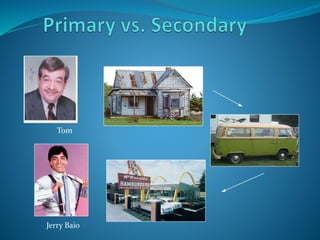
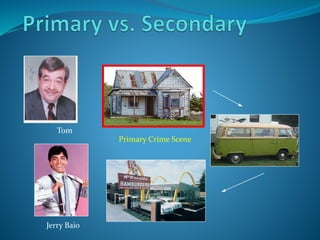
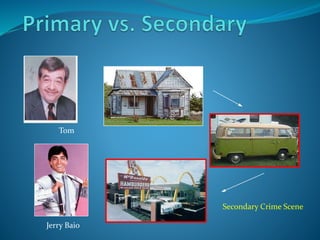
 Primary = where the original crime occurred
Let’s look at an example
 Secondary = subsequent crime scenes
Tom
Jerry Baio
Tom
Jerry Baio
Primary Crime Scene
Tom
Jerry Baio
Secondary Crime Scene
Size of Crime Scene
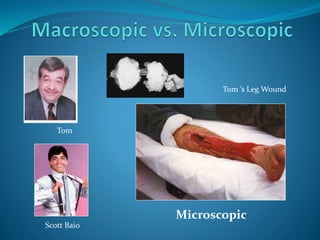
 Macroscopic = one location,
composed of many microscopic
crime scenes
 Microscopic = focuses on specific
type of physical evidence
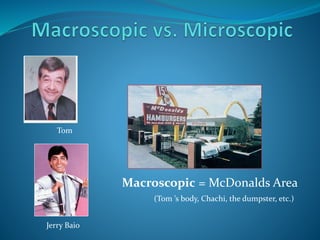
Tom
Jerry Baio
Macroscopic = McDonalds Area
(Tom ’s body, Chachi, the dumpster, etc.)
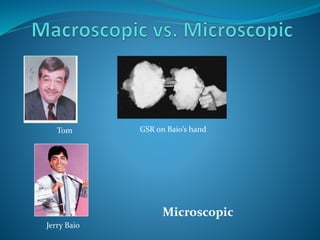
Tom
Jerry Baio
Microscopic
GSR on Baio’s hand
Tom
Scott Baio
Microscopic
Tom ’s Leg Wound
Type of Crime Committed
Homicide, Robbery, Sexual Assault, etc.
Physical Location of Crime Scene
Indoors, Outdoors, Vehicle, etc.
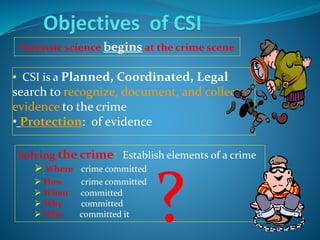
• CSI is a Planned, Coordinated, Legal
search to recognize, document, and collect
evidence to the crime
• Protection: of evidence
Objectives of CSI
Solving the crime: Establish elements of a crime
 Where crime committed
 How crime committed
 When committed
 Why committed
 Who committed it
Forensic science begins at the crime scene.
?
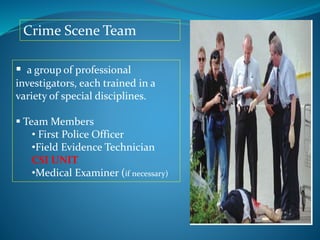
 a group of professional
investigators, each trained in a
variety of special disciplines.
 Team Members
• First Police Officer
•Field Evidence Technician
CSI UNIT
•Medical Examiner (if necessary)
Crime Scene Team
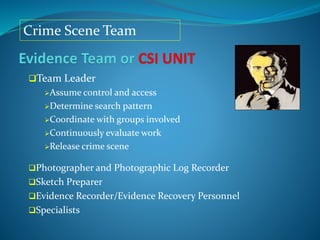
Crime Scene Team
Team Leader
Assume control and access
Determine search pattern
Coordinate with groups involved
Continuously evaluate work
Release crime scene
Photographer and Photographic Log Recorder
Sketch Preparer
Evidence Recorder/Evidence Recovery Personnel
Specialists
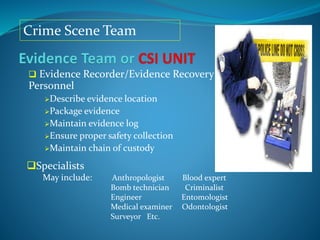
Crime Scene Team
 Evidence Recorder/Evidence Recovery
Personnel
Describe evidence location
Package evidence
Maintain evidence log
Ensure proper safety collection
Maintain chain of custody
Specialists
May include: Anthropologist Blood expert
Bomb technician Criminalist
Engineer Entomologist
Medical examiner Odontologist
Surveyor Etc.
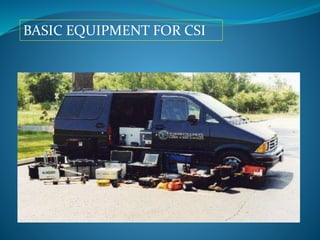
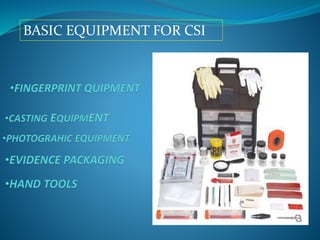
BASIC EQUIPMENT FOR CSI
The removal of any person or evidence from a crime scene
must be done in conformity with Forth Amendment privileges.
Therefore, search warrants are required.
A warrantless search only be conducted under the following
circumstances:
 Existence of an emergency
 To prevent immediate loss or destruction of evidence
 Search of a person or property of the person during his arrest
 Search an seizure with the consent of the persons involved
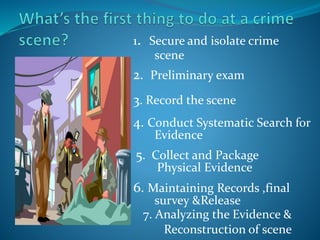
2. Preliminary exam
3. Record the scene
6. Maintaining Records ,final
survey &Release
5. Collect and Package
Physical Evidence
1. Secure and isolate crime
scene
4. Conduct Systematic Search for
Evidence
7. Analyzing the Evidence &
Reconstruction of scene
Responsibility of first officer on scene:
steps to preserve and protect scene:
 First priority - medical assistance
 Exclude all unauthorized personnel
 Establish and Control entry / exit points
 Ropes, Tape, Barricades and Guards
strategically placed.
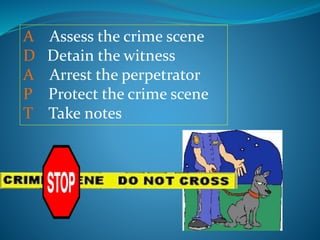
A Assess the crime scene
D Detain the witness
A Arrest the perpetrator
P Protect the crime scene
T Take notes
 Establish perpetrator’s path of entry and exit
 Obvious items photographed and
documented
 Initial walk through to gain overview and
develop strategy for systematic search
 Boundaries of Scene determined
Does the area being searched need to be expanded?
Investigators have a limited time to work a crime
site in its untouched state.
Such records useful during the investigation &
required at a trial in order to document the condition
of the crime site and to delineate the location of
physical evidence.
Every step of the investigation should be
documented thoroughly with an appropriate method.
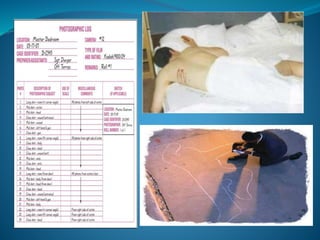
1. Photograph
2. Sketch
3. Notes
4. +/- Video/taping
 Three methods of crime-scene recording:
 Ideally all, should be used
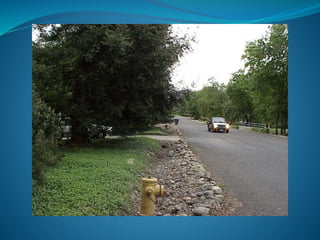
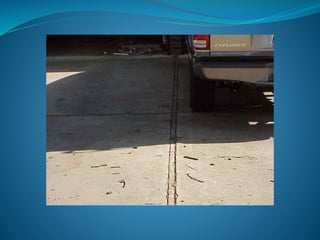
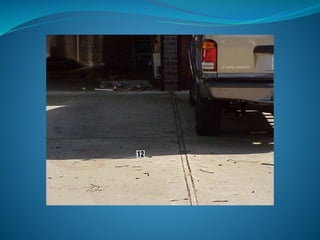
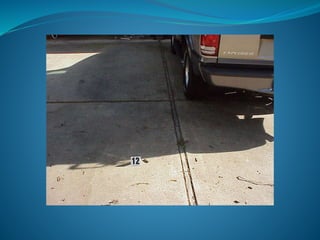
Crime scene should be photographed completely :
 The crime scene should be unaltered, unless
injured people are involved.
Objects must not be moved until they have been
photographed from all necessary angles.
If things are removed, added, or positions changed
the photographs may not be admissible evidence.
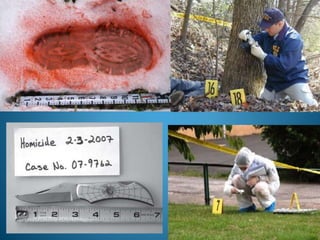
Crime scene should be photographed completely :
If crime scene includes a body:
Take photos to show body’s location & position relative to the
whole crime scene
Take close-up photos of injuries & weapons lying near the body
After the body is removed, photograph the surface underneath.
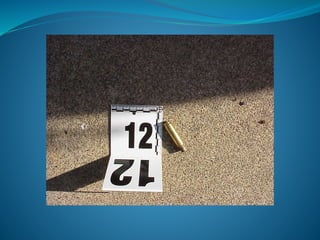
When size is significant, use a ruler or other measuring
scale
Digital cameras preferred examination in fine detail.
Crime scene should be photographed completely :
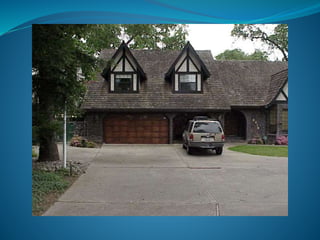
1. Overall:
1. Outside and inside
2. All directions
3. All four walls/ all rooms
4. Doors/ windows
5. Orientation of evidence with and without
labels
2. Midrange
3. Close up
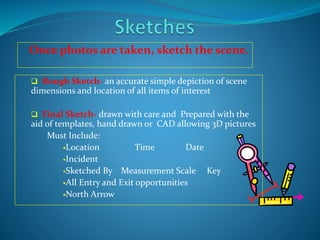
Once photos are taken, sketch the scene.

 Definition: The notes and measurements one
takes at a scene which shows the key physical
measurements or map of the scene and its evidence
location.
Purpose
To document relationship of evidences to crime scene
To illustrate to others the crime scene
To provide an overall perspective of the scene
Once photos are taken, sketch the scene.
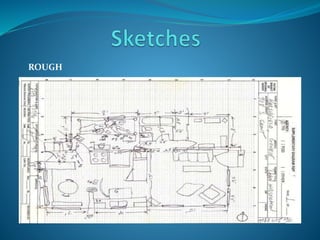
 Rough Sketch- an accurate simple depiction of scene
dimensions and location of all items of interest
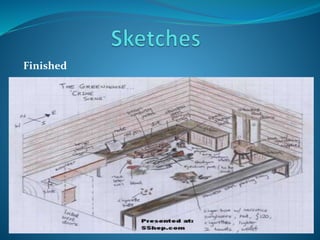
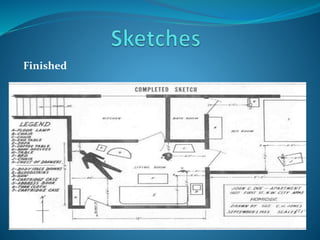
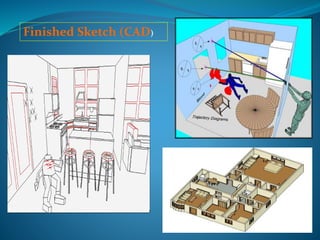
 Final Sketch- drawn with care and Prepared with the
aid of templates, hand drawn or CAD allowing 3D pictures
Must Include:
Location Time Date
Incident
Sketched By Measurement Scale Key
All Entry and Exit opportunities
North Arrow
ROUGH
Finished
Finished
Finished Sketch (CAD)
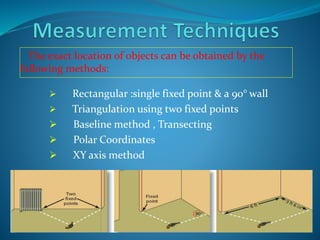
The exact location of objects can be obtained by the
following methods:
 Rectangular :single fixed point & a 90° wall
 Triangulation using two fixed points
 Baseline method , Transecting
 Polar Coordinates
 XY axis method
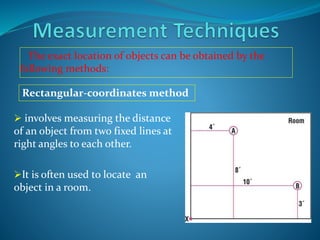
The exact location of objects can be obtained by the
following methods:
 involves measuring the distance
of an object from two fixed lines at
right angles to each other.
It is often used to locate an
object in a room.
Rectangular-coordinates method
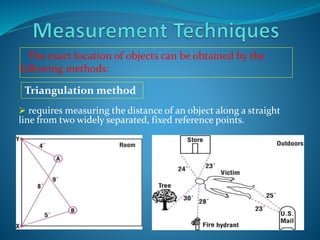
The exact location of objects can be obtained by the
following methods:
 requires measuring the distance of an object along a straight
line from two widely separated, fixed reference points.
Triangulation method
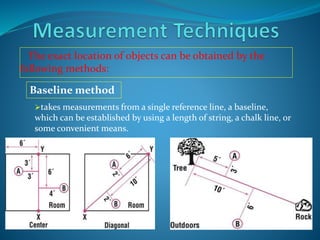
The exact location of objects can be obtained by the
following methods:
takes measurements from a single reference line, a baseline,
which can be established by using a length of string, a chalk line, or
some convenient means.
Baseline method
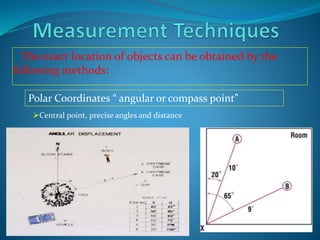
Polar Coordinates “ angular or compass point”
The exact location of objects can be obtained by the
following methods:
Central point, precise angles and distance
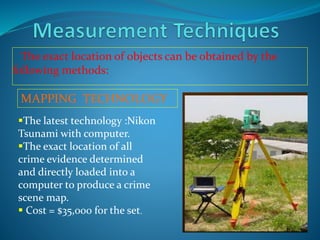
The exact location of objects can be obtained by the
following methods:
MAPPING TECHNOLOGY
The latest technology :Nikon
Tsunami with computer.
The exact location of all
crime evidence determined
and directly loaded into a
computer to produce a crime
scene map.
 Cost = $35,000 for the set.
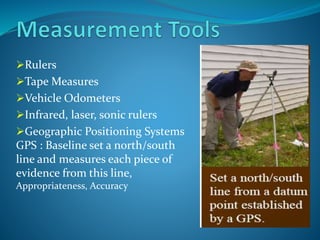
Rulers
Tape Measures
Vehicle Odometers
Infrared, laser, sonic rulers
Geographic Positioning Systems
GPS : Baseline set a north/south
line and measures each piece of
evidence from this line,
Appropriateness, Accuracy
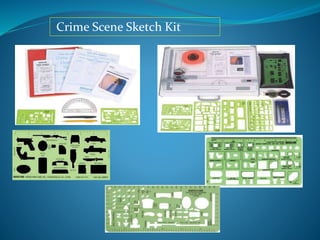
Crime Scene Sketch Kit
 Constant activity throughout the investigation
 Notes must include:
 detailed written description of the scene
 Mention every piece of physical evidence collected and rationale for collection.
 Records time that each piece of evidence was discovered.
 Record who discovered the evidence and how they packaged it
 This may be the only source of memory recall after the crime
scene
 Tape-recording the notes is a good idea
 Narrating a video as the scene is investigated is an even better
idea
 Video or audio must still be transcribed into a written document
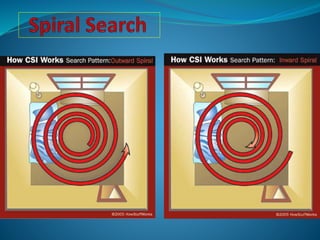
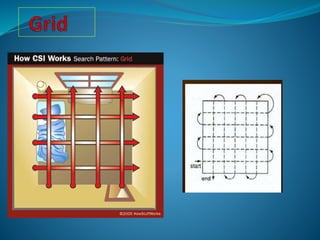
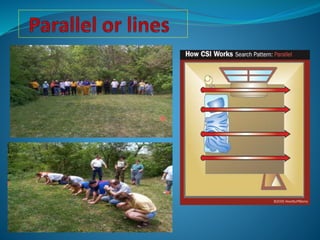
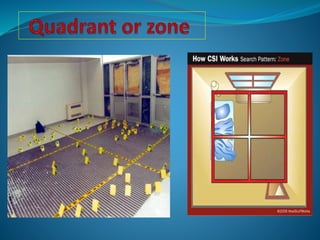
 The search for physical evidence at a crime
scene must be thorough and systematic.
 The search pattern depend on the size and
locale of the scene and the number of collectors
participating in the search.
 Physical evidence can be anything from massive
objects to microscopic traces.
 Spiral - Used when there’s only one investigator
or under water
 Strip or Lane – Parallel rows
 Grid- Crisscross
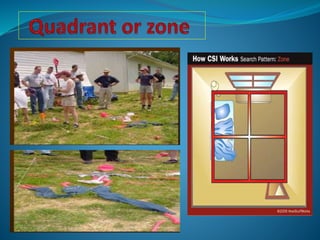
 Quadrant- Area is divided into 4 quarters and
each is searched individually.
Four types
oPhysical evidence must be handled and processed in
a way that prevents any change from the time it is
removed to the time it arrives at the lab.
oWhat are some sources of contamination?
Breakage
Evaporation
Accidental Scratching or bending
Loss through improper Careless packaging
Improper handling
oWhat to Collect:
Anything from a massive object to a microscopic trace
Often, many items of evidence are clearly visible but
others may be detected only through examination at the
crime laboratory.
For this reason, it is important to collect possible carriers
of trace evidence, such as clothing, vacuum sweepings, and
fingernail scrapings, in addition to more discernible items.
oDeceased Victims: Pathologist will collect:
Clothing
Fingernail scrapings
Head and pubic hairs
Blood (for DNA typing)
Vaginal, Anal, and Oral Swabs (Sex Crimes)
Recovered bullets from body
Hand swabs from shooting victims
After burial, collection of evidence from
the body is difficult if not impossible
 Investigators must wear gloves, protective shoe coverings
and hair nets to prevent contamination
 Four main packaging categories:
Trace (fibers, hairs, skin cells),
Non-Biological (soil, paper),
Biological (body fluids, insects)
 Arson
Collection Methods:
Whenever possible, items should be collected “intact,” otherwise a sampling
method is used
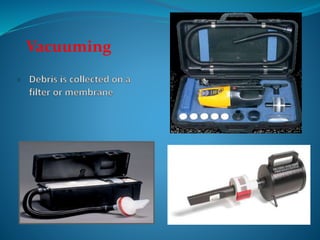
Sampling methods include using forceps, tape lifts, or vacuuming the item
Biological material may be sampled by cutting, swabbing or scraping
Shaking or scraping the item should be done in a lab environment
Numbering & Description Methods:
Numbering, a brief description marked on the
packaging and in the evidence log
Numbers at the scene, on the packaging, and in the
evidence log should all agree
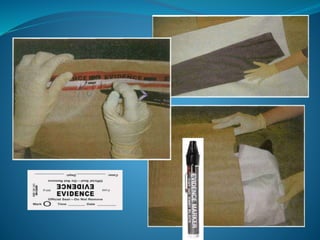
Each piece of evidence is packaged, labeled
and sealed
Removal of All evidence must be in accordance with
appropriate search and seizure protocols.
 Standard/Reference Sample:
For example, blood-stained evidence must be accompanied
by blood samples from both the victim as well as the
suspect(s), Same is true with hair, fibers, fingerprints soil,
etc
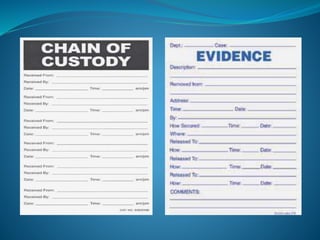
Continuity of possession
Established when evidence is presented in court
Info. Collected: initials, date, location of evidence
To avoid confusion and retain control at all times – individuals
on chain of custody should be kept to a minimum.
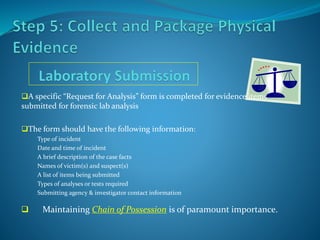
A specific “Request for Analysis” form is completed for evidence items
submitted for forensic lab analysis
The form should have the following information:
Type of incident
Date and time of incident
A brief description of the case facts
Names of victim(s) and suspect(s)
A list of items being submitted
Types of analyses or tests required
Submitting agency & investigator contact information
 Maintaining Chain of Possession is of paramount importance.
Vacuuming
Typically, numerous forms must be filled out
Submitting officers name, agency, address,
phone
Case number
Summary of case including date and time
Name & description of individuals involved,
both victims and suspects
A list of evidence
Types of examinations
Where evidence & reports should be sent
The following is completed by a team leader:
Review of all aspects of search
Discussion of findings
Make sure all evidence is marked and accounted for
Ensure all equipment has been gathered
Time and date of release and who scene is released to.
Following the CSI, the forensic lab work begins
Crime scene analysis involves theory building from all scene
and investigative information
Investigative information includes:
Forensic laboratory analysis and comparisons of all relevant evidence
submitted for analysis
Medical examiner’s report on the cause and manner of death, which
usually includes the results of toxicological analysis of biological
samples from the autopsy
Following the CSI, the forensic lab work begins
Reconstruction:
The formulation of the “best theory” of the events in a case
Based on all the available evidence, information, and supportive data
May require experiments to try and duplicate some of the events (e.g.
blood spatter)
May be complete, partial, or limited
Reenactment:
A hypothetical rendition of a set of events at a crime scene partially
based on the reconstruction theory
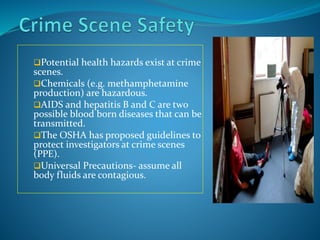
Potential health hazards exist at crime
scenes.
Chemicals (e.g. methamphetamine
production) are hazardous.
AIDS and hepatitis B and C are two
possible blood born diseases that can be
transmitted.
The OSHA has proposed guidelines to
protect investigators at crime scenes
(PPE).
Universal Precautions- assume all
body fluids are contagious.
‫اقفشتك‬‫ال‬ ‫انتي‬ ‫اكيد‬ ‫حرمياية‬ ‫يا‬??Assailant ……

Csi ppt

  • 1.
    CSI Series Presented bydetective Mr. Sherlock Holmes Edited by Nashwa Mostafa Mahmoud
  • 2.
  • 3.
    Crime Scene Vocabulary •Chain of Custody : The continuity of custody for items collected as physical evidence to prove that items offered as evidence during a trial are the same items collected at the crime scene processing. A CRIME : Any illegal act or any act against the law • Evidence ; Anything that bears on a relationship between a crime, victims and suspects.  physical objects: prints, body fluids or hair or fibers etc.  Testimonial evidence: oral or written statements given to police as well as testimony in court by people who witnessed an event. Two major categories of criminal activities having crime scenes: property crimes (larceny, burglary, auto theft) crimes against persons (assault, battery, sexual assault, robbery, murder)
  • 4.
    Can be classifiedby: Location of Criminal Activity Size of Area Type of Crime Committed Physical Location of the Crime Where is the crime scene? CRIME SCENE: Any physical location in which a crime has occurred or is suspected of having occurred.
  • 5.
    Location of CriminalActivity  Primary = where the original crime occurred Let’s look at an example  Secondary = subsequent crime scenes
  • 6.
  • 7.
  • 8.
  • 9.
    Size of CrimeScene  Macroscopic = one location, composed of many microscopic crime scenes  Microscopic = focuses on specific type of physical evidence
  • 10.
    Tom Jerry Baio Macroscopic =McDonalds Area (Tom ’s body, Chachi, the dumpster, etc.)
  • 11.
  • 12.
  • 13.
    Type of CrimeCommitted Homicide, Robbery, Sexual Assault, etc. Physical Location of Crime Scene Indoors, Outdoors, Vehicle, etc.
  • 14.
    • CSI isa Planned, Coordinated, Legal search to recognize, document, and collect evidence to the crime • Protection: of evidence Objectives of CSI Solving the crime: Establish elements of a crime  Where crime committed  How crime committed  When committed  Why committed  Who committed it Forensic science begins at the crime scene. ?
  • 16.
     a groupof professional investigators, each trained in a variety of special disciplines.  Team Members • First Police Officer •Field Evidence Technician CSI UNIT •Medical Examiner (if necessary) Crime Scene Team
  • 17.
    Crime Scene Team TeamLeader Assume control and access Determine search pattern Coordinate with groups involved Continuously evaluate work Release crime scene Photographer and Photographic Log Recorder Sketch Preparer Evidence Recorder/Evidence Recovery Personnel Specialists
  • 18.
    Crime Scene Team Evidence Recorder/Evidence Recovery Personnel Describe evidence location Package evidence Maintain evidence log Ensure proper safety collection Maintain chain of custody Specialists May include: Anthropologist Blood expert Bomb technician Criminalist Engineer Entomologist Medical examiner Odontologist Surveyor Etc.
  • 19.
  • 20.
  • 21.
    The removal ofany person or evidence from a crime scene must be done in conformity with Forth Amendment privileges. Therefore, search warrants are required. A warrantless search only be conducted under the following circumstances:  Existence of an emergency  To prevent immediate loss or destruction of evidence  Search of a person or property of the person during his arrest  Search an seizure with the consent of the persons involved
  • 23.
    2. Preliminary exam 3.Record the scene 6. Maintaining Records ,final survey &Release 5. Collect and Package Physical Evidence 1. Secure and isolate crime scene 4. Conduct Systematic Search for Evidence 7. Analyzing the Evidence & Reconstruction of scene
  • 24.
    Responsibility of firstofficer on scene: steps to preserve and protect scene:  First priority - medical assistance  Exclude all unauthorized personnel  Establish and Control entry / exit points  Ropes, Tape, Barricades and Guards strategically placed.
  • 25.
    A Assess thecrime scene D Detain the witness A Arrest the perpetrator P Protect the crime scene T Take notes
  • 26.
     Establish perpetrator’spath of entry and exit  Obvious items photographed and documented  Initial walk through to gain overview and develop strategy for systematic search  Boundaries of Scene determined Does the area being searched need to be expanded?
  • 27.
    Investigators have alimited time to work a crime site in its untouched state. Such records useful during the investigation & required at a trial in order to document the condition of the crime site and to delineate the location of physical evidence. Every step of the investigation should be documented thoroughly with an appropriate method.
  • 28.
    1. Photograph 2. Sketch 3.Notes 4. +/- Video/taping  Three methods of crime-scene recording:  Ideally all, should be used
  • 29.
    Crime scene shouldbe photographed completely :  The crime scene should be unaltered, unless injured people are involved. Objects must not be moved until they have been photographed from all necessary angles. If things are removed, added, or positions changed the photographs may not be admissible evidence.
  • 30.
    Crime scene shouldbe photographed completely : If crime scene includes a body: Take photos to show body’s location & position relative to the whole crime scene Take close-up photos of injuries & weapons lying near the body After the body is removed, photograph the surface underneath. When size is significant, use a ruler or other measuring scale Digital cameras preferred examination in fine detail.
  • 31.
    Crime scene shouldbe photographed completely : 1. Overall: 1. Outside and inside 2. All directions 3. All four walls/ all rooms 4. Doors/ windows 5. Orientation of evidence with and without labels 2. Midrange 3. Close up
  • 46.
    Once photos aretaken, sketch the scene.   Definition: The notes and measurements one takes at a scene which shows the key physical measurements or map of the scene and its evidence location. Purpose To document relationship of evidences to crime scene To illustrate to others the crime scene To provide an overall perspective of the scene
  • 47.
    Once photos aretaken, sketch the scene.  Rough Sketch- an accurate simple depiction of scene dimensions and location of all items of interest  Final Sketch- drawn with care and Prepared with the aid of templates, hand drawn or CAD allowing 3D pictures Must Include: Location Time Date Incident Sketched By Measurement Scale Key All Entry and Exit opportunities North Arrow
  • 48.
  • 49.
  • 50.
  • 51.
  • 52.
    The exact locationof objects can be obtained by the following methods:  Rectangular :single fixed point & a 90° wall  Triangulation using two fixed points  Baseline method , Transecting  Polar Coordinates  XY axis method
  • 53.
    The exact locationof objects can be obtained by the following methods:  involves measuring the distance of an object from two fixed lines at right angles to each other. It is often used to locate an object in a room. Rectangular-coordinates method
  • 54.
    The exact locationof objects can be obtained by the following methods:  requires measuring the distance of an object along a straight line from two widely separated, fixed reference points. Triangulation method
  • 55.
    The exact locationof objects can be obtained by the following methods: takes measurements from a single reference line, a baseline, which can be established by using a length of string, a chalk line, or some convenient means. Baseline method
  • 56.
    Polar Coordinates “angular or compass point” The exact location of objects can be obtained by the following methods: Central point, precise angles and distance
  • 57.
    The exact locationof objects can be obtained by the following methods: MAPPING TECHNOLOGY The latest technology :Nikon Tsunami with computer. The exact location of all crime evidence determined and directly loaded into a computer to produce a crime scene map.  Cost = $35,000 for the set.
  • 58.
    Rulers Tape Measures Vehicle Odometers Infrared,laser, sonic rulers Geographic Positioning Systems GPS : Baseline set a north/south line and measures each piece of evidence from this line, Appropriateness, Accuracy
  • 59.
  • 60.
     Constant activitythroughout the investigation  Notes must include:  detailed written description of the scene  Mention every piece of physical evidence collected and rationale for collection.  Records time that each piece of evidence was discovered.  Record who discovered the evidence and how they packaged it  This may be the only source of memory recall after the crime scene  Tape-recording the notes is a good idea  Narrating a video as the scene is investigated is an even better idea  Video or audio must still be transcribed into a written document
  • 61.
     The searchfor physical evidence at a crime scene must be thorough and systematic.  The search pattern depend on the size and locale of the scene and the number of collectors participating in the search.  Physical evidence can be anything from massive objects to microscopic traces.
  • 62.
     Spiral -Used when there’s only one investigator or under water  Strip or Lane – Parallel rows  Grid- Crisscross  Quadrant- Area is divided into 4 quarters and each is searched individually. Four types
  • 68.
    oPhysical evidence mustbe handled and processed in a way that prevents any change from the time it is removed to the time it arrives at the lab. oWhat are some sources of contamination? Breakage Evaporation Accidental Scratching or bending Loss through improper Careless packaging Improper handling
  • 69.
    oWhat to Collect: Anythingfrom a massive object to a microscopic trace Often, many items of evidence are clearly visible but others may be detected only through examination at the crime laboratory. For this reason, it is important to collect possible carriers of trace evidence, such as clothing, vacuum sweepings, and fingernail scrapings, in addition to more discernible items.
  • 70.
    oDeceased Victims: Pathologistwill collect: Clothing Fingernail scrapings Head and pubic hairs Blood (for DNA typing) Vaginal, Anal, and Oral Swabs (Sex Crimes) Recovered bullets from body Hand swabs from shooting victims After burial, collection of evidence from the body is difficult if not impossible
  • 71.
     Investigators mustwear gloves, protective shoe coverings and hair nets to prevent contamination  Four main packaging categories: Trace (fibers, hairs, skin cells), Non-Biological (soil, paper), Biological (body fluids, insects)  Arson
  • 72.
    Collection Methods: Whenever possible,items should be collected “intact,” otherwise a sampling method is used Sampling methods include using forceps, tape lifts, or vacuuming the item Biological material may be sampled by cutting, swabbing or scraping Shaking or scraping the item should be done in a lab environment Numbering & Description Methods: Numbering, a brief description marked on the packaging and in the evidence log Numbers at the scene, on the packaging, and in the evidence log should all agree
  • 73.
    Each piece ofevidence is packaged, labeled and sealed Removal of All evidence must be in accordance with appropriate search and seizure protocols.  Standard/Reference Sample: For example, blood-stained evidence must be accompanied by blood samples from both the victim as well as the suspect(s), Same is true with hair, fibers, fingerprints soil, etc
  • 74.
    Continuity of possession Establishedwhen evidence is presented in court Info. Collected: initials, date, location of evidence To avoid confusion and retain control at all times – individuals on chain of custody should be kept to a minimum.
  • 75.
    A specific “Requestfor Analysis” form is completed for evidence items submitted for forensic lab analysis The form should have the following information: Type of incident Date and time of incident A brief description of the case facts Names of victim(s) and suspect(s) A list of items being submitted Types of analyses or tests required Submitting agency & investigator contact information  Maintaining Chain of Possession is of paramount importance.
  • 77.
  • 79.
    Typically, numerous formsmust be filled out Submitting officers name, agency, address, phone Case number Summary of case including date and time Name & description of individuals involved, both victims and suspects A list of evidence Types of examinations Where evidence & reports should be sent
  • 80.
    The following iscompleted by a team leader: Review of all aspects of search Discussion of findings Make sure all evidence is marked and accounted for Ensure all equipment has been gathered Time and date of release and who scene is released to.
  • 81.
    Following the CSI,the forensic lab work begins Crime scene analysis involves theory building from all scene and investigative information Investigative information includes: Forensic laboratory analysis and comparisons of all relevant evidence submitted for analysis Medical examiner’s report on the cause and manner of death, which usually includes the results of toxicological analysis of biological samples from the autopsy
  • 82.
    Following the CSI,the forensic lab work begins Reconstruction: The formulation of the “best theory” of the events in a case Based on all the available evidence, information, and supportive data May require experiments to try and duplicate some of the events (e.g. blood spatter) May be complete, partial, or limited Reenactment: A hypothetical rendition of a set of events at a crime scene partially based on the reconstruction theory
  • 83.
    Potential health hazardsexist at crime scenes. Chemicals (e.g. methamphetamine production) are hazardous. AIDS and hepatitis B and C are two possible blood born diseases that can be transmitted. The OSHA has proposed guidelines to protect investigators at crime scenes (PPE). Universal Precautions- assume all body fluids are contagious.
  • 84.
    ‫اقفشتك‬‫ال‬ ‫انتي‬ ‫اكيد‬‫حرمياية‬ ‫يا‬??Assailant ……