Cumberland County 
Sheriff’s Department 
Inv. John Haynes 
931-484-6176 
ccsd843@officer.com
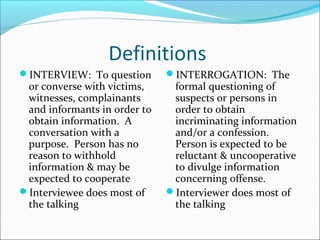
Definitions 
INTERVIEW: To question 
or converse with victims, 
witnesses, complainants 
and informants in order to 
obtain information. A 
conversation with a 
purpose. Person has no 
reason to withhold 
information & may be 
expected to cooperate 
Interviewee does most of 
the talking 
INTERROGATION: The 
formal questioning of 
suspects or persons in 
order to obtain 
incriminating information 
and/or a confession. 
Person is expected to be 
reluctant & uncooperative 
to divulge information 
concerning offense. 
Interviewer does most of 
the talking
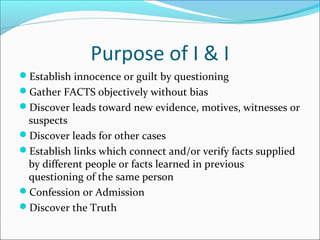
Purpose of I & I 
Establish innocence or guilt by questioning 
Gather FACTS objectively without bias 
Discover leads toward new evidence, motives, witnesses or 
suspects 
Discover leads for other cases 
Establish links which connect and/or verify facts supplied 
by different people or facts learned in previous 
questioning of the same person 
Confession or Admission 
Discover the Truth
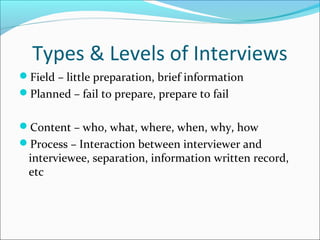
Types & Levels of Interviews 
Field – little preparation, brief information 
Planned – fail to prepare, prepare to fail 
Content – who, what, where, when, why, how 
Process – Interaction between interviewer and 
interviewee, separation, information written record, 
etc
The Setting 
A room without distractions 
One table & three chairs 
Large enough for three 
Nothing between you and the subject 
Make him comfortable 
No stimulants 
Partner to take notes 
Your own personal Hygiene & Appearance
The Setting at Suspect’s Home 
No interruptions 
No other family members 
Take control and be in charge 
Have partner take notes 
Phones turned OFF 
Miranda ????????? 
 Custodial 
 Interrogation 
 Police
What If They Lawyer Up 
Can you interview after a suspect ask for a lawyer? 
Feb. 24, 2010. The Supreme Court ruled that a break in 
custody of more that two, (2) weeks is sufficient for new 
questioning without a lawyer, according to the opinion 
by Justice Antonin Scalia. Scalia wrote, “While it is 
certainly unusual for this court to set forth precise time 
limits governing police action, it is not unheard of.” 
Scalia further wrote, “A 14 day period provides plenty of 
time for the suspect to get re-acclimated to his normal 
life, to consult with friends and counsel and to shake off 
any residual effects of his prior custody.”
What If They Lawyer Up 
Can you interview after a suspect ask for a lawyer? 
 Check with your local D A as to what their policy 
is.
I & I Rules 
ID & interview ALL victims & witnesses ASAP 
Privacy and/or Separation 
Location of interview 
Miranda warning 
Take your time 
Keep written record of facts learned 
One question at a time 
Allow person to save face 
Control the interview 
Keep a positive attitude 
Know what questions to ask and order to ask
Dealing with Juveniles 
No black or white rules, 37-1-115, case law 
Does child understand Miranda 
How old is child 
Is there an opportunity to ask parents 
Has child been exposed to the Justice System 
Can you defend your actions in Court
The Interviewer 
SALESMAN 
ACTOR 
PSYCHOLOGIST 
LISTENER
The Interviewer 
SALESMAN. An interviewer is selling two things. 
First you must sell yourself as a PROFESSIONAL. You 
must sell the interviewee on the idea that it is in his 
best interest to tell you his version of the story. The 
second thing you are selling is jail time. Statistically, 
85 percent of the general population will confess if the 
interview is properly conducted.
The Interviewer 
ACTOR. You must be a good actor. Regardless of 
what type of crime you are investigating you must 
minimize the severity of it. Do not become 
emotionally involved. You must leave out your human 
bias.
The Interviewer 
PSYCHOLOGIST. Learn as much as you can about 
the person being interviewed prior to the interview. 
Listen carefully throughout the interview to continue 
to learn things about him. The more you know about 
him the more likely you can sell him on the idea of 
telling you his side of the story.
The Interviewer 
EFFECTIVE LISTENER. You must learn to maintain 
eye contact, Allow the person to finish sentences, 
focus on the content of feedback, focus on his posture 
and be able to break down information while taking 
notes. The interviewer must learn to listen with his 
eyes as well as his ears.
The Interviewer 
Attitude 
 Be Objective 
 Be Cordial and Polite 
 Be Even-Tempered 
 Be Sincere 
 Be Interested 
 Be Understanding
The Interviewer 
Posture 
 Sit Upright 
 Sit Frontally Aligned 
 Lean Forward on Occasion 
 Stay Open, No Crossed Arms 
 Avoid Slouching 
 Feet flat on floor 
 Close the Distance Between You and Him
The Interviewer 
Eye Contact 
 Should be maintained when asking questions or 
when they answer 
 Avoid staring, casual eye contact breaks are 
important 
 Look away when he gives denials
The Interviewer 
Facial Expressions 
 Avoid expressions of disbelief, shock, anger, humor, 
disgust and skepticism 
 Show interest 
 Expressions of understanding when you give him 
moral justification for his actions
The Interviewer 
Tone of Voice 
 Medium, conversational 
 Smooth speech 
 No skeptical tone
The Interviewer 
Questioning the Suspect 
 Avoid paraphrasing what he says 
 Show understanding when he expresses strong 
negative emotions 
 Avoid challenges to his statements and alibis 
 Avoid long delays between asking questions 
 If It Is Important To Him, It Should Be Important 
To You
The Interviewer 
Hand Gestures 
 Use a lot of hand gestures when talking 
 Palms should be up and arms open 
 Avoid negative or strong gestures
Baseline Analysis 
Establish Rapport. If the subject isn’t comfortable 
with you he will not tell you anything. 
Introduce yourself, shake his hand and ask to call him 
by his first name. 
Show concern for his welfare. 
If in subject’s home look around for clues as to who 
he is. ( Family, Hobbies, Education ) 
Biographical Worksheet.
Interrogation Techniques 
Assumptive questions 
Watch for timeliness – immediate is good, delayed 
response is not good 
Observe all of interviewee’s behavior 
Remember interviewee is watching you 
We are looking for manifestation of stress or deceit 
Timing of deceit indicators MUST coincide with 
stress questions.
Interrogation Techniques 
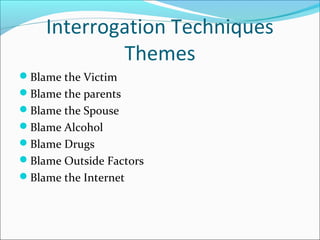
Themes 
Blame the Victim 
Blame the parents 
Blame the Spouse 
Blame Alcohol 
Blame Drugs 
Blame Outside Factors 
Blame the Internet
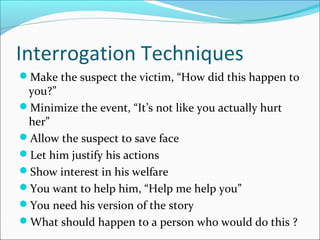
Interrogation Techniques 
Make the suspect the victim, “How did this happen to 
you?” 
Minimize the event, “It’s not like you actually hurt 
her” 
Allow the suspect to save face 
Let him justify his actions 
Show interest in his welfare 
You want to help him, “Help me help you” 
You need his version of the story 
What should happen to a person who would do this ?
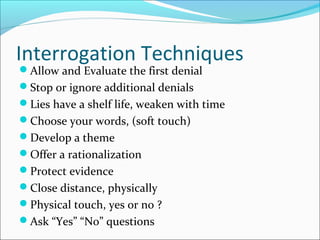
Interrogation Techniques 
Allow and Evaluate the first denial 
Stop or ignore additional denials 
Lies have a shelf life, weaken with time 
Choose your words, (soft touch) 
Develop a theme 
Offer a rationalization 
Protect evidence 
Close distance, physically 
Physical touch, yes or no ? 
Ask “Yes” “No” questions
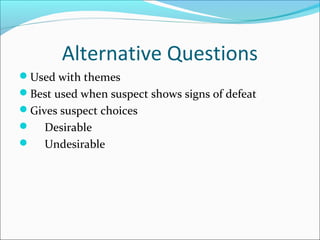
Alternative Questions 
Used with themes 
Best used when suspect shows signs of defeat 
Gives suspect choices 
 Desirable 
 Undesirable
Alternative Questions 
My investigation shows that you 
did________________ there is no reason to deny it. I 
need to know is this the first time or has this 
happened before? 
This is the first time, isn’t it?
Alternative Questions 
There is no doubt that you did____________I just 
need to know how it happened. Did you plan this or 
did it just happen? It just happened, didn’t it? Didn’t 
it?
Share the Blame 
The chocolate chip cookie story. It probably isn’t 
entirely your fault.
Who would You rather help 
The surveillance camera in the warehouse story. 
Which person would you be more willing to work 
with?
I fix things 
The target practice story. You can’t get the bullet 
back but with your help we can fix the target.
Help me understand 
I need your side of the story. Help me help you. 
Your story verses their story. Any time there are 
opposing stories the truth usually lies somewhere in 
the middle. So, what color is the dog?
What should happen 
Ask the suspect: Hypothetically, if someone did do 
these things, what do you think should happen with 
them? Listen for there response. Often guilty persons 
will not want to respond and will say that they don’t 
know what the law allows. They will try not to 
answer, press them for an answer. Generally the more 
lenient they are the more likely that they are guilty. 
(counseling, probation or Hang ‘m High)
Submission 
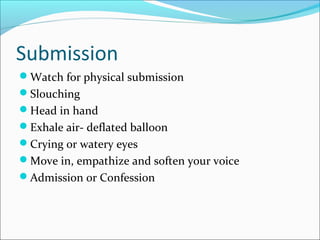
Watch for physical submission 
Slouching 
Head in hand 
Exhale air- deflated balloon 
Crying or watery eyes 
Move in, empathize and soften your voice 
Admission or Confession
Statements 
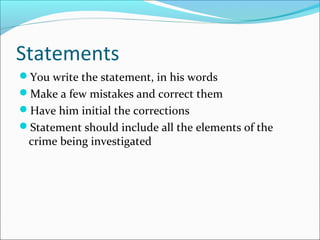
You write the statement, in his words 
Make a few mistakes and correct them 
Have him initial the corrections 
Statement should include all the elements of the 
crime being investigated
Analyzing Statements 
The statement is broken down into three parts. The 
introduction. The incident. The conclusion. 
Introduction: "My husband and I were sitting in the 
first booth on the right as you come into the 
restaurant." Criminal incident: "I heard a loud bang, 
like a firecracker, and shouts to lay down on the floor, 
and I knew the restaurant was being robbed. I saw 
two men with ski masks. The taller man had a rifle or 
a shotgun." Conclusion: "We stayed under the table 
until the police came."
Analyzing Statements 
The incident part of the statement should have more 
volume that either the introduction or the conclusion. 
Studies have shown that when the actual incident is 
minimized, when compared to the introduction and 
the conclusion, there is a good chance that it may 
contain deceit. In the previous slide the incident is 
clearly the bulk of the statement 
Introduction-19 words 
Incident-40 words 
Conclusion-9 words
Analyzing Statements 
The presence of Sensory details shows truthfulness. 
* Sight: "I looked back and saw that the car was in total 
flames." 
* Sound: "I heard a very loud thud." 
* Smell: "I had to change her diaper 'cause she 
smelled 
awful.'" 
* Taste: "It was so bitter that I couldn't drink it." 
* Touch: "The window blew out, and I felt heat on my 
face."
Deception Clusters 
What we say and how we say it gives clues about the 
type of person we are, the level of stress and whether 
our statements are truthful or not 
It is easier to control verbal clues than non verbal 
Looking for verbal clues 
Look for non-verbal or physical clues 
Pay close attention to the timing of the deceptive 
clues, their reaction must be coupled with a stressful 
question or statement on your part
Deception Verbal Clues 
 Stammering, Stuttering, slurring speech, hesitating indicates deception, if; 
observed for the first time during a tough question. 
 People who are lying often make noises or sounds to stall for time: “Aahhu” 
“Ummm” Ohhh” 
 Nervous laughter: tremendous indicator of stress or fear 
 Politeness of overly helpful, suggesting answers before the question, etc. are 
indicators of stress & deception 
 Skipping around a sentence, stopping a sentence, restarting sentence 
 Stalling: ask to repeat/rephrase question, answer w/ question 
 Complaints – why are you picking on me 
 Religious statements – oh my god, I couldn’t do that, I am a Christian 
 Political statements – I know the mayor 
 Memory lapses – no such thing in regard to significant events 
 Redirecting blame
Negative Body Language 
Signals 
Rocking motion of torso 
Leg or foot swinging 
Foot or finger tapping 
Short breaths 
Tightly clenched hands 
Wringing hands 
Clearing throat 
Fidgeting in chair 
Scratching or rubbing back 
of hands 
Runner Stance 
Closed eyes 
Lowering of chin 
Hunching of shoulders 
Arms crossed 
Fists clenched 
Legs crossed 
Downcast eyes 
Face turned away 
Body turned slightly away 
Grooming 
Yawning
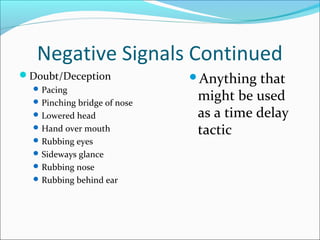
Negative Signals Continued 
Doubt/Deception 
Pacing 
Pinching bridge of nose 
Lowered head 
Hand over mouth 
Rubbing eyes 
Sideways glance 
Rubbing nose 
Rubbing behind ear 
Anything that 
might be used 
as a time delay 
tactic
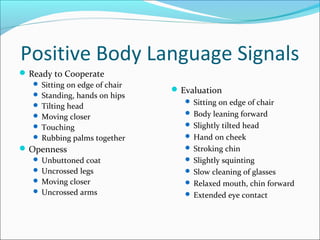
Positive Body Language Signals 
Ready to Cooperate 
 Sitting on edge of chair 
 Standing, hands on hips 
 Tilting head 
 Moving closer 
 Touching 
 Rubbing palms together 
Openness 
 Unbuttoned coat 
 Uncrossed legs 
 Moving closer 
 Uncrossed arms 
Evaluation 
 Sitting on edge of chair 
 Body leaning forward 
 Slightly tilted head 
 Hand on cheek 
 Stroking chin 
 Slightly squinting 
 Slow cleaning of glasses 
 Relaxed mouth, chin forward 
 Extended eye contact
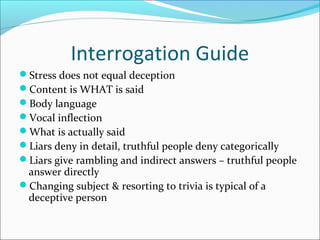
Interrogation Guide 
Stress does not equal deception 
Content is WHAT is said 
Body language 
Vocal inflection 
What is actually said 
Liars deny in detail, truthful people deny categorically 
Liars give rambling and indirect answers – truthful people 
answer directly 
Changing subject & resorting to trivia is typical of a 
deceptive person
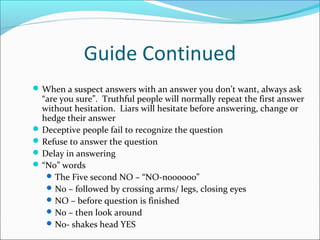
Guide Continued 
When a suspect answers with an answer you don’t want, always ask 
“are you sure”. Truthful people will normally repeat the first answer 
without hesitation. Liars will hesitate before answering, change or 
hedge their answer 
Deceptive people fail to recognize the question 
Refuse to answer the question 
Delay in answering 
“No” words 
The Five second NO – “NO-noooooo” 
No – followed by crossing arms/ legs, closing eyes 
NO – before question is finished 
No – then look around 
No- shakes head YES
Flag Expressions of Deception 
“Really” “Really” – over emphasis 
To tell the truth--- 
To the best of knowledge--- 
I couldn’t lie to you--- 
Frankly speaking--- 
May my mother drop dead--- 
To be perfectly honest--- 
I knew this was going to happen--- 
Why would I want to do something like this--- 
You’re just saying that because, I’m--- 
Couldn’t, Wouldn’t, Shouldn’t
Qualifying & Camouflage Flag Phrases 
I’m not trying to evade the questions--- 
I’m not trying to confuse you--- 
You know you are looking at me like I’m lying--- 
By the way--- 
Incidentally--- 
I already answered that question--- 
Like I told you before--- 
My mother didn’t raise me to--- 
Words that end in “LY” 
HOW WOULD YOU REACT ?
Perception 
While the judge decides if a defendant’s statement is 
admitted into evidence 
The jury, ultimately , decides if a suspect’s statement 
is voluntary and will be used as evidence against the 
defendant
False Confessions 
It is true that some persons for some reasons will 
confess to a crime that they did not commit. We , as 
investigators, must make sure that when we secure a 
confession that it is true. 
Be your own check and balance system.
False Confessions 
An easy test to confirm that the suspect in not 
admitting to doing something that he didn’t do. 
When you have secured the admission to what the 
victim said happened or what the evidence indicated 
happened, try to get the suspect to admit what you 
KNOW did not happen. To use this test you have to 
be very confident that you know what did not 
happen. The assumption being that if he is admitting 
to a crime because you are pressuring him he should 
admit to other actions that would be associated with 
that type of crime. When he denies what he didn’t do 
then he did do at least what he did admit to.
The Eyes Are The Window To 
The Soul 
While completing the biographical worksheet watch 
the suspect’s eyes. 
Where does he go when being truthful? 
His eyes will look in the opposite direction when 
being deceitful. 
Can he look at you while denying the allegations or 
does he look away? 
Truthful people tend to maintain better eye contact. 
Deceptive people tend to focus on objects or look out 
the window to reduce stress.
The Eyes Are The Window To 
The Soul 
There has been extensive study on eye movement and 
what it means. There are studies on whether you are 
right or left brained and how that effects which way 
you look when being truthful or deceptive. There are 
studies on where your eyes look depending on 
whether you are sound predominant, sight 
predominant or kinetic predominant. The bottom line 
is if you look to the right when you are recalling you 
look to the left when you are creating, or visa versa.
Biographical Worksheet 
Beginning time------------------Ending Time 
Personal Information 
 Name, DOB, Age, POB, Address, Phone Number 
 Alternate Phone Number, Education, SSN 
Health & Medical 
 Alcohol or Drugs in last 24 hours 
 Current health Problems, Meds? 
 How much sleep last night
Biographical Worksheet 
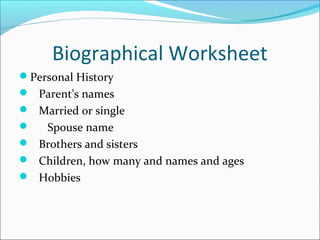
Personal History 
 Parent's names 
 Married or single 
 Spouse name 
 Brothers and sisters 
 Children, how many and names and ages 
 Hobbies
Biographical Worksheet 
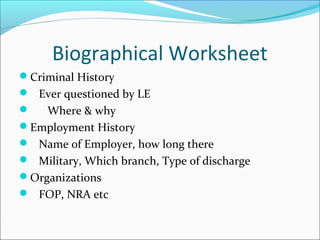
Criminal History 
 Ever questioned by LE 
 Where & why 
Employment History 
 Name of Employer, how long there 
 Military, Which branch, Type of discharge 
Organizations 
 FOP, NRA etc

Interview & Interrogation

  • 1.
    Cumberland County Sheriff’sDepartment Inv. John Haynes 931-484-6176 ccsd843@officer.com
  • 2.
    Definitions INTERVIEW: Toquestion or converse with victims, witnesses, complainants and informants in order to obtain information. A conversation with a purpose. Person has no reason to withhold information & may be expected to cooperate Interviewee does most of the talking INTERROGATION: The formal questioning of suspects or persons in order to obtain incriminating information and/or a confession. Person is expected to be reluctant & uncooperative to divulge information concerning offense. Interviewer does most of the talking
  • 3.
    Purpose of I& I Establish innocence or guilt by questioning Gather FACTS objectively without bias Discover leads toward new evidence, motives, witnesses or suspects Discover leads for other cases Establish links which connect and/or verify facts supplied by different people or facts learned in previous questioning of the same person Confession or Admission Discover the Truth
  • 4.
    Types & Levelsof Interviews Field – little preparation, brief information Planned – fail to prepare, prepare to fail Content – who, what, where, when, why, how Process – Interaction between interviewer and interviewee, separation, information written record, etc
  • 5.
    The Setting Aroom without distractions One table & three chairs Large enough for three Nothing between you and the subject Make him comfortable No stimulants Partner to take notes Your own personal Hygiene & Appearance
  • 6.
    The Setting atSuspect’s Home No interruptions No other family members Take control and be in charge Have partner take notes Phones turned OFF Miranda ?????????  Custodial  Interrogation  Police
  • 7.
    What If TheyLawyer Up Can you interview after a suspect ask for a lawyer? Feb. 24, 2010. The Supreme Court ruled that a break in custody of more that two, (2) weeks is sufficient for new questioning without a lawyer, according to the opinion by Justice Antonin Scalia. Scalia wrote, “While it is certainly unusual for this court to set forth precise time limits governing police action, it is not unheard of.” Scalia further wrote, “A 14 day period provides plenty of time for the suspect to get re-acclimated to his normal life, to consult with friends and counsel and to shake off any residual effects of his prior custody.”
  • 8.
    What If TheyLawyer Up Can you interview after a suspect ask for a lawyer?  Check with your local D A as to what their policy is.
  • 9.
    I & IRules ID & interview ALL victims & witnesses ASAP Privacy and/or Separation Location of interview Miranda warning Take your time Keep written record of facts learned One question at a time Allow person to save face Control the interview Keep a positive attitude Know what questions to ask and order to ask
  • 10.
    Dealing with Juveniles No black or white rules, 37-1-115, case law Does child understand Miranda How old is child Is there an opportunity to ask parents Has child been exposed to the Justice System Can you defend your actions in Court
  • 11.
    The Interviewer SALESMAN ACTOR PSYCHOLOGIST LISTENER
  • 12.
    The Interviewer SALESMAN.An interviewer is selling two things. First you must sell yourself as a PROFESSIONAL. You must sell the interviewee on the idea that it is in his best interest to tell you his version of the story. The second thing you are selling is jail time. Statistically, 85 percent of the general population will confess if the interview is properly conducted.
  • 13.
    The Interviewer ACTOR.You must be a good actor. Regardless of what type of crime you are investigating you must minimize the severity of it. Do not become emotionally involved. You must leave out your human bias.
  • 14.
    The Interviewer PSYCHOLOGIST.Learn as much as you can about the person being interviewed prior to the interview. Listen carefully throughout the interview to continue to learn things about him. The more you know about him the more likely you can sell him on the idea of telling you his side of the story.
  • 15.
    The Interviewer EFFECTIVELISTENER. You must learn to maintain eye contact, Allow the person to finish sentences, focus on the content of feedback, focus on his posture and be able to break down information while taking notes. The interviewer must learn to listen with his eyes as well as his ears.
  • 16.
    The Interviewer Attitude  Be Objective  Be Cordial and Polite  Be Even-Tempered  Be Sincere  Be Interested  Be Understanding
  • 17.
    The Interviewer Posture  Sit Upright  Sit Frontally Aligned  Lean Forward on Occasion  Stay Open, No Crossed Arms  Avoid Slouching  Feet flat on floor  Close the Distance Between You and Him
  • 18.
    The Interviewer EyeContact  Should be maintained when asking questions or when they answer  Avoid staring, casual eye contact breaks are important  Look away when he gives denials
  • 19.
    The Interviewer FacialExpressions  Avoid expressions of disbelief, shock, anger, humor, disgust and skepticism  Show interest  Expressions of understanding when you give him moral justification for his actions
  • 20.
    The Interviewer Toneof Voice  Medium, conversational  Smooth speech  No skeptical tone
  • 21.
    The Interviewer Questioningthe Suspect  Avoid paraphrasing what he says  Show understanding when he expresses strong negative emotions  Avoid challenges to his statements and alibis  Avoid long delays between asking questions  If It Is Important To Him, It Should Be Important To You
  • 22.
    The Interviewer HandGestures  Use a lot of hand gestures when talking  Palms should be up and arms open  Avoid negative or strong gestures
  • 23.
    Baseline Analysis EstablishRapport. If the subject isn’t comfortable with you he will not tell you anything. Introduce yourself, shake his hand and ask to call him by his first name. Show concern for his welfare. If in subject’s home look around for clues as to who he is. ( Family, Hobbies, Education ) Biographical Worksheet.
  • 24.
    Interrogation Techniques Assumptivequestions Watch for timeliness – immediate is good, delayed response is not good Observe all of interviewee’s behavior Remember interviewee is watching you We are looking for manifestation of stress or deceit Timing of deceit indicators MUST coincide with stress questions.
  • 25.
    Interrogation Techniques Themes Blame the Victim Blame the parents Blame the Spouse Blame Alcohol Blame Drugs Blame Outside Factors Blame the Internet
  • 26.
    Interrogation Techniques Makethe suspect the victim, “How did this happen to you?” Minimize the event, “It’s not like you actually hurt her” Allow the suspect to save face Let him justify his actions Show interest in his welfare You want to help him, “Help me help you” You need his version of the story What should happen to a person who would do this ?
  • 27.
    Interrogation Techniques Allowand Evaluate the first denial Stop or ignore additional denials Lies have a shelf life, weaken with time Choose your words, (soft touch) Develop a theme Offer a rationalization Protect evidence Close distance, physically Physical touch, yes or no ? Ask “Yes” “No” questions
  • 28.
    Alternative Questions Usedwith themes Best used when suspect shows signs of defeat Gives suspect choices  Desirable  Undesirable
  • 29.
    Alternative Questions Myinvestigation shows that you did________________ there is no reason to deny it. I need to know is this the first time or has this happened before? This is the first time, isn’t it?
  • 30.
    Alternative Questions Thereis no doubt that you did____________I just need to know how it happened. Did you plan this or did it just happen? It just happened, didn’t it? Didn’t it?
  • 31.
    Share the Blame The chocolate chip cookie story. It probably isn’t entirely your fault.
  • 32.
    Who would Yourather help The surveillance camera in the warehouse story. Which person would you be more willing to work with?
  • 33.
    I fix things The target practice story. You can’t get the bullet back but with your help we can fix the target.
  • 34.
    Help me understand I need your side of the story. Help me help you. Your story verses their story. Any time there are opposing stories the truth usually lies somewhere in the middle. So, what color is the dog?
  • 35.
    What should happen Ask the suspect: Hypothetically, if someone did do these things, what do you think should happen with them? Listen for there response. Often guilty persons will not want to respond and will say that they don’t know what the law allows. They will try not to answer, press them for an answer. Generally the more lenient they are the more likely that they are guilty. (counseling, probation or Hang ‘m High)
  • 36.
    Submission Watch forphysical submission Slouching Head in hand Exhale air- deflated balloon Crying or watery eyes Move in, empathize and soften your voice Admission or Confession
  • 37.
    Statements You writethe statement, in his words Make a few mistakes and correct them Have him initial the corrections Statement should include all the elements of the crime being investigated
  • 38.
    Analyzing Statements Thestatement is broken down into three parts. The introduction. The incident. The conclusion. Introduction: "My husband and I were sitting in the first booth on the right as you come into the restaurant." Criminal incident: "I heard a loud bang, like a firecracker, and shouts to lay down on the floor, and I knew the restaurant was being robbed. I saw two men with ski masks. The taller man had a rifle or a shotgun." Conclusion: "We stayed under the table until the police came."
  • 39.
    Analyzing Statements Theincident part of the statement should have more volume that either the introduction or the conclusion. Studies have shown that when the actual incident is minimized, when compared to the introduction and the conclusion, there is a good chance that it may contain deceit. In the previous slide the incident is clearly the bulk of the statement Introduction-19 words Incident-40 words Conclusion-9 words
  • 40.
    Analyzing Statements Thepresence of Sensory details shows truthfulness. * Sight: "I looked back and saw that the car was in total flames." * Sound: "I heard a very loud thud." * Smell: "I had to change her diaper 'cause she smelled awful.'" * Taste: "It was so bitter that I couldn't drink it." * Touch: "The window blew out, and I felt heat on my face."
  • 41.
    Deception Clusters Whatwe say and how we say it gives clues about the type of person we are, the level of stress and whether our statements are truthful or not It is easier to control verbal clues than non verbal Looking for verbal clues Look for non-verbal or physical clues Pay close attention to the timing of the deceptive clues, their reaction must be coupled with a stressful question or statement on your part
  • 42.
    Deception Verbal Clues  Stammering, Stuttering, slurring speech, hesitating indicates deception, if; observed for the first time during a tough question.  People who are lying often make noises or sounds to stall for time: “Aahhu” “Ummm” Ohhh”  Nervous laughter: tremendous indicator of stress or fear  Politeness of overly helpful, suggesting answers before the question, etc. are indicators of stress & deception  Skipping around a sentence, stopping a sentence, restarting sentence  Stalling: ask to repeat/rephrase question, answer w/ question  Complaints – why are you picking on me  Religious statements – oh my god, I couldn’t do that, I am a Christian  Political statements – I know the mayor  Memory lapses – no such thing in regard to significant events  Redirecting blame
  • 43.
    Negative Body Language Signals Rocking motion of torso Leg or foot swinging Foot or finger tapping Short breaths Tightly clenched hands Wringing hands Clearing throat Fidgeting in chair Scratching or rubbing back of hands Runner Stance Closed eyes Lowering of chin Hunching of shoulders Arms crossed Fists clenched Legs crossed Downcast eyes Face turned away Body turned slightly away Grooming Yawning
  • 44.
    Negative Signals Continued Doubt/Deception Pacing Pinching bridge of nose Lowered head Hand over mouth Rubbing eyes Sideways glance Rubbing nose Rubbing behind ear Anything that might be used as a time delay tactic
  • 45.
    Positive Body LanguageSignals Ready to Cooperate  Sitting on edge of chair  Standing, hands on hips  Tilting head  Moving closer  Touching  Rubbing palms together Openness  Unbuttoned coat  Uncrossed legs  Moving closer  Uncrossed arms Evaluation  Sitting on edge of chair  Body leaning forward  Slightly tilted head  Hand on cheek  Stroking chin  Slightly squinting  Slow cleaning of glasses  Relaxed mouth, chin forward  Extended eye contact
  • 46.
    Interrogation Guide Stressdoes not equal deception Content is WHAT is said Body language Vocal inflection What is actually said Liars deny in detail, truthful people deny categorically Liars give rambling and indirect answers – truthful people answer directly Changing subject & resorting to trivia is typical of a deceptive person
  • 47.
    Guide Continued Whena suspect answers with an answer you don’t want, always ask “are you sure”. Truthful people will normally repeat the first answer without hesitation. Liars will hesitate before answering, change or hedge their answer Deceptive people fail to recognize the question Refuse to answer the question Delay in answering “No” words The Five second NO – “NO-noooooo” No – followed by crossing arms/ legs, closing eyes NO – before question is finished No – then look around No- shakes head YES
  • 48.
    Flag Expressions ofDeception “Really” “Really” – over emphasis To tell the truth--- To the best of knowledge--- I couldn’t lie to you--- Frankly speaking--- May my mother drop dead--- To be perfectly honest--- I knew this was going to happen--- Why would I want to do something like this--- You’re just saying that because, I’m--- Couldn’t, Wouldn’t, Shouldn’t
  • 49.
    Qualifying & CamouflageFlag Phrases I’m not trying to evade the questions--- I’m not trying to confuse you--- You know you are looking at me like I’m lying--- By the way--- Incidentally--- I already answered that question--- Like I told you before--- My mother didn’t raise me to--- Words that end in “LY” HOW WOULD YOU REACT ?
  • 50.
    Perception While thejudge decides if a defendant’s statement is admitted into evidence The jury, ultimately , decides if a suspect’s statement is voluntary and will be used as evidence against the defendant
  • 51.
    False Confessions Itis true that some persons for some reasons will confess to a crime that they did not commit. We , as investigators, must make sure that when we secure a confession that it is true. Be your own check and balance system.
  • 52.
    False Confessions Aneasy test to confirm that the suspect in not admitting to doing something that he didn’t do. When you have secured the admission to what the victim said happened or what the evidence indicated happened, try to get the suspect to admit what you KNOW did not happen. To use this test you have to be very confident that you know what did not happen. The assumption being that if he is admitting to a crime because you are pressuring him he should admit to other actions that would be associated with that type of crime. When he denies what he didn’t do then he did do at least what he did admit to.
  • 53.
    The Eyes AreThe Window To The Soul While completing the biographical worksheet watch the suspect’s eyes. Where does he go when being truthful? His eyes will look in the opposite direction when being deceitful. Can he look at you while denying the allegations or does he look away? Truthful people tend to maintain better eye contact. Deceptive people tend to focus on objects or look out the window to reduce stress.
  • 54.
    The Eyes AreThe Window To The Soul There has been extensive study on eye movement and what it means. There are studies on whether you are right or left brained and how that effects which way you look when being truthful or deceptive. There are studies on where your eyes look depending on whether you are sound predominant, sight predominant or kinetic predominant. The bottom line is if you look to the right when you are recalling you look to the left when you are creating, or visa versa.
  • 55.
    Biographical Worksheet Beginningtime------------------Ending Time Personal Information  Name, DOB, Age, POB, Address, Phone Number  Alternate Phone Number, Education, SSN Health & Medical  Alcohol or Drugs in last 24 hours  Current health Problems, Meds?  How much sleep last night
  • 56.
    Biographical Worksheet PersonalHistory  Parent's names  Married or single  Spouse name  Brothers and sisters  Children, how many and names and ages  Hobbies
  • 57.
    Biographical Worksheet CriminalHistory  Ever questioned by LE  Where & why Employment History  Name of Employer, how long there  Military, Which branch, Type of discharge Organizations  FOP, NRA etc