Crime Scene Sketching Basics Tutorial
Introduction: The crime scene sketch: Accurately portrays the physical facts Relates the sequence of events at the scene Establishes the precise location and relationship of objects and evidence at the scene Creates a mental picture of the scene for those not present Is a permanent record of the scene
Overview A crime scene sketch assists in: 1) Interviewing and interrogating persons 2) Preparing an investigative report 3) Presenting the case in court The sketch supplements photographs, notes, plaster casts and other investigative techniques. Two types of sketches Rough sketch Finished or scale sketch
The Rough Sketch The rough sketch is the first pencil-drawn outline of the scene and the location of objects and evidence within this outline. Usually not drawn to scale Although distances are measured and indicated in the sketch Sketch after photographs are taken and before anything is moved. Sketch as much as possible.
Sketching Materials Paper Pencil Measuring tape Ruler Clipboard Eraser Compass
Steps in Sketching the Crime Scene Observe and plan Measure distances Outline the area Locate objects and evidence within the outline Record details Make notes Identify the sketch with a legend and a scale
Measure and Outline Area A steel tape is best It doesn’t stretch Use conventional units of measurement Inches Feet Centimeters Meters
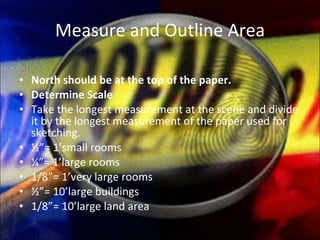
Measure and Outline Area North should be at the top of the paper. Determine Scale Take the longest measurement at the scene and divide it by the longest measurement of the paper used for sketching. ½”= 1’small rooms ¼”= 1’large rooms 1/8”= 1’very large rooms ½”= 10’large buildings 1/8”= 10’large land area
Measure and Outline Area Measure from fixed locations Walls Trees Telephone poles Corners Curbs Outlets Any Immovable Object
Plotting Objects & Evidence Plotting methods are used to locate objects and evidence on the sketch.  They include the use of: Rectangular coordinates A baseline Triangulation Compass points.
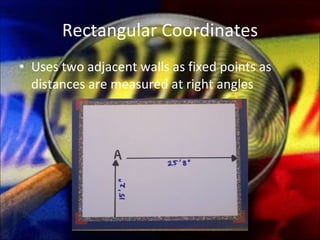
Rectangular Coordinates Uses two adjacent walls as fixed points as distances are measured at right angles
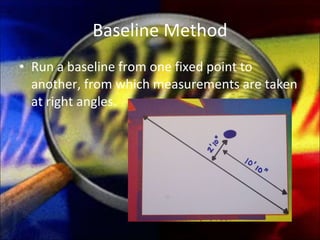
Baseline Method Run a baseline from one fixed point to another, from which measurements are taken at right angles.
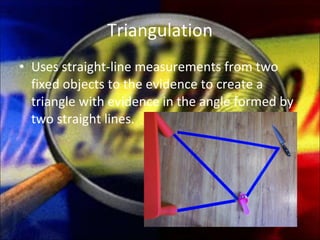
Triangulation Uses straight-line measurements from two fixed objects to the evidence to create a triangle with evidence in the angle formed by two straight lines.
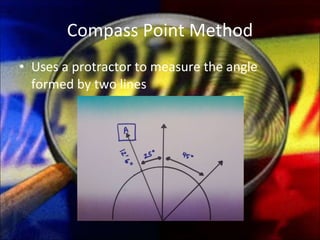
Compass Point Method Uses a protractor to measure the angle formed by two lines
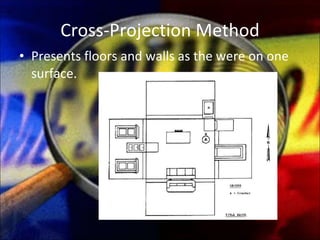
Cross-Projection Method Presents floors and walls as the were on one surface.
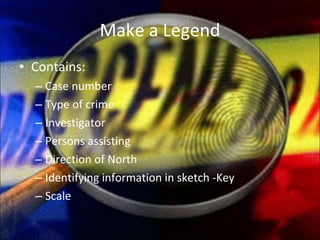
Make a Legend Contains: Case number Type of crime Investigator Persons assisting Direction of North Identifying information in sketch -Key Scale
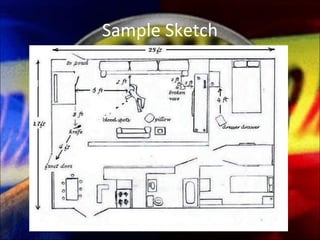
Sample Sketch
The Assignment Now it’s your turn!  In a moment you will visit a 360 0  Virtual Crime Scene. You will need to complete a rough sketch and finished sketch of all rooms at the crime scene. Be sure to explore all rooms floor to ceiling and wall to wall. Remember to include a legend I will provide you with the necessary measurements to include in your sketches.
Sketches Should Include: Bodies Furniture (tables, chairs, desks, lamps, couches, etc.) Key objects on or near furniture Windows, doors Weapons or other evidence (bullets, broken glass, drugs, etc.) Blood spatter or prints
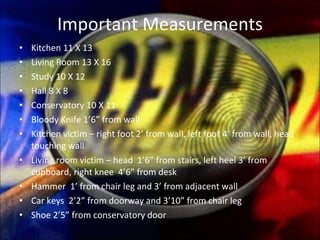
Important Measurements Kitchen 11 X 13 Living Room 13 X 16 Study 10 X 12 Hall 8 X 8 Conservatory 10 X 11 Bloody Knife 1’6” from wall Kitchen victim – right foot 2’ from wall, left foot 4’ from wall, head touching wall Living room victim – head  1’6” from stairs, left heel 3’ from cupboard, right knee  4’6” from desk Hammer  1’ from chair leg and 3’ from adjacent wall Car keys  2’2” from doorway and 3’10” from chair leg Shoe 2’5” from conservatory door
The Crime Scene Visit the virtual crime scene below and begin sketching! http://www.360crimescene.co.uk/virtualtour.phtml   You will need to scan your completed sketches, save as a PDF file, and email to me or upload to Moodle.

Crime scene sketching basics

  • 1.
    Crime Scene SketchingBasics Tutorial
  • 2.
    Introduction: The crimescene sketch: Accurately portrays the physical facts Relates the sequence of events at the scene Establishes the precise location and relationship of objects and evidence at the scene Creates a mental picture of the scene for those not present Is a permanent record of the scene
  • 3.
    Overview A crimescene sketch assists in: 1) Interviewing and interrogating persons 2) Preparing an investigative report 3) Presenting the case in court The sketch supplements photographs, notes, plaster casts and other investigative techniques. Two types of sketches Rough sketch Finished or scale sketch
  • 4.
    The Rough SketchThe rough sketch is the first pencil-drawn outline of the scene and the location of objects and evidence within this outline. Usually not drawn to scale Although distances are measured and indicated in the sketch Sketch after photographs are taken and before anything is moved. Sketch as much as possible.
  • 5.
    Sketching Materials PaperPencil Measuring tape Ruler Clipboard Eraser Compass
  • 6.
    Steps in Sketchingthe Crime Scene Observe and plan Measure distances Outline the area Locate objects and evidence within the outline Record details Make notes Identify the sketch with a legend and a scale
  • 7.
    Measure and OutlineArea A steel tape is best It doesn’t stretch Use conventional units of measurement Inches Feet Centimeters Meters
  • 8.
    Measure and OutlineArea North should be at the top of the paper. Determine Scale Take the longest measurement at the scene and divide it by the longest measurement of the paper used for sketching. ½”= 1’small rooms ¼”= 1’large rooms 1/8”= 1’very large rooms ½”= 10’large buildings 1/8”= 10’large land area
  • 9.
    Measure and OutlineArea Measure from fixed locations Walls Trees Telephone poles Corners Curbs Outlets Any Immovable Object
  • 10.
    Plotting Objects &Evidence Plotting methods are used to locate objects and evidence on the sketch. They include the use of: Rectangular coordinates A baseline Triangulation Compass points.
  • 11.
    Rectangular Coordinates Usestwo adjacent walls as fixed points as distances are measured at right angles
  • 12.
    Baseline Method Runa baseline from one fixed point to another, from which measurements are taken at right angles.
  • 13.
    Triangulation Uses straight-linemeasurements from two fixed objects to the evidence to create a triangle with evidence in the angle formed by two straight lines.
  • 14.
    Compass Point MethodUses a protractor to measure the angle formed by two lines
  • 15.
    Cross-Projection Method Presentsfloors and walls as the were on one surface.
  • 16.
    Make a LegendContains: Case number Type of crime Investigator Persons assisting Direction of North Identifying information in sketch -Key Scale
  • 17.
  • 18.
    The Assignment Nowit’s your turn! In a moment you will visit a 360 0 Virtual Crime Scene. You will need to complete a rough sketch and finished sketch of all rooms at the crime scene. Be sure to explore all rooms floor to ceiling and wall to wall. Remember to include a legend I will provide you with the necessary measurements to include in your sketches.
  • 19.
    Sketches Should Include:Bodies Furniture (tables, chairs, desks, lamps, couches, etc.) Key objects on or near furniture Windows, doors Weapons or other evidence (bullets, broken glass, drugs, etc.) Blood spatter or prints
  • 20.
    Important Measurements Kitchen11 X 13 Living Room 13 X 16 Study 10 X 12 Hall 8 X 8 Conservatory 10 X 11 Bloody Knife 1’6” from wall Kitchen victim – right foot 2’ from wall, left foot 4’ from wall, head touching wall Living room victim – head 1’6” from stairs, left heel 3’ from cupboard, right knee 4’6” from desk Hammer 1’ from chair leg and 3’ from adjacent wall Car keys 2’2” from doorway and 3’10” from chair leg Shoe 2’5” from conservatory door
  • 21.
    The Crime SceneVisit the virtual crime scene below and begin sketching! http://www.360crimescene.co.uk/virtualtour.phtml You will need to scan your completed sketches, save as a PDF file, and email to me or upload to Moodle.