The Future of Forensic
 Science: The Impact of
the National Academy of
    Sciences Report
          Gerald M. LaPorte, MSFS
      Forensic Policy Program Manager
          National Institute of Justice
      Office of Science and Technology
 Investigative and Forensic Sciences Division
National Institute of Justice
• Research, development and evaluation arm of the Department
  of Justice
• NIJ's principal authorities are derived from the Omnibus Crime
  Control and Safe Streets Act of 1968, as amended (see 42 USC
  § 3721-3723) and Title II of the Homeland Security Act of 2002.
   – Title II of the Homeland Security Act as it relates to NIJ’s Office of
     Science & Technology
• Advances scientific research, development, and evaluation
   – to enhance the criminal justice system
   – to increase public safety
• Emphasis on State and local practitioner needs
• Committed to scientific process of open competition, peer-
  reviewed, published reports and archived data
Office of Science & Technology
•   Principal authority derived from the Homeland Security Act of 2002
     – Lead agency in the U.S. for work in criminal justice technology
         • Law enforcement, corrections, investigative and forensic, judicial process
         • Coordinate the Federal approach to Criminal Justice technology issues
     – Conduct research, development, test and evaluation (RDT&E)
         • Leading to adoption of improved tools and technologies into practice
     – Establish and maintain advisory groups to assess criminal justice
       technology needs
     – Establish and maintain performance standards and a compliance testing
       program
     – Provide technology assistance
•   Executes the DNA Initiative
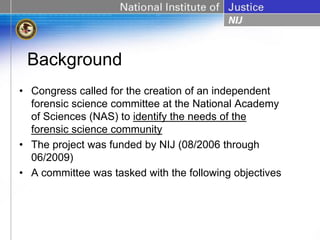
Background
• Congress called for the creation of an independent
  forensic science committee at the National Academy
  of Sciences (NAS) to identify the needs of the
  forensic science community
• The project was funded by NIJ (08/2006 through
  06/2009)
• A committee was tasked with the following objectives
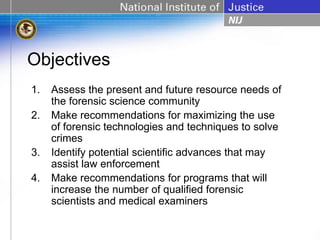
Objectives
1.   Assess the present and future resource needs of
     the forensic science community
2.   Make recommendations for maximizing the use
     of forensic technologies and techniques to solve
     crimes
3.   Identify potential scientific advances that may
     assist law enforcement
4.   Make recommendations for programs that will
     increase the number of qualified forensic
     scientists and medical examiners
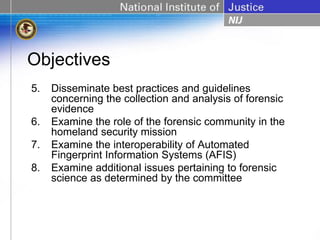
Objectives
5.   Disseminate best practices and guidelines
     concerning the collection and analysis of forensic
     evidence
6.   Examine the role of the forensic community in the
     homeland security mission
7.   Examine the interoperability of Automated
     Fingerprint Information Systems (AFIS)
8.   Examine additional issues pertaining to forensic
     science as determined by the committee
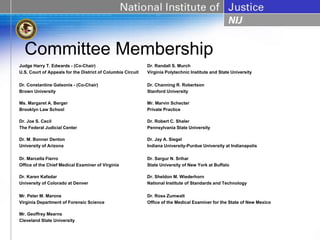
Committee Membership
Judge Harry T. Edwards - (Co-Chair)                          Dr. Randall S. Murch
U.S. Court of Appeals for the District of Columbia Circuit   Virginia Polytechnic Institute and State University

Dr. Constantine Gatsonis - (Co-Chair)                        Dr. Channing R. Robertson
Brown University                                             Stanford University

Ms. Margaret A. Berger                                       Mr. Marvin Schecter
Brooklyn Law School                                          Private Practice

Dr. Joe S. Cecil                                             Dr. Robert C. Shaler
The Federal Judicial Center                                  Pennsylvania State University

Dr. M. Bonner Denton                                         Dr. Jay A. Siegel
University of Arizona                                        Indiana University-Purdue University at Indianapolis

Dr. Marcella Fierro                                          Dr. Sargur N. Srihar
Office of the Chief Medical Examiner of Virginia             State University of New York at Buffalo

Dr. Karen Kafadar                                            Dr. Sheldon M. Wiederhorn
University of Colorado at Denver                             National Institute of Standards and Technology

Mr. Peter M. Marone                                          Dr. Ross Zumwalt
Virginia Department of Forensic Science                      Office of the Medical Examiner for the State of New Mexico

Mr. Geoffrey Mearns
Cleveland State University
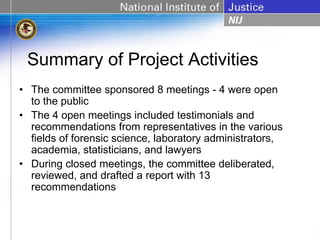
Summary of Project Activities
• The committee sponsored 8 meetings - 4 were open
  to the public
• The 4 open meetings included testimonials and
  recommendations from representatives in the various
  fields of forensic science, laboratory administrators,
  academia, statisticians, and lawyers
• During closed meetings, the committee deliberated,
  reviewed, and drafted a report with 13
  recommendations
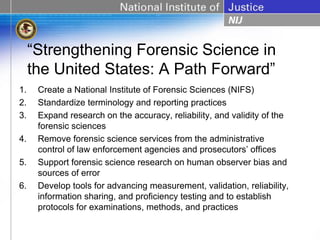
“Strengthening Forensic Science in
     the United States: A Path Forward”
1.    Create a National Institute of Forensic Sciences (NIFS)
2.    Standardize terminology and reporting practices
3.    Expand research on the accuracy, reliability, and validity of the
      forensic sciences
4.    Remove forensic science services from the administrative
      control of law enforcement agencies and prosecutors’ offices
5.    Support forensic science research on human observer bias and
      sources of error
6.    Develop tools for advancing measurement, validation, reliability,
      information sharing, and proficiency testing and to establish
      protocols for examinations, methods, and practices
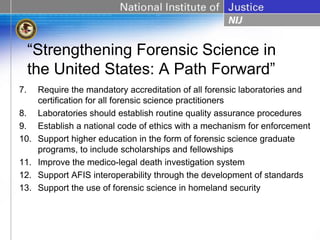
“Strengthening Forensic Science in
     the United States: A Path Forward”
7.    Require the mandatory accreditation of all forensic laboratories and
      certification for all forensic science practitioners
8.    Laboratories should establish routine quality assurance procedures
9.    Establish a national code of ethics with a mechanism for enforcement
10.   Support higher education in the form of forensic science graduate
      programs, to include scholarships and fellowships
11.   Improve the medico-legal death investigation system
12.   Support AFIS interoperability through the development of standards
13.   Support the use of forensic science in homeland security
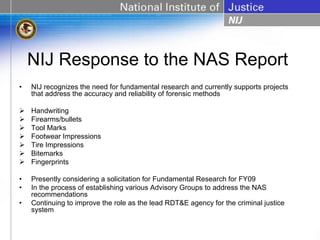
NIJ Response to the NAS Report
•   NIJ recognizes the need for fundamental research and currently supports projects
    that address the accuracy and reliability of forensic methods

    Handwriting
    Firearms/bullets
    Tool Marks
    Footwear Impressions
    Tire Impressions
    Bitemarks
    Fingerprints

•   Presently considering a solicitation for Fundamental Research for FY09
•   In the process of establishing various Advisory Groups to address the NAS
    recommendations
•   Continuing to improve the role as the lead RDT&E agency for the criminal justice
    system
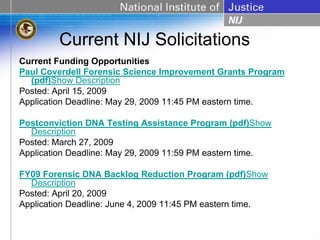
Current NIJ Solicitations
Current Funding Opportunities
Paul Coverdell Forensic Science Improvement Grants Program
  (pdf)Show Description
Posted: April 15, 2009
Application Deadline: May 29, 2009 11:45 PM eastern time.

Postconviction DNA Testing Assistance Program (pdf)Show
  Description
Posted: March 27, 2009
Application Deadline: May 29, 2009 11:59 PM eastern time.

FY09 Forensic DNA Backlog Reduction Program (pdf)Show
  Description
Posted: April 20, 2009
Application Deadline: June 4, 2009 11:45 PM eastern time.
Gerry LaPorte
         National Institute of Justice
     Office of Science and Technology
Investigative and Forensic Sciences Division
          810 Seventh Street, N.W.
           Washington, DC 20531
               202-305-1106
      Email: gerald.laporte@usdoj.gov

Future forensic science

  • 1.
    The Future ofForensic Science: The Impact of the National Academy of Sciences Report Gerald M. LaPorte, MSFS Forensic Policy Program Manager National Institute of Justice Office of Science and Technology Investigative and Forensic Sciences Division
  • 2.
    National Institute ofJustice • Research, development and evaluation arm of the Department of Justice • NIJ's principal authorities are derived from the Omnibus Crime Control and Safe Streets Act of 1968, as amended (see 42 USC § 3721-3723) and Title II of the Homeland Security Act of 2002. – Title II of the Homeland Security Act as it relates to NIJ’s Office of Science & Technology • Advances scientific research, development, and evaluation – to enhance the criminal justice system – to increase public safety • Emphasis on State and local practitioner needs • Committed to scientific process of open competition, peer- reviewed, published reports and archived data
  • 3.
    Office of Science& Technology • Principal authority derived from the Homeland Security Act of 2002 – Lead agency in the U.S. for work in criminal justice technology • Law enforcement, corrections, investigative and forensic, judicial process • Coordinate the Federal approach to Criminal Justice technology issues – Conduct research, development, test and evaluation (RDT&E) • Leading to adoption of improved tools and technologies into practice – Establish and maintain advisory groups to assess criminal justice technology needs – Establish and maintain performance standards and a compliance testing program – Provide technology assistance • Executes the DNA Initiative
  • 4.
    Background • Congress calledfor the creation of an independent forensic science committee at the National Academy of Sciences (NAS) to identify the needs of the forensic science community • The project was funded by NIJ (08/2006 through 06/2009) • A committee was tasked with the following objectives
  • 5.
    Objectives 1. Assess the present and future resource needs of the forensic science community 2. Make recommendations for maximizing the use of forensic technologies and techniques to solve crimes 3. Identify potential scientific advances that may assist law enforcement 4. Make recommendations for programs that will increase the number of qualified forensic scientists and medical examiners
  • 6.
    Objectives 5. Disseminate best practices and guidelines concerning the collection and analysis of forensic evidence 6. Examine the role of the forensic community in the homeland security mission 7. Examine the interoperability of Automated Fingerprint Information Systems (AFIS) 8. Examine additional issues pertaining to forensic science as determined by the committee
  • 7.
    Committee Membership Judge HarryT. Edwards - (Co-Chair) Dr. Randall S. Murch U.S. Court of Appeals for the District of Columbia Circuit Virginia Polytechnic Institute and State University Dr. Constantine Gatsonis - (Co-Chair) Dr. Channing R. Robertson Brown University Stanford University Ms. Margaret A. Berger Mr. Marvin Schecter Brooklyn Law School Private Practice Dr. Joe S. Cecil Dr. Robert C. Shaler The Federal Judicial Center Pennsylvania State University Dr. M. Bonner Denton Dr. Jay A. Siegel University of Arizona Indiana University-Purdue University at Indianapolis Dr. Marcella Fierro Dr. Sargur N. Srihar Office of the Chief Medical Examiner of Virginia State University of New York at Buffalo Dr. Karen Kafadar Dr. Sheldon M. Wiederhorn University of Colorado at Denver National Institute of Standards and Technology Mr. Peter M. Marone Dr. Ross Zumwalt Virginia Department of Forensic Science Office of the Medical Examiner for the State of New Mexico Mr. Geoffrey Mearns Cleveland State University
  • 8.
    Summary of ProjectActivities • The committee sponsored 8 meetings - 4 were open to the public • The 4 open meetings included testimonials and recommendations from representatives in the various fields of forensic science, laboratory administrators, academia, statisticians, and lawyers • During closed meetings, the committee deliberated, reviewed, and drafted a report with 13 recommendations
  • 9.
    “Strengthening Forensic Sciencein the United States: A Path Forward” 1. Create a National Institute of Forensic Sciences (NIFS) 2. Standardize terminology and reporting practices 3. Expand research on the accuracy, reliability, and validity of the forensic sciences 4. Remove forensic science services from the administrative control of law enforcement agencies and prosecutors’ offices 5. Support forensic science research on human observer bias and sources of error 6. Develop tools for advancing measurement, validation, reliability, information sharing, and proficiency testing and to establish protocols for examinations, methods, and practices
  • 10.
    “Strengthening Forensic Sciencein the United States: A Path Forward” 7. Require the mandatory accreditation of all forensic laboratories and certification for all forensic science practitioners 8. Laboratories should establish routine quality assurance procedures 9. Establish a national code of ethics with a mechanism for enforcement 10. Support higher education in the form of forensic science graduate programs, to include scholarships and fellowships 11. Improve the medico-legal death investigation system 12. Support AFIS interoperability through the development of standards 13. Support the use of forensic science in homeland security
  • 11.
    NIJ Response tothe NAS Report • NIJ recognizes the need for fundamental research and currently supports projects that address the accuracy and reliability of forensic methods Handwriting Firearms/bullets Tool Marks Footwear Impressions Tire Impressions Bitemarks Fingerprints • Presently considering a solicitation for Fundamental Research for FY09 • In the process of establishing various Advisory Groups to address the NAS recommendations • Continuing to improve the role as the lead RDT&E agency for the criminal justice system
  • 12.
    Current NIJ Solicitations CurrentFunding Opportunities Paul Coverdell Forensic Science Improvement Grants Program (pdf)Show Description Posted: April 15, 2009 Application Deadline: May 29, 2009 11:45 PM eastern time. Postconviction DNA Testing Assistance Program (pdf)Show Description Posted: March 27, 2009 Application Deadline: May 29, 2009 11:59 PM eastern time. FY09 Forensic DNA Backlog Reduction Program (pdf)Show Description Posted: April 20, 2009 Application Deadline: June 4, 2009 11:45 PM eastern time.
  • 13.
    Gerry LaPorte National Institute of Justice Office of Science and Technology Investigative and Forensic Sciences Division 810 Seventh Street, N.W. Washington, DC 20531 202-305-1106 Email: gerald.laporte@usdoj.gov