Management Skills Development
Solving Problems Analytically and
Creatively
Lecture 4
By Dr. L.L Ekanayake
1
Learning Objectives
• Increase proficiency in analytic problem
solving
• Recognize personal conceptual blocks
• Enhance creativity by overcoming
conceptual blocks
• Foster innovation among others
2
A Model of
Problem Solving
• Step 1: Define the Problem
– Differentiate fact from opinion
– Specify underlying causes
– Tap everyone involved for information
– State the problem explicitly
– Identify what standard is violated
– Determine whose problem it is
– Avoid stating the problem as a disguised solution
3
A Model of
Problem Solving
• Step 2: Generate Alternative Solutions
– Postpone evaluating alternatives until several
alternatives has been proposed
– Be sure all involved individuals generate alternatives
– Specify alternatives that are consistent with
organizational goals or policies
– Specify both short- and long-term consequences
– Build on one another. combined and modified
– Specify alternatives that solve the problem
4
A Model of
Problem Solving
• Step 3: Evaluate and Select an Alternative
– Evaluate relative to an optimal standard rather than
satisfactory standard
– Evaluate systematically without short circuiting
– Evaluate relative to goals of the organization and the
individuals involved
– Evaluate main effects and side effects
– State the selected alternative explicitly
5
3 -
A Model of Problem Solving
• Step 4: Implement and Follow Up on the
Solution
– Implement at proper time and in the right
sequence
– Most effective when it is accomplished in small
steps or increments
– Provide opportunities for feedback
– Stimulate acceptance
– Establish ongoing monitoring system
– Evaluate based on problem solution
6
Limitations of the Analytical Problem-
Solving Model
• Defining the problems
– Lack of consensus as to the definition of the
problem
– Uncertainty as to whose definition will be
accepted
– Usually defined in terms of the solutions
already possessed
– Symptoms are often get confused with the
real problem
– Confusing information inhibits problem
identification 7
Constraints on the Analytical Problem-
Solving Model
• Generating Alternatives
• Alternatives are evaluated one at a time as
they are proposed
• Few of the possible alternatives are usually
known
• The first acceptable solution is usually
accepted
• Alternatives are based on what was successful
in the past
8
Constraints on the Analytical Problem-
Solving Model
• Evaluating and Select an Alternative
• Information on alternatives is limited
• Search for information occurs close to home
• The type of information is constrained by other factors
• Gathering information is costly
• Preferences for the best alternatives are not always
known
• Satisfactory solution, not optimal ones are usually
accepted
• Solutions often are implemented before the problem is
defined
9
Constraints on the Analytical Problem-
Solving Model
• Implementation and Follow up
– Acceptance is not always forthcoming
– Resistance to change
– Uncertainty about what part of solution to
monitor
– Political and organizational processes must be
managed
– It may take a long time to implement a solution
10
Impediments to Creative Problem
Solving
• Focused on generating something new.
• Most people have trouble solving problems
creatively.
• They have developed certain conceptual
blocks in their problem-solving activities of
which they are not even aware.
• The blocks are largely personal. So skill
development is required to overcome them.
© 2007 by Prentice Hall 11
Conceptual blocks
• Conceptual blocks are mental obstacles that
constrain the way problems are defined and limit
the number of alternative solutions thought to be
relevant.
• Almost everyone has created blocks that inhibit
our creativity over time.
• In fact, we need some of them to cope with
everyday life.
12
Conceptual blocks
• Over time, you must develop the habit of mentally
filtering out some of the information to which you are
exposed; otherwise, information overload would drive
you crazy. These filtering habits eventually become
conceptual block
• Paradoxically, the more formal education individuals
have, and the more experience they have in a job, the
less able they are to solve problems in creative ways.
• It has been estimated that most adults over 40 display
less than 2 percent of the creative problem solving
ability of a child under 5 years old.
• Training in thinking increased the number of good
ideas produced in problem solving.
© 2007 by Prentice Hall 13
Conceptual Blocks
Constancy –vertical thinking, one thinking language
Individual become wedded to one way of looking at a problem or to using
one approach to define, describe or solve it.
Commitment- Stereotyping based on past experience, ignoring
commonalities
Once individuals become committed to a particular point of view,
definition, or solution, it is likely that they will follow through on that
commitment.
Compression- Distinguishing figure from ground, Artificial constraint
Looking too narrowly at a problem, screening out too much relevant data,
and making assumptions that inhibit problem solution
Complacency – Noninquisitiveness (not asking questions), Nonthinking,
(Bias Against Thinking).
Some conceptual blocks occur because of fear, ignorance, insecurity, or
just plain mental laziness. Block are a lack of questioning and a bias against
thinking.
14
deBono’s Ways of Thinking
•Vertical Thinking
– Continuity
– Chooses
– Stability
– Searches for what
is right
– Analytic
– Where the idea
came from
– Develops an idea
• Lateral Thinking
– Discontinuity
– Changes
– Instability
– Searches for what is
different
– Provocative
– Where the idea is
going
– Discovers the idea
15
Multiple Thinking Languages
• Words
• Symbols
• Sensory (i.e. smell)
• Feelings and emotions
• Visual imagery
• The more languages available to problem
solvers, the more creative the solution will
be.
16
Stereotyping
When individuals define present problems
in terms of problems that they have faced
in the past. So the alternatives proposed
to solve the current problem are one that
have proven successfully in the past.
However, it may prevent individuals from
viewing a problem in novel way.
17
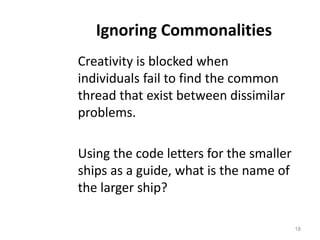
Ignoring Commonalities
Creativity is blocked when
individuals fail to find the common
thread that exist between dissimilar
problems.
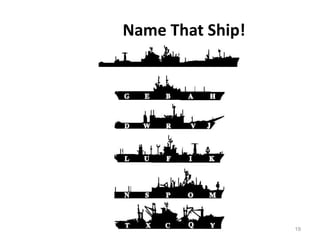
Using the code letters for the smaller
ships as a guide, what is the name of
the larger ship?
18
Name That Ship!
Insert figure 3.6
19
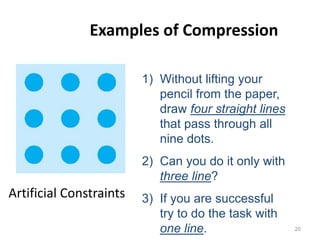
Examples of Compression
Artificial Constraints
20
1) Without lifting your
pencil from the paper,
draw four straight lines
that pass through all
nine dots.
2) Can you do it only with
three line?
3) If you are successful
try to do the task with
one line.
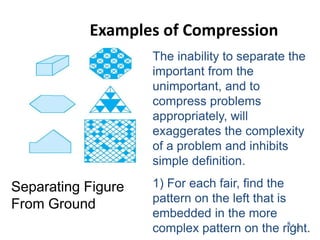
Examples of Compression
21
Separating Figure
From Ground
The inability to separate the
important from the
unimportant, and to
compress problems
appropriately, will
exaggerates the complexity
of a problem and inhibits
simple definition.
1) For each fair, find the
pattern on the left that is
embedded in the more
complex pattern on the right.
3 -
Examples of Complacency
• Noninquisitiveness: Unwillingness to ask
questions
We often stop being inquisitive as we get older because we learn that it is good
to be intelligent, and being intelligent is interpreted as already knowing the
answers instead of asking questions. Creative problem solvers, however are
frequently engaged in inquisitive and experimental behavior.
• Bias against thinking: To avoid doing mental
work
Left-hemisphere thinking is concerned with logical, analytical, linear, or
sequential tasks.
Right-hemisphere thinking is concerned with intuition, synthesis, and qualitative
judgment.
Most creative problem solvers use both left and right hemisphere thinking and
easily switch from one to the other. 22
Conceptual Blockbusting
Conceptual blocks cannot be overcome all at once because most
blocks are a product of years of habit forming thought process.
Overcoming them requires practice in thinking in different ways
over a long period of time.
Stages in Creative Thought
• Preparation-gathering data, define problem,
gathering alternatives
• Incubation- mind combine unrelated things
• Illumination-insight is recognized and a creative
solution is articulated
• Verification- evaluating the creative solution related
to some standard. 23
Methods to Improve Problem
Definition
• Make the strange familiar and the familiar
strange – (Synectics) By analyzing what you know
and applying it to what you don’t know, you can
develop new insight.
• Elaborate the definition- there can be more
than one problem definition, more than one right
answer, more than one perspective
• Reverse the definition
than one problem definition, more than one right
answer, more than one perspective 24
Technique to Generate More
Alternatives
1. Defer judgment – Brainstorming
• No evaluation of ideas is permitted
• Wild ideas are encouraged
• Quantity before quality
• Build on ideas of others
2. Expand current alternatives-
Subdivision
3. Combine unrelated attributes
25
Hints to Facilitate Creative
Problem Solving
• Give yourself relaxation time
• Find a place where you can think
• Talk to other people about ideas
• Ask other people for their suggestions
about your problems
• Read a lot
• Protect yourself from idea-killers
26
3 -
Three Principles for Fostering
Creativity
1. Pull people apart; put people together
• Let individuals work alone as well as with team
• Encourage minority reports and legitimize roles
• Encourage heterogeneous membership in teams
• Separate competing groups or subgroups
2. Monitor and prod
• Talk to customers, Identify customer expectations
• Hold people accountable, Use ‘sharp-pointed’ prods
3. Reward multiple roles
• Idea champion, Sponsor and mentor, Orchestrator and facilitator,
Rule breaker.
27

Solving problems Analytically and creatively.pdf

  • 1.
    Management Skills Development SolvingProblems Analytically and Creatively Lecture 4 By Dr. L.L Ekanayake 1
  • 2.
    Learning Objectives • Increaseproficiency in analytic problem solving • Recognize personal conceptual blocks • Enhance creativity by overcoming conceptual blocks • Foster innovation among others 2
  • 3.
    A Model of ProblemSolving • Step 1: Define the Problem – Differentiate fact from opinion – Specify underlying causes – Tap everyone involved for information – State the problem explicitly – Identify what standard is violated – Determine whose problem it is – Avoid stating the problem as a disguised solution 3
  • 4.
    A Model of ProblemSolving • Step 2: Generate Alternative Solutions – Postpone evaluating alternatives until several alternatives has been proposed – Be sure all involved individuals generate alternatives – Specify alternatives that are consistent with organizational goals or policies – Specify both short- and long-term consequences – Build on one another. combined and modified – Specify alternatives that solve the problem 4
  • 5.
    A Model of ProblemSolving • Step 3: Evaluate and Select an Alternative – Evaluate relative to an optimal standard rather than satisfactory standard – Evaluate systematically without short circuiting – Evaluate relative to goals of the organization and the individuals involved – Evaluate main effects and side effects – State the selected alternative explicitly 5 3 -
  • 6.
    A Model ofProblem Solving • Step 4: Implement and Follow Up on the Solution – Implement at proper time and in the right sequence – Most effective when it is accomplished in small steps or increments – Provide opportunities for feedback – Stimulate acceptance – Establish ongoing monitoring system – Evaluate based on problem solution 6
  • 7.
    Limitations of theAnalytical Problem- Solving Model • Defining the problems – Lack of consensus as to the definition of the problem – Uncertainty as to whose definition will be accepted – Usually defined in terms of the solutions already possessed – Symptoms are often get confused with the real problem – Confusing information inhibits problem identification 7
  • 8.
    Constraints on theAnalytical Problem- Solving Model • Generating Alternatives • Alternatives are evaluated one at a time as they are proposed • Few of the possible alternatives are usually known • The first acceptable solution is usually accepted • Alternatives are based on what was successful in the past 8
  • 9.
    Constraints on theAnalytical Problem- Solving Model • Evaluating and Select an Alternative • Information on alternatives is limited • Search for information occurs close to home • The type of information is constrained by other factors • Gathering information is costly • Preferences for the best alternatives are not always known • Satisfactory solution, not optimal ones are usually accepted • Solutions often are implemented before the problem is defined 9
  • 10.
    Constraints on theAnalytical Problem- Solving Model • Implementation and Follow up – Acceptance is not always forthcoming – Resistance to change – Uncertainty about what part of solution to monitor – Political and organizational processes must be managed – It may take a long time to implement a solution 10
  • 11.
    Impediments to CreativeProblem Solving • Focused on generating something new. • Most people have trouble solving problems creatively. • They have developed certain conceptual blocks in their problem-solving activities of which they are not even aware. • The blocks are largely personal. So skill development is required to overcome them. © 2007 by Prentice Hall 11
  • 12.
    Conceptual blocks • Conceptualblocks are mental obstacles that constrain the way problems are defined and limit the number of alternative solutions thought to be relevant. • Almost everyone has created blocks that inhibit our creativity over time. • In fact, we need some of them to cope with everyday life. 12
  • 13.
    Conceptual blocks • Overtime, you must develop the habit of mentally filtering out some of the information to which you are exposed; otherwise, information overload would drive you crazy. These filtering habits eventually become conceptual block • Paradoxically, the more formal education individuals have, and the more experience they have in a job, the less able they are to solve problems in creative ways. • It has been estimated that most adults over 40 display less than 2 percent of the creative problem solving ability of a child under 5 years old. • Training in thinking increased the number of good ideas produced in problem solving. © 2007 by Prentice Hall 13
  • 14.
    Conceptual Blocks Constancy –verticalthinking, one thinking language Individual become wedded to one way of looking at a problem or to using one approach to define, describe or solve it. Commitment- Stereotyping based on past experience, ignoring commonalities Once individuals become committed to a particular point of view, definition, or solution, it is likely that they will follow through on that commitment. Compression- Distinguishing figure from ground, Artificial constraint Looking too narrowly at a problem, screening out too much relevant data, and making assumptions that inhibit problem solution Complacency – Noninquisitiveness (not asking questions), Nonthinking, (Bias Against Thinking). Some conceptual blocks occur because of fear, ignorance, insecurity, or just plain mental laziness. Block are a lack of questioning and a bias against thinking. 14
  • 15.
    deBono’s Ways ofThinking •Vertical Thinking – Continuity – Chooses – Stability – Searches for what is right – Analytic – Where the idea came from – Develops an idea • Lateral Thinking – Discontinuity – Changes – Instability – Searches for what is different – Provocative – Where the idea is going – Discovers the idea 15
  • 16.
    Multiple Thinking Languages •Words • Symbols • Sensory (i.e. smell) • Feelings and emotions • Visual imagery • The more languages available to problem solvers, the more creative the solution will be. 16
  • 17.
    Stereotyping When individuals definepresent problems in terms of problems that they have faced in the past. So the alternatives proposed to solve the current problem are one that have proven successfully in the past. However, it may prevent individuals from viewing a problem in novel way. 17
  • 18.
    Ignoring Commonalities Creativity isblocked when individuals fail to find the common thread that exist between dissimilar problems. Using the code letters for the smaller ships as a guide, what is the name of the larger ship? 18
  • 19.
  • 20.
    Examples of Compression ArtificialConstraints 20 1) Without lifting your pencil from the paper, draw four straight lines that pass through all nine dots. 2) Can you do it only with three line? 3) If you are successful try to do the task with one line.
  • 21.
    Examples of Compression 21 SeparatingFigure From Ground The inability to separate the important from the unimportant, and to compress problems appropriately, will exaggerates the complexity of a problem and inhibits simple definition. 1) For each fair, find the pattern on the left that is embedded in the more complex pattern on the right. 3 -
  • 22.
    Examples of Complacency •Noninquisitiveness: Unwillingness to ask questions We often stop being inquisitive as we get older because we learn that it is good to be intelligent, and being intelligent is interpreted as already knowing the answers instead of asking questions. Creative problem solvers, however are frequently engaged in inquisitive and experimental behavior. • Bias against thinking: To avoid doing mental work Left-hemisphere thinking is concerned with logical, analytical, linear, or sequential tasks. Right-hemisphere thinking is concerned with intuition, synthesis, and qualitative judgment. Most creative problem solvers use both left and right hemisphere thinking and easily switch from one to the other. 22
  • 23.
    Conceptual Blockbusting Conceptual blockscannot be overcome all at once because most blocks are a product of years of habit forming thought process. Overcoming them requires practice in thinking in different ways over a long period of time. Stages in Creative Thought • Preparation-gathering data, define problem, gathering alternatives • Incubation- mind combine unrelated things • Illumination-insight is recognized and a creative solution is articulated • Verification- evaluating the creative solution related to some standard. 23
  • 24.
    Methods to ImproveProblem Definition • Make the strange familiar and the familiar strange – (Synectics) By analyzing what you know and applying it to what you don’t know, you can develop new insight. • Elaborate the definition- there can be more than one problem definition, more than one right answer, more than one perspective • Reverse the definition than one problem definition, more than one right answer, more than one perspective 24
  • 25.
    Technique to GenerateMore Alternatives 1. Defer judgment – Brainstorming • No evaluation of ideas is permitted • Wild ideas are encouraged • Quantity before quality • Build on ideas of others 2. Expand current alternatives- Subdivision 3. Combine unrelated attributes 25
  • 26.
    Hints to FacilitateCreative Problem Solving • Give yourself relaxation time • Find a place where you can think • Talk to other people about ideas • Ask other people for their suggestions about your problems • Read a lot • Protect yourself from idea-killers 26 3 -
  • 27.
    Three Principles forFostering Creativity 1. Pull people apart; put people together • Let individuals work alone as well as with team • Encourage minority reports and legitimize roles • Encourage heterogeneous membership in teams • Separate competing groups or subgroups 2. Monitor and prod • Talk to customers, Identify customer expectations • Hold people accountable, Use ‘sharp-pointed’ prods 3. Reward multiple roles • Idea champion, Sponsor and mentor, Orchestrator and facilitator, Rule breaker. 27