CRAWLING EXERCISE
DR. ANERI PATWARI
MPT
CARDIO-RESPIRATORY
ASSISTANT PROFESSOR
CONTENT
• DEVELOPMENT OF CRAWLING
• MILESTONE ACHIEVED BEFORE CRAWLING
• INTRODUCTION OF CRAWLING
• PURPOSE & USES OF CRAWLING
• TYPES OF CRAWLING
09-04-2024 2
DEVELOPMENT OF CRAWLING
• Child tends to begin scooting forward on their belly between months of age.
• Typically child takes their first official crawling “steps” on their hands and knees with their belly
off the floor between 9-11 months of age.
• Child will tend to use crawling as their primary means of mobility for around 4-6 months.
• This may appear a straight forward process, however the preparation leading up to crawling
begins long before child ever takes those first wonderful steps on their hands and knees.
09-04-2024 3
MILESTONE ACHIEVED BEFORE
CRAWLING
09-04-2024 4
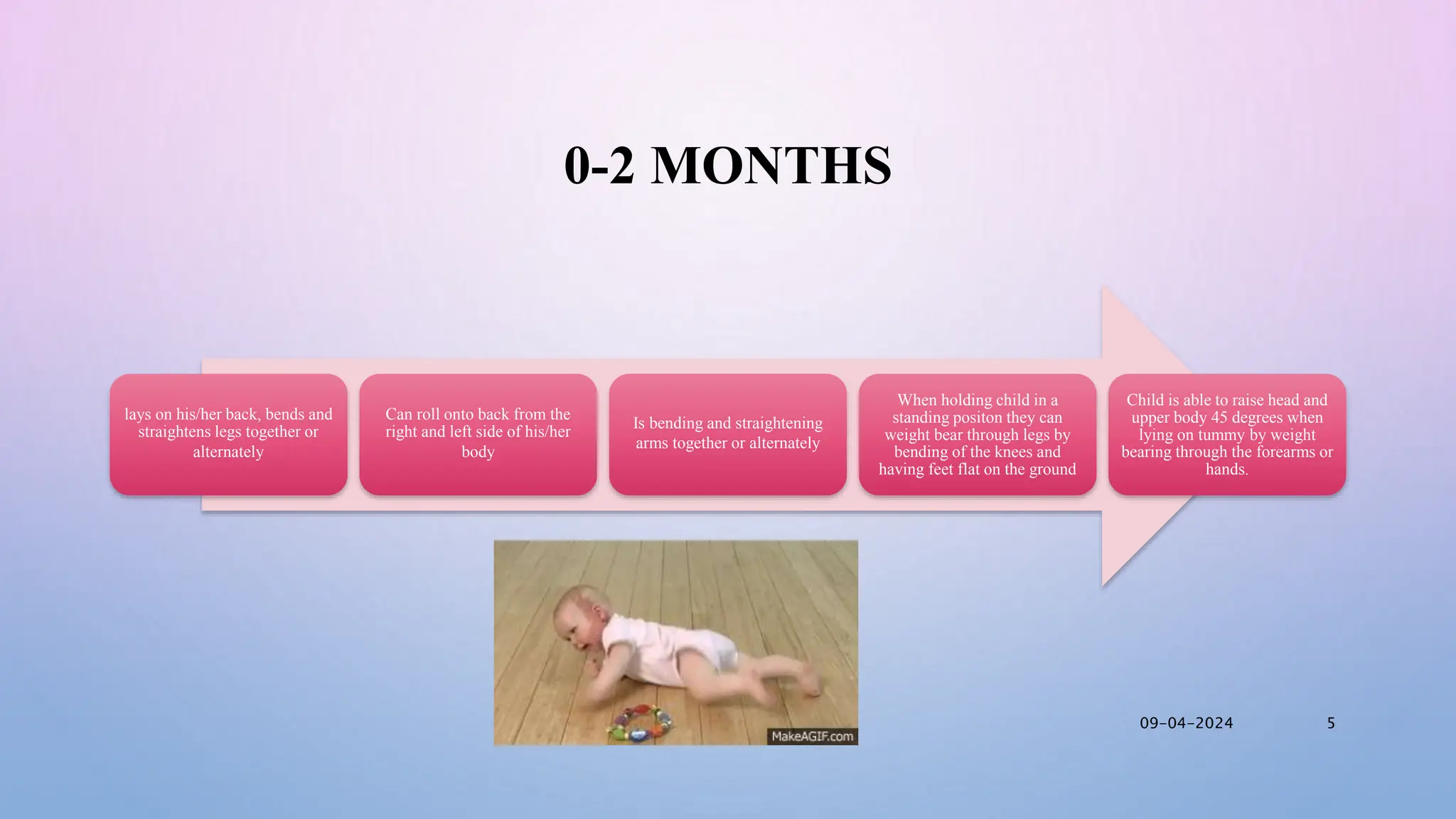
0-2 MONTHS
lays on his/her back, bends and
straightens legs together or
alternately
Can roll onto back from the
right and left side of his/her
body
Is bending and straightening
arms together or alternately
When holding child in a
standing positon they can
weight bear through legs by
bending of the knees and
having feet flat on the ground
Child is able to raise head and
upper body 45 degrees when
lying on tummy by weight
bearing through the forearms or
hands.
09-04-2024 5
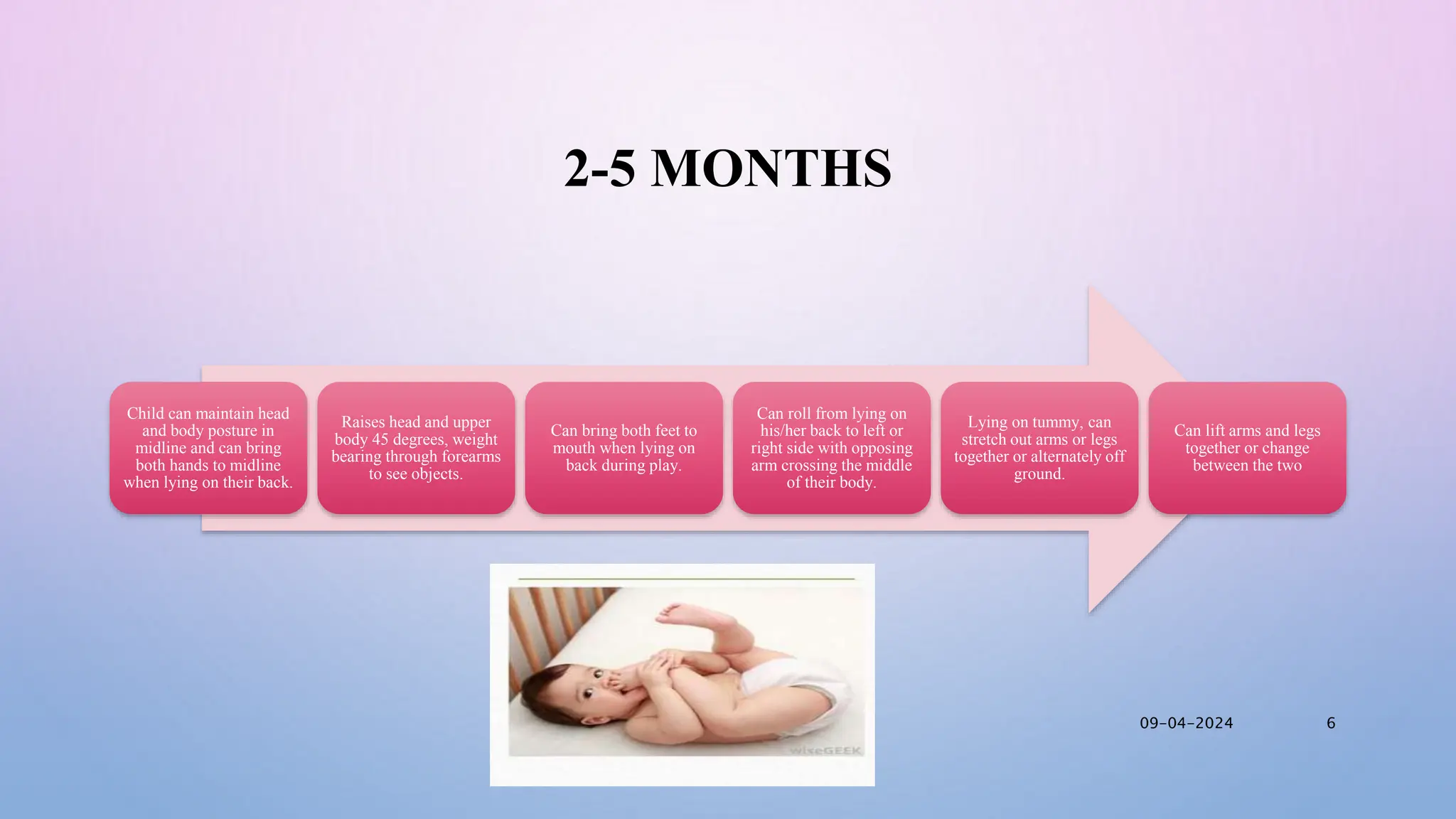
2-5 MONTHS
Child can maintain head
and body posture in
midline and can bring
both hands to midline
when lying on their back.
Raises head and upper
body 45 degrees, weight
bearing through forearms
to see objects.
Can bring both feet to
mouth when lying on
back during play.
Can roll from lying on
his/her back to left or
right side with opposing
arm crossing the middle
of their body.
Lying on tummy, can
stretch out arms or legs
together or alternately off
ground.
Can lift arms and legs
together or change
between the two
09-04-2024 6
5-8 MONTHS
When lying on tummy child can
raise upper trunk and move his/her
weight to one side and can reach
out with arm for a toy.
Can reach out for feet their and
hold them.
From lying on tummy he/she can
raise head and tummy by weight
bearing through hands.
Can shift own weight from lying on
his/her back to one side. Uses one
arm to support body and the
stretching the other out for a toy/
person/ object.
Can roll from back to tummy,
pushing forward with lower body,
followed by the tummy and the
shoulders.
Scoots forward on their tummy
using their arms.
09-04-2024 7
INTRODUCTION
• This may be regarded as movement in a position and it is such an important and useful activity.
• When balance and stability in prone kneeling have been established patients can being to practise
lifting a hand or knee from floor to balance on ‘three legs’.
• This makes in possible for the crawling movement to take place in any chosen direction as
weight free limb can be lifted and replaced in a new position before taking weight once more.
• These are given mainly for the :
• A) mobilization of trunk
• B) co-ordination of movement
• C) improvement of endurance
09-04-2024 8
INTRODUCTION
• When resistance is given , it also important the power of trunk muscles.
• All these crawling exercise are given in various starting position and they have different effects.
• All these different crawling may be performed with music.
• Manual resistance can be given around the shoulder and the knees depending on the muscle to be
strengthen.
• Flat pad may be used to protect the knees from undue pressure. Introduction
09-04-2024 9
PURPOSE AND USES
• Crawling activities built up co-ordination at whole body including reciprocal movement of arms
and legs as required in walking.
• The spine is weight free in horizontal movement, the potential rom in the joint increased so
crawling is useful for the spine mobilization, also helps in learning control of excessive mobility.
• A measure of weight bearing on arms and legs stimulates activities in the region of this joint
approximation. This can continue in retaining the functions of limb.
• Crawling provides safe and effective means of moving from one area of room to another area of
room for those who has very poor balance in erect position.
• Patient should be instructed properly which and where limb should be moved during practice.
• Rest period is given by allowing patient to sit.
09-04-2024 10
TYPES
Dog’s crawl
Low dog’s
crawl
Arm stretch
crawl
Leg shift
crawl
Low ‘s’
crawl
09-04-2024 11
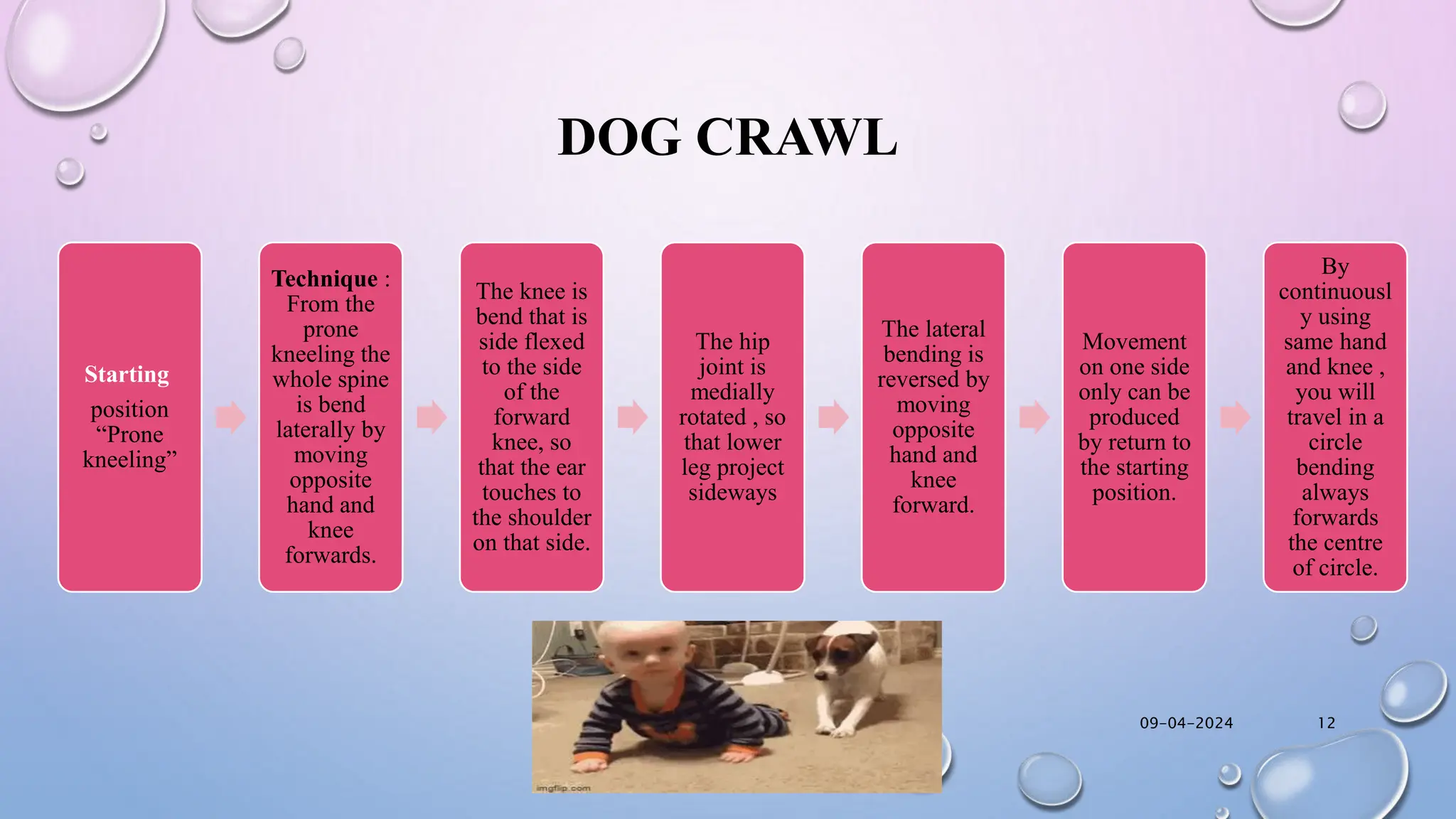
DOG CRAWL
Starting
position
“Prone
kneeling”
Technique :
From the
prone
kneeling the
whole spine
is bend
laterally by
moving
opposite
hand and
knee
forwards.
The knee is
bend that is
side flexed
to the side
of the
forward
knee, so
that the ear
touches to
the shoulder
on that side.
The hip
joint is
medially
rotated , so
that lower
leg project
sideways
The lateral
bending is
reversed by
moving
opposite
hand and
knee
forward.
Movement
on one side
only can be
produced
by return to
the starting
position.
By
continuousl
y using
same hand
and knee ,
you will
travel in a
circle
bending
always
forwards
the centre
of circle.
09-04-2024 12
LOW DOG CRAWL
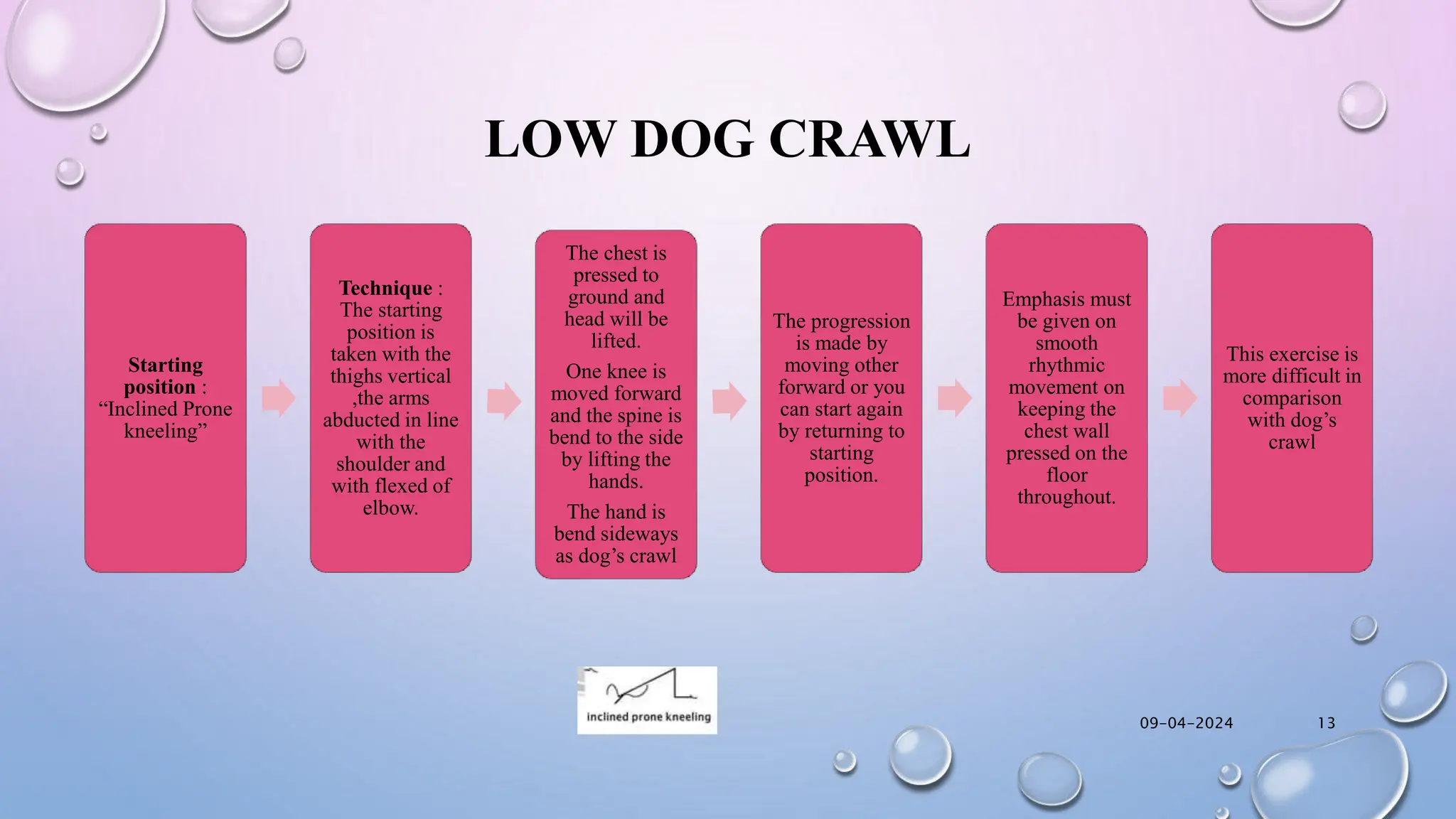
Starting
position :
“Inclined Prone
kneeling”
Technique :
The starting
position is
taken with the
thighs vertical
,the arms
abducted in line
with the
shoulder and
with flexed of
elbow.
The chest is
pressed to
ground and
head will be
lifted.
One knee is
moved forward
and the spine is
bend to the side
by lifting the
hands.
The hand is
bend sideways
as dog’s crawl
The progression
is made by
moving other
forward or you
can start again
by returning to
starting
position.
Emphasis must
be given on
smooth
rhythmic
movement on
keeping the
chest wall
pressed on the
floor
throughout.
This exercise is
more difficult in
comparison
with dog’s
crawl
09-04-2024 13
ARM STRETCH CRAWL(FOR KYPHOSIS)
Starting
position :
“Stretch stoop
kneeling”
Technique :
The chest is
well pressed to
the ground.
The thighs are
vertical
throughout the
movement.
The patient
moves forward
by taking small
steps with the
knee and sliding
the hands
forwards along
the ground.
The crawl is
used –Increases
extension of
thoracic spine -
For the
correction of
kyphosis -To
strengthen the
upper back
muscle.
09-04-2024 14
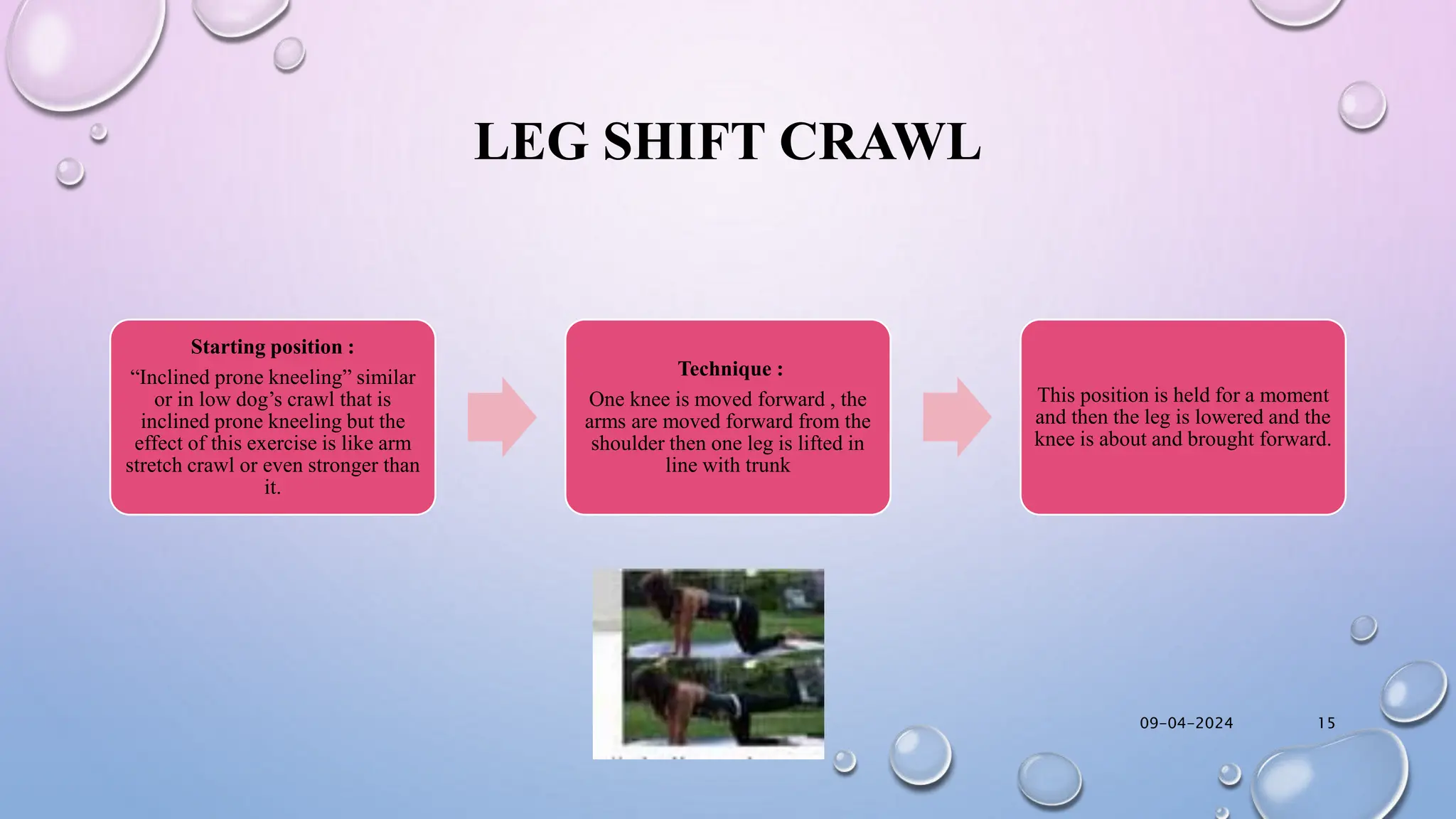
LEG SHIFT CRAWL
Starting position :
“Inclined prone kneeling” similar
or in low dog’s crawl that is
inclined prone kneeling but the
effect of this exercise is like arm
stretch crawl or even stronger than
it.
Technique :
One knee is moved forward , the
arms are moved forward from the
shoulder then one leg is lifted in
line with trunk
This position is held for a moment
and then the leg is lowered and the
knee is about and brought forward.
09-04-2024 15
LOW ‘S’ CRAWL(FOR SCOLIOSIS)
Starting position
: “Inclined prone
kneeling” This
crawl is designed
to straighten the
spine in case of the
scoliosis by strong
contraction of
muscle on convex
side and by
stretching the
muscles of the
concave side
Technique :
From the inclined
prone kneeling
position , the arm
on the side of
concavity on the
thoracic curve is
stretched forward
and the leg on the
side of the lumber
concavity is
stretched
backward.
The thigh of
supporting limb
remains verticle
throughout on the
patient to stretch
arm and leg.
The extended knee
is bent and more
forward and
opposite side arm
return to the
starting position
A short step
forward is taken
with the opposite
hand and knee ,
the movement is
repeated.
09-04-2024 16
REFERENCE
• PRACTICAL EXERCISE THERAPY MARGARET HOLLIS 4TH EDITION
09-04-2024 17

CRAWLING EXERCISES by Dr. Aneri.....pptx

  • 1.
    CRAWLING EXERCISE DR. ANERIPATWARI MPT CARDIO-RESPIRATORY ASSISTANT PROFESSOR
  • 2.
    CONTENT • DEVELOPMENT OFCRAWLING • MILESTONE ACHIEVED BEFORE CRAWLING • INTRODUCTION OF CRAWLING • PURPOSE & USES OF CRAWLING • TYPES OF CRAWLING 09-04-2024 2
  • 3.
    DEVELOPMENT OF CRAWLING •Child tends to begin scooting forward on their belly between months of age. • Typically child takes their first official crawling “steps” on their hands and knees with their belly off the floor between 9-11 months of age. • Child will tend to use crawling as their primary means of mobility for around 4-6 months. • This may appear a straight forward process, however the preparation leading up to crawling begins long before child ever takes those first wonderful steps on their hands and knees. 09-04-2024 3
  • 4.
  • 5.
    0-2 MONTHS lays onhis/her back, bends and straightens legs together or alternately Can roll onto back from the right and left side of his/her body Is bending and straightening arms together or alternately When holding child in a standing positon they can weight bear through legs by bending of the knees and having feet flat on the ground Child is able to raise head and upper body 45 degrees when lying on tummy by weight bearing through the forearms or hands. 09-04-2024 5
  • 6.
    2-5 MONTHS Child canmaintain head and body posture in midline and can bring both hands to midline when lying on their back. Raises head and upper body 45 degrees, weight bearing through forearms to see objects. Can bring both feet to mouth when lying on back during play. Can roll from lying on his/her back to left or right side with opposing arm crossing the middle of their body. Lying on tummy, can stretch out arms or legs together or alternately off ground. Can lift arms and legs together or change between the two 09-04-2024 6
  • 7.
    5-8 MONTHS When lyingon tummy child can raise upper trunk and move his/her weight to one side and can reach out with arm for a toy. Can reach out for feet their and hold them. From lying on tummy he/she can raise head and tummy by weight bearing through hands. Can shift own weight from lying on his/her back to one side. Uses one arm to support body and the stretching the other out for a toy/ person/ object. Can roll from back to tummy, pushing forward with lower body, followed by the tummy and the shoulders. Scoots forward on their tummy using their arms. 09-04-2024 7
  • 8.
    INTRODUCTION • This maybe regarded as movement in a position and it is such an important and useful activity. • When balance and stability in prone kneeling have been established patients can being to practise lifting a hand or knee from floor to balance on ‘three legs’. • This makes in possible for the crawling movement to take place in any chosen direction as weight free limb can be lifted and replaced in a new position before taking weight once more. • These are given mainly for the : • A) mobilization of trunk • B) co-ordination of movement • C) improvement of endurance 09-04-2024 8
  • 9.
    INTRODUCTION • When resistanceis given , it also important the power of trunk muscles. • All these crawling exercise are given in various starting position and they have different effects. • All these different crawling may be performed with music. • Manual resistance can be given around the shoulder and the knees depending on the muscle to be strengthen. • Flat pad may be used to protect the knees from undue pressure. Introduction 09-04-2024 9
  • 10.
    PURPOSE AND USES •Crawling activities built up co-ordination at whole body including reciprocal movement of arms and legs as required in walking. • The spine is weight free in horizontal movement, the potential rom in the joint increased so crawling is useful for the spine mobilization, also helps in learning control of excessive mobility. • A measure of weight bearing on arms and legs stimulates activities in the region of this joint approximation. This can continue in retaining the functions of limb. • Crawling provides safe and effective means of moving from one area of room to another area of room for those who has very poor balance in erect position. • Patient should be instructed properly which and where limb should be moved during practice. • Rest period is given by allowing patient to sit. 09-04-2024 10
  • 11.
    TYPES Dog’s crawl Low dog’s crawl Armstretch crawl Leg shift crawl Low ‘s’ crawl 09-04-2024 11
  • 12.
    DOG CRAWL Starting position “Prone kneeling” Technique : Fromthe prone kneeling the whole spine is bend laterally by moving opposite hand and knee forwards. The knee is bend that is side flexed to the side of the forward knee, so that the ear touches to the shoulder on that side. The hip joint is medially rotated , so that lower leg project sideways The lateral bending is reversed by moving opposite hand and knee forward. Movement on one side only can be produced by return to the starting position. By continuousl y using same hand and knee , you will travel in a circle bending always forwards the centre of circle. 09-04-2024 12
  • 13.
    LOW DOG CRAWL Starting position: “Inclined Prone kneeling” Technique : The starting position is taken with the thighs vertical ,the arms abducted in line with the shoulder and with flexed of elbow. The chest is pressed to ground and head will be lifted. One knee is moved forward and the spine is bend to the side by lifting the hands. The hand is bend sideways as dog’s crawl The progression is made by moving other forward or you can start again by returning to starting position. Emphasis must be given on smooth rhythmic movement on keeping the chest wall pressed on the floor throughout. This exercise is more difficult in comparison with dog’s crawl 09-04-2024 13
  • 14.
    ARM STRETCH CRAWL(FORKYPHOSIS) Starting position : “Stretch stoop kneeling” Technique : The chest is well pressed to the ground. The thighs are vertical throughout the movement. The patient moves forward by taking small steps with the knee and sliding the hands forwards along the ground. The crawl is used –Increases extension of thoracic spine - For the correction of kyphosis -To strengthen the upper back muscle. 09-04-2024 14
  • 15.
    LEG SHIFT CRAWL Startingposition : “Inclined prone kneeling” similar or in low dog’s crawl that is inclined prone kneeling but the effect of this exercise is like arm stretch crawl or even stronger than it. Technique : One knee is moved forward , the arms are moved forward from the shoulder then one leg is lifted in line with trunk This position is held for a moment and then the leg is lowered and the knee is about and brought forward. 09-04-2024 15
  • 16.
    LOW ‘S’ CRAWL(FORSCOLIOSIS) Starting position : “Inclined prone kneeling” This crawl is designed to straighten the spine in case of the scoliosis by strong contraction of muscle on convex side and by stretching the muscles of the concave side Technique : From the inclined prone kneeling position , the arm on the side of concavity on the thoracic curve is stretched forward and the leg on the side of the lumber concavity is stretched backward. The thigh of supporting limb remains verticle throughout on the patient to stretch arm and leg. The extended knee is bent and more forward and opposite side arm return to the starting position A short step forward is taken with the opposite hand and knee , the movement is repeated. 09-04-2024 16
  • 17.
    REFERENCE • PRACTICAL EXERCISETHERAPY MARGARET HOLLIS 4TH EDITION 09-04-2024 17