BRUNNSTORM
APPROACH
Dr. Nerusu Sai Priyanka
MPT NEUROSCIENCES
INTRODUCTION
 Hierarchical theory- says that higher centers
control on lower center, but when higher center
damage then this inhibitory control is lost
 Which leads to exaggeration of movement
 In normal individuals there is smooth, rhythmic
movement as there is presence of control from
higher center on lower center
INTRODUCTION
 Emphasize on the development of
synergy in spastic group of muscle. It
helps in developing a voluntary
movement.
 Associated Reaction- movement of
sound extremity causes movement of
affected extremity. E.g- flexion of
normal affected upper extremity
causes flexion of affected limb.
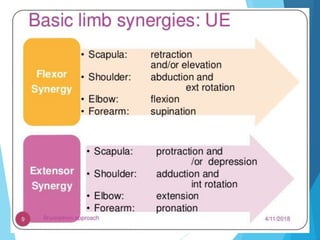
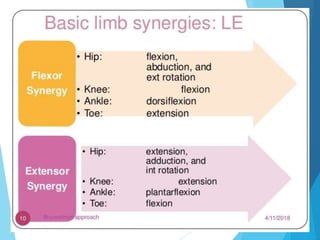
Basic limb synergies
 Mass movement patterns in response to
stimulus or voluntary effort or both
 Gross flexor movement(flexor synergy)
 Gross extensor movement(extensor
synergy)
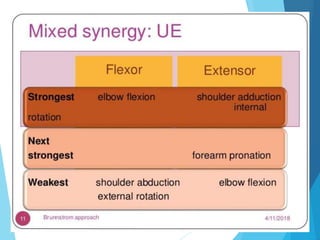
 Combination of the strongest components
of the synergies(mixed synergy)
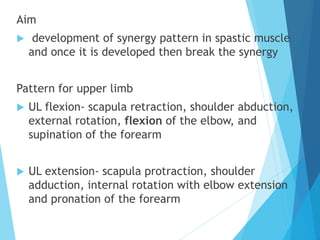
Aim
 development of synergy pattern in spastic muscle
and once it is developed then break the synergy
Pattern for upper limb
 UL flexion- scapula retraction, shoulder abduction,
external rotation, flexion of the elbow, and
supination of the forearm
 UL extension- scapula protraction, shoulder
adduction, internal rotation with elbow extension
and pronation of the forearm
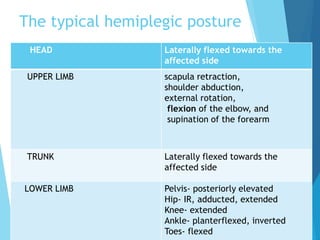
The typical hemiplegic posture
HEAD Laterally flexed towards the
affected side
UPPER LIMB scapula retraction,
shoulder abduction,
external rotation,
flexion of the elbow, and
supination of the forearm
TRUNK Laterally flexed towards the
affected side
LOWER LIMB Pelvis- posteriorly elevated
Hip- IR, adducted, extended
Knee- extended
Ankle- planterflexed, inverted
Toes- flexed
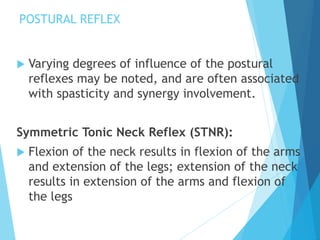
POSTURAL REFLEX
 Varying degrees of influence of the postural
reflexes may be noted, and are often associated
with spasticity and synergy involvement.
Symmetric Tonic Neck Reflex (STNR):
 Flexion of the neck results in flexion of the arms
and extension of the legs; extension of the neck
results in extension of the arms and flexion of
the legs
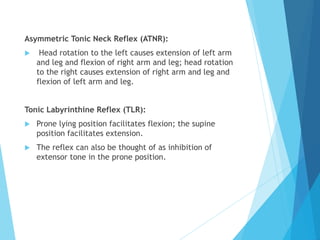
Asymmetric Tonic Neck Reflex (ATNR):
 Head rotation to the left causes extension of left arm
and leg and flexion of right arm and leg; head rotation
to the right causes extension of right arm and leg and
flexion of left arm and leg.
Tonic Labyrinthine Reflex (TLR):
 Prone lying position facilitates flexion; the supine
position facilitates extension.
 The reflex can also be thought of as inhibition of
extensor tone in the prone position.
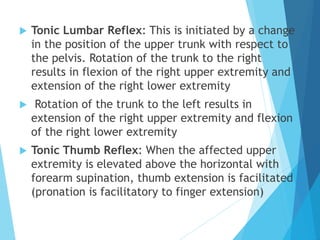
 Tonic Lumbar Reflex: This is initiated by a change
in the position of the upper trunk with respect to
the pelvis. Rotation of the trunk to the right
results in flexion of the right upper extremity and
extension of the right lower extremity
 Rotation of the trunk to the left results in
extension of the right upper extremity and flexion
of the right lower extremity
 Tonic Thumb Reflex: When the affected upper
extremity is elevated above the horizontal with
forearm supination, thumb extension is facilitated
(pronation is facilitatory to finger extension)
ASSOCIATED REACTIONS
 Associated reactions are automatic responses of
the involved limb resulting from action occurring
in some other part of the body, either by
voluntary or reflex stimulation (e.g., resistance
or ATNR)
 They are commonly elicited when some degree of
spasticity is present and are infrequently seen in
a limb exhibiting minimal muscle tone.
 Souques’ Phenomenon: Elevation of the affected arm
above the horizontal evokes an extension and abduction
response of the fingers.
 Raimiste’s Phenomenon: Resistance applied to
abduction or adduction of the nonaffected lower
extremity evokes a similar reaction in the affected limb
 Homolateral Limb Synkineses: It has been noted
that a dependency exists between the synergies
of the involved upper and lower extremities.
Thus, flexion of the involved upper extremity
will elicit flexion of the involved lower
extremity.
 Sensory evaluation: Joint sense: With the
patient seated and is blindfolded; the affected
upper limb is supported by the examiner and
moved to different positions asking the patient
to perform identical position with the
unaffected extremity.
ASSOCIATED REACTIONS
 Yawning
 Flexor synergy is elicited during initiation of
yawn
 Coughing and sneezing
 Evoke sudden muscular contractions of short
duration.
HAND REACTIONS
 Instinctive grasp Reaction:
 Stationary contact with the palm of the hand
results to closure of the hand
 Instinctive avoiding Reaction:
 With the arms elevated in a forward-upward
direction, the finger an thumb hyperextend;
stroking the palm in a distal direction
exaggerates the posture
Stages of motor recovery: Brunnstrom classified stages of
recovery into six stages:
 Stage 1: The patient is completely flaccid, no voluntary
movement, and patient is confined to bed.
 Stage 2: Basic limb synergy develops, no voluntary
movement, can be done as spasticity appears but is not
marked.
 Stage 3: Basic limb synergy develops voluntarily and is
marked, spasticity is marked. (This is the stage of
maximal spasticity).
 Stage 4: Spasticity begins to decrease, four movement
combinations deviate from basic limb synergies and
become available, which are:
 Placing the hand behind the body,
 alternative pronation- supination with the elbow at 90°
flexion
 elevation of the arm to a forward horizontal position.
 Stage 5: There is relative independence of the basic
limb synergies.
 Spasticity is wanning, and movements can be performed
as arm raising to a side horizantal position, alternative
pronation- supination with the elbow extended and
bringing hand over the head.
 Stage 6: There are isolated joint movements.
 Speed test: It can be used to assess spasticity
during anyone of the recovery stages, provided
that the patient has sufficient active ROM.
 The patient is seated on a chair without armrest
leaning against chair back and keeping the head
erect.
 The two movements studied are:
 (1) The hand is moved from lap to chin,
requiring complete range of elbow flexion.
 (2) The hand is moved from lap to opposite
knee, requiring full range of elbow extension.
Treatment principles
(1) When no motion exists, movement is facilitated using
reflexes, associated reactions, proprioceptive facilitation,
and/or exteroceptive facilitation to develop muscle tension
in preparation for voluntary movement.
(2) The responses of the patient from such facilitation
combine with the patient's voluntary effort to produces
semi-voluntary movement.
(3) Proprioceptive and exteroceptive stimuli assist in
eliciting the synergies.
(4) When voluntary effort appears:
a)The patient is asked to hold (isometric) the contraction.
b) If successful, he is asked for an eccentric (controlled
lengthening) contraction.
c) Finally, a concentric (shortening) contraction.
d) Reversal of the movement between the agonist and
antagonist.
(5) Facilitation is reduced or dropped out as
quickly as the patient shows voluntary control
(primitive reflexes & associated reactions).
(6) Correct movement is repeated.
(7) Practice in the form of ADL
THANKYOU!

BRUNNSTORM APPROACH.pptx

  • 1.
    BRUNNSTORM APPROACH Dr. Nerusu SaiPriyanka MPT NEUROSCIENCES
  • 2.
    INTRODUCTION  Hierarchical theory-says that higher centers control on lower center, but when higher center damage then this inhibitory control is lost  Which leads to exaggeration of movement  In normal individuals there is smooth, rhythmic movement as there is presence of control from higher center on lower center
  • 3.
    INTRODUCTION  Emphasize onthe development of synergy in spastic group of muscle. It helps in developing a voluntary movement.  Associated Reaction- movement of sound extremity causes movement of affected extremity. E.g- flexion of normal affected upper extremity causes flexion of affected limb.
  • 4.
    Basic limb synergies Mass movement patterns in response to stimulus or voluntary effort or both  Gross flexor movement(flexor synergy)  Gross extensor movement(extensor synergy)  Combination of the strongest components of the synergies(mixed synergy)
  • 5.
    Aim  development ofsynergy pattern in spastic muscle and once it is developed then break the synergy Pattern for upper limb  UL flexion- scapula retraction, shoulder abduction, external rotation, flexion of the elbow, and supination of the forearm  UL extension- scapula protraction, shoulder adduction, internal rotation with elbow extension and pronation of the forearm
  • 9.
    The typical hemiplegicposture HEAD Laterally flexed towards the affected side UPPER LIMB scapula retraction, shoulder abduction, external rotation, flexion of the elbow, and supination of the forearm TRUNK Laterally flexed towards the affected side LOWER LIMB Pelvis- posteriorly elevated Hip- IR, adducted, extended Knee- extended Ankle- planterflexed, inverted Toes- flexed
  • 10.
    POSTURAL REFLEX  Varyingdegrees of influence of the postural reflexes may be noted, and are often associated with spasticity and synergy involvement. Symmetric Tonic Neck Reflex (STNR):  Flexion of the neck results in flexion of the arms and extension of the legs; extension of the neck results in extension of the arms and flexion of the legs
  • 11.
    Asymmetric Tonic NeckReflex (ATNR):  Head rotation to the left causes extension of left arm and leg and flexion of right arm and leg; head rotation to the right causes extension of right arm and leg and flexion of left arm and leg. Tonic Labyrinthine Reflex (TLR):  Prone lying position facilitates flexion; the supine position facilitates extension.  The reflex can also be thought of as inhibition of extensor tone in the prone position.
  • 12.
     Tonic LumbarReflex: This is initiated by a change in the position of the upper trunk with respect to the pelvis. Rotation of the trunk to the right results in flexion of the right upper extremity and extension of the right lower extremity  Rotation of the trunk to the left results in extension of the right upper extremity and flexion of the right lower extremity  Tonic Thumb Reflex: When the affected upper extremity is elevated above the horizontal with forearm supination, thumb extension is facilitated (pronation is facilitatory to finger extension)
  • 13.
    ASSOCIATED REACTIONS  Associatedreactions are automatic responses of the involved limb resulting from action occurring in some other part of the body, either by voluntary or reflex stimulation (e.g., resistance or ATNR)  They are commonly elicited when some degree of spasticity is present and are infrequently seen in a limb exhibiting minimal muscle tone.
  • 14.
     Souques’ Phenomenon:Elevation of the affected arm above the horizontal evokes an extension and abduction response of the fingers.  Raimiste’s Phenomenon: Resistance applied to abduction or adduction of the nonaffected lower extremity evokes a similar reaction in the affected limb
  • 15.
     Homolateral LimbSynkineses: It has been noted that a dependency exists between the synergies of the involved upper and lower extremities. Thus, flexion of the involved upper extremity will elicit flexion of the involved lower extremity.  Sensory evaluation: Joint sense: With the patient seated and is blindfolded; the affected upper limb is supported by the examiner and moved to different positions asking the patient to perform identical position with the unaffected extremity.
  • 16.
    ASSOCIATED REACTIONS  Yawning Flexor synergy is elicited during initiation of yawn  Coughing and sneezing  Evoke sudden muscular contractions of short duration.
  • 17.
    HAND REACTIONS  Instinctivegrasp Reaction:  Stationary contact with the palm of the hand results to closure of the hand  Instinctive avoiding Reaction:  With the arms elevated in a forward-upward direction, the finger an thumb hyperextend; stroking the palm in a distal direction exaggerates the posture
  • 18.
    Stages of motorrecovery: Brunnstrom classified stages of recovery into six stages:  Stage 1: The patient is completely flaccid, no voluntary movement, and patient is confined to bed.  Stage 2: Basic limb synergy develops, no voluntary movement, can be done as spasticity appears but is not marked.  Stage 3: Basic limb synergy develops voluntarily and is marked, spasticity is marked. (This is the stage of maximal spasticity).
  • 19.
     Stage 4:Spasticity begins to decrease, four movement combinations deviate from basic limb synergies and become available, which are:  Placing the hand behind the body,  alternative pronation- supination with the elbow at 90° flexion  elevation of the arm to a forward horizontal position.  Stage 5: There is relative independence of the basic limb synergies.  Spasticity is wanning, and movements can be performed as arm raising to a side horizantal position, alternative pronation- supination with the elbow extended and bringing hand over the head.
  • 20.
     Stage 6:There are isolated joint movements.  Speed test: It can be used to assess spasticity during anyone of the recovery stages, provided that the patient has sufficient active ROM.  The patient is seated on a chair without armrest leaning against chair back and keeping the head erect.  The two movements studied are:  (1) The hand is moved from lap to chin, requiring complete range of elbow flexion.  (2) The hand is moved from lap to opposite knee, requiring full range of elbow extension.
  • 21.
    Treatment principles (1) Whenno motion exists, movement is facilitated using reflexes, associated reactions, proprioceptive facilitation, and/or exteroceptive facilitation to develop muscle tension in preparation for voluntary movement. (2) The responses of the patient from such facilitation combine with the patient's voluntary effort to produces semi-voluntary movement. (3) Proprioceptive and exteroceptive stimuli assist in eliciting the synergies.
  • 22.
    (4) When voluntaryeffort appears: a)The patient is asked to hold (isometric) the contraction. b) If successful, he is asked for an eccentric (controlled lengthening) contraction. c) Finally, a concentric (shortening) contraction. d) Reversal of the movement between the agonist and antagonist.
  • 23.
    (5) Facilitation isreduced or dropped out as quickly as the patient shows voluntary control (primitive reflexes & associated reactions). (6) Correct movement is repeated. (7) Practice in the form of ADL
  • 24.