CARDIAC
REHABILITATION
Dr. ANERI PATWARI(MPT)
CARDIO-RESPIRATORY
03-01-2024 Dr. Aneri Cardiac Rehab 1
CONTENT
• Definition
• Objectives
• Centre & Team
• Core components
• Cardiac rehab assessment
• Training principles
• Management
• Summary
03-01-2024 Dr. Aneri Cardiac Rehab 2
DEFINITION
•“Cardiac rehabilitation is a multidisciplinary program
of education, exercise, and behavioral change
established to assist individuals with heart disease in
achieving optimal physical, psychological and
functional status within the limits of their disease.”
03-01-2024 Dr. Aneri Cardiac Rehab 3
OBJECTIVES
• Education of the patient and family in the recognition, prevention, and Rx of
cardiovascular disease.
• Amelioration or reduction of risk factors
(prepare pt, family and significant others for a healthy lifestyle there by ↓ing
further risk of CAD)
• Dealing with the psychological factors that influence recovery from heart disease
(following MI, CABG, Diagnosed CAD)
• Structured, progressive physical activity either in a rehabilitation setting or home
program
• Vocational or return to leisure activities counseling
• Activity of daily living (ADL) and functional training
03-01-2024 Dr. Aneri Cardiac Rehab 4
CARDIAC REHABILITATION
CENTER
• It is the facility in which an interdisciplinary team provides the
planned and monitored program to promote psychological,
educational and vocational improvement of the cardiac patient.
03-01-2024 Dr. Aneri Cardiac Rehab 5
CARDIAC REHABILITATION TEAM
03-01-2024 Dr. Aneri Cardiac Rehab 6
03-01-2024 Dr. Aneri Cardiac Rehab 7
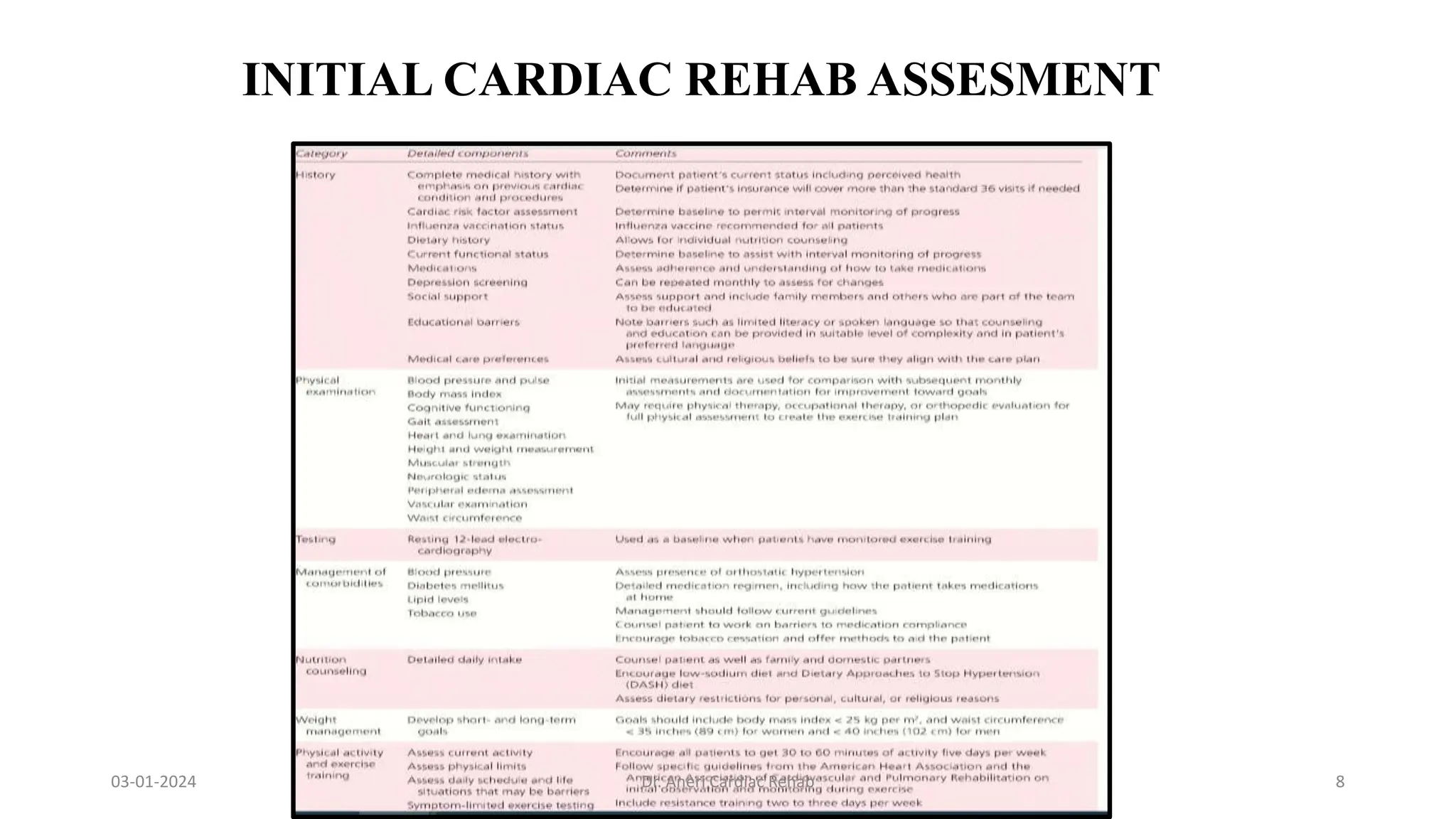
INITIAL CARDIAC REHAB ASSESMENT
03-01-2024 Dr. Aneri Cardiac Rehab 8
03-01-2024 Dr. Aneri Cardiac Rehab 9
MEASUREMENT
• These activities can best be accessed via the aerobic capacity,
which is defined by the ACSM as the product of the capacity of the
cardiorespiratory system to supply oxygen and the capacity of the
skeletal muscles to utilize oxygen.
• The criterion measure for aerobic capacity are
1.the peak oxygen consumption (VO2max). Denote as ml/kg/min
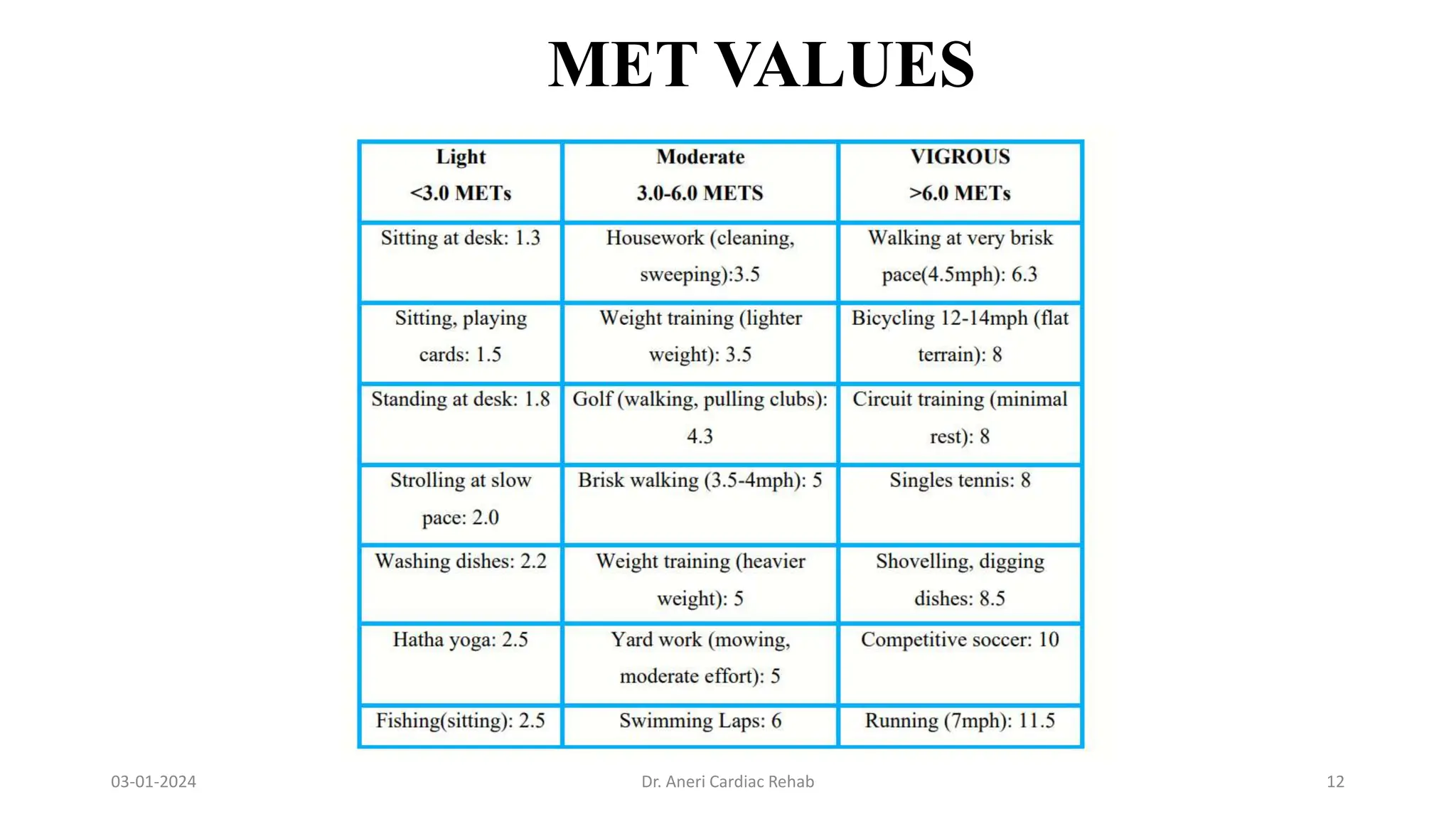
2.MET= 1 met= 3.5ml/kg/min
3.HR
03-01-2024 Dr. Aneri Cardiac Rehab 10
VO2MAX
MALE FEMALE
03-01-2024 Dr. Aneri Cardiac Rehab 11
03-01-2024 Dr. Aneri Cardiac Rehab 12
MET VALUES
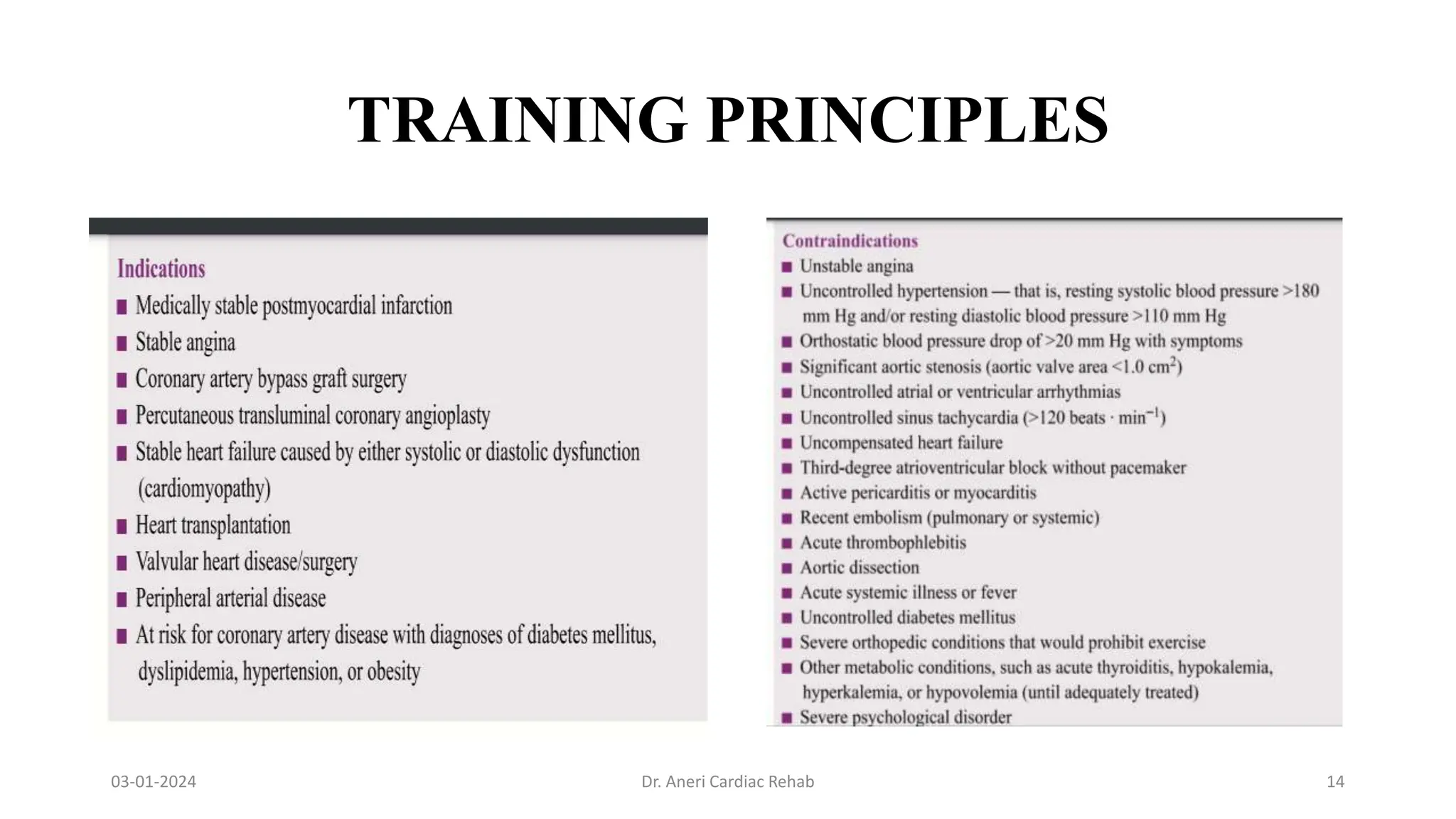
TRAINING PRINCIPLES
03-01-2024 Dr. Aneri Cardiac Rehab 13
TRAINING PRINCIPLES
03-01-2024 Dr. Aneri Cardiac Rehab 14
TRAINING PRINCIPLES
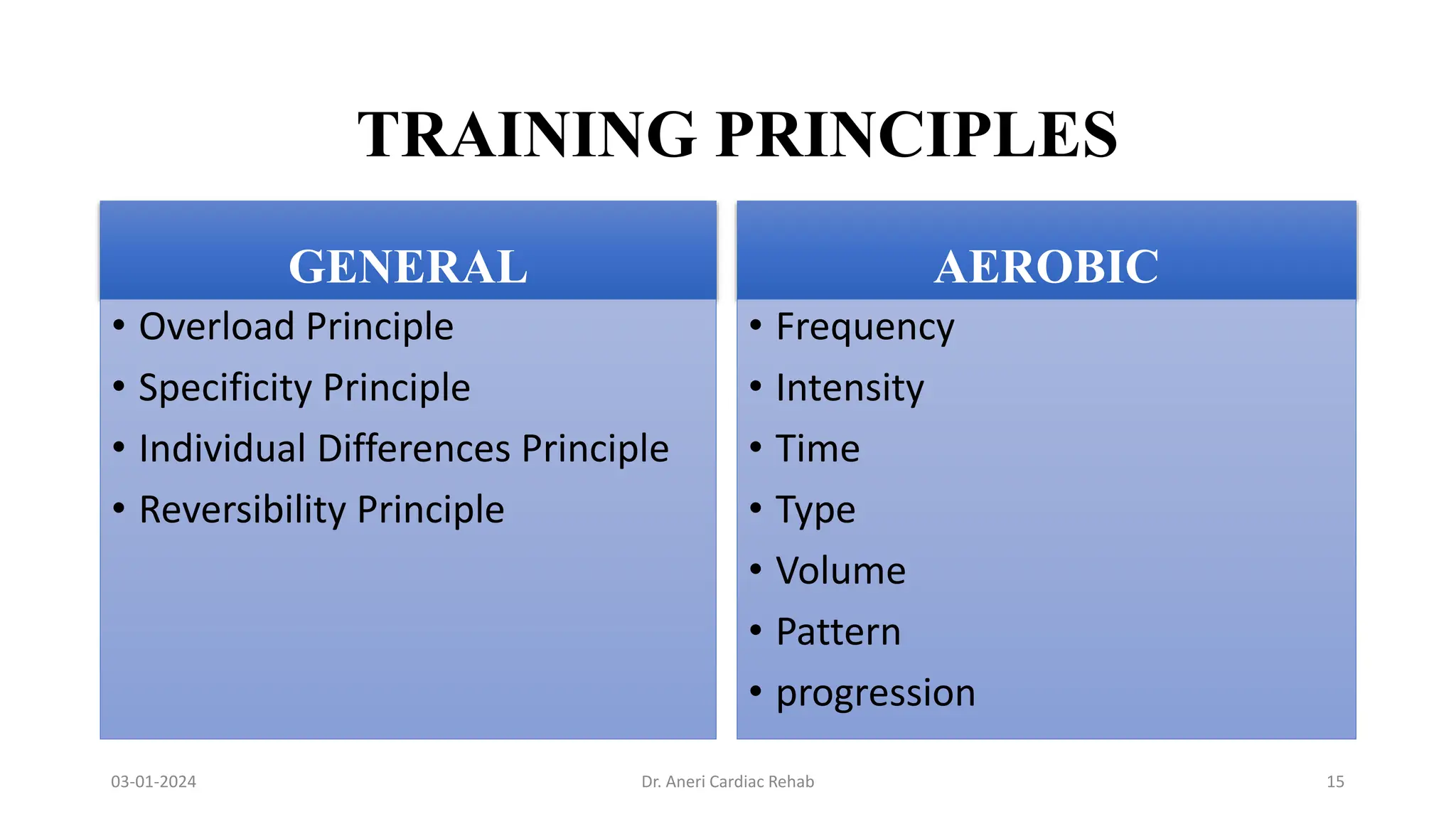
GENERAL
• Overload Principle
• Specificity Principle
• Individual Differences Principle
• Reversibility Principle
AEROBIC
• Frequency
• Intensity
• Time
• Type
• Volume
• Pattern
• progression
03-01-2024 Dr. Aneri Cardiac Rehab 15
03-01-2024 Dr. Aneri Cardiac Rehab 16
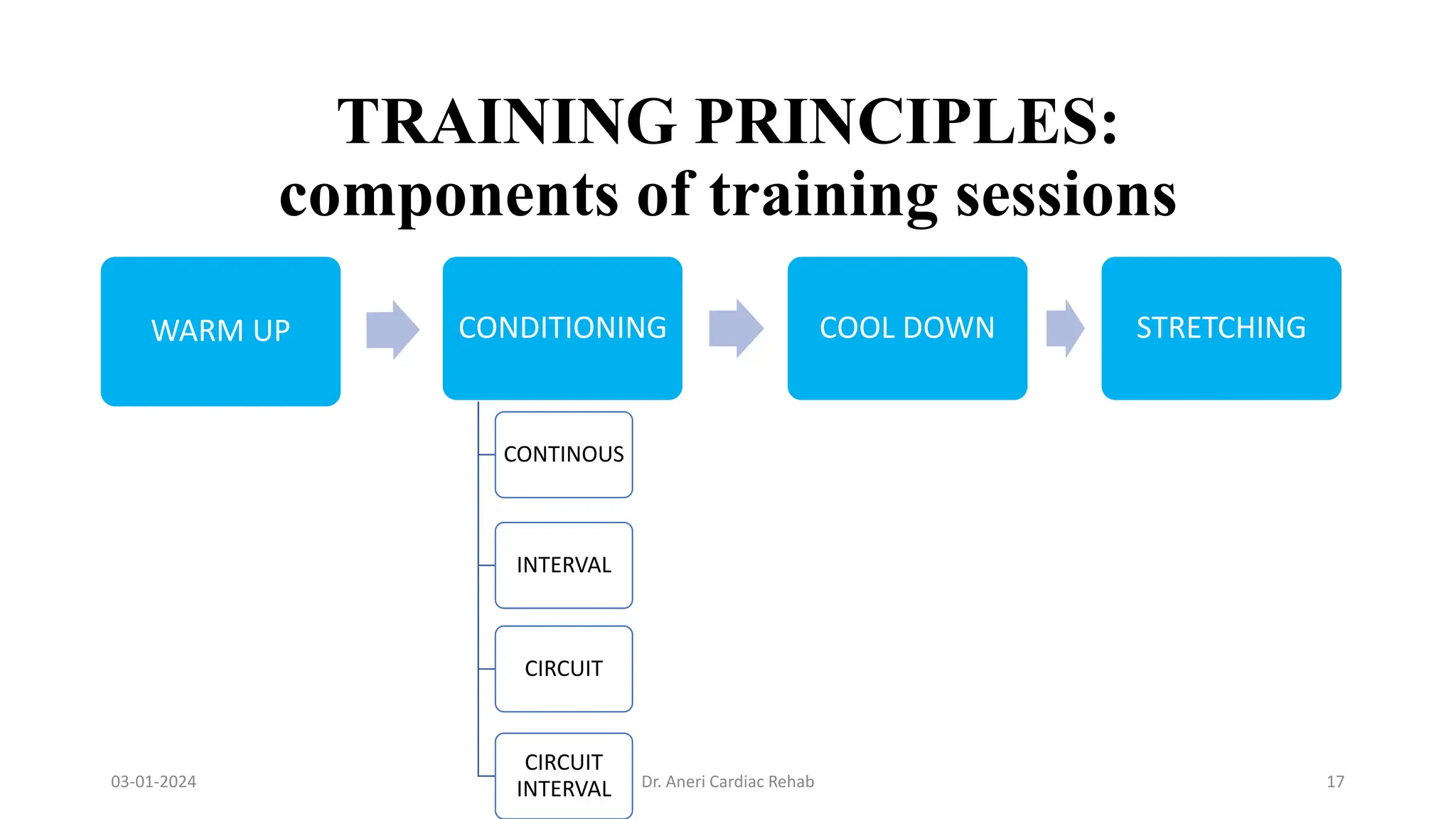
TRAINING PRINCIPLES:
components of training sessions
CONTINOUS
INTERVAL
CIRCUIT
CIRCUIT
INTERVAL
WARM UP CONDITIONING COOL DOWN STRETCHING
03-01-2024 Dr. Aneri Cardiac Rehab 17
TRAINING PRINCIPLES
Patient’s instruction before exercises
• Don’t eat a large meal for at least 2 hours prior to the exercise session
• Alcohol not consumed
• Beverages, coffee, tea, cola not had before exs at least 2 hours prior 2
exercise
• Don’t smoke 1 hour prior to exercise
• Wear comfortable clothing to exercise
• Information about any changes in medications before exercising.
03-01-2024 Dr. Aneri Cardiac Rehab 18
03-01-2024 Dr. Aneri Cardiac Rehab 19
03-01-2024 Dr. Aneri Cardiac Rehab 20
03-01-2024 Dr. Aneri Cardiac Rehab 21
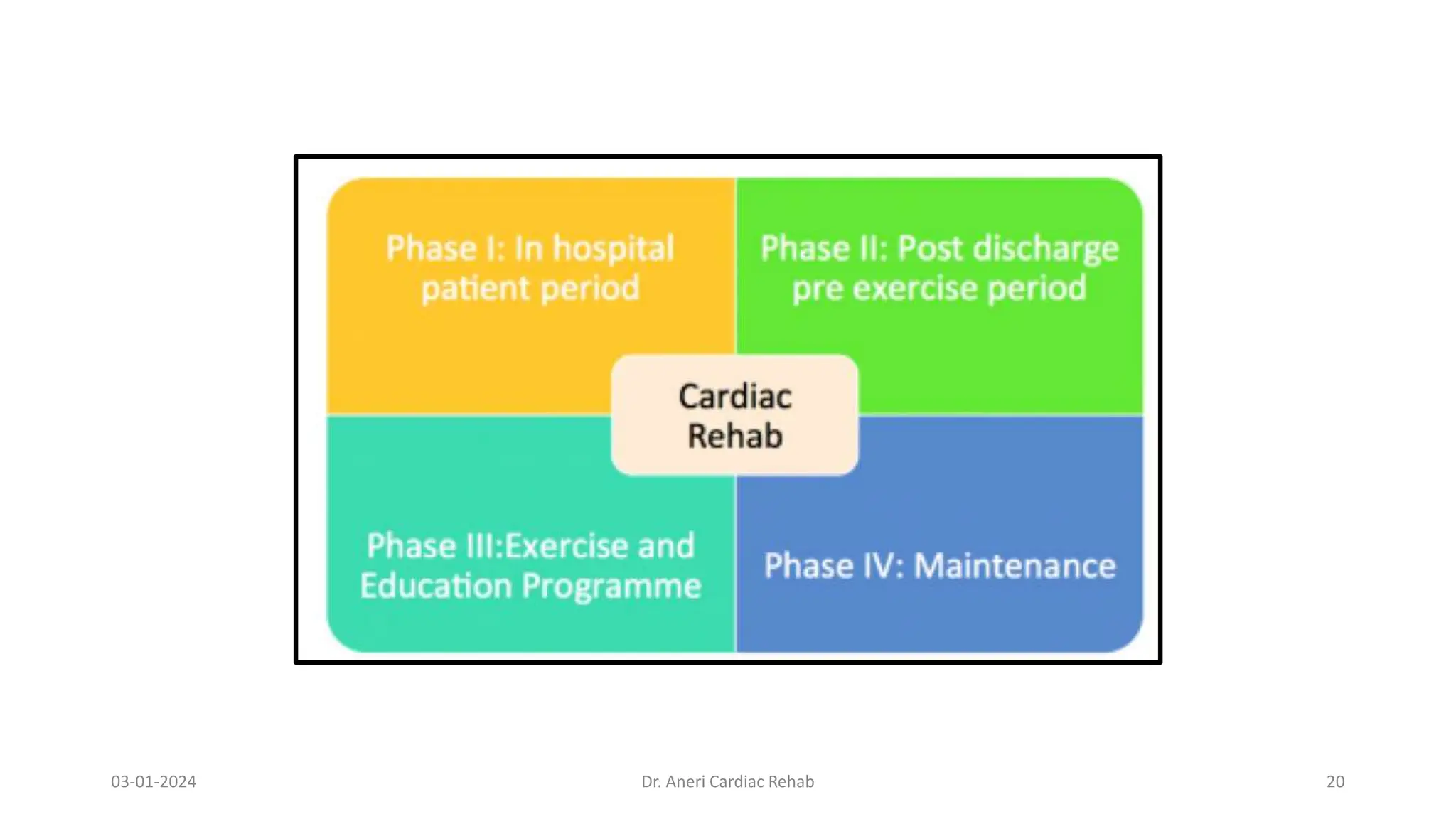
PHASE 1
03-01-2024 Dr. Aneri Cardiac Rehab 22
STEP 1
2 MET
• Diaphragmatic breathing exercise+ventilatory patterns
• Active assisted exercise of extremities
• Milking draisn
STEP2
2 MET
• Patent in lying
• Active exercise of extremities , Exercise with ventilatory incentive & flutter
STEP3
3-4
• Standing
• Active exercise & stretch, marching
• Exercise with ventilatory incentive , 35 meters ambulation
STEP4
3-4
• 60 meters ambulation
• Descending stairs (1 floor)
STEP 5
3-4
• 100 meter ambulation
STEP 6
3-4
• 160 meters ambulation, descending stairs (2 floor)
• Encourage breathing exercise
STEP 7
3-3
• 200 meters ambulation
• Descending stairs( 3 floor)
03-01-2024 Dr. Aneri Cardiac Rehab 23
03-01-2024 Dr. Aneri Cardiac Rehab 24
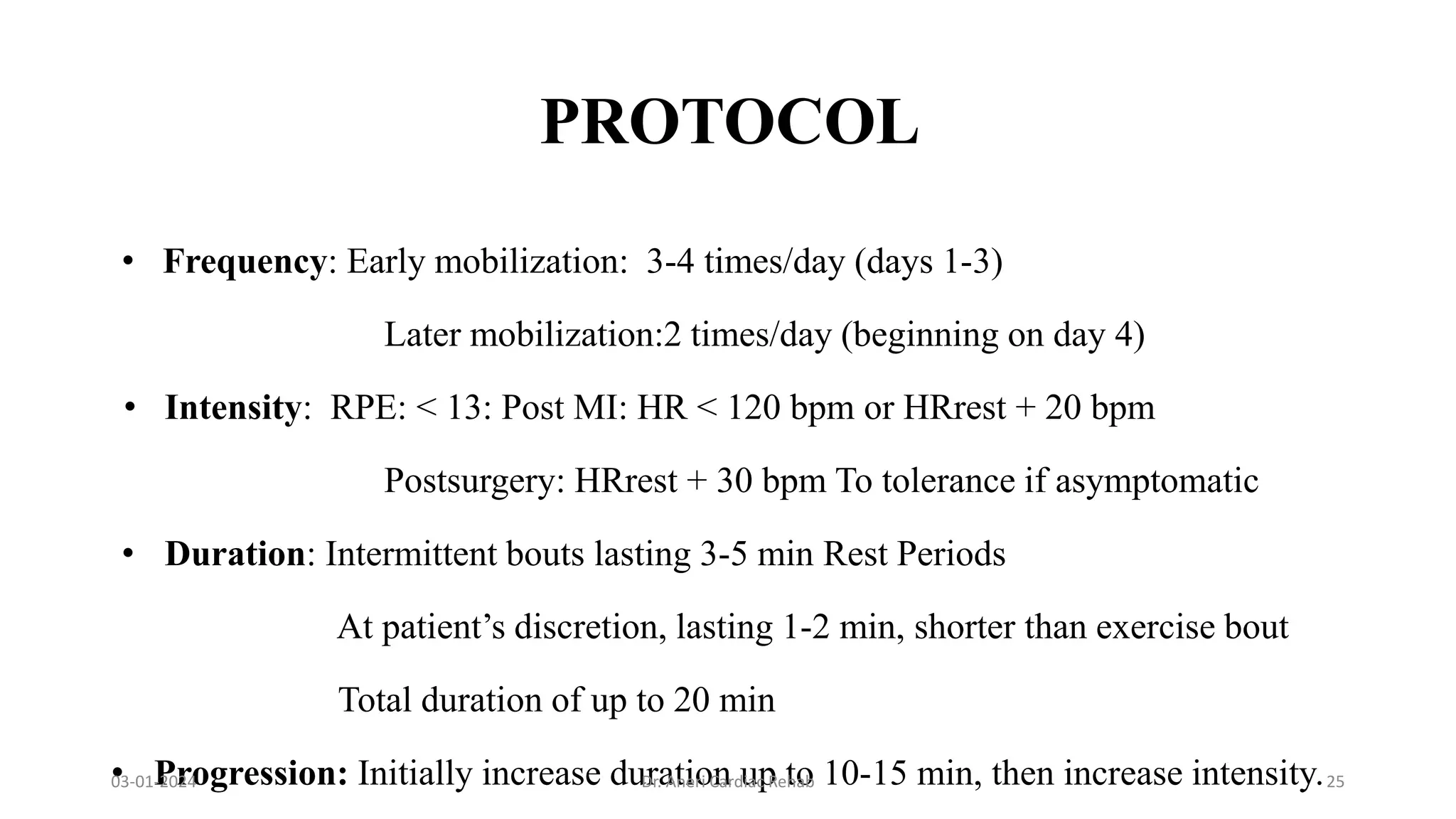
PROTOCOL
• Frequency: Early mobilization: 3-4 times/day (days 1-3)
Later mobilization:2 times/day (beginning on day 4)
• Intensity: RPE: < 13: Post MI: HR < 120 bpm or HRrest + 20 bpm
Postsurgery: HRrest + 30 bpm To tolerance if asymptomatic
• Duration: Intermittent bouts lasting 3-5 min Rest Periods
At patient’s discretion, lasting 1-2 min, shorter than exercise bout
Total duration of up to 20 min
• Progression: Initially increase duration up to 10-15 min, then increase intensity.
03-01-2024 Dr. Aneri Cardiac Rehab 25
PHASE 2
03-01-2024 Dr. Aneri Cardiac Rehab 26
ASSESSMENT BEFORE PHASE II
TEMPT HR BP RR auscultation ECG
PAIN POSTURE STRENGTH
03-01-2024 Dr. Aneri Cardiac Rehab 27
COMPONENTS
PHYSICAL CORE COMPONENTS
• Evaluation
• Intervention
• Expected outcome
EXERCISE TRAINING CORE
COMPONENTS
• Evaluation
• Intervention
• Expected outcome
03-01-2024 Dr. Aneri Cardiac Rehab 28
PROTOCOL
• Warm up: 7-15 min; 40-50% vo2 peak, rom exercises
• Frequency: 3-4 sessions/week
• Intensity: 50-70%
RPE:12-13
• Duration: 20-60; continuous or intermittent
• Time: walking, jogging, stationary cycling, arm ergometer, stairclimbing
• Progression: frequency>>duration>>intensity
• Cool down: 5-10 min; 40% vo2 peak; stretching
03-01-2024 Dr. Aneri Cardiac Rehab 29
03-01-2024 Dr. Aneri Cardiac Rehab 30
PHASE 3
03-01-2024 Dr. Aneri Cardiac Rehab 31
OUTCOMES
• Functional capacity goals > 8 METS or 2x energy
• No cardiac symptoms
• EKG monitoring happens occasionally or when increasing activity
parameters
• Self monitoring of HR & symptoms knowledge to the patient
• Improved exercise tolerance
• Return to work
• Improved quality of life
• Decreased risk factor (secondary prevention)
03-01-2024 Dr. Aneri Cardiac Rehab 32
COMPONENTS
03-01-2024 Dr. Aneri Cardiac Rehab 33
RISK STATIFICATION BEFORE
EXERCISE
ISCHEMIC RISK
• Postoperative angina
• LVEF (EF <35%)
• NYHA grade III or IV CHF
• Ventricular tachycardia of
fibrillation in the postoperative
period
• SBP drop of 10 points or more
with exercise
• Excessive ventricular ectopic with
exercise
• Myocardial ischemia with exercise
ARRHYTHMIC RISK
• Acute infarction within 6 weeks
• Active ischemia by angina or
exercise testing
• Significant left ventricular
dysfunction (LVEF <30%)
• History of sustained VT
• History of sustained life-
threatening SVT
• Initial therapy of a patient with a
rate adaptive cardiac pacemaker
03-01-2024 Dr. Aneri Cardiac Rehab 34
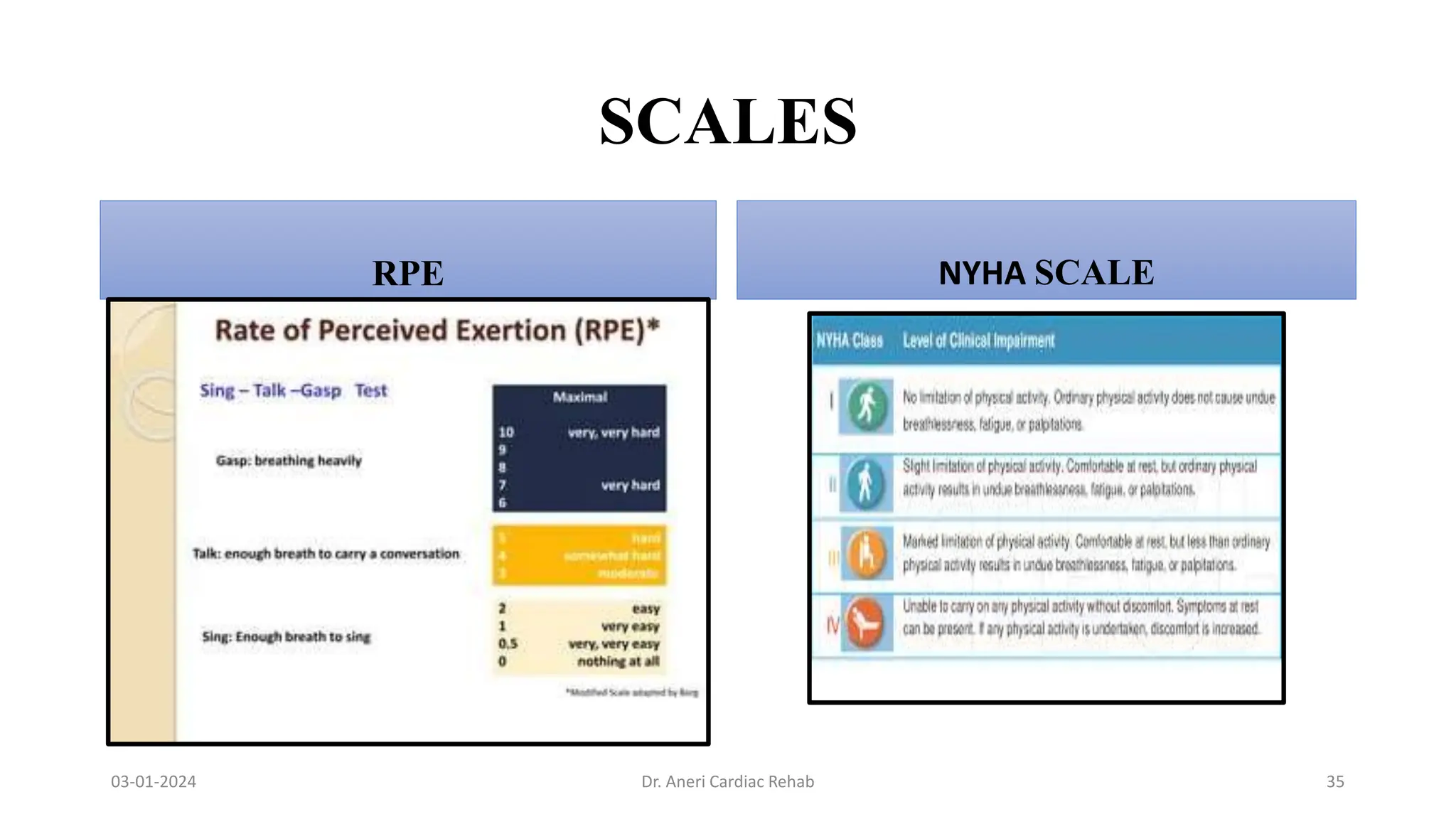
SCALES
RPE NYHA SCALE
03-01-2024 Dr. Aneri Cardiac Rehab 35
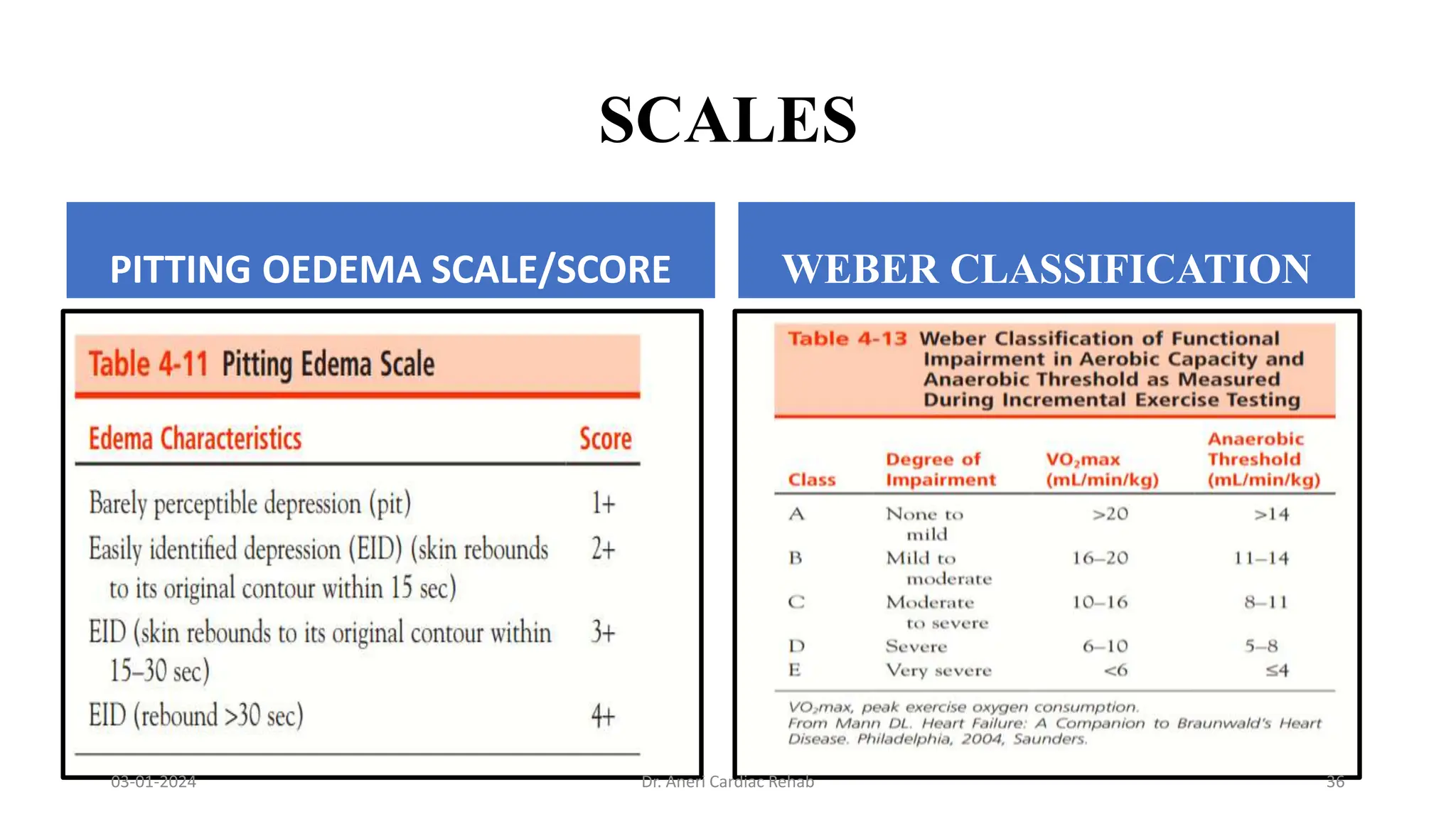
SCALES
PITTING OEDEMA SCALE/SCORE WEBER CLASSIFICATION
03-01-2024 Dr. Aneri Cardiac Rehab 36
PROTOCOL
CARDIORESPIRATORY
ENDURANCE
• Frequency – 3-5 days
per week
• Intensity – 55-90%
maximum heart rate
• Time/Duration – 20-
60 minutes
STRENGTH
• Frequency – 2-3 days
per week
• Intensity – enough to
enhance muscle
strength, muscle
endurance, and
improve body
composition
• Time/Duration – 8 to
12 repetitions of 8 to
10 different exercises
FLEXIBILITY
• Frequency – 2-3 days
per week
• Intensity – enough to
develop and maintain
a full range of motion
• Time/Duration – 4
repetitions of 10-30
seconds per muscle
group
03-01-2024 Dr. Aneri Cardiac Rehab 37
PHASE 4
03-01-2024 Dr. Aneri Cardiac Rehab 38
03-01-2024 Dr. Aneri Cardiac Rehab 39
03-01-2024 Dr. Aneri Cardiac Rehab 40
NUTRITIONAL MANAGEMENT
03-01-2024 Dr. Aneri Cardiac Rehab 41
WEIGHT MANAGEMENT
03-01-2024 Dr. Aneri Cardiac Rehab 42
03-01-2024 Dr. Aneri Cardiac Rehab 43
SMOKING/TOBOCCO CESSATION
03-01-2024 Dr. Aneri Cardiac Rehab 44
BEHAVIOURAL MODIFICATION
Provide a Tailored and
Individualized Approach
Recognize ThatKnowledge Is
Necessary but NotSufcient
or Behavior Change
Promote a Positive Sense OF
SelF and the Personal
Relevance of Risk Reduction
Set Goals to Promote a
S.M.A.R.T. Plan o Action
Promote Readiness
toChange
Promote Self-Efficacy
andthe Power of Control
promote
IndependenceThrough
Consciousness Raising
andSel -Monitoring Skills
Provide RoutineFeedback
and Rewards toCelebrate
Success
Help Patients CreatePositive
Environmental Cuesto
Action,
Promote
HelpingRelationships and
Engage RoleModels
03-01-2024 Dr. Aneri Cardiac Rehab 45
PSYCHOLOGICAL MANAGEMENT
03-01-2024 Dr. Aneri Cardiac Rehab 46
SUMMARY
03-01-2024 Dr. Aneri Cardiac Rehab 47
SUMMARY
03-01-2024 Dr. Aneri Cardiac Rehab 48
REFERENCES
• KISNER & COLBY
• KATCH & CATCH
• ACSM , AHA & AACVPR GUIDELINES
• WILLMORE
• CASH CARDIO
• CASH PTMS
• SULLIVAN
• SADOWSKY
03-01-2024 Dr. Aneri Cardiac Rehab 49
03-01-2024 Dr. Aneri Cardiac Rehab 50

CARDIAC PHYSIOTHERAPY REHABILITATION.pptx

  • 1.
  • 2.
    CONTENT • Definition • Objectives •Centre & Team • Core components • Cardiac rehab assessment • Training principles • Management • Summary 03-01-2024 Dr. Aneri Cardiac Rehab 2
  • 3.
    DEFINITION •“Cardiac rehabilitation isa multidisciplinary program of education, exercise, and behavioral change established to assist individuals with heart disease in achieving optimal physical, psychological and functional status within the limits of their disease.” 03-01-2024 Dr. Aneri Cardiac Rehab 3
  • 4.
    OBJECTIVES • Education ofthe patient and family in the recognition, prevention, and Rx of cardiovascular disease. • Amelioration or reduction of risk factors (prepare pt, family and significant others for a healthy lifestyle there by ↓ing further risk of CAD) • Dealing with the psychological factors that influence recovery from heart disease (following MI, CABG, Diagnosed CAD) • Structured, progressive physical activity either in a rehabilitation setting or home program • Vocational or return to leisure activities counseling • Activity of daily living (ADL) and functional training 03-01-2024 Dr. Aneri Cardiac Rehab 4
  • 5.
    CARDIAC REHABILITATION CENTER • Itis the facility in which an interdisciplinary team provides the planned and monitored program to promote psychological, educational and vocational improvement of the cardiac patient. 03-01-2024 Dr. Aneri Cardiac Rehab 5
  • 6.
    CARDIAC REHABILITATION TEAM 03-01-2024Dr. Aneri Cardiac Rehab 6
  • 7.
    03-01-2024 Dr. AneriCardiac Rehab 7
  • 8.
    INITIAL CARDIAC REHABASSESMENT 03-01-2024 Dr. Aneri Cardiac Rehab 8
  • 9.
    03-01-2024 Dr. AneriCardiac Rehab 9
  • 10.
    MEASUREMENT • These activitiescan best be accessed via the aerobic capacity, which is defined by the ACSM as the product of the capacity of the cardiorespiratory system to supply oxygen and the capacity of the skeletal muscles to utilize oxygen. • The criterion measure for aerobic capacity are 1.the peak oxygen consumption (VO2max). Denote as ml/kg/min 2.MET= 1 met= 3.5ml/kg/min 3.HR 03-01-2024 Dr. Aneri Cardiac Rehab 10
  • 11.
    VO2MAX MALE FEMALE 03-01-2024 Dr.Aneri Cardiac Rehab 11
  • 12.
    03-01-2024 Dr. AneriCardiac Rehab 12 MET VALUES
  • 13.
    TRAINING PRINCIPLES 03-01-2024 Dr.Aneri Cardiac Rehab 13
  • 14.
    TRAINING PRINCIPLES 03-01-2024 Dr.Aneri Cardiac Rehab 14
  • 15.
    TRAINING PRINCIPLES GENERAL • OverloadPrinciple • Specificity Principle • Individual Differences Principle • Reversibility Principle AEROBIC • Frequency • Intensity • Time • Type • Volume • Pattern • progression 03-01-2024 Dr. Aneri Cardiac Rehab 15
  • 16.
    03-01-2024 Dr. AneriCardiac Rehab 16
  • 17.
    TRAINING PRINCIPLES: components oftraining sessions CONTINOUS INTERVAL CIRCUIT CIRCUIT INTERVAL WARM UP CONDITIONING COOL DOWN STRETCHING 03-01-2024 Dr. Aneri Cardiac Rehab 17
  • 18.
    TRAINING PRINCIPLES Patient’s instructionbefore exercises • Don’t eat a large meal for at least 2 hours prior to the exercise session • Alcohol not consumed • Beverages, coffee, tea, cola not had before exs at least 2 hours prior 2 exercise • Don’t smoke 1 hour prior to exercise • Wear comfortable clothing to exercise • Information about any changes in medications before exercising. 03-01-2024 Dr. Aneri Cardiac Rehab 18
  • 19.
    03-01-2024 Dr. AneriCardiac Rehab 19
  • 20.
    03-01-2024 Dr. AneriCardiac Rehab 20
  • 21.
    03-01-2024 Dr. AneriCardiac Rehab 21
  • 22.
    PHASE 1 03-01-2024 Dr.Aneri Cardiac Rehab 22
  • 23.
    STEP 1 2 MET •Diaphragmatic breathing exercise+ventilatory patterns • Active assisted exercise of extremities • Milking draisn STEP2 2 MET • Patent in lying • Active exercise of extremities , Exercise with ventilatory incentive & flutter STEP3 3-4 • Standing • Active exercise & stretch, marching • Exercise with ventilatory incentive , 35 meters ambulation STEP4 3-4 • 60 meters ambulation • Descending stairs (1 floor) STEP 5 3-4 • 100 meter ambulation STEP 6 3-4 • 160 meters ambulation, descending stairs (2 floor) • Encourage breathing exercise STEP 7 3-3 • 200 meters ambulation • Descending stairs( 3 floor) 03-01-2024 Dr. Aneri Cardiac Rehab 23
  • 24.
    03-01-2024 Dr. AneriCardiac Rehab 24
  • 25.
    PROTOCOL • Frequency: Earlymobilization: 3-4 times/day (days 1-3) Later mobilization:2 times/day (beginning on day 4) • Intensity: RPE: < 13: Post MI: HR < 120 bpm or HRrest + 20 bpm Postsurgery: HRrest + 30 bpm To tolerance if asymptomatic • Duration: Intermittent bouts lasting 3-5 min Rest Periods At patient’s discretion, lasting 1-2 min, shorter than exercise bout Total duration of up to 20 min • Progression: Initially increase duration up to 10-15 min, then increase intensity. 03-01-2024 Dr. Aneri Cardiac Rehab 25
  • 26.
    PHASE 2 03-01-2024 Dr.Aneri Cardiac Rehab 26
  • 27.
    ASSESSMENT BEFORE PHASEII TEMPT HR BP RR auscultation ECG PAIN POSTURE STRENGTH 03-01-2024 Dr. Aneri Cardiac Rehab 27
  • 28.
    COMPONENTS PHYSICAL CORE COMPONENTS •Evaluation • Intervention • Expected outcome EXERCISE TRAINING CORE COMPONENTS • Evaluation • Intervention • Expected outcome 03-01-2024 Dr. Aneri Cardiac Rehab 28
  • 29.
    PROTOCOL • Warm up:7-15 min; 40-50% vo2 peak, rom exercises • Frequency: 3-4 sessions/week • Intensity: 50-70% RPE:12-13 • Duration: 20-60; continuous or intermittent • Time: walking, jogging, stationary cycling, arm ergometer, stairclimbing • Progression: frequency>>duration>>intensity • Cool down: 5-10 min; 40% vo2 peak; stretching 03-01-2024 Dr. Aneri Cardiac Rehab 29
  • 30.
    03-01-2024 Dr. AneriCardiac Rehab 30
  • 31.
    PHASE 3 03-01-2024 Dr.Aneri Cardiac Rehab 31
  • 32.
    OUTCOMES • Functional capacitygoals > 8 METS or 2x energy • No cardiac symptoms • EKG monitoring happens occasionally or when increasing activity parameters • Self monitoring of HR & symptoms knowledge to the patient • Improved exercise tolerance • Return to work • Improved quality of life • Decreased risk factor (secondary prevention) 03-01-2024 Dr. Aneri Cardiac Rehab 32
  • 33.
  • 34.
    RISK STATIFICATION BEFORE EXERCISE ISCHEMICRISK • Postoperative angina • LVEF (EF <35%) • NYHA grade III or IV CHF • Ventricular tachycardia of fibrillation in the postoperative period • SBP drop of 10 points or more with exercise • Excessive ventricular ectopic with exercise • Myocardial ischemia with exercise ARRHYTHMIC RISK • Acute infarction within 6 weeks • Active ischemia by angina or exercise testing • Significant left ventricular dysfunction (LVEF <30%) • History of sustained VT • History of sustained life- threatening SVT • Initial therapy of a patient with a rate adaptive cardiac pacemaker 03-01-2024 Dr. Aneri Cardiac Rehab 34
  • 35.
    SCALES RPE NYHA SCALE 03-01-2024Dr. Aneri Cardiac Rehab 35
  • 36.
    SCALES PITTING OEDEMA SCALE/SCOREWEBER CLASSIFICATION 03-01-2024 Dr. Aneri Cardiac Rehab 36
  • 37.
    PROTOCOL CARDIORESPIRATORY ENDURANCE • Frequency –3-5 days per week • Intensity – 55-90% maximum heart rate • Time/Duration – 20- 60 minutes STRENGTH • Frequency – 2-3 days per week • Intensity – enough to enhance muscle strength, muscle endurance, and improve body composition • Time/Duration – 8 to 12 repetitions of 8 to 10 different exercises FLEXIBILITY • Frequency – 2-3 days per week • Intensity – enough to develop and maintain a full range of motion • Time/Duration – 4 repetitions of 10-30 seconds per muscle group 03-01-2024 Dr. Aneri Cardiac Rehab 37
  • 38.
    PHASE 4 03-01-2024 Dr.Aneri Cardiac Rehab 38
  • 39.
    03-01-2024 Dr. AneriCardiac Rehab 39
  • 40.
    03-01-2024 Dr. AneriCardiac Rehab 40
  • 41.
  • 42.
    WEIGHT MANAGEMENT 03-01-2024 Dr.Aneri Cardiac Rehab 42
  • 43.
    03-01-2024 Dr. AneriCardiac Rehab 43
  • 44.
  • 45.
    BEHAVIOURAL MODIFICATION Provide aTailored and Individualized Approach Recognize ThatKnowledge Is Necessary but NotSufcient or Behavior Change Promote a Positive Sense OF SelF and the Personal Relevance of Risk Reduction Set Goals to Promote a S.M.A.R.T. Plan o Action Promote Readiness toChange Promote Self-Efficacy andthe Power of Control promote IndependenceThrough Consciousness Raising andSel -Monitoring Skills Provide RoutineFeedback and Rewards toCelebrate Success Help Patients CreatePositive Environmental Cuesto Action, Promote HelpingRelationships and Engage RoleModels 03-01-2024 Dr. Aneri Cardiac Rehab 45
  • 46.
  • 47.
  • 48.
  • 49.
    REFERENCES • KISNER &COLBY • KATCH & CATCH • ACSM , AHA & AACVPR GUIDELINES • WILLMORE • CASH CARDIO • CASH PTMS • SULLIVAN • SADOWSKY 03-01-2024 Dr. Aneri Cardiac Rehab 49
  • 50.
    03-01-2024 Dr. AneriCardiac Rehab 50