FUNCTIONAL
RE-EDUCATION
 Education - the process of teaching and learning.
 Re-Education - Re-education means educating
something, which is already known by an individual.
 Functional Re-education
Here the patient knows the activities or movements that
has to be performed but due to his ailment or diseased
pathology he could not perform it properly.
 “making the man independent” is the main motto for
the functional re-educational program.
 In the functional re-educational training, sequence of
progressions of position like the development of
milestone of the child from lying to walking.
 Depends on the condition and level of his independence
the program can be designed.
 Depending on the condition , the sequence can be
planned and multiple postures may be overlapped
Sequence can be varied from one patient to another.
PRINCIPLES
 Proper and thorough assessment
 Assessment of functional Ability needs special
attention
 Rx should be Tailor made.
 Commands
 Treatment should be task specific.
 Never ever discourage the patient.
 Feedback should be taken from the pt and
relatives.
 Treatment should be effective, that patient have to
achieve physical independence
 Reviews are needed to Record.
Functional Re-education helps to……
 Improve coordination and balance.
 Increase strength and endurance of muscle.
 Increase pelvic stability.
 Increase the dynamic and static stability.
 Enhance the proprioceptive function.
 Improve postural stability.
 Improve the ambulatory skills.
 Reduce Fatigue
Re-education can be done on..
1-On Mat
2-On Re-education Board
3-Using Parallel Bar
4-Using Suspension Therapy
5-Using Hydrotherapy
 Functional re-educational training consists of the
pre-ambulatory mat exercises and ambulatory
training.
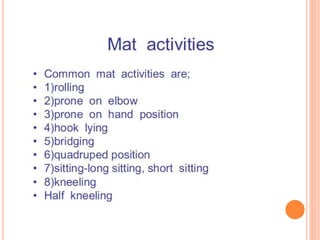
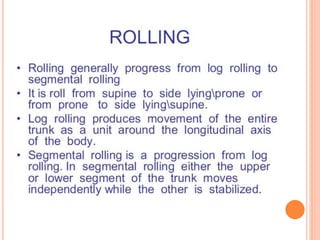
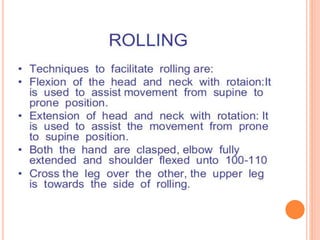
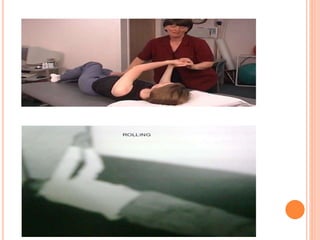
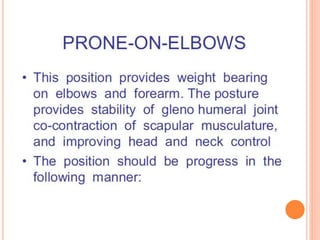
Rolling
•Supine to side lying
•Side lying to prone lying
•Prone to side lying
•Side lying to supine
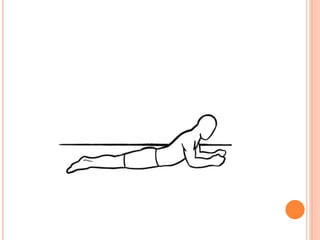
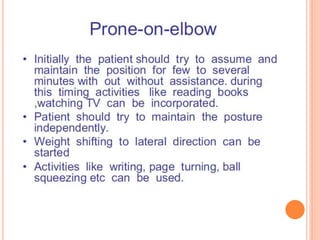
•Elbow prone lying
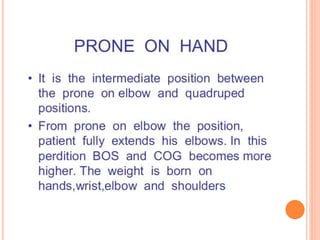
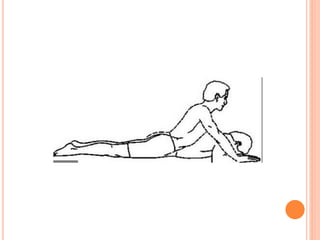
•Hand prone lying
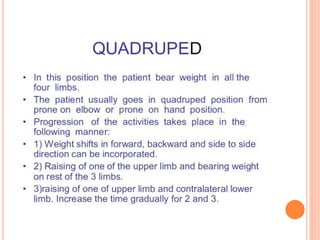
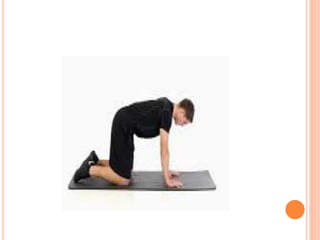
•Quadruped position
•Side sitting
•Sitting
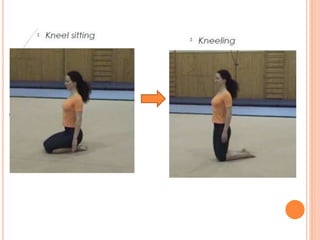
•Kneel sitting
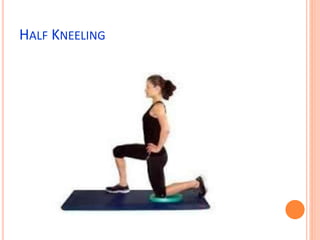
•Half kneeling
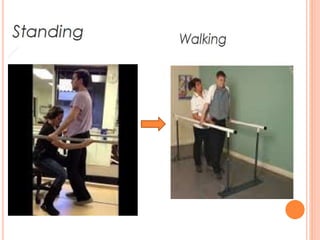
•Standing
•Walking
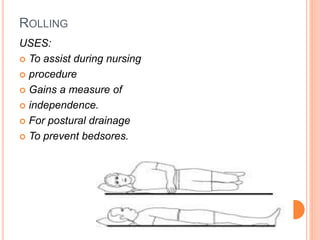
ROLLING
USES:
 To assist during nursing
 procedure
 Gains a measure of
 independence.
 For postural drainage
 To prevent bedsores.
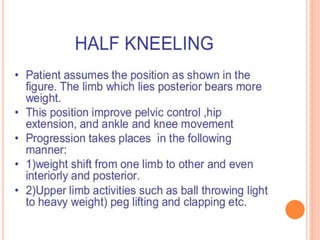
HALF KNEELING
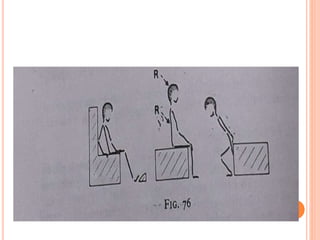
STANDING FROM SITTING
 For many patients the ability to stand upright is
great morale booster and is regarded as a
milestone of progress.
 Each patient has his own specific difficulties but
there are few factors which should be considered
even before an attempt to stand is made.
 The Factors include..
Suitable shoes –
 Most patients have the habit to wear shoes for wt
bearing as in standing or walking, but the shoes
should be firm, comfortable and well fitting.
 It should not be sloppy slippers or should not be
walking with bare foot on cold hard surface.
 Suitable clothing – slacks or track suits which is easily
pulled on seems more comfortable, than long slippery
nighties, dressing gowns, or inadequately secured pyjamas.
 Because in terms of safety as well as dignity.
 Range of joint movement – It is adviced to check that the
ROM in ankles, hips, and lumbar spine, That the ROM should
be sufficient to permit the body segments to be brought in
alingments for balance in erect posture.
 Lack of Rom in any of these joint will lead to adjustment in
surrounding joint and will demand adjustment to maintain
balance, which will be recognized as postural faults.
 It is important to find out the route cause or else it will lead to
disability.
 Eg:- TA tightness, hamstring tightness, biceps spasticity, ETC
 Stability of support – Any Apparatus used for
support must be check and tested stability .
 Eg- chair, bars furniture and floor mats.
 For those of us who are able to stand whenever
occasion demands. There is little or no need of
worry, but for the patients who has been unable to
get up for some time, this operation needs
planning.
 With the need of independence in mind the patient
must be permitted and encourage the start to part
in decision concerning such thing as
 Placing the feet, whether to pull or push with the
arms and other relevant details
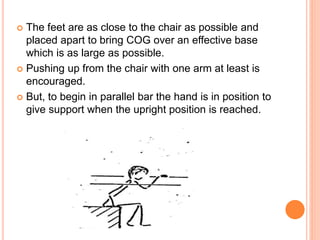
 The feet are as close to the chair as possible and
placed apart to bring COG over an effective base
which is as large as possible.
 Pushing up from the chair with one arm at least is
encouraged.
 But, to begin in parallel bar the hand is in position to
give support when the upright position is reached.
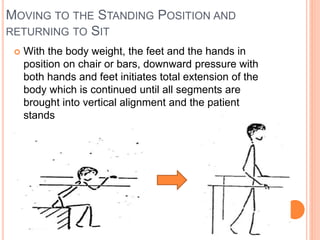
MOVING TO THE STANDING POSITION AND
RETURNING TO SIT
 With the body weight, the feet and the hands in
position on chair or bars, downward pressure with
both hands and feet initiates total extension of the
body which is continued until all segments are
brought into vertical alignment and the patient
stands
 The therapist is at hand to give help or support when it
is needed, being mindful of the fact that too much help
delays the achievement of independence but that too
little may rum confidence if, as a result, things do not
go smoothly.
 Only when the therapist is satisfied that the patient can
stand, balance in standing and return to sit, is it safe
for him to practise alone.
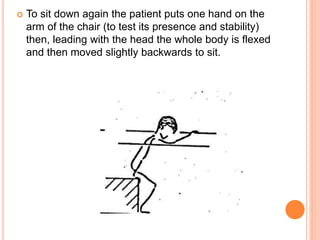
 To sit down again the patient puts one hand on the
arm of the chair (to test its presence and stability)
then, leading with the head the whole body is flexed
and then moved slightly backwards to sit.
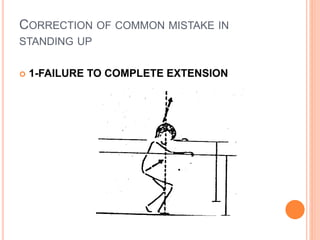
CORRECTION OF COMMON MISTAKE IN
STANDING UP
 1-FAILURE TO COMPLETE EXTENSION
 2-FAILURE TO PUSH DOWN WITH ARM FOR
SUPPORT
 Patients who use their arms to pull up to stand tend to
pull upwards instead of pushing downwards on the bars
thus losing the benefit of effective support and bracing of
the back muscles.
 This is usually a panic reaction arising because the
downward push required for support has not been
explained or taught.
 It is likely to occur with patients who have used ‘monkey
poles’ or other means of pulling themselves up in bed.
 Instruction in the supporting function of the arms is
essential for many in order to teach them the
management of frames, crutches or sticks at a later
date.
 The flexion pull on a therapist’s arm either for
standing or walking does not lead to independent
activity in the upright position and should always be
discouraged.
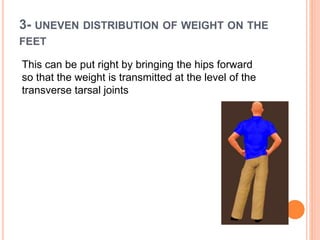
3- UNEVEN DISTRIBUTION OF WEIGHT ON THE
FEET
This can be put right by bringing the hips forward
so that the weight is transmitted at the level of the
transverse tarsal joints
WALKING
 walking is a complex activity which requires the
cooperation and control of the whole body. From a
functional point of new the ability to walk is pretty useless
unless the patient has first learnt to get tip and stand.
 Some general principles to be observed in teaching a
patient to walk again are as follow:
A- The patient must learn the correct pattern of walking
from the start. Movement patterns learnt and repeated
accurately become habitual very quickly. Bad habits, as
well as good ones, are established just as rapidly . and
they are difficult and time consuming to eradicate.
 B. Sufficient support and/or aids must be provided
to allow a correct pattern of walking to be a
practically possibility.
 In many cases the correct or optimum pattern of
movement is only possible with the assistance of
suitable support, e.g. parallel bars, crutches or
Sticks, to help balance or to reduce weight-bearing
on one or both legs to an acceptable magnitude.
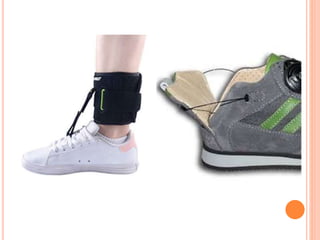
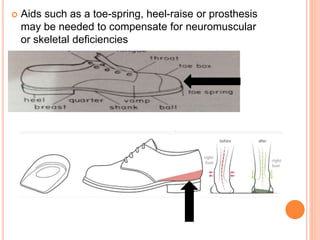
 Aids such as a toe-spring, heel-raise or prosthesis
may be needed to compensate for neuromuscular
or skeletal deficiencies
 C- The amount of support or aid must only be
withdrawn or modified when the patient can
demonstrate his ability to walk satisfactorily with
less support or no aid.
 A demonstration of good walking for a few paces in
a room is insufficient for testing purposes;
endurance over longer distances and under Other
circumstances, such as out of doors or on carpets,
must also be taken into account.
 Assure standing balance before walking, a
mechanical support such as parallel bars or the
backs of two or more heavy chairs, is preferable to
manual support.
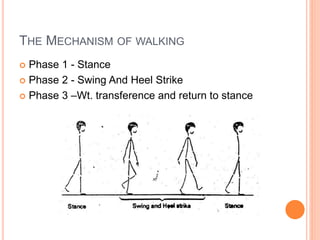
THE MECHANISM OF WALKING
 Phase 1 - Stance
 Phase 2 - Swing And Heel Strike
 Phase 3 –Wt. transference and return to stance
CORRECTION OF FAULTY PATTERN OF
WALKING
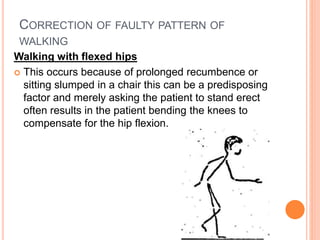
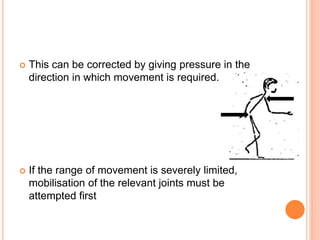
Walking with flexed hips
 This occurs because of prolonged recumbence or
sitting slumped in a chair this can be a predisposing
factor and merely asking the patient to stand erect
often results in the patient bending the knees to
compensate for the hip flexion.
 This can be corrected by giving pressure in the
direction in which movement is required.
 If the range of movement is severely limited,
mobilisation of the relevant joints must be
attempted first
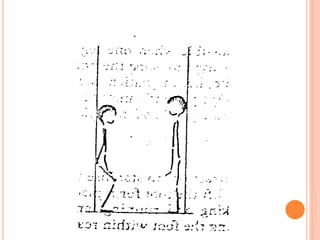
Lateral Pelvic Shift
 This is a situation which frequently occurs when one leg has
been non-weight-baring for longer time.
 The fault lies in the failure to transfer the weight over the hip
of the affeted leg
 This can be corrected.
By Practice of Stance position until it is established and
secure, then it can be integrated with the total pattern of
walking.
It can also corrected by walking sideways, with support of a
handrail, in the direction of the affected leg, pausing when it is
weight-bearing
LIMB ACTIVITY
 The extremities, i.e. the upper and lower limbs, are
appendages of the trunk developed primarily for support
and ambulatory mobility of the body as a whole.
 In the normal subject lower limb activity is still almost
exclusively concerned with these functions but,the upper
limb also has an important and often forgotten role with
regard to body support and movement which is
immediately recognized and exploited when leg function
is impaired for any reason, e.g. arm function used for
transferring from chair to bed, crutches and handrails
 Any disability, however localized it appears to be,
affects the whole body to a greater or lesser
degree. Therefore total restoration of function must
be the aim of treatment in every case.
 Attention to be given that efficiency of limb function
is profoundly influenced by and largely dependent
on the co-operation of pelvic or shoulder girdle
movement and stability.
LEG FUNCTION
 a. to support the body in weight bearing position
 b. To lift or lower the body from or to the ground
 c. To propel the body in any direction
 d. To maintain Balance
 e. To maintain Erect posture
 f. To Perform any recreational activity, etc
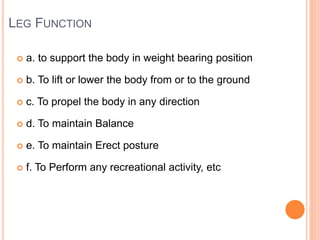
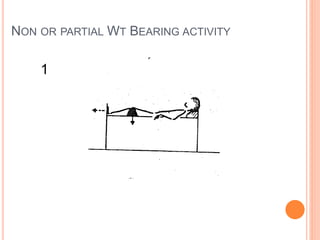
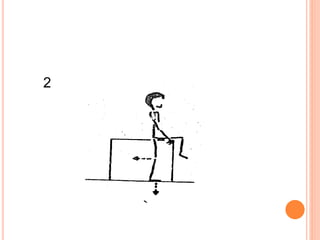
NON OR PARTIAL WT BEARING ACTIVITY
1
2
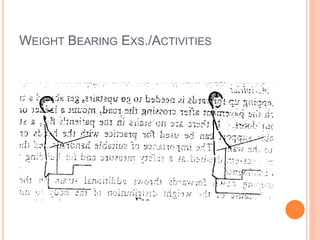
WEIGHT BEARING EXS./ACTIVITIES
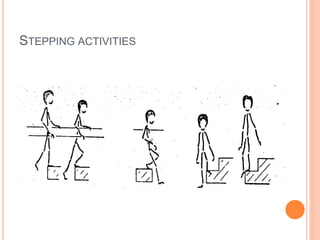
STEPPING ACTIVITIES

Functional re education

  • 1.
  • 2.
     Education -the process of teaching and learning.  Re-Education - Re-education means educating something, which is already known by an individual.  Functional Re-education Here the patient knows the activities or movements that has to be performed but due to his ailment or diseased pathology he could not perform it properly.  “making the man independent” is the main motto for the functional re-educational program.
  • 3.
     In thefunctional re-educational training, sequence of progressions of position like the development of milestone of the child from lying to walking.  Depends on the condition and level of his independence the program can be designed.  Depending on the condition , the sequence can be planned and multiple postures may be overlapped Sequence can be varied from one patient to another.
  • 4.
    PRINCIPLES  Proper andthorough assessment  Assessment of functional Ability needs special attention  Rx should be Tailor made.  Commands  Treatment should be task specific.  Never ever discourage the patient.  Feedback should be taken from the pt and relatives.  Treatment should be effective, that patient have to achieve physical independence  Reviews are needed to Record.
  • 5.
    Functional Re-education helpsto……  Improve coordination and balance.  Increase strength and endurance of muscle.  Increase pelvic stability.  Increase the dynamic and static stability.  Enhance the proprioceptive function.  Improve postural stability.  Improve the ambulatory skills.  Reduce Fatigue
  • 6.
    Re-education can bedone on.. 1-On Mat 2-On Re-education Board 3-Using Parallel Bar 4-Using Suspension Therapy 5-Using Hydrotherapy
  • 7.
     Functional re-educationaltraining consists of the pre-ambulatory mat exercises and ambulatory training. Rolling •Supine to side lying •Side lying to prone lying •Prone to side lying •Side lying to supine •Elbow prone lying •Hand prone lying •Quadruped position •Side sitting •Sitting •Kneel sitting •Half kneeling •Standing •Walking
  • 8.
    ROLLING USES:  To assistduring nursing  procedure  Gains a measure of  independence.  For postural drainage  To prevent bedsores.
  • 23.
  • 26.
    STANDING FROM SITTING For many patients the ability to stand upright is great morale booster and is regarded as a milestone of progress.  Each patient has his own specific difficulties but there are few factors which should be considered even before an attempt to stand is made.  The Factors include.. Suitable shoes –  Most patients have the habit to wear shoes for wt bearing as in standing or walking, but the shoes should be firm, comfortable and well fitting.  It should not be sloppy slippers or should not be walking with bare foot on cold hard surface.
  • 28.
     Suitable clothing– slacks or track suits which is easily pulled on seems more comfortable, than long slippery nighties, dressing gowns, or inadequately secured pyjamas.  Because in terms of safety as well as dignity.  Range of joint movement – It is adviced to check that the ROM in ankles, hips, and lumbar spine, That the ROM should be sufficient to permit the body segments to be brought in alingments for balance in erect posture.  Lack of Rom in any of these joint will lead to adjustment in surrounding joint and will demand adjustment to maintain balance, which will be recognized as postural faults.  It is important to find out the route cause or else it will lead to disability.  Eg:- TA tightness, hamstring tightness, biceps spasticity, ETC
  • 29.
     Stability ofsupport – Any Apparatus used for support must be check and tested stability .  Eg- chair, bars furniture and floor mats.  For those of us who are able to stand whenever occasion demands. There is little or no need of worry, but for the patients who has been unable to get up for some time, this operation needs planning.  With the need of independence in mind the patient must be permitted and encourage the start to part in decision concerning such thing as  Placing the feet, whether to pull or push with the arms and other relevant details
  • 30.
     The feetare as close to the chair as possible and placed apart to bring COG over an effective base which is as large as possible.  Pushing up from the chair with one arm at least is encouraged.  But, to begin in parallel bar the hand is in position to give support when the upright position is reached.
  • 31.
    MOVING TO THESTANDING POSITION AND RETURNING TO SIT  With the body weight, the feet and the hands in position on chair or bars, downward pressure with both hands and feet initiates total extension of the body which is continued until all segments are brought into vertical alignment and the patient stands
  • 32.
     The therapistis at hand to give help or support when it is needed, being mindful of the fact that too much help delays the achievement of independence but that too little may rum confidence if, as a result, things do not go smoothly.  Only when the therapist is satisfied that the patient can stand, balance in standing and return to sit, is it safe for him to practise alone.
  • 33.
     To sitdown again the patient puts one hand on the arm of the chair (to test its presence and stability) then, leading with the head the whole body is flexed and then moved slightly backwards to sit.
  • 34.
    CORRECTION OF COMMONMISTAKE IN STANDING UP  1-FAILURE TO COMPLETE EXTENSION
  • 35.
     2-FAILURE TOPUSH DOWN WITH ARM FOR SUPPORT  Patients who use their arms to pull up to stand tend to pull upwards instead of pushing downwards on the bars thus losing the benefit of effective support and bracing of the back muscles.  This is usually a panic reaction arising because the downward push required for support has not been explained or taught.  It is likely to occur with patients who have used ‘monkey poles’ or other means of pulling themselves up in bed.
  • 36.
     Instruction inthe supporting function of the arms is essential for many in order to teach them the management of frames, crutches or sticks at a later date.  The flexion pull on a therapist’s arm either for standing or walking does not lead to independent activity in the upright position and should always be discouraged.
  • 37.
    3- UNEVEN DISTRIBUTIONOF WEIGHT ON THE FEET This can be put right by bringing the hips forward so that the weight is transmitted at the level of the transverse tarsal joints
  • 38.
    WALKING  walking isa complex activity which requires the cooperation and control of the whole body. From a functional point of new the ability to walk is pretty useless unless the patient has first learnt to get tip and stand.  Some general principles to be observed in teaching a patient to walk again are as follow: A- The patient must learn the correct pattern of walking from the start. Movement patterns learnt and repeated accurately become habitual very quickly. Bad habits, as well as good ones, are established just as rapidly . and they are difficult and time consuming to eradicate.
  • 39.
     B. Sufficientsupport and/or aids must be provided to allow a correct pattern of walking to be a practically possibility.  In many cases the correct or optimum pattern of movement is only possible with the assistance of suitable support, e.g. parallel bars, crutches or Sticks, to help balance or to reduce weight-bearing on one or both legs to an acceptable magnitude.
  • 40.
     Aids suchas a toe-spring, heel-raise or prosthesis may be needed to compensate for neuromuscular or skeletal deficiencies
  • 41.
     C- Theamount of support or aid must only be withdrawn or modified when the patient can demonstrate his ability to walk satisfactorily with less support or no aid.  A demonstration of good walking for a few paces in a room is insufficient for testing purposes; endurance over longer distances and under Other circumstances, such as out of doors or on carpets, must also be taken into account.  Assure standing balance before walking, a mechanical support such as parallel bars or the backs of two or more heavy chairs, is preferable to manual support.
  • 42.
    THE MECHANISM OFWALKING  Phase 1 - Stance  Phase 2 - Swing And Heel Strike  Phase 3 –Wt. transference and return to stance
  • 43.
    CORRECTION OF FAULTYPATTERN OF WALKING Walking with flexed hips  This occurs because of prolonged recumbence or sitting slumped in a chair this can be a predisposing factor and merely asking the patient to stand erect often results in the patient bending the knees to compensate for the hip flexion.
  • 44.
     This canbe corrected by giving pressure in the direction in which movement is required.  If the range of movement is severely limited, mobilisation of the relevant joints must be attempted first
  • 45.
    Lateral Pelvic Shift This is a situation which frequently occurs when one leg has been non-weight-baring for longer time.  The fault lies in the failure to transfer the weight over the hip of the affeted leg  This can be corrected. By Practice of Stance position until it is established and secure, then it can be integrated with the total pattern of walking. It can also corrected by walking sideways, with support of a handrail, in the direction of the affected leg, pausing when it is weight-bearing
  • 46.
    LIMB ACTIVITY  Theextremities, i.e. the upper and lower limbs, are appendages of the trunk developed primarily for support and ambulatory mobility of the body as a whole.  In the normal subject lower limb activity is still almost exclusively concerned with these functions but,the upper limb also has an important and often forgotten role with regard to body support and movement which is immediately recognized and exploited when leg function is impaired for any reason, e.g. arm function used for transferring from chair to bed, crutches and handrails
  • 47.
     Any disability,however localized it appears to be, affects the whole body to a greater or lesser degree. Therefore total restoration of function must be the aim of treatment in every case.  Attention to be given that efficiency of limb function is profoundly influenced by and largely dependent on the co-operation of pelvic or shoulder girdle movement and stability.
  • 48.
    LEG FUNCTION  a.to support the body in weight bearing position  b. To lift or lower the body from or to the ground  c. To propel the body in any direction  d. To maintain Balance  e. To maintain Erect posture  f. To Perform any recreational activity, etc
  • 49.
    NON OR PARTIALWT BEARING ACTIVITY 1
  • 50.
  • 52.
  • 54.