PT Ashish
Physiotherapy Education Web
PEDweb
 Rolling in Lying
 Lying to Sitting
 Activities in Mat/Bed
 Movement and stability at floor level
 Sitting activities
 Gait
 Lower Limb activities
 Upper Limb Activities
 Functional – related to day-to-day functions
 Re-education – re-training
 Here the patient knows the activities or
movements that has to be performed but due
to his ailment or diseased pathology he could
not perform it properly
 Based on patient’s clinical condition.
 Specific
 Individuality: patient specific
 Team work: co-operation from relatives and
other care takers
 Adapted and modified movements based on
patient’s need
 Train coordination and balance.
 Increase strength and endurance of muscle.
 Train pelvic stability.
 Improve the dynamic and static stability.
 Augment the proprioceptive function.
 Promote postural stability.
 Re-educate Gait.
 Functional Training:
 Developing and progressing exercise
programs that improve a patient’s
muscle performance in order to regain
an individual’s pre-injury level of
function.
 Sequential:
 Supine – to – Rolling
◦ Supine to side-lying
◦ Supine to prone lying
◦ Supine – Bridging
 Supine – to – Sitting
◦ Supine to side-lying
◦ Supine to bedside sitting
 Prone – to – Rolling
◦ Prone to side lying
◦ Prone to supine
 Prone – to – Kneeling
◦ Prone to creeping
◦ Prone to crawling
◦ Prone to Kneeling
 Side-lying – forearm supported side-lying
 Kneeling
◦ Kneeling from standing
◦ Kneeling from sitting
◦ Kneeling from Side-sitting
◦ Kneeling from Prone lying
 Transfers
◦ Bed to chair; Chair to bed
◦ Bed to floor
◦ Chair to floor
◦ Chair to toilet seat
 Standing
 Standing from sitting
 Standing from Floor
Supine to side-lying
Sequence: roll head and neck on movement side –
trunk rotation – Hand movement – Leg
movement.
Purpose and uses:
1. To assist in nursing procedures
2. To gain independence
3. Surrounding environment reach
4. Reduce constant pressure on back
5. Reduce leg stiffness
6. Comfortable sleeping posture
Supine to side-lying to prone
Sequence: Initiate with reaching support with
hand on the side of roll – reach side-lying –
continue head roll and extension to reach
prone – extension-rotation of upper trunk.
Purpose and uses:
1. Reduce effects of long term re-cumbancy –
pressure sores.
2. Maintain extension range in trunk and hips.
3. Optional exercise position while at bed-
rest.
Supine: Bridging
Bridging: Lifting of pelvis from crook-lying position.
Position: Back arched from knee to shoulders – Foot
supported – Knees praced – arma supported –
extension through legs to hip and lower back lift the
buttocks off the bed.
Purpose and Uses:
1. Bedpan routines
2. Relieve lower back pressure areas
3. Trunk control
4. Avoid prolong flexor posture
5. Maintained efficiency of extensor muscles.
6. Dressing in bed
7. Pressure on soles demands leg activity as in body
weight bearing positions.
Supine – Sitting: On the side of Mat/Bed
Sequence: Supine – Side-lying – Forearm support
Side-Lying – Sitting.
Side-lying – to – forearm supported side-lying:
Push the shoulder in extension and abduction
and elbow in flexion to support the upper trunk.
Forearm – supported side-lying to sitting:
Extend the supporting arm and push the trunk in
upright position while lowering the foot on bed
side, or in side-sitting on mat.
Purpose and Uses:
Functional position to train UL functions.
 Prone – Side-Lying – Supine
 Just the reversal of Supine to prone.
 Take care of affected hand in hemiplegics
while rolling.
 Prone – to – Creeping (Forearm supported Prone
Kneeling)
 Method 1: Elbow supported side lying to forearm
supported prone lying .
 Method II: Prone lying to forearm supported
prone lying.
 Purpose and uses:
1. Counter stooping od head and shoulders.
2. Shoulder muscles stimulation.
3. Maintain extensibility of hip and lumbar spine.
4. Pulling body forwards in this position demands
coordination and strength.
 Prone Kneeling or “Four foot position” or “On all
fours”:
 Pulling up from prone/Creeping position by
extending arms at elbows and flexing hip &
Knee.
 Needs widespread and coordinated isometric
activity of various muscles.
 Purpose and Uses:
1. Starting for crawling.
2. Partial weight bearing through hip joints.
3. Strength and mobility at shoulders.
4. Activities at ground level.
 CRAWLING:
 Balance and stability training by alternate lifting
of one hand and/or leg.
 Spontaneous forward walking by comfortable
weight transfer as per the patient’s comfort.
 Purpose and uses:
1. Coordination with use of reciprocal arms and
leg movements.
2. Mobilization and/or learning mobility control
3. Retraining limb functions.
4. Mobility for patients with poor erect balance.
5. Independence of mobility in vicinity of house.
 Before Kneeling:
◦ Supporting surface
◦ Knee ROM: min 1000
◦ Firm furniture
◦ Any other disability restricting the movement:
 Kneeling from Standing.
 Kneeling from Sitting.
 Kneeling from Prone Kneeling.
 Kneeling from Side Sitting.
 Purpose and Uses:
1. Verticle alignment of trunk and thighs.
2. Promote Hip and lumbar control.
3. Half kneeling, weight transfers can be initiated.
4. Forward, backward and side walking can be progressed.
 Normal sitting posture: Active stability and
balance of head and trunk in erect position.
 Trunk stability leads to effective movement of
extremities.
 Sitting without back support – challenges normal
body alignment.
 Sitting with back support – without arm support –
pulls the trunk in flexion and buttocks slide
forwards – causes prolong stretching of back
extensors and loss of normal lumbar lordosis –
hyperextension at atlanto-occipital joint.
 Sitting from
◦ Lying down
◦ Getting up from floor
◦ From standing
 Sitting for work
◦ Bending forward with a turn from sitting and raising
◦ Sitting with legs crossed
◦ Sitting weight transfers from buttocks to buttocks
◦ Lifting body weight forward towards the front of
chairseat, using the arms.
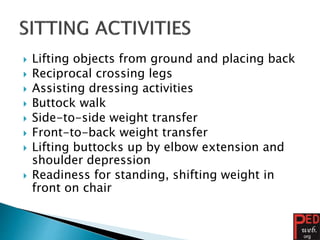
 Lifting objects from ground and placing back
 Reciprocal crossing legs
 Assisting dressing activities
 Buttock walk
 Side-to-side weight transfer
 Front-to-back weight transfer
 Lifting buttocks up by elbow extension and
shoulder depression
 Readiness for standing, shifting weight in
front on chair
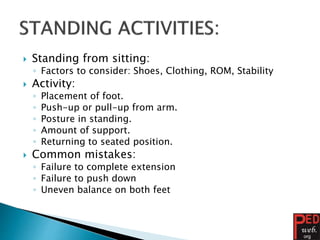
 Standing from sitting:
◦ Factors to consider: Shoes, Clothing, ROM, Stability
 Activity:
◦ Placement of foot.
◦ Push-up or pull-up from arm.
◦ Posture in standing.
◦ Amount of support.
◦ Returning to seated position.
 Common mistakes:
◦ Failure to complete extension
◦ Failure to push down
◦ Uneven balance on both feet
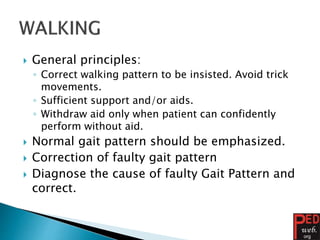
 General principles:
◦ Correct walking pattern to be insisted. Avoid trick
movements.
◦ Sufficient support and/or aids.
◦ Withdraw aid only when patient can confidently
perform without aid.
 Normal gait pattern should be emphasized.
 Correction of faulty gait pattern
 Diagnose the cause of faulty Gait Pattern and
correct.
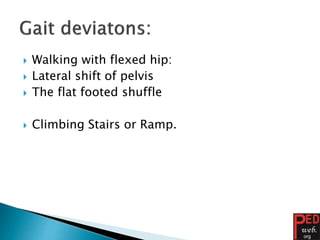
 Walking with flexed hip:
 Lateral shift of pelvis
 The flat footed shuffle
 Climbing Stairs or Ramp.
 LOWER LIMB ACTIVITIES:
 Lower Limb Functions:
a. Support body in weight bearing
b. Lift or lower body from floor or ground
c. Propel body in any direction
d. Non-weight bearing functions
 Considerations:
◦ Majority functions are weight bearing
◦ Weight bearing initiated from “FIXED FOOT”
◦ NON-weight bearing “FREE FOOT”
 UPPER LIMB ACTIVITIES:
 Upper Limb Functions:
 Support or help body support in various
positions
 Move or help move the body
 Stabilise the positions of the objects
 Considerations
 Majority of functions are NON-weight bearing
 Weight-bearing initiated with “Fixed Hand”
 Non-weight bearing “Free Hands”
 The Principles of Exercise Therapy
 M. Dena Gardiner; 4th Ed.
 Practical Exercise Therapy
 Margaret Hollis; 4th Ed.
Functional Re-education Basics

Functional Re-education Basics

  • 1.
  • 2.
     Rolling inLying  Lying to Sitting  Activities in Mat/Bed  Movement and stability at floor level  Sitting activities  Gait  Lower Limb activities  Upper Limb Activities
  • 3.
     Functional –related to day-to-day functions  Re-education – re-training  Here the patient knows the activities or movements that has to be performed but due to his ailment or diseased pathology he could not perform it properly
  • 4.
     Based onpatient’s clinical condition.  Specific  Individuality: patient specific  Team work: co-operation from relatives and other care takers  Adapted and modified movements based on patient’s need
  • 5.
     Train coordinationand balance.  Increase strength and endurance of muscle.  Train pelvic stability.  Improve the dynamic and static stability.  Augment the proprioceptive function.  Promote postural stability.  Re-educate Gait.
  • 6.
     Functional Training: Developing and progressing exercise programs that improve a patient’s muscle performance in order to regain an individual’s pre-injury level of function.
  • 7.
     Sequential:  Supine– to – Rolling ◦ Supine to side-lying ◦ Supine to prone lying ◦ Supine – Bridging  Supine – to – Sitting ◦ Supine to side-lying ◦ Supine to bedside sitting  Prone – to – Rolling ◦ Prone to side lying ◦ Prone to supine  Prone – to – Kneeling ◦ Prone to creeping ◦ Prone to crawling ◦ Prone to Kneeling
  • 8.
     Side-lying –forearm supported side-lying  Kneeling ◦ Kneeling from standing ◦ Kneeling from sitting ◦ Kneeling from Side-sitting ◦ Kneeling from Prone lying  Transfers ◦ Bed to chair; Chair to bed ◦ Bed to floor ◦ Chair to floor ◦ Chair to toilet seat  Standing  Standing from sitting  Standing from Floor
  • 9.
    Supine to side-lying Sequence:roll head and neck on movement side – trunk rotation – Hand movement – Leg movement. Purpose and uses: 1. To assist in nursing procedures 2. To gain independence 3. Surrounding environment reach 4. Reduce constant pressure on back 5. Reduce leg stiffness 6. Comfortable sleeping posture
  • 10.
    Supine to side-lyingto prone Sequence: Initiate with reaching support with hand on the side of roll – reach side-lying – continue head roll and extension to reach prone – extension-rotation of upper trunk. Purpose and uses: 1. Reduce effects of long term re-cumbancy – pressure sores. 2. Maintain extension range in trunk and hips. 3. Optional exercise position while at bed- rest.
  • 11.
    Supine: Bridging Bridging: Liftingof pelvis from crook-lying position. Position: Back arched from knee to shoulders – Foot supported – Knees praced – arma supported – extension through legs to hip and lower back lift the buttocks off the bed. Purpose and Uses: 1. Bedpan routines 2. Relieve lower back pressure areas 3. Trunk control 4. Avoid prolong flexor posture 5. Maintained efficiency of extensor muscles. 6. Dressing in bed 7. Pressure on soles demands leg activity as in body weight bearing positions.
  • 12.
    Supine – Sitting:On the side of Mat/Bed Sequence: Supine – Side-lying – Forearm support Side-Lying – Sitting. Side-lying – to – forearm supported side-lying: Push the shoulder in extension and abduction and elbow in flexion to support the upper trunk. Forearm – supported side-lying to sitting: Extend the supporting arm and push the trunk in upright position while lowering the foot on bed side, or in side-sitting on mat. Purpose and Uses: Functional position to train UL functions.
  • 13.
     Prone –Side-Lying – Supine  Just the reversal of Supine to prone.  Take care of affected hand in hemiplegics while rolling.
  • 14.
     Prone –to – Creeping (Forearm supported Prone Kneeling)  Method 1: Elbow supported side lying to forearm supported prone lying .  Method II: Prone lying to forearm supported prone lying.  Purpose and uses: 1. Counter stooping od head and shoulders. 2. Shoulder muscles stimulation. 3. Maintain extensibility of hip and lumbar spine. 4. Pulling body forwards in this position demands coordination and strength.
  • 15.
     Prone Kneelingor “Four foot position” or “On all fours”:  Pulling up from prone/Creeping position by extending arms at elbows and flexing hip & Knee.  Needs widespread and coordinated isometric activity of various muscles.  Purpose and Uses: 1. Starting for crawling. 2. Partial weight bearing through hip joints. 3. Strength and mobility at shoulders. 4. Activities at ground level.
  • 16.
     CRAWLING:  Balanceand stability training by alternate lifting of one hand and/or leg.  Spontaneous forward walking by comfortable weight transfer as per the patient’s comfort.  Purpose and uses: 1. Coordination with use of reciprocal arms and leg movements. 2. Mobilization and/or learning mobility control 3. Retraining limb functions. 4. Mobility for patients with poor erect balance. 5. Independence of mobility in vicinity of house.
  • 17.
     Before Kneeling: ◦Supporting surface ◦ Knee ROM: min 1000 ◦ Firm furniture ◦ Any other disability restricting the movement:  Kneeling from Standing.  Kneeling from Sitting.  Kneeling from Prone Kneeling.  Kneeling from Side Sitting.  Purpose and Uses: 1. Verticle alignment of trunk and thighs. 2. Promote Hip and lumbar control. 3. Half kneeling, weight transfers can be initiated. 4. Forward, backward and side walking can be progressed.
  • 18.
     Normal sittingposture: Active stability and balance of head and trunk in erect position.  Trunk stability leads to effective movement of extremities.  Sitting without back support – challenges normal body alignment.  Sitting with back support – without arm support – pulls the trunk in flexion and buttocks slide forwards – causes prolong stretching of back extensors and loss of normal lumbar lordosis – hyperextension at atlanto-occipital joint.
  • 19.
     Sitting from ◦Lying down ◦ Getting up from floor ◦ From standing  Sitting for work ◦ Bending forward with a turn from sitting and raising ◦ Sitting with legs crossed ◦ Sitting weight transfers from buttocks to buttocks ◦ Lifting body weight forward towards the front of chairseat, using the arms.
  • 20.
     Lifting objectsfrom ground and placing back  Reciprocal crossing legs  Assisting dressing activities  Buttock walk  Side-to-side weight transfer  Front-to-back weight transfer  Lifting buttocks up by elbow extension and shoulder depression  Readiness for standing, shifting weight in front on chair
  • 21.
     Standing fromsitting: ◦ Factors to consider: Shoes, Clothing, ROM, Stability  Activity: ◦ Placement of foot. ◦ Push-up or pull-up from arm. ◦ Posture in standing. ◦ Amount of support. ◦ Returning to seated position.  Common mistakes: ◦ Failure to complete extension ◦ Failure to push down ◦ Uneven balance on both feet
  • 22.
     General principles: ◦Correct walking pattern to be insisted. Avoid trick movements. ◦ Sufficient support and/or aids. ◦ Withdraw aid only when patient can confidently perform without aid.  Normal gait pattern should be emphasized.  Correction of faulty gait pattern  Diagnose the cause of faulty Gait Pattern and correct.
  • 23.
     Walking withflexed hip:  Lateral shift of pelvis  The flat footed shuffle  Climbing Stairs or Ramp.
  • 24.
     LOWER LIMBACTIVITIES:  Lower Limb Functions: a. Support body in weight bearing b. Lift or lower body from floor or ground c. Propel body in any direction d. Non-weight bearing functions  Considerations: ◦ Majority functions are weight bearing ◦ Weight bearing initiated from “FIXED FOOT” ◦ NON-weight bearing “FREE FOOT”
  • 25.
     UPPER LIMBACTIVITIES:  Upper Limb Functions:  Support or help body support in various positions  Move or help move the body  Stabilise the positions of the objects  Considerations  Majority of functions are NON-weight bearing  Weight-bearing initiated with “Fixed Hand”  Non-weight bearing “Free Hands”
  • 26.
     The Principlesof Exercise Therapy  M. Dena Gardiner; 4th Ed.  Practical Exercise Therapy  Margaret Hollis; 4th Ed.