Lifting moving
& patient
positionDR:
MARRY Grace E.Medina
Presented by:
Suaad , Amjad , Shahd , Amal , Abrar .Ashwaq and
Maram
Out lines:
• Moving and turning Clint in bed.
• Lifting
-PULLING AND PUSHING.
• Position of infants , children and elders
• Patient position
-Fowler’s position
-Dorsal recumbent position
-LATERAL POSITION.
-PRONE POSITION
-SIMS POSITION
Learning Objective
• At the end of the session , student will be able to :
• Discuss importance of safety in lifting or
moving patients
• To know the principles of lifting and moving
• Explain the important of lifting
• Explain how to pull and push
• Know the methods of moving.
• Realize the nursing consideration for moving the patient.
• Demonstrate and understand the general and specific
procedures of moving and transferring.
• Identify different patient position
Introduction
• Thousands of patients are lifted and moved by EMTs
and many EMTs are injured because they attempt to
lift or move a patient improperly. A wide variety of
patient conditions as well as circumstances affect how
the patient is "packaged" for transport. Lifting and
moving the patient is a critical skill and can range from
a simple procedure to a complex operation. We must
move the patient, keep the patient from being injured
further, and protect themselves from any unnecessary
injuries. Lifting and moving skills can be developed
and improved through practice in a nonemergency
environment, but some patient moving requires quick
thinking and ingenuity.
Moving and Turning
Clients in Bed
Although healthy people usually take for
granted that they can change body
position and go from one place to another
with lit-tle effort, ill people may have
difficulty moving, even in bed.
How much assistance clients require
depends on their own abil-ity to move and
their health status. Nurses should be
sensitive to both the need of people to
function independently and their need for
assistance to move.
When a nurse assists a person to move,
correct body mechan-ics need to be
employed so that the nurse is not injured.
Correct body alignment for the client must
also be maintained so that under stress is
not placed on the musculoskeletal system.
Actions and rationales applicable to moving
and lifting clients include these:
• Before moving a client, assess the degree
of exertion per-mitted, the client’s physical
abilities(e.g. muscle strength, presence of
paralysis) and ability to assist with the
move, ability to understand instructions,
degree of comfort or dis-comfort when
moving, client’s weight, presence of ortho-
static hypotension(particularly important
when client will be standing), and your
own strength and ability to move the
client.
• If indicated, use pain relief modalities or
medication prior to moving the client.
• Prepare any needed assistive devices and
supportive equip-ment (e.g. pillows, trochanter
roll).
• Plan around encumbrances to movement such as
an IV or heavy cast.
• Be alert to the effects of any medications the
client takes that may impair alertness, balance,
strength, or mobility.
• Obtain required assistance from other persons.
• Explain the procedure to the client and listen to
any sugges-tions the client or support people
have.
• Be alert to the effects of any medications the
client takes that may impair alertness, balance,
strength, or mobility.
• Obtain required assistance from other persons.
• Explain the procedure to the client and listen to
any sugges-tions the client or support people
have.
• Provide privacy.
• Wash hands.
• Raise the height of the bed to bring the client
close to your center of gravity.
• Lock the wheels on the bed, and raise the rail on
the side of the bed opposite you to ensure client
safety.
• face in direction of the movement to
prevent spinal twisting
• Assume a broad stance to increase
stability and provide balance
Lean your trunk forward and flex
your hips knees and an kles to
lower your center of gravity
increase stability and ensure use
of large muscle groups during
movements
Tighten your gluteal
abdominal
• Leg and arm muscles to prepare them for action and
prevent injury
• Rock from the front leg to the back leg when pulling or
from the back leg to the the front leg when pushing
overcome to overcome iner tia counteract the clients
weight and help attain a bal anced smooth motion
• After moving the client determine and document the
clients comfort (presence of anxiety dizziness or pain
)body align ment tolerance of the activity (e.g . Check
puise rate blood pressure ) ability to assist use of
support devices and safety precautions required (e.g
side rails)
assessment
• Before moving client assess the following:the the clients
physical abilities (e.g . Muscle strength presence of
paralysis)
Planning
• Review the client record to determine if previous nurses
have recorded information about the clients ability to
move use previous nurses have recorded information
about the clients ability to move
Purposes
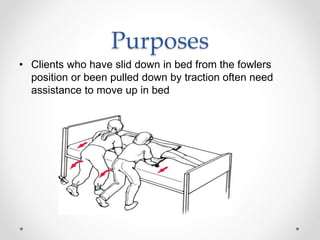
• Clients who have slid down in bed from the fowlers
position or been pulled down by traction often need
assistance to move up in bed
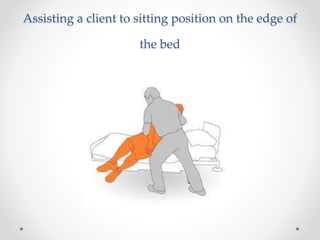
Assisting a client to sitting position on the edge of
the bed
infants
 Position infants on thrie back for sleep even after
feeding there is little regurgitation and choking and
the rate of sudden in- fant death syndrome (sids) is
significantly lower in infants who sleep on their
backs.
 The skin of newborns can be fragile and may be
abraded or tom (sheared) if the infant is pulled
across a bed.
Children
• Carefully inspect the dependent skin surfaces of all
infants and children confined to bed at least three
times in each 24 hour period.
Elders
• In client who have had cerebrovascular accident
(strokes) there is a risk of shoulder displacement on
the paralyzed side from im-proper moving or
respositioning techniques.
• Decreased subcutaneous fat and thinning of the skin
place elders at risk breakdown.
• Assess the height of the bed and the perso’s leg length
to ensure that self-movement in and out of the bed are
smooth.
• Assess the caregivers’ knowledge and application of
body mechan - ics to prevent injury
Lifting
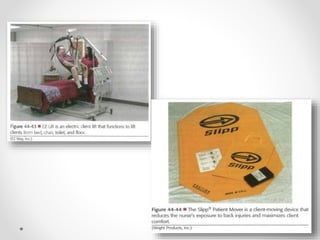
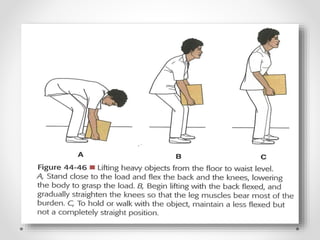
• Lifting. It is important to remember that nurses should not
lift more than 51 pounds without assistance from proper
equipment and/or other persons. Types of assistive
equipment include partial standing lifts, permanently
mounted ceiling lifts, and horizontal air-transfer
mattresses (E-Z lift, E-Z lift assist, and the slipp patient
mover are examples of such devices).
See figures 44-43 ■ and 44-44. At times it may be
necessary to lift under less than ideal circumstances. It is
always wise to use proper body mechanics, even though
they do not guarantee freedom from injury.
• When a person lifts or carries an object, for example, a
suitcase, the weight of the object becomes part of the
person's body weight. This weight affects the location of
the person's center of gravity, which is displaced in the
direction of the added weight. To counteract this potential
imbalance, body parts (e.g., Arm and trunk) move in a
direction away from the weight. In this way, the center of
gravity is maintained over the base of support. By holding
the lifted object as close as possible to the body's center of
gravity, the lifter avoids undue displacement of the center
of gravity and achieves greater stability.
• People can lift more weight when they use a lever than
when they do not. In the body, the bones of the skeleton act
as levers, a joint is a fulcrum (fixed point about which a
lever moves), and the muscles exert the force (figure 44-45
■). use of the arms as levers is often applied in clinical
practice when the nurse needs to raise a client's head off
the bed, for example, or give back care to a client in
traction.
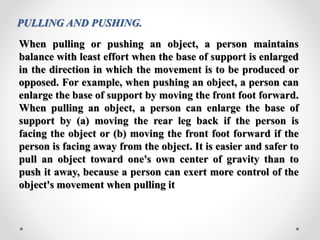
PULLING AND PUSHING.
When pulling or pushing an object, a person maintains
balance with least effort when the base of support is enlarged
in the direction in which the movement is to be produced or
opposed. For example, when pushing an object, a person can
enlarge the base of support by moving the front foot forward.
When pulling an object, a person can enlarge the base of
support by (a) moving the rear leg back if the person is
facing the object or (b) moving the front foot forward if the
person is facing away from the object. It is easier and safer to
pull an object toward one's own center of gravity than to
push it away, because a person can exert more control of the
object's movement when pulling it
CLINICAL ALERT
Lateral-assist devices such as horizontal air transfer mattresses and
transfer chairs are essential equipment for most client care areas to
prevent acute and chronic back pain and disability. Observing
principles of body mechanics is recommended even when using
assistive equipment, as any lifting and forceful movement is
potentially injurious, especially when repeated over time.
PIVOTING. Pivoting is a technique in which the body is turned in a
way that avoids twisting of the spine. To pivot, place one foot ahead
of the other, raise the heels very slightly, and put the body weight on
the balls of the feet. When the weight is off the heels, the frictional
surface is decreased and the knees are not twisted when turning.
Keeping the body aligned, turn (pivot) about 90 degrees in the
desired direction. The foot that was forward will now be behind.
Patient position
• Positioning a client in good body alignment and changing the
position regularly ( every 2 hours ) and systematically are essential
aspects of nursing practice , clients who can move easily auto–
matically reposition themselves for comfort . Such people gener-
ally require minimal positioning assistance from nurses , other
than guidance about ways to maintain body alignment and to ex-
ercise their joints . However , people who are weak , frail , in pain
paralyzed , or unconscious rely on nurses to provide or assist with
position changes . For all clients , it is important to assess the skin
and provide skin care before and after a position change . any
position, correct or incorrect , can be detrimental if maintained for
a prolonged period . frequent change of position helps to prevent
muscle discomfort , undue pressure resulting in pressure ulcers ,
damage to superficial nerves and blood vessels , and contractures .
position changes also maintain muscle tone and stimulate
postural reflexes .
• When the client is not able to move independently or
assist with moving , the preferred method is to use
appropriate assis - tive equipment , as well as to have
two or more people move or turn the client .
appropriate assistance reduces the risk of mus – cle
strain and body injury to both the client and nurse ,
and is likely to protect the dignity and comfort of the
client . when positioning clients in bed , the nurse can
do a number of things to ensure proper alignment and
promote client comfort and safety
Fowler’s position
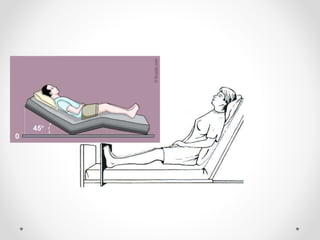
• ; fowler’s position , or a semi sitting posi- tion , is a bed position
in which the head and trunk are raised 45 to 60 degrees . in low
fowler’s or semi fowler’s position , the head and trunk are raised
15 to 45 de- grees ; high fowler’s position , the head and trunk are
raised 60 to 90 degrees . in this position , the knees may or may not
be flexed fowler’s position is the position of choice for people
who have difficulty breathing and for some people with heart
prob- lems . when the client is in this position . gravity pulls the
di- aphragm downward , allowing greater chest expansion and
lung ventilation . a common error nurses make when aligning
clients in fowler’s position is placing an overly large pillow or
more than one pillow behind the client’s head . this promotes the
develop- ment of neck flexion contractures . if a client desires
several head pillow , the nurse should encourage the client to rest
with – out a pillow for several hours each day to extend the neck
fully and counteract the effects of poor neck alignment
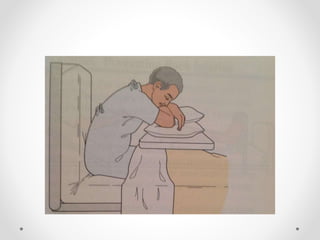
Orthopneic position
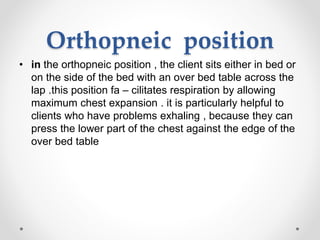
• in the orthopneic position , the client sits either in bed or
on the side of the bed with an over bed table across the
lap .this position fa – cilitates respiration by allowing
maximum chest expansion . it is particularly helpful to
clients who have problems exhaling , because they can
press the lower part of the chest against the edge of the
over bed table
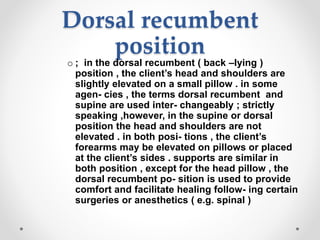
Dorsal recumbent
position
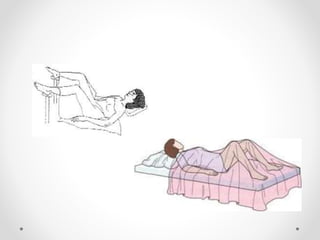
o ; in the dorsal recumbent ( back –lying )
position , the client’s head and shoulders are
slightly elevated on a small pillow . in some
agen- cies , the terms dorsal recumbent and
supine are used inter- changeably ; strictly
speaking ,however, in the supine or dorsal
position the head and shoulders are not
elevated . in both posi- tions , the client’s
forearms may be elevated on pillows or placed
at the client’s sides . supports are similar in
both position , except for the head pillow , the
dorsal recumbent po- sition is used to provide
comfort and facilitate healing follow- ing certain
surgeries or anesthetics ( e.g. spinal )
39
Position of clients
PRONE POSITION
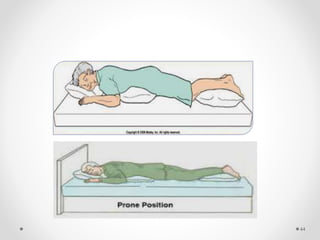
• in the prone position the client lies on
the abdomen with the head turned to
one side the hips are not flexed.both
children and adults often sleep in this
position ,sometimes with one or both
arms flexed over their heads.it is the
only bed position that allows full
extension of the hip and knee joints
• when used periodically the prone
position helps to prevent flexion
contractures of the hips and knee thereby
counteracting a problem caused by all
other bed positions also promotes
drainage from the mouth and is
especially useful for unconscious clients
or those clients recovering from surgery
of the mouth
• the prone position poses some distinct disadvantages
the pull grvity on the trunk produces a marked
lordosis in most people and the neck is rotated
laterally to a significant degree.
• For this reason , the prone position may not be
recommended for people with proplems of the cervical
or Iumbar spine . This position also causes plantar
flexion. Som clients with cardiac or respiratory
problems find the prone position confining and
suffocating because chest expansion is inhibited
during respirations .
• The prone position shouuld be used only when
the client’s back is correctly aligned, only for
short periods, and only for people with no
evidence of spinal abnormalities.
44
LATERAL POSITION.
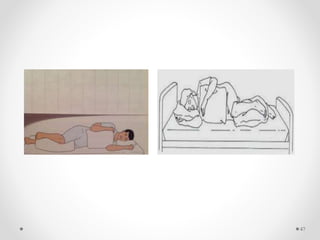
• the person lies on one side of the body. Fiex-ing the top
hip and knee and placing this leg in front of the body
creates a wider, triangular base of support and achieves
greater stability. The greater the flexion of the top hip
and knee, the greater the stability and balance in this
position. This flexion reduces lordosis and promotes
good back algnment .
• For this reason, the lateral position is good for resting
and sllping clients. The lateral position helps to relieve
pressure on the sacrum and heels in people who sit for
much of the day or who are confined to bed and rest in
fowler’s or dorsal re-cumbent positions much of the
time. In the lateral position,
47
SIMS POSITION
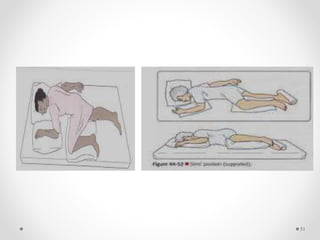
• In sims ‘’semiprone’’ position the client assumes a
posture halfway between the lateral and the prone
positions. The lower arm is positioned behind the
client, and the upper arm is flexed at the shoulder and
the elbow. Both legs are flexed in front of the client.
The upper leg is more acutely flexed at both the hip
and the knee than is the lower one.
• Sims’ position may be used for unconscious clients
because it facilitates drainage from the mouth and
prevents aspiration of fluids. It is also used for

paralyzed clients because it reduces pressure over the
sacrum and greater trochanter of the hip.
• It is often used for clients receiving enemas and
occasionally for clients undergoing examinations or
treatments of the perineal area. Many people,
especially pregnant women, find sims’ po-sition
comforable for sleeping. People with sensory or
motordeficits on one side of the body usually find that
lying on the uninvolved side is morecomfortable
51
Summary
• Nurses should be sensitive to both the need of people to
function independently and their need for assistance to
move.
• It is important to remember that nurses should not lift
more than 51 pounds without assistance from proper
equipment and/or other persons.
• For all clients , it is important to assess the skin and
provide skin care before and after a position change
Reference
• Foundational of nursing book .
• https://www.scribd.com/
Thank You.

Lifting moving & patient position

  • 1.
    Lifting moving & patient positionDR: MARRYGrace E.Medina Presented by: Suaad , Amjad , Shahd , Amal , Abrar .Ashwaq and Maram
  • 2.
    Out lines: • Movingand turning Clint in bed. • Lifting -PULLING AND PUSHING. • Position of infants , children and elders • Patient position -Fowler’s position -Dorsal recumbent position -LATERAL POSITION. -PRONE POSITION -SIMS POSITION
  • 3.
    Learning Objective • Atthe end of the session , student will be able to : • Discuss importance of safety in lifting or moving patients • To know the principles of lifting and moving • Explain the important of lifting • Explain how to pull and push • Know the methods of moving. • Realize the nursing consideration for moving the patient. • Demonstrate and understand the general and specific procedures of moving and transferring. • Identify different patient position
  • 4.
    Introduction • Thousands ofpatients are lifted and moved by EMTs and many EMTs are injured because they attempt to lift or move a patient improperly. A wide variety of patient conditions as well as circumstances affect how the patient is "packaged" for transport. Lifting and moving the patient is a critical skill and can range from a simple procedure to a complex operation. We must move the patient, keep the patient from being injured further, and protect themselves from any unnecessary injuries. Lifting and moving skills can be developed and improved through practice in a nonemergency environment, but some patient moving requires quick thinking and ingenuity.
  • 5.
  • 6.
    Although healthy peopleusually take for granted that they can change body position and go from one place to another with lit-tle effort, ill people may have difficulty moving, even in bed. How much assistance clients require depends on their own abil-ity to move and their health status. Nurses should be sensitive to both the need of people to function independently and their need for assistance to move.
  • 7.
    When a nurseassists a person to move, correct body mechan-ics need to be employed so that the nurse is not injured. Correct body alignment for the client must also be maintained so that under stress is not placed on the musculoskeletal system. Actions and rationales applicable to moving and lifting clients include these:
  • 8.
    • Before movinga client, assess the degree of exertion per-mitted, the client’s physical abilities(e.g. muscle strength, presence of paralysis) and ability to assist with the move, ability to understand instructions, degree of comfort or dis-comfort when moving, client’s weight, presence of ortho- static hypotension(particularly important when client will be standing), and your own strength and ability to move the client.
  • 9.
    • If indicated,use pain relief modalities or medication prior to moving the client. • Prepare any needed assistive devices and supportive equip-ment (e.g. pillows, trochanter roll). • Plan around encumbrances to movement such as an IV or heavy cast. • Be alert to the effects of any medications the client takes that may impair alertness, balance, strength, or mobility. • Obtain required assistance from other persons. • Explain the procedure to the client and listen to any sugges-tions the client or support people have.
  • 10.
    • Be alertto the effects of any medications the client takes that may impair alertness, balance, strength, or mobility. • Obtain required assistance from other persons. • Explain the procedure to the client and listen to any sugges-tions the client or support people have. • Provide privacy. • Wash hands. • Raise the height of the bed to bring the client close to your center of gravity. • Lock the wheels on the bed, and raise the rail on the side of the bed opposite you to ensure client safety.
  • 11.
    • face indirection of the movement to prevent spinal twisting • Assume a broad stance to increase stability and provide balance
  • 12.
    Lean your trunkforward and flex your hips knees and an kles to lower your center of gravity increase stability and ensure use of large muscle groups during movements
  • 13.
    Tighten your gluteal abdominal •Leg and arm muscles to prepare them for action and prevent injury • Rock from the front leg to the back leg when pulling or from the back leg to the the front leg when pushing overcome to overcome iner tia counteract the clients weight and help attain a bal anced smooth motion • After moving the client determine and document the clients comfort (presence of anxiety dizziness or pain )body align ment tolerance of the activity (e.g . Check puise rate blood pressure ) ability to assist use of support devices and safety precautions required (e.g side rails)
  • 14.
    assessment • Before movingclient assess the following:the the clients physical abilities (e.g . Muscle strength presence of paralysis)
  • 15.
    Planning • Review theclient record to determine if previous nurses have recorded information about the clients ability to move use previous nurses have recorded information about the clients ability to move
  • 16.
    Purposes • Clients whohave slid down in bed from the fowlers position or been pulled down by traction often need assistance to move up in bed
  • 17.
    Assisting a clientto sitting position on the edge of the bed
  • 18.
    infants  Position infantson thrie back for sleep even after feeding there is little regurgitation and choking and the rate of sudden in- fant death syndrome (sids) is significantly lower in infants who sleep on their backs.  The skin of newborns can be fragile and may be abraded or tom (sheared) if the infant is pulled across a bed.
  • 19.
    Children • Carefully inspectthe dependent skin surfaces of all infants and children confined to bed at least three times in each 24 hour period.
  • 20.
    Elders • In clientwho have had cerebrovascular accident (strokes) there is a risk of shoulder displacement on the paralyzed side from im-proper moving or respositioning techniques. • Decreased subcutaneous fat and thinning of the skin place elders at risk breakdown. • Assess the height of the bed and the perso’s leg length to ensure that self-movement in and out of the bed are smooth. • Assess the caregivers’ knowledge and application of body mechan - ics to prevent injury
  • 21.
  • 22.
    • Lifting. Itis important to remember that nurses should not lift more than 51 pounds without assistance from proper equipment and/or other persons. Types of assistive equipment include partial standing lifts, permanently mounted ceiling lifts, and horizontal air-transfer mattresses (E-Z lift, E-Z lift assist, and the slipp patient mover are examples of such devices). See figures 44-43 ■ and 44-44. At times it may be necessary to lift under less than ideal circumstances. It is always wise to use proper body mechanics, even though they do not guarantee freedom from injury.
  • 24.
    • When aperson lifts or carries an object, for example, a suitcase, the weight of the object becomes part of the person's body weight. This weight affects the location of the person's center of gravity, which is displaced in the direction of the added weight. To counteract this potential imbalance, body parts (e.g., Arm and trunk) move in a direction away from the weight. In this way, the center of gravity is maintained over the base of support. By holding the lifted object as close as possible to the body's center of gravity, the lifter avoids undue displacement of the center of gravity and achieves greater stability.
  • 25.
    • People canlift more weight when they use a lever than when they do not. In the body, the bones of the skeleton act as levers, a joint is a fulcrum (fixed point about which a lever moves), and the muscles exert the force (figure 44-45 ■). use of the arms as levers is often applied in clinical practice when the nurse needs to raise a client's head off the bed, for example, or give back care to a client in traction.
  • 27.
    PULLING AND PUSHING. Whenpulling or pushing an object, a person maintains balance with least effort when the base of support is enlarged in the direction in which the movement is to be produced or opposed. For example, when pushing an object, a person can enlarge the base of support by moving the front foot forward. When pulling an object, a person can enlarge the base of support by (a) moving the rear leg back if the person is facing the object or (b) moving the front foot forward if the person is facing away from the object. It is easier and safer to pull an object toward one's own center of gravity than to push it away, because a person can exert more control of the object's movement when pulling it
  • 28.
    CLINICAL ALERT Lateral-assist devicessuch as horizontal air transfer mattresses and transfer chairs are essential equipment for most client care areas to prevent acute and chronic back pain and disability. Observing principles of body mechanics is recommended even when using assistive equipment, as any lifting and forceful movement is potentially injurious, especially when repeated over time. PIVOTING. Pivoting is a technique in which the body is turned in a way that avoids twisting of the spine. To pivot, place one foot ahead of the other, raise the heels very slightly, and put the body weight on the balls of the feet. When the weight is off the heels, the frictional surface is decreased and the knees are not twisted when turning. Keeping the body aligned, turn (pivot) about 90 degrees in the desired direction. The foot that was forward will now be behind.
  • 30.
  • 31.
    • Positioning aclient in good body alignment and changing the position regularly ( every 2 hours ) and systematically are essential aspects of nursing practice , clients who can move easily auto– matically reposition themselves for comfort . Such people gener- ally require minimal positioning assistance from nurses , other than guidance about ways to maintain body alignment and to ex- ercise their joints . However , people who are weak , frail , in pain paralyzed , or unconscious rely on nurses to provide or assist with position changes . For all clients , it is important to assess the skin and provide skin care before and after a position change . any position, correct or incorrect , can be detrimental if maintained for a prolonged period . frequent change of position helps to prevent muscle discomfort , undue pressure resulting in pressure ulcers , damage to superficial nerves and blood vessels , and contractures . position changes also maintain muscle tone and stimulate postural reflexes .
  • 32.
    • When theclient is not able to move independently or assist with moving , the preferred method is to use appropriate assis - tive equipment , as well as to have two or more people move or turn the client . appropriate assistance reduces the risk of mus – cle strain and body injury to both the client and nurse , and is likely to protect the dignity and comfort of the client . when positioning clients in bed , the nurse can do a number of things to ensure proper alignment and promote client comfort and safety
  • 33.
    Fowler’s position • ;fowler’s position , or a semi sitting posi- tion , is a bed position in which the head and trunk are raised 45 to 60 degrees . in low fowler’s or semi fowler’s position , the head and trunk are raised 15 to 45 de- grees ; high fowler’s position , the head and trunk are raised 60 to 90 degrees . in this position , the knees may or may not be flexed fowler’s position is the position of choice for people who have difficulty breathing and for some people with heart prob- lems . when the client is in this position . gravity pulls the di- aphragm downward , allowing greater chest expansion and lung ventilation . a common error nurses make when aligning clients in fowler’s position is placing an overly large pillow or more than one pillow behind the client’s head . this promotes the develop- ment of neck flexion contractures . if a client desires several head pillow , the nurse should encourage the client to rest with – out a pillow for several hours each day to extend the neck fully and counteract the effects of poor neck alignment
  • 35.
    Orthopneic position • inthe orthopneic position , the client sits either in bed or on the side of the bed with an over bed table across the lap .this position fa – cilitates respiration by allowing maximum chest expansion . it is particularly helpful to clients who have problems exhaling , because they can press the lower part of the chest against the edge of the over bed table
  • 37.
    Dorsal recumbent position o ;in the dorsal recumbent ( back –lying ) position , the client’s head and shoulders are slightly elevated on a small pillow . in some agen- cies , the terms dorsal recumbent and supine are used inter- changeably ; strictly speaking ,however, in the supine or dorsal position the head and shoulders are not elevated . in both posi- tions , the client’s forearms may be elevated on pillows or placed at the client’s sides . supports are similar in both position , except for the head pillow , the dorsal recumbent po- sition is used to provide comfort and facilitate healing follow- ing certain surgeries or anesthetics ( e.g. spinal )
  • 39.
  • 40.
    PRONE POSITION • inthe prone position the client lies on the abdomen with the head turned to one side the hips are not flexed.both children and adults often sleep in this position ,sometimes with one or both arms flexed over their heads.it is the only bed position that allows full extension of the hip and knee joints
  • 41.
    • when usedperiodically the prone position helps to prevent flexion contractures of the hips and knee thereby counteracting a problem caused by all other bed positions also promotes drainage from the mouth and is especially useful for unconscious clients or those clients recovering from surgery of the mouth
  • 42.
    • the proneposition poses some distinct disadvantages the pull grvity on the trunk produces a marked lordosis in most people and the neck is rotated laterally to a significant degree. • For this reason , the prone position may not be recommended for people with proplems of the cervical or Iumbar spine . This position also causes plantar flexion. Som clients with cardiac or respiratory problems find the prone position confining and suffocating because chest expansion is inhibited during respirations .
  • 43.
    • The proneposition shouuld be used only when the client’s back is correctly aligned, only for short periods, and only for people with no evidence of spinal abnormalities.
  • 44.
  • 46.
    LATERAL POSITION. • theperson lies on one side of the body. Fiex-ing the top hip and knee and placing this leg in front of the body creates a wider, triangular base of support and achieves greater stability. The greater the flexion of the top hip and knee, the greater the stability and balance in this position. This flexion reduces lordosis and promotes good back algnment . • For this reason, the lateral position is good for resting and sllping clients. The lateral position helps to relieve pressure on the sacrum and heels in people who sit for much of the day or who are confined to bed and rest in fowler’s or dorsal re-cumbent positions much of the time. In the lateral position,
  • 47.
  • 49.
    SIMS POSITION • Insims ‘’semiprone’’ position the client assumes a posture halfway between the lateral and the prone positions. The lower arm is positioned behind the client, and the upper arm is flexed at the shoulder and the elbow. Both legs are flexed in front of the client. The upper leg is more acutely flexed at both the hip and the knee than is the lower one.
  • 50.
    • Sims’ positionmay be used for unconscious clients because it facilitates drainage from the mouth and prevents aspiration of fluids. It is also used for paralyzed clients because it reduces pressure over the sacrum and greater trochanter of the hip. • It is often used for clients receiving enemas and occasionally for clients undergoing examinations or treatments of the perineal area. Many people, especially pregnant women, find sims’ po-sition comforable for sleeping. People with sensory or motordeficits on one side of the body usually find that lying on the uninvolved side is morecomfortable
  • 51.
  • 53.
    Summary • Nurses shouldbe sensitive to both the need of people to function independently and their need for assistance to move. • It is important to remember that nurses should not lift more than 51 pounds without assistance from proper equipment and/or other persons. • For all clients , it is important to assess the skin and provide skin care before and after a position change
  • 54.
    Reference • Foundational ofnursing book . • https://www.scribd.com/
  • 55.