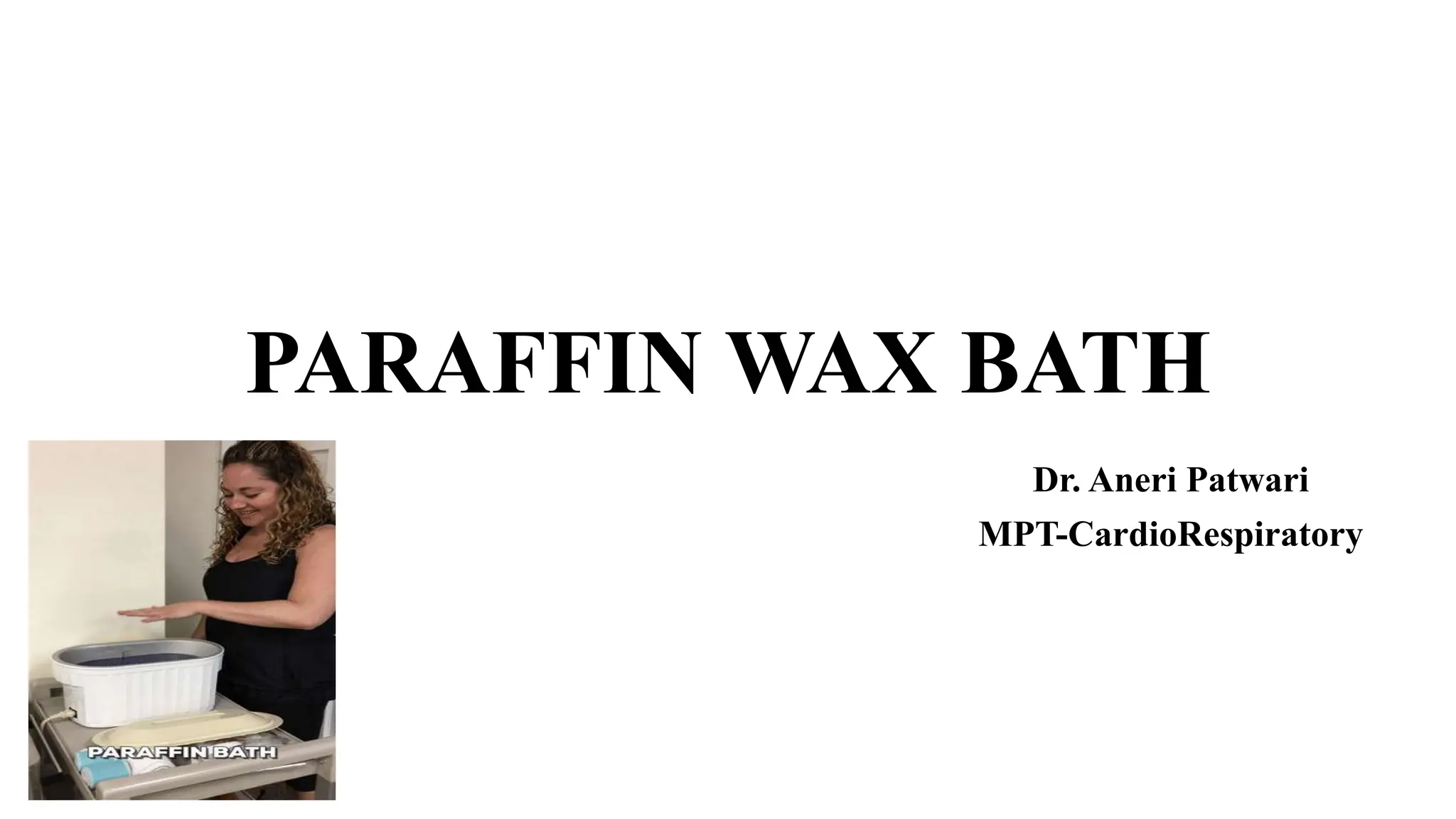
PARAFFIN WAX BATH
Dr. Aneri Patwari
MPT-CardioRespiratory
INTRODUCTION
• Paraffin wax bath therapy is an application of melted paraffin wax on
the body parts.
• Paraffin wax for therapy is one of the most convenient ,reasonably
efficient method of applying conducted heat to the extremities.
• one of the most useful of the superficial thermal modalities .
• It is an easy , economical , and efficient way of applying gentle heat
to an irregular surface such as the hand or wrist .
PARTS OF UNIT
• Container
• Mains
• Thermostat
• thermostat pilot lamp,
• lid and caster.
WAX UNIT
• Container is made up of enamelled baths or stainless steel and
fiberglass shell.(electrically heated)
• Thermostat keeps the temperature adjusted with knob. Thermostat
pilot’s lamp indicates whether thermostat is on or off.
• Power pilot’s lamp show whether power is on or off.
• Lid cover container and caster allow the paraffin wax bath container
to be move from place to place.
WAX UNIT
• The melting point of wax is 51-55°c. If the molten wax at 51-55°c is
poured on the body part, its may cause burn.
• Some impurity like liquid paraffin or mineral oil is added to lower the
melting point for safe application(burns).
• Thus the temperature of the paraffin wax is maintained at 40-44°c
COMPOSITION
• contains wax and paraffin oil in the prescribed ratio.
• The combination of the wax: paraffin: mineral oil/petroleum jelly has
low specific heat which enhances the patient’s ability to tolerate heat
from the wax better than from the water of the same temperature.
• Composition of the wax: paraffin: mineral oil or jelly is 7:3:1/7:1:1/
2:1:1
• The combination of paraffin and mineral oil has low specific
heat which enhances the patient’s ability to tolerate heat from
paraffin better than from the water of the same temperature.
PRINCIPLE
• Way of transferring heat to the patient by conduction
• It is a process by which heat is transferred from the hotter end to the colder
end of an object.
• The law of heat conduction, also known as Fourier's law, states that the
rate of heat transfer through a material is proportional to the
negative gradient in the temperature and to the area, at right angles to that
gradient, through which the heat flows
• q= -K ∇T
• where (including the SI units)
• Q is the local heat flux density, W/m2,
• K is the material's conductivity, W/(m·K),
• ∇T is the temperature gradient, K/m.
CHARACTERISTICS
1. Low thermal conductivity
2. Self insulating
3. Analgesic
PHYSIOLOGICAL RESPONSE
1. Heat production
2. Circulatory effects
3. Analgesic effects
4. Stretching effect
PHYSIOLOGICAL RESPONSE: HEAT
• In the first 2 min a marked increase in skin temperature: 12°C to 13°C.
• While wax wrapping the temprature drops.
• Then after 30 min. at the end of the treatment to:
8°C at skin level.
5°C at subcutaneous fascia.
2°C -3°C in superficial muscles.
PHYSIOLOGICAL
RESPONSE:CIRCULATORY
• Stimulation of superficial capillaries & arterioles → local hyperemia
→ reflex vasodilatation of capillaries in the skin ( pink).
→ reflex heating of the joints.
→ skin t° drops quickly after min.
→ reduces then vasodilatation.
• N.B : Exercises after wax is important to ↑ ROM and muscle strength.
PHYSIOLOGICAL RESPONSE
• Analgesic effects: Most important effect as sedative effect on tissue.
Moist heat gives a soothing effect. Very good prior to the exercise for
superficial joints.
• Stretching effects: wax leaves the skin moist, soft and pliable. It is
useful for stretching scars and adhesions.
INDICATIONS
1. Pain and musle spasm especially in the distal extremities ( toes and
fingers).
2. Oedema and inflammation: gentle heat reduces:
• Post-traumatic swelling of the hands and feet
• Swelling of the hands in rheumatoid arthritis.Swelling of the hands in
degenerative joints disease.
• Especially in sub-acute and early chronic stages or inflammation.!
• Caution is needed in acute phase of arthritic pain and swelling.
3. Adhesions and scars : wax softens and facilitates the mobilization and
stretching procedures.
CONTRAINDICATIONS
1. Impaired skin sensation (hot/cold sensation test): anaesthesia,
hypostasia, hyperesthesia, parastesia.
2. Some dermatological conditions: eczema,dermatis. (report any
reactions after ttt)
3. Circulatory dysfunction ( varicose veins, DVT, arterial disease)
4. Analgesic drugs as pain tolerance to heat is impaired.
5. Infections and open wounds ( as it increases the infective activity)
such as in blood born infections.
CONTRAINDICATIONS
6. Cancer, tumors or tuberculosis ( TB) in the area to be treated as it ↑
the metabolic activity & rate of growth.
7. Gross oedema with a very thin and delicate skin covering the area .
8. Lack of comprehension ( children, senile , head injuries, confused,
agitated,…)
9. Deep X~ray therapy within three months prior to treatment ↓
bloodflow thus impaired sensation.
10. External or internal metal fixators, implants (metal plates in
orthopedics).
ADVANTAGES
1. Low specific heat allows for application at a
higher temperature than water without the risk
of a burn.
2. Low thermal conductivity allows for heating of
tissues to occur more slowly, thus reducing the
risk of overheating the tissues.
3. Molten state allows for even distribution of heat
to areas like finger and toes.
4. First dip traps air and moisture (Insulation) to
create more even heat distribution.
5. Oils used in the wax add moisture to the skin
6. Wax remains malleable, after removal.
7. Comfortable, moist heat.
8. Relative inexpensive to replace wax.
9. It can be carried out at home for the chronic
sufferers.
10. Useful for patients with poor heat tolerance
11. Two or Three patients can be treated at a time.
DISADVANTAGES
1. Effective only for distal extremities in the
terms of ease of application
2. No method of temperature controls once
applied.
3. Sedimentation occurs at the bottom.
4. It is a passive treatment: exercise may not
be performed simultaneously.
5. The bath must be cleaned regularly &
emptied at least twice a year.
6. Contamination of oil by atmospheric dust.
7. It also poses environmental concerns
regarding its disposal.
METHOD OF APPLICATION
1. BRUSHING
2. POURING
3. DIPPING
4. IMMERSION
5. BANDAGING/WRAPING/TOWELING
BRUSHING
• A brush is used to apply wax over
the body part.
• Several coats (4-6) are applied
over the body part
• Towel is wrapped over the part.
• Wax is allowed to solidify.
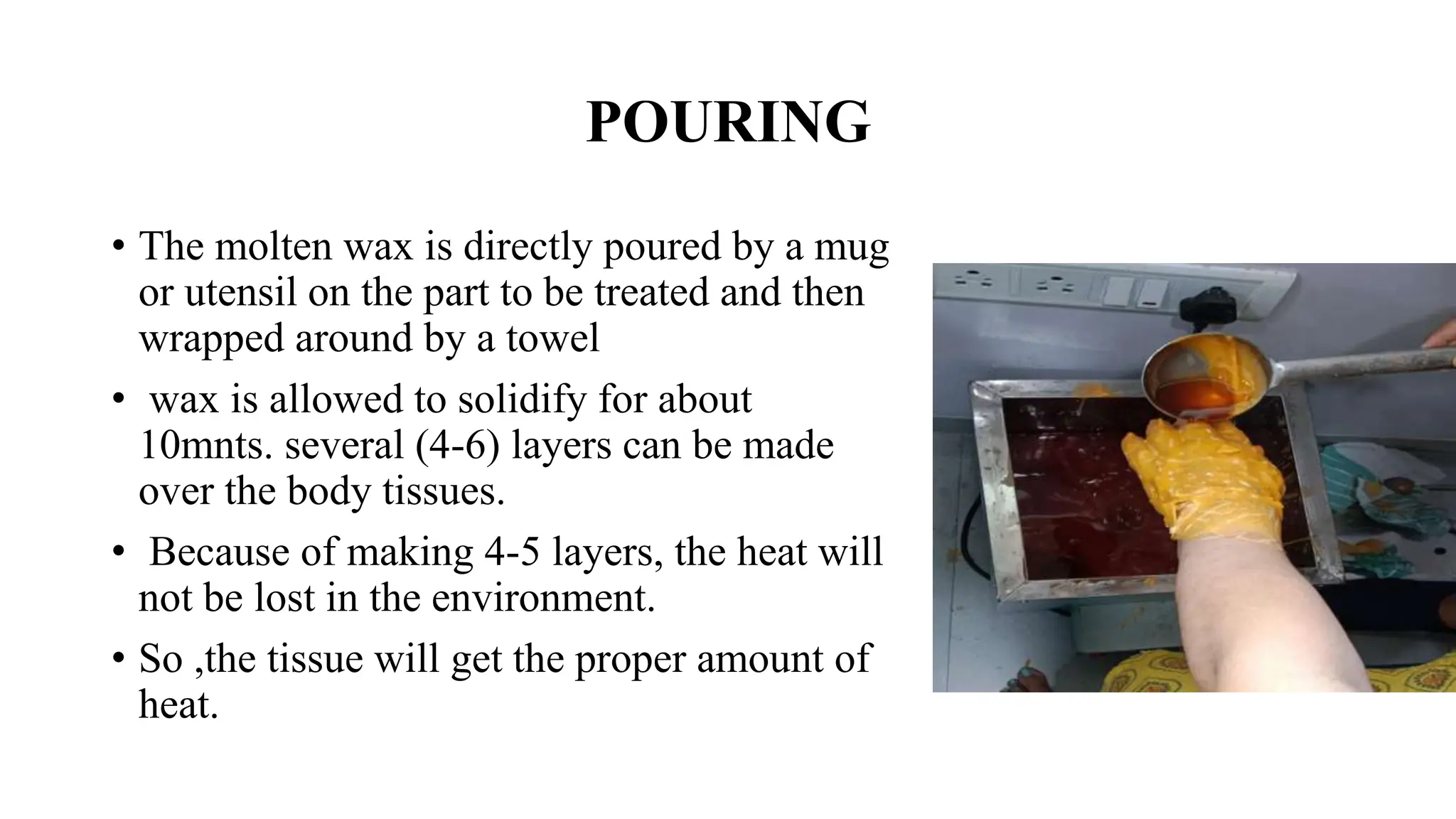
POURING
• The molten wax is directly poured by a mug
or utensil on the part to be treated and then
wrapped around by a towel
• wax is allowed to solidify for about
10mnts. several (4-6) layers can be made
over the body tissues.
• Because of making 4-5 layers, the heat will
not be lost in the environment.
• So ,the tissue will get the proper amount of
heat.
DIPING
• Involves placing the body part to be treated in a
paraffin bath, followed by removing it and
allowing the paraffin to cool and harden.
• Approximately 7 to 12 dips are done followed
by wrapping in wax paper or plastic, which is
covered by towels or insulated mitts.
• Application time is 20 to 30 minutes or till wax
cools.
• not to move the joints that are in the liquid. The
cracking of the wax will allow fresh paraffin to
touch the skin, increasing the risk of burns.
• The warm wax is placed on the body tissues by
various techniques and the treatment is given
for about minutes.
IMMERSION
• Dip once for having a glove
• Then immerse for 15 to 20 min.
• Never immerse at first for a long time
without making a glove dry before to
have insultions.
• not to move the joints that are in the
liquid. The cracking of the wax will
allow fresh paraffin to touch the skin,
increasing the risk of burns.
• The warm wax is placed on the body
tissues by various techniques and the
treatment is given for about minutes.
BANDAGING/WRAPING/TOWELING
• A towel or a roll of bandage is
immersed in molten paraffin
wax and wrapped around the
body part.
• Several layers can be made
over the body part.
• This method is preferably used
for treating proximal parts of the
body.
TECHNIQUE OF APPLICATION
An area to be treated is inspected for any
contraindications Like wound ,skin infection
,rashes etc .
the patient is positioned in such a way that the
part be treated comes closer to the container
bath , clean the skin using tissue paper/cotton
tell the patient in brief about nature and
temperature of wax and the benefits
drip down few drops of molten wax on the
dorsal surface of your hand to check the
temperature .
This is done before the patient so that
he/she can prepare psychologically and fear
of heat is minimized
Using 4 inch broad and thin pointing brush ,paste few inch
area on the part of patient .see patients reaction ,tolerance
and confidence to bear the heat . then repeat twice or thrice
.
from the mind of patient.. After the above steps
the patient is always found to cooperate and fear of
molten wax and heat is removed
Now paste the entire area to be treated ,
and first layers of wax is formed .this layer
should not be thin . -Like the same way,
second and third layer is coated
When the layers are cooled and patients feels
temperature has been reduced ,the wax layers are
broken down or the ‘glove’ of the wax is normally
left in place for some 10-15 minutes by which time
the wax is completely solid, so that can be
removed in one piece.
Always use small quantity of wax on the brush especially
when making first layer. -Brush movements should be
medio-laterally and/or superio-inferiorly.
•after removing the wax ,area is checked for any
adverse conditions developed. • the wax is applied
in cycles for 5 to 20 minutes per day , for at least 10
days .
CARE OF APARATUS
• The patient’s body part should be cleaned before
• Bath is to be cleaned regularly (every 6 months) while the paraffin is liquid.
• Disconnect the unit from electrical outlet & dip the parraffin out of the bath with
a small pan in another container.
• Remove & clean the slats , remaining paraffin can be removed and sediments
removed with paper towels.
• Replace then the parrafin back in the bath and add new paraffin as needed.

PARAFFIN WAX BATH THERAPY by Dr. Aneri..

  • 1.
    PARAFFIN WAX BATH Dr.Aneri Patwari MPT-CardioRespiratory
  • 3.
    INTRODUCTION • Paraffin waxbath therapy is an application of melted paraffin wax on the body parts. • Paraffin wax for therapy is one of the most convenient ,reasonably efficient method of applying conducted heat to the extremities. • one of the most useful of the superficial thermal modalities . • It is an easy , economical , and efficient way of applying gentle heat to an irregular surface such as the hand or wrist .
  • 4.
    PARTS OF UNIT •Container • Mains • Thermostat • thermostat pilot lamp, • lid and caster.
  • 5.
    WAX UNIT • Containeris made up of enamelled baths or stainless steel and fiberglass shell.(electrically heated) • Thermostat keeps the temperature adjusted with knob. Thermostat pilot’s lamp indicates whether thermostat is on or off. • Power pilot’s lamp show whether power is on or off. • Lid cover container and caster allow the paraffin wax bath container to be move from place to place.
  • 6.
    WAX UNIT • Themelting point of wax is 51-55°c. If the molten wax at 51-55°c is poured on the body part, its may cause burn. • Some impurity like liquid paraffin or mineral oil is added to lower the melting point for safe application(burns). • Thus the temperature of the paraffin wax is maintained at 40-44°c
  • 7.
    COMPOSITION • contains waxand paraffin oil in the prescribed ratio. • The combination of the wax: paraffin: mineral oil/petroleum jelly has low specific heat which enhances the patient’s ability to tolerate heat from the wax better than from the water of the same temperature. • Composition of the wax: paraffin: mineral oil or jelly is 7:3:1/7:1:1/ 2:1:1 • The combination of paraffin and mineral oil has low specific heat which enhances the patient’s ability to tolerate heat from paraffin better than from the water of the same temperature.
  • 8.
    PRINCIPLE • Way oftransferring heat to the patient by conduction • It is a process by which heat is transferred from the hotter end to the colder end of an object. • The law of heat conduction, also known as Fourier's law, states that the rate of heat transfer through a material is proportional to the negative gradient in the temperature and to the area, at right angles to that gradient, through which the heat flows • q= -K ∇T • where (including the SI units) • Q is the local heat flux density, W/m2, • K is the material's conductivity, W/(m·K), • ∇T is the temperature gradient, K/m.
  • 9.
    CHARACTERISTICS 1. Low thermalconductivity 2. Self insulating 3. Analgesic
  • 10.
    PHYSIOLOGICAL RESPONSE 1. Heatproduction 2. Circulatory effects 3. Analgesic effects 4. Stretching effect
  • 11.
    PHYSIOLOGICAL RESPONSE: HEAT •In the first 2 min a marked increase in skin temperature: 12°C to 13°C. • While wax wrapping the temprature drops. • Then after 30 min. at the end of the treatment to: 8°C at skin level. 5°C at subcutaneous fascia. 2°C -3°C in superficial muscles.
  • 12.
    PHYSIOLOGICAL RESPONSE:CIRCULATORY • Stimulation ofsuperficial capillaries & arterioles → local hyperemia → reflex vasodilatation of capillaries in the skin ( pink). → reflex heating of the joints. → skin t° drops quickly after min. → reduces then vasodilatation. • N.B : Exercises after wax is important to ↑ ROM and muscle strength.
  • 13.
    PHYSIOLOGICAL RESPONSE • Analgesiceffects: Most important effect as sedative effect on tissue. Moist heat gives a soothing effect. Very good prior to the exercise for superficial joints. • Stretching effects: wax leaves the skin moist, soft and pliable. It is useful for stretching scars and adhesions.
  • 14.
    INDICATIONS 1. Pain andmusle spasm especially in the distal extremities ( toes and fingers). 2. Oedema and inflammation: gentle heat reduces: • Post-traumatic swelling of the hands and feet • Swelling of the hands in rheumatoid arthritis.Swelling of the hands in degenerative joints disease. • Especially in sub-acute and early chronic stages or inflammation.! • Caution is needed in acute phase of arthritic pain and swelling. 3. Adhesions and scars : wax softens and facilitates the mobilization and stretching procedures.
  • 15.
    CONTRAINDICATIONS 1. Impaired skinsensation (hot/cold sensation test): anaesthesia, hypostasia, hyperesthesia, parastesia. 2. Some dermatological conditions: eczema,dermatis. (report any reactions after ttt) 3. Circulatory dysfunction ( varicose veins, DVT, arterial disease) 4. Analgesic drugs as pain tolerance to heat is impaired. 5. Infections and open wounds ( as it increases the infective activity) such as in blood born infections.
  • 16.
    CONTRAINDICATIONS 6. Cancer, tumorsor tuberculosis ( TB) in the area to be treated as it ↑ the metabolic activity & rate of growth. 7. Gross oedema with a very thin and delicate skin covering the area . 8. Lack of comprehension ( children, senile , head injuries, confused, agitated,…) 9. Deep X~ray therapy within three months prior to treatment ↓ bloodflow thus impaired sensation. 10. External or internal metal fixators, implants (metal plates in orthopedics).
  • 17.
    ADVANTAGES 1. Low specificheat allows for application at a higher temperature than water without the risk of a burn. 2. Low thermal conductivity allows for heating of tissues to occur more slowly, thus reducing the risk of overheating the tissues. 3. Molten state allows for even distribution of heat to areas like finger and toes. 4. First dip traps air and moisture (Insulation) to create more even heat distribution. 5. Oils used in the wax add moisture to the skin 6. Wax remains malleable, after removal. 7. Comfortable, moist heat. 8. Relative inexpensive to replace wax. 9. It can be carried out at home for the chronic sufferers. 10. Useful for patients with poor heat tolerance 11. Two or Three patients can be treated at a time. DISADVANTAGES 1. Effective only for distal extremities in the terms of ease of application 2. No method of temperature controls once applied. 3. Sedimentation occurs at the bottom. 4. It is a passive treatment: exercise may not be performed simultaneously. 5. The bath must be cleaned regularly & emptied at least twice a year. 6. Contamination of oil by atmospheric dust. 7. It also poses environmental concerns regarding its disposal.
  • 18.
    METHOD OF APPLICATION 1.BRUSHING 2. POURING 3. DIPPING 4. IMMERSION 5. BANDAGING/WRAPING/TOWELING
  • 19.
    BRUSHING • A brushis used to apply wax over the body part. • Several coats (4-6) are applied over the body part • Towel is wrapped over the part. • Wax is allowed to solidify.
  • 20.
    POURING • The moltenwax is directly poured by a mug or utensil on the part to be treated and then wrapped around by a towel • wax is allowed to solidify for about 10mnts. several (4-6) layers can be made over the body tissues. • Because of making 4-5 layers, the heat will not be lost in the environment. • So ,the tissue will get the proper amount of heat.
  • 21.
    DIPING • Involves placingthe body part to be treated in a paraffin bath, followed by removing it and allowing the paraffin to cool and harden. • Approximately 7 to 12 dips are done followed by wrapping in wax paper or plastic, which is covered by towels or insulated mitts. • Application time is 20 to 30 minutes or till wax cools. • not to move the joints that are in the liquid. The cracking of the wax will allow fresh paraffin to touch the skin, increasing the risk of burns. • The warm wax is placed on the body tissues by various techniques and the treatment is given for about minutes.
  • 22.
    IMMERSION • Dip oncefor having a glove • Then immerse for 15 to 20 min. • Never immerse at first for a long time without making a glove dry before to have insultions. • not to move the joints that are in the liquid. The cracking of the wax will allow fresh paraffin to touch the skin, increasing the risk of burns. • The warm wax is placed on the body tissues by various techniques and the treatment is given for about minutes.
  • 23.
    BANDAGING/WRAPING/TOWELING • A towelor a roll of bandage is immersed in molten paraffin wax and wrapped around the body part. • Several layers can be made over the body part. • This method is preferably used for treating proximal parts of the body.
  • 24.
    TECHNIQUE OF APPLICATION Anarea to be treated is inspected for any contraindications Like wound ,skin infection ,rashes etc . the patient is positioned in such a way that the part be treated comes closer to the container bath , clean the skin using tissue paper/cotton tell the patient in brief about nature and temperature of wax and the benefits drip down few drops of molten wax on the dorsal surface of your hand to check the temperature . This is done before the patient so that he/she can prepare psychologically and fear of heat is minimized Using 4 inch broad and thin pointing brush ,paste few inch area on the part of patient .see patients reaction ,tolerance and confidence to bear the heat . then repeat twice or thrice . from the mind of patient.. After the above steps the patient is always found to cooperate and fear of molten wax and heat is removed Now paste the entire area to be treated , and first layers of wax is formed .this layer should not be thin . -Like the same way, second and third layer is coated When the layers are cooled and patients feels temperature has been reduced ,the wax layers are broken down or the ‘glove’ of the wax is normally left in place for some 10-15 minutes by which time the wax is completely solid, so that can be removed in one piece. Always use small quantity of wax on the brush especially when making first layer. -Brush movements should be medio-laterally and/or superio-inferiorly. •after removing the wax ,area is checked for any adverse conditions developed. • the wax is applied in cycles for 5 to 20 minutes per day , for at least 10 days .
  • 25.
    CARE OF APARATUS •The patient’s body part should be cleaned before • Bath is to be cleaned regularly (every 6 months) while the paraffin is liquid. • Disconnect the unit from electrical outlet & dip the parraffin out of the bath with a small pan in another container. • Remove & clean the slats , remaining paraffin can be removed and sediments removed with paper towels. • Replace then the parrafin back in the bath and add new paraffin as needed.