The Importance of CPR and First Aid
Certification Skills
By Veronica Flores
CPR and First Aid
Community Awareness
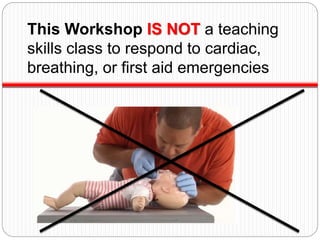
This Workshop IS NOT a teaching
skills class to respond to cardiac,
breathing, or first aid emergencies
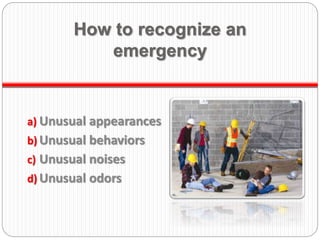
How to recognize an
emergency
a) Unusual appearances
b) Unusual behaviors
c) Unusual noises
d) Unusual odors
Barriers to Act
 Being unsure of the person’s
condition
and what to do
ď‚— Assuming someone else will take
action
ď‚— Being unsure of when to call
ď‚— Fear of catching a disease
ď‚— Type of injury or illness
ď‚— Fear of being sued
Decide to Act
ď‚— Overcome
Barriers
ď‚— Getting the
appropriate
skills
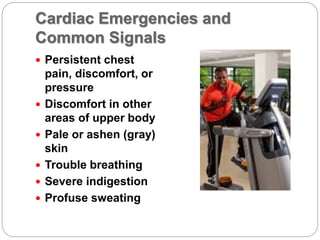
Cardiac Emergencies and
Common Signals
ď‚— Persistent chest
pain, discomfort, or
pressure
ď‚— Discomfort in other
areas of upper body
ď‚— Pale or ashen (gray)
skin
ď‚— Trouble breathing
ď‚— Severe indigestion
ď‚— Profuse sweating
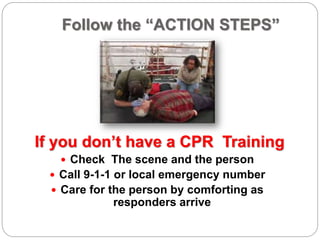
Follow the “ACTION STEPS”
If you don’t have a CPR Training
ď‚— Check The scene and the person
ď‚— Call 9-1-1 or local emergency number
ď‚— Care for the person by comforting as
responders arrive
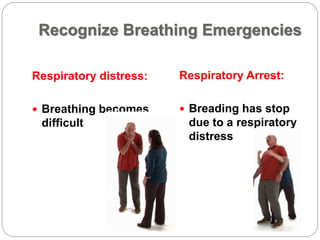
Recognize Breathing Emergencies
Respiratory distress:
ď‚— Breathing becomes
difficult
Respiratory Arrest:
ď‚— Breading has stop
due to a respiratory
distress
Breathing Emergencies are
Caused by:
ď‚— Chronic conditions
such as asthma
ď‚— Lungs or abdomen
problems
ď‚— Drug overdose
ď‚— Poisoning
ď‚— Drowning
ď‚— Choking
ď‚— Injury to the head
brain stem, or
chest
ď‚— Irregular heartbeat
ď‚— Emotional distress
ď‚— Electrocution
ď‚— Heart attack
ď‚— Illness
Choking: Call 911 if:
ď‚— Most common
breathing
emergencies
ď‚— Airway is partially or
completely blocked
ď‚— Person is not
breathing
ď‚— Breathing is too fast
ď‚— Too slow
ď‚— Painful
ď‚— Noisy
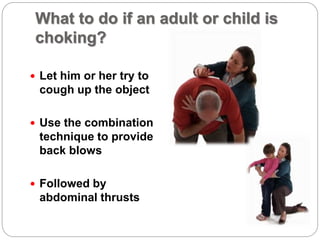
What to do if an adult or child is
choking?
ď‚— Let him or her try to
cough up the object
ď‚— Use the combination
technique to provide
back blows
ď‚— Followed by
abdominal thrusts
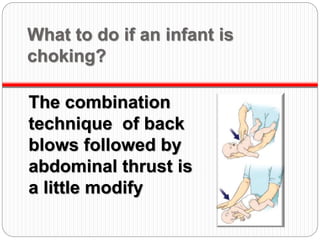
What to do if an infant is
choking?
The combination
technique of back
blows followed by
abdominal thrust is
a little modify
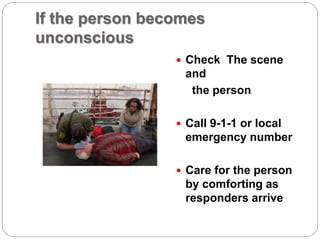
If the person becomes
unconscious
ď‚— Check The scene
and
the person
ď‚— Call 9-1-1 or local
emergency number
ď‚— Care for the person
by comforting as
responders arrive
Sudden Illness
Fainting
ď‚— Insufficient blood
supply to the brain
for a short period of
time
ď‚— It may be a symptom
of a more serious
condition
Seizures
ď‚— Abnormal electrical
activity in the brain
ď‚— Involuntary changes
in body movement
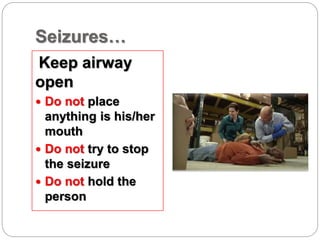
Seizures…
Keep airway
open
ď‚— Do not place
anything is his/her
mouth
ď‚— Do not try to stop
the seizure
ď‚— Do not hold the
person
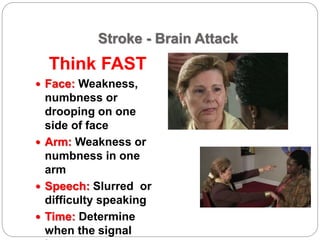
Stroke - Brain Attack
Think FAST
ď‚— Face: Weakness,
numbness or
drooping on one
side of face
ď‚— Arm: Weakness or
numbness in one
arm
ď‚— Speech: Slurred or
difficulty speaking
ď‚— Time: Determine
when the signal
Follow the “ACTION STEPS”
ď‚— Check the scene
and the person
ď‚— Call 9-1-1 or local
emergency number
ď‚— Care for the person
by comforting as
responders arrive
Diabetic Emergencies
Hyperglycemia Hypoglycemia
High level of sugar
Both high and low
have similar
characteristics
ď‚— Rapid breathing and
pulse
ď‚— Abnormal skin
characteristics
ď‚— Drowsiness
Low level of sugar
ď‚— Abnormal rapid or
weak pulse
ď‚— Changes in level of
consciousness
ď‚— Dizziness
ď‚— Confusion
If you suspect a diabetic
emergency
Do not administer insulin
Call for advanced medical personal
If the patient becomes unconscious …
follow the “Action Steps”
Allergic Reactions
Over activity of the immune
system
Causes: What to look for?
ď‚— Latex
ď‚— Pinots
ď‚— Pollen
ď‚— Antibiotics
ď‚— Some drugs
ď‚— Certain foods
ď‚— Bee or insect venom
ď‚— Itching
ď‚— Rash
ď‚— Nausea
ď‚— Vomiting
ď‚— Dizziness
ď‚— Weakness
ď‚— Stomach cramps
ď‚— Trouble breathing
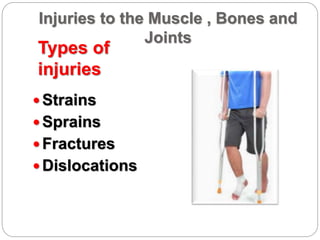
Injuries to the Muscle , Bones and
Joints
Types of
injuries
ď‚— Strains
ď‚— Sprains
ď‚— Fractures
ď‚— Dislocations
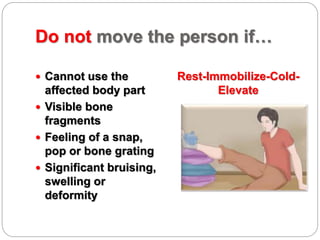
Do not move the person if…
ď‚— Cannot use the
affected body part
ď‚— Visible bone
fragments
ď‚— Feeling of a snap,
pop or bone grating
ď‚— Significant bruising,
swelling or
deformity
Rest-Immobilize-Cold-
Elevate
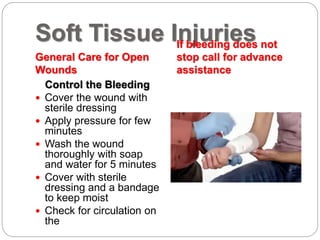
Soft Tissue Injuries
General Care for Open
Wounds
If bleeding does not
stop call for advance
assistance
Control the Bleeding
ď‚— Cover the wound with
sterile dressing
ď‚— Apply pressure for few
minutes
ď‚— Wash the wound
thoroughly with soap
and water for 5 minutes
ď‚— Cover with sterile
dressing and a bandage
to keep moist
ď‚— Check for circulation on
the
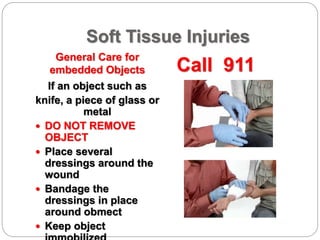
Soft Tissue Injuries
General Care for
embedded Objects Call 911
If an object such as
knife, a piece of glass or
metal
ď‚— DO NOT REMOVE
OBJECT
ď‚— Place several
dressings around the
wound
ď‚— Bandage the
dressings in place
around obmect
ď‚— Keep object
Do not forget to call for advanced
medical personal if….
ď‚— Suspect any
cardiac emergency
ď‚— There is a
breathing distress
ď‚— The patient
becomes
unconscious
ď‚— Cannot use the
affected body part
CPR and First Aid Workshop

CPR and First Aid Workshop

  • 1.
    The Importance ofCPR and First Aid Certification Skills By Veronica Flores CPR and First Aid Community Awareness
  • 3.
    This Workshop ISNOT a teaching skills class to respond to cardiac, breathing, or first aid emergencies
  • 4.
    How to recognizean emergency a) Unusual appearances b) Unusual behaviors c) Unusual noises d) Unusual odors
  • 5.
    Barriers to Act Being unsure of the person’s condition and what to do  Assuming someone else will take action  Being unsure of when to call  Fear of catching a disease  Type of injury or illness  Fear of being sued
  • 6.
    Decide to Act ď‚—Overcome Barriers ď‚— Getting the appropriate skills
  • 7.
    Cardiac Emergencies and CommonSignals ď‚— Persistent chest pain, discomfort, or pressure ď‚— Discomfort in other areas of upper body ď‚— Pale or ashen (gray) skin ď‚— Trouble breathing ď‚— Severe indigestion ď‚— Profuse sweating
  • 8.
    Follow the “ACTIONSTEPS” If you don’t have a CPR Training  Check The scene and the person  Call 9-1-1 or local emergency number  Care for the person by comforting as responders arrive
  • 9.
    Recognize Breathing Emergencies Respiratorydistress: ď‚— Breathing becomes difficult Respiratory Arrest: ď‚— Breading has stop due to a respiratory distress
  • 10.
    Breathing Emergencies are Causedby: ď‚— Chronic conditions such as asthma ď‚— Lungs or abdomen problems ď‚— Drug overdose ď‚— Poisoning ď‚— Drowning ď‚— Choking ď‚— Injury to the head brain stem, or chest ď‚— Irregular heartbeat ď‚— Emotional distress ď‚— Electrocution ď‚— Heart attack ď‚— Illness
  • 11.
    Choking: Call 911if: ď‚— Most common breathing emergencies ď‚— Airway is partially or completely blocked ď‚— Person is not breathing ď‚— Breathing is too fast ď‚— Too slow ď‚— Painful ď‚— Noisy
  • 12.
    What to doif an adult or child is choking? ď‚— Let him or her try to cough up the object ď‚— Use the combination technique to provide back blows ď‚— Followed by abdominal thrusts
  • 13.
    What to doif an infant is choking? The combination technique of back blows followed by abdominal thrust is a little modify
  • 14.
    If the personbecomes unconscious ď‚— Check The scene and the person ď‚— Call 9-1-1 or local emergency number ď‚— Care for the person by comforting as responders arrive
  • 15.
    Sudden Illness Fainting ď‚— Insufficientblood supply to the brain for a short period of time ď‚— It may be a symptom of a more serious condition Seizures ď‚— Abnormal electrical activity in the brain ď‚— Involuntary changes in body movement
  • 16.
    Seizures… Keep airway open  Donot place anything is his/her mouth  Do not try to stop the seizure  Do not hold the person
  • 17.
    Stroke - BrainAttack Think FAST ď‚— Face: Weakness, numbness or drooping on one side of face ď‚— Arm: Weakness or numbness in one arm ď‚— Speech: Slurred or difficulty speaking ď‚— Time: Determine when the signal
  • 18.
    Follow the “ACTIONSTEPS”  Check the scene and the person  Call 9-1-1 or local emergency number  Care for the person by comforting as responders arrive
  • 19.
    Diabetic Emergencies Hyperglycemia Hypoglycemia Highlevel of sugar Both high and low have similar characteristics ď‚— Rapid breathing and pulse ď‚— Abnormal skin characteristics ď‚— Drowsiness Low level of sugar ď‚— Abnormal rapid or weak pulse ď‚— Changes in level of consciousness ď‚— Dizziness ď‚— Confusion
  • 20.
    If you suspecta diabetic emergency Do not administer insulin Call for advanced medical personal If the patient becomes unconscious … follow the “Action Steps”
  • 21.
    Allergic Reactions Over activityof the immune system Causes: What to look for? ď‚— Latex ď‚— Pinots ď‚— Pollen ď‚— Antibiotics ď‚— Some drugs ď‚— Certain foods ď‚— Bee or insect venom ď‚— Itching ď‚— Rash ď‚— Nausea ď‚— Vomiting ď‚— Dizziness ď‚— Weakness ď‚— Stomach cramps ď‚— Trouble breathing
  • 22.
    Injuries to theMuscle , Bones and Joints Types of injuries ď‚— Strains ď‚— Sprains ď‚— Fractures ď‚— Dislocations
  • 23.
    Do not movethe person if…  Cannot use the affected body part  Visible bone fragments  Feeling of a snap, pop or bone grating  Significant bruising, swelling or deformity Rest-Immobilize-Cold- Elevate
  • 24.
    Soft Tissue Injuries GeneralCare for Open Wounds If bleeding does not stop call for advance assistance Control the Bleeding ď‚— Cover the wound with sterile dressing ď‚— Apply pressure for few minutes ď‚— Wash the wound thoroughly with soap and water for 5 minutes ď‚— Cover with sterile dressing and a bandage to keep moist ď‚— Check for circulation on the
  • 25.
    Soft Tissue Injuries GeneralCare for embedded Objects Call 911 If an object such as knife, a piece of glass or metal ď‚— DO NOT REMOVE OBJECT ď‚— Place several dressings around the wound ď‚— Bandage the dressings in place around obmect ď‚— Keep object
  • 26.
    Do not forgetto call for advanced medical personal if….  Suspect any cardiac emergency  There is a breathing distress  The patient becomes unconscious  Cannot use the affected body part