EMERGENCY
SEVERITY INDEX (ESI)
 By.Dr.Shaukat Ali MBBS (Pesh), DCP(Pesh), DCH (Ireland), MPH, M.Phil Epi.
OBJECTIVES
 Identify the 5-level triage scale of the ESI
 Describe the ESI Triage Algorithm
 Identify resources that would affect the
algorithm
 Verbalize the process involved in patient
transfers
Emergency Severity Index (ESI)
 ESI is a five-level triage scale developed by ED physicians and nurses
 Provides a reliable, valid tool for determination of acuity
 Describes parameters for the rapid identification of those who need
immediate care
 Discriminates between patients that need to be seen emergently versus
urgently
 Improves patient flow based on rapid sorting with projected resource and
operational needs
Get the right patient to right resources in the right place
at the right time
Institute of Medicine (IOM)Aims
 Safety
 Avoiding injuries from care that is intended to help
 Effectiveness
 Providing services based on evidence and avoiding interventions not likely to benefit
 Patient-Centeredness
 Respectful and responsive to individual patient preferences, needs, values, in clinical
decision making
 Timeliness
 Reducing waits and sometimes harmful delays for those who receive care
 Efficiency
 Avoiding waste, in particular of equipment, supplies, ideas, energy
 Equitable Care
 Care that does not vary in quality due to personal characteristics (gender, ethnicity,
geographic location, or socio-economic status)
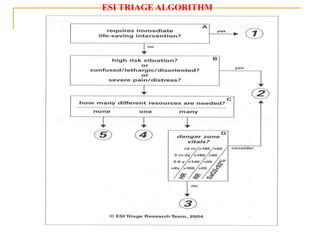
ESI Triage Algorithm
Decisions are based on 4 key questions:
A. Is this patient dying?
B. Is this a patient who shouldn't wait?
C. How many resources are needed?
D. What are the vital signs?
ESI TRIAGE ALGORITHM
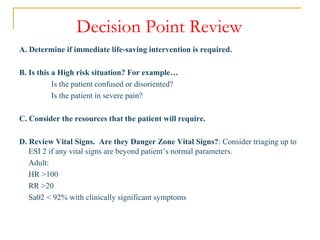
Decision Point Review
A. Determine if immediate life-saving intervention is required.
B. Is this a High risk situation? For example…
Is the patient confused or disoriented?
Is the patient in severe pain?
C. Consider the resources that the patient will require.
D. Review Vital Signs. Are they Danger Zone Vital Signs?: Consider triaging up to
ESI 2 if any vital signs are beyond patient’s normal parameters.
Adult:
HR >100
RR >20
Sa02 < 92% with clinically significant symptoms
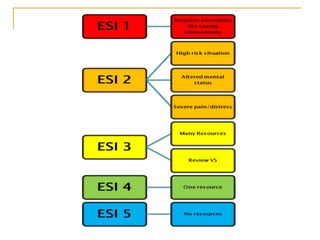
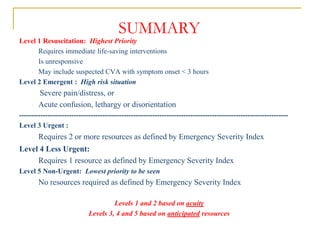
SUMMARY
Level 1 Resuscitation: Highest Priority
◦ Requires immediate life-saving interventions
◦ Is unresponsive
◦ May include suspected CVA with symptom onset < 3 hours
Level 2 Emergent : High risk situation
◦ Severe pain/distress, or
◦ Acute confusion, lethargy or disorientation
-----------------------------------------------------------------------------------------------------------------
Level 3 Urgent :
◦ Requires 2 or more resources as defined by Emergency Severity Index
Level 4 Less Urgent:
◦ Requires 1 resource as defined by Emergency Severity Index
Level 5 Non-Urgent: Lowest priority to be seen
◦ No resources required as defined by Emergency Severity Index
Levels 1 and 2 based on acuity
Levels 3, 4 and 5 based on anticipated resources
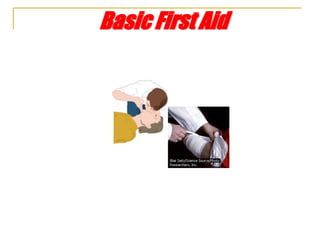
Basic First Aid
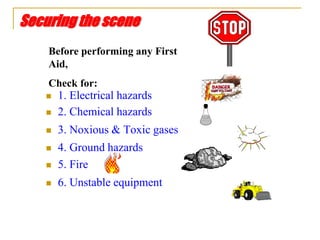
Securing the scene
 1. Electrical hazards
 2. Chemical hazards
 3. Noxious & Toxic gases
 4. Ground hazards
 5. Fire
 6. Unstable equipment
Before performing any First
Aid,
Check for:
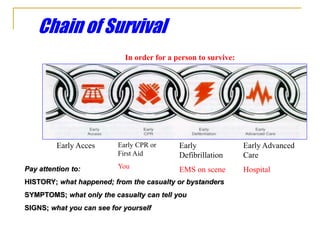
Chain of Survival
Early Acces Early CPR or
First Aid
You
Early
Defibrillation
EMS on scene
Early Advanced
Care
Hospital
In order for a person to survive:
Pay attention to:
HISTORY; what happened; from the casualty or bystanders
SYMPTOMS; what only the casualty can tell you
SIGNS; what you can see for yourself
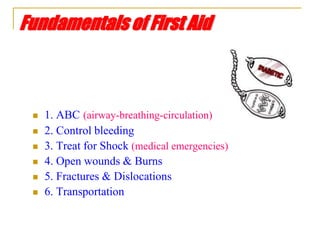
Fundamentals of First Aid
 1. ABC (airway-breathing-circulation)
 2. Control bleeding
 3. Treat for Shock (medical emergencies)
 4. Open wounds & Burns
 5. Fractures & Dislocations
 6. Transportation
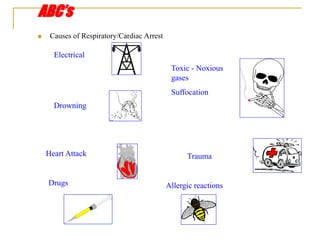
ABC’s
 Causes of Respiratory/Cardiac Arrest
Electrical
Drowning
Toxic - Noxious
gases
Suffocation
Heart Attack Trauma
Drugs Allergic reactions
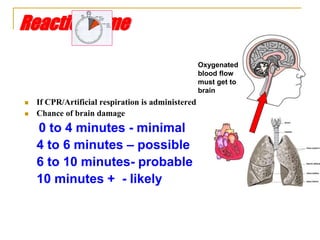
Reaction Time
 If CPR/Artificial respiration is administered
 Chance of brain damage
0 to 4 minutes - minimal
4 to 6 minutes – possible
6 to 10 minutes- probable
10 minutes + - likely
Oxygenated
blood flow
must get to
brain
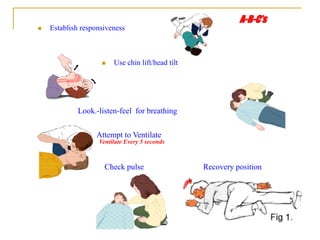
A-B-C’s
 Use chin lift/head tilt
Look.-listen-feel for breathing
Attempt to Ventilate
Ventilate Every 5 seconds
 Establish responsiveness
Check pulse Recovery position
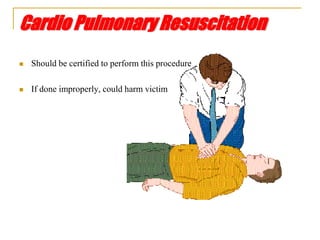
Cardio Pulmonary Resuscitation
 Should be certified to perform this procedure
 If done improperly, could harm victim
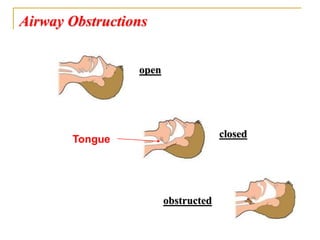
Airway Obstructions
open
closed
obstructed
Tongue
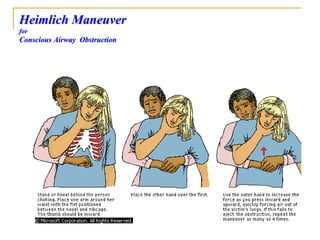
Heimlich Maneuver
for
Conscious Airway Obstruction
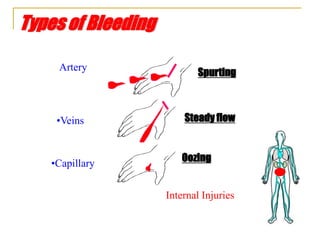
Types of Bleeding
•Veins
•Capillary
Spurting
Steady flow
Oozing
Artery
Internal Injuries
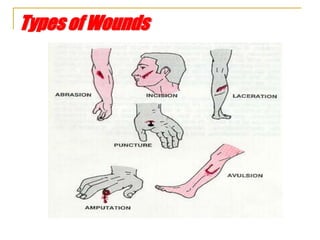
Types of Wounds
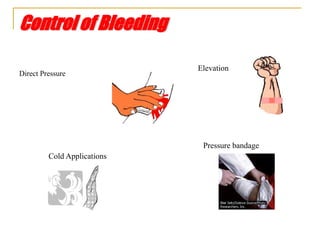
Control of Bleeding
Direct Pressure
Elevation
Cold Applications
Pressure bandage
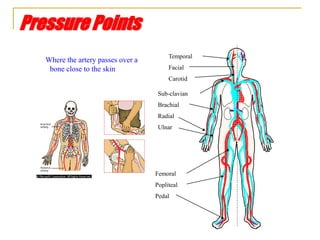
Pressure Points
Where the artery passes over a
bone close to the skin
Temporal
Facial
Carotid
Sub-clavian
Brachial
Radial
Ulnar
Femoral
Popliteal
Pedal
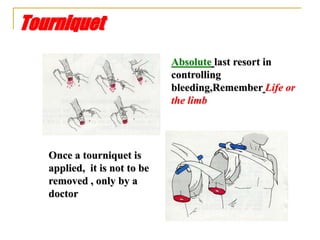
Tourniquet
Absolute last resort in
controlling
bleeding,Remember Life or
the limb
Once a tourniquet is
applied, it is not to be
removed , only by a
doctor
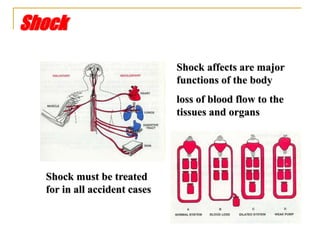
Shock
Shock affects are major
functions of the body
loss of blood flow to the
tissues and organs
Shock must be treated
for in all accident cases
Treatment for Shock
•Lie victim down if possible
•Face is pale-raise the tail
•Face is red-raise the head
•Loosen tight clothing
•Keep victim warm and dry
•Do not give anything by mouth
•No stimulants
HEAT EXHAUSTION
HEAT EXHAUSTION is caused by exertion accompanied by heat and
high humidity. It particularly affects the very young and the elderly.
SIGNS AND SYMPTOMS
pale, clammy skin
profuse and prolonged sweating
cramps in the limbs and/or abdomen
nausea and/or vomiting
headache
lethargy
CARE AND TREATMENT
complete rest in the shade, no further exertion
cool casualty by sponging with tepid water
when nausea passes, give cool water to drink
(cautiously)
ensure casualty has assistance when recovered
HEAT STROKE
Heat stroke is potentially fatal. In this condition, the body's temperature regulation
center in the brain has been rendered inoperable, and the temperature continually
rises, causing eventual brain damage. Immediate active intervention is necessary to
avoid coma and death.
SIGNS AND SYMPTOMS
flushed, hot, dry skin the casualty has ceased sweating
rapid, strong pulse (sometimes irregular)
irrational or aggressive behavior staggering gait
visual disturbances vomiting
collapse and seizures coma - death
CARE AND TREATMENT
urgent ambulance transport complete rest in shade
remove casualty's clothing
cool casualty with any means possible
be prepared to resuscitate as required
nothing by mouth - rehydration is by intravenous fluid
HYPOTHERMIA
HYPOTHERMIA is a potentially fatal condition that especially affects the elderly. The
body's core temperature has been lowered to the extent that the brain function is impaired
and the heart's activity is about to be compromised. Urgent first aid intervention is
required.
SIGNS AND SYMPTOMS
pale, cold skin - no capillary return when fingernails are pressed
slow pulse, sometimes skipping a beat
slow, shallow respirations blurred, or double, vision
casualty is silent, appears asleep, difficult to rouse; may be unconscious
casualty experiences a sense of 'wellbeing' absence of shivering
If very cold, may have non-reacting pupils and appear 'death-like'
CARE AND TREATMENT
urgent ambulance transport
warm casualty slowly, wrap in 'space blanket' or similar
if wet, leave less bulky clothing on and warm slowly
once casualty commences shivering, reassess heating
nothing by mouth until fully recovered
be prepared for sudden collapse and resuscitation
Diabetic emergencies
Insulin Shock (Hypoglycemia)
Result of insufficient sugar- Fast onset
•Cold clammy skin, pale, rapid respiration's and pulse,
incoherent
•Treat by giving sugar bases products
Diabetic coma (Ketoacidosis)
Too much sugar or insufficient insulin- Slow onset
•Warm, dry skin, slow respirations, smell of rotten fruit on
breath
•True medical emergency, activate EMS system
immediately
Find out if victim has past diabetic history
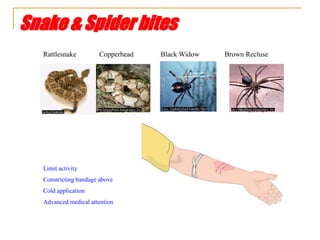
Snake & Spider bites
Rattlesnake Copperhead Black Widow Brown Recluse
Limit activity
Constricting bandage above
Cold application
Advanced medical attention
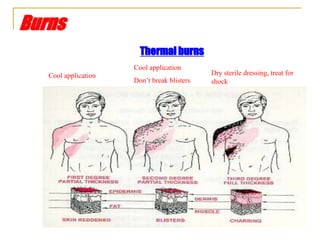
Burns
Thermal burns
Cool application
Cool application
Don’t break blisters
Dry sterile dressing, treat for
shock
Severe Burns and Scalds
Treatment:
Cool the burn area with water for 10 to 20 minutes. Or use Burn Jel.
Lay the casualty down and make him as comfortable as possible,
protecting burn area from ground contact.
Gently remove any rings, watches, belts or constricting clothing from the
injured area before it begins to swell.
Cover the injured area loosely with sterile unmediated dressing or similar
non fluffy material and bandage.
Don't remove anything that is sticking to the burn.
Don't apply lotions, ointments, butter or fat to the injury.
Don't break blisters or otherwise interfere with the injured area.
Don't over-cool the patient and cause shivering.
If breathing and heartbeat stop, begin resuscitation immediately,
If casualty is unconscious but breathing normally, place in the recovery
position.
Treat for shock.
Send for medical attention.
Minor Burns and Scalds
Treatment:
Place the injured part under slowly running water,
or soak in cold water for 10 minutes or as long as
pain persists.
Gently remove any rings, watches, belts, and
shoes from the injured area before it starts to
swell.
Dress with clean, sterile, non fluffy material.
Don't use adhesive dressings.
Don't apply lotions, ointments or fat to burn/
scald.
Don't break blisters or otherwise interfere.
If in doubt, seek medical aid.
Chemical Burns
Treatment:
Flood the area with slowly running
water for at least ten minutes.
Gently remove contaminated clothing
while flooding injured area, taking care
not to contaminate yourself.
Continue treatment for SEVERE
BURNS
Remove to hospital.
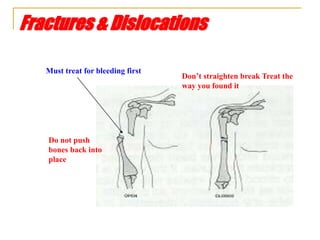
Fractures & Dislocations
Must treat for bleeding first
Do not push
bones back into
place
Don’t straighten break Treat the
way you found it
IF A DISLOCATION IS SUSPECTED...
1. Apply a splint to the joint to keep it from moving.
2. Try to keep joint elevated to slow bloodflow to the area
3. A doctor should be contacted to have the bone set back
into its socket.
The most common dislocations occur in the shoulder, elbow,
finger, or thumb.
Dislocations
LOOK FOR THESE SIGNS:
1. swelling
2. deformed look
3. pain and tenderness
4. possible discoloration of the affected area
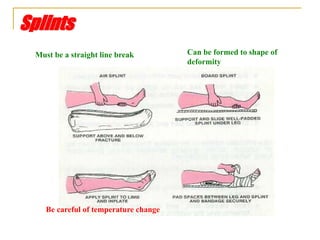
Splints
Must be a straight line break Can be formed to shape of
deformity
Be careful of temperature change
PROPER CARE:
1. While waiting on help to arrive, keep the victim lying down in the
recovery position
2. Control any bleeding, and be sure that he is breathing properly.
3. Do not give the victim any liquids to drink.
4. If the victim becomes unconscious for any amount of time, keep track of
this information so that you can report it when medical help arrives.
Head Injuries
A sharp blow to the head could result in a concussion, a jostling of the
brain inside its protective, bony covering. A more serious head injury
may result in contusions, or bruises to the brain.
OTHER SYMPTOMS TO LOOK FOR IF YOU SUSPECT A VICTIM MAY HAVE
A BRAIN INJURY:
1. clear or reddish fluid draining from the ears, nose, or mouth
2. difficulty in speaking
3. headache
4. unequal size of pupils
5. pale skin
6. paralysis of an arm or leg (opposite side of the injury) or face (same
side of the injury)
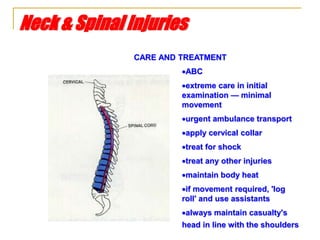
Neck & Spinal Injuries
CARE AND TREATMENT
ABC
extreme care in initial
examination — minimal
movement
urgent ambulance transport
apply cervical collar
treat for shock
treat any other injuries
maintain body heat
if movement required, 'log
roll' and use assistants
always maintain casualty's
head in line with the shoulders
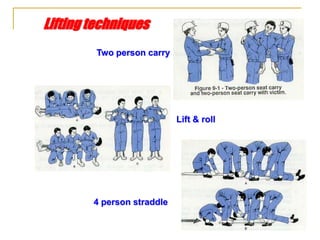
Lifting techniques
Two person carry
Lift & roll
4 person straddle
Thank You!!
Questions ?

Esi first aid

  • 1.
    EMERGENCY SEVERITY INDEX (ESI) By.Dr.Shaukat Ali MBBS (Pesh), DCP(Pesh), DCH (Ireland), MPH, M.Phil Epi.
  • 2.
    OBJECTIVES  Identify the5-level triage scale of the ESI  Describe the ESI Triage Algorithm  Identify resources that would affect the algorithm  Verbalize the process involved in patient transfers
  • 3.
    Emergency Severity Index(ESI)  ESI is a five-level triage scale developed by ED physicians and nurses  Provides a reliable, valid tool for determination of acuity  Describes parameters for the rapid identification of those who need immediate care  Discriminates between patients that need to be seen emergently versus urgently  Improves patient flow based on rapid sorting with projected resource and operational needs Get the right patient to right resources in the right place at the right time
  • 4.
    Institute of Medicine(IOM)Aims  Safety  Avoiding injuries from care that is intended to help  Effectiveness  Providing services based on evidence and avoiding interventions not likely to benefit  Patient-Centeredness  Respectful and responsive to individual patient preferences, needs, values, in clinical decision making  Timeliness  Reducing waits and sometimes harmful delays for those who receive care  Efficiency  Avoiding waste, in particular of equipment, supplies, ideas, energy  Equitable Care  Care that does not vary in quality due to personal characteristics (gender, ethnicity, geographic location, or socio-economic status)
  • 5.
    ESI Triage Algorithm Decisionsare based on 4 key questions: A. Is this patient dying? B. Is this a patient who shouldn't wait? C. How many resources are needed? D. What are the vital signs?
  • 6.
  • 7.
    Decision Point Review A.Determine if immediate life-saving intervention is required. B. Is this a High risk situation? For example… Is the patient confused or disoriented? Is the patient in severe pain? C. Consider the resources that the patient will require. D. Review Vital Signs. Are they Danger Zone Vital Signs?: Consider triaging up to ESI 2 if any vital signs are beyond patient’s normal parameters. Adult: HR >100 RR >20 Sa02 < 92% with clinically significant symptoms
  • 9.
    SUMMARY Level 1 Resuscitation:Highest Priority ◦ Requires immediate life-saving interventions ◦ Is unresponsive ◦ May include suspected CVA with symptom onset < 3 hours Level 2 Emergent : High risk situation ◦ Severe pain/distress, or ◦ Acute confusion, lethargy or disorientation ----------------------------------------------------------------------------------------------------------------- Level 3 Urgent : ◦ Requires 2 or more resources as defined by Emergency Severity Index Level 4 Less Urgent: ◦ Requires 1 resource as defined by Emergency Severity Index Level 5 Non-Urgent: Lowest priority to be seen ◦ No resources required as defined by Emergency Severity Index Levels 1 and 2 based on acuity Levels 3, 4 and 5 based on anticipated resources
  • 10.
  • 11.
    Securing the scene 1. Electrical hazards  2. Chemical hazards  3. Noxious & Toxic gases  4. Ground hazards  5. Fire  6. Unstable equipment Before performing any First Aid, Check for:
  • 12.
    Chain of Survival EarlyAcces Early CPR or First Aid You Early Defibrillation EMS on scene Early Advanced Care Hospital In order for a person to survive: Pay attention to: HISTORY; what happened; from the casualty or bystanders SYMPTOMS; what only the casualty can tell you SIGNS; what you can see for yourself
  • 13.
    Fundamentals of FirstAid  1. ABC (airway-breathing-circulation)  2. Control bleeding  3. Treat for Shock (medical emergencies)  4. Open wounds & Burns  5. Fractures & Dislocations  6. Transportation
  • 14.
    ABC’s  Causes ofRespiratory/Cardiac Arrest Electrical Drowning Toxic - Noxious gases Suffocation Heart Attack Trauma Drugs Allergic reactions
  • 15.
    Reaction Time  IfCPR/Artificial respiration is administered  Chance of brain damage 0 to 4 minutes - minimal 4 to 6 minutes – possible 6 to 10 minutes- probable 10 minutes + - likely Oxygenated blood flow must get to brain
  • 16.
    A-B-C’s  Use chinlift/head tilt Look.-listen-feel for breathing Attempt to Ventilate Ventilate Every 5 seconds  Establish responsiveness Check pulse Recovery position
  • 17.
    Cardio Pulmonary Resuscitation Should be certified to perform this procedure  If done improperly, could harm victim
  • 18.
  • 19.
  • 20.
    Types of Bleeding •Veins •Capillary Spurting Steadyflow Oozing Artery Internal Injuries
  • 21.
  • 22.
    Control of Bleeding DirectPressure Elevation Cold Applications Pressure bandage
  • 23.
    Pressure Points Where theartery passes over a bone close to the skin Temporal Facial Carotid Sub-clavian Brachial Radial Ulnar Femoral Popliteal Pedal
  • 24.
    Tourniquet Absolute last resortin controlling bleeding,Remember Life or the limb Once a tourniquet is applied, it is not to be removed , only by a doctor
  • 25.
    Shock Shock affects aremajor functions of the body loss of blood flow to the tissues and organs Shock must be treated for in all accident cases
  • 26.
    Treatment for Shock •Lievictim down if possible •Face is pale-raise the tail •Face is red-raise the head •Loosen tight clothing •Keep victim warm and dry •Do not give anything by mouth •No stimulants
  • 27.
    HEAT EXHAUSTION HEAT EXHAUSTIONis caused by exertion accompanied by heat and high humidity. It particularly affects the very young and the elderly. SIGNS AND SYMPTOMS pale, clammy skin profuse and prolonged sweating cramps in the limbs and/or abdomen nausea and/or vomiting headache lethargy CARE AND TREATMENT complete rest in the shade, no further exertion cool casualty by sponging with tepid water when nausea passes, give cool water to drink (cautiously) ensure casualty has assistance when recovered
  • 28.
    HEAT STROKE Heat strokeis potentially fatal. In this condition, the body's temperature regulation center in the brain has been rendered inoperable, and the temperature continually rises, causing eventual brain damage. Immediate active intervention is necessary to avoid coma and death. SIGNS AND SYMPTOMS flushed, hot, dry skin the casualty has ceased sweating rapid, strong pulse (sometimes irregular) irrational or aggressive behavior staggering gait visual disturbances vomiting collapse and seizures coma - death CARE AND TREATMENT urgent ambulance transport complete rest in shade remove casualty's clothing cool casualty with any means possible be prepared to resuscitate as required nothing by mouth - rehydration is by intravenous fluid
  • 29.
    HYPOTHERMIA HYPOTHERMIA is apotentially fatal condition that especially affects the elderly. The body's core temperature has been lowered to the extent that the brain function is impaired and the heart's activity is about to be compromised. Urgent first aid intervention is required. SIGNS AND SYMPTOMS pale, cold skin - no capillary return when fingernails are pressed slow pulse, sometimes skipping a beat slow, shallow respirations blurred, or double, vision casualty is silent, appears asleep, difficult to rouse; may be unconscious casualty experiences a sense of 'wellbeing' absence of shivering If very cold, may have non-reacting pupils and appear 'death-like' CARE AND TREATMENT urgent ambulance transport warm casualty slowly, wrap in 'space blanket' or similar if wet, leave less bulky clothing on and warm slowly once casualty commences shivering, reassess heating nothing by mouth until fully recovered be prepared for sudden collapse and resuscitation
  • 30.
    Diabetic emergencies Insulin Shock(Hypoglycemia) Result of insufficient sugar- Fast onset •Cold clammy skin, pale, rapid respiration's and pulse, incoherent •Treat by giving sugar bases products Diabetic coma (Ketoacidosis) Too much sugar or insufficient insulin- Slow onset •Warm, dry skin, slow respirations, smell of rotten fruit on breath •True medical emergency, activate EMS system immediately Find out if victim has past diabetic history
  • 31.
    Snake & Spiderbites Rattlesnake Copperhead Black Widow Brown Recluse Limit activity Constricting bandage above Cold application Advanced medical attention
  • 32.
    Burns Thermal burns Cool application Coolapplication Don’t break blisters Dry sterile dressing, treat for shock
  • 33.
    Severe Burns andScalds Treatment: Cool the burn area with water for 10 to 20 minutes. Or use Burn Jel. Lay the casualty down and make him as comfortable as possible, protecting burn area from ground contact. Gently remove any rings, watches, belts or constricting clothing from the injured area before it begins to swell. Cover the injured area loosely with sterile unmediated dressing or similar non fluffy material and bandage. Don't remove anything that is sticking to the burn. Don't apply lotions, ointments, butter or fat to the injury. Don't break blisters or otherwise interfere with the injured area. Don't over-cool the patient and cause shivering. If breathing and heartbeat stop, begin resuscitation immediately, If casualty is unconscious but breathing normally, place in the recovery position. Treat for shock. Send for medical attention.
  • 34.
    Minor Burns andScalds Treatment: Place the injured part under slowly running water, or soak in cold water for 10 minutes or as long as pain persists. Gently remove any rings, watches, belts, and shoes from the injured area before it starts to swell. Dress with clean, sterile, non fluffy material. Don't use adhesive dressings. Don't apply lotions, ointments or fat to burn/ scald. Don't break blisters or otherwise interfere. If in doubt, seek medical aid.
  • 35.
    Chemical Burns Treatment: Flood thearea with slowly running water for at least ten minutes. Gently remove contaminated clothing while flooding injured area, taking care not to contaminate yourself. Continue treatment for SEVERE BURNS Remove to hospital.
  • 36.
    Fractures & Dislocations Musttreat for bleeding first Do not push bones back into place Don’t straighten break Treat the way you found it
  • 37.
    IF A DISLOCATIONIS SUSPECTED... 1. Apply a splint to the joint to keep it from moving. 2. Try to keep joint elevated to slow bloodflow to the area 3. A doctor should be contacted to have the bone set back into its socket. The most common dislocations occur in the shoulder, elbow, finger, or thumb. Dislocations LOOK FOR THESE SIGNS: 1. swelling 2. deformed look 3. pain and tenderness 4. possible discoloration of the affected area
  • 38.
    Splints Must be astraight line break Can be formed to shape of deformity Be careful of temperature change
  • 39.
    PROPER CARE: 1. Whilewaiting on help to arrive, keep the victim lying down in the recovery position 2. Control any bleeding, and be sure that he is breathing properly. 3. Do not give the victim any liquids to drink. 4. If the victim becomes unconscious for any amount of time, keep track of this information so that you can report it when medical help arrives. Head Injuries A sharp blow to the head could result in a concussion, a jostling of the brain inside its protective, bony covering. A more serious head injury may result in contusions, or bruises to the brain. OTHER SYMPTOMS TO LOOK FOR IF YOU SUSPECT A VICTIM MAY HAVE A BRAIN INJURY: 1. clear or reddish fluid draining from the ears, nose, or mouth 2. difficulty in speaking 3. headache 4. unequal size of pupils 5. pale skin 6. paralysis of an arm or leg (opposite side of the injury) or face (same side of the injury)
  • 40.
    Neck & SpinalInjuries CARE AND TREATMENT ABC extreme care in initial examination — minimal movement urgent ambulance transport apply cervical collar treat for shock treat any other injuries maintain body heat if movement required, 'log roll' and use assistants always maintain casualty's head in line with the shoulders
  • 41.
    Lifting techniques Two personcarry Lift & roll 4 person straddle
  • 42.